Why Does My Child Lie? 3 Real Reasons & What Parents Should Do | Riddhi Deorah
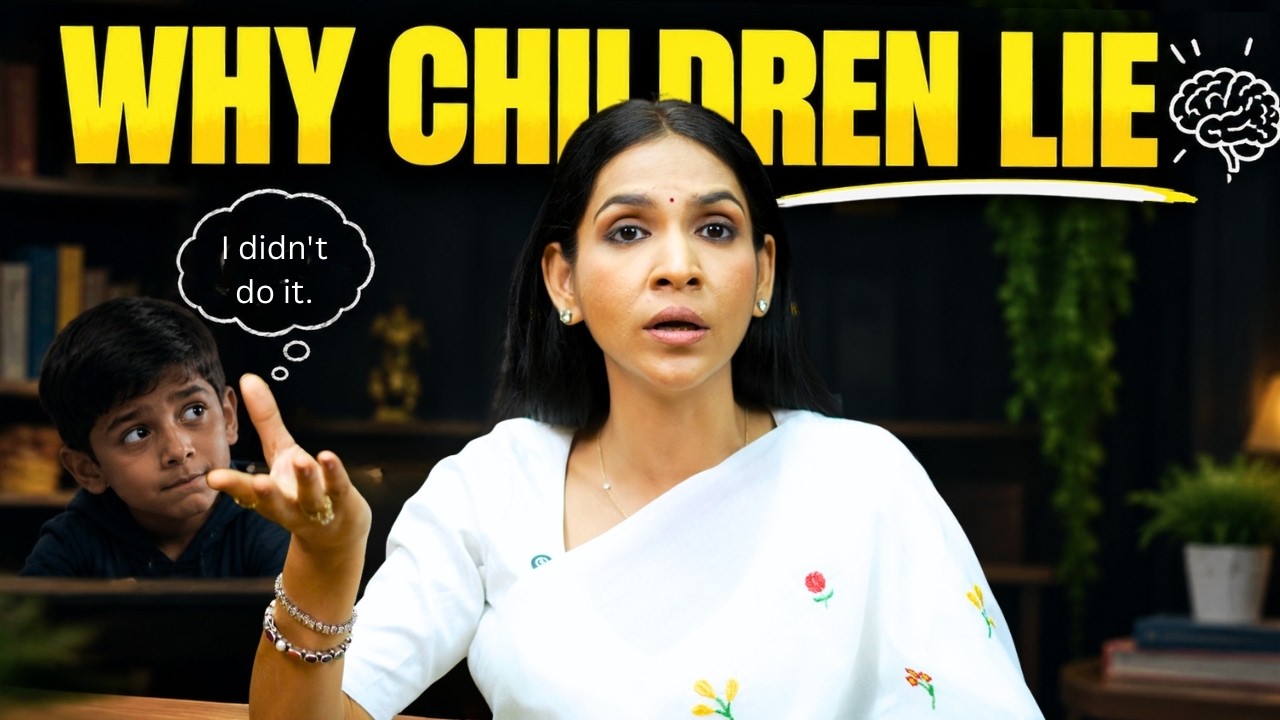
Certified parenting coach Riddhi Deorah explains why children lie: fear of the parent's reaction, protecting someone they love, or never learning that truth matters. She uses the story of an 11-year-old who lied habitually because her mother always fixed her problems, making honesty feel unsafe. The fix is pausing before reacting and listening without solving.
Chapters
Your child is not lying because your child is bad. Your child is not lying because they don't have any values. Your child is not lying because you failed as a parent. Your child is lying because somewhere along the way they have learnt that saying the truth is not safe, and that is the thing that most parenting advice completely misses. When a child makes a mistake, breaks some things, fails at a test, does something they know that you will not approve of, they do a very quick calculation in their mind. If I tell the truth, what happens? And if the answer that their experience has taught them is that my mother will shout, she will get disappointed, she will bring it up again and again, she'll make me feel terrible about myself, then they will Lie to you. Hi everybody, and before we start with the topic for today, I want to thank everyone for giving so much love to my previous video. And today we'll discuss something very interesting, something a lot of you have been asking me So I thought I'll make a video because this is definitely going to help you. Today I'm going to talk about the psychology why children lie so much and why parents almost always get this wrong. So ये बहुत ही important है समझना। So let's begin. Just imagine that you caught your child in a lie today. Maybe it was small. They said they had finished their homework, but they hadn't. Maybe it was something bigger. They said they were at a friend's house. But maybe they were somewhere else. Maybe it has been happening for a while now, and every time you catch them, you feel something that goes beyond frustration. You feel betrayed, you feel extremely worried, and you feel so helpless because you've given your child everything. You've given them your time, you've given them your attention, you've given love, and they looked you in the eye and lied straight at your face. And the question that keeps coming back is, "Riddhi, ma'am, can you tell me where did I go wrong? मैंने ऐसे क्या किया कि मेरा बच्चा झूठ बोलता है? How did I raise a child who lies to me? I know it's very difficult as a mother, and if this is where you are right now, this video is exactly for you. Hi, I'm Riddhi Devra. I'm a certified parenting coach, and over the last ten years, I built a very beautiful digital school for mothers where more than fifteen thousand mothers are my students from UK, US, lots of cities in India, and this has all been because of God's grace and your love and support. So now in this video, I'm not going to tell you to punish your child more strictly. I'm not going to give you a list of consequences to try. I'm going to show you exactly why children lie to us, and I promise you, once you understand this You will never look at your child lying the same way again, which means if your child is lying, you will not feel frustrated. So here's what I need you to understand, that lying is not a character problem, it is a coping mechanism. Your child is not lying because your child is bad. Your child is not lying because they don't have any values. Your child is not lying because you failed as a parent. Your child is lying because somewhere along the way they have learnt that saying the truth is not safe. And that is the thing that most parenting advice completely misses. We focus entirely on the lie, the detection— let's find out what went wrong— the punishment, the consequence. But we never ask the real question. And the real question is, What made my child feel that lying was a better option than telling me the truth? Let me tell you about one student who came to me. Her name is Priya. Priya came to me 8 months ago. Her daughter— I'm changing the name of the child— her daughter, let's say Anya, was 11 years old. Very bright, well-spoken, good at school. By every visible measure, a very great child. But Priya had started noticing things that just didn't add up. Anya would say she had eaten lunch, and the lunchbox would come back full. She would say that she had spoken to her teacher about a problem at school, and the teacher would tell Priya nothing had been discussed. She would say that she is fine, and then Priya would find her crying alone in her room. Small lies, consistent lies, About nothing that seemed important. Priya was devastated. She told me, I had never given Anya any reason to lie to me. I'm not a strict mother. I have never punished her harshly. I don't understand why she won't tell me the truth. In our 3rd session, I asked Priya something that made her go very quiet. I said, when Anya comes back to you with a problem, What is your first response? Priya thought about it, and then slowly she said, I suppose I'll try to fix it if I tell her what she should have done differently. I will explain why the situation happened, I give her solutions, and then I ask her for how long had she been doing that. She said that almost immediately I give her Response, and I try to help her. I just want to help my daughter. And there was the answer. Anya was not lying to deceive or cheat her mother. Anya was trying to protect herself from a conversation that always ended with her feeling like she had done something wrong. Not because Priya was a bad mother, but because Priya's way of helping immediately, solving problems, immediate advice, immediate correction made Anya feel that every truth She shared with her mother became a lesson about some mistake Anya had made. So Anya stopped sharing. And when you stop sharing, you start hiding. And hiding is just lying with better packaging. Within 6 weeks of Priya learning to simply listen without fixing, without advising, without immediately redirecting, Anya started telling her things she had kept hidden for months. Not because Priya had changed the rules. Because Priya had changed the feeling. So let's talk about the 3 real reasons children lie. Because once you see these, you cannot unsee them. Reason number 1, they are afraid of your reaction. This is the most common reason and the most honest one. When a child makes a mistake, breaks some things, fails at a test, does something they know that you will not approve of, they do a very quick calculation in their mind. If I tell the truth, what happens? And if the answer that their experience has taught them is that my mother will shout, she will get disappointed, she will bring it up again and again, She'll make me feel terrible about myself. Then they will lie to you every time. Not because they want to lie to you, not because they want to cheat or deceive you, but because they are trying to avoid the pain of your reaction. Think about it from their perspective. They already feel bad about what happened, and now they have to face your reaction on top of it. The lie feels like the only way to protect themselves. The child who tells the truth easily is not a more honest child, but a child who has learned from experience that when I tell my mother the truth, I will still feel safe. She might be upset, but I will not be destroyed. That safety is built over hundreds of small moments. So every time your child is sharing a truth with you, Don't get angry. Be a little curious. Make it safe for them to come to you again and again. It's not easy to not react, but please do so, because once your child starts to lie, that's even more difficult. So every time your reaction made them feel ashamed, stupid, or made you feel disappointed, you make it less safe for them. So make sure you take care of your reaction. Reason number 2, they're protecting someone they love. Sometimes children lie not for themselves but for someone else. They saw something happen between you and their father, and they don't want to make it worse. They're covering for a sibling. They're protecting a friend. They're trying to keep peace in the house. Children are extraordinarily sensitive to the emotional atmosphere of their home. They pick up on tension, on stress, on what topics make the adults uncomfortable. And they become skilled at managing that atmosphere. At saying what keeps everyone calm. At hiding things that might create conflict. If your child lies frequently about things happening in the home, ask yourself what they might be trying to protect. Instead of trying to judge them or blame them or shout at them. And reason number 3, they have never been taught that truth has value. This one is subtle, but it is very important. Some children lie not out of fear, but because honesty was never modeled for them as something that matters. They have watched adults telling small lies very casually. Say one thing and do another. Present one face to the world and another face at home, and they have absorbed the message. Truth is very flexible. I can change it when I want. You say what works at the moment. Children do not learn values from what we tell them. They learn from what we watch. For example, you are in the lift, but you get a call from your mother-in-law, and you tell her, "Mummy, I am in the car." मैं गाड़ी में बैठ गई. Your child is listening to you. Sometimes you are not even ready and you get a call and you tell, yes, yes, I'm completely ready and I'm leaving. Now you think your child is not listening to you, but your child is listening and your child feels that, okay, this is a very normal thing to do. If honesty is something you want your child to have, it has to be something they see lived in your home, in how you speak about others, In how you handle your own mistakes. They learn everything, whether you're saying sorry, thank you, whether you're being honest. So what you do is what they learn, not what you say. So one shift: move from being a parent your child fears disappointing to being a parent your child trusts with the complete truth. I know that sounds simple, but let me make it very practical. The next time your child tells you something very hard, something that makes you want to immediately react, pause for 3 seconds before you speak. In those 3 seconds, ask yourself just one question: If I respond the way I'm about to respond right now, will my child be more likely or less likely to come to me with the truth next time? That question will change everything about how you respond. Because the goal is not just to handle this moment. The goal is to protect the communication channel. To make sure that your child keeps coming back to you no matter whether that thing is small or big or how they feel. They should be able to come to you and share everything with you. A child who tells you small truths at 7 will also tell you the big truths at 17. A child who learns to hide from you at 7 will be a complete mystery to you at 17. And you will wonder when this distance happened. It happened in the small moments, when the truth felt dangerous and the lie felt safer. Priya told me something in our last session that I want to leave you with. She said, Riddhi, I spent so much energy trying to catch Anya in her lies, checking her messages, cross-questioning her, trying to find proof against her, And all that time, Anya just needed me to be someone she wasn't afraid of. The day I stopped being a detective and started being a safe place, she stopped needing to lie. ये एक shift, judgment से curiosity तक, सिर्फ इस एक shift ने मेरी और मेरी Anya के बीच के relationship को पूरी तरह बदल दिया। If this video opened something for you, if you recognized yourself or your child, In any of this, I want to invite you to go deeper. I run a free parenting masterclass every week where I work on exactly this— how to become the parent your child can trust, how to heal the emotional patterns that create distance between you and your child, how to build a relationship with your child where truth feels safer. Mothers from across India, from Dubai, UK, UK, US, and from so many countries across the world. They're all a part of this community. They're not here to become perfect mothers, but they're here to learn, to grow, to heal, and to do better for themselves and their families. Because nothing is more important than you and your family. The link is in the description. Register and I will see you in my masterclass. This is very important for you to learn. And if this video helped you see something differently today, share it with one parent who needs it. By sharing it, you'll also get some spiritual points because you'll be helping someone out there. And if you have a question about your child or anything related to lying, or maybe not even related to lying, just drop it in the comments. It's going to give me more ideas about my future content because I read every single Comment, and most of my videos are based on the questions you ask me. So I hope this was helpful. This is Riddhi, and it's always a pleasure to come back and help you and to share these simple ideas with you, because even if one idea can change one family, I think my time here is well spent. So keep learning. Thank you for staying till the end. It really means a lot to me, and I will see you in the next video. Thank you.
More from Riddhi








5 Emotional Needs Every Child Has | Raise Emotionally Healthy Children | Riddhi Deorah

