Do This EVER MORNING To Completely Change Your Life! | Rob Dial
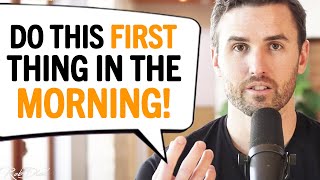
Rob Dial walks through a 10-minute morning gratitude meditation that shifts your nervous system from fight-or-flight to calm. Count your breaths at your nose while pairing each one with gratitude for something specific like sunshine or a person. Skip your phone first thing, and use a two-minute breathing reset later if stress hits.
Chapters
You woke up. 150,000 people didn't wake up yesterday. Must be a reason. There must be some sort of purpose behind my life. Today we're going to be talking about the number one most important thing that I think that you should do every single morning. To set yourself up for success, to set yourself up for gratitude, to set yourself up for joy, for peace, for happiness. This is the most important thing, in my opinion, my humble opinion, that I think every single person should do first thing in the morning. So the first thing that I recommend that you do is this. Before you have your coffee, before you look at your phone, take 10 minutes to do this, okay? Don't look at your phone. If you've got an alarm on your phone, turn the alarm off. Don't look at your text messages, don't look at your Instagram, don't look at your Facebook, your TikTok, your emails, any of those things. Don't look at any of those things. Because as soon as you look through those things, it's going to take your brain down this crazy rabbit hole of thoughts, because that's what the human mind does, is. Thanks. So what I want to talk to you about is how to use your brain with the state that it's in, to be able to get yourself more calm, more present, more focused, and more grateful throughout your day. So when you first wake up in the morning, let me explain something to you real quick. There's two different parts of your nervous system or two different aspects of your nervous system. One of them is called your sympathetic nervous system, which, when you say sympathetic nervous system, it sounds like, oh, that must be the good part, right? Like there's. And there's not a good and bad. Let me, let me say it this way. Sympathetic nervous system, though, is the thing that prepares your body for physical activity. It is the thing that when you feel like fight or flight, that's usually your sympathetic nervous system getting turned on and clicking into place, right? It increases your heart rate, it changes your breath. So your sympathetic nervous system is more for, like, physical activity, stress, whatever it might be. That's. It's not what you want first thing in the morning is what we'll say. That's your sympathetic nervous system. On the other side is the exact opposite, which is your parasympathetic nervous system, which is the exact opposite of the sympathetic. It is the thing that relaxes your body. It is the. If you get done with a meditation, you feel much more chilled. It's because you've most likely tapped into your parasympathetic nervous system, and you've turned off your sympathetic nervous system system. It slows your heart rate down, it slows your breathing down and allows your body to relax. And so the thing that I think that you should do every single morning to set yourself up is a very, very simple gratitude meditation. Okay? And the reason why I say gratitude meditation is because one of the things that I found that causes a lot of anxiety in people and stress and worry is the thought of I'm not where I should be or I'm not where I want to be yet. And if there's one thing I know about humans, we're never really where we want to be. Especially if you listen to this podcast, there's a party that wants to learn, that wants to grow, that wants something new, that wants something better, that feels like there's more potential inside of you. And so there's a pretty good chance that you may never feel like you are exactly where you want to be. And to start your day off and to go straight into sympathetic, which is like looking at the phone, Movement, fight, or flight, all of those feelings. Instead of doing that, what if we go, okay, before I go into emails, before I turn my phone and before I do anything else, I'm going to set myself up and I'm going to tell myself and remind myself of all of the things that I am grateful for, all of the things that I have to be grateful for, because my life is freaking amazing. All of your lives are amazing. Even if you're going through. We all go through. Things happen, but there are still things to be grateful for. No matter where you are in your life, there's always something to be grateful for. The fact that you literally woke up this morning is something to be grateful for. Even if all of the other is hitting the fan, there is something to be grateful for right now. And that is, you woke up. 150,000 people didn't wake up yesterday. Wow. That's pretty damn amazing, isn't it? Must be a reason. There must be some sort of purpose behind my life. Maybe you don't know what it is, maybe you do know what it is, but at least you're still here. And so it's to change your focus to. To something to be grateful for. From the very first second that you wake up in the morning, change your focus to something that you can be grateful for. That sets the rest of your day up to search for more things that you'd be grateful for. You're setting your emotional GPS towards gratitude. Instead of Stress or worry or anxiety. Because when you have gratitude, it's really hard to be stressed out. When you have gratitude, it's really hard to worry. When you have gratitude, it's really hard to have anxiety and stress and feel fear. Because gratitude reminds you of all of the great things that you have. And so it changes your perception of the world. And this is something that I learned, just kind of like a strategy. When I was in, I did a thing called ten day Vipassana. And ten day vipassana means it's a ten day silent meditation retreat. And literally you cannot talk for 10 days. And all you do is you meditate and that's about it. And they teach you how to meditate and they teach you to go through it and all that stuff. And it's very simple, it's not hard Vipassana. Meditation is the simplest form of meditation in my mind. Cause you just focus on your breathing and that's it. And so for 10 days you're not allowed to speak, you're not allowed to look other people in the eye. Because now is the thing I didn't know before I got there, but it was real interesting because you realize how much people can talk with their eyes. And so you don't look people in the eyes, you don't journal, you don't read. It's either meditate or you can go outside and stare at a tree. And it usually takes about. For me, it took about seven days for my mind to calm down. Cause people are like, oh my God, I can never do 10 days. But I could do like three. Three, right? People always say that. To me, I could do like three. For some reason the number's like, yeah, I could do three. And they always say that. And it took like seven days for my mind to finally calm down to a place of like pure bliss and joy. And I was like, holy shit, this is amazing. But the way that they teach us to get there is through the breath. Through the breath. And literally all you focus on for the first few days is just the nose and the feeling of the breath going in the nose and the feeling of the breath going out of the nose, the feeling go within the nose and the feeling of the breath going out of the nose. Then your brain will wander off and it will go some other place. And as soon as it goes to another place, you just gently bring it back. You remind yourself, feeling going in the nose, feeling going out of the nose, and then your brain will go off somewhere else. And when it does, you just bring it back Feeling going in the nose, feeling going out of the nose, in the nose, out of those. Eventually your brain starts to calm down. And so what you're going to do in this very quick 10 minute meditation, this 10 minute gratitude thing, is you're going to focus on your nose, feeling going in, feeling going out of the nose, and then focus on one thing that you're grateful for today. What is it? It could be that you woke up today. It could be the sun is shining outside. It could be that the weather is great. It could be that your dog is sitting next to you. It could be that you have the sun on your face. It could be anything. I don't need you to be something that's like, oh, I'm a millionaire. You're like, I'm not going to be grateful until I'm a millionaire. Like, no, there's things to be grateful for. Find the things to be grateful for and just focus on that one thing. And what you're going to do is you're going to focus and act like you're breathing it in and then you're breathing it out. So let's say I'm real grateful for the sunshine. I'm sitting outside and meditating in the morning, sun's in my face. I'm going to breathe in the feeling and the gratitude for the sunshine. I'm going to breathe out the feeling for the gratitude, sunshine, and you focus on just that thing the entire time. If you think about your you know what? I'm really grateful for my mom and how she's always been there for me. Okay, Breathe in the feelings of gratitude for your mom. Breathe out the feelings of gratitude for your mom. Breathe in the feelings of gratitude for your mom. Breathe out feelings of gratitude and what you're doing. And the reason why this is important is because you are literally focusing your energy on gratitude. You're focusing your energy on what in your life you have to be grateful for versus what you have or you don't have in your life or what you have that you don't want in your life, which is how most people usually spend their entire day. They think about they don't have, or they think about the things that they have that they don't want, or they think about what they have to do in their to do list and all this stuff that has to happen, but you just breathe in the feeling of gratitude. But whatever that thing is, you breathe out a feeling of gratitude for that and you just focus on your nose. And the important thing is this, what I will Always say is have no expectations in this quick 10 minute meditation. Have no expectations. Don't think that you're gonna leave and you know you're gonna be this peaceful butterfly. It's gonna just, oh man, I'm floating on. Floating on water. Everything's perfect. You might feel that way some days. Some days you might feel like after because it's just, you're just so deep into a hole that it's really hard to get yourself out of. Maybe, but no expectations. Don't think, oh my gosh, I'm gonna float away on a blissful cloud and, you know, transcend this realm through my meditation. Have no expectations. Just have it be a routine. I'm going to do this no matter what, and I'm going to have no expectations. I'm gonna do this. I'm gonna focus on things to be grateful for. Don't try to get anything out of it. And here's the thing, the thing that's funny about it, the less you try to get out of it, the more you'll get out of it. If you try to get something out of it, you'll get a whole lot less out of it. But when you don't try to get anything out of it except for, I'm just going to focus on gratitude and just feeling the feelings of gratitude in my body, and I'm going to focus on the things that I have to be grateful for. I breathe in, I breathe it out. That's usually when you get the most out of it. The next thing is this. There is no right or wrong. So with meditation, a lot of people are like, I don't meditate because I don't know how to do it right. You literally close your eyes and breathe. That's it. There's nothing. One of the important things though is you find a comfortable position and then you do not move a muscle for the entire 10 minutes or the entire time that you do it. That's it. And the reason why is because of this. And this is what we were taught during the 10 day silent meditation retreat. The reason why is because everything in your life, as Buddhists say, is Anita. Anita just means impermanence. Everything is impermanent. And so if I'm sitting there, quite often one of my knees will start to hurt, usually my left knee. And I'll feel it. And I'm like, oh, damn it, my knee's starting to hurt. And I start thinking about my knee hurting. And then I'm like, you know what, I'll just move my knee so I Can be better. And then I move my knee and I'm like, oh, God, now I'm thinking about this, and I've gotten my brain out of this relaxed, meditative, grateful state. Now I'm focusing on something. So if you feel an itch, let it exist. If you feel a scratch, if you feel a soreness, just let it exist. It will eventually go away. Everything eventually goes away. And the idea, the Buddhist way of thinking is that everything in this world is impermanent. This, you know, I'm impermanent, you're impermanent. Everyone that we love is impermanent. The house that I'm recording this in is impermanent. The weather is impermanent. You know, it's a beautiful sunny day out here in Austin, but it could be a sh tty tomorrow. But both of those are impermanent. Everything is impermanent. The video camera recording is on my computer. That's in front of me. The microphone, the metal microphone is impermanent. Everything will eventually not be here one day. The same way that my problems, my stresses, my worries, the feeling and the itch and the scratch, all of those things will all be gone at some point in time. So there's no reason to invest my energy into something that will be gone, except for the feeling that I feel internally inside of myself. And so once you find your comfortable position, don't move a muscle. Stay. The only muscles you're going to be breathing or using are your breathing muscles. And then you do six really deep breaths. Just in through the nose, out through the mouth. You just in inhale through the nose. And when you exhale through the mouth, make sure that your exhale is like breathing through a straw. So it's just literally inhale. And then. That's the exhale. Simple. You do that six times, you'll start to notice, your state will change. And then observe your body. Observe any soreness, any itching, scratching, any movement inside of your belly. Whatever it is, you're 99.999% energy. You're very, very little amount of matter. Like super small amount of matter. You're almost nothing. That's what's crazy. So just focus on the energy that's inside of your body. Focus on that for a second. Oh, my gosh, this is crazy. I literally am all vibrating energy. It's what I am. And then you switch your mind to the gratitude. After you've brought yourself into your body, after you've brought yourself into this present moment, then you focus on breathing in the feeling that you wanna Be grateful for. And you breathe out that feeling that you wanna be grateful for. If you have your children. Breathe in the feeling of gratitude for your children. Breathe out. If you feel the weather outside, you meditate outside and it's just 70 degrees and it feels great. Breathe in the feeling of gratitude for that weather. Breathe out the feeling. Gratitude. It doesn't have to be grateful. You don't have to have a ton of money, a beautiful house, an amazing marriage, any of those things to find something to be grateful for. It could be just that. You have a body that's working. You have. I have all 10 fingers, I have all 10 toes. I have both my arms, I have both my legs. Holy sh t. There's a lot of people on the earth that don't have all those things. I was blessed with a body that works and, you know, knock on wood, I still have all my limbs and I have my fingers and all my toes and all those. And hopefully, knock on wood, I get to keep them for a long time. And then here's the thing that I'll tell you, getting back to the feeling of gratitude, you're gonna set yourself up much better in the morning by doing this. That's not to say that shit doesn't hit the fan later on in the day. So it's possible that you might go to work and you might feel like you're on cloud nine. And then your boss might come in and, you know, negative Nancy from accounting might come in and throw something on your table. And now you're completely different. It's important to know that you can do. It's a quick two minute SOS meditation. It's very simple, but it'll completely change your state. And every time I do this on a live, every time I do this on a zoom call, any of everyone's like, oh, my God, I'm so glad I did this. It's so simple. You're going to do exactly what we did at the beginning of the meditation. You're going to get yourself in a real quick, comfortable position. And you're like hitting the fan, but I'm going to be intentional on this. And you're going to breathe in through your nose, you're going to breathe out through your mouth. And you're gonna take two minutes to do this. That's it. It only takes two minutes to reset your body. Breathe in through your nose, breathe out through your mouth. Six deep breaths and just allow everything to exist outside of those two minutes. After those two minutes, you can do whatever it is you need to do. But in those two minutes, your goal is to be as centered as possible, as focused as possible, and just allow yourself to be in your body. And if you wanna go back to focusing on something to be grateful for, focus on something to be grateful for. Bring in the same thing that you were grateful for this morning. Bring in a different feeling or just say this. If all else fails, breathe in and say thank you. Breathe out and say thank you. And then breathe in and say thank you. And breathe out and say thank you. The reason why this is so important is because when you focus on something to be grateful for, you'll find more things in your life that you should be grateful for. If you focus on things that are stressing you out, you will find more things to be stressed out about in your life. Where your focus goes, your energy flows. And so if I'm going to set myself up every single morning to focus on on gratitude, I am going to find so many places in my life that I can be grateful. So do this quick meditation first thing in the morning. And if you ever need help throughout the day, if you feel the stress, the worry, the anxiety hits the fan, do the quick six breaths, two minute SOS meditation and reset your body. Hey, thanks so much for watching this video. If you want to learn even more about mastering your mind, you click right here and watch this video as well. All of these things are just tips and tricks to help you calm yourself down. You can listen to them if you want to, or you can stay in your heightened stress, nervous, anxious state if you really want to. This is your world. You can do whatever it is that you want.
More from Rob


Why NOT to stay single 👉 @robdialjr #adviceoftheday #motivation #mindset #growth

You Reap What You Plant 👉 @robdialjr #adviceoftheday #motivation #mindset #growth

3 signs that you're addicted to chaos 👉 @robdialjr #adviceoftheday #motivation #mindset #growth

Stop making excuses for people 👉 @robdialjr #growth #mindset #positivity #adviceoftheday

Tip for an amazing life 👉 @robdialjr #inspiration #mindset #adviceoftheday #positivity

It's time to move on 👉 @robdialjr #adviceoftheday #motivation #mindset #happiness

The right person for you is... 👉 @robdialjr #love #truelove #inspiration #mindset #soulmate

Get ready to take risks 👉 @robdialjr #motivation #adviceoftheday #mindset #positivity

The real competition You Vs You 👉 @robdialjr #mindset #inspiration #positivity #adviceoftheday

Their Mood Isn’t Your Responsibility. 👉 @robdialjr #mindset #adviceoftheday #motivation