How to Easily Enter Flow State Anytime You Want
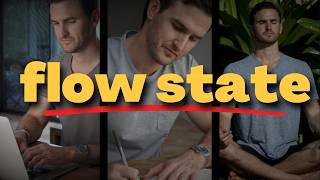
Rob Dial breaks down flow state as a neurobiological condition where your brain shifts into alpha/theta waves and floods with dopamine, norepinephrine, endorphins, and serotonin. His six-step protocol: pick a task where challenge matches skill, kill distractions, build a ritual that signals your brain to switch modes, work in 90-minute blocks, track what triggers flow for you, and stop trying to force it.
Chapters
What if you could flip a switch in your brain and become unstoppable on command? There's a hidden setting that's inside of your mind that turns distraction into laser focus and then effort into ease. And most people never actually access it and they waste years of their life grinding instead of flowing. And so this isn't about hacks. This, this is about unlocking your brain's real superpower of focus and taking action. And once you know how to tap into this through these six steps that I'm going to teach you, you'll never approach productivity the same way again. This is the exact process of how to neurologically enter flow state. And I'm sure you felt it before. You know, have you ever done something before? We have one of those moments where everything just kind of clicks and it seems like time disappears. Like you're fully immersed. Every part of you, your brain, your body is fully immersed into what you're doing. Time disappears. You're not overthinking, you're not thinking about other people. You're just doing. It's kind of like flowing out of you. And honestly, when you get yourself there, it feels kind of magical. And then when you're not in it, you're kind of addicted to trying, to getting back there. And so that isn't a fluke. You know, years ago when I first heard about it, I was like, ah, it seems kind of weird. I bet that's not a real thing. I bet that's just some weird woo woo thing. But it's not, it's not a fluke, it's not luck. It's actually flow state. And it is a real biological and neurological measurable brain state that you can enter and teach your brain to enter on demand. And that's what we're gonna go over today. First off, let's talk about what flow state is exactly. So flow state is the mental state where you are fully focused in something. You're bringing all of your brain power to it. You are deeply, deeply engaged in what's going on. And you're also performing at your strangely, it's this feeling of being very relaxed, but also extremely energized and focused. And this term came about when psychologists were actually studying artists and athletes and musicians in high performers. Like people who were at the absolute top of their field is they noticed that they could kind of enter this state. Like, they noticed that they all got to some point where they got lost in what they were doing in their actual neurology and what was going on in their brain Kind of shifted. And so it was first called years ago, optimal experience. And it's basically where the challenge of what you're doing meets your skill. And you basically lose yourself in the task that you're doing. And so flow state is basically, you want to think about this, right? To get into flow state, you need to have high skill, you need to have high challenge, and then you need to bring full focus to this thing. And so focus in this flow state and getting yourself in there, you'll know that you're in it. And I'm going to explain why you shouldn't chase it. But you're going to kind of want to chase it. But just go with me, and it'll all start to make sense. You'll know you're in it because you'll lose track of time. You'll forget about yourself. You'll forget about your inner critic. You'll forget about what other people are going to think about you. Your actions start to feel like they're coming out of you. Like, they'll feel automatic, they'll feel effortless, you'll feel calm, but also extremely excited at the same time. And ideas and problem solving just kind of flows out of you. The way you want to think about is this. It's like an athlete in the zone. If you've ever seen, like, Tom Brady when he used to play in the final two minutes of a drive, it was like, you don't want that guy to have the ball, because it is absolute focus. It is really high skill, but also really, really high challenge. You can also think about, like, a writer that sits down and writes nonstop with no blocks. Or a musician where you watch them and their eyes are closed and it's just kind of like flowing out of them. It's like flawless improvisation, right? Or a creator that's editing for three hours and then they get done and they're like, oh, my God, that felt like 20 minutes. Hey, to the 65.6% of you who watch my videos but are not subscribed, yes, we see it. And if you've ever learned anything from any of the videos I've put out, please do me a favor. Hit that subscribe button. It helps the channel grow, and it helps me keep making more content to help you grow as well. So with that, let's go back to the show. So when you look at flow state, I want you to know what's happening inside of your brain. Because if you can understand what's happening inside of your brain, you can know that the step by step process to bring yourself back there, to know when you're there and then to be able to get yourself back there whenever you want to. And so this is the part that most people skip. But when you understand it, you can get yourself into flow kind of whenever you want to. So what happens is this, when you get yourself into flow, the inner critic that's inside of your head starts to shut down. The programmed version of you. Your prefrontal cortex, which is the part that you know makes you self conscious and time awareness starts to actually go quiet like it's your brain stops sending as much blood flow to your prefrontal cortex. This is called transient hippo frontality. And so it's your brain goes from what will people think of me? To turning off and just excited to create something and have it flow out of you. Then what happens is your brain waves will start to shift you. Your brain waves will drop from fast beta waves into slower alpha and even theta waves. It's this sweet spot for creativity, insight and flow. And you're not thinking about any other person in the world and what they're going to think of you. It's just kind of coming out of you. Right. The next thing is that your brain's going to start to release this like neurochemical super cocktail. Your brain floods yourself with these feel good focus enhancing chemicals. So basically there's dopamine which is motivation and reward. There is norepinephrine which is your laser focus is going to start to come online line. There's endorphins that are going to get released which are feel good and pain relief as well. There's serotonin, which is calm confidence. When you get done with everything is that post flow feeling. So your brain like flow is literally creating a chemical super cocktail, like a chemical high inside of your brain. But the best part is that there's no crash. And so can you train yourself to do this a hundred percent? Like you can create the conditions for flow to follow a process and to get yourself in there. If the ingredients are right, if the timing is right, if you do it right, flow just kind of shows up once again. You can't chase it, it just kind of shows up. And so let me show you like the step by step process to entering flow state anytime that you want to. Okay. So the first thing is that you need to pick a high challenge, high skill task. Okay. It cannot be easy. It's got to be something that actually challenges you. Flow and lives like right on the edge of your comfort zone. If it's too easy. You'll get bored and your brain won't focus as much as it needs to because it's too easy. You don't really need to bring all of your brain. If it's too hard, then you'll probably start to get anxious or upset. If it's just right and you're in between the two of them of too easy and too hard, that's where you'll find flow. This is why an athlete like you can see Michael Jordan when he would go into flow, right? Like game six, NBA Finals. That's not easy. Like that is the highest of highest of challenge. In that moment, in the final minute and 30 seconds, that is the biggest stage, the biggest challenge you could possibly get into. But at the same time, you've got his high skill, both of those things click, time disappears. He ends up stealing the ball, getting the game winning shot. And so what you want to do is you want to choose something. What's really important is choose something that matters to you. Like make it challenging enough to just stretch you a little bit. It could be something with work, something with your business. It could be something with creativity. You know, maybe it's like trying to learn a guitar solo that's just, just a little bit outside of your comfort zone. Like you can get some of it, but you're going to mess up a lot. And you want to set a clear goal of what you're trying to do when you're doing it. Okay? So that's the first thing that you're going to want to do. The second thing that you want to do is eliminate every possible distraction that exists in your reality. Right. Flow requires deep focus. Not checking your phone, checking your emails, getting notifications. No multitasking, no doom scrolling. So like take your phone, put it in another room for the next 90 minutes. No notifications. You know, close out all of your extra tabs, let people know that you're off the grid for the next 90 minutes and you'll come back at 2 o' clock or whatever it is. I learned this and I was really researching a lot of this when I was writing my book. Level up. And what I learned to do and do all of this was I learned to take my computer and to put my phone in another room. So it was just me in my computer. My phone was in another room. I would turn off the Internet connection on my computer, I would put my headphones on, I would listen to the exact same song every single time. And I went a little bit overboard because I know that Your visual focus always comes before your mental focus. So mental focus follows visual focus. So I would wear a hat and a hoodie. And so, like, all I could see in the frame of my eyesight was the computer and the flashing, like, blinking sign, like just the cursor just blinking in front of me, right? And so it was this way to be, like, everything in this world disappears except for my brain in this computer that's sitting in front of me. And, you know, that's the really, the way that you want to try to create this space. Okay, so that's step number two. Step number three is to create a ritual to enter this flow state. Your brain loves consistency, and so it likes to have triggers to know when it's about to go and do something. And so, like I said, I play the exact same song for probably almost 10 years now. I would say at this point, you can create a flow playlist if you want. It could be low fi beats, it could be instrumental, it could be binarial beats. Like I said that I use. I saw it as a way to train my brain. Like Pavlov's Dogs, where you ring a bell and you give a dog a treat. You ring a bell, you give a dog a treat and do it enough times, you ring a bell, and naturally they start to salivate. It's because their brain's expecting that thing. When I put on my headphones and I put on this song and I put on my hat and I put on my hoodie and nothing else exists. My brain has literally just learned, okay, now it's when we lock in, because we've gotten so unfocused in our life. I'm trying to train my brain to do what I need it to do. So you can do that. You can set a vibe. You have the music, you can light a candle, you can have incense, you can have essential oils if you want to. Trying to set a vibe, drink some water, stretch, get comfy, get your body in the right state, get your body ready to go. And then what I recommend doing is doing two to three minutes of some sort of breath work. It could be deep breathing, it could be box breathing, if you want to. One of the ones that I really like doing, I think they call it breath of fire, which is just breathing in and out of your nose as fast as you possibly can for two or three, three minutes. You might have some snot fly out because it's a lot. So it's just for two or three minutes. It actually gets your heart rate up. It gets Your brain focused, gets your body focused as well. You can do this thing called ice skiers. Ice skiers is when you stand up and you act like you're, you know, actually like skiing. So you, you put your hands above your head, you breathe in on the way out, you put your hands all the way down as if you're skiing and you have both poles in your hand and you breathe all the way out on the way down. You could do that, you could jump on a rebounder, you know, which is a tiny little trampoline. Have your eyes focus on one thing in the distance. Because once again, mental focus follows visual focus. Basically what you're trying to do is you're creating your own ritual, not routine ritual, because rituals are important. These signals are telling your brain, hey, we're doing something different, not the same thing we've been doing all day. And we're entering the flow state. And then what you want to do, step number four is to set a timer for deep work. The magic number is 90 minutes. That's how long, about how long your brain can sustain deep concentration. It's called ultradian rhythms. And so ultradian rhythms are basically natural rhythms that your, like biological cycles that your brain and your body go through multiple times a day. And so during each cycle, your brain rises to peak alertness and then naturally starts to dip into lower focus and fatigue. And so that 90 minute focus window is basically your brain's natural productivity wave, not just some random number. So you want to set it for 90 minutes and you can use the Pomodoro technique to actually get focus, which is 25 minutes of work, 5 minutes off. And you do three cycles of these, which would equal 90 minutes, 25 minutes of work, 5 minutes OFF. So it's deep focus. Give your brain 5 minutes off, close your eyes, you know, meditate, you know, stare in the distance, whatever it might be. Don't look at your phone and you repeat it three times and that ends up being an entire 90 minutes. And then you could also do something if you want to, you could do something like a trigger phrase where you say something out loud to yourself. You have a phrase that's also another phrase right before. So you get your mind focused as well. You say it out loud and it's like the cue to the mind that you could use. Okay, so that's step number four. Step number five is actually as you start to do this, what you're going to do is you're going to start to track your flow triggers, everybody's brain and body has is different. Like, we all have these, like, different flow portals. And so you've got to ask yourself, like, what time of day do you feel the most creative? You know, what, when do you feel the most alive? And then you keep a journal and you start to notice patterns. Your patterns will emerge, and that's how you create your personal flow. Like, for me, if I need to be creative, I know if I need to be creative, like today to create podcast episodes and write them before I record. I cannot do anything with work before because my brain has this weird thing for me, and I found this over years and years of tracking myself, is if I want to be creative, I cannot turn on my analytical brain. And if I have a call with my team, we start talking about business, we start talking about employees, and we start talking about numbers and sales and all this stuff. I've become very analytical. A completely other side of my brain is creative. It's kind of like it turns off. So if I need to be creative, I can't do anything with business first. And so for me, what I found. Cause I track my energy throughout the day. And the way I track my energy, just so you know, is that, you know, every hour my phone would go off and I would rate my energy on a scale of 1 to 10 over the past hour. And what I found out is that my working hours, like, when my brain is the most focused for me, it's different for everybody. My best friend, it's like 10pm at night is when he's the most focused. It's wild. For me, it's 10am to 1pm that is like, I've got to get my deep work done at some point in time in that. That's where my brain, my body, everything just feels like it's in flow. And so that's step number five, is to start figuring out and tracking your flow triggers so that you can start getting yourself into it better. And then the last part that's really important, step six is don't try to force it. Like, it's like kind of like I said earlier, it's kind of like trying to chase a cat. Like, if you try to chase a cat, you probably won't catch it. The way that you catch a cat is that you have to allow it to come to you. And so, you know, with flow, you've got to be able to not put any pressure to be productive, but just try to do something that you enjoy and know that, all right, I might work for 90 minutes a day, and I might not get into flow. Okay, well, then I figured out what works, and I figured out what doesn't work. And then you do it for a couple more days. And a couple more days, you start figuring out this works and this works, and that works, and this doesn't work, and that doesn't work. So I'm going to take this out, I'm going to put these in, and you start creating, like, your own little plan of exactly how to enter flow. And so this whole idea of flow, it really changes everything because we're not just talking about getting stuff done. We're talking about feeling more alive when you're doing something, which will most likely turn into you getting more done. Like, way more done and better quality of work. And when you're in flow consistently, you access these great ideas, you feel more confident and fulfilled. You're aligned with your purpose and what you're trying to do here. You stop overthinking, and you just really start executing and just start doing. And honestly, you stop living on autopilot. You start living with an actual purpose towards something. And so you already know what flow feels like. You've gotten there at least once or twice in your entire life. You've done it before, even if it was on accident. But what if you can make it more intentional? What if you could do it every single day at some point throughout the day? What if you designed your days around it? Because flow isn't just for high performers or for artists or for athletes or any of that. Flow is something that everybody can access. It's your birthright, and it's trainable, and you will get better the more that you do it. You just got to figure out what works best for you. Hey, thanks so much for watching this video. Based off of what you've been watching recently, YouTube has decided to pop this video in right here. It's perfectly crafted for you to watch right now. So click that and. And if you want to make sure that you don't miss any more of these videos, click that button right there and subscribe.
More from Rob


Why NOT to stay single 👉 @robdialjr #adviceoftheday #motivation #mindset #growth

You Reap What You Plant 👉 @robdialjr #adviceoftheday #motivation #mindset #growth

3 signs that you're addicted to chaos 👉 @robdialjr #adviceoftheday #motivation #mindset #growth

Stop making excuses for people 👉 @robdialjr #growth #mindset #positivity #adviceoftheday

Tip for an amazing life 👉 @robdialjr #inspiration #mindset #adviceoftheday #positivity

It's time to move on 👉 @robdialjr #adviceoftheday #motivation #mindset #happiness

The right person for you is... 👉 @robdialjr #love #truelove #inspiration #mindset #soulmate

Get ready to take risks 👉 @robdialjr #motivation #adviceoftheday #mindset #positivity

The real competition You Vs You 👉 @robdialjr #mindset #inspiration #positivity #adviceoftheday

Their Mood Isn’t Your Responsibility. 👉 @robdialjr #mindset #adviceoftheday #motivation