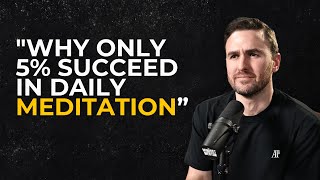
Rob Dial walks through a basic meditation practice: sit still, set a timer, focus on your breath, and watch your thoughts pass without judgment. He's meditated for over a decade and says it improves attention, memory, mood, and slows brain aging.
Chapters
Welcome to today's video. Today I'm going to teach you how to improve at being a meditator. Step by step, let's dive in. You know, I've been meditating since 2009. I'm still not great at it. I am way better than I was before. I'm getting better and that's okay because I have no attachment to mastering meditation. I'm not a monk. I'm not trying to become the best meditator that's ever been alive. I just do it for the benefits, the way that I feel when I do it. You know, I've done a. I've done a 10 day silent meditation retreat. It's called Vipassana. And you can't speak, you can't look people in the eyes, you can't journal, you can't work out, you can't do yoga. You can either meditate, you can sit in, you know, the sun outside, or you could sleep. That's basically all the options that you have for 10 days. And a lot of stuff comes up when you don't have anything that you can keep yourself busy with. I've done week long Dr. Joe Dispenza advanced retreats where you meditate and it's like basically meditation bootcamp. And I've been doing it for a while and the first time I started getting into it is because I read about it in a book and I started thinking, hey, I can try this out. And so, you know, if I'm still not great at it, why do it? That's the first question that probably pops up, right? If you've been doing it for so long and you're getting a little bit better, but you're still not mastering it, why do you still do it? And the reason why is because I see so many benefits and it's pretty crazy. I do events and I do zooms and I get live in front of people in many different ways. And it's crazy to me how few people actually still meditate every single day. Like, how few people do it, you know, like people who listen to the podcast will come to an event or they'll come to a zoom that I'm running. And it's like 5% of people when I ask the question, how many people meditate every single day? It's like 5, 7% of the people. It's so low. I'm just really blown away why that is. So why meditate in the first place? I guess I kind of need to tell you the benefits of it so you can actually See, because a lot of people, they say like, oh, I feel like it's a waste of time. They feel like they're not being productive, like there's something more productive they could be doing. And as somebody who is hardcore on efficiencies and productivity, I get that feeling. But it's like the phrase I heard somebody say one time, if you don't have 30 minutes to meditate, you need three hours to meditate because you gotta chill the hell out. Right? And so why would you meditate? Well, there's a lot of really good reasons to meditate. There's a lot of studies and I was researching a lot of them for this episode and I'll give you a couple of them that really show you the benefits of it, because I want you to actually start doing it before I tell you how to do it. Right. So there was a study that was published in Consciousness and cognition back in 2010 and found out that brief daily meditation enhances your attention, it enhances your memory, it enhances your mood and your emotional regulation. And they found this in non experienced meditators. And they found that even short periods of meditation can have immediate benefits on enhancing, enhancing your cognitive functioning. So people are like, oh, I'm not being productive. Well, if you can enhance your cognitive function, your attention span, your memory, your mood and your emotional regulation, I think that's pretty good, right? And this is done in non experienced meditators, okay. So it helps with your cognitive functioning, also helps with your depression. There was a research that was done at Harvard that investigated how mindfulness based cognitive therapy changes brain activity in the structure of the brain in people who are depressed patients. And so the study aimed at understanding how meditation affects interoception, which is body awareness and rumination, which are both critical in depression. And by focusing on, by focusing attention on the present through meditation, they found that it can actually help break the cycle of negative thoughts that are very typical in depression. So it's been found to help with depression as well. And it also helps with brain aging. So it slows the aging of your brain down. There's a study that was done in 2016 and it compared the compared brains of 50 long term meditators along with 50 controls. And they found that meditators brains on average appeared about seven and a half years younger than those who did not meditate, suggesting that meditation actually might slow down your brain aging. So I get it for those of you guys who are like, I have shit to do, I'm busy, I got a business, I've got a family, I've got stuff that's gotta be done. I don't have 10 minutes. I get it. But you do. And there's a lot of benefits in it. And it makes you a better person, it makes you a better parent, it makes you slower to react and not blow up on people. And so it is very important, I think, for everyone to do it. So for the 95% of people that are listening that don't do it every day, try it out, it's five, ten minutes. Not really a big deal. So let's talk about how to meditate once again. I've been doing it for 15, 16 years at this point, and I'm not a master, but I know some things that have definitely helped me over the time that I've been doing it. I personally have found that I like to do breath work before. And so I'll give you a couple different tips, but I've gone straight into meditating for years and I have found that my brain can go all over the place if I go straight into meditating and I'll sit for 20 minutes, and for 20 minutes, all I'm thinking about is my to do list. I've had it happen many times, right? And so what I found is what calms me down a whole lot more and kind of gets me out of my head and into my body is doing breath work. And it can be very simple breath work. It could be six deep breaths, which if you've been listening to this podcast for a long time, you know, there was a Japanese study that found that six deep breaths changes the state of people very quickly. And so it's just in through the nose, breathe out through the mouth, and a long exhale, like you're breathing out through a straw. That's a very short version of it that takes about a minute, two minutes at most. There's somebody who I have no affiliation with, but I've been loving his YouTube videos over the past six months. And he's got a YouTube that's called Breathe with Sandy. And it's just this guy that just does breath work and just puts up free episodes in about 15 minutes, 10 minutes. There's some five minute ones all the way up to 40 minutes. And so I like to do about 15 minute session of Breathe with Sandy and then do about 15 minutes of meditation. It doesn't matter what you do. I just find that it helps me get out of my head and into my body. You can do 60 breaths. You can look up Breathe with Sandy. You can do something else. You can do box breathing. You do whatever it is that you want. But I find that breathing kind of gets me out of my head into my body and allows me to kind of be more present and not just be everywhere else. Next thing that I have found that works really well. And this is what I Learned in the 10 day silent meditation retreat that I did years ago. You know, it was about six, seven years ago at this point that I did this is to get yourself in a meditation position. I recommend not laying down, because if you're laying down, you're probably going to fall asleep. And that's not the point. That's not meditation, that's a nap. And take it from someone who's taken many accidental naps when trying to meditate. That's not a nap or that's not meditation, that's a nap. Right? So you know how to get into a meditative position. You could just sit and put your feet on the floor and your hands and your knees, whatever it is that you want. I recommend sitting up. And here's the thing, you can set a timer, you can listen to a song. That's a certain amount of time you find your position. And then here's the thing that bugs people the most. Do not move a muscle after you find yourself in your position. Because what I have found is that your brain is so used to distraction that when you start to get into deep meditation, your brain wants to distract you. How does it distract you? By having a little itch on your nose? By feeling like there's a little itch that happens to be in your earlobe. And so what happens is if you distract and go and itch that thing, well, then you just got out of your meditation. And so I always say if a fly were to land on your face, you're just going to let him walk around and you're not gonna be like, oh my God, he's so dirty. But I don't know where that flies been. What if he was in the trash? Get over it. You're not gonna die. It's not a big deal. If he lands on your face or she lands on your face, let him walk around. And what we're trying to do through this meditation is to build the muscle. We're so reactive all day long. We're reactive to our text messages, emails to other people barging in. We're trying to build the muscle of not being reactive because our reaction muscle is so damn strong. And so you just sit there and you don't move a muscle if you get sore, let yourself be sore. It will go away eventually. If you have an itch, let it be there. It'll go away eventually. If a fly lands your face, let it be there. It will go away eventually. And so what you'll notice is you sit in your meditation position and your brain goes wild. It goes bonkers. The point of meditating, like, if you're sitting there and you meditate for five minutes and you're like, oh, my God, my brain was everywhere. The point of meditation is to not think. I'm sorry. The point of meditation is not not to think. The point is to not think nothing. The point of meditation, which I don't hear people say enough, is to observe your thoughts. Observe your thoughts. What you'll notice is whatever happens in meditation is actually what is always happening in your brain. And. But you're just not allowing yourself to observe it, right? So the way I like to describe meditation and observing your thoughts is imagine that you're just sitting on a mountain, right? And you see down below there happens to be a road, and there's just cars that are just driving by every once in a while on that road. And you're just sitting on the mountain. You're just watching the cars go by. That is what meditation is. It is becoming more aware of your thoughts. Not identifying with your thoughts, but becoming aware of what's going on in your mind. But you're just so damn busy all day that you're not actually aware of what's going on in your mind, right? You're just becoming more aware of yourself. Whatever comes up during your meditation is your normal self. Meditation's not bringing it up. It's showing you what your normal self is. So, like, if you get anxious during meditation, it's because you're anxious probably throughout the day. Mind you, I have dealt with this, right? I have sat down to meditate and then had 15 minutes of just being anxious as shit. And I was like, why am I so anxious? I don't know what's going on. And I start getting anxious about being anxious. And then I'm like, okay, this is what's normally going on throughout the day. But I'm just so damn busy, I'm not allowing myself. I'm running from it. And so I'm just going to sit here and I'm just going to just watch my anxiousness. And if it wants to stay here, it can stay here, but I'm just not going to resist it. And what's really interesting, and when you have that anxiousness and you don't resist the anxiousness, it slowly starts to go away. And it doesn't. What you resist, persists. And so it's just like, all right, Rob, we're gonna be anxious throughout this meditation today. You know what's funny is when you just let go, like when I let go, and I'm like, I'm gonna be anxious throughout this meditation. It's like dropping a little sugar cube into water. It slowly starts to just disappear and dissolve. And your anxiousness, sometimes, not always, I promise you, sometimes you're gonna have a 20 minute meditation. You're just anxious throughout the entire time. And you're like, well, what the fuck did I do that for? Right. You're just starting to learn yourself is what you're trying to do. So if you get anxious during your meditation, which once again, I've had happen before, you're probably just anxious throughout the day. So it goes. And we're trying to get away from those things and not resist them anymore. Right. The difference is you're just not keeping so busy that you're able to hide from it. If you get distracted throughout your meditation, you're probably easily distracted throughout the day. If you get angry during your meditation, you probably are living with anger under the surface. You might have a short fuse in some sort of way. If you have your brain bouncing from one place to another to another, to another, to another, to another, to another, which I have had in so many meditations. What you're realizing is that your brain is like that. Your brain is like that all day long. And you're not trying to resist it, you're not trying to fight it. You're not trying to wrestle that brain down. You're just allowing it to be for a little while and you're starting to become more aware of what's bubbling under the surface all day long. It's just we try to be so busy throughout the day that we try to run from it. A lot of times what you're basically doing is you're becoming aware of your thoughts and you're also starting to train your brain. So two days ago, I went out into my. By my pool and I did some breath work. And after the breath work that I was doing, I was, you know, laying down, sorry, sitting down on a, like one of the, whatever, the pool chairs, right? And I was sitting there and I did my breath work and then I was sitting there and I noticed my brain go, okay, get up. And I was like, nope, like I was about to get up. I was about to open my eyes, and I was like, no, no, no. I'm just gonna make myself stay a little bit longer. My mind is not the one that's in control here. I am the one that's in control. Now. You might be like, well, hold on. Are you. Your mind, well, that's a whole deeper discussion we can go into. But I noticed my mind want to go to the next thing, which I do all the time. All day long. I'm always hurrying to the next thing. I was like, hold on, we're gonna chill here for a minute, right? I see training your brain the same way that I see training a dog, right? So I've always mentioned. I've mentioned bear for so long now. Bear's, you know, three and a half, about to be four years old now. When he was a puppy, he was my very first puppy I've ever had, and I had to train him. And so, you know, there is negative reinforcement, there's positive reinforcement. Humans, dogs, most animals react better to positive reinforcement. And so, like, you know, when bear would pee inside, I take him outside. You pee inside and take it outside, Pee inside and take him outside over and over and over again. You don't do it here, you do it outside. You don't do it here, you do it outside. You don't do it here, you do it outside. And eventually he trains himself by me doing that. He starts to understand it. I'll say it better that way, right? And so your mind's the same. Your mind, you're going to go, okay, I'm going to focus on the breath. And you go, you just focus on the breathing. And then two seconds later, your mind is off doing something else. And your brain goes for a little while and what do you do? You just go, hey. Oh, my God. Three minutes later, you notice your brain somewhere else. Don't get mad at yourself. Don't guilt yourself, don't shame yourself. Just nicely bring your back your mind back to your breathing. And then 30 seconds later, your mind's off talking about something else. And you notice five minutes later, you've been. For five minutes, you've been thinking about something else and not even paying attention. What do you do? You just bring your mind nicely back to the present moment. You bring your mind nicely back to the present moment to your body, to the way that your skin feels, sitting feels the way that the breathing feels. And it runs off, and you bring it back, and he runs off and you bring it back, and eventually your brain starts to actually calm down a little bit. And I'm going to tell everybody this. We need more moments of silence. Because we are so overstimulated and people are becoming so anxious in this world. We need more moments of silence. It's not being unproductive. It's self care. And that's really important. Like, if you would've told this to rob 10 years ago, he'd have been like, all right, dude, fuck off. Right? But I'm just telling you right now, moments of silence are not being unproductive. Moments of silence, even if it's just three minutes in between meetings, is self care. So instead of thinking, I'm bored, start thinking to yourself, I'm relaxing. I'm relaxing my mind. I'm training my mind. I'm relaxing my mind. Same way that you go and you get a massage, you're relaxing yourself. It's self care, right? Meditation, silence, being bored for a little while, every once in a while is self care. And I just want everyone to start to understand that. To sit down, to close your eyes. Cause people are always like, well, can I go? Can I do a walking meditation? If you want. But don't call it meditation, right? Meditation is sitting down and closing your eyes and just being with yourself. Because about 60% of our brain is dedicated to visually looking around and visual stimuli, right? And finding things visually. So when you close your eyes, your brain doesn't have as much to distract itself with. And so all we're trying to do is become aware of our thoughts, become aware of our mind, and to start to train ourself to be a little bit more calm, a little bit less anxious, a little bit less angry, and everything's okay. And it can all exist. And your emotional regulation, there's study after study after study after study that shows that people who meditate are better with their emotional regulation because they know how to be with themselves. Most people don't know how to be with themselves and they're so distracted nowadays. And so really what it comes down to is there's no such thing as a bad meditation. For years I thought that I had bad meditations. There's not. It's just more awareness and more awareness and just allowing yourself to relax a little bit more. It's not boredom, it's relaxing. It's self care. And so give it a try. Let me know how you think of it. Send me a message on Instagram. Let me know how your meditation went. If it goes terrible, let me know. If it goes great, let me know. But really what it's about is finding your position doing some breathing and then not moving a muscle for an extended period of time. And you do it for years and years and years, and you'll start to notice yourself improve. So that's what I got for you for today's episode. If you love this episode, do me a favor. Please share it on your Instagram stories. Tag me in it. Robdial Jr R O B D I A L J R the only way this podcast grows is from you guys sharing it. And so I greatly appreciate it from the bottom of my heart every single time that you guys share it. If you would continue to share it, we can continue to impact more people's lives because I think more people need to hear this message. And so if you agree, please be a part of it and actually start helping us share the message. And with that, I'm going to leave the same way leave you every single episode. Make it your mission. Make someone else's day better. I appreciate you and I hope that you have an amazing day.
More from Rob


Why NOT to stay single 👉 @robdialjr #adviceoftheday #motivation #mindset #growth

You Reap What You Plant 👉 @robdialjr #adviceoftheday #motivation #mindset #growth

3 signs that you're addicted to chaos 👉 @robdialjr #adviceoftheday #motivation #mindset #growth

Stop making excuses for people 👉 @robdialjr #growth #mindset #positivity #adviceoftheday

Tip for an amazing life 👉 @robdialjr #inspiration #mindset #adviceoftheday #positivity

It's time to move on 👉 @robdialjr #adviceoftheday #motivation #mindset #happiness

The right person for you is... 👉 @robdialjr #love #truelove #inspiration #mindset #soulmate

Get ready to take risks 👉 @robdialjr #motivation #adviceoftheday #mindset #positivity

The real competition You Vs You 👉 @robdialjr #mindset #inspiration #positivity #adviceoftheday

Their Mood Isn’t Your Responsibility. 👉 @robdialjr #mindset #adviceoftheday #motivation