How to Trick Your Monkey Brain To Like Doing Hard Things (Dopamine Detox)
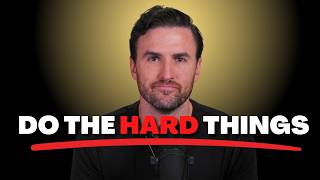
Your brain floods you with dopamine when you voluntarily face effort, not just when you finish. The anterior cingulate cortex, your willpower hub, physically grows with hard work. Shrink a dreaded task to five minutes, do it before your brain negotiates, then celebrate to rewire yourself toward challenge instead of scrolling.
Chapters
The number one breakthrough that you need in your life is sitting behind one hard thing that you keep avoiding. And deep down, I'm sure you know exactly what it is. But instead of doing it, your brain defaults to fear and you burn energy rehearsing failure and worrying about the future instead of actually moving forward. And the longer that you put it off, the louder that your stress and your anxiety will get. And so this episode is a pattern interrupt for you. I'm going to be breaking down the neuroscience behind avoidance, motivation, and the exact moment where your brain learns to stop running and fall in love with taking action. So if you've been feeling stuck or unmotivated or low key anxious all the time, then this is the reset that you're going to need. Okay. When you are about to do something hard, something that puts you out of your comfort zone, your body will sound the alarm. It'll say fear, it'll say stress, it'll say anxiety, and it will flood your body with the chemicals that are associated with those. But neurologically, that's actually the start of progress for you. But most of us usually back down at that point. Here's the reason why it's. It's the start of progress for us. When you voluntarily face effort and stress and something that's going to push you, your dopamine system activates inside of your brain and your dopamine system. Dopamine inside of your brain is the chemical of motivation. Whenever you are trying to achieve something, your brain releases dopamine. When you're anticipating achieving that, your brain releases dopamine. When you achieve that thing, your brain releases dopamine. All of those are designed to, to keep you motivated. And the key here is that it doesn't just happen. You don't just get dopamine when you finish the thing. Dopamine rises in your brain, in your body, in the pursuit of trying to achieve something. That's the key. And so the translation is that you don't have to succeed or hit a home run with everything that you do in order to feel motivated, in order to do the hard things, you. You just need to start. And when you do this, you will start to rewire your brain to associate challenge with reward. And if you do it enough, your brain will begin to rewire itself. Effort triggers neuroplasticity, and neuroplasticity is your brain's ability to change itself. But the catch is, if there is no strain, there's no change. The key to neuroplasticity is that the bigger the strain the harder it is for you, the more it will change your brain. So if you're having trouble doing the hard thing, taking the action, doing what you need to do to change your life, it's because you have accidentally wired your brain into connecting challenge with danger or fear or threat. When in reality we are wired for challenge equals reward. So unless you make a drastic change in your life, there is no shortcut, there is no book that you can read. You have to make a drastic change in your life and if you don't, you will always default to your brain connecting challenge with danger or threat or fear. And if you continue that way, nothing in your life will change and everything will get harder and harder to do. Like, think about it for a second and I want you to really, really think about this. Is going to the gym really that hard? Like an hour of discomfort? Oh, you poor baby. An hour of discomfort. That's the hardest thing right now. Sending that email that you've been putting off for so long. Oh, you poor baby. You're moving your fingers on a keyboard. Oh my goodness, that's so hard, right? You're sitting in an air conditioned room moving your fingers, right? You're literally just moving your fingers and you're staring at a screen. That's what you're doing when you're doing an email, like making cold calls. If that's what you need, you need to make cold calls to prospects in order to grow your business. You're just pushing a piece of plastic with your fingers and then putting that piece of plastic to your ear. So like quote unquote difficult. What I'm talking about here, when you put it into the perspective of being a human and from what other people in this world are going through, let's be honest, like, it's really not that difficult. It's that we have made it more difficult in our brains by our old default programming. And that programming just says, oh, when I'm challenged, I lay down Mike. We're just flaccid humans, like just getting run over by small challenges. Get your up and do something that's harder, right? When we seek challenges, we, when we seek discomfort, your brain starts to change itself. And studies have shown that this change in your brain can happen in as little as 21 days of consecutive action. So your nervous system uses discomfort as a sign that instead of it being a threat, it uses it as a sign that you are adapting, that you're changing. And over time, your brain starts to anticipate the and become addicted to the chemicals released when you do something hard. Dopamine, serotonin, endorphins, all of those are feel good chemicals that are released when you do something hard or when you achieve something. And whenever you get those feel good chemicals, guess what, you want more of those. And so, yes, you can literally get yourself to a place where if you push yourself for long enough, that you will eventually want to, to do what is hard. And there's a part of your brain, you may have heard me talk about this a few episodes ago, called the interior cingulate cortex, which is where neurologists are actually starting to think is the center of your willpower. And so for people who don't push themself, who don't push themselves out of their comfort zone, that don't go to the gym often, who don't do hard things, their interior cingulate cortex is very small. Not because they, that's just what they were born with, and that's the way it's going to stay forever. It's because when you start to push yourself and do something hard, the interior cingulate cortex grows. They found people that are, that are professional athletes. Their interior cingulate cortex is much larger than somebody who doesn't challenge themselves, not because they were born that way, but because professional athletes have to push themself and do things that they don't want to do every single day for 20 or 30 years. And so they have found that when people start to push themselves more, people's interior cingulate cortex will grow. So next time that you think something is hard and you're like, I don't know if I can do it. I don't know if I'm going to be able to do it. Maybe I should lay down, maybe I should scroll. Maybe I should do something different. Try this. Reframe. When you're feeling the feeling of something is hard or difficult, say to yourself, this is my nervous system updating. It's updating, and I am growing. You know, dopamine doesn't come from comfort. It comes from the pursuit of conquest, the pursuit of going and creating something with your life. So doing the hard things will always make your life easier, though. That's the weird kind of paradox of it is doing hard things makes your life easier. Avoiding hard things only makes your life harder. So the truth is that your brain actually wants to be challenged. Like, your brain wasn't designed for comfort. It was built for adaptation. When we evolved in environments where survival required effort, like hunting and building and escaping and enduring and going through challenges, every Single day, we developed. Our brain, developed a reward system that fires dopamine during the pursuit of doing something hard, not just the prize. And the reason why is because it kept us pushing ourselves. It. It kept our species adapting. And it's now built into us to actually want to do something that's challenging. That means that your neurochemistry is hardwired to reward challenge. You get the boost when you're in the middle of doing something, and when you're in the pursuit of something, not when it's done, but when you're actually in motion. But here's the modern problem, though. Modern life has made us soft, today, most of us are just completely soft. Like, our ancestors would have laughed at how soft we are. Oh, you've got to move your thumbs. Oh, my God, that's so hard for you to do. To send that difficult text message or to, you know, to send that email. And you got to move your fingers inside of air conditioning with a full belly and with, you know, water and clothes and everything. Oh, so hard, right? Like, our ancestors literally had to fight for their lives every single day. And so modern life has made us soft. Today's life is basically we live in a dopamine buffet. We can scroll on our phones instead of doing what's hard. We can watch TV instead of pushing ourselves. Comfort is always one click away. Like, if I. If I'm sitting on my couch, scrolling on my phone, watching Netflix at the same time, and I'm like, you know what? I'm kind of hungry. I can just go on a doordash. I can order it, and it's going to be at my house in 20 minutes. There's no challenge. It's like dopamine scrolling in my phone, dopamine, watching Netflix, dopamine, eating food. It's just a buffet of dopamine. And the result is that our nervous systems have been hijacked by cheap dopamine, like the tv, like scrolling on our phones. And we have unconsciously trained ourselves to avoid effort to. And to fear discomfort, we have become soft. And so when a real challenge shows up, a challenge that if we face it and we work through it, will make our life better, like a workout or having a difficult conversation that we need to have, or a decision that's a big life decision in your business, your brain misreads it as some sort of threat and something to fear instead of looking at it and seeing the actual opportunity that's in front of us. And so what happens is we feel resistance. Oh, my God, I feel this resistance inside of my body. So what do we do? We hesitate. We procrastinate. But underneath all that hesitation, that procrastination, the wiring is still there. Even if you're the softest human alive and you haven't ever pushed yourself in your entire life, and you're listening to this podcast episode, your original wiring is still there. The wiring that craves to be pushed to stress, to do something that is hard, because it feels good to do something that is hard. And so you have to understand, if that's the case, well, then even if I'm the softest human alive, I can make myself be somebody that's harder because that wiring is inside of me. But I can't do it from. You know, I love that you listen to this podcast, but this isn't doing something hard. You know, it's not going to come from reading a book. It's not going to come from going to a conference. It's going to come from you doing something that is hard. That is it. There is no magic pill that I can give you to grow your interior cingulate cortex. And now you do hard things. Like the magic of it is every time you do something that is hard, your brain updates and it learns, oh, wait, I just did something that seemed hard. I did something that I was afraid of. I survived, I adapted. I'm stronger now. And so what happens is you get sharper, you become more confident, you become more resilient. And slowly what was at some point in time, something that felt unbearable to you, something that was so hard to do, becomes automatic. So many people when they're on the weight loss journey and they're 100 pounds overweight, and they just go at it and go at it and go at it. Like, the first few months, at least the first few weeks are just so hard. And you watch these videos of transformation and you see them two years down the road, and it's like they work out every single day or five days a week, no matter what. It is part of who they are now. And so it went from this thing that was so hard for them to do and so unbearable to basically automatic. It's become part of who they are. Because you have to understand that the weight of life doesn't change. I don't know if you've been seeing what's going on in the world. It's a show, it's always been a show, and I'm gonna assume it's gonna continue being a show. The weight of life does not change. It does not get Easier, you are the one that changes. You become stronger. And that is how life becomes easier. The paradox is that if you do something that is hard over and over again, the more that you do hard things, the easier your life will get. The more that you avoid hard things, the harder your life will get. And so yes, doing the hard things, it sucks in the moment, I get it. But on the other side of that, it is a better you. It's a calmer you, it's a stronger you, it's a more confident you, it's a more resilient you. Your brain was built for discomfort. It is how our species learn to survive. But modern comfort has made you forget it. So you are way back. You got to do the hard thing. There's no way around it. I'm sorry, buddy. And you got to do it often. And you've got to do it on purpose. Because when you do the hard thing, life always gets easier. And so here's the real kicker of all of this though. Every time you do the hard thing, especially when you don't want to, especially when you don't feel ready, your brain basically records a message of like, hey, I'm the kind of person who takes action no matter what. That right there is an identity. And the identity is where everything changes. You don't build confidence by thinking that you're confident. You don't build confidence by reading a book unconfidence. You build it by doing what you don't want to do, by doing what scares you and noticing that you survived and then actually taking time and reinforcing by how you speak to yourself, how well you did with your own self talk. Oh my God. I can't believe you showed up for the gym. You didn't want to. You were tired, you were exhausted. I'm so proud of you. You're the type of person who follows through and you reinforce this identity by, by your unconscious mind seeing what you do and by you talking to yourself in the right way. So if you're stuck in self doubt, start with doing something hard and then do it again tomorrow. Because self doubt is a slippery slope. If you don't do something about it and force yourself to take some form of action, you will lose more belief in yourself. So you have to pay attention to what it is that you do and how it is that you speak to yourself. Like, I noticed something today at the gym. So I have a new trainer who's an ex Navy Seal for 15 years and he's hardcore and he made me start off on the assault bike. And the assault bike sucks. And I had to do two and a half minutes as hard as I possibly could and hit a certain time and hit a certain mile and all this stuff in a certain amount of time. And today was just not the day because we worked legs really hard two days ago. And I was thinking to myself as I was going, this is so hard. Oh, my God, I don't think I can do this. I don't think I could do this. I don't think I can hit the time. And I noticed my own self talk, which I still get stuck in everybody. And I noticed how I was slowing down when I was saying, I don't think I can do this. This is hard. And then I was like, that. I'm not gonna speak to myself that way. I'm gonna say, you got this. Started saying, you got this. You can do this. I know you can do this. I know you can do this. You're gonna get it done. I know you can do this. You got this. I believe in you. And I had to hit a mile in two and a half minutes on the assault bike. And I literally hit it in 2 minutes and 28 seconds. And I was like, oh my God. I was behind time and somehow I caught up. And it was because I was doing something that was hard, but I was also rewiring myself by not only doing the thing, but also the way that I was talking to myself, which is really key in all of this as well. And so my assignment for you today is to pick one thing that has felt too hard for you to do for way too long. And what I want you to do is I want you to figure it out. I want you to write it down. I've been avoiding blank and fill in that blank. And I want you to shrink it down. What is a five minute version of that thing, Whatever it might be. I've been avoiding going to the gym. Okay, go onto YouTube. Find a five minute YouTube video of a workout, and you're straight up, just do five minutes of it. So you name it, you shrink it. You start anyways, and you do it immediately, before your brain has any time to negotiate or think of other options. And then what you get done, once you get done with those five minutes, whatever it is, you build yourself up by how you talk to yourself. And you actually start to reinforce the feel good chemicals in your brain. Now you have endorphins, now you have serotonin, now you have dopamine. And you're also talking to yourself. Oh, my gosh I'm so proud of you. You did it in five minutes. You didn't want to. I'm proud of you. You release more dopamine, you start to actually become more addicted to needing to do the hard things. And so the key here is, if you want a better life, if you want your life to be easier, you need to start wiring yourself to do things that are hard. And if you do that, your life will become better. Hey, thanks so much for watching this video. Based off of what you have been watching recently, YouTube's algorithm thinks this video is the one that you need to watch the most right now. So click this one, and if you want to make sure that you do not miss any more videos, click that button right there to subscribe and I'll see you on the next one.
More from Rob


Why NOT to stay single 👉 @robdialjr #adviceoftheday #motivation #mindset #growth

You Reap What You Plant 👉 @robdialjr #adviceoftheday #motivation #mindset #growth

3 signs that you're addicted to chaos 👉 @robdialjr #adviceoftheday #motivation #mindset #growth

Stop making excuses for people 👉 @robdialjr #growth #mindset #positivity #adviceoftheday

Tip for an amazing life 👉 @robdialjr #inspiration #mindset #adviceoftheday #positivity

It's time to move on 👉 @robdialjr #adviceoftheday #motivation #mindset #happiness

The right person for you is... 👉 @robdialjr #love #truelove #inspiration #mindset #soulmate

Get ready to take risks 👉 @robdialjr #motivation #adviceoftheday #mindset #positivity

The real competition You Vs You 👉 @robdialjr #mindset #inspiration #positivity #adviceoftheday

Their Mood Isn’t Your Responsibility. 👉 @robdialjr #mindset #adviceoftheday #motivation