REWIRE Your Anxious Brain For SUCCESS & HAPPINESS By Doing THIS TODAY... | Rob Dial
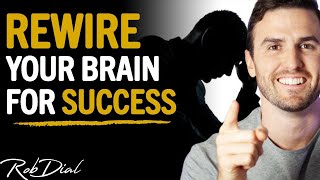
Rob Dial breaks anxiety into two types: neocortex worry about the future, which responds to meditation and reframing, and amygdala fight-or-flight, which needs physical fixes like the 4-4-7 breathing pattern, intense exercise, or cold showers. Identifying which one is active lets you rewire your brain to reduce anxiety.
Chapters
Depression can be an actual chemical imbalance in your brain. Anxiety only comes from your thoughts. Your anxiety can actually be fixed if you and I'm back to normal. Today we're going to be talking about how to rewire your anxious brain. So if you're out there, you feel like I deal with anxiety a little bit too much, I'm actually going to teach you how to rewire the anxiety that you have in your brain by first off understanding where the anxiety comes from, what anxiety is, and then the two different parts of the brain that actually deal with your anxious thoughts. And first off, what I wanna say is this anxiety comes from your thoughts. So I always have to preface whenever I talk about anxiety is that anxiety and depression are two completely separate things. Depression can be an actual chemical imbalance in your brain. Anxiety or only comes from your thoughts. And so that means that your anxiety can actually be fixed if you fix your thoughts. And anxiety is actually more prevalent than depression nowadays. It is called basically the common cold of mental illnesses. And we can fix it. And so this episode is going to teach you exactly how to fix it. Anxiety, just so you know, though, is usually fear of something happening in the future. And so if we can process these fears of something happening in the future, it'll help you know how to work through them whenever you go through them. So one of the beautiful things about being a human is that we can imagine the future. We have really, really complex and beautiful imaginations. But the problem with that is if we don't pay attention to them and we're not in control of them, they can completely get out of hand by bringing in too much fear of imagining something bad happening inside of the future. And, and so I'm gonna talk about two major circuits inside of your brain so that we can dive into each one of them and know how anxiety works in both of them. The first one is called your neocortex. Now, your neocortex is the more advanced of the two that I'm going to talk about. Your neocortex is when you have anxiety in your neocortex. It's the anticipation of something bad happening in the future. You know, like I said, humans can imagine the future, but if we don't pay attention, those can get out of hand. And so you have anxiety inducing thoughts. So your thoughts of what could possibly happen in this future is going to make you anxious. And so I'll give you an example. Let's say you're driving your car and it's a place that you typically drive Your car. And around a certain bend, let's not even say in a bend, let's say that you get to a stoplight and you go through the stoplight. You're sitting there, you're stopped, and. And then it turns green for you and you decide to start going, and you start going, and then, boom, you're smacked. Somebody T boned your car. Now you live through it, you're fine, no big deal. But next time you're at that exact same stoplight, you're going to think, oh, my God, I should probably look both ways before I go because I don't want to be T boned again. That's the next time you're at that stoplight. And you know what? Next time you're at each stoplight, you might slowly take off and look right and look left, and you might get anxiety about going through a stoplight. And so with your neocortex, it's able to look into the future and say, this might happen. I should be anxious about it. I should be very cautious about this happening. You know, and I always give this example. Let's say you walk by a lake and one day you happen to see an alligator outside of that lake, and you saw an alligator that attack a bird. Well, then if you have to go by that lake every single day, you're going to think about that alligator every single day. And what you're doing is the good thing about this anxiety and thinking into the future is that it kept our species alive because we were able to go, okay, something bad happened in this exact spot. I need to think about that bad thing so that I can avoid it, so that I don't have that bad thing happen to me. Whether it's a car accident, getting T bowed at a stoplight, or maybe it's walking by a lake because you saw something attack something else. You're going to think about that. Now, what does this have to do with your personal anxiety is, you know, you can have anxious thoughts about getting up and going on stage. You can think, what if people don't accept me? What if they laugh me off stage? What if I go and give this presentation for my boss and. And I look like a complete fool. And what you can do is you can have anxiety thinking about a future event. Now you have to realize, once again, this kept our species alive. That's a beautiful thing. But if you let it run rampant, it's going to completely control your life. Now, how do you get rid of it? How do you get rid of it? Well, the good Thing about the neocortex and getting rid of it is that this is the thinking part of your brain. So how do you get rid of it? You think through it. You think through these things. Couple ways that you can do it. Number one is through meditation. So if you, for instance, have the feeling of, I'm going to give a presentation. I don't want to be completely embarrassed and mess up or walk up there with my fly down, you can sit and actually go, okay, this is my neocortex. This is the thinking part of my brain. I'm thinking about something happening in the future, and. And it is right now giving me anxiety. Okay, so what do I need to do? I need to calm that part of my brain down. What's the easiest way to calm myself down? Breathing, visualization and meditation. And so you can sit there and go, okay, I'm feeling anxiety. Okay, feeling anxiety right now. What am I feeling anxious about? I'm feeling anxious about giving this presentation for my boss. What am I afraid of? I am afraid of being embarrassed walking up there with my fly down, you know, stumbling over my words, whatever it is, okay? So I'm going to close my eyes, I'm going to think through this. I'm going to actually visualize and think and feel what it would feel like to get up there, feel confident in myself, give an amazing presentation, and have my boss come up to me after and say, you know what, Rob? You did a really great job. We want to give you a promotion, whatever it is. And you can literally, instead of using your thinking mind to create a bad, fearful event, you can use your thinking mind to do the exact opposite, to see and feel. More specifically, feel how successful that presentation that you're so afraid to give actually feels inside of you. And so when you get up and give that presentation, you've got a lot more confidence. Because the neocortex, if you realize how this works inside of your brain, you can go, okay, I'm just feeling anxious. That's okay. That's built inside of me. Being a human. What am I feeling anxious about? And then you can start to process it and think through it. Once again, it is in the thinking part of your brain. So how do you get rid of it? You think through it. One of the really smart ways to deal with the brain is if it's in a thinking part of the brain, you can show your brain how illogical that fear is. For instance, you're afraid to go give this presentation for your boss, and you have all of this fear. You can go. Do you remember, you know, you gave your last presentation and you knocked it out of park and you gave another presentation and you knocked it out of the park. And you're not going to be fired for giving a bad presentation. And you can literally make it seem illogical to your brain. So your brain's like, this is ridiculous. I don't need to hold on to this fear anymore. So that's the neocortex side of anxiety. Hey, if you're enjoying this video, do me a favor and hit that like button down below. It helps with the YouTube algorithm. Subscribe so that more people can see this message because it helps us get it out organically. So hit that like button and I appreciate you. So you could have an anxiety coming up because of the neocortex side, or you can have it because of the amygdala, which is the other major circuit of the brain that has to deal with anxiety. The amygdala is where fear comes from. It is in the back of your brain. It's in the reptilian part of your brain, the oldest part of your brain, that gives you fears that sometimes are completely ridiculous. And so the amygdala creates the fears. And so, for instance, what happens is you see something or hear something or feel something. Your body reacts and thinks later. That's what the amygdala does. So let's say you're walking in your house at night. I've done this probably a million times. You've got to go out, you turn the light on because you've got to go to the kitchen and get a glass of water. And oh my God, you see something and you react to it because you think someone's inside of your house. And then you realize it's just your jacket that's on the coat rack. And you're like, oh my God. Okay, that's the amygdala reacting to something immediately. Or you're walking outside and you're like, oh my God, snake. And your body just reacts. And then you realize it's a curled up hose and it's not a noise or I'm sorry, it's not a snake, but it looked like a snake. Your body reacted the same way that your body reacted to the coat, thinking that the coat was someone that broke into your house. And is the same way that your body reacts to the hose, thinking that it might be a snake. It's there to protect you. You know, you could be sitting, it could be peaceful, perfectly fine. Boom. Loud noise outside. Your body's going to react to it. That is the reptilian part of your brain that just reacts. So how do you deal with the amygdala? And also, just so you know, it responds quick and then asks questions later. And so it's the reason why you can't really talk yourself out of a panic attack. Because literally your body is responding exactly like this. It is doing what it's supposed to do. This is where, you know, the part of the brain where PTSD usually works is they can hear it. Someone has ptsd, let's say their PTSD for more, and there's ptsd. You don't have to just go to war to have ptsd. You could have bad relationships, you could have trauma. There's a lot of different things. But let's just say someone goes off to war and when they come back home, they hear a lot of noise. It could set their PTSD off and their anxiety and their panic attack comes up. And the reason why is because that part of the brain has literally been trained to be on alert for sometimes six months, a year, two years, while people are overseas. Then they come back where that threat doesn't exist. And that part of their brain they just can't turn off. And that's when they have to seek medical advice and attention for that. So how do we work through, now that we know how to work through the neocortex side of it, how do we work through the amygdala side of anxiety? You can't use your thinking mind. You have to bypass your thinking mind and literally directly affect your nervous system. Cause your nervous system will react. How do you do it? A couple different ways that you can do it. Number one is deep breathing, right? The actual nervous system. You have to calm your nervous system down through deep breathing. So if you feel anxious, an anxiety attack coming up, something happens, your body just reacts to it. And it's not you fearing something in the future, it just pops, pops up. Sometimes when people have anxiety attacks, there's nothing that really set it off. It's just their body reacting to something. And so you can breathe through it. And deep breathing would be, you breathe in for four seconds, hold for four seconds, breathe out for seven seconds. So it's like this, And you do that until you feel your nervous system start to calm down again. And you can start. I mean, it's like the phrase is perfect when emotion is high, logic is low when your emotions are high. You can't really think through these types of things. So you've got to breathe through it calm your body down, calm your brain down, calm your nervous system down to realize there is no immediate fear that needs to be in front of you. There's no immediate attack. You're not about to die, you're in a safe place. What just happened? Loud noise or something that sets you off. There's no immediate something, there's no immediate danger that's in front of you. So you can do it through deep breathing. Another thing that's that supposedly works really well is working out now that your body's in a heightened state is to go and actually exert physical like actually. And here's the interesting thing is that if you ever watch a. This is super interesting. What you'll notice is if you watch a chase on National Geographic of an animal, an animal gets chased by, you know, let's say little tiny rabbit gets chased by a cheetah, right? And the cheetah loses them very quick. A lot of animals, what they'll do is they'll actually shake. They'll do a quick shake right after the chase is over. And the reason why is because there's so much adrenaline and cortisol going through their body that they're actually trying to shake it out of their body. And so they have pent up energy they, that they need to get out. So sometimes when people have really anxious thoughts or something coming up to be able to get rid of that helps a lot. And the way to do that is to exert yourself physically. And that usually helps. Another way that I've actually never tried with an anxiety attack, but I've tried it whenever I'm stressed out or something comes up is Wim Hof, who is considered the Iceman. He does breathing techniques and teaches you how to breathe. He does something where he does 30 deep breaths. So it's 30 deep breaths like this, Does 30 of them. And then on the 30th breath, breathe all the way in, all the way out. And on the 30th breath you sit there and you do as many pushups as you possibly can. And what it does is it actually supposedly resets your nervous system. And so for me, I've done this before and I'm super stressed out. I've got a lot on my plate. My brain's all over the place and I just can't seem to focus on what it is I need to focus on. What I will do is I will do 30 deep breaths, exhale as deep as I possibly can, so there's nothing inside of my body. And then I'll do as many push ups as I possibly can. What's really crazy is that when I do this I can do more push ups than when I am actually breathing. Because you might sit there and think, well if I'm going to be doing pushups I need to breathe or I'm going to pass out, right? Well of course you need to breathe eventually. But for me, whenever I've done this, I have so much oxygen inside of my body, I'm over oxygenated in my body and my muscles, in my blood that I can actually do more pushups than if I just do normal breathing while I'm doing it. And what I realize is after 40, 50 pushups, which sometimes I can get to about 45, 50 pushups before I need to breathe again. It's like my nervous system has gotten rid of all of the anxious feelings and the cortisol and the adrenaline. It's worked all of it out and I'm back to normal and I feel normal again. So you, you know what you can do is you can use these two different techniques depending on what it is that you feel like you're working for. So if you feel anxiety coming through, ask yourself what type of anxiety is it? Is it the neocortex thinking brain side of it or is it the amygdala automatically reptilian, just react, fight or flight mechanism inside of your brain that's working towards it and you can work through it. If it's the neocortex, remember it's the thinking part of your brain. You can think through it, you can use meditation, you can show your brain how ridiculous this fear of the future, whatever it is, and you can work through it with your thinking part of your brain. If it's the amygdala, you've got to bypass the thinking part of your brain. You've got to do deep breathing, you've got to do the workout or you've got to try the Wim Hof breathing technique with the pushups and both of those can help you. Another thing that supposedly really helps that I forgot about with the amygdala side is cold showers. Take a really, really cold shower, your body will react because it sees that as a threat and something that it needs to work through. But you know, we could do a whole other episode on, on, on cold showers and cold baths because I love those as well. But figure out your with yourself. Is it the, the neocortex thinking side or is it the amygdala just reaction side? And depending on which one it is you can listen to this episode and you can figure out a way to work through it to help yourself get past the the anxiety that you feel inside of your brain. If you do this enough, it will actually start to rewire your brain so that you don't have these thoughts, you don't have these feelings, and you can go on without having to worry about your anxiety. Hey, thanks so much for watching this video. If you want to learn even more about mastering your mind, click right here and watch this video as well. 97% of the that you're worrying about means nothing, so why are you focusing on it?
More from Rob


Why NOT to stay single 👉 @robdialjr #adviceoftheday #motivation #mindset #growth

You Reap What You Plant 👉 @robdialjr #adviceoftheday #motivation #mindset #growth

3 signs that you're addicted to chaos 👉 @robdialjr #adviceoftheday #motivation #mindset #growth

Stop making excuses for people 👉 @robdialjr #growth #mindset #positivity #adviceoftheday

Tip for an amazing life 👉 @robdialjr #inspiration #mindset #adviceoftheday #positivity

It's time to move on 👉 @robdialjr #adviceoftheday #motivation #mindset #happiness

The right person for you is... 👉 @robdialjr #love #truelove #inspiration #mindset #soulmate

Get ready to take risks 👉 @robdialjr #motivation #adviceoftheday #mindset #positivity

The real competition You Vs You 👉 @robdialjr #mindset #inspiration #positivity #adviceoftheday

Their Mood Isn’t Your Responsibility. 👉 @robdialjr #mindset #adviceoftheday #motivation