The #1 Skill For Healthy Relationships
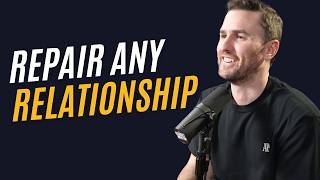
Rob Dial Jr. explains repair, a skill that goes beyond apology: revisiting moments of disconnection, taking responsibility, and changing the story the other person tells themselves. A parent who ignores conflict leaves their child with guilt and self-blame; proper repair builds safety and secure attachment instead.
Chapters
Welcome to today's video. Today, I'm going to teach you the number one skill to build healthy, lasting, loving relationships. Let's dive in. We have children, we have partners, we have friends, we have parents, we have siblings. And these relationships are actually what make our lives meaningful. One of the things that I love about watching sports, like the Olympics or watching basketball, is when somebody wins, let's say they run a world record in the Olympics, right? When they win that world record, they win that gold. The first thing they always want to do is find the person that they love because they don't want to celebrate on their own. Celebrating is only fun when you have other people to celebrate with, so they find the people that mean the most to them. These are what make our lives meaningful. And one of the most powerful tools that you can have to maintain and strengthen your relationships is this process that's called repair. And so I got this from a clinical psychologist. Her name is Dr. Becky Kennedy. And we're gonna dive into the importance of this thing that's called repair. And I'm gonna give you an example that is gonna be specifically around a parent to child relationship. But you can take this and you can mold it into any of your relationships. So let me give you the example. Okay, let's say that it's Sunday night. You've had a really long day. You know, maybe you had to work this Sunday and you had to work overtime, and you're exhausted. And you ask your children to do something. You ask them to put away their toys, and they say, okay. And then you come back and their toys aren't done and they didn't put them away. And you say, hey, will you put them. Will you put your toys away? And then you go and you do something else. And now it's just like you got more stuff building up and building up and building up. You're starting to feel exhausted, you're starting to feel overwhelmed. You're starting to feel, oh, my God, I gotta go back to work in the morning. And I just got off work with working a double. And then what happens? You walk in and the room is still not clean. And what happens? You, you just blow up and you find it's like the straw that breaks the camel's back. And you start yelling at your kid. You start saying, why don't you appreciate me? I've been working so hard. And you just snap. You start yelling them, and then the child starts yelling at you. And then they storm off to the room, they slam their door, and you're there by yourself sitting there. And how do you feel? Do you feel like you did a good job? You feel like you crushed it? No. What do you feel? You feel guilt, you feel regret, you feel, you start blaming yourself, you start getting all in your own emotions of self blaming and you're not good enough, you're not a good enough parent. And you just screwed your child up forever. They're never going to be the same. And so for a lot of parents, this is really common. But this is also common in any relationship where your spouse does something and they've even been telling them not to this thing for a while and they do it again. And then you blow up on them. And then do you ever feel good about it? No, you never feel good about it. You always feel like, oh my God, I shouldn't have done that. What the hell is wrong with me? And this happens all the time in really close relationships that we have. And the thing that we have to understand is that the relationships that are the closest to us is our biggest area for personal growth. The people who are closest to us. And the reason why is because the people that are closest to us trigger and push our buttons more than anybody else, which when we're triggered, we're not free. And so no matter how skilled or well intentioned you are as a parent, mistakes, moments like this, all of these things, they're gonna. There's the disconnection of one person to another person, that there's that connection feeling. Where there's connection, there's love, and then there's a feeling of disconnection when these moments happen. Right. But those moments are inevitable. But I want you to understand, it's not the mistakes that define the relationship. It's not the mistakes that define you as a person. It's really how you handle the mistakes afterwards. And this is where this concept of, of repair comes in. And when I say repair, it's not apologizing. Cause apologizing is not the same thing. But what I'm gonna be talking about today is repair. And we're gonna dive into the difference between them. So when we look at repair itself, what is repair? Repair is just basically the process of revisiting a moment of disconnection from the other person, taking responsibility for your behavior and acknowledging the impact that it's had on the other person. It's not like an apology. An apology oftentimes, an apology often aims to shut down the conversation. Hey, I'm sorry that I yelled at you. Can we move on? I'll let you have ice Cream for dessert. There's no solution in that at all. It's like, hey, can we just get past this thing? And you know what? I'll even give you a treat if you don't talk about it. Right? That's an apology. And trying to move on a good repair, what it does is it opens the door to further connection with that person and understanding. And I'm going to tell you why this is so important in just a second. The idea of repair has the acknowledgement that there was a moment of the disconnection. But rather than viewing this, this disconnection as some sort of failure, it's helpful to see this as really just an opportunity. And you will learn so much about yourself through this. And the other person, especially if they're your children, will learn so much about how to get better at conflict resolution if you get better at this. And don't try to just push it under the rug, okay? Repair allows us to really kind of transform this disconnection into a moment of deeper understanding between us and them. And really the importance of it is. I mean, I'm going to give it to you. There's so many different important pieces of repair. Now, what if we look at this situation and we don't repair? So if we're going to dive into. Before we talk about how to repair, let's talk about what happens if we don't repair with the other person. So let's go back to the same scenario we were just in with a child, right? You yell at them, the child now runs to their room, and that child feels what? Alone? That's one of the worst feelings in the world for a child, but it's also one of the worst feelings alone for an adult. But your child is now alone in the room, feeling overwhelmed, feeling stressed out, and without the repair, your child is basically going to take this situation on their own and often revert to coping mechanisms. And one of the most, the most common coping mechanisms for someone who doesn't really understand emotions is self blame. They're going to see it and they're going to say, I'm the reason why my father just got mad. When in reality they're not the reason why. I would have just gotten mad. I got mad because of my reaction to a circumstance. So it has nothing but my getting mad if I get mad at my child has nothing to do with them. It has everything to do with my own shit that I need to work on. Are you seeing this? But what happens to the child when they're alone? Oh, this is my fault. I did this thing that made this person get mad. Hey, real quick, I want to introduce you to something called Mindset Mentor Plus. If you love this podcast, you will absolutely love what I'm about to talk about. I designed Mindset Mentor plus to help you actively integrate every one of these episodes into your life. And here's how it works. With every episode of this podcast that comes out, Mindset Mentor plus subscribers get more. You're going to get multiple page detailed, printable worksheets, effectively a mini masterclass that's way more in depth than just this podcast. They also come with journaling, questions, challenges, assignments, and so much more so that you're not just listening to these podcasts passively, but you're actively integrating them into your life. That way you improve much faster. I also do monthly Q and A sessions in there and much, much more. If you want to learn more about it, go to mindsetmentor.com click the link that's down in the description. And so children lack the emotional tools and maturity to process these situations correctly and usually tend to internalize moments like this and think to themselves, this was my fault. And let's be real, children lack emotional tools and maturity. But most adults lack emotional tools and tools to be able to process things like this. So they think, something's wrong with me, I'm unlovable, I did something bad, no one loves me, I'm alone in this world, I can't trust anyone else but myself. And this internalization most times carries into adulthood. And then that leads to people who are alone, people who have anxiety, people who have depression, people have a deep sense of unworthiness. I see this all of the time with all of these adults that I coach. And you see a 40 year old, 50 year old person that's dealing with things or not. Excuse me. They have never dealt with these things from their childhood because their parents didn't really know how to do stuff like repair. And so they always thought things were their own problem and they thought it was their fault. The key to repair is this. The stories of self blame that the children create in those moments can shape their identity and how they relate to others and how they grow throughout their entire life. And these stories become core fears that many adults struggle with. The feeling of I'm unlovable, the feeling of being fundamentally flawed, the fear of love and connection and the fear of rejection. So here is the key. Repair is not just an apology. Repair is not just about fixing the momentary fight or the disconnection. It's about changing the story that your child is telling themselves to ensure that the story is being changed to one that is safety, that's connection, that's self worth, that is love, that is repair versus oh, I'm sorry about it. Can we just move on? See the difference? Because what happens is if the child goes to themself and they're alone, they start creating their own narratives. And a lot of times these narratives are, there's something wrong with me. Well, as an adult, I want to step in and say, hey, there's nothing wrong with you, that was my fault and start repairing the situation. I'll teach you exactly how to repair it. Cool. So hopefully you understand the importance of this. So let's talk about how to repair the situation and to change the story that's going on in your child's head. Or once again, this could be your loved one's head. This could be a fight that you got into with your spouse, it could be your boyfriend, it could be your girlfriend, it could be your sister. So when you engage in repair, you do more than just like patch up a momentary issue with this person. What you're doing is you're helping rewrite the child's narrative and rewrite their story of that event and, and change their own identity. And this is the reason why therapy is so effective for people is because what do you do in therapy? You revisit painful memories in safety, the safety of a therapeutic relationship, which when you revisit it, you can then change the story. And when you change the story, you change the individual and you change their own identity to have themselves. So you're kinda doing a mini therapy session after the event with your child so that later on they don't have to go to therapy. They don't have to go to therapy as an adult because of you, right? So that's what you're kind of doing in that moment. In the same way, when the repair itself allows you to revisit and alter the narrative that your child might create about this stressful event of it being their fault. And it's not just about removing the negative self blame, but it's also about adding other things that might have been missing. Right? The feeling of love, the feeling of safety, the feeling of connection, the feeling of understanding, the feeling of, hey, I was, you know, as an adult, I was the one who just went through this and I want to say that I am sorry for the way that I acted. It had nothing to do with you. I have just had a stressful day and it Allows them to see what an apology looks like. It allows them to see what fixing and what it looks like to be triggered, but then also what it looks like to come back and, you know, actually fix a wound that you just caused. Everyone in this world has triggers. Everybody has hangups. Nobody is perfect. And your child needs to understand that too. And so they understand, yeah, my mom and dad aren't perfect. But every time that they did mess up, they always came back to make sure that I knew I was loved, that I knew that I was saved. And so the first piece of repair is you have to repair with yourself. Before you can give anybody anything, before you can offer compassion or understanding or love to the child or to your spouse, you need to give those qualities to yourself. First. Repair of yourself involves separating your identity, which is who you are, from the behavior, which is what you did. Because there's a lot of times that people will say, oh my God, I just did this, I'm a terrible mother. That's bullshit, right? What you're doing is you're taking behavior and placing on top of your identity. Your identity is who you are, your behavior is what you did. And so it's about sitting there and acknowledging. While you may not be proud of your behavior, it doesn't define you. You're still a good parent, you're a good person. You just had a momentary lapse of judgment. You had a hard time, it's been a hard day, right? You blew up. That's what you did. That's behavior. But it doesn't go into your identity and make you a bad person. It's not about letting yourself off the hook or any of that stuff, but it's really a way of holding yourself more accountable. That is constructive versus destructive. And so when you pair with yourself, then you can come and you can go, okay, now I'm calm, now I'm clear headed. Now I can get into a meaningful conversation with the kid or a meaningful conversation with my spouse. Okay, step two, the second thing that you want to do is you want to repair with your child or the other person. Once you've grounded yourself, now you can go and you can talk to them, right? So the steps that Dr. Becke gives is this quite simple. Number one, name what happened. Number two, take responsibility. Number three, state that you will do something differently next time. And then make sure you start working to be different. So first one, name exactly what you did, say exactly what happened, exactly what went through, and it shows your child that you're aware of the event you're aware of what went wrong. The second thing you're going to do is you're going to take responsibility, own up to your actions. Don't blame it on anybody else. Don't say, oh, well, I wouldn't have said this if you wouldn't have said that. No, because then that's also them being the problem. When it's not them that's the problem, it's you that's the problem. I want you to understand, this is the core of what I'm saying here, is it's never about the circumstances of your life. It's always about our reaction to the circumstances. If you blew up at your child or you blew up at your spouse, it's not them, it's you. And that's really hard for most people to hear because they're like, no, they won't clean their shit up. It's them. No, no, no. Okay, yeah, we can get better at helping them clean their stuff up. But your reaction to them is what actually you're in control of. And so this is really crucial for modeling what accountability looks like. So many parents, and I see this, I can't tell you how many times I see this with people who are grown adults where their parents still won't take accountability for anything. And so what you're doing is you're showing your child, you're modeling what accountability looks like for them. And then the last thing you do is you're going to tell them what you're going to do differently next time. It shows the child that you're committed to change and committed to growth and becoming better. Damn, that looks so good for a child to see, right? And so it can be something like, hey, listen, can we talk about what happened an hour ago? Listen, I'm sorry I yelled, and I'm sure that probably was terrifying because I understand. I'm an adult and I'm way bigger. And I want to let you know that the yelling wasn't your fault. And I'm really working at trying to be more calm, especially when I'm frustrated. And so I just want to tell you that I'm sorry and I love you. It wasn't your fault. And so what happens is when they hear that, the child goes, okay. And it's not saying the child doesn't need to get better at cleaning their stuff up. I don't want you to think that. Think that at all. What it's saying is, my reaction was not your problem. My reaction was my problem. You're taking responsibility as an adult should, right? This simple 15 minute intervention, inter 15 second intervention can have a massive impact on your child. So it clears up the feelings of self blame for them, but also strengthens the moment of safety of like, I am still safe here, I can still trust my parents and I don't have to do this on my own. And so when you look at like the long term consequences of repairing, repairing with your child sets the stage for them to have healthy relationships when they're an adult also. So they're not the kid that goes off into the schoolyard and is a bully to another kid because they feel like they were bullied at home. Right. So it allows them to grow up and be an adult who, you know, if you're a child who had consistent repair, like the parents weren't perfect but they kept repairing, then the child's less likely to spiral into self blame and not feel like everything is their fault. They're also more likely to develop a secure attachment style and like a love attachment style with another person instead of like an anxious attachment or an avoidant attachment. They'll also be way better equipped to take responsibility for their own behavior because they were able to see from their parent how to take responsibility for the behavior and what to do from there. So it's a skill that they will learn from who? From you? Yeah, wouldn't you like them to model that? And so really what it does, and the most important part of this, of the difference between an apology and a repair is the apology is just like, hey, I'm sorry, can we move on? The repair itself, the biggest part about it is that you're changing the story. But behind everything, right? You're changing the narrative that's going on inside of your head. You're changing the narrative that's going on inside of the head of the person that you love so that they don't take it on and put it all on themselves and make them think that it's their fault and that there's something wrong with them and that they're unlovable. And it's about moving beyond guilt, moving beyond blame and more of a place of like love, understanding and growth, which is, which is a really big part of a deep connection with another person. So next time a fight occurs in your relationship, just remember it's not the end of the story. This is going to happen. That's what being a human is. But what you want to do is you want to think, okay, how can I not just apologize, but how can I repair? And repair means changing the story that might be going on in their head so they can understand the whole reality, really. With repair, you have the power to write a new, more loving chapter with this person who you actually love. You're able to take responsibility, start working on yourself and start becoming better, but then also repair and work through the relationship with the person that you love. So that's what I got for you for today's episode. If you love this episode, please share it on your Instagram stories and tag me in it. Robdial Jr R O B D I A L J R the number one way that you can give back and say thanks for this podcast or anything that we've put out there is just by sharing it. The only way this podcast grows is by you guys sharing it through grassroots. We don't have any big advertising agencies behind us trying to put this podcast out or anything like that. We only grow when you guys share it. So if you would share this, hopefully someone that follows you will be able to find it. Hopefully be able to help them with their relationships as well. And so I would greatly, greatly appreciate that. And with that, I'm gonna leave the same way I leave you every single episode. Make it your mission to make somebody else's day better. I appreciate you and I hope that you have an amazing day.
More from Rob


Why NOT to stay single 👉 @robdialjr #adviceoftheday #motivation #mindset #growth

You Reap What You Plant 👉 @robdialjr #adviceoftheday #motivation #mindset #growth

3 signs that you're addicted to chaos 👉 @robdialjr #adviceoftheday #motivation #mindset #growth

Stop making excuses for people 👉 @robdialjr #growth #mindset #positivity #adviceoftheday

Tip for an amazing life 👉 @robdialjr #inspiration #mindset #adviceoftheday #positivity

It's time to move on 👉 @robdialjr #adviceoftheday #motivation #mindset #happiness

The right person for you is... 👉 @robdialjr #love #truelove #inspiration #mindset #soulmate

Get ready to take risks 👉 @robdialjr #motivation #adviceoftheday #mindset #positivity

The real competition You Vs You 👉 @robdialjr #mindset #inspiration #positivity #adviceoftheday

Their Mood Isn’t Your Responsibility. 👉 @robdialjr #mindset #adviceoftheday #motivation