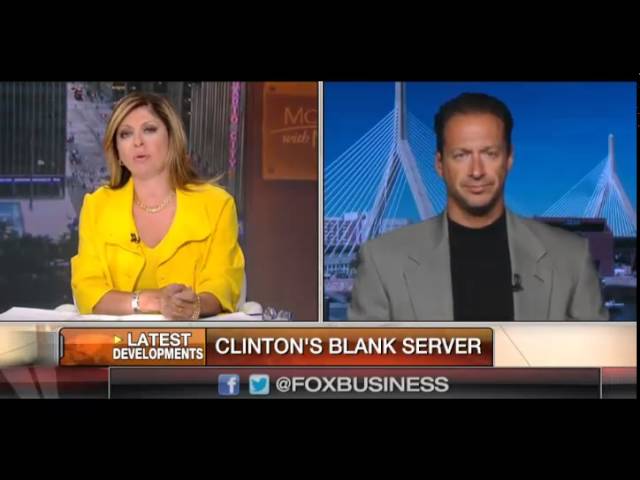
Robert Siciliano, a cybersecurity analyst, discusses Hillary Clinton's deliberately overwritten email server and whether deleted data can be recovered. The conversation covers overwriting methods, where copies of emails might still exist on recipients' servers and staff drives, and investigative paths forward.
Chapters
We begin this morning with the latest on the Clinton classified email scandal. Senate Intelligence Committee Vice Chair Dianne Feinstein running to Hillary's defense. Feinstein claiming that Hillary did not write any of the classified emails in question, but did not push back on the fact that she was using a personal email account to receive sensitive classified intelligence. Feinstein says, quote, "The questions are whether she received emails with classified information in them, and if so, whether information in those emails should have been classified in the first place." Those questions have yet to be answered. Even more questions were raised, though, with the Washington Post revealing that the server that Clinton turned over to the Justice Department this week was actually blank. My next guest says that overwriting a server is a deliberate task that requires not only skill but specific software designed to erase all traces of data. Joining us right now from Boston is cybersecurity analyst Robert Siciliano. Good to see you, Robert. Thanks very much for joining us.
Thank you.
Okay. So first off, first question, since you are a cyber expert, are those emails truly gone forever? I mean, I've been told for so many years that nothing is ever gone and that you could always retrace anything that's on the server. Is that true?
Well, like you said, these, these servers were deliberately erased, which means that they were overwritten probably 3 to 5 times which means that the person that was responsible for that had specific software. They knew what they were doing. They erased all that data. Chances are you will never find anything on that server. Hitting delete generally does not delete it. It just deletes the path to it. But when you overwrite a server in the way in which it has been speculated, uh, that data is gone from this particular server.
Well, I mean, why would anyone overwrite a server?
What—
why would Hillary Clinton, the Secretary of State, decide that she wants to scrub her clea— her server clean?
Well, likely because they don't want traces of that information being found. Now, all that being said, more than likely that data resides somewhere else. So all the people in the chain of all those emails that were CC'd probably have those same emails on their own servers or their own inbox, let's say. So more than likely, all that data is somewhere. It could be on her employees' or staff's drives and so forth. So if somebody wants to get access to it, FBI, whoever, they can.
All right. So what I think you're saying is that these emails are retracable then. Then we will— because if you're talking about the recipients or others who are CC'd, they have them. So it's not— they're not gone forever. It's just much more legwork.. And, and, and you have to expect that the investigators will do that legwork.
There would have to be a certain amount of people that would have to be subpoenaed. Others would have to be, their servers would have to be turned over. There would be some legwork involved in getting access to that data. But more than likely, somebody has that information somewhere.
Gary Dagan, weigh in here. This is pretty extraordinary, isn't it?
Robert, quick question. In order to erase the data from the servers. Do you think that someone in the Clinton camp went outside and hired a company? Could they do that online? I mean, isn't that really the, the path of information that needs to be followed? Who actually did the erasing so we can get to, you know, what nefarious thing may have happened?
So it is not for the faint of heart in regards to resetting a drive, reformatting, and so forth. You really need to know what you're doing. Certainly there are online tutorials and various software programs that will allow you to do this on your own, but to really do it effectively, you do need to know what you're doing. You do need to have specific software. It is a deliberate task that requires a certain amount of skill. And so backtracing, you know, who is responsible for that, what was the process they went through, is all doable. But, uh, you know, covering up one's tracks is also, uh, feasible if you certainly know what you're doing.
And it's Robert Siciliano, and also, so there, you know, her personal emails were deleted, the server's been handed over. Her personal attorney said earlier this year that there's no information left on the server related to her work as Secretary of State. We know that. But there's no way to know if any of the information that was there was compromised in terms of a break-in by a hacker, right? There's no way to know until that information pops up somewhere else.
Yet done properly, uh, there's no way to determine, uh, if that data had been accessed by anybody nefariously. Uh, you know, Quantico, whoever may be reviewing the server, uh, they have some of the best forensics analysts on the planet, and if anybody's going to find anything, it will be them. It really revolves around all those that were involved in the chain of emails and their servers being accessed to determine, you know, if and when any information was classified, uh, who may have had additional access to it. You know, there was— there is some significant amount of resources and research that needs to be conducted in order to find out exactly what has occurred.
Robert, it's good to have you on the show today. Thanks so much. We appreciate you weighing in.