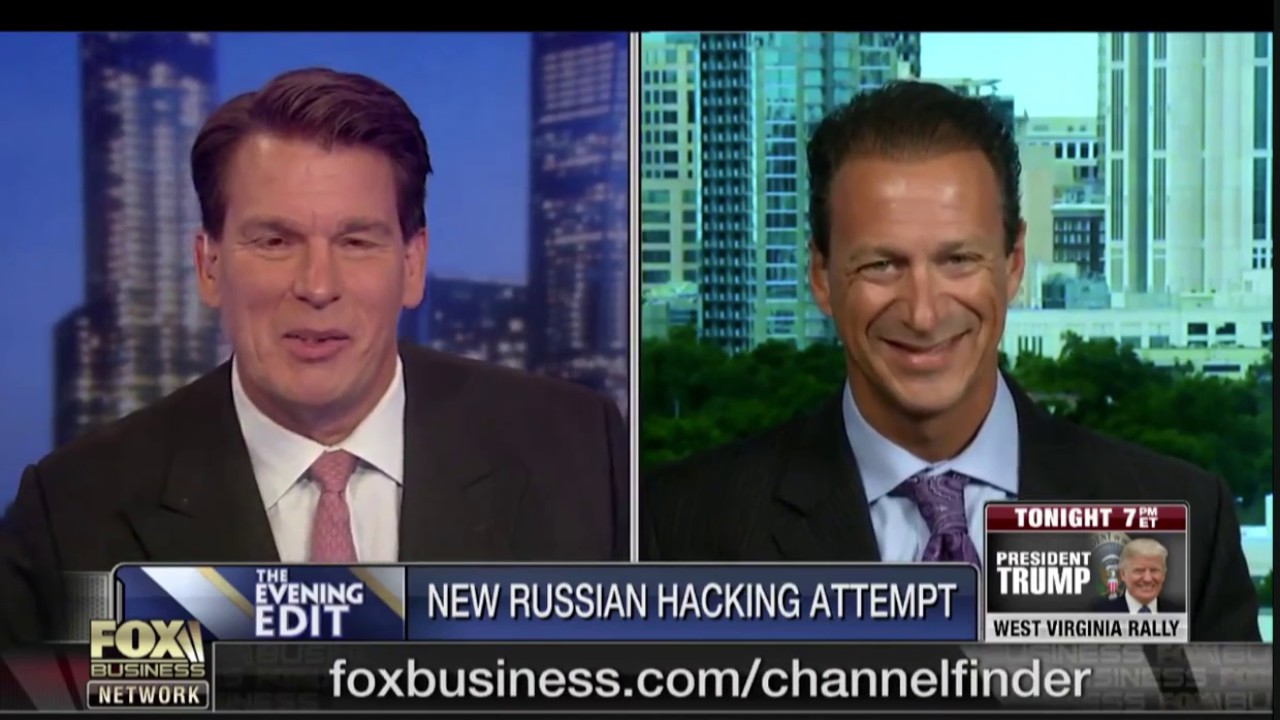
Robert Siciliano, a cybersecurity expert, discusses Microsoft's discovery of Russian-linked hackers targeting U.S. political groups including the Senate and think tanks. He covers vulnerabilities shown at DEF CON, including a replicated hack of a Florida voting system, and recommends stronger passwords, password managers, and VPNs.
Chapters
Russian hackers linked to the 2016 election cyberattacks on the Democratic Party are widening their target ahead of midterms, now attempting to hack the U.S. Senate and conservative think tanks. Microsoft announcing it thwarted attempts last week by taking control of 6 websites created by a Russian military intelligence unit that could have been used to launch cyberattacks on candidates and other political groups. Let's take it up with Hotspot Shield security analyst and cybersecurity expert Robert Siciliano. I hope I got your name right. I'm sorry, I'm just tongue-tied here, Robert, with all this incredible breaking news. Look, this is what the Mueller investigation was supposed to be all about, was the Russian collusion, the Russian hacking. It seems to me we're arguing over who the collusion is with, who was witnesses to this hacking. The base root of this was the Russians that were hacking the election. Have we done enough as a country to stop this going forward?
You know, there's always more to do. You know, hackers, whether they're government-funded, government-backed, have unlimited resources. And they're just gonna continue on their mission. In this particular scenario, Microsoft stepped in and they were able to thwart this particular hack, but that does not mean that the hackers aren't playing the whack-a-mole game and have a number of others planned.
The recent DEF CON convention, which is an aggregation of hackers from around the world, they had 35 11 to 17-year-olds, I believe it was, or 6 to 17-year-olds, an 11-year-old rather, was the one that actually won the hacking of the Florida election system in 10 minutes. An 11-year-old, not a sovereign state actor, not somebody backed by billions of dollars, an 11-year-old hacked the Russian, the Florida replica of the Florida election system in 10 minutes.
Yeah.
Are we really that vulnerable?
So that was in a controlled environment. It was not the actual system in place. That said, Yes, we're vulnerable. The good news is that a lot of these votes are hand-counted and then collated and submitted electronically, but that does not mean that we are, you know, unimpenetrable. Lots more has to be done before the voting system is completely digital.
What do we have to do? I mean, the Kremlin today denied any knowledge of attempts to interfere in the U.S. elections. What do we need to do? You say we have a lot more to do. How do we actually to prevent Russia from doing this again? And what do we need to do to President Trump? He seems to be shrugging off all of these allegations. Yeah, I'm sorry, President Putin, forgive me.
Yeah, so, you know, at this point it's all about vigilance. We've heard this over and over again. Security is all about, you know, good versus evil, and it's a 24/7, 365 battle. And as long as you have security companies in place that are doing their jobs effectively, all those that are affected, doing their jobs as well. And the general public, consumers, people like you and I, making sure that our data is properly protected, using stronger passwords, password managers, VPNs, making sure that anything and everything that you do digitally is properly secured.
So password123 is probably not the best way to use the password, is it?
Yeah, not at all. About 20 million people using that same password.
It's insane, is it? Despite all the warnings. Robert, thank you very much for joining us. Appreciate your time.