Robert Siciliano talks with CIA spy Peter Wormka about AI threats: deepfakes on social media, voice-cloning scams, and AI-generated propaganda. They cover detection tools, what vendors should do, and how to protect family members with authentication codes.
Chapters
And welcome to The Security Guy and CIA Spy. I am Robert Siciliano.
And this is Peter Wormka from sunny Orlando.
So buddy, is that a green screen I'm looking at? What is going on behind you?
I'm into authentic, an authentic presentation of myself. This is the great outdoors. And the reason why I had to do this— normally I'm in my house or an office space when we get online here, but today they're installing solar panels on the roof and I just can't even stand being there, let alone trying to do a podcast from there. So I'm outside near my house, uh, at a nice park here.
It is the great outdoors, and your internet is great, your background is fantastic. You should do that every week because I love it.
I can try to do that. I wouldn't want you to try to do that in the wintertime up where you are though.
Oh God, no. Yeah, solar panels, you're going green. I love that. Good for you, man.
Yeah, give it a try. Yeah.
All right, so we got, um, uh, before somebody shows up, uh, riding a lawnmower behind you, let's get ready. Okay, so, uh, this week, um, we're gonna be doing some AI stuff. Okay, because, uh, there is a lot of stuff going on right now that I think that, um, everybody needs to be aware of in regards to, uh, AI. And, uh, it's, uh, getting pretty, uh, nasty out there. Pretty scary, actually. Um, I actually was just recently pitched, um, by a network to do an entire TV show on current AI scams. And I think that what I'm seeing right now is the proliferation of digital media being manipulated in such a way where it's being used for propaganda is really just the beginning of how human beings are going to be unduly influenced by what they're taking in via their eyes and ears.
I agree with you. I mean, this is just starting. This is the tip of the iceberg of what's to come.
Now, now, right here, this particular article, Americans— this is via DNYUZ. Americans under 30 don't trust religion or anything else. Now, we're not here to talk about religion. But what caught my eyes in regards to this particular article is that those under 30 don't trust, and that is not necessarily a bad thing. Okay. And with what's going on right now in regards to AI and deepfakes and everything else, um, that generation stands to fare well in regards to what's coming at them on a daily basis in regards to all print and digital media. Okay, so check this out. I'm going to scroll right down to, uh, a new report from the Survey Center on American Life at the Enterprise American Institute calls this what's called formative distrust. Which is a new term that I've, I've never heard before. And I think this is great, actually. Formative distrust, noting that older Americans had a greater confidence in political leaders during their childhood years. And if you grew up as I did during the relatively stable Clinton years, for example, you probably have a very different view of political institutions than someone who turns 25 today. That's me, uh, whose political consciousness may have been formed during the Trump era. So that said, you know, those who are 25 years old right now, they're like, we don't trust our government institutions, we don't necessarily trust media. They're looking at the world around them and going, something is not right. Like, we're supposed to trust our government institutions, trust the media that comes at us but we really don't. And that this is considered their formative years, and that's actually a good thing, Peter.
No, I agree. I think that's a, that's a very interesting observation that you've made, uh, because yeah, you know, our generation and people even older, we know it's sort of like we blindly trust everything, you know, we trust everything until something comes out that proves it to be, to be false. So we automatically trust. That's the culture that That's the upbringing we had. And the fact that now we're— there's a generation that sort of has this, I would say, skepticism and wanting to really verify, uh, whether this news is true or not. That's a good thing. I think on the other side of it though, there, uh, there's pros and cons. We also have a generation that, that's very attuned to using technology, to using these cool AI tools, such as there's a number of these applications where you can, you can create, um, you you know, like another image of yourself and manipulate that image. And, and so a lot of these kids are blindly giving their, their ID— I mean, their, what can I say, their, their physical ID away to these companies where they might lose control of it and it could be used for something. So in some ways they're skeptical and very, you know, want to dig in a little bit more to trust whether or not some of the news is, is true or not. The technology that they're involved in though, they can still be even more likely to be scammed than some of the older generations.
It's very possible. And yet, like you said, their, their, their lives are online, and so their, their faces, they're, they're essentially their biometrics at some level, and their, um, a voice, uh, is, uh, everywhere. And that is— it's not only being manipulated by them via the various tools that they use to kind of clean up their, or, you know, wash their their, their, their, their looks and filters and such. But it's also has been or will be used by scammers and others to, to manipulate others, uh, with, with their presence, right? So check this out, right? Here is via the Washington Post, uh, these look like prize-winning photos and they're AI fakes. Artificially generated images of real-world events proliferate on stock image sites. Think Adobe, think Getty, blurring truth and fiction. So a young Israeli woman wounded clinging to a soldier's arms in anguish, a Ukrainian boy or girl holding hands alone in the rubble of a bombed-out cityscape, an inferno rising improbably from the tropical ocean waters amid Maui's raging fliers. At a glance, they could pass as iconic works of photojournalism, but not one of them is real.
Okay, this is a serious problem because when you go as a potential customer to buy these images, they're— I mean, you should be, you should be, you know, reassured that these are not, uh, you know, made with artificial intelligence unless they are posted that they are, and people still want to buy them for some reason.
Check this out, Peter. This is an AI-generated photo of the Israeli woman clinging to a soldier. This is on Adobe Stock, right? Here is what looks like an AI-generated fake photo depicting an explosion in Gaza. Okay. Here is an AI-generated fake photo on Adobe of a girl holding a teddy bear in a civilian area. This looks like a Ukrainian child. Beautiful, beautiful picture, you know, beautiful kid, right? Uh, but everything about it, apparently, you know, I guess I don't know if the child is real or not, or her, if her background is real or not. I mean, it's a beautiful photo, but it, and it's definitely heartfelt. Uh, you know, look at that, like that's supposed to be Maui, you know, that's wild, Peter. Yeah, so what is it saying? It's saying that, uh, responding to questions about its policies from The Washington Post, the stock image site Adobe Stock said Tuesday it would crack down on AI-generated images that seem to depict real newsworthy events and take steps to prevent its images from being used in misleading ways. Man, like Adobe and Getty being the basically the media police in regards to what's real and what's fake. For-profit entities that are ultimately at some level going to be responsible for determining whether or not a photo is fake or a, you know, or real. That's a little frightening to me, you know, and it's not that I don't have any confidence in them. It's that a, they're for profit, and b, it's an enormous responsibility that they have. Uh, and but it's not just them, it's every single user of Facebook and Twitter and LinkedIn or that has a blog that takes any of these images that they find anywhere on Google Photos or Google Images for that matter and thinks it's real, uh, or any journalist that finds it anywhere and thinks it's real and posts it.
Mhm. But I think for now— I agree with you— but I think for now there's going to be no other choice, and it's going to have to at least start with this because there's not any current regulation that really is going to be able to be utilized to to enforce, you know, the— someone utilizing— for somebody who's utilizing deepfakes to be, you know, to prevent that or to prosecute them. So, it's going to have to be the vendors of those photographs, of that media, whether it's, you know, the creators like Adobe, like Stock, or on some of these social media platforms that is going to have to— they're going to have to take that, you know, maybe there's going to be regulation that's directly going to impact them, that they could be prosecuted are fined if they are offering through them deepfake images. Because at the government end, I don't think any government entity is going to be able to police this. And at the consumer end, I mean, how often is a consumer going to get online and be able to use some tool, let's say, and check a photograph? I mean, it's not realistic. They're not going to do that.
They're not going to check the photos themselves, right?
No, they're not.
Now here, the AP discusses fake babies, real horror. Deepfakes from the Gaza War increase fears about AI's power to mislead. So propaganda. So among the images of the bombed-out homes and ravaged streets of Gaza, some stood out for the utter horror. Bloodied, abandoned infants viewed millions of times since the war began. These images are deepfakes created using AI. If you look closely, you can see clues, fingers that curl oddly or eyes that shimmer with unnatural light, all telltale signs of digital deception.. And for a media company like an AP, they would be able to maybe differentiate. For most of us casually, uh, taking a look and seeing something that a friend posts online, maybe not. The outrage the images were, were created to provoke, however, is all too real. Pictures from Israel-Hamas war have vividly and painfully illustrated AI's potential as a propaganda tool used to create lifelike images of carnage. Since the war began last month, digital altered ones spread on social media have been used to make to make false claims about responsibility for casualties or to deceive people about atrocities that never happened.
Wow. Yeah, I think what it comes down to for the consumer itself, I mean, you mentioned earlier in the program that younger people are a little bit more cautious and not necessarily trusting of what they read, what they hear being put out. The same thing here. A photograph many times is even more compelling, but You got to think about how does this photograph really impacting me right now? Is it, is it pushing some buttons regarding my emotions? And if, if so, you go, why? You know, what's the purpose of this photograph? And then maybe take it back to be more critical thinking about this and not letting that happen automatically, saying, you know what, am I— I'm allowing this media to impact my emotions. Maybe I shouldn't.
Yeah, I mean, this picture right here, when you see that looks like I what I think might be a little girl, and she's looking over a bombed-out Gaza. I mean, that right there, I mean, just the bombed-out Gaza by itself is compelling enough. And then, you know, the what looks like a, at this point, homeless child by herself. I mean, everything about that photograph just says you know, wth, right? Yeah, I mean, I for one would be compelled to respond to this, you know, uh, uh, it's, it's, it's moving, and that is problematic. And, and I think that like what this boils down to is for all of us growing up, my mom, you know, said, always said, you know, believe half of what you see and nothing of what you hear. You know, and today it's like you can almost believe nothing of what you see, right?
So much for that expression, seeing is believing, right?
Really, like, wow, Peter, like, we— what you and I put out there today in regards to, uh, being aware of— being aware of fraud prevention and all the telltale signs we, you and I, really need to kind of renegotiate how we see it all and, and how we're gonna— what the information that we put out there as to what the consumer needs to be aware of is all being flipped on its head right now in real time.
And things are moving so fast that even if you put something out there and it has an impact on somebody, then there's some other news stories. So people don't go back necessarily and and fact-checking. Once it's out there, it's out there. The damage has been done.
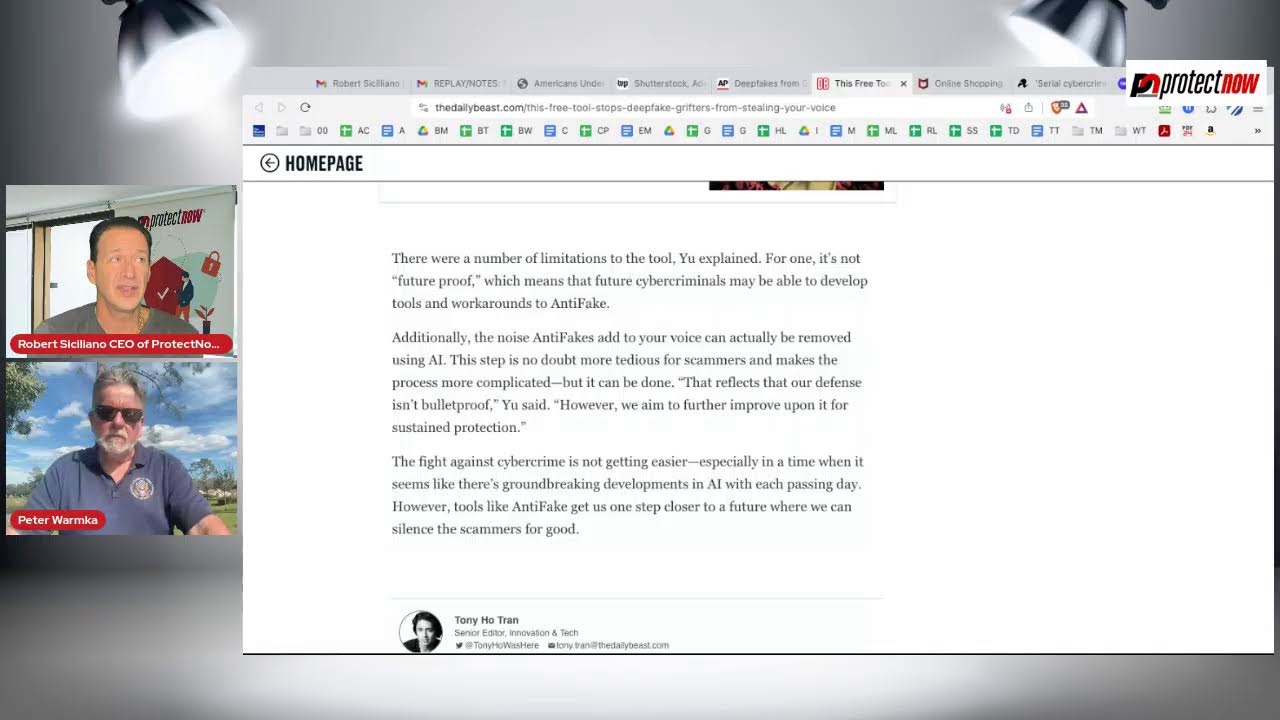
Yeah, right. Uh, all right, so right here, you know, step in the right direction, I guess. This free tool stops deepfake grifters from stealing your voice. An AI technology has prompted surge in scam artists targeting victims by cloning people's voices, which we've seen that we talked about that, I believe, on the last podcast, or at least in some of my webinars. I do know that like there have been, you know, kidnap-type scams where the mom gets a phone call saying, hey, we have your daughter, and you hear the daughter's voice in the background, which basically is being AI-generated. She's screaming for help with her from a mom, you know, from a mom to pay the ransom. A new tool is offering protection, and so it's a nightmare scenario. You receive a phone call from an unknown number, and when you pick it up, it's the voice of your loved one frantically telling you they've been kidnapped. Although your first instinct is to call the police, they tell you that the kidnappers will kill them soon unless you immediately wire large sums of money to a bank account. And there's no time to think. What do you do? So while scary, the person on the other side of the call might not be a loved one at all. In fact, it might even be a person rather than artificial intelligence. Clone your loved one's voice to trick you into sending money. So I mean, it's saying that right now that, uh, there's the— an energy company had as much as a quarter million dollars stolen as a result of AI voice scams. Okay, so what is this saying? They're saying that basically that there are tools of technology that are rolling out. I don't know whether or not they are future-proof Uh, because they're saying it right here that it's not necessarily future-proof, but right now there are options. And we're going to include this particular link in the show notes so you can do a deeper dive yourself. But look, as, as scary as this all is— and we're not all about fear, uncertainty, and doubt, and, you know, crawl under the covers and just freak out and live in a cave in Montana— we want to provide you solutions. And this right here shows that there are solutions out there. Whether or not they are future-proof is another story, as this article plainly admits. I think that it is— it's on us. We can't rely on government to police this, like Peter said, that we do need to know what our options are. We do need to take a step back and not necessarily believe in what you see going forward.
Yeah, I think with this particular product, you will need to download an app to your phone through which most of your communicate— your, uh, voice communications are done anyway, right? So it's an app that's on your phone that you activate and use for every time you, uh, speak on the telephone, uh, which, which, you know, they say— they claim it works. Uh, but now the question is whether people will buy. I mean, I presume it— there'll probably be some sort of— I don't think— I don't think they're going to offer it for free, but they might, you you know, they might have to buy this particular service. And so how many people— first of all, there's not many people that are aware of this problem. Then how many people are going to buy it? It's something that works. I think one of the things that we all should— I mentioned this earlier— is establish that code between family members and friends that you can use. It's not going to cost you anything. And I think having those discussions with your family members during the holiday season, especially Christmas, New Year's, uh, is something that you can automatically, uh, established right now. And I think it's practically foolproof even going forward in the future.
I do think that it's a good idea to have some type of a discussion with your family right now and say, hey, you know, with all this AI stuff and AI-generated voice and AI-generated video and kidnapping scams and everything else, look at, you know, grandma, you know, grandchild, whatever, uh, grandparents scams. Like, let's have this conversation now. So if the phone ever does ring, or if you ever get an email, if you ever get a text message in regards to me or anyone else in distress, don't just automatically react. Pick up the phone, send a text message, make a phone call, like send an email, do what's necessary to get in touch with whoever to make sure that everybody is okay going forward. You cannot just automatically trust. And the good news, like we said earlier, is that an entire generation right now under the age of 30 doesn't trust. But we do need to relay that to all other generations at this point. So Peter As we close, what do you got going on? Where you at? What's your website? What's your book?
Well, right now I'm in Orlando, but I'm getting ready to pack my bags and head to Las Vegas, and it's not to play the slot machines. I actually have a course next week. There's about 20 Brazilian magistrates, federal judges, that are coming up from Brazil to take this 4.5-day course. I'm leading most of it. Eu vou falar em português o tempo todo. I'm going to be speaking in Portuguese, so I'm going to have a good time.
I love that.
And beyond that, I'm still putting up my books if you haven't come across them yet. Confessions of a CIA Spy, The Art of Human Hacking, available in English, Spanish, and Portuguese, paperback and Kindle, and even English audio. Could be a great gift for someone coming up. And there's also another book, Why Are You Messing With Me? It's a guide for seniors, how to protect themselves from security— I mean, how to protect themselves from fraud. And other types of scams. And so that's available as well. You might want to consider getting the book for a loved one. And my website, counterintelligence-institute.com. You can also find me on LinkedIn.
Excellent. And as we close out the year, I'm home pretty much for the rest of the month. I'm really— actually, the rest of the year, I'm actually really happy about that. It was a really busy fall. We'll be ramping up things again in early winter. But you can— y'all can see me online at protectnowllc.com. We've got e-learning and distance learning and on-site training, whatever you want. I'm always game. And any last words, Peter?
Just be careful out there, be safe, take care of each other, both physically as well as taking care of what people are consuming on the internet. Make sure that they keep themselves safe.
And as my dad says, be good, behave, and be careful. Talk to you later, buddy. Thanks.
More from Robert

America's #1 Top Cyber Security Speaker Architect of The Strategic Human Firewall™

Robert Siciliano Cyber Security Speaker, Cybersecurity Awareness & Security Appreciation expert.






Nancy Guthrie Deleted doesn’t mean destroyed- FBI recovers 'inaccessible' surveillance video servers


