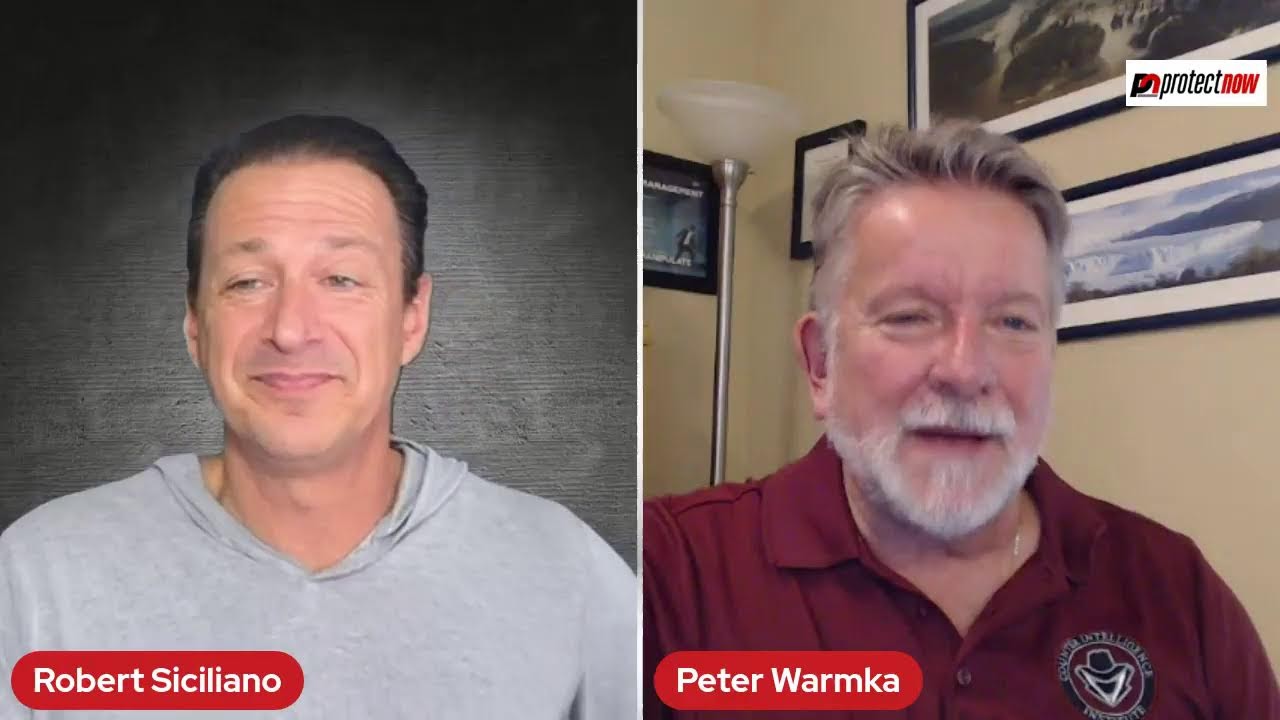
Retired CIA case officer Peter Warmka spent 23 years targeting insider threats. He explains how pretexts and disinformation breach organizations, breaks down the five Ps of persuasion from romance scams to political propaganda, and describes the psychology behind human hacking.
Chapters
Welcome to The Security Guy and CIA Spy. I am Robert Siciliano, and this is Peter Warmka.
Robert, how are you today?
Hey, Peter, I'm doing pretty good. Nice to see you.
Yeah, the end of the week, great.
Those of you who don't know, Peter is an actual, uh, retired CIA spy. Peter, like, uh, for those who are seeing us live on LinkedIn and live on Facebook, live on Twitter, and live on YouTube, uh, tell them a little bit about yourself.
Well, I spent over 23 years as a case officer with the Central Intelligence Agency and almost That entire time, over 20 years I was overseas, I came to be a specialist in how to breach security of organizations. As I did that to collect intelligence, you know, requirements I would receive, and I would breach the security predominantly through the targeting of insiders. So I've turned that around now after retiring to work with organizations, both from the private sector as well as public sector, and because we know that the security breaches are happening all of the time. They're on the increase, and it's across the entire spectrum. It's not only these really big companies that we hear about because that's what makes the press, right? But we got a lot of companies of all sizes. So I work with organizations to help sensitize them regarding the threats and to help them understand that their weakest link, but the most— what should be the strongest part of their defense is going to be their employees. So helping work with their employees to change their mindsets and help them to, to, uh, combat this huge problem of, of human hacking.
So let me ask you, when you were a CIA spy, did you lie?
So, well, the thing is, now do I lie today? If I say I did, did lie or I didn't lie, how would you know? I guess you assume that I'm being truthful. Of course, of course there were times when I had to lie. You know, we, we can have a whole program on, online actually. I'm going to be presenting some presentations regarding how to spot a liar. But yeah, I had to lie to protect my cover at different times because if I were to go out and say, hey, I'm with the CIA, spy, I'm a CIA, and who, who would want to work with me? People are going to say no way, right? So I had to protect that cover. I had to approach them with another pretext, uh, to get them to trust me and, and then eventually work with them. Uh, but yeah, I had to lie. Uh, it was part of the job.
So a pretext is, um, a form of disinformation, correct?
Uh, yes, and to a certain degree it is disinformation, at least regarding the, uh, who, you know, who I generally am And what am I after, right? That's— I'm feeding disinformation to get them to, to trust me, because if I were to give them the real reality, uh, once again, the real truth, let's say, they might not want to, uh, you know, they might be very reluctant to cooperate with me.
Well, that is exactly what we're going to be talking about today. So, uh, here, uh, CNBC, uh, talks, uh, Department of Justice charges 3 Russians with running foreign influence and disinformation network in the US. This was published just this week. So the Department of Justice is charging a high-ranking Russian legislator and 2 of his staffers with running a years-long scheme to influence US officials by peddling disinformation to advance the Kremlin's interests, court documents showed. So essentially, uh, these were likely, you know, Russian legislators who were functioning as spies for the Kremlin. The 3 men worked to undermine America's international alliances, evade US sanctions, and promote Russia's illicit actions designed to destroy the sovereignty of Ukraine, according to an indictment. Their scheme included staged events, paid propaganda, and the recruitment of at least 1 American citizen to do their bidding in unofficial capacities, the indictment alleges.
Yeah, this happens all of the time, and I'm glad they're taking— they've actually taken some action, identified these individuals. Whether or not they were brought to justice, I mean, in U.S. courts is a whole nother thing, right? But at least, at least they're going after some of these people, and that's important.
Yeah, so I wrote an article not too long ago in regards to disinformation, right? Disinformation, fake news, how the weaponization of social media has you conned. And that's partly what, you know, the Russian ambassador or intelligence officer was doing. So this post, it talks about— takes a hard, honest look at what's happening right now. You either get it or you're a victim of what's going on. Victims who read this will trash it and deny the reality of what they read. Denial is warm and comfortable, as I always say. The truth is cold and can hurt, and nobody likes to admit that they're wrong ever. So, you know, I expect plenty of haters if you don't like what you're hearing. So I often say, Peter, and people don't like it when I say it, is that people are much like cattle or sheep. They want to be led. Okay. So when you have a US official that says and does things and people cheer that person on and others say, well, that guy's lying or she's lying and you really shouldn't trust what they're saying because, you know, it's not true. And then people respond, well, maybe it's the media that's lying, maybe it's you that's lying. And so we disagree as to what's the truth and what's not, right?
Well, that's very true. And you know that this is important to distinguish between disinformation and misinformation. Disinformation is that whoever is communicating the information knows that this information is false and they're intentionally disseminating it, putting it out there to deceive and to manipulate the public versus misinformation is when people are continuing to pass on information. It's like someone that might be reading an article on Facebook that is not totally true, not totally correct. They're not realizing it, they believe it's true and they will pass that on, they will share it or they will talk to their friends about what's going on. You know, they heard it, they saw it, and that could be misinformation, but they're not intentionally trying to mislead. They think the information is true, but they're passing it on. So that's, that's a very important distinction between those two types of things. We're talking about specifically disinformation, intentional deception.
You definitely are the expert here. So here's how it's done, right? So many of you may recall back in 2018-19, there was an exposé regarding Cambridge Analytica on behalf of its clients. And Cambridge Analytica was a, company that had essentially access to Facebook's info. You and I, uh, they on behalf of their clients specifically weaponized social media using disinformation to win elections here in the U.S. and overseas. It was first tested in third world countries, uh, when, uh, Brexit, and most recently to win the United States presidential election, as has been documented in a lot of different places. Uh, here's a breakdown of what is believed to be the basis of how it used social influence to change hearts and minds. Goes on to say that company leaders understood that the weaponization of social media is the act of manipulating facts by spreading fake news for propaganda. This act is accomplished by a coordinated effort using viral memes, emotionally charged videos, and clickbait headlines. And I remember when I would post something in opposition of misinformation or disinformation that was being posted by others that I was consuming. And I would respond with and say, hey, this is actually BS. You need to go to this particular source, and this is the actual real information. Because those of you who are regurgitating, repeating, sharing this information, in effect, you are perpetuating a lie, misinformation, disinformation. And when I would do that, my feed would begin to fill up with what was likely Russian bots or humans that were feeding into the lie and telling me that I'm lying. Yeah, telling me that I don't know what I'm talking about and basically like repeating or regurgitating the lie. And I know it was like either— I know it was either bots or it was humans that were working for, say, the disinformation campaign because of the nature of their communications being relatively robotic, copying and pasting information that you'd see elsewhere. Like, it was coordinated opposed to it being one of my friends or followers. You know, and then my friends and followers who I might have been in, say, opposition with, or we might not have been on the same page politically, would then echo the sentiments of the bot. And it would just get ugly. And I'd be like, you know, Barbara, do you realize what you're saying, that you are echoing what is being perpetrated by a Russian bot? Like, think for yourself, you know, go to the source, like look at the actual, you know, source of the information of what's correct versus this right, right, right, right, right-wing propaganda machine that really is designed to, uh, you know, confuse you and others like you to get you to believe things that simply aren't true.
Well, you know, it's, it's interesting, this technique For effective disinformation campaigns, usually it's going to include kernels of truth. All right? There's going to be some real information, accurate information that's put out there to sort of hook the individual because we all tend to believe in things that we all— I mean, to be more accepted, to pay attention more and to accept information that we already sort of, you know, believe in, that we already have, uh, you know, a certain belief in. If you hear something, oh yeah, that I believe in, that I've seen that. And then so you— they will provide a number of kernels of truth, but then with, you know, mixed in with that is going to be their disinformation message. So a person will hear part of it, say, yeah, oh yeah, that's true, I heard that. And then they'll pretty much go with everything that's put in there because they believe it's coming from an accurate source. So it's sort of a— it's an art form, really.
Yeah, it's an art form and it's fundamentally a lie. So here, one of the methodologies, one of the motivations for disinformation, if you don't already know, listening audience, is to divide and conquer. That's the ultimate goal of fake news, misinformation, disinformation. The desired outcome of disinformation by its author, in this case, let's say Russia in regards to the Ukraine, is to divide and conquer or rule the persons who are manipulated by it. Okay, so for those that are living in Russia right now, they are receiving all kinds of disinformation. The Oxford Dictionary defines divide and conquer as the policy of maintaining control over one's subordinates or subjects by encouraging dissent between them. In other words, from the perspective and motivation of the con man, don't trust them, trust me. So in the case of the Russian propaganda machine that's being perpetrated overseas in Russia, even in the Ukraine, and definitely here in the United States, you've got the Kremlin saying, hey, don't trust them, trust me. You know, divide, right? And even here in America, where you have, uh, the left, you have the right, you have Republicans, you have Democrats, the goal of a disinformation campaign perpetrated by Russia is don't trust Republicans, trust Democrats. Don't touch— don't trust Democrats, trust Republicans, to divide us as a society so that we don't trust each other. And that's their point and purpose. That's what they want. They want us to not like each other. They want us to never find common ground. They want to separate us so that instead of being one, we are divided in half.
Very, very true as a nation. But even though it's sort of interesting because the Russians— Russians are not the only ones that, that do this, but they're sort of the ones that have been in this game for the longest period of time and been very effective. There is a book I think I mentioned on the previous show, uh, Robert, but I want to also mention it again today because we're specifically talking about disinformation. Uh, the book is called Active Measures: The Secret History of Disinformation and Political Warfare, written by Thomas Rid. Really, really, really, for anyone interested in the topic, I highly recommend it because it goes back and analyzing when the KGB established a special directorate to focus specifically on what we call disinformation, but also referred to as active measures. And it was very much focused at that particular time on how to sow division between the United States and its allies, Western Germany, France, and other allies to basically try to weaken the allies and then eventually try to weaken NATO, right? Try to weaken the NATO states, the relationship. And they continued to do that. So they've been at it for a long time. And there's, in this book and other publications, there's a lot of case studies that really get into detail about how this is, how they have been doing it, which is pretty relevant today. And you're mentioning how try to divide the society. And yeah, we've seen a lot of this over the last couple of years in the United States in a variety of topics, right? Topic of Black Lives Matter, topic of COVID And you see, you see the two sides, and it's like, wow, it's almost like a civil war on how people come down on, on, on two or three sides of an issue. And a lot of that, of course, they're not behind, they're not causing, you know, this per se, but they are aggravating, they're using it, they're manipulating it. These are just, you know, topics that they can really leverage and, and be able to disseminate information, whether it's through their own sources or assets— individuals who already have a listening audience, who have— who write for major articles, who have maybe— who have podcasts, okay, or who, uh, have, you know, blogs on Facebook. They will have individuals on their payroll who will be actually working to conduct these type of things.
Yeah, like Tucker Carlson. Hey, I'm just kidding, right?
Okay, right.
So disinformation, also known as desinformation— disinformation fundamentally is lying. Fake news used to be spread by the spoken word only, but with the invention of the printed word and the press, disinformation was spread using pamphlets, leaflets, books, magazines, political cartoons implanted in clandestine newspaper articles. Agents of influence, political spies, like you had mentioned journalists, can all be used to spread disinformation. As you, the expert, said, digitally, social media spreads fake news like the proverbial wildfire, which is a huge problem and leverage for the bad guy. In this case, you know, Cambridge Analytica, the Kremlin, and so forth. The birth of the word disinformation comes from the Russian word desinformatsiya. Right. Desinformation. Joseph Stalin coined the term in 1923, derived from the title of the KGB black propaganda special disinformation office department. Disinformation was formally defined in the Great Soviet Encyclopedia in 1952 as false information with the attention to deceive the public. Disinformation, the Russians created it. They built it. It was born of their intellect, and they are the best at it. And it now has been perfected through science, through companies like Cambridge Analytica, and it is being used to influence us via social media all day, every day. And from my perspective, you are either sheep or cattle being led, or you are questioning what you are reading, and you are finding out what is real and what is fake. Or again, you're just a victim of it. And people who are a victim of it often will deny that they are a victim of it, that they just want to believe that this person who is spouting all of this BS is in fact legit, because they want to believe in that person. Their heart of hearts want to believe in that individual. Like right now, Millions and millions and millions of people in Russia want to believe that Putin is a good guy. They want to believe that. They don't want to believe that the guy that is in charge of their country is indiscriminately killing women and children who are waiting for the train. They don't want to believe that. So the moment that you tell them that What Putin is telling you is a lie, they will yell and scream at you because they don't want to believe that, because it's too difficult for them to believe that their guy Putin is a bad guy. They want to believe he's a good guy. So they would prefer to believe the disinformation than the truth.
It's a little bit more difficult for them, in all fairness, though, for the Russian public to really try to make an informed decision about events, right? Because here, you know, in the Western world, United States, we have freedom, you know, freedom of press. We have a— we mean, we can get into discussion about different types of censorship, but for the most part, it's a pretty free society in regard to sharing of information of all, you know, opinions. But right now, in Russia, of course, a lot of the information they receive is censored, you know, because they live in that authoritarian society where a lot of the information is basically— they don't have— they don't necessarily have access, ready access to it, that compared to what we would have at all.
Like, they don't have, um, Wall Street Journal, New York Times, they don't have USA Today. And even those publications lean a little bit left, lean a little bit right, a little bit of left to center, a little bit of right of center. And then you have all your left-leaning and right-leaning, and— but they don't even have that. They have, you know, government-issued information, that, that, and that's it. They block Facebook, they block LinkedIn, they block social media entirely. They— and the only way that their citizens can actually get legit information from other countries is by using a VPN, a virtual private network, that allows them to, um access IP addresses or change their IP address to look like it's coming from, say, you know, Italy or Poland or wherever, uh, that will allow or facilitate access to news beyond their borders.
I mean, we heard stories right in the, in the news about, uh, family members, you know, for example, people in Ukraine getting, getting telephone calls from relatives in Russia. And when their family in Ukraine is telling this is what's happening, their family in Russia doesn't want to accept it. They don't want to— they can't imagine that's happening. That's not what they're seeing in their trust— through their trusted media sources, right?
Yeah. So the 5 Ps of persuasion, and my guess is, Peter, that, you know, being a former CIA agent, that you have engaged in a lot of these processes, and I'm sure that you teach it as well, or at least in such a sense that so your audiences understand what to look out for. Because I do the same thing regarding social engineering. Every time an email comes in, every time the phone rings, every time you get a text message, that you have to pay attention to what it is that you're consuming and what you're clicking and what you're doing and how it might affect your identity or your client data and so forth. So the 5 Ps of persuasion are, you know, uh, psychographics, right? Uh, this is the study of people based on their aspirations, attitudes, and other criteria, and it is especially the case in market research. Uh, the study of psychographics is a methodology that is used to describe a person based on their psychological attributes. This method has been applied to studying values, attitudes, personality, opinions, lifestyles, and interests. And we saw a lot of that in the Cambridge Analytica, um, scam, where they would basically determine if you are, uh, Republican, Democrat, left, right, pro-abortion, anti-abortion, pro-gun, anti-gun. And so forth. And they would serve up or feed you information based on your preferences, and they would then counter that information, get you all upset. Um, they, you know, they would, they would send people information regarding— if you, if you were like a hardline, you know, on the right, they would send you information against BLM, uh, that would upset you. So you'd be against BLM and so on. Psychological operations, psyops, are used to convey certain pieces of indicators and information to an audience to influence their motives, objective reasoning, and emotions. It can ultimately affect the behavior of organizations, governments, and individuals. Not much different than psychographics, but parallel. Psychological warfare, right, which is, you know, a little bit of gaslighting as well, right? Uh, the act of psychological warfare is planned use of threats, propaganda, and other non-combat techniques during the danger of war, or even during a war. I can also apply to any time of political unrest to demoralize, intimidate, influence the behavior or thinking of the enemy. And where we're seeing psychological warfare today is also in, um, artificial intelligence leading to deepfakes.
Yeah, that's a growing topic and it's just starting. It's just starting, but it's going to really, really— as the technology advances, it's an incredible tool for good and for evil, really.
So propaganda ultimately is defined as the information that has no objectivity and is used to influence a specific audience or to further an agenda. This is often done by presenting selective facts to encourage a particular perception or synthesis or by using loaded language to create an emotional instead of a rational response to the given information. And that, uh, emotional response opposed to rational, that is all of social media today.
It seems to be, yeah, right?
And look at, you know, all of fraud is designed to elicit an emotional response.
Right?
I mean, people aren't engaging rationally when they are, you know, providing all their sensitive information to a scammer who sends off an email. They're engaging emotionally because they don't want to get in trouble, or they think that it's going to benefit them in some way. Or, or when they get involved in a romance scam, they're not doing it because they're rational. They're doing it because they feel a sense of what they think is love, but really it's an— it's It's wanting and needing and belongingness, and it's all emotional, right? It's passion. And so disinformation, misinformation, all ultimately is to elicit an emotional response.
Yeah, you're absolutely right with the, uh, the passion, especially with these romance scams, right? Because you see so many cases where, oh man, I'm hearing about this every day, you know, and from people from all levels of society to even corporate executives, individuals that, you know, have started companies and are worth millions of dollars, and all of a sudden they get caught up in a romance scam and, uh, they, and they believe that person. And even if, you know, you, you— sometimes we get a call recently from a son of one of these executives who got sucked into this, and, and he's just really concerned. He just sees this, this guy just spending all kinds of money, and he's trying to rationalize with his father, but his father doesn't want to hear any of it because The father doesn't, you know, he is absolutely sure that, that this is all legitimate and he's in love. And you're right, it's the passion, and, and they don't rational— they don't— it's hard to rationalize with them.
And, and he, and he does not want to think that the person who he has this relationship with virtually is in fact, you know, some guy wearing sandals in a hut in Ghana. Nobody wants to think that they have— they've been scammed. Nobody wants to be called a victim. Nobody wants to, you know, consider themselves being vulnerable, right?
Right, right.
And, and, and then so they dig their heels in and they take an even harder line stance, uh, and they, they, they, they will argue their position, which doesn't really solve anybody's problem, uh, it ultimately causes, you know, more of a divide, and ultimately it leads to, you know, people just fighting and arguing and yelling at each other. Whereas if you just kind of step back and say, well, maybe I am wrong, maybe I, you know, didn't make the right choice, maybe I didn't consume the right amount of information or the right information, maybe I, you know, need to look at a different perspective here because maybe whoever's trying to tell me something might have a, you know, a valid point, and maybe I should think about it and listen to it. Yeah, and it's that, like, accessing your vulnerability, your own vulnerability, which I, which I am, I am of the belief myself that as far as I am concerned, that there isn't a day that goes by that I personally do not learn something, that I do not find that, oh, I did not know that. Like, every day I find that, oh, I did not know that. Oh, that is new to me. Oh, I am 53 years old, I'm just figuring this out now. And, and I think that the moment that you in your life say, I know everything, that I'm pretty sure that I've got this whole thing figured out, that life, it makes total sense to me, and I've got my opinions all wrapped up, and there's nothing you could tell me that I don't already know— I think the moment that you think you know everything, that you know nothing.
You're so vulnerable. That is a, that is a huge vulnerability to think, oh, it's huge. You know what I think, uh, we need to see more of, you know, and there's been— there's thousands, hundreds of thousands, millions of people that have been burnt through romance scams or other types of cons, right? And many times they don't really want to come out and talk about it because they're— they feel really embarrassed, right? Or you, you know, you deal a lot with identity people that have suffered from identity theft, and you know there's millions of people but a lot of them don't like to talk about how some of their actions actually led them down that path or allowed it to happen. But I think how we can really help each other— I mean, Robert, I mean, we can talk about this all the time and other people that are kind of like experts in the industry, but when people hear testimonials of, of people in their family or their neighbors or their friends or other people, testimonials of this is what happened to me and this is why it happened to me, This is how it really devastated me, and this is how I had to, you know, this is all the things I had to do to recover from it. I think we, if we were to hear more of those stories from the public, and maybe in the future getting some of our listeners to be able to come in and share some of their stories in regard, would be really valuable to our listeners.
Agreed. So Peter, uh, what do you got going on these days? What do you want to promote? What do you want our, uh, listeners, uh, viewers to, uh, head to?
I always, every time you give me an opportunity, I like to promote my, my book. Uh, this, this actually goes into great detail about human hacking because it talks about, from my perspective of being a former, uh, spy, and how I breached security and how this is completely relevant to, uh, human hacking today. So I promote that. I give a lot of presentations. I, I have training specifically geared toward, uh, organizations that want to want to learn more about this and companies. So I'm out on the road doing quite a few presentations now, and I'm getting queries for more. I'd be happy to entertain— just send me an email at— go to my website, counterintelligence-institute.com, for more information, and just send me off an email with a query. I'd be happy to engage with anybody interested in the topic.
Yeah, Peter is the real deal. He actually goes to Langley and does presentations. So he is the real deal. Yeah, uh, I am at protectnowllc.com. So me and my team, protectnowllc.com. Uh, Peter, I think I told you last time we spoke, we sent out like a dozen contracts in the past couple of weeks. Uh, organizations, associations, corporations are getting back to meetings and, uh, bringing in security awareness trainers, and that's me. Uh, so yeah, you know, check us out at protectnowllc.com. We also have like a dozen hours of e-learning that your organization can consume. That would be under one of the tabs for cybersecurity training. So that's protectnowllc.com. And Peter, last words?
Hey, good luck with the marathon. You are getting ready, right?
I am, yes. Yeah, this is my 11th, so yeah.
Fantastic. Congratulations. Congratulations. And have a happy weekend for those of you that that follow Easter. Happy Easter to the— to our listeners and to you, Robert. Um, okay, stay safe out there and be nice to each other.
Thank you, Peter.
Yeah, take care. Till next time.
More from Robert

America's #1 Top Cyber Security Speaker Architect of The Strategic Human Firewall™

Robert Siciliano Cyber Security Speaker, Cybersecurity Awareness & Security Appreciation expert.






Nancy Guthrie Deleted doesn’t mean destroyed- FBI recovers 'inaccessible' surveillance video servers


