Robert Siciliano and Peter Wormka discuss New York's SAFE KIDS Act restricting addictive social-media features for minors, the mental-health toll of violent content on children, and how retailers are fighting organized smash-and-grab robberies with drones and reinforced glass.
Chapters
Good.
And welcome to the Security Guy and CIA Spy Pod broadcast. I am Robert Siciliano, and this is Peter Wormka.
Hi Robert, how are you doing?
Hey buddy, uh, I'm doing all right. Hey, I got a question for you. Does my voice and everything sound good to you? Like any static or anything?
There's like a little bit of, uh, background noise. I don't really want to call it like, uh, yeah, like, like, like when you put on— maybe if you want to turn on the airplane and you don't want to hear anything and you put this background noise in it that's kind of like low hum, like, oh, like like a low hum, like a white noise. Yeah.
All right. And if anybody out there in the podcast broadcast sphere hears any crackling or anything that you don't like, just let us know in the comment section. We appreciate that. All right, y'all. So listen, what's going on in the world today is that chaos and disruption and confusion and murders and all kinds of stuff that, you know, makes us all upset on a regular basis, right? Absolutely. Is, uh, none of it is good. I mean, I mean, of course there is good, there is good, plenty of good, but there is like a lot of stuff that's like too much, right? And, um, that too much is, um, affecting us and our psyche and our well-being and our general overall, you know, uh, peace and balance, right? Not happy about any of it. That said, You know, New York put together the Safe Kids Act to restrict addictive social media and to protect kids online, right? And, you know, if you've been paying any attention in the past, what, 10 years, kids are just like all bringing their phones to school, kids' phones 24 hours a day. And, you know, it's just— it's causing problems. And the studies are now coming out that say, yeah, this isn't good for the kids. And yeah, we're going to restrict phones in schools. And it's about time that they did that. And we are way overdue in regards to restricting kids' access to social media as much as they have. You know, I didn't give my kids their phones until they were 14, for obvious reasons. And when they finally got them, you know, I started to see changes in their behavior, more with one kid than the other. And, you know, right here, the SAFE KIDS Act is designed to essentially, like, let social media sites know that they've got to properly identify and authenticate children in order to allow them to be online. And I think, like, what's going to happen is the reverse. I think us adults at some level might need to be identified, authenticated, if the social media companies use some type of a biometrics technology that would essentially look at them and recognize that they are underage, let's say, some type of a marker that says that. And then from there, they would require identification for children if they said, okay, you look too young to us, is what I'm thinking. Peter, what are your thoughts on all this?
No, I agree. But I think, I think a big problem is it's not so much The concern, well, the concern is there for the younger adult, for the youngsters, but the problem are the adults really when it comes to a lot of this too. When it takes the parents also to participate in this type of program for it to be successful. And if the parents just say, well, I don't agree with this, I'll let my kid have the free use of the cell phone. I mean, it's only going to have half the effectiveness. That it maybe really should, just because the parents are, are going to allow their kids to have unrestricted access. Yeah, be able to bypass some of these controls.
Yeah, not good. Um, you know, the, the article talks about how children and teenagers are struggling— this is a press release— with high rates of anxiety and depression because of addictive features on social media platforms. Um, you know, like, that's, that's the reality of it. And, uh, when you see, you know, suicides rates skyrocketing You know, and parents like throw their hands up in the air saying that my kid knows more about technology than I do. There's a serious disconnect going on here. And I see it with parents struggling with their kids all the time. And, you know, they— I get a message from a friend who says, hey, what software should I install on my 10-year-old's iPad to monitor what they do and restrict their access? My response to that parent is, what is your 10-year-old doing on iPad?
Who gave it to him?
But why does your 10-year-old have an iPad? I mean, and I asked him back up, did you have an iPad when you were a kid? Well, the technology is so great and they love it. And it's like, well, yeah, but you know, it's messing with them in ways in which that we're not really grasping. It's just too much. It's a babysitter to a lot of parents.
That's what it is.
And a lot of— and kids aren't doing what they could or should be doing, like outside. And like, there's a— there's a— yeah, there are all kinds of good things too. Like, you know, there are certain things that, uh, you know, language apps, and there's a number of other things, a number of benefits to it, of course. But they're on devices enough during the day at school, I think. And give them maybe like an hour at night, if that, but in your presence, and be done with it. And then at 14, the game changes a little bit. But even at 14, they should have enough homework to do that they're just, you know, in front of screens for the homework aspect of things. And they shouldn't be on all kinds of crazy social Snapchat, Facebook, you know, Facebook, Twitter, whatever it is, you know, Instagram, TikTok, whatever, like for 5, 6 hours a day. Like, it just is— it's too much. This isn't a technology problem. It's a parenting problem.
And with a lot of these technologies, I suppose the parents will be allowed to opt out of these type of controls, right? So that's, you know, it's gonna— a lot of it kind of come to be important in the whole process here is the awareness, bringing these parents aware more detailed about what are the harmful effects and what their role as parents are in ensuring that this, this can properly be implemented. And then on the other side of the coin though, you know, you got platforms that are going to say, okay, we're going to be held responsible— liable, uh, responsible to ensure that these controls are put in place, but it's going to have to be backed up with penalties. And I think there's some mention of potential penalties up to $5,000 per civil offense in regard to this. I mean, which can, can run up to be substantial if that actually is enforced.
Yeah, it says, um, uh, uh, requires social media companies to restrict algorithmically personalized feeds or addictive feeds, uh, and nighttime notifications for users under the age of 18 unless parental consent is granted. Addictive feeds and nighttime notifications are tied to depression, anxiety, eating and sleeping disorders, and other mental health issues children and teens. Uh, the proposed rules released today explain which companies must comply with the law and outlines standards to determine users' age and obtain parental consent. The public comment period, uh, is proposed rules for 60 days. You know, I would love to see this actually work. I would love it. It'd be the best thing.
Well, yeah, but it should be the— it should be at the federal level, really.
Yeah, yeah. Well, that, that states I mean, so, so keeping things like data breach notification laws in mind, when you say, when you say that, Peter, that breach, that breach notification laws came into fruition, like as a result of ChoicePoint back in 2004 and '05 being breached in California, being one of the only countries, one of the only states in the country to have data breach notification laws in place. Right, right. And so now all 50 attorneys generals across the country have data breach notification laws in place. Further, I think Graham Leach-Bliley says something in that regard, too, which is federal. I could be wrong on that. But, you know, it's happening across the country, right? When the ChoicePoint breach happened, California was one of the only states in the union that point notified as a result of that breach because that was the only state that they had to, you know. Now, like, that's— and they became the poster child for what not to do with the data breach. Okay. Now, since that time, you know, things have changed significantly. There's a lot more, I guess, understanding of risk state to state and on the federal level. And I would— I And California, New York, and Massachusetts, from my experience, are the three states that are generally ahead on most laws revolving around security, technology, digital literacy, social risk in general. I see this as a good thing that New York is running with it.
No, I agree. And if successful, I mean, it will— you'll see other states falling in line.
If successful. Yeah, and, um, let's, let's, let's hope for that, you know. And parents, let's hope for that. All right, so all that being said, right, uh, this is also, uh, you know, uh, about social media reduced two horrific killings to cheap snuff films, via the New York Times. First, it was the nightmarish stabbing of um, Irina, uh, Zarutskaya, a 23-year-old Ukrainian refugee on the, um, train in, I believe it was North Carolina. And then Charlie Kirk's, uh, assassination, uh, shooting, uh, with his, you know, neck exploding and blood just gushing out. I mean, it was awful. And when that happened, um, you know, we all got access to that video pretty quickly. Frankly, I sought it out, you know, and I got a message from my daughter who's 16 not too long afterwards, which was to me a little shocking because, you know, I remember being a kid and the only access that I remember having to that violent of content started with the JFK shooting in Dallas. And we saw that grainy footage. But even that, even that footage, I don't recall— I personally don't recall there being blood. I just recall the physical action of him getting shot and his body being hit by it, his physical reaction to it, and his wife climbing, um, on the back. And that's what I— that's how I remember it. And I've probably seen it, I'm guessing, 20, 30 times easy, you know. And now— and then later on in the mid to late '90s with VHS, um, even maybe even earlier than that, the, the film Faces of Death and then a lot of footage like that with access to the internet via dial-up in the mid-'90s. But as a child, child under the age of 18, never really saw anything like that. My daughter calling me with that, "Hey, I saw this," and her reaction to it for me was a bit overwhelming.
Well, it can be traumatic actually seeing those videos, that level of detail. It can be— that can stay with you forever, really. To think of a kid that sees something like that, especially.
Yeah. The columnist in The Times says, you know, the, the naissant stages of social— she was an optimist about unfiltered imagery. You know, she said, as others did, that unfiltered images from the news events might make people more empathetic towards victims of natural disasters, repression, or systemic violence. She also hoped that raw reality from conflict zones would challenge the sanitized cinematic version of war that too many people held, uh, or might force them to care about conflicts they were otherwise happy to ignore. But that's not what happened. Uh, today there are far more cameras than ever. We're drowning in videos documenting the last breaths of victims after victim. But instead of making us almost sensitive to the horrors of that of our fellow humans' experiences. Instead of functioning as tools of understanding, graphic images turn into something closer to viral snuff films, and they are endlessly replayed, reducing tragedy to voyeuristic content, and they dehumanize not just the victim but all of us.
It's sort of— I mean, there's a two-pronged thing here. First of all, why do major news networks, they will edit out portions of the video that they think are too graphic, or, and/or they will provide you an advisory in advance saying, no, we're going to be showing this, you may want to, you know, not want— you know, you have the option knowing that something really graphic might be shown, and they're warning you, and, and, uh, so they're trying to protect you from seeing something that might, you know, you might not want to see. You know that in advance. Also though, hey Robert, I'm thinking about— you don't hear too much about this right now, but I would think one of the first things that pops in my head that so many of these incidents, you want to say the majority of them, are by younger males for the most part. And it's sort of a generation that is— that's grown up with gaming. You know, a lot of this gaming is actually very, you know, it's showing combat and it can be very graphic. And it just brings to my mind a question: is growing up and playing these particular games every single day in some ways desensitizing individuals when it comes to being able just to, you know, just take a gun and just start shooting around? It's like, you know, lowering the value or lowering the sensitivity that, hey, this is, you know, in the real world, these are real people. This is not a game. I don't know.
So I, um, hear me out, right? So JFK mentioned that over the past couple of weeks. Uh, is it JFK? Yeah. Uh, RFK. RFK. RFK. Yeah, RFK mentioned that in the last couple weeks. And, um, that, uh, I guess, um, observation has been around for right post-Columbine. And when, um, as a result of, you know, teenagers post-Columbine shooting up a school, murdering their fellow classmates, and then has been part of the dialogue after school shootings for quite some time. And I would say yes, there is a correlation.
There.
I don't know that there's a correlation there that it is like in any way, shape, or form epidemic proportions because the amount of kids or adults for that matter that are consuming video games and the amount of shootings that are happening, I don't know that the, I don't know that like statistically like if there's, let's just say there's 20 million people playing video games on a regular basis, and there's 1, 2 school shootings per year. I think that, like, you know, that's, that's statistically, like, that's like a lot of people watching video games and not a lot of shootings. Not that any of them are okay. My point is that without a doubt there's people out there that are affected by it and desensitized to it and act on it. We as human beings, as you know, become what we think about. We become what we think about. So if you're being bombarded by advertising and imagery that, you know, is designed to make you buy something, you are likely to make that purchase as a result of that, right? If you are consuming and doom-scrolling all kinds of types of information on a regular basis, it's making you upset, or that's making you, you know, think left-wing, or that's making you think right-wing, you are apt to be upset or think more left-wing and think more right-wing. And so on. And without a doubt, you know, consuming violent imagery on a regular basis is going to have an effect on you. Is it going to make you act out? I would bet yes, certain people that maybe their minds are, I guess, more influenced and/or unhealthy. Yeah, of course.
But you said it's not on a massive scale that if it was a causational, maybe it's just like an added It's an added potential influencer, but it's not necessarily the cause. I mean, because otherwise there'd be a lot more people that would be perhaps doing such thing if these were a major contributor to their—
I would say causational is the key word there. Is it causational? I don't know that it is at— because of the— because of how many people play games. But there's definitely those out there that look at copycat crimes are, you know, that there's some causational causation going on there. Copycat crimes. We become what we think about. Somebody does it, it makes it okay for me to do it too, because I've been thinking about it to begin with. Therefore, now it just happened.
Oh, right.
Roof. Let's do it. You know, uh, that's it. That's 3 in, in the past couple of weeks right now, you know, uh, 3 shootings from roofs in the past couple of weeks. Was it— is it 2 or 3? 2. 2. Yeah.
Oh, we had the shooting, uh, just that happened yesterday, right?
Yeah, that's 2 in the last week, you know, riding on the bullets, the whole thing, right?
So No doubt that this problem is getting more serious. I mean, if you look at what's happened over the last year, right, it's definitely— we're, we're on the upward trend here. And with, uh, unfortunately, I don't see much hope in sight that this is going to get significantly better.
You know what I'd like to see? I would like to see the, uh, current administration lower the temperature a little bit. Yeah, call for, call for calm, call for you know, call for a little, uh, uh, you know, lowering of the, of the, um, the anger that's going on, you know. But I don't see that happening because I don't really think that the administration cares that much in that regard.
I don't know. Yeah, yeah, we haven't seen— I mean, this has been going on for that, you know, going on for some time with, yeah, having a lot of, uh, you know, the heat being turned up more than, than actually being turned down.
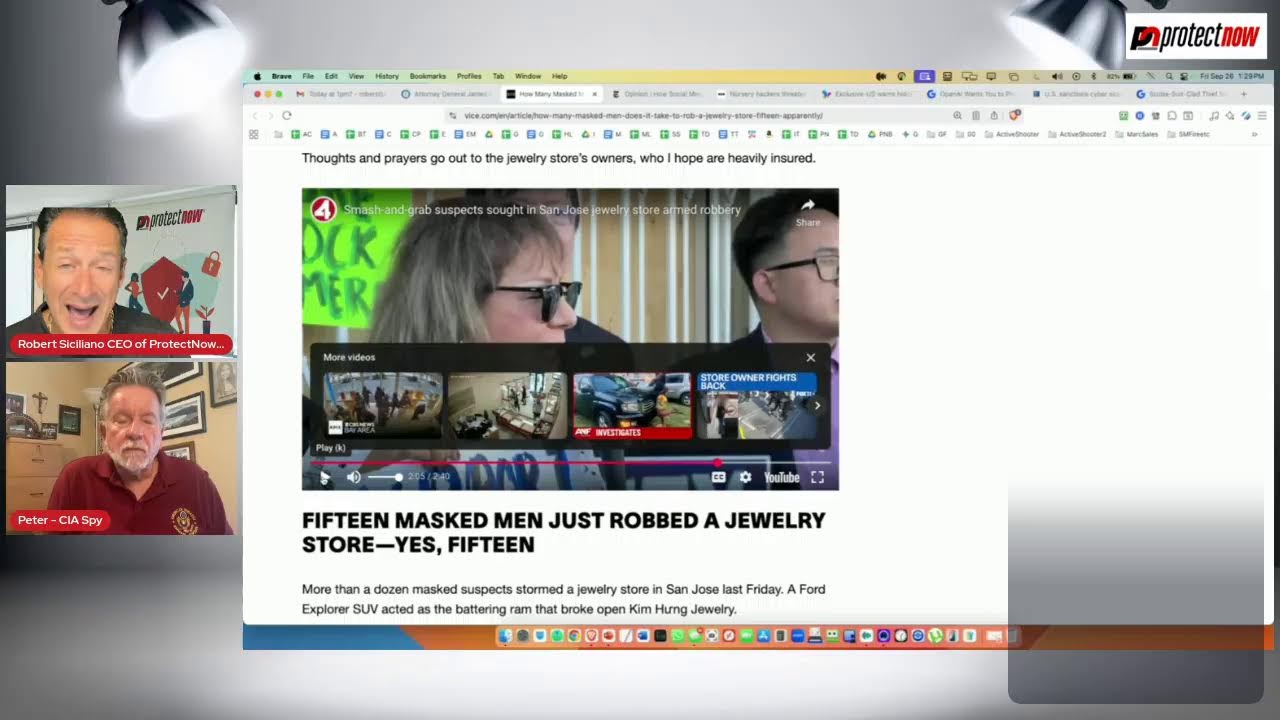
Unfortunately, it's kind of a continual So I think, I think, like, for anybody who's paying any attention, like, if you want the temperature to go down, then, like, maybe, like, in your own life, like, just talk to the people you know. And, you know, in that regard, to kind of, you know, bring it down a little bit. Yeah. And speaking of, you know, high temperatures, how many masked men does it take to rob a jewelry store? 15, apparently. And this happened in New York— not New York, California. And this is the second one.
Oh, I'm not hearing any audio.
Okay, yeah, yeah, yeah.
But you— it's clear though, it's clear what's happening. So it's basically a team of 15 people that arrived with— I mean, they have a number of cars that, that were staged there, and then one of the main vehicles backing in to the storefront and then running in and basically just starting to crash, smash and grab, and even throwing the owner of the store on the floor. And I guess he even— he suffered a stroke as a result of this incident.
Yeah. So for those of you who are just listening, we had no audio. For those of you who are viewing, obviously you had some video. Thank you for that, Peter. You know, this is the second time it's happened in California in the past couple of weeks. And obviously, you know, these kids know what they're doing and they're successful at it. And the stores who are affected by it, you know, they're only now beginning to put technology in place to to, to, to, to, I guess, uh, mitigate the risk. Now, the second one that I saw this week, uh, the, um, storefront was such that it, um, that they didn't break in with their vehicles. They actually ran in through. And when they actually ran, when they came in and the door closed behind them, it locked. Yeah, it locked and it wouldn't let them out. And, and when they were smashing and grabbing through the jewelry cases, they had glass that didn't just shatter. It had like a form of film on the inside of it. And so as they were puncturing the glass, it wasn't just shattering so they, so they could reach their hand in and grab all kinds of stuff. It, it made it hard for them to get their hand in and get their hand out. And when it came time for them to leave, without getting as much jewelry as they, you know, would have otherwise. The door was locked, and you actually saw bullets shattering the glass. They were shooting through the glass of the door or the windows. Yeah, yeah. So like, I mean, none of it is any good, obviously. But, you know, there's technology in place that assists in reducing risk to a higher degree. And I think, and, and this particular, I guess, uh, strip mall, they had a, um, a technology, uh, running that had a drone that when the alarms went off, the drone kicked in and the drone was filming, uh, the break-in. It filmed all the cars, it filmed the break-in, and it filmed where the cars went. So, um, that drone, I think you're gonna see in a lot more places going forward. Uh, I think Amazon actually had a— sells that technology too. Uh, so that's actually a good thing. And I think that the more, uh, retail environments adopt that form of technology, the, the less likely this particular crime is going to be.
But also, another question is, how— what, what are the, uh, what are the penalties? I mean, these individuals, is it worth— is is it worth getting caught anyway? I mean, how are they going to be prosecuted? I think it's a jail time. How long is that, you know, how many months of jail time? Yeah, you don't have the, you know, if you don't have the penalties in place that are significant.
And I, and I don't know, I don't know where California is at in that regard. I do think that they have changed things a little bit. I do think that there needs to be, um, much, much, much, much stiffer penalties because these are violent, violent crimes. And, uh, the, the— it's, it's not about what they steal, uh, it's more so— it's not about the dollar amount, it should be the— about the violent aspect of it. Um, and, and, and when, when, when, when you have organized mobs with the penchant for violence going in with, uh, bats and crowbars and they're assaulting people and they're breaking glass, I mean, I just think the breaking the glass by itself is considered a violent act. The smashing of the glass with the vehicle is considered, of course, a violent act. And that by itself, it should not be about the dollar amount, it should be about the violent act. And whether they, you know, put their hands on somebody or not, I think, you know, preface that with the violent act of of breaking in to begin with, um, and how they go about it should be the highest penalties of the law.
And then there's also— I mean, they— one thing is stealing everything, and they still got to find somebody to basically— you want to call like reseller, you know, someone that's going to buy the stuff off of them. And, and, you know, and, and have their network of how they sell these high, you know, very expensive, uh, items that probably are not that hard to trace back to the fact that this item that they found, you find for sale, was actually a piece that was stolen from this jewelry store. I don't know.
Yeah. So Peter, uh, where can people find you?
Well, they can find me on the website counterintelligence-institute.com, but more easily on LinkedIn. Peter Wormka on LinkedIn has everything that I'm doing, upcoming, upcoming, uh, conferences that I'm speaking at, events that I've been to, videos that I upload. Probably the easiest place to find me. Okay, yourself, Robert?
Yeah, uh, I am at protectnowllc.com. And, uh, my, uh, September has been nuts. I was on— I was on the road for 5 days this week. October's coming up, which is gonna be pretty busy, but I still have holes in my calendar for, for the rest of the fall. And, uh, there are some availabilities, uh, come this winter. So, you know, y'all check in. Peter, famous last words.
Hey, take care of each other, yourself and each other, because so many things are out there that are happening and so many people really need help, right? And without other people to lend a hand, you know, to be all by yourself and not have any sort of compassion from fellow humans can be quite lonely, quite desperate.
Yes, compassion is good. Empathy, sympathy is good. Talk to you later, brother. Peace out.
Take care.
More from Robert

America's #1 Top Cyber Security Speaker Architect of The Strategic Human Firewall™

Robert Siciliano Cyber Security Speaker, Cybersecurity Awareness & Security Appreciation expert.






Nancy Guthrie Deleted doesn’t mean destroyed- FBI recovers 'inaccessible' surveillance video servers


