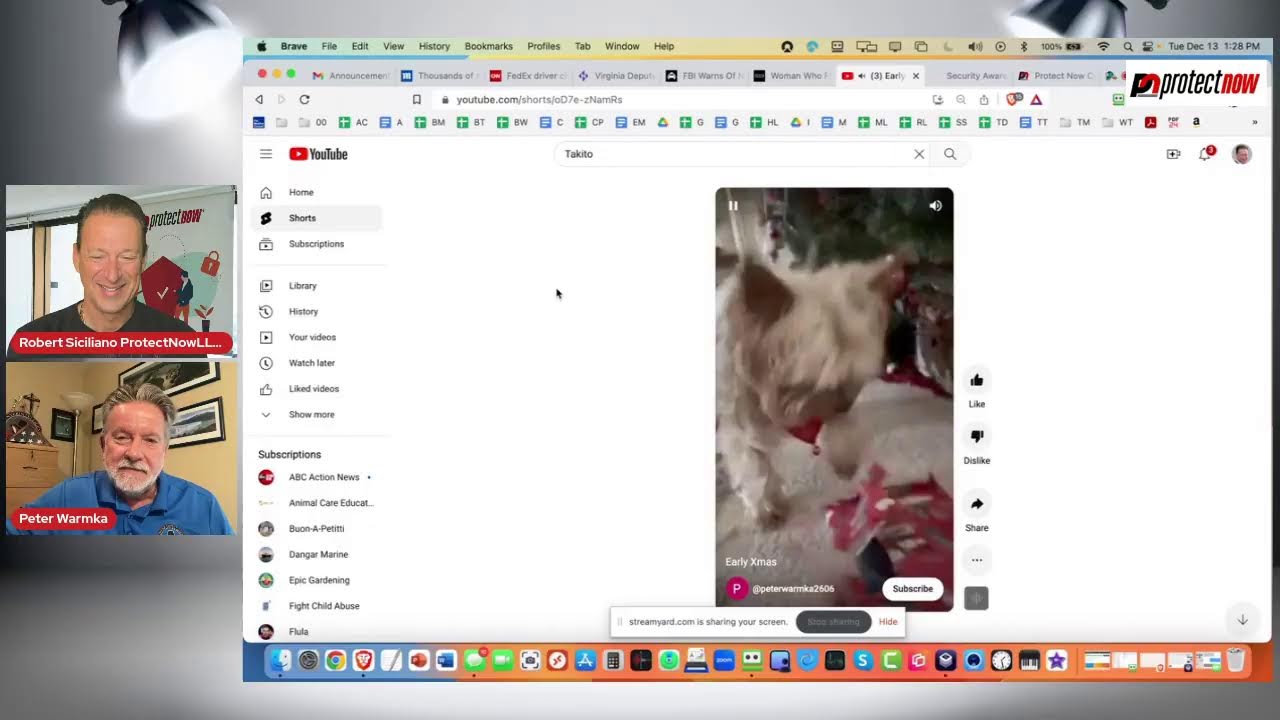
Robert Siciliano and former CIA operative Peter Warmka discuss child safety risks during the holidays. There are 750,000 to 850,000 registered sex offenders nationwide, and a Daily Mail investigation found thousands of convicted offenders in California released after just months. They cover predators in trusted positions, uncomfortable parental conversations about touch, and emerging sextortion scams using deepfake images to extort children.
Chapters
Welcome to The Security Guy and CIA Spy. I am Robert Siciliano, and this is Peter Wormka.
How are you doing, Robert?
Hey, buddy, I'm doing pretty good. Happy holidays to you.
Thank you, likewise. We're in this season again. I thought I just, uh, I thought I just took the Christmas ornaments down, and all of a sudden we're putting it back up. I can't imagine, can't believe how fast this year has gone by.
Yeah, we just took the Halloween stuff down and then the Thanksgiving stuff down, and now we put the Christmas stuff up. And, uh, yeah, it's, uh, it's a whole thing. It's, you know, hey, I got kids, so I have kids in it, so it's, it's a lot of fun. I You know, the, the excitement of children is, um, you know, something to behold. And, uh, unfortunately, yeah, he's happy and healthy and all good.
I don't know about you, but I've noticed in our neighborhood last year, probably only about half of the people put up decorations. It was pretty somber compared to this year. It just seems like the spirit, you know, people wanting to decorate. And I mean, people are more into it this year than last year for some reason.
Yeah, last year people were exa— they were COVID exhausted. This year they're getting out more, they want to, you know, socialize more because they were so, you know, oppressed, I guess. And, uh, so this year, yeah, I'm seeing a lot of Christmas lights, I'm seeing a lot of festive activity going on. So yeah, it's all good. Yeah. So speaking of kids and children, uh, you know, uh, being that the holidays is about getting together and about, you know, love and kindness and, uh and, and kids. Uh, we've just been seeing— both Peter and I have been seeing a lot of news lately in regards to, you know, children and child predators and the security of those kids. And so, you know, we thought it would be a, a time to discuss that, you know. Um, and here, as you can see, Daily Mail, uh, it's frightening for society. Thousands of convicted pedophiles in California are being released from prison in less than a for horrific acts including rape, sodomy, sexual abuse of kids under 14. The Daily Mail Investigates. Okay, look, this is one of those topics that, you know, we would love to say, hey, it can't happen to me, it's not going to happen in my neighborhood, I live in a safe neighborhood. But do you really? I mean, safe is an absolute. Like, there's no such thing as a safe neighborhood. The safer neighborhoods, right? But safe is an absolute— like, if you watch baseball, you're either out or you're safe. It's one or the other. So our goal here is just to bring attention to this stuff so that you understand how to manage risk. You understand that, you know, there's bad guys everywhere, and that's nothing to worry about, but it's definitely something to do something about. Even in my own town if I was to do a search on, you know, the local sex offender app, right, I'd see little red dots of sex offenders living within 2 miles of where I live. And I think that's pretty much everywhere you are in the country. Okay, so what this particular article talks about is an analysis of a California sex offenders database shows thousands of child molesters are being let out of prison after just a few months. Okay, and I'm sure California is not the only state in the nation like that. Uh, the Daily Mail investigation revealed more than 7,000 sex offenders were convicted of lewd and lascivious acts with a child under the age of 14. And this is not unique to California at all. My recent calculations are anywhere from 750,000 to 850,000 registered sex offenders in the U.S. That's like 17,000, you know, sex offenders per state-ish. And that's like, I don't know, 40 or 50 per city or town with the almost 20,000 city or towns we have in the U.S., you know.
You know what's even more scary about this, Robert, if you think about it? We're not talking about necessarily here the majority of sexual predators. I mean, because a lot of them are never really caught or never prosecuted, right? There's so many out there. I mean, you hear about it, even children that maybe have been molested by, by family members, you know, aunts, uncles, or cousins, that those— that comes out, you know, way, way later if it ever comes out. And by that time, you know, they're not convicted as predators. So this is a huge, huge problem. And I fortunately, I never had any direct experience with this, but well, I went to a— I'm not going to say which school it was, but I went to a boarding school, uh, in high school, and I never saw anything. I mean, I never perceived anything. When you're 14 to 18 years old back then, you're not really— people don't talk about that, you're not really aware. But after the fact, several years, decades after I graduated, I found out that a number of my classmates were sexually molested by individuals who were— several of the individuals who ran this school, who were teachers at the school. And I was amazed when I found this out, the fact that how could I have not have noticed something? But I guess I was not sensitized to this issue. People did not talk about it. But I see the impact on these individuals. And it's for life. I mean, it really traumatizes many of them. Uh, some of them— I'm not saying in particular this particular— my classmates, but some of them do go on to become, become predators themselves. Some of them go on to commit suicide. I mean, this is, this is, uh, a really serious problem.
Yeah, it's the real deal. And you could do some searches, uh, on like Psychology Today and other, you know, uh, psychology type trade publications. And the research that I've done is— backing up a second, like, you know, like heterosexual, homosexual, you know, these are generally like adults that have certain preferences towards, you know, the opposite sex or the same sex, right? Well, basically at this point psychologists have deemed, um, pedophilia as an innate, uh, choice, meaning that approximately 3 to 4% of all humans that are born, when they become adults, they choose children as their sexual preference. It's not that difficult to find that stat. And that's unfortunate because that's like 3 to 4% of the world's population are attracted to children. And if you look at everything that's gone on in the Catholic Church over the past, what, 100 years, uh, if you look at what's going on with the Boy Scouts of America, I mean, it's real. It's nothing that we can sweep under the rug like we did 20 years ago. It's out in the open now.
When you see that though, that figure, that's— are that percentage that are attracted to, or people that act upon that attraction.
Excellent observation, Peter. You are a true security professional. Um, that is, uh, those who are, um, consider themselves attracted to children. And not all, uh, those who are attracted to children, who, um, who, who, where pedophilia is innate within them, not all of them act upon that. The majority of them know that it's wrong. Not all of them can stop those sexual urges. Many of them do, unfortunately, which is why we see so many millions of children that are, you know, preyed upon, and adults that get into professions or volunteer activities where they're around kids.
That's where it's so important for parents to have conversations with their kids and talk about this, even if you think, hey, that would never happen to my family, right, Derek? There would always be some, uh, you know, some of these families now are become very fluid where you have people that, you know, get into a relationship, have kids, and, and whether they're married or not, and move on. And then all of a sudden they're with a new person, and that person— those are not the offspring of this new person that moves into the house. So I mean, you get these kind of things at times surface with these next families.
Overwhelmingly it is, you know, men who engage in these activities, whether it is with young boys or young girls. Obviously, we see that it is women who engage in it, but it is a very small percentage compared to men. And, yeah, it is like the new boyfriend, the stepfather. Often it is, you know, the coach of a sporting team. You know, it is, it is, it is, it is a, a, a, a religious, you know, person. It is, you know, the, the, the, the leader of a, you know, volunteer organization where they are catering to children. And it, this certainly not Not all teachers, not all volunteers who work with kids, certainly, like, it's a very small percentage that's engaged in, in these atrocious activities. But parents do need to have these uncomfortable conversations with each other, with other family members, with their kids, as to what is a good and bad touch, what behavior they should be aware of. And then there should always be open dialogue with, you know, parent and child. Look, my kids at this point are 14 and almost 17 tomorrow. Very— I have had numerous and multiple conversations with my kids throughout their development, throughout their ages, as to, you know, when they go over somebody's house, uh, tell me about the big brother, tell me about the father, tell me, tell me who they had over the house, anything weird going on, any inappropriateness, any inappropriate comments or touching. And I would always get to know, you know, whoever is going to be at that house ahead of time, uh, before I would, you know, allow that. Uh, we didn't allow an overnight sleep until my youngest turned, I think, 13, you know. Uh, so these uncomfortable conversations, I think, are fundamental to that child's development and their safety.
Oh, they really, really, really are. Um, and I think so. I think, I mean, I think, I think there's a lot of people that maybe haven't had those conversations Many have, but I think there's still many of the listeners that haven't, and they really should think about it. And even if they are uncomfortable, how— what that one conversation or two conversations, what difference it could make in helping to prevent their children from being, um, you know, um, chosen as a victim.
Yeah. Now check this out. FedEx driver charged in 7-year-old Athena Strand's death delivered her Christmas present before abducting her. Mother said this just happened. This made international news. Obviously, you know, FedEx isn't the bad guy here, although they are in a position to at some level prevent it only if they have knowledge that the driver has a history, a background of that type of behavior. And like you said, Peter, you know, while I, while I alluded to 750,000 to 800,000 registered sex offenders, there's many who have committed these crimes and just simply haven't been caught or prosecuted. And whether or not this particular FedEx driver had been caught or prosecuted, I don't know. I think if he had, that, that would have made national news as well. And I haven't seen a single story that says he was a convicted sex offender.
No, I hadn't seen that either. But, you know, I think it— we don't know what measures FedEx took,. But I think it kind of like, it's, uh, emphasis for a lot of companies who are hiring people that will be out there representing their company to really do, um, a very minimal background check, right? And maybe FedEx did, but those background checks are crucial. Now I think the driver, I think what he said, right, is that he accidentally hit her and, and she died from, or, you know, because of the because of hitting her, and then he kind of like panicked and took her and then disposed of the body. That's, I think, what he said as far as, um, but, but I don't know. I mean, I think there's probably a lot more information regarding the story, but that was his line of, uh, of the events.
Yeah. So what I'm seeing here is, uh, the FedEx driver accused of the kidnapping and killing the 7-year-old delivered Christmas presents, Barbie dolls, before the girl's disappearance. Her mother called for stricter screening policies for delivery drivers at a news conference. And while that is always a good thing and should be done, like for example, I recently have been filling out applications in the state of Florida to provide continuing education for the CSI Protection Certification Program for real estate agents and their clients. You know, CSI Protection, of course, is Cyber Social Identity and Personal Protection. And to work with, you know, California's Board of Realty Regulate— I'm sorry, Florida's Board of Realty Regulation, you need an extensive background check to become a real estate agent or even a provider in some cases, which is a good thing. You know, but that doesn't necessarily mean that a background check is going to provide all of the absolute truth as to that person's character. Okay, that's very important to acknowledge. A background check in many cases can be a false sense of security, although it should be done.
You're absolutely right. And anybody that's done something, there's always been a first-time offender, right? Right. So before that first-time offender, you know, they maybe didn't have necessarily any any information that could have been pulled up in the background, um, screening that would have indicated any concern.
So the suspect identified by authorities as a contract driver for FedEx is a 31-year-old, uh, Tanner Lynn Horner. Uh, he allegedly delivered a package to her father's home and then she disappeared. Like, imagine—
no, I can't.
I mean, that's the definition of the parent's worst nightmare.
Can't imagine. I really can't imagine.
Yeah, so, you know, hey, just keep your kids tight, you know. I mean, you should be able to let them out of your front door to play in the front yard, but it's like, damn, you know. Uh, deputy posed as a teen online to groom girl before killing her family. OMG, Peter. This is via Newsy. The previous one was CNN. Police say a Virginia sheriff's deputy catfished a 15-year-old girl into giving him her personal information. Uh, California. He, he, he asked a teenage girl for nude photos before he drove across the country and killed her mother and grandparents and set fire to their home. This is insane. Austin Lee Edwards, 28, died by suicide during a shootout with a San Bernardino— Virginia to California. Uh, the 15-year-old girl is at Riverside, California, was rescued and is in counseling for trauma. She's never gonna be the same. A resident of North Chesterfield, Virginia, appears to have posed as a teenager online to engage in a romantic relationship with the girl to obtain her personal information by deceiving her with a false identity, known as catfishing.
This is— I mean, this is— I think this is an article, uh, Robert, that parents should share with— instead of saying, oh, this is like so terrible, I don't want to— I don't want my kids to see this. I think actually this is an article that, whether you show the article to them or talk about it, should be shared with your, your teenagers because— or those even be preteens because This is an example, probably an extreme example, but this is an example of you don't necessarily know who's on the other side of that computer screen, and they can tell you anything they want. And look at what can happen in those, in an extreme case. It's terrible.
Yeah, nuts. And when you're dealing with a sociopath, psychopath adult preying upon a child in this case just about half his age, he could say anything to her to get her to trust him. And human beings, by default, we just trust by default. I mean, that's just our inherent nature as an interdependent species. You just have to trust that the person you are communicating with is in fact who they say they are. When I say inherently, because we rely on each other. We rely on each other to function in a civilized society, in a society that requires procreation in order to flourish and exist, you know. And so trust is a default, and you come out of your mama just trusting that she will take care of you and that you will not be abused and so forth. I mean, it's just nature. And here you have a 15-year-old that probably never had like this uncomfortable conversation with her parents as to, hey, you know, you need to be aware that like who you communicate with online, you just don't know if they are who they say they are. And run that by me first, child. You know, like have that dialogue with me, child. Yeah, look it, I'm a 54-year-old to a 14 and a 17-year-old, and I spend time on their devices. I know who they're communicating with, you know. I see their texts, I see their Snap, I see their— they don't do social media, but I see their, you know, WhatsApp and everything else. Like, I know who they're communicating with. I, I, I've intervened when stuff has gone on that, like, I'm not comfortable with because they shouldn't be comfortable with. Because you need to, you need to be involved in your children's digital lives. Like, that digital divide between what's going on in a kid's life and what their parents think they're doing is becoming wider.
Yeah.
So, all right, Peter, uh, and here, uh, FBI warns of new child sextortion scams that use deepfakes. Peter, this one's a bit in your wheelhouse there, right? Deepfakes.
So I'm amazed, uh, Robert, I, I speak about this topic quite frequently, and then when I happen to mention it to somebody who I've just met they, I said, you know what deepfakes are, right? And they shake their head like no, like they've never heard of it before. I'm just amazed by— I mean, there's already a bit of information that's out there talking about the dangers of, I mean, how deepfakes can really be utilized, uh, with detrimental consequences, but so few people are really understanding of it. I guess for the benefit of your listeners, think of deepfakes as a manipulation of synthetic media whereby the likeness of one person— think about the likeness, the face of an individual— is superimposed upon the body of another individual. That can be done via photograph, it can be done via video, there's even deepfake voice cloning. So basically it means that, you know, people are having fun with it, but because maybe they know through the apps that they're using, hey, this is a fake.. But the danger is when someone doesn't know that what the image they're seeing or the video they're seeing has been manipulated. And I think in this particular case, Robert, is when children might begin to have a conversation with that, that extortionist, not knowing that they're, they're in danger. And then the extortionist, instead of asking for, hey, send me a, a picture of you nude or whatever, they don't ask for that. They just ask for a normal picture. And the kid's probably thinking, ah, I can send my picture, you know, there's nothing wrong with my picture. And then that individual manipulates that image, the likeness of the individual's face, and superimposes it upon the body of someone who is, who is, uh, you know, sexually explicit in nature. And then go back to the child and say, listen, I got these images of you, and I am going to, unless you pay me, 'Or you do something for me, I am going to share this with all your friends,' or, you know, 'send it in your family.' And that just— kids don't know what to do at that point, right? Right.
Or adults, for that matter. Uh, so a different sort of sexual predator is prowling the internet to exploit— this is via, um, uh, designtaxi.com— uh, to exploit teens, says the FBI. Overseas scammers are threatening to send explicit images of minors to their friends and family if the victims don't pay up. Only thing, the young subjects were never involved in these graphic scenes. Their faces in realistically— are realistically planted at the pictures of bodies in compromising positions. The FBI, uh, has been on high alert for these sextortion schemes since July. However, it has noticed that the crime spreading to Middle Tennessee, local news outlets report. So this must be in Tennessee. So far, the offending deepfakes are, uh, termed by authorities that the FBI has seen just, uh, are photos. No videos have turned, uh, into the bureau yet. So, uh, Rachel, uh, R. Cohen, intelligence analyst for the FBI, uh, said the perpetrators aren't sexually, uh, gratified by the doctored photos. Instead, there's a ploy for revenue for quick cash.
And they can be easily doing this from anywhere in the world. Doesn't mean that they're necessarily down the street or the other side of the United States. They could be doing this from— I mean, they're— they could be doing this from, uh, Thailand or India or wherever.
So, Peter, I, uh, funny story, have, you know, um, received emails, you know, that ended up either in my inbox and/or in my spam folder. Regarding, um, this exact type of a scam where the email would say, hey, Robert Siciliano, you know, uh, your username and your password is right here. And they would show like an old username and an old password from an old account that was breached, data that they got from the dark web, you know, nothing that I did. And they would say, we have this, you know, sensitive information, uh, about you from a data breach, and we have all of your nude photos from when you were on that webcam, wink wink, right? And, uh, and they say, and we are going to share all of that, uh, all those photos with all your friends and family if you don't pay us up via Bitcoin. And, you know, I see this and I know that it's fraud, obviously, you know, man. I know it's like you know, bad guys trying to get access to me. And I would take that email out of my spam folder and I'd put it in my inbox so that I can share it with my audience, you know, when I speak live. Now, my wife, she, uh, manages a portion of my email because she deals with my clients in some cases.
I can imagine.
My wife sees this email in my inbox and she calls me on the phone. Because I was like out doing something. She's like, um, I'm looking at an email in your inbox regarding you and webcam and naked pictures. Um, is there anything that you need to tell me? I'm like, oh no, no, that's— no, no, no, no, no, no, that, that, that was a, a, a scam. Like, it's a scam. Are you sure it's a scam? I'm like, honey, I don't do that stuff. Like, I don't. So that happened, right? And worse, a colleague of mine— contact— two colleagues of— two colleagues of mine, two colleagues, uh, people in position of authority called me, contacted me, saying, hey man, I get this email regarding like me and webcam and naked photos and Bitcoin, uh, what do I do? And I'm like, uh, Because what they were basically insinuating or telling me was that, like, they think it's real and they were engaged in activities via webcams and they want to know how to, like, deal with it, you know what I mean? Like, they actually did what the guy was saying that they had, but they didn't know that, like, that same email goes out to tens of thousands of people a day.
Exactly. I think, I mean, I don't know if I would say what percentage of the population, but there's a significant pop— significant percentage of the population at one time, you know, or other in their life has done something like that. And so it— they're using the, uh, tactic of fear, right? Because it's that unknown.
Probably done it.
Yeah. And, and so who has this information? What exactly do they have?
What could be the—
and they want the problem to go away. So it's kind of like 'If I pay this person, that problem is going to go away,' or at least they, they hope so. So these, these guys are out there just putting, you know, sending this out to so many people knowing that, you know, out of a certain percentage of people are going to respond and pay because they're afraid that actually it is true, right? Yeah.
So listen, it's not— don't— I would say to most people, don't engage in webcam stuff anyways. Not that there's anything like inherently wrong with that. I mean, welcome to being human. But still, like, there is the potentiality for something like that to leak. So yeah, you know, like, keep it under wraps. Anyways, Peter, check this out, everybody. This is Taquito.
I know that guy.
This is Taquito. Taquito is— introduce Taquito, Peter.
Taquito is actually— this is the sign. I actually gave Taquito to my wife 8 years ago as a Christmas present. He arrived Christmas Eve inside of a box, and I told her that the FedEx had just dropped something off, but she had to sign for it. So she was a little bit irritated because, why do I have to go? I'm getting ready, you know. And she came down and there was the box. She opened it and she found Taquito. He was smaller then, and he's been with us now since, since, uh, you know, 9 Christmases ago. And he, he is our— he's part of our family, and he gets a little bit excited when we give him gifts and he just can't wait to open them.
All right, let's check out Taquito. You ready? Oh, it's your book!
Yeah, he was so excited. I'm so excited. What did you do?
Did you like smear the book with dog treats?
Don't give away any of my secrets. I'm really good at manipulating people, and I think I can easily manipulate dogs in the process too. Yeah, that's, uh, I just put it out there. It's cute and reminds people that you have the book Confessions of a CIA Spy: The Art of Human Hacking. It is the holiday season. You can get it on Amazon for yourself, treat yourself, or maybe you're looking for something for, you know, a family member or a friend, and it's, uh, you can acquire it and get it in no time via Amazon.
That is at counterintelligence-institute.com/books. You can see Peter online at counterintelligence-institute.com. Uh, you can see me and my team online at ProtectNow LLC. Com. Uh, you know what we've been doing a lot lately, Peter, is providing virtual chief information security officer type FTC compliance, uh, security as a service type services. So yeah, uh, and other than that, Peter, uh, last words?
Well, I'm, I'm glad to be finally back. I've made some international trips. I've been to Mexico, been to Saudi Arabia. Now I'm home, and I'm really looking looking forward to this holiday season with family and friends. It's such an important time. Cherish, cherish those friendships and the family members, and stay safe, and really have a blessed season.
And a happy holidays and Merry Christmas to you and your family, Peter.
Thank you, likewise.
And to all of you out there, take care of yourself and be good to each other. Talk to you soon.
More from Robert

America's #1 Top Cyber Security Speaker Architect of The Strategic Human Firewall™

Robert Siciliano Cyber Security Speaker, Cybersecurity Awareness & Security Appreciation expert.






Nancy Guthrie Deleted doesn’t mean destroyed- FBI recovers 'inaccessible' surveillance video servers


