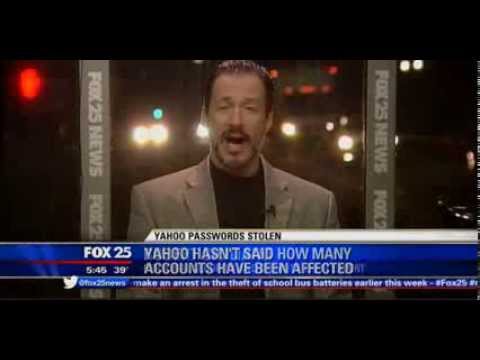
This content was created by Robert Siciliano. This content was uploaded by Robert Siciliano. This is a YouTube video titled "Yahoo email hacked, passwords leaked" (posted 2014-02-01). It is an interview-style conversation between a host (Speaker B) and security expert Robert Siciliano about a Yahoo-related data breach. They discuss the scale of exposed accounts, risks to users (including downstream impacts on banking and shopping), and recommended defenses—changing passwords, using password managers, keeping antivirus/anti-spyware and firewalls up to date, and applying OS security patches—while noting the ongoing arms race between hackers and defenders and the shared responsibility of consumers, corporations, and government.
Chapters
Oh, her eyes, her eyes make the stars look like they're not shining. Her hair, her hair falls perfectly without her—
So guess what we're talking about again? Personal information being stolen. This time it's Yahoo users, so we've got to check in with Rob Siciliano. Rob, I feel like I talk to you every other day about something like this. How are you?
You know, the bleeding just doesn't stop, does it?
No, it really doesn't. I mean, first we had those millions of users that were, uh, shopping at Target, they had their information compromised. We just get over that hump and now we're talking about Yahoo. Now they're saying that it's not directly affected by them, it was some sort of third-party database. That's alarming.
Yeah, it's always somebody else's fault, right?
Right.
Yeah, and now there are 300 million people that are using Yahoo email, 80 million of them here in the US, and at this point we don't know how many millions are affected. Uh, the fact is that there are going to be lots of people whose email accounts are going to be vulnerable to criminal hackers.
Now What are we supposed to do though? Keep changing our passcodes? If something like this happens, you might change it for Yahoo, but they might already be in your bank account. They might already be in online shopping.
Yeah, that is a problem. So right now, any consumer that has a Yahoo account should go right ahead and they should change their, uh, their password so that if in fact the usernames and passwords have been compromised, if they change their password today, it more than likely will keep a bad guy out.
Now, if you change your passcode and then you change it for your different logon, it's kind of hard to keep track of. And then if you store all of that information somewhere, that could potentially fall into bad hands too. So what is somebody supposed to do at this point?
So the best way to manage your passwords is really to use a password manager. Okay, uh, what a password manager is, it's a software program that does what it says— it manages your passwords. You can have Hundreds of passwords being managed by basically a toolbar in your browser that works across the Chrome browser, Internet Explorer, Firefox. It works across different operating systems such as Macs and Microsoft Windows and so forth. And it resides on the desktop or on the PC and it manages all your different passwords. So no matter how many passwords you have, you plug in one password and it opens up all of your other passwords to manage.
Okay, what happens if your computer is compromised in some other way though? Is that toolbar hackable?
So, okay, you have to start off with the basics like antivirus, anti-spyware, anti-phishing, and a firewall. You have to make sure that your operating system has the latest critical security patches so that it's not hackable. So there's always gonna be some type of a vulnerability. Your job as the consumer is to make sure that you have systems in place to keep the bad guys out. A password manager is one way to actually manage your passwords to keep them as safe and secure as possible, along with keeping your devices secure with antivirus and so forth.
Okay, antivirus, those are small things that we as consumers can do, but when you're talking about things like Yahoo and Target and then Neiman Marcus, these are big companies, and it seems like we're getting these situations more and more often. Is the technology to protect us not keeping up with the technology that the hackers are using?
Yeah, it is a battle between good and evil 24/7, 365, and the bad guys seem to be winning at the moment. But the reality is the good guys in fact are winning, right? We are, because if we weren't, then the lights would be off and the bank accounts would be empty. So, you know, we do have the upper hand. The bad guys win one every once in a while. Lately they've won a few. But consumers do have a responsibility to keep their information secure with the tools that I said. And overall, you know, we'll come out of this, you know, we'll get ahead. But we all have to be vigilant. The consumers have to be vigilant. The corporations and the government agencies all have to be vigilant, and we will.
And Rob, thank you. Hopefully I'm not talking to you about the same exact thing with a different company next week, right?
I'm sure we will.
Exactly. But thank you for those pointers, and I think those are important things that people can keep in mind. Simple things. All right, Rob, thank you.