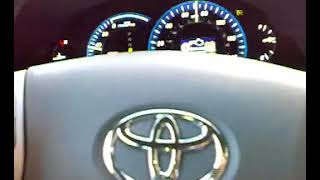
Rob Greenlee drives his 2007 Camry Hybrid on the freeway, showing how the Synergy Drive system shifts between gas engine and electric motor. Hard acceleration cuts battery assist, while easing off the pedal recharges it. On flat ground at 65-70 mph he hits 60 MPG, averaging 40 MPG overall.
Chapters
Hello again, this is Rob Greenlee, and I thought I would do a little video for you safely in the car as I'm driving down the freeway at 65-70 miles an hour here. Show you the dashboard of my 2007 Toyota Camry Hybrid and kind of how the gas engine and the electric engine kind of work in synergy. Since this is quote-unquote from Toyota a synergy drive, it really does mean that. You know, if you watch the little square box right in the middle the video screen, you can see some activity going on. What's going on there is that round circle on the left is the tires. Basically, it's the front tires of the car, which actually is where the drive activity actually gets transferred to since it is not a 4-wheel drive vehicle. And the top little icon there that you see right in the middle is a representation of the gas engine. And then down below, you'll see a little bar that pops on and off that is actually pointing to the tire. If you look at it there on the far right, and that's the representation of a battery. And so what's happening is I'm driving down the freeway down— it's shifting between the gas engine and powering through the battery to the tires. So it is truly a synergy drive. They actually work in tandem with each other. So it actually, in different situations, you're pulling from the battery battery, and in other situations you're pulling from both, and in other even more situations you're pulling from just the gas engine. So if I were to push the gas pedal really, really hard for a second here, the battery portion of it turns off. Okay, and you probably saw that really quick, and then I backed off on the gas, and those wheels are charging the battery. The arrow switches the opposite direction. So I push the gas just a little bit and the gas engine comes on. Well, I'm I'm also going kind of uphill too, so there's more drain or call for the engine to kind of keep up with the speed. But if I back off on the gas, then the battery kicks in and provides some boost in there, which then boosts my miles per gallon on the left there. The gauge that you see on the left actually is the gauge that tells you how many miles per gallon that you're getting. So there's no RPM gauge in this car, but you do have miles per gallon gauge in the car. So it tells you based on how hard you're pushing the gas pedal how much mileage that you're getting. And in a lot of situations, you know, if I'm going downhill or if I'm on a flat surface and I'm just barely touching the gas pedal, that gauge on the left will actually drop all the way down to 60 like where it is right now. So I'm driving almost 70 miles an hour in this car, and for a brief period of time though it is, I'm getting actually 60 miles per gallon. So, you know, that's kind of how this works. You get as good a gas mileage as you're going to get in this car based on how you drive the car and also on the terrain that you're driving. If you're driving uphill a lot, you're not going to get as much— your miles per gallon are going to be much less driving uphill with this vehicle than if you're driving downhill because then the car is just coasting. The engine turns off and it's charging the battery. So it's the average between those two things that basically drives that average about 40 miles per gallon. And also, I've also noticed that in very smooth street surfaces, the car is more likely to operate fully off the battery. So if it's a really kind of rough surface on the road, the engine has to work a little bit harder to actually drive the vehicle forward. Then if it's a really smooth concrete surface, which I've seen in a lot of parking garages, where I can actually drive uphill up to the top of a parking garage going up each level with just the battery if the surface of the road is smooth. So, so anyway, this is some details and some personal experience that I've had with using this 2007 Toyota Camry hybrid that might be helpful to you as you kind of evaluate your own purchase of a similar car with a hybrid technology in it. But I am still really anxiously waiting to get a 100% all non-gas vehicle, you know, a full or 100% juice-driven non-gas vehicle that's all electric. So that's my goal. My next vehicle is going to be a 100% non-gas petroleum-based transportation. So I'm, I'm really looking forward to that. So thanks for watching my video, appreciate it, and I'll keep thinking of other ways I can demo this car to you to help people that happen to be on YouTube or whatever can, can learn more about the, the car and how it works. Take care.