2024 Podcast Hall of Fame Inductees | New Media Show
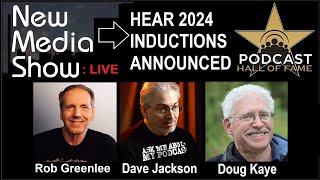
In this special episode of the New Media Show, host Rob Greenlee is joined by Hall of Fame inductees Dave Jackson and Doug Kaye to discuss the upcoming 2024 Podcast Hall of Fame ceremony at Podfest Orlando (January 26). The conversation covers the Hall of Fame’s voting process, eligibility criteria, and the backlog of deserving candidates. They profile the eight new inductees—Jesse Thorne, Michael Butler, Maria Hinojosa, Daniel J. Lewis, Lori Sims, Aaron Mankey, Adam Carolla, and others—highlighting each person’s unique contributions to podcasting. Doug recounts his claim to the first podcast, the creation of the Conversations Network, and the development of a dynamic content‑assembly system that led to the Levelator audio‑normalization tool. The hosts explore early technical challenges (volume leveling, dynamic insertion), the evolution of the medium from a niche “attention economy” to today’s crowded landscape, and tensions between creator‑driven content and commercial, download‑focused strategies. They also discuss the industry’s fight against a patent‑troll threat, the role of community platforms like Libsyn, and logistical details of the live‑streamed ceremony. Throughout, they emphasize the importance of passion, community service, and lasting impact as the core values of the Hall of Fame.
Chapters
All right, well, welcome to the New Media Show, and my name is Rob Greenlee, and my co-host Todd Cochran is busy in Las Vegas at the Consumer Electronics Show, so I thought I would put together a special episode. I know this isn't on our normal day of the week. We're usually live every Wednesday at 3 PM Eastern Eastern, noon Pacific. But this is unusual times because there's an unusual event that's happening down at Podfest down in Orlando. So if you go to podfestexpo.com, or you can go to another site called Podcast HOF, or the Podcast Hall of Fame. So this episode is really focused on talking about the Podcast Hall of Fame and what was just announced in Pod News about the induction ceremony that's going to happen down in Orlando at Podfest on January 26th at 7 PM Eastern. And that is going to be an in-person event. So if you happen to be going to Podfest, you will be able to attend that in person. And but you will be able to watch it live because it will be live streamed and made available on like a YouTube type of experience via the Lipson YouTube channel. So if you want to go to youtube.com/@lipson, I believe Dave is the place to go. But I'm lucky to have with me 3 terrific guys. Dave Jackson, which I'm sure many of you probably already know him. So let me pull them all up to the screen here. And Dave, thanks for joining me. He's in the Hall of Fame as well. He was inducted back in 2018. I was also inducted into the Hall of Fame back in 2017, and so was Todd. Todd was inducted back in 2015, I believe. And Doug is our— is one of our 8 new inductees to the Hall of Fame. And I've known Doug for a very long time. Doug, welcome to the New Media Show. It's the first time for you.
Great to be here, Rob and Dave. Good to see both of you. Thank you.
Yeah, yeah, it's great to, to come in here and, and talk about this. So the induction ceremony, as Dave, you know, maybe you can talk about your experience with it too. You know, it, it basically what I'm trying to do here with this episode is just kind of give a little bit of a behind-the-scenes look at the inductees, kind of what the purpose of the Hall of Fame is, and we can talk about it and what the experience is. So I know, Dave, why don't you give us a little bit of a snapshot of what your kind of feeling is about the Hall of Fame and what you thought about it at the time that you got inducted.
Yeah, it's an honor. It's hard to make Dave Jackson speechless, but that did it when Gary Leland called me up because you're being voted on by your peers. And so I didn't realize till later when I got to vote that, you know, you end up with— you end up— everybody kind of writes down a bunch of names and then they pull all those, and then we look for duplicates and who got the most votes. And then that— it just keeps getting thinned down till you get down to a certain number. And when you get down to— the smaller the list gets, the harder the voting gets because everybody has done such great work. And it's really, you know, sometimes people think it's just, well, they've been doing it a long time. No, it's, you know, do you have an engaged audience? Have you contributed to not just podcasting, but the whole community? Are you, you know, having people, are you inspiring people to start a podcast? There are all sorts of reasons why you would get voted in. But yeah, when Gary called me, I was like, are you sure you got the right guy? You know, that whole thing. And then the other thing is I think I had, If I remember right, it was 7 minutes, and it's— that 7 minutes goes by quick. And I was trying to come up with something because obviously you want to thank everyone who's kind of helped you along the way, but I still wanted to be somewhat kind of, uh, you know, get out there and start a podcast speech. So it was, uh, interesting. I just remember when I watch the video now, I'm like, I had my notes on my phone, and I'm like, I wish I hadn't done that because half the speech I'm looking at my phone and I'm like, ah, You know, so that's, that's a classic example of the, the presentation you want to give, the presentation you gave, and then the presentation you wish you had given. But, uh, it's a fun time, and it's— I know last year especially, the, the new inductees, everybody had an amazing story. And that's the whole thing, you're, you're inducting people who are good with words. And so it's amazing to hear all the, you know, kind of there because of my podcast stories and all the things that happened to them and how they engage with their audience. And it was— I know last year I was like, wow, it was like every person, even if I'd never heard of their podcast because we all run in different bubbles. And I was like, I got to go start listening to that guy's show because that was amazing.
Yeah, yeah, yeah. I, I tend to agree with you. I think that the, the presentations that were made actually in all the Hall of Fames, I've been to all of them and just the, the stories of podcasters and how they got started in their journey. And, and also, you know, like any other award, there's some thankfulness that goes into this too. And people talk about the, the other people that were influential in their, their lives and helping them get to that point. And I think it's very instructive to, to new podcasters that are coming up that are thinking about starting a show and kind of what that journey might look like. It's, it's not like you're going to get there in your first, you know, 10 episodes or in the first year or something like that. This is, this is a slog. It's something that people do over many, many years. And, and so I wanted to also get, uh, get Doug, your thoughts on, on what it means to you to be inducted. And we'll soon get into actually talking about all the inductees as well, but I just wanted to get your, your kind of emotional reaction to being asked to be inducted into the Hall of Fame and what it means to you. And then also tell us a little bit about what you did in the early days of podcasting that, that, you know, you think got you here.
Yeah, well, it's, it's like Dave says, it's a great honor. Um, I'm thrilled. I wish I could be there live. Unfortunately, I'll have to be joining by video, uh, recorded video. But, um, Yeah, it's great. Um, you know, I got started pretty early, uh, in the whole thing. If you, if you go to Wikipedia, Wikipedia says I had actually the very first podcast. That's arguable, but I'll take the credit. Thanks.
Yeah.
Um, and you know, I got started in an odd way. I was writing some tech books and I was interviewing people for these books and recording the interview so I didn't have to take notes. And I realized from my second book that the interviews were probably going to be better than the book. So I went back to all these people and I asked for permission to put them online, and I put— I hope— put the MP3s online. And then after a few months, Dave Weiner released a version of RSS, you know, that had the enclosure tag. And so I took and used that, uh, to attach the MP3s and put out an RSS feed with MP3s, and that was essentially the first podcast. Um, and it just took off from there. What can I say?
Yeah, because I think you were, um, you're very, um, much an example of the early podcasters and the ones that were in this medium. I, I kind of include myself in that too, is that we were, we were really technologists first and content creators kind of just because of the technology, right? We saw this opportunity with technology to distribute content. You know, I was on the radio in those days and I actually worked with you, Doug, with my radio show and we created a version of my radio show on the Conversations Network, which is what— That's right. One of those very early networks in the podcasting space. But what was really interesting about what you were doing back then, and if you can talk about this a little bit too, that the content that you were producing, you were implementing dynamic insertion and assembly of shows, not so much advertising, but I thought it was very interesting. If you could talk about what you were doing in the early days with the Conversation Network, 'cause I know that you were putting things at the front of the content, things behind the content kind of in the backend, and which has turned into now everybody's all excited about dynamic ad insertion and all this stuff, but I've always been this advocate that dynamic ad insertion can also be used for content. So if you could talk about that a little bit, that, that'd be great.
Yeah, we, um, you know, after we got IT Conversations going, um, I started doing a lot of extra interviews. People listened, they wanted to help, and so we ended up creating a nonprofit called the Conversations Network. And over time, we brought in a lot of other people audio people, writers, web people, and so forth. And one of the challenges of podcasts are because they have a fairly long shelf life, you know, it's evergreen content as we used to call it. And if you put anything like an ad or a promotion in the stuff, you know, a year later that promotion is invalid. So how do you put in content that is fresh as of the time of delivery rather than the time of creation, right? So for that, we did create a content management system, uh, that did show assembly. And we did it to the point where we would have, you know, maybe 20 segments in a show, but they would be an opening intro and there would be credits. It would, like, at the end it would say The recording engineer for this podcast was— cut— Rob Greenlee. Cut. And each one of those things, those— each of those phrases was a separate piece of audio that was assembled at, at delivery time.
Yeah.
Um, and that was— that really made a difference because we had then podcasts that you could listen to a year later and still get news about upcoming events.
Um, so that was a big part of And if I recall too, so you had all these different segments of audio that were being produced separately and then assembled, but then that caused some issues around volume levels, right? Each of those separate recordings may have a different volume level. So that's what drove you to create another tool called Levelator, correct?
Yeah. Yeah, we started— it was at first developed just for our own internal use. Didn't call it the Levelator at first, but it was software that would analyze a piece of audio and change the levels to a— what we determined at that point was an industry standard level. That determining an industry standard level was a lot of work, that's for sure. It wasn't well understood in those days because we're going back to 2003, so it's now almost 20 years— no, it's more than 20 years. So, um, yeah, we had this software that was developed, uh, my concept, but Bruce Sharp and Norman Lorraine did the coding, and our, you know, our goal with the Conversations Network was really best expressed by Brewster Kahle at the Internet Archive, where he used the phrase evaporate, meaning that, you know, there are lectures, there are presentations that go on every day around this world that nobody records, nobody saves. And so these brilliant things just evaporate. So our mission was to make it so that people could preserve these recordings and make them available forever. Well, over time, we succeeded in that. We made podcasting something that was available to everybody. And by the time we got there, we didn't really need the Conversations Network any longer, but we did need the Levelator as a tool. So we released the Levelator for free. We had versions for— we still have versions for Mac, Windows, and Linux. And we've had over half a million downloads still. It's still very popular.
Yeah, I use it every week myself still. I mean, it's such an easy tool. It's available if you just do a search for Levelator, like the level, L-E-V-E-L-A-T-O-R, I believe,.com. You can find this tool and it's really as simple as taking your WAV file and dragging and dropping it right on top of the software little box on the window and it will process it process the audio and it'll optimize the volume level. I found it to be a terrific kind of normalizer and compressor boost that makes it, you know, the audio actually listenable. I mean, a lot of podcasts today get produced, I think, at too low of volumes, and people have a hard time hearing the audio when they're on a bus or train or something like that. Where your tool or the Levelator tool creates audio that is listenable without having to hit your MP3 or your phone volume level up to the maximum to be able to hear it. So did you guys play around with that to come up with that ceiling? And what was that process of trying to find that optimum level?
We first did some research to see what standards were out there, and we looked to NPR here in the States. We looked at BBC, they had some standards for audio level. But audio level is quite complex because it depends not just on the instantaneous level but how you measure it over time. And, you know, because there may be a particularly loud spike like a you know, hit of a drum head or something like that, or crashing of my chair in the office. And so, so dealing with the time component as opposed to the level was part of it. And, you know, the Levelator is not a compressor, it's not a limiter. If you think about a compressor, a compressor, if I started to talk very loudly, it would bring the level down, and then as I stopped talking, the level would slowly come back up. That's the release time. And of course, that brings up all the background noise and all the garbage like that. But think how a really good audio engineer works at the mixing board. So you hear something very loud, you bring the pot down, but you don't just bring it back up right away. You wait and see what's happening, because in the case of silence, you don't want to raise the level.
You don't—
you just want to leave the level low where it is. But when a person then starts talking or there's music, then you bring it back up to the right level. So you can't just use a compressor to do this. Similarly, you can't just use a limiter either, because a limiter is just going to flatten all the high levels and not do any more than that. So what Bruce Sharp did was develop a fairly complicated mathematical— I shouldn't say fairly complicated, extremely complicated mathematical model. Bruce is a mathematician by trade and has developed some very sophisticated modeling algorithms for audio and video. And, um, so anyway, that's, that's what we did. It's, it's, it's not at all what people think. For, for example, you talked about how easy it is to use. People used to write in and say, oh, can't I have some knobs and levers? I want to be able to adjust the list, the, the compression.
Yeah.
And we'd say, no, you can't. There are about 40 parameters and none of them will make any sense to you. So yeah, that was always hidden.
Yeah, I think that's the magic spot, is that a lot of times these audio adjusting tools just have too many knobs to— and you can never get them set right. You know, I've got like a RODECaster Pro here, and then Dave, I'm sure you'll appreciate this, is that there's so many settings in that you can totally get your audio all messed up. So you need to have, you know, somebody that's really an engineer like your background and, and your colleagues there to really come up with something. And I do think that there are some efforts in the industry right now to really come up with that, really kind of simplify this stuff and make it a lot easier. But, but anyway, let's, let's go ahead and show who's been inducted into the Hall of Fame here. And let me see if I can get that pulled up on the screen here. Yeah. So we've got Doug, like, uh, like I just mentioned, he's down here in the right-hand corner. And then, uh, we have Jesse Thorne, um, who actually has been around the podcasting space for a long time. He's the founder of Maximum Fun, um, and I, I believe, uh, he also did the Bullseye podcast too. Uh, he's done a lot of work with, um, public radio kind of stuff in his past as well. Um, Michael Butler, um, who, Dave, I guess you're gonna introduce Michael to, to his induction, um, at the, at the Hall of Fame. I don't know if you wanted to— yeah, he's mentioned a little bit about Michael, right?
Yeah, he's been podcasting since 2004, so he is— oh, he's the original music podcast. And, uh, what I love about Michael is Rob and Doug, you guys remember this, when we first started, we kind of wanted to be anti-radio. And, uh, Michael is still very much that. If when you sit down to listen to Michael, it sounds like you're in his bedroom and you guys are just going to talk about tunes, you're going to spin some music, and it's really made for those people that used to read the liner notes when back when we had, you know, vinyl, uh, and that whole nine yards. And He's, uh, he'll be the first— like, he always makes fun of the fact that he— when he calls it Reading with Butler, like, he'll get a, an email, and for whatever reason, when he goes to read on the mic, he just butchers it and has a lot of fun. And— but he's, uh, he's got— I'm gonna save some of his best stories for when I induct him, but he's, he's got a super engaged audience. And he's— I, I tell him, I'm like, man, I love your show, but I, I I'm green with envy because he's interviewed some really big names in music. And one of the reasons you like him is, on one hand, you hate him because you're like, I can't believe you're talking to that, you know, rock star. But he's also doing his best, and sometimes failing miserably, at fanboying out because he can't believe he's talking to them either. So he's just a super humble guy, and I can't wait to see him.
Yeah, he did a, a, a show called the Rock and Roll Geek Show, and worked worked very closely with Adam Curry, um, with the— was it the PodShow platform?
Yeah, back in the day I was part of that too, uh, and he had— he was instrumental in kind of managing what was called back then the PodSafe Music Network, where musicians could upload their music and basically say you're free to play this on your podcast. And I really wish somebody would bring that back. I know, um, Adam is working with musicians now with, uh, the value-for-value model. But I just love the fact that there was this giant, really huge database. Now, it wasn't all great. That was the bad news, is there was no restriction. Anybody could upload their music. But there were then podcasters who would sift through, find the great music, and then play it on their show. And it was amazing. There were, there were kind of early podcast stars. One of them was a guy named Brother Love that, uh, is now in another band in Nashville. But it was, uh, it was a great time in the early days, uh, because you had the, the music guys and then you had the sports guys and you had, you know, ever all these little different niches of stuff. And, uh, Michael's been doing it a long time and still doing it. And, uh, it's weird because I was just listening the other day and his daughter— like, he's now a grandpa. And I'm like, wait a minute, because I, I remember him talking about his little daughter and, uh, and now he's a grandpa. And I was like, okay, thanks, Michael, I feel old now.
Yeah, and then the, the next one over, right next to, is, um, Maria Hinojosa, I think is the proper pronunciation. Yeah, she's a Pulitzer Prize-winning creator and founder of the Futuro Media and, and, and the host of the Latino USA podcast. So she's been doing a very successful effort. I believe that's been mostly on public radio, so it's going to be fantastic to have her in. I know she's had significant contributions to, to the growth of the media on the public radio side especially. So, um, so I think it's terrific. And then, um, Daniel J. Lewis is also in here. He is at the top right here. You can see his picture up here. I think the thing about Daniel— and Dave, certainly jump in and talk about Daniel and his contribution to the podcasting medium. I think it's been significant over the years in educating thousands and thousands of new podcasters and people that are wanting to get into the medium. And then he's really kind of geeked out over the last few years creating stats and metrics and things like that to analyze, the podcasting space. I don't know, Dave, go ahead and take it away with—
Yeah, the thing that's— and, and he realizes this about himself— Daniel is a guy that really loves the details. So when you get into stats and things like that, that's where he really gets excited. But he's, uh, got to show The Audacity to Podcast, and he's had a— I forget the name of his, uh, I need to ask him before we do this, uh, next time— but he used to have a community of people that it wasn't about launching your podcast, it was about growing But along the way, as you mentioned, he's got his podcast industry stats. Now he's got Podgagement, which is a tool that kind of rounds up all your, uh, your reviews.
And he—
it's a place where you can have feedback. Now it's all about engaging your audience. And he's a great example of a guy— well, first of all, this is the one thing to me that just defines Daniel J. Lewis. He taught himself JavaScript. Like, that does not sound like a lot of fun to me, but if you're somebody who likes stats and codes and all that, uh, you know, getting down to the weeds he's having a blast. And so he's a guy that's just had his ear to the ground listening to what podcasters wanted. So I know, I think he still has a course on the Zoom H6 because everybody was buying one and nobody knew how to work it, so he made that. And then he had a course on SEO for podcasters because nobody understood that. And so he's always been just listening to what people want and then making it.
And, uh, in a, in a prolific podcaster himself, you know, with the Audacity to Podcast. And then he had, uh, I think he's had dozens of, uh, like TV, um, covered shows or TV topic shows.
Yeah, there was a show on ABC called Once. It was a Disney show and that got really popular, right? And he's done, uh, the Podcaster's Roundtable with some guy named Dave Jackson and Ray Ortega.
I've been on that show many times myself. Yeah, yeah.
And now he's the co-host of The Future of Podcasting is what he does, and that's a show he does with myself as well. So he's always— again, he's always involved in the community and finding out what people need and helping them. And I see him a lot in the different Facebook groups and Reddits and Quora and all the other places. If they're talking podcasting, Daniel J. Lewis is probably standing right behind you.
Yeah. And I would say that the industry really over, over many, many years has really respected his contributions to the medium. And helping others and helping people. I think that's, that's really where he stands out, uh, and that's, that's my perception of it. I've known Daniel for, you know, he's— I don't know how long he's been in the medium. I think he started back in maybe like 2005, 2006 or something like that. So he's been around almost as long as both, both of, um, all of us here that are on the show. I know Doug has been involved in podcasting since back in that 2000, um, 4 earlier time frame, um, just like, you know, both Dave and I. But I, I think Daniel's contributions, I mean, um, really, really stand out on this list of people, um, just, just how profound his contributions have been. Um, so I'm, I'm, I'm really happy he's on the list, but he was voted in pretty highly by the other inductees to be a part of this list, and we're proud to have him there. And, and I think he's going to give a, give a really great, great induction speech up there as well. So, and the next one over is Lori Sims. I would say she's maybe an unsung hero in the podcasting space, really was one of the key leaders at Lipson at its formation and its founding and really kind of led that company through, you know, being an early pioneer in podcasting. I mean, I don't know that podcasting would exist the way it is today without the birth of Lipson and Laurie's kind of behind-the-scenes contribution with Rob Walsh over, you know, almost two decades really gave the industry a platform that they could really grow on. I mean, some of the biggest podcasters in the world started on Libsyn, like Joe Rogan and Marc Maron, and all these guys really started on the platform because it was the— I mean, for a few years it was the only platform. So Dave, I don't know if you want to talk about Laurie, but I worked a lot with Laurie when I used to work for Libsyn.
Yeah, she's just amazing. She's, um, I always love the fact that no matter what was going on in the podcasting space, because it's, it's a space that changes all the time, you know, this happens or this happens, and, you know, IAB stats and getting certified and all this other stuff that's going on, and I never saw Lori lose it. Like, I never saw her stressed out. She was always like, okay, what do we need? Okay, let's, uh, let's get somebody in here. Let's get him in here and her 'Let's have a discussion. Let's figure out what the problem is,' and then you just solved it. And so, yeah, she's, uh, she's great. I was very happy to see that, uh, she was getting inducted because, uh, you know, she, she, um, she steered the boat through some interesting waters over the years.
Yeah, exactly. Uh, just to be, you know, upfront, she's no longer working for Lipson, just like me, I'm no longer working at Lipson. Um, but nonetheless, those contributions, uh, over really a decade and a half or more of work behind the scenes of building a platform that the industry really kind of built itself on. It was significant, and I think she deserves to be here. So, so, but the whole, you know, induction committee voted. I mean, it was like all these potential people were put in front of them to vote on, and she was one of the ones at the top of the list. So it's exciting to have him there, or have her there. The next one over is Aaron Mankey. He's the creator and host of the Lore podcast. I believe he's probably working on other projects as well. I don't have those right in front of me, but he's a consummate podcast expert, has been a real leader in the industry for many years now. He speaks at all the podcasting conferences. He is just out there. He's created a very popular series that got— actually got turned into a TV series. Yeah, that's the Lore podcast. I don't know. Do you want to talk about Aaron at all, David, or—
Well, I just— to the best of my knowledge, he doesn't have a team of 18 people.
No, he does it all.
Yeah. And so that's one of the things I always liked about Aaron is, A, Lore's a great show. Unless you, you know, don't watch that at night, you'll, you'll wet your pants before you go to bed. But some really interesting stories. But just the fact— I always loved it that— and he's kind of a no-nonsense kind of guy. He's kind of a, hey, just shut up and do the work, because that's really what he did. And, uh, so I've always admired— I'm looking forward to meeting— I don't think I've ever met him, as much as we run in the same circles, I don't think I've ever met him. And looking forward to shake his hand and congratulate him.
Yeah, I've, I've spoken to him many times and met him at many events. Um, I would say, you know, he's, he's known for getting on Twitter and these other platforms and creating these conversations with podcasters about best practices and things to do in the podcasting space, just based on his own personal experience and growing a very, very successful show. Um, so he's always been willing to share with the community. And I think that's, that, um, is one of the key things that will get you into the Hall of Fame is your impact, just like we were talking about Daniel and Dave, your, your contributions and Doug as well, working with a lot of different creators to help them improve and do, do better in the podcasting space is one of the key components. I will actually read kind of the induction requirements because I know I get asked that question a lot, but, but I wanted to just cover the next person on the list, which I would say probably everybody knows. Mr. Adam Carolla has been doing podcasting. I remember I first talked to his team back in 2008, uh, and that's when— that's just after he left, uh, I believe, um, commercial radio. I think he had a contract with Viacom or, or one of those big media companies and, and was working with Cumulus, I believe, at the time. And, and, um, kind of, they let him go for some reason. I think he was, you know, doing a very popular show and And he was like still under contract for a while, and yeah, and he couldn't do a new show and monetize that new show, uh, after— until after his contract expired. It's kind of like what Tucker Carlson just went through, I believe, with Fox, where he had this window of time when he really couldn't do anything. Um, but now he's outside of that window, and it's the same thing with Adam. And so once he— once the shackles were taken off, he was able to start building, building a show. And he built, uh, one of the most popular shows, um, back when he really kicked that off. And I believe it was late 2009, uh, is when he actually was able to take his handcuffs off and really get going with this show and, and set the Guinness Book of World Records for the, the most downloaded podcast. I, I don't know that anybody I think Joe Rogan could probably challenge that now, but, but I would say he, he really has had a significant impact. And I do, do remember Adam, uh, really being one of the leaders around the time period— and a lot of people might be forgot this— about the patent troll that was going after, um, all the big media companies and even the podcast hosting platforms and individual podcasts too, trying to extort money, uh, from them because they own they— this company owned the patent for podcasting. And so Adam really built a rebellion against that and really, you know, fundraised and donated a bunch of money to the legal defense of the industry and really kind of got that patent troll squashed. And I think that was a huge accomplishment that he contributed to the medium. So I would say if you know, his content abilities as well as his contributions to the industry itself, uh, can't be understated. Um, you know, I don't know what the industry would look like right now if, uh, we hadn't defeated that patent troll. I don't know, Dave, if you have any comments about that.
Well, yeah, I remember that because we were all scared, and then we squashed it, and then they came back and we had to squash it again. They, they tried to do some sort of, uh, you know, appeal or whatever, but eventually it was like, no, no, they, they've, they've been defeated and that whole nine yards. But yeah, I remember Adam had replaced Howard Stern on terrestrial radio on the West Coast. And, and that's when, you know, radio is radio. And if I was a DJ, I think every DJ should have their own podcast because there's going to come a time when they change formats or whatever and send you to the door. And Adam was smart. He's like, well, while I'm sitting here getting paid to do nothing, I'm going to build up an audience so that when I can move, I'll already have my own audience. So I thought that was a brilliant move.
Yeah, totally. And, um, so here's the, the website for the Podcast Hall of Fame too. You can see January 26th in Orlando, uh, and then, uh, wanted to also mention that, uh, we're lucky to have Mr. Dr. Drew to be our master of ceremonies at the event. So, so we were able to recruit, uh, Dr. Drew to fly out from LA and go all the way to Orlando and and be a, be a speaker at Podfest and do a fireside chat on the morning of the 26th and then, um, emcee the Hall of Fame the night of the 26th. So I'm really excited to have Dr. Drew there. He's, he's a— he's been very supportive of the Hall of Fame, um, actually even back in 2022 he inducted, um, a one of the inductees into the Hall of Fame as well. It was Emily Morse, uh, from the Sex with Emily podcast. He actually showed up and, and inducted her into the Hall of Fame. So, so he's had an involvement in the Hall of Fame for a while. I think he would love to be in the Hall of Fame at some point. So, because he did the, the Loveline podcast, uh, with Adam Carolla, so he's gonna also induct Adam Carolla into the Hall of Fame. So it's going to be exciting to have both those guys there, and I appreciate Dr. Drew. I've met him a few times over the years, and he's a consummate content creator, that's for sure. So we're honored to have him there. So anyway, I don't know, Doug, do you have any comments about, you know, all those inductees and being a part of that group of inductees?
Well, you know, I know some of them. Michael Butler in particular I know fairly well. Um, and I think the key to all of these things goes back to something that people used to ask me about early on, which is what makes a good podcast, right? And I think the key is personal involvement with the subject. Um, you know, Michael's a musician, so it makes perfect sense for him to do the Rock and Roll Geek Show. And to interview other musicians. Um, uh, Maria, you know, is involved with the Latinx community, so for her support of that is very important. So, um, that's the thing that comes across to me, is that these are not— you know, it takes me back. I mean, going way back, I mean, they're still going. Don and Drew, for example. Don and Drew are still podcasting, aren't they, Michael?
Yeah, I think so.
Yeah.
Yeah. And, you know, their podcast is just about their personal life, but it's their personal life. So the key is focus on the things that you're passionate about, and that's going to come through quite a bit.
Yeah, I agree with that. I think it's really important that, that the industry really keep that in mind because I do think that there is kind of a, a a focus away from that concept here. You're, uh, I think over the last couple years, and I know that the industry is a little bit struggling right now to some degree, I, I think it's going through a lot of changes, um, but I think keeping that focus on, you know, where podcasting started and what got us here, I think is, is important, and to hold on to that as much as possible. And because I do think the industry has gotten a little bit tied up in this, uh, focus on commercialism, right? And, and trying to build this medium as an advertising medium, as a, as really a reason for its existence. And I think that it is kind of missing the point. I know, Dave, do you have any thoughts about that?
Yeah, I just, I, I wonder sometimes when I hear when someone is doing yet another true crime show, it's not because they have a passion about the case It's because what can I do? What kind of podcast can I start that's going to require the least amount of work, get the most amount of downloads, and make the most amount of money? And that's typically just not the way podcasting works, especially if you compare it to, to when Doug and Rob Greenlee and I here started. It was a little easier to break into podcasting. It was harder to make one because they didn't have all the tools we have now. But, you know, the listeners were listening to maybe 3 podcasts a day because there weren't that many. So it was easy to get into their rotation, where now, according to Edison Research, you know, people are listening to 9 episodes— I think it is a week, I don't think it's a day, that'd be crazy— 9 a week. And so their dance card might be a little fuller than it was, say, 10 years ago. And so even though you've, you've created something that was popular, you know, some sort of true crime, It is a matter of coming up with something maybe with a different angle or a different viewpoint, because, you know, the Beatles are really popular and then a bunch of bands tried to copy them. You know, Led Zeppelin is really popular and then other bands tried to copy them. It's when you're copying somebody else, it usually doesn't, uh, result in the same type of, of, uh, success. So find something you're passionate about, figure out who your audience is that wants to hear that, and then I would say you have to define your why, because so many people judge their success on downloads, and downloads are important. It helps you figure out what's, what's working and what's not. But sometimes you're just trying to increase your reach, or you want to position yourself as an expert, or you want to be seen as a thought leader, or bring customers to your company, whatever it is. And, uh, sometimes I think we get really hyper-obsessed over downloads. I know, uh, the last couple years I've really been paying more attention. I go into Podcast Connect in Apple, and I've really been paying attention to the retention rate because that's one of the, the stats that actually affects Apple's algorithm. And so, you know, get into something because— and I don't know, I think a lot of the early guys, we're all just doing it for fun, and then it just turned into something else. I don't know, Rob, when you started, where we— I know you came from radio, but you were talking about a subject you loved, right?
Oh yeah, I was always, um, doing that, I mean, it was always about, um, trying to connect with audiences around a particular kind of genre area because I was focused on talking about the growth and development of the internet and the web back in those days. So I was very much trying to connect on the technology side. Now granted, with my radio show, I was very focused on, on trying to sell advertising into my show and things like that, and, and I did take some some flack in the podcasting space because I, I had ads in my show. You sell out. Yeah, I mean, that's exactly, you know, if you really think back to the early days of podcasting, uh, and, and if you talk to Adam Curry about this, he'll tell you the same thing, is that it was all about, you know, sticking it to the man, right? Um, that's kind of the, the attitude. I don't know, Doug, if you want to talk about that too, but it was more about kind of breaking the stranglehold of control. Of content that had permeated media up to that point. Right. And kind of ushered in this new era that we see today, which is independent media and independent creators really starting to dominate. So, you know, Doug, why don't you kind of give us some hindsight of that? I mean, I think you've been kind of a little bit out of the, out of the content creator kind of space to some degree. How do you see what's been happening As far as this transition from when this all started was very much focused on traditional media and now what we have today.
Well, like you said, Rob, when we all got started, there were no podcasts, right? And, you know, we were putting out podcasts and we were discussing things like how long should they be because people were going to listen to them in the gym or listen to them during their commute, but there was very little competition in those days, you know. And if we had an audience of 25,000 or 30,000 for a show, we considered that to be very successful. Now, of course, the numbers have gone crazy. But, you know, one of the things that I did back in about 2005, um, I produced the Gilmore Gang Show. And, um, Steve Gilmore had the phrase back then called we're entering an attention economy.
Remember that? Yeah, I do.
And boy, was he right. Oh yeah. And this, remember, this predates social media, right? This is all before any social media. But now we are absolutely in an attention economy. And so, you know, there's still only 24 hours a day. You still only spend 20 or 30 minutes on the treadmill. You only spend 20 or 30 minutes on your commute. And so we are all competing for that same little bit of time, but there are thousands and thousands of podcasts. So that's the big difference. Now, of course, another big thing is podcast subscriptions. I mean, remember in the beginning, Apple rejected all this stuff, right? Remember that, guys? When Apple was— first of all, they didn't like the fact they were using pod in the name, right? And then they wanted to have nothing to do with it. And then they finally got a couple of guys there who we, we know, we've met them all, who, uh, fought the good fight and convinced Apple to embrace podcasting. And, um, you know, Apple became sort of the, the default platform for so much stuff. So it's changed so much. It's changed in terms of huge podcasts, big audiences, you know, people, people who are TV stars having their own podcasts, you know. I mean, You know, you look at somebody like Rachel Maddow, for example, right? Hugely popular podcast. And, um, so that— the money, the length— but we still have the same amount of attention to compete for. That's the thing that hasn't changed.
And I think the thing that's changed there with attention is so many people love to quote that goldfish, you know, goldfish only has whatever— we have the brains of a goldfish. And if you look into that, I debunked that. That was like a footnote of another thing. It's like, it's not true, but it's been repeated so often that it's true. I don't think we have short attention spans. I think we've actually increased our ability to identify when someone's about to waste 20 minutes of our time. And then we like, oh wait, when I hear a podcast start off with, well, I don't know what we're going to talk about today, but I promised you a show every Thursday, I immediately eject because that person is not ready. They haven't prepared anything. And I realize there are tons of people that do kind of improv shows, but that's not what I'm talking about. And so I think that's why, again, it's as Doug said, it's the attention economy and you kind of have to grab people out of the gate now. You can't just start off talking about, well, the title of the episode is, you know, how to make money with free software. And you start off talking about French toast recipes and, you know, Mr. Whiskers, your cat. I'm like, I don't think that's going to float anymore.
Right? That's true. That's true. Well, let's, let's kind of move on to Another topic here, and that's talking about the Hall of Fame eligibility. I know a lot of people out there feel like they've earned their place in the Hall of Fame, and they would like to get their name in there for consideration. And we're always— I'm always open to hearing ideas around people that have done significant contributions. I don't know everybody in the medium over the 20 years I've been involved in this medium. So I would love to hear from you. If you wanted to send me an email, I'd be more than happy to get it. And if you have a nomination that you want to make to add to our consideration list, I'd be more than happy to consider that and add it to the list potentially if the other committee members agree. And then prior to next year, we will review that and make our next, you know, 8 selections. So that's kind of how it works, but what I wanted to do was to pull up the actual description of what the criteria is, if I can get it up on the screen here. Let's see here, add to stage. I think it's coming. Okay. So the Hall of Fame eligibility as it currently stands today Says the criteria for entry into the Hall of Fame is a combination of mainstream popularity, being considered a great podcaster or contributor to the industry by their peers, or excelling in the medium of podcasting. So there's a variety of different, uh, kind of positions and things that you can do in the medium that contribute to the medium and consideration for being inducted into the Hall of Fame. As well as having a historical significance in a positive manner in the medium. So that's— and I believe it says candidates should have something to offer in all three of the above categories mentioned or be so outstanding in one or two that they deserve to be included. To be eligible for entry into the Hall of Fame, a nominee must have completed at least 5 years since their first involvement in the medium, but longevity will not and should not be considered as a sole qualification in the, in the, in the consideration. So let me scroll, I believe, down in itself, and I think that's it. So, uh, it's on the website. So if you wanted to go to podcasthof.com and see that for yourself, um, that might be something that's worth doing. And, um, and send me an email. I would love to hear from you. And I, I appreciate your, your being here today watching this. And if you're watching it on, on demand, um, you know, if you know a terrific podcaster that kind of meets those criteria, or at least is, uh, is a, is a close proximity to that, we would love to add that person to the list. So we're open. I know, Dave, is there any thoughts that you have around the criteria, or Doug as well?
For me, no, it's, as I was thinking about the different people here, you know, they all have some combination of, of all these. And so I can't really think if I was going to add or take away anything here because it's like, this is it, you know. I love the fact they had, uh, you know, they— a contributor to the industry, you know, by their— that's excellent— excelling in the medium of podcasting. So, you know, there, there are again— and, and for those people that you— like, I have not heard of, uh, what was the one about something fun, or that forget the guy's name, but, um, he's one of the inductees, and I'm gonna go listen to his show. Yeah, thank you.
Just hit the Maximum Fun.
Maximum Fun, yes. And I was like, I need to go, go check that out. So obviously with podcasting, it's not like, you know, back in the days of M*A*S*H where the entire country was watching the, the final episode. We're all kind of splintered out. So, but in their little— I always call them, it's like a little bubble You know, they're well known. So these are the big fish in some cases, a smaller pond, but that small pond is impacting people and it's, it's helping them, you know, get through the day. Even, even that is a contribution. If you're a comedy podcast and you make me forget that my boss is a jerk and the dog ate my shoes and whatever else is going on in your life, that's a contribution.
You know, you're helping people. Yeah, yeah, exactly.
Doug, what do you think?
Yeah, Doug, well, yeah, you know, just looking at the list of this year's inductees, what impresses me is the variety, uh, and the fact that people can come to podcasting a number of different ways. You know, maybe a third or more of the people on your list this year are podcasters first and foremost, but half or more are people who have other things they do in their daily lives. Podcasting is to some extent incidental to that, but it's still driven by the same passions, which is what Dave was talking about. And, um, so I am impressed with the variety of people that you're bringing in, and I would encourage people with a variety of backgrounds and a variety of involvements with podcasting to apply for this, because I think That's part of the richness of the community.
Yeah, and I would say that, you know, I've heard some feedback about that there's so many people out there, like I think I got Twitter commented about sports podcasters. I don't believe we've inducted any sports podcasters to the Hall of Fame yet. And I would agree that there's a lot, you know, I talk about this a lot with Todd Cochran, my co-host, as well as Rob Walsh from Lipson as well, about, you know, how do we accommodate this backlog that we have of people that are deserving to be inducted into the Hall of Fame when we only can induct 8 a year? It's— there's a lot of— I feel a lot of pressure on having an induction ceremony that maybe has 20 people in it, just because of the, the backlog that we have of people that are deserving to be added to the Hall of Fame. So, um, but it's kind of like a time limitation too. It's like, how long of an event do you want to put on? Is anybody going to watch a 2-hour induction ceremony? Because that's— it would probably be 2 and a half hours, probably, if you're gonna induct 20 people.
We turn into the Oscars. We're going to start playing people off the stage. You're done. You had your 30 seconds, right?
It's a— it'll turn into an induction marathon. But, but that's not to say that those, those people don't deserve to be in the Hall of Fame. So what I would say is that I think we all have to back up and have some patience because when this Hall of Fame started back in 2015, We were banging them out pretty good up until 2018. And then, then COVID hit us and podcast movement decided that they weren't going to hold any induction ceremonies. And last year, 2022, was the first time that it was held again. So as you might imagine, that many years, you have, you know, 4 years is a significant backlog. But we're up to 41 inductees with the 8 that we have in there right now. So, you know, that list is starting to become significant. So the next year will be at, what, 49? So if I can squeeze out another 2 more, maybe we can squeeze in 10 next year. I don't know. Let's, let's see what's possible. But, but anyway, that's, that's what's involved in that part of this whole conversation to help address some of those questions. Questions and concerns, I wanted to also mention that the induction ceremony is going to be streamed live, so it, it will be available on YouTube off of the Lipson YouTube channel. Hopefully I'll, I'll get a Hall of Fame channel as well set up in YouTube, and then at least we can make it available on, on demand over there. And especially if I can go back and grab all of the older, ceremonies that were recorded, uh, via Podcast Movement, um, and put them all up on one channel and things like that. And, um, yeah, because I think, Dave, your, your induction ceremony is— I believe it's still up on from 2018, isn't it?
I believe so. I know I, I grabbed a copy of at least my part, but, uh, yeah, I think it's still up there somewhere.
Yeah, so you can go to this in person if you happen to be, you know, passing through Orlando on the 26th of January, or you want to go to Podfest. Uh, I'm sure Podcasts will welcome you with welcome arms, and that's at podfestexpo.com. And, um, and then you can also, like I said, it's going to be streamed live as well. And the hotel that it's happening at is the Wyndham Orlando, resort and off of International Drive. So that's where that event's being held, and it runs from, I believe, is it the 25th through the 28th? Is that correct, Dave? Did I get those dates right?
That sounds right, because I always, I always get it wrong because I always arrive the day before and leave the day after. Yeah, according to their website, 25th through the 28th.
Yeah, okay. So, so anyway, well, um, I, I appreciate both of you guys, um, jumping in here. I'm, I'm gonna try and wrap it up at an hour. The show usually goes 90 minutes, but, uh, I've got another thing I have to do. So, so thank you so much, and thank you for everybody for, for watching this, uh, live. I believe that we had another comment come through. Um, where do I find more information? Um, go to podcastexpo.com if you want to find out the event that is being held at. And then the actual website for the Hall of Fame is right here, uh, podcasthof.com. So, so check out the, the live stream., and on the evening of the 26th. And Dave, Doug, thank you. And Doug, congratulations for being a part of the Hall of Fame. Now it's been officially announced, and, and now it's just like going through the, the presentation and, and sharing with people, you know, what, what your experience has been over these years. And, and we'll do the same thing. I'm going to induct you, so I'm going to talk about you up on stage and And so, and then Dave's going to induct a couple of, of the other folks as well. So, but thanks everybody for watching the, the New Media Show. We'll be back with another episode, um, hopefully. I think Todd will be back next Wednesday at 3 PM Eastern, uh, noon Pacific, uh, for another episode of the New Media Show at newmediashow.com. So thank you so much for joining us and Have a terrific evening. Thank you.
More from Rob

Future-proofing with Delphi AI/Human clones: your podcast as a personal LLM | New Media Show






How sports reveal what AI spectacle gets wrong #Technology #Sports #Commentary



