Advertising Week & NAB Show NYC from Podfest PodTour NYC Meetup
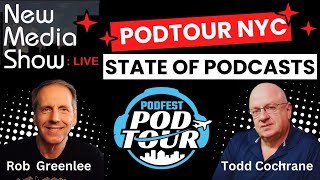
Rob Greenlee and Todd Cochrane compare NAB Show's older broadcaster crowd to Advertising Week's younger influencer-focused attendees. They discuss the pressure on podcasters to add video, the difficulty converting listeners to paid subscribers, and why owned communities matter more than relying on social platforms.
Chapters
Todd and Rob in the afternoon.
Hey, afternoon delight with Todd and Rob. Oh yeah. So here we are for another edition of the New Media Show, and Rob is in New York with a, uh, doing the best he can on his iPhone and I don't know, some sort of headset microphone setup. But the main thing is we can't hear the background, Rob.
Yeah, well, there's not a lot going on quite yet, so—
oh, okay. So, so did you go to the NAB event? Did you go to Advertising Week?
I did. I went to both today. Yeah.
Oh, okay.
Very interesting, uh, what I saw there.
So yeah, so first and foremost, uh, today is my 20th, 20th anniversary in podcasting. So I guess, you know, there's, there's tomorrow on another show, right? So I don't get China, you know, plates and stuff for my 20-year anniversary. So as I've kind of indicated in a blog post, it's kind of like, okay, yeah, that was nice. Now get back to work.
It was a very short celebration.
Yeah, very, very short. Very short celebration, uh, so, you know, it is what it is. But so tell me, you're— so you're in New York, you went to Advertising Week. I guess we can start with that. Um, so how's the NAB Advertising Week event?
Well, I kind of went to both, Todd, to kind of get it— get an assessment of what's going on with the NAB and, you know, how many people are there. So it was You know, the NAB event was very well attended, I have to say. But like what we've seen at a lot of the other conferences, Todd, there's a lot of similarities, and it's, it's design and a lot of panel sessions happening on the exhibition floor and lots and lots of aisle space between, uh, rows of exhibitors. Oh yeah. So I don't think that there's as many people turning out, to exhibit at the NEB show. But, but there was a good group, and the number that I heard, um, of attendees was over 10,000. So, you know, I guess, you know, in comparison to Las Vegas, it's just a fraction.
Yeah. And it's always been a fractional show, but I don't know what— I don't know what their numbers normally are.
Yeah, well, I think it's been in the 15,000 to 20,000 is what I remember in the past. So I think even the New York NAB show is off a little bit on its attendance and also on its exhibitors. So, but it's a good show. I went to a couple of podcasting panel sessions that were mostly populated by folks from the radio industry. So ones that, you know, you know, like Todd, you and I used to do a lot of radio events talking about podcasting. Well, it's safe to say that we've been fully replaced at those events by podcasting experts from the radio industry. So that's kind of— well, I think that's been going on for a while, and I think it's just because they have their own now, right? It isn't like they had to go into the podcasting industry to bring people into their events to talk about podcasting.
Yeah. What kind of radio people?
You know, from the typical ones, iHeartRadio, right? Odyssey, you know, a bunch of independent kind of platforms and networks that were there talking about, you know, this convergence that they're seeing in the market and that they're experiencing with their, their shows where they're trying to leverage the power of the broadcast tower in addition to the digital side. And they're trying to leverage that increasingly into— I think it was a quote that I heard on stage of driving radio listeners to become podcast listeners.
Wow. So I wonder how that's working out for them considering No one I know listens to the radio anymore.
Well, I think it's a little bit of a clash of demographics, right? I mean, if you think about a typical radio listener, it's usually a lot older, but I guess it depends on if you're talking about talk radio or you're talking about music. You know, I think it's a, it's kind of a separate conversation. Now, this was in the context of talk type content, which, you know, I think that the people that listen to talk content on the radio tend to be quite a bit older than the people that listen to podcasts. Now, granted, there's a a certain subset of people that are listening to podcasts that are in the older generations and those have come through the early days of bike. I mean, just your anniversary and my anniversary is a good example, Todd, of what we're going through is that back when we started podcasting, we were 20 years younger.
Yeah, but at the same time, the 35-year-olds and 30-year-olds that were listening are now 50-year-olds and 60 years old. So, you know, you know, we've had, and I still have, this pretty broad audience where new people came in and then the old people have hung out, you know. So I've got people have listened to the show for 20 years that were in their 50s. So, you know, right, not all of us have had to struggle to find an older audience because they grew up with us. But, you know, we're a little bit of, uh, we're weirdos in that regard, I guess.
Yeah, yeah, it's true.
So, so what are you hearing on the— what did you hear at NAB?
What's—
because of course everyone's talking about video, blah blah blah.
Yeah, I mean, I think, you know, that the NAB is NAB, right? It's, it's a, it's an event that caters to the broadcaster side. I think that they've been trying to get more involved in the, the online kind of digital creator space, but I don't think that they've really been able to succeed. I mean, if you look at a lot of the people that attend that conference, they tend to be older men. There's not a lot of young people at the event.
There's some, but that's interesting being an advertising event.
Oh, oh no, they— I'm still talking about the NAB. Yeah. Unless you're talking about the Advertising Week, that's a whole different conversation. So I can talk a lot, but the NAB Show is Advertising Week. No, it's not. They're two separate, two separate events.
Okay. Well, the NAB Show is mostly covering— I thought was mostly covering advertising, right?
Or no? No, it's, it's, it's like their Las Vegas event. Really? It's, it's It's got, got a bunch of hardware exhibitors, software stuff for, you know, for broadcast.
So must be those, must be those two shows have always run together and I just assumed.
Yeah, I don't, yeah, I don't think that that event in, I mean, at least from the panel sessions that I saw there too, it wasn't advertising-centric. It was really across the board. Okay. Of radio and, and TV and you know, the OTT opportunities with, with smart TV apps and things like that. That's kind of the area that the NAB kind of— okay, kind of, kind of really, really focuses on at that event. Now, the Advertising Week—
so how long did you spend at each? So you spent some time at NAB. How long did you stay there?
I was there only for like maybe 2 or 3 hours.
Oh, okay. Then you went to Advertising Week.
And I went to Advertising Week, and that was a completely different experience. Had a lot more younger people at the events, had like TikTok, you know, sponsorship type areas, had a lot more kind of collaborative spaces, but there's a lot of younger generation there, a lot of women, a lot of diversity, a lot of, um, really focus— really, I thought it was fascinating that this focus on the influencer side and, and more kind of authentic voices, you know, brands trying to connect with people that were doing authentic hostery type of type of presentations, which I thought was very ironic as I think about the podcasting industry in the early days when we started, which was very focused on host reads, very authentic brand endorsements, things like that that were really believable on the part of the listener. And it seems like that that's the direction that the Advertising Week is starting to push towards. That whole name advertising is really starting to take on a whole new meaning of what that is implying. It's not so much like what we traditionally think of advertising. It's, it's much more than that. A lot of kind of deep data metrics companies there that were analyzing consumers and what their purchase behavior was. And this mapping is really kind of more of a digital marketing event and how people are going to market around video and audio. But I heard so many times, yeah, I went to multiple panels talking with creators and like brands and the agencies that were working with them. Talking about how the future of this is gonna be looking more like personal brands are going to be where the future is. And part of what they also said was podcasters are an example of that, right? Podcasters building direct relationships with their audience and building those connections and this walking this line between pitching brands to them and being seen as authentic in what they're doing, but yet at the same time maybe not taking on as many different brands because then their authenticity starts to be eroded, right? Because they need to really speak with passion that they really want to or still brand.
Oh, that's interesting. So I guess my 20 years—
I felt this to some degree with my— oh, go ahead.
Oh, I was going to say, I guess with my 19 years of promoting GoDaddy fits in line with what they're starting to think about now is individuals have more of an alignment with one or two brands than they do with multiple.
Well, yeah, and I think that there's a feeling that the audience, which I laughed when I heard this, is that the audience was smart, right? Okay. They could sniff out kind of like a less than authentic endorsement, right? Wow. Which I laughed because you and I both know that in the early days of podcasting, there were people that took sponsors and then they trashed the brands that sponsored. Yeah, right. Yeah. So I thought that was like the next thing. Is that going to be the next thing that we see from the, the whole advertising side?
It's just, it's just like the, you know, fake it till you make it type of thing that, you know, has happened in the past and people have, uh, um, has, has essentially You know, I guess for a better word, I don't know what I want to say, but I'm just, I'm just, I'm just laughing at it.
Yeah, I mean, it's, it's so funny to think about, you know, if we think about all these big media companies wanting to come into the podcasting space and, and do like what they did with radio, right? And now we're starting to see the industry, the, the next generation coming through here, um, is, is starting to look at, well, you know, I don't believe all those sponsor ads and they're not very effective. So we need to go back to a new model, Todd.
Oh, really? Yeah. Well, that's kind of funny. So apparently, uh, Adam Curry's doing the Boostagram Ball right now and Dave Jones just boosted and said, going head to head with Boostagram Ball, bold move. Well, this is our— this is our normal schedule, so, uh, you know, I'm not changing my schedule because Booster Graham Ball goes live at Wednesday at 3 PM now.
So yeah, that's why I'm, I'm doing this show from the Podfest tour event in New York, because I didn't want it to interfere with our show, and— but I wanted to be here too.
So yeah, um, you know, so it's just, it's just ironic. You know, what is old is new again. So, uh, so I guess there's hope yet that they'll understand the, you know, the model of podcasting authenticity. You know, I, I've been inundated lately on YouTube with a certain, uh, green drink, you know, uh, getting— seeing these green drink, uh, commercials.
And is that what you're talking about?
Well, I'm just going to talk about a green drink. And so what I did, what I wanted to do was, you know, I've seen this and I, you know, some of these guys, you know, oh, I drink it every day, you know. And I saw someone that has their first ad said, yeah, I started drinking it, I feel great, blah blah blah. And I went and started doing, uh, a little bit of research about a green drink and the reality behind that product, in my opinion, is, is it's amazing what they're able— the sales they've been able to accomplish with influencers on, uh, in my opinion, in Todd's opinion only, that this drink is less than what it is made out to be, in my opinion. So I'm being very careful here. Um, so, you know, if, if a green drink came to me and said, Todd, we want you to drink that product on your show, I would decline based upon what I know about that product, what I personally read about. Now, if Red Bull comes to me and says, hey Todd, we'd love to have you be a sponsor, say hell yeah. I love Red Bull. Is it bad for me? I don't care. I like it. I don't— I drink it in moderation. So You know, and again, uh, you know, say what you will say about Red Bull, um, I, I'm a fan. It's because I like the product, but I also don't drink 5 cans a day and give myself a heart attack. So I think that, um, you know, again, what can you talk about in and, and give your, you know, and, and a lot— everyone knows what Red Bull is. So there's people out there that tell me all the time, put drink in that. But I like it. So if I have 2 or 3 a week, you know, I guess that's in moderation, right?
Yeah. Yeah, actually, one of the panel sessions that I went to at the Advertising Week had the CEO of AG1 on stage.
Oh, really?
Yeah. And she was talking to a couple of big YouTube creators, podcasters on stage, and then And she had a— also had on the stage too an agency that was working with creators. But that's what that conversation that I heard earlier that I was talking about was, was how EG1, which is a very— it's a brand of one of the companies that's making the kind of product you were just talking about, um, is trying to work with influencers, right? They're, they They want to be very selective to work with certain influencers that they think have genuine, authentic trust relationships with their audience. And that's not everybody, right? Some of the content creators out there, they don't, they don't think that they have that authentic relationship with their audience, so they don't want to work with them. So it's, you know, it gets back to that thing that we were just talking about, Todd. It was, it's, it seems like things are coming full circle on all this.
You know, I walked away from a lot of money in the early years, a lot. I remember having a deal presented to me personally. It was like $5,000 for 4 episodes. And it was some product that was just, I guess for a better word, slimy. And I just couldn't bring it. Like, when I tell you, walking away from $5,000 and I'm thinking, how can I spin this? You know, can I say I'm not endorsed, or, you know, some, some sort of— but there was just no way. There was just no way to get around the slimy feel of this product. I had to turn it away, you know. And of course, you never tell those stories to your audience. Uh, you know, that you just gave up 5 grand because the product was slimy. Um, right. So, you know, I— yeah, I did do a mattress ad one time, and, uh, I got the mattress after I'd done the ad, and I gave the mattress away. So that might tell you something too. And I told my audience I gave the mattress away, so Yeah, it's—
I mean, they said on stage that they only want to work with influencers that are— have been using their product. Yeah, already for a long time, right?
Yeah. What's a long time?
A week? Well, I think I know a couple of them that have been talking about that product for a long time, quite a while before they actually, it appears, got a sponsorship.
So, you know, I guess the, you know, here's my challenge with all of that. Again, after I did my own research, then my opinion on that creator has gone down. Yeah. So again, it's Todd's opinion on the green drink, but yeah, interesting. So it's, it's in, you know, they are definitely a number one advertiser on YouTube channels, at least the ones I watch. Yeah, so I would agree. So it must be having results. People must be buying it.
So I think that the BetterHelp folks are still the number one podcast advertisers.
Yeah. And I don't even know what their product is, to be honest with you. I have no clue.
Uh, it's mental counseling.
Oh, well, I guess I haven't been targeted with that ad. I don't listen to shows that are sharing mental health, uh, services. I didn't even— is that a thing? Oh, you froze up right when I asked the question. So— oh, are you back? Oh no, he's not back. Yeah. Oh, you're cutting out, Rob. Hello? Maybe Rob's gonna have to disconnect and come back. So I guess, you know, I've heard this name, so I guess it must be a big, big business out there if they're the number one subscriber of, uh, or number one advertiser of online, um, I guess what's the word, psychiatric help, or, or I don't— I guess it's psychiatric help, help. I'm thinking anyway, see if Rob disconnects here, but he definitely is not. This is what happens when you're remote somewhere and you're using Wi-Fi or your LTE connection to, to do stuff. Rob had some stuff in the agenda today. Let's see if I can look at what he wanted to talk about. Um, wanted to talk about growing paywall access, how more podcasts move behind paywalls and what it means for creators and listeners. I was talking with the client today. There he goes. To see if he comes back. Are you guys liking that effect on the screen right now on how it went into infinity? Let me come back to— and now it's weird because you guys can see the other screen. Let's see if I can— oh, here he comes.
All right.
Yeah, there you're flipped again, Rob. So you're sideways on the screen.
How do I flip that around?
I don't know, but it's looking pretty funny here. Yeah, I guess maybe that's the key is turn the phone. I'm not sure. Uh, hey, we're getting, uh, we're getting the back of your hand, so I'll flip it this way.
Okay, there we go.
All right, so okay, um, I just moved on. I basically said, I guess that's a big, you know, for BetterHelp, that must be, you know, they're spending so much money, then must be a lot of people need that service. If they wouldn't be advertising as big as they were if people weren't signing up.
Yeah, it's I think it's been the number one advertiser in podcasting for like the last 2 or 3 years.
Yeah, that's, that's pretty impressive that they're able to sustain that many signups. So it isn't—
I think it was since COVID Yeah, they really took off.
So very, very interesting. Hey, let's go and talk about this topic that you sent me about growing paywall access and how more podcasts move behind paywalls. And what it means for creators and listeners. And, and I started to talk about it while you're getting reconnected, but I think it's just— I talked to a creator today and he's absolutely struggling. Uh, advertising has dried up. Um, he's trying to figure out how to pay bills, um, and sustain this, and he's thinking about taking his content behind a paywall. And I'm You know, for me, I think there is an incredible risk in doing that because, you know, and on average, you might get 5 or 6% to move with you to a paywall. So unless you've established a paywall already and have built a base, I think it could be a spiraling death trap.
Yeah, I think this, I think in, in pod news here, I, I believe it was yesterday, um, it said The Economist, which is a, a long time, you know, kind of like a media company, um, has, has said that they, they put almost all their content behind a paywall and kept 80% of their listeners.
Well, I want to know the formula to that because that's an incredible conversion rate.
I agree.
And if someone— if, if someone can replicate— if I could replicate today getting any— my 80% of my Geek News Central audience to go to a paywall and pay me $5 a month, I'd move tomorrow. I, I, I'd go to the paywall because, you know, if I, if I could get $5 a month from 80% of my audience, damn, that's all I can say. That would, that would— I, I could really, I could actually retire, do about, you know, do about, do about a year of that, and, you know, I, I could probably have enough money to take me to the end. Um, So that's, that's a number. How much are they charging for that? Do you know?
Um, I don't think it needs to be a lot. I mean, I think that that's the key takeaway is that, is that, you know, $5 a month or $2.99 a month, right? Right. That kind of thing can add up if you have a lot of listeners.
Yeah. You know, and And this is why value for value has such an opportunity. If people understand that and understand how to get people to, you know, again, value for value can work many, many different ways. But if you can get, if you can get 80% of your audience to contribute, just for me, just $2 a month. Yeah, $2 a month for me would be like, oh, That'd be like a paycheck I've never seen before, you know. Yeah, I could make more in one month than I've made for salary in a year, you know. So just at $2 a month and 80% of the audience— but do you need— but do you need 80%? I, I would need about 10%, 10% to go, and I could— that would, that would be incredible.
I mean, I think the whole freemium model has a lot of validity, I think, of making some content free and some content behind the paywall. And I think that may be where we're going for a couple of reasons, Todd. And it's not so much financial, it's also about freely being able to express yourself and free speech to some degree, right? Yeah, um, does factor into this. But I do know creators that are putting out free content that they're concerned about that.
Yeah.
And then they're, they're putting out content in there inside their paywalls that are not being self-censored. Yeah. And that's, that's the value add right there.
You know, there's no, there's no doubt that if you work at it, And I've always contended the reason that my audience doesn't contribute more is because I still had a— I still have a sponsor. I'm getting a check every month. So, um, so that's what I contend with. You know, I had— I took a picture. I did it. I have a different YouTube channel. It's called, uh, what do I actually call the thing? Uh, let me go over here. It's Beyond the Office is what I call it. It's a It's one of my— a side channel I'm just playing with, and I, I don't put too much stuff on it on YouTube. And I put up a, um, a post the other day about, uh, um, essentially exactly what I, you know, my move, my move here to the studio, and you know what happened in it. And I got a lot of response to that video.. And, uh, basically, um, where I said don't build your castle on rented land. It's one of the highest viewing videos I've ever put out. And the comments came in and the trolls came in right away and says, all that gear and doesn't have a clue. And I'm like, yeah, fuck you, I do have a clue and I just choose to do it a different way, you know. And, uh, um So that's another problem too, is the trolls come in and making YouTube channels. I can see where that, you know, something you have to deal with, where you don't have to deal with too many trolls in podcasting per se.
Um, so I don't know. I'm also seeing that this whole conversation around subscription platforms and stuff, um, also has a little caveat, is that it's just like what you said. If you have a good existing, uh, audience base, uh, that has a loyal following to you, you're probably more likely to be able to convert them.
Right, right. And, and, and that Economist is definitely targeted and sounds like probably all financial advice. And right, and if the content's valuable and the people are getting value, again, value for value, they're getting value out of the content and they're willing to pay $2.99 a month to have access to it. You know, it's just like ChatGPT right now. It's like the cheapest $20 investment I've got. And, you know, some people are going to laugh at that, but, you know, it saved me from hiring an assistant for a year. But now I'm at a point where I'm probably going to hire an executive assistant. Because I've just, you know, I've run out of cycles again. Um, no matter what ChatGPT is doing to help me, you know, and Idea, and, you know, whatever else I'm using it for. So I think that, uh, the paywall, if you're getting value, um, again, but is value— you know, the thing we have to be cautious of, maybe an episode's worth $100, maybe an episode's worth $1,000. So if you limit yourself to $2.99, um, that, that, you know, again, you know, which way to go. And I know that, you know, we've talked about value for value a lot here and had Adam on, and he's the master of it, of course. But at the same time, um, I don't know, you know, we spent, uh, last week I had my team most of my team in, uh, in Florida. And, uh, we were in Jensen, Florida, and we were staying at a place called the Hutchinson Resort. Very nice, very nice place right on the, right on the ocean. Uh, matter of fact, I opened my door every morning, got sunrise and the crash of the Atlantic. Um, but, uh, you know, we spent a lot of time talking about, you know, how we're going to help podcasters. And, you know, one thing that we've learned for sure is, you know, a podcaster can say, well, I'm going to do premium. We built premium podcasting, but our adoption rate of podcasters adopting a premium model has not hit KPIs. I mean, not at all. Has not hit the numbers. You know, we put a number out there. So, okay, we get this many people using premium podcasting. Same thing with Apple subscriptions. We get this number of people because we put a lot of time and code for both those projects, their products, to coexist. And, um, it's easy— a lot of people say they want to do it, but very few actually implement it. So, you know, we had a list of podcasters, probably 40, I said, oh, I want premium, I'm going to do premium. Yet to a person, just a small number of them have actually implemented it. So it's easy to say, hard to implement.
It is. That's hard. That's exactly— that's a good point because I think we can all think about this stuff and, and hear people talk about it, but it's another matter to actually make it happen, right? And make it a real thing. Yeah. And it may not be something that everybody can do. I mean, if your only example is The Economist, yeah, being able to do that, or like Slate or some other kind of big, big, you know, publication that's been around, or The New York Times or Wall Street Journal or some of these, we'll be able to do. Yeah, that doesn't mean that Joe Blow podcaster is going to be able to really effectively do.
Yeah, it boils down to this, and I hate to say it, but I almost talk podcasters sometimes out of doing it. I, I tell them, okay, what do you want to do? And I said, if you want to give them an ad-free experience, that's one thing. There's not much extra work there. If you want to give them an early release, that's probably pretty good because there's no extra work there. But if you want to give them an extra episode, as soon as you commit to that, then you have to have an extra episode however often you've committed to for 1, 200, 500— you don't know how many subscribers you're going to get, but you, but you've also committed to it. So I always tell folks that are thinking about going to a paywall, it's much, much better to have either an ad-free offering where they don't have to listen to the ads you've already got, or number 2, they get the content early. And to be honest with you, you have to have super, super valuable content in order for someone to say, okay, for $2.99, I'll get the— I'll get the podcast 5 days earlier than those that don't. So, you know, you have to consistently deliver enough value to make it make some, some— there has to be some, um, competitive reason to get the episode 5 days early. It's like the Marketing AI show. I would pay to get that show early. I would pay to get that before everyone else got to hear it because there's stuff in there that 4 or 5 days could end up being enough competitive advantage of an idea that you gain from that show to give me enough head start to make it worth that money every month.
So yeah, yeah, I've been— yeah, Todd, I've been seeing a, a growth on Pod News here lately. I mean, I mean, to bring up James a little bit here is I've noticed that his list of personal sponsors—
yeah.
Has been, has been growing. Yeah. And, and I think that is a little bit of a similar type of a relationship. Sure. Right. It's almost like this— he could probably convert that group that he has into a special group that he has that he would have a different kind of a relationship with than just getting a newsletter every day.
Yep. Well, that's what Sounds Profitable did.
Yeah.
Well, yeah, you know, exactly. Yeah.
So let's— I guess Sounds Profitable, I guess, is doing stuff here at Advertising Week too.
Yeah, I heard that. So again, they're an advertising-focused organization.
Tom's going to hate that, but I think it's a fair comment.
Yeah. I'm gonna be honest about it. Yeah, at this point, you know. Yeah. So let's talk a little bit about private communities around shows.
Well, I think we have been talking about it.
Well, you know, I— and, you know, here's the thing I've been thinking about too. I'm getting, you know, the, the phone calls again. I'm doing 6, 7 podcasts or maybe 10 podcaster calls a week. And a lot of the things have been discussed now is I can't reach people on Facebook no more, I can't reach them on LinkedIn, I can't reach them in my group, I can't— everything that I do on these platforms, and we're just going to call them platforms, A, B, C, D, E, F, G, X, Y, Z, um, they are losing— they can't just put a message out and their audience will never get it. It won't surface unless they make a purposeful, purposeful click into the group. And we see that at Blueberry. We see that with our Blueberry Podcasting group. Unless someone purposely comes in, our message doesn't surface in the stream of Facebook at all. And if we put a link in the post, God forbid we would try to make them leave Facebook, it even gets, you know, it gets plummeted even further down. Same thing with X. So private communities, I, you know, I, we, I think at this point anyone that's building a community on a social media platform is an idiot. I'm just gonna say it frank. You need to build your community off these social media platforms. You need to bring them back to the web, bring them to a forum group, bring— there's plenty of these tools out there. Literally hundreds of them that you can run on your own website or a subdomain. I think the key is if you want to— and I've tried it in the past and, you know, it's very, very hard— but if you start and build a community location somewhere off of social, I think it's a much better way to go at this point. And, and why? Because you're not reaching your tribe. You're being prevented by the gatekeepers of any message that you put out.
Yeah. Well, there are platforms, but, but Todd, this is where it conflicts with this thought that you need to own your own real estate, right? Yeah. Is that there's like schools and there's like Kajabi platforms that are out there that people can build a community that's theirs, branded them. Has, has a custom domain name.
Well, I'm not all that— I'm not against that at all. I think, I think, and if you're willing to pay for that and that company is not going to be moving anywhere, of course do that, you know. But the key is get them all—
get off social, get them off of Facebook and get them off.
Yeah, get them off Facebook, send them to a destination, send them to community.something. You know, send them someplace where you know when they come there they are going to see your, your, your tribe. I, you know, you look at what Patreon does, and if, you know, if you build a Patreon following on Patreon and you post something new, you get an email and you go to the Patreon page and you get access to the— you know, I pay for a few services where I get free episodes or exclusive group or whatever. I go there and watch, but most of the times now those videos that are on Patreon are not being tied to YouTube anymore. They're, they're usually in Vimeo because YouTube has got such strict policies again on discussion. So people are putting, you know, you say one thing wrong and that, that content's not available. But again, I think it's important if you're going to have an external platform to send your community to and you want to put videos and stuff up there to talk to your community, that platform should support that, should support, you know, having the ability to put a video on it or whatever you want to do to reach the community. Um, but get the hell off these, these big social media sites. Yeah, I think you still have to promote on there with whatever messaging gets through and buy your way into you know, SEM, buy your way into placement. But I just don't think that, um, building a community on a big social network right now is smart.
I don't think that you could build it off of your own website.
No, you have it work. Yeah, well, you could, but again, how much work does— you know, most people are not geeks, so they need to go on some platform that has these tools. That you can easily organize, right?
Yeah. Yeah. So that's, that's probably, that's probably the best option right now. And then, then there's those that will build on like a Patreon or something like that. That's not so much of a community platform. No. But also, Todd, I've been thinking about this too, this whole concept of building a community. I've been hearing some thought leaders out there talking about, well, maybe we shouldn't be talking about the concept of community. What we should be talking about is the concept of creating deeper individual connections with our audience members. And, and if you use the term community, it almost like it It doesn't give the amount of, I guess, purpose.
Well, let me get— let me guess though, that's all based upon spying analysis to say listener 1 loved my discussion about the RIAA, listener 2 loved my discussion about the FAA, and let me send a custom message to each based upon me spying on what they like. Well, yeah, yeah. And I hate to say it, but boy, that's what they— that's what they're— that's what that person was really saying. And having a deeper connection? No, it wasn't a deeper connection about you love me and you love my content. It's about let me go ahead and, and target that person, which is just another form of advertising.
Yeah, I think if you think about it at scale, I agree with you because you can't have a close individual kind of connection or relationship with 10,000 or 50,000 different audience members, but tech could give you that ability, right?
Yeah, I You know, and there's a fine line there, but I think it would be better if you are doing a Kajabi or something like that than to segment the community. And again, I don't know, I guess you just saw somebody that, you know, I see you waving at someone. Oh yeah. Um, you know, if you're going to set up a community, then you should segment your community based upon your content topics so that they can find other people. But you have to be too careful. You can't segment too much in those types of community because no one's going to talk to one another. You, and again, you got to build volume. Gonna have 2 or 3 people in there not contributing, and you know, it's, it's, it looks like it's worse than anything else. I think you have to be careful on that deployment.
Yeah. So you want me to— I can bring in Mr. Andrew Weiss if you want to have him.
If you can hear, if we can hear him. I can barely hear you half the time, so.
Oh yeah. That could be a problem. I'm not sure.
Yeah.
As far as you being heard, Andrew.
Yeah, that's the challenge. So, you know, I saw your topic here today and I'm like, you know, this is really not happening that much, but you're saying, oh, I bet you're reacting to the Spotify interview about how we don't need RSS.
Well, you know, I've been hearing more and more talk about people in the industry not wanting to say it publicly, but people are leaning, starting to lean this direction.
Well, good luck to them that want to do that.
I mean, it's, it's— I don't, I mean, I don't like it either, but I've had lots of conversations with Lots of, lots of different people talking about what's, what's the future of video in RSS.
Well, we already know it's the video in RSS is rich. We just got to have people surface it.
Well, I agree with that. But the question is that there's so much momentum around video outside of RSS now. I don't know what Apple's going to do. I know what Apple's going to do.
Well, we'll see. Um, I don't think it's going to happen fast enough. But again, I don't— as a hosting provider, I'm not hearing this. This is the interesting thing. You would think I would be the first one to say— to hear customers say, I want video. You would think that I would hear that first from creators. My creators are not asking me for video. They're saying, uh, it's hard, it's extra work.
Yeah, I think it's a different— it's probably a different creator.
No, it's a, it's a smaller segment of a different creator. But they're not podcasters, then they're YouTubers.
Well, no, no, I'm talking about the other way around. I think the people that we typically, we typically hear from are people that are more audio-centric.
I hear from— I, you know, I've got 100,000 people using our products and services. So, you know, so would— if I'm not hearing it from that segment saying you need more support for video, where else, where else are we going to hear it? I think this again goes—
a lot of people, Todd, that are not— don't consider themselves to be a part of the podcast industry. Well, don't go to podcast conference.
Yeah, well, again, here's the thing though. This is all a story made up about advertising.
It's all about—
it's all about advertising. So, you know, we have to put— we, we have to understand that this is a— this has been a marketing opportunity to try to get podcasters to think that they need to do video, and it's only a chase to find more dollars for advertising. So I, I think it's— I think it's a made-up BS story, to be honest with you. And it's, it's affected some, but again, you have Spotify saying we don't need RSS. Well, that's, that's incredible.
Well, Todd, if, if the, if the narrative is true, the reason why we're seeing so much interest in video is coming from a monetization perspective, which is what we saw from Spotify wanting to do that, um, then that may be the answer to the question. And I think we both have come to that conclusion, that that is the real motivation here. Because based on what I'm seeing at Advertising Week, um, and even to some degree at the NAB, is that there is such a heightened focus on monetization now It's driving people to consider things and also deeper audience metrics because there's so much money being made now on audience metrics. Like, I spoke to the Instacart folks, both the advertising folks, our platform, you know, selling groceries and food and delivering and things like that. There, that guy told me that his business is increasingly becoming a data business.
Data brokerage. Yeah. Spying on, spying on consumers.
Right. And giving and sharing that data with the brand. Yep. So they can better target campaigns. That's right.
To consumers. It's all about spying. It's all about privacy. It's all about figuring out who Todd is and what he likes and make sure he can— they can sell directly to me exactly what I want at the time I need it.
Yeah, and the Instacart company is actually making a digital grocery cart, so it actually will track all the specials in the grocery store and it'll prompt you on the screen.
Well, I I shop online with the, our local grocery store called Meijer. And it's in, when I get in there to reorder my groceries so that I can either pick up or have them delivered, it tells me, hey, do you need milk? Do you need bread? All the stuff I normally buy is right there on the bottom. And all I gotta do is click, click, click, click, click, click, and add 10 or 15 things that I've ordered 2 or 3 times to the cart. But one thing they're not good at is surfacing me new products as I go in the grocery. So, wow, what is that? And I buy that product, and as long as I don't use my rewards card— well, they probably know through credit card, you know, they tie it back. But yeah, you know, we're just being— we're just— we're just— we are— what we are is, uh, I don't have it here. What we are is a source of money. We are a source of money. We have— we have a pocket full of credit cards and debit cards that they want us to, to, to spend, spend, spend, spend, spend. So when creators are getting all wrapped around the axle about, oh my God, I need to do video, just understand this isn't mostly an advertising play, right? I like it or not.
But, but yet at Advertising Week, lots of conversation around authentic advertising.
Yeah, so, uh, Fader Design— Fader Dragon says Discord is much better option than Facebook groups. I'll be honest with you, I hate Discord. I really do. It's a jumbled mess. If you're geek and you love Discord, Discord's a great place. I hate Discord. I really do. I'm in 5 or 6 Discord groups and it's the worst. It's the worst experience. I don't— if they say they can build community there, I, I can't handle to be in the app. So again, I think it's depending on who— if you're a geeky nerd stuff, which I am, you probably like Discord or you're trying to show somebody. Rob's flipping his camera around here. Are you in a restaurant or where are you at? Yeah. Okay, so I got you full screen here.
So I just wanted to show everybody where I'm at.
Are you at the Podfest, uh, meetup? Yeah. So is Chris there already? Is the meetup going on, or—
No, he's not here. Um, Andrew's here. Oh, Chris had to stay down in Tampa because he's got a hurricane on top of him right now.
Yeah, yeah. Yeah, my daughter's in Tampa too, so she's, uh, she's 41 feet above sea level and she's with her mother. The house is boarded up. So yeah, everyone's in the path of this nasty thing. And of course, folks in North Carolina that was all affected by the last one, they're still digging out. Um, I, I don't know, I, I can get real, real mean on this show about that whole situation. If you're watching TikTok and you're watching the people that are actually in North Carolina, not watching the pundits But just look at the people, the true people that are suffering. We just have to do a better job. That's all I'm going to say. And it's been that way forever, you know. We, we know that when you're in a major disaster like that, you can't rely on the government. The government's not going to be there to help you. Just, you, you better plan for at least 7 days on your own. And most people don't. Most people don't. So they get in trouble. Everyone says 3 days. 3 days is a bullshit number. 7 days is a bigger number.. And, um, something that big, it doesn't matter if the government has all the resources in the world, they're not going to get to you in time. So all I can say is, uh, thanks for all the volunteers in North Carolina. We'll see what happens in, in Florida.
Yeah, I mean, we're gonna find out in, what, a couple of days?
Yeah, 6 hours, this thing's really going to start ramping up. So Yeah. So, um, I guess, you know, we'll see what happens in this. But it's curious then that you were at Advertising Week, you got into NAB.
Are you driving back tonight?
What's that? Are you driving? Are you driving back tonight or are you staying there for another day?
I'm gonna, I'm gonna jump on a train and and head home here probably in the early evening.
Okay, so you know what, what does the rest of you say? You know, this audience has been pretty quiet lately, um, in regards to, uh, our topics, and, uh, we don't like it when you guys are quiet. It's better when you guys are, are whispering to us. Um, or people are just afraid to whisper to us now.
It's just, you know, I think, Todd, the key takeaway from what I saw here is that there is new things that people are thinking about, but yet in some ways, they're a return to older ways of thinking about relationships with audience. And what's changed is just this laser focus on monetization.
Yeah.
And I think it's even more focused on monetization than even promotion and marketing. Oh, yeah. So I think they go hand in hand.
Yeah. I had a call, well, with Dave from BackBeat Media., and, you know, he's doing, repping our shows for, uh, host read deals. And I just want him to give us a, you know, rundown of, you know, what things are like in the advertising space now. And, uh, he sees it, he sees the same thing, he sees a shift. Um, while traditional advertising is still there and still, you know, stuff for being booked out for a year on shows, they're getting one spot a month for an advertiser, so they need to have, you know, 4, 5, 6, 7, 8 advertisers to cover all their spots for the month. And, um, but he's starting to see this influencer thing trying to come into effect. And, you know, we've always said, we've always known this, um, and this is what's— what's the whole story? Yeah, what's— what cracks me up is the— I see the YouTube channels that are getting monetized and the levels they're hitting at far as audience-wise, you I watched this one show grow over about 9 months, and he, he finally hit about 25,000 subs, and all of a sudden the, the green juice and other stuff started showing up. And I kind of giggled a little bit because he, you know, he met their threshold of being able to get advertising. So they're obviously doing incredible research to see where upcoming YouTube channels are, whereas um, and he's got huge engagement with his audience. But the, the thing I will continue to see as well is that small shows— I was engaged with this show when he had 5,000 subs, and had he got someone in there early that wasn't a green juice person— he did have someone come in with some sort of clothing line that I actually checked out. I went and checked out clothing line. And I'm not a big outdoors, in the woods, you know, survival type of guy, but there's a lot of folks that are, that, you know, they have hunting, they go to the woods, they've got cabins, they do hard labor, you know. So they, they need some of these more stronger, durable clothes. And I thought, wow, perfect, perfect advertising. This guy's wearing the clothes. And so, you know, he was truly being a great brand ambassador for that brand. And they got their money's worth out of that. This is where I think most of the advertisers who are— they're just lazy in the simple fact that you look at my audience, my tech audience, oh man, my God, I got the most, the most dedicated, loyal audience. But yet, you know, I'm not, I'm not, uh, swilling green drink stuff. So I think they're just lazy. I think the, the advertiser is just lazy. They wait till the show gets big They're not going to work with small shows which have more engagement. Um, and it just, you know, it's, it's kind of shocking to be honest with you, but we're still, we're still in that economy of scale spot.
Yeah. It's also, also funny. I don't think I've ever heard people up on stage ever use the term trust is important.
Wow. At an advertising conference. Right. That's usually us telling the advertisers that the content is trustworthy. Right. Of course, that's not the case for the 288-some new shows that have been created by AI. So, yeah, I've been hearing that. Yeah. Yeah. You know, I'm going to push hard. To make sure that there is a flag, voluntary flag, that's going to be set by podcasters. Say, yes, this is my real voice. You know, 90% of this show has been by me. I may have done minor editing, you know, whatever that threshold is that we'll have to set. But I think it's important that we start marking content, uh, um, this is from a real human with, uh, human emotions and this AI content gets flagged, and we can flag it ourselves or the creator can flag it. You know, I think it'll be important that we have some policing going on.
So, Todd, do you think that we are going to reach a point where AI content will be flagged and it's going to be— it's like a regulation with the FCC or something like that?
I think internally we need to self-police immediately, um, because it's already It's, you know, it's recognizable now. We can actually hear— we know what some of these voices sound like. But it won't be very long. You know, someone was telling me they were using ElevenLabs and they were converting their English show into Spanish. And the reason that the Spanish-speaking episode resonated with U.S. people but did not resonate in Mexico— and the reason it didn't was because the Spanish speaker was from the United States, not from Mexico. So the ElevenLabs Spanish did not have the tone and inflection of someone truly from Mexico. It makes sense. Said the translations were right, but the persona that was put forth was not. So, you know, I think that type of content needs to be, you know, original content, uh, but voice cloned. I think some of this stuff we're going to have to designate this in the content. It pisses me off already when I go on YouTube and I know the content is, um, uh, done by an AI. I downvote those videos. I go immediately and downvote, um, that content, um, and I don't listen to the whole thing because I don't want to be drizzled to by a transcript, um, that was 100% AI-generated, and it's all over YouTube right now, and they need to get a handle on it. So if they have to get a handle on it, it's out of control.
It's going to get out of control here. Yeah, and then, then there's going to be a mad rush to get control of it. I'm sorry, I said there's probably going to be a mad rush to actually get control of the AI content and identify it. But it's probably going to get so much that it's going to be hard to get it under control again.
Paula says, hi, Todd. Hi, Rob. Fader Dragon says again, getting tired of stuff made by AI on YouTube. It should be flagged and displayed prominently when something mostly AI-generated. Yes, downvote the AI stuff. I do that too. So, um, yeah, and you know, it's, it's a real problem. I would say stuff that surfaced in my home screen that I— that where they're trying to get me to discover stuff is probably 3 out of 10 is AI generated, just voices. And it's not— it's just, it's just monotone read. Shows some pictures. So some mass-produced shit is what it is. And, um, I'm sure it'll get better, but, you know, there needs to be some flagging put on it. And if, and if, you know, if Podcasting 2.0 doesn't get it, I'm sure they're going to get it in there. Uh, we're going to put something out in our system and find a way to flag it. I, I'm— it's, it's just we need to do so. But I don't know where those 288 shows went. I bet you they went somewhere, a place where it was free, where you can just put this dribble out, just like the test, test, test shows that were showing up before. So it'd be real curious to see where those 288 AI shows that was talked about in Pod News went, where they're hosted at.
Well, I think the danger is, is that Not all the platforms will, will identify the content. Well, then some platforms will not and some will. And if the creators are going to go that want to use AI are going to go to the platforms.
Well, then good. Then, then listeners can be educated and we can tell listeners, hey, we're going to— stuff here is flagged. And, and again, I said police early. I can't police content. So we got to get people to voluntarily do it. But it has to be in their face. When we go to publish an episode, we need to actually have it there where they have to make a decision, yes or no, this was original content, or no, this was AI. So that there's a— so that when they're called out and say, hey, in the publishing process you said no, that this was not AI, and you, and you lied, um, there's, there should be consequences for that. There should be terms of service consequences for this type of stuff. Yeah, but I don't think some of those other— what is— how many letters in that company's name? 6. Um, that, that you— if it's not— and YouTube has a policy now, you're supposed to be flagging it, but this other company doesn't, that talked about doing away with RSS and don't needing RSS. You know, they don't have any flags for AI.
So that's where all that content's gonna go. Yeah, well, I thought that—
I thought that YouTube put out—
they did, they put out a policy that they wanted AI flagged.
Yeah, they, they— and I don't know if it's in the interface, I'll have to look through because I've never seen it.
I think it is. Yeah, I think it is.
It's like a radio button. Yeah. Well, when we, when we, when I set up live, I don't think there's a setting for that. I'll have to look closer next time I go through. But, but again, I'm using AI to create image art. So, you know, do I need to flag that as the COVID art is AI? That's, you know, that's another question. You know, where's the line? So, you know, we'll have to hash that out.
Uh, Stuart says, appreciate it. I don't even know if, if the, the COVID art that AI makes is really all that effective.
Yeah, it's, it's— guess what? It's for lazy people like me that have no artistic skills. And now if we had an engaged audience that was sending us, uh, you know, if you're listening to the show live right now and you've got some skills and you want to send us, uh, uh, album art for this episode, hey, feel free to put it together and send it to me. I'll use it. Um, you know, Stuart Goffman says, appreciate gentlemen discussing the podcasting industry trends, issues, and concerns from the inside. Be well. Thank you, Stuart, for the comment. Appreciate it. I, you know, I don't know, Rob, where we're headed. All I know is, uh, I think the big scam story of the, of the, of, you know, the past couple of years is you have to do video. And if you, if you do, if you do and you're successful, congratulations.
I'm not saying don't do it. Yeah, I don't think that everybody has to do video.
I don't agree with that at all. Yeah, I, I don't think they should too either, but that's the bill of goods that's being sold.
I think that's the perception that a lot of creators have, right? Is that they want to play in the current ecosystem that exists of shorts and long-form content and podcasts and all stuff, that they have to be doing all that stuff.
Well, I, you know, I don't mind if you want to do shorts and stuff like that and it's effective to growing your audience. Here's the key: in the end, In the end, it really means there's only one thing. If you can build a million listeners on YouTube, congratulations, go for it. If you can build a million listeners on podcasting, congratulations, go for it. There's no rules. Do what you want to do, right? Exactly. We built this medium so that RSS— and Adam hates me saying this— RSS, which is open, you do whatever you want. There's no rules. Don't listen to me, you know.
Go do, go do your thing. I agree with that. And there are audio creators and there's video creators.
Yeah, there aren't that many audio video creators actually. And, and, and we do really well on audio and very bad on video, even though 20% of you watch this show on Apple Podcasts. Thank you.
Because we've trained you that you can do that. Yeah. It's, it's, it's do what you want. But there also is some feeling out there that, that if you want to grow faster, there are certain things that maybe you should do.
Oh, if you want to grow faster, you got to work.
Yeah. Doing audio and video equates to, right, you gotta, you gotta work, you know, and then doing shorts and doing all the other things you have to do to be a content creator is, it's, it's, it's mind-boggling.
And, uh, you know, I went and doing my show tonight to talk about the 20th year of podcasting, and I'm going to go do quite of a rundown memory lane. I started doing video in 2009, Rob. So, you know, 2009 I've been doing video, and guess what? Most everyone listens.
So when someone tells me, oh, you got to do video, I'm like, okay, this show's been doing video a long time, but, you know, oh, casting started with a lot of video, so this isn't anything new for us.
And by the way, I screwed up the other day. I'm a very, very bad host. We didn't cross 500, we crossed 600. Yeah, that's what I thought.
If so, last show was 601, not 501.
Yeah, yeah, that's equivalent to what, um, 12 years? Well, if you, if you think about— yeah, about— well, I had the date somewhere written down. But if you think about 601 and you think about time, that means those of you that have been here from the early days, you've listened to Rob and I for 900 hours. So you should know us. You should know us well. You should know what we're going to say and what we're going to bitch about and everything else, good or bad. Right, exactly. You know And we really do need— Rob, someone asked for their PhD the other day. We really need— if, you know, if you've got any graphic skills, we need someone to create us a PhD in Podcasting certificate. So if you want to add value for value for the show and you have artistic skills, create me something really super off the top, moonshot, PhD in Podcasting, something very flamboyant. And, uh, we will— for the New Media Show, PhD in Podcasting. And, you know, we will We'll start issuing those, but I think we'll have to charge for that, just like you charge to get— uh, there's some church out there you can pay $99 or something like that and you can become ordained and actually do marriages. So we should have something like that where you, you pay $99 to get your PhD. Well, it looks like you're getting bothered.
Uh, anything, any other takeaways here?
I thought I just got this.
What does it say?
I don't know if you can see it. You got to hold it still. You are talking very loudly and very— it is very distracting. Oh yeah.
Oh, they're saying that to you?
Yeah, yeah, because I'm having to speak up pretty high because of the Oh, their noise. Okay, well, I guess we'll, we'll let you, uh, let you go back to the party and not be distracting. I guess not. Yeah, we need to get you some better on the road. We should have just had a handheld ATR today.
That'd have been better.
Yeah, yeah, I was thinking about that. So by the way, um, just from an administrative standpoint, starting next week I am, uh I am no longer in the United States, so next show we're gonna revert back. Hey, hey, uh, Dave, don't worry, we won't have to compete with the Boostergram Ball, um, but we're gonna move to a later start time. So what time did we start before when I was overseas? 7 o'clock or something like that?
Or was it 8 or 7 or 8?
I think it was 8 o'clock. Yeah, let me know works for you, and then, uh, that's fine. I'll crawl myself out of bed and do the show, uh, in the mornings my time. And we go to 13 hours at some point, which will help me in regards to this show but hurt me when I'm working. So, right. Yep. Okay, um, all right, I guess we'll get out of here. Rob, have fun at Podfest.
All right, Podfest tour. Yes, the podcast tour in New York.
Yeah, and I'll see if I can salvage this audio.
All right.
Yeah, yeah, sorry about that. Yeah, send this one through a phonic and see how it does. So if you're listening to this later, it's bad, it's Rob's fault for not having a good portable rig. Well, I have it, it just didn't work. Yeah, I know.
Uh, testing, testing, testing. I know, I tried to tell us, but you can't test until you really start doing it. I should have called you and tried to test with you.
Yeah, and I got a cat here that wants to jump on my lap. No, you can't come up here. Why? This cat is dumber than a box of rocks. You ever have a cat that should wear a dunce cap? I've got one. So Don't get mad, cat lovers. He really is stupid. So, okay, um, Todd at blueberry.com, at Geek News on X, at Geek News, at geeknews.chat on, um, Mastodon.
Rob, uh, on Twitter, X, uh, at Rob Greenlee. And certainly send me an email with the book, email if you want, uh, rob.greenlee@gmail.com.
All right, awesome. And if you want to come out tonight, if you're watching live, I'll be doing my 20 years in podcasting, uh, celebration at 6 PM Eastern today, just a few short hours. But if you have not caught it and you're listening later, you can catch the, uh, the 20 years in podcasting on my, on my flagship show, Geek News Central. But to make sure you follow and subscribe to The New Media Show, thanks for being here, Rob. We'll, we'll see you next week.
Okay. All right, thanks everybody.
More from Rob

Future-proofing with Delphi AI/Human clones: your podcast as a personal LLM | New Media Show






How sports reveal what AI spectacle gets wrong #Technology #Sports #Commentary



