AI Podcast Publishing Processes and Growth or Decline in Podcast Market
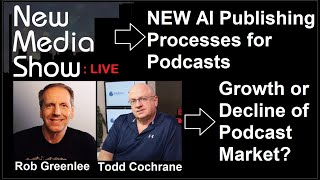
Todd Cochrane and Rob Greenlee discuss AI tools for podcast workflows, domain name trading in the podcast space, and the challenges of daily versus multi-weekly production schedules. They promote a Bitcoin tipping model through Lightning wallets and new podcast apps like Fountain and Podverse that reward listeners with Satoshi.
Chapters
Welcome to The New Media Show. We're back!
Doing The New Media Show again.
People are actually going to listen to this junk.
We do it live.
We're live right now.
We'll just do it live!
We're going live! We're going live!
We just can't get enough. The New Media Show.
Let's go!
Just do it live!
We're going live! We're going live! Badda bing, badda boom.
The New Media Show. We do it live. Just do it live! We're going live!
We're going live!
The New Media Show. I'm like Adam Curry and you're more like John C. De Vorak.
I think I am. I'm Todd Curry and you're the old curmudgeon.
We do it live on the New Media Show again.
The New Media Show technology, we make it sound so special and it is special. Welcome to the New Media Show, everyone. Hey Rob, how you doing?
I'm doing great, Todd. It's great to be here. So, you know, it's another, another week of the New Media Show. I think we're well over 500 episodes now. I think we're pushing 600, right?
Uh, no, I think we are, uh, The number hasn't— now let me look at the official number. We're at 551. Yes, this would be 552 today.
Okay, so we got another year to go to hit 600.
Yeah, absolutely. And you know, did you see the last show's album art?
Yeah, I did.
It was cool. It was pretty cool because I followed the intuition and I named the last show AI Discriminates Against Black Podcasters, and then the image is, uh, people that are protesting and almost having a riot around what looks like a big computer bank. And, uh, so I thought, oh, it did, did pretty good. And then, uh, the video one was not as good, but anyway, it, it, it sufficed. But I, I do have to say, we, we have some boost. Some boosts have come in to the booster. The boost have come in, and we, we've had some Rob, you have achieved getting some comments.
I have achieved.
Yes, you have.
Well, let's go reach some level of notoriety. Is that what you're telling me?
Yeah. Says Rob. Steve says, Rob, just for clarity, Satoshi Sats are Bitcoin, same as cents or dollars. It's just a term, not exchange linked or other coin currency. Lightning is, Lightning is off-chain Bitcoin, Bitcoin accounting. Like a bar tab or a business cash drawer relative to a bank account. 333 sats.
I think we're splitting hairs on that, but that's okay.
Well, it is. It is Bitcoin. It's, you know, I know it's Bitcoin.
I've always said it was. So it's all right.
100 sats from, from Weather_Brain. Great content.
Right.
Dave Jones says, I show 14,049 megaphone feeds in the index. And I don't remember what we were talking about. This is what I get for not watching the live stats during the show.
Uh, I think we were speculating at one point in a past episode about how many, uh, feeds or shows are in Megaphone, and I just don't know that we knew an exact number. I think we threw out some, some numbers.
Okay, so 14,049 stats for 14,049 feeds.
And then we maybe had mentioned a number like 40,000 or something like that, and I think he's, he's correcting us.
Yeah, I never thought— I, I didn't— I kind of knew what the number was, but I don't ever want to like reveal all my sources.
Well, it's an interesting number actually to think about from the context of the hosting platforms. You know, they are— Megaphone has been a platform that has been fairly, you know, much an exclusive club. So that's—
they got—
that explains a lot of why you see a 14,000 number versus, you know, you know, your platform and Lipson, whatever, being in the more than the 80,000 range.
So we're not more than 80,000. We have, we have 80,000 use a variety of our tools. We don't have—
yeah, exactly. Yeah, yeah, whole tool set, right? It's the same thing with the, you know, like a Lipson or a Podbean or whatever. They're all, you know, even, even Buzzsprout's in that 100,000 range too, as far as, you know, shows that people are publishing in there. I mean, there's a lot of accounts in all these platforms. It's the same thing with Spreaker too. They've got a lot of accounts, but a lot of them are really full podcasts. That's right. Doing, doing very much right.
There's, there's over 600,000 user accounts on Blueberry, right, that are classified as podcasters. But that site's been online for a while too, so a lot of those accounts haven't been logged into for years. So It means nothing.
If you— yeah, and if you think about the numbers that we see every week is that there's only like 200,000 shows that are actively updating every week. That kind of gives you a, you know, kind of a broad picture of what's happening in the media.
So that, that number means nothing, you know, right?
Right. And especially the 4.4 million shows, right, really means absolutely nothing, right?
Dave says, uh, $12,000 says, come on, Todd, we all know the reason Blueberry closes at noon on Fridays so y'all can listen to Podcasting 2.0 at 12:30.
Right.
Well, you know, I do get that advantage now that I'm able to listen when they come online. But, and then here's the— Adam Curry came in with $10,000 says, AI is like talking to an intern. Quote of the show. So anyway, so we did have some activity.
That's kind of how you've thought about AI. I know a few months ago, that's how you gloated about it. Well, I don't need to hire an assistant now because I have ChatGPT.
Although just before the show, I said I might have to hire an assistant now because, you know, we'll be honest with you. What it is is we did hire somebody that's been with the team for a long time., that spent part-time and we brought her on full-time and we just got, we just got a lot to do. And, uh, part of it's also because we've been testing a bunch of tools. Um, I'm not going to mention the tool, but I'm about to write a very big check. I mean, a very big check for a tool, a check I don't normally write.
For a third-party tool that you're going to integrate or something, or a party tool we're going to use? Use in the platform.
Okay. Yeah. And, and that was more of a backend thing. It's going to be, it's going to be, it's going to be for Blueberry. It's not for the podcasters. This is a—
got it. Yeah. It's a tool that you're using as an organization to better manage your business.
Okay. So yeah. And that one was like, you know, go to the board and say, hey, I, I, I need a check with this many zeros on it, you know, and gulp, you know, and, you know, 3 meetings later and, you know, much discussion. So yeah, but there's some, there's some really, really cool stuff out there.
And so is it— I can, I can poke and prod you on this one a little bit.
Nope, nope, nope. Can it be? Nope, because it's top secret. You got to go find it yourself.
Oh, okay. I was going to use some generic acronym to describe what it could be.
I'm not, I'm not making any commentary whatsoever.
Uh, okay, but you did though. Right, but that's okay. Yeah, we'll let you off the hook here.
So anyway, the, um, uh, I, I've been testing and continue to have a little bit of fun, and there are— I'm sure at Podcast Movement we're probably going to see a dozen vendors there that are going to be promoting to podcasters their, their wares., and I don't want to get too far into the AI. Everybody does, doesn't they? Yeah, I don't want to get too far into the AI piece, but I just want to explain the process I'm using currently just so everyone understands.
And it's not publishing process utilizing some AI tools.
It's uncomplicated.
It truly is. Uh, well, that should be what, what the results are, right?
It's uncomplicated, right? So because I don't get my transcript until— the way I work, and the other people that work differently, if you get your transcript before you publish your episode, then you can flip the script on how I do this. But what I do is, let's just take my tech show. My tech show, I, I pick one— I'll cover 30 topics in my tech show. I'll pick my lead story. Yeah. And then I will take that article from that lead story and I'll put that in ChatGPT. And I have a script that I have written. I've refined my, my script. And basically I ask it, give me 10 titles, write me a summary with so many words, give me a keyword. SEO-associated keyword with that summary. And because I use Yoast, I say give me a maximum of 143-character summary of the summary, right? So I get 4 things: I get 10 titles, I get a summary, I get a keyword, usually 1 or 2 words— I have to tell it to minimize it or it'll give me 5— and I get a Yoast summary. So I take that data and along with the article that I have referenced, and I'll pick a title, copy the summary, do my own editing, basically personalizing it, make some personal commentary at the beginning and the end, get it really kind of cleaned up. Um, and then I will, uh, oh, I also ask it to create me a description of a visual description of the summary. So the summary that I've asked, like, give me— so I actually get 5 things: title, 10 titles, summary. I get the keyword, I get the Yoast summary, and I get a visual description. The visual description is not great, but sometimes it gives me enough ideas to get the— to get an image out of Midjourney. So then I go to Midjourney and I try to get an image that looks right. Meanwhile, the episode's uploading. And as soon as the episode's uploading, I usually have the base done of the post. And I'll go ahead and hit publish. Now, the way the Blueberry system currently works is because we work in a We create the closed caption file immediately after the show is published. So we've got the last master of the audio to create the summary from, to create the closed caption. At the same time, I get a text version of that delivered to our management system. So about 3 to 4 minutes after I've hit publish, and if it's basically first out there and the podcast is published, is I'll get the transcript. Now, if you get your transcript before you publish your episode, you could take your transcript then, and I'm using currently, I'm using Claude, and I tell Claude AI, uh, to— this is the new way I've done it— I said, pick the top 10 stories. You pick the top 10 stories from this posts or from this transcript and write me summaries for those top 10 stories. And then if you look at what's come out recently on Geek News Central, and we'll try this today with this show, we'll see what, what if it's able to discern, because it's easy to discern because I'm changing topics dramatically from article to article. But if you look at Geek News Central's latest post, My headline was Google Enhances Online Safety. And then it gave, I've got my summary along with my, and then I put in here top story summaries and it gives me title, summary, title, summary, title, summary, title, summary, title, summary, title, summary, all the way down. Mm-hmm. And then I get information about the sponsor and I'm gonna reformat this page now because of the way I'm doing this, it's laid out not quite the way I want it. And then at the bottom is I have all the corresponding links and time hacks that go along with the content.
So when you click on those links, does that activate the player?
It does. It'll jump to that place in the player. So what I've done now is I've taken what I used to have of just a paragraph or two of show notes, and now I have much richer A much richer summary. Now I have to edit every one of these. I have to look at— it's a Google improving tool. They're accurate. Yeah, to make sure it's accurate, make sure that there's nothing been in there weird. But again, I tell Claude, I say, do not use external sources, only use from what I have discussed in this text.
So you have to be explicit about that and describe that, or is that built into your algorithm?
That's what I tell it. I, you know, because I'll say, please write, pick the top 10. And I say, only use, don't use external sources. I don't know if it will, but I'm telling it not to. And then I get these 10, these 10. So again, we have to remember one thing. They're saying, Tom, why are you doing this? I'm not doing this for the audience. You're doing it for Google.
Doing it for Google. Right.
Or Bing or whoever. Whoever. Right. I'm not doing this for the audience. So that's the key takeaway here. Quit thinking about your blog post is something your audience— this is for discovery. This is to build better.
Well, that's your ultimate goal. Ultimate goal. Yeah.
Is to better, better connect with the search results. So ultimately what's going to happen is, and this is where podcasters are going to have to be very, very cognizant, and businesses too, search is changing.
Yeah. All you have to do is go look at Bing and you can see how it's changing, right? And Bing is the best example right now to go see where this is all going.
So if you don't want to be eliminated you have to now start feeding the language model. And this is for survivability 2 years from now.
Yeah, I started, Todd, I've been trying to, over the last couple days, I've been trying to train ChatGPT more and more just about me. Right. Because it doesn't seem to have a very good grasp of who I am.
Every time you take and start a new chat, You erase the field. So you have to stay in the same chat to teach it about you. You have to stay in the same chat thread.
Yeah. But the question, and this is what I've been testing it, is whether or not it remembers. Yeah. So if I were to come back in a couple of days later, do an entirely different query.
Oh no, it won't.
It won't. Well, I've seen it. I've seen it learn. I've seen it learn a little bit. It doesn't always spit out the whole picture. Right. Right. And it will very quickly and easily default back to, well, my dataset's only from 2021, all this kind of stuff. But it will give you a little bit of teaser from some of the new information. It will actually tell you when you give it new information. So let's say you give it your resume, right? Just say you put it in and say, you know, add, add this to Rob Greenlee's You know, index profile or however you want to term it, and it'll go through and it'll scan it and it will summarize it. It'll rewrite it itself to some degree after you do that, but it will thank you for giving it the information. And what I've seen subsequent days afterwards is that if you do specific queries about certain aspects of that resume, it will pull back the information from that resume.—
in a specific reference. So this is going to be the ultimate goal for me is the tech show's not going— the tech show, you know, it's— the better thing to do is almost ask a question and answer. Say, what has Google done to enhance online safety tools? That should be— that's almost what the title of the episode should be. Versus Google enhances online safety tools, because people are going to be Googling, Googling what has Google done to improve online safety tools, right? And if you're a— if you are a source that is trusted, you may end up as the part of the quote that the language model will look at later on and maybe link to you. So if you're now doing a single— let's say you like this show, we talk about 3, 4 topics typically on the show. How do I get what we've talked about during this show to a 1,500-word blog post description, right, that goes along with it?
Not 500 words, 1,500.
That's what you do with this episode every week now, is you get a summary Output. But, but the summary output in currently, we're only getting about maybe last show we get, you have to do the word count, 400 or 500 words.
Yeah, it wasn't that big. Do you really want to have too much more than that?
Yes, because things have changed for Google. But the key is it has to be good content and it has to be, it has to be Okay, so what I did on GNC, and again, I'm experimenting on my own SEO here. So, you know, if I do this wrong, I'll make sure everybody knows I screwed myself. Is what Google, if you think about Google and some of the top ranking search pages, you get these very long articles that talk about this, this, and this. And usually, let's be kind of frank, most people probably only read the first page of data. They don't get too deep into the meat.
Well, that's, that's where my question comes from, is that once you get beyond about 500 words, you've probably lost it. It's kind of like long-form content sometimes. Yeah, but you get a lot of people listening to the first half but not the last, right?
So again, I think that it's an experiment over time whether or not this extra metadata is going to make a difference.
It may make a difference to Google, but it may not make a difference to—
it won't make— yeah, and humans, we don't care because, well, you do ultimately. Well, we want them For me, I want them to get to the website and click play or follow or subscribe.
That's the goal. That's the result aspect of this. I don't know, Todd, have you gone and played with the Bing search capability that has the integration with DALL-E?
Yeah, it's okay.
You know, again, I don't know about you, but I got into a conversation with the AI at one point where it was probing me questions. Well, that's a little weird. It was like saying, well, would you tell me a little bit more about this part of what you're inquiring about?
Yeah, because it's trying to build a better— because it's about the prompting. You have to learn.
My prompt now is about— it was— no, my point is, is it was prompting me.
I know, but give it a better prompt. But that's right, because you didn't write a good enough prompt.
So, well, yeah, but that's all That's not exactly, you know, that's not a solid comeback on that because it's very subjective, right? What's— that may be the prompt that you wanted to create. It may not, you know, and it's prompting you for more information, but you may not have thought about it even considering that information.
If you want demonstrated results again and again, again for a repetitive task, you have to write a good prompt.
Yeah, but how does the, the, how does the AI know what's, what's good or what's better?
I don't know what's worse. I never let it take its own data. I feed it data.
That's the difference. I'm not arguing that point, but, but the AI is, is just probing for information based on what you gave it, no matter what you give it. Right. Well, then that's, that's a problem. Why is that a problem? It's taking what you've given it that maybe will always be imperfect.
But I don't want it—
I don't want it to be— pulling out finer details based on its intelligence.
I don't want it to be injecting stuff that it thinks it knows.
Well, that's why it's asking you. It's looking for that information so it can be more accurate.
Then again, you didn't give it a good enough prompt to begin with.
Okay.
We're in a similar scenario. Again, the problem with that is Yeah. Well, then we'll see what happens. Again, I'm just telling you my process. And then as soon as something starts asking me questions, then I'm going to get suspicious.
Why?
Why? Why does it need that when I have given it the data that I want it to work on?
Well, that's, that's another question, which is, do we want to limit AI's ability to do what it's told, or can it have some intelligence itself and delve deeper into those topics that you have.
Well, if it delves deeper, if it delves fully, fully communicate. If it delves deeper, then that means it's pulling from its information and putting something on the screen.
Not necessarily. It's probing your head to create, I guess, I guess what you can say is a better prompt.
Well, again, I'm using this for a use case in creating the blog post for a podcast episode. I'm not gonna get into the use cases of doing research.
Well, that's probably a different use case. So I mean, if you're using this AI just to pull information out of a transcript, right, and that's a different use case than actually having a conversation with the AI and delving into a topic of, you know, the human survival in the age of AI, right? Having that conversation with the AI is going to be one where there's going to be a back and forth as well.
The human survival is of your job is what's important right now, and being able to write great prompts and be the subject matter expert.
I think we're a few years off from, um, mass amounts of people.
Yeah, I'm getting emails, people that listen to my tech show, that says outside of the United States there's already mass firings happening. Yeah, but is that happening for economic reasons, or is that happening because of AI?
It's happening because of AI. You can't kind of somewhat can't separate those things entirely. So, well, when a company fires copy editors, copywriters, well, okay, for certain type of jobs, of course, those are gonna be specifically to what AI does.
Well, they're going to be, they're going to be gone. And knowledge workers, again, those were knowledge workers. Yeah, it's so automation is coming, right? So, you know, people that are, have been doing freelancing out and basically doing nothing but being content writers, they better find it, better, better hurry up quick or they're going to be extinct.
Well, it's going to be copy editors, not writers, because they're going to still have jobs for a while.
Well, the people that are the subject matter experts, if you are not a subject matter expert in the content you're creating, you better not use these tools. You better, you better be very careful on the output that these tools give you if you are not the subject matter expert of—
well, that's, that's kind of my point, is that you need to have enough expertise to be able to edit these things, right? And make sure that they're, they're accurate representation of you. If you're going to use these to put them out there, right, they need to be edited, you know. And who's going to edit the edits? And, you know, I mean, I'm already seeing this, and I've mentioned this on the show before, is that you output from ChatGPT GPT or any of these tools and you run it through Grammarly and Grammarly rips them apart.
So it's grammar— it's— I'm seeing 90 percentile scores by Grammarly. Uh, yeah, I mean, it's, it's not bad. It's not bad.
But you know, that's why it definitely wants to rewrite things. So that's the, that's the problem with transcripts. You don't want to run them through Grammarly. Oh no, Grammarly is going to change everything.
No, no, no, no, no, no. But right But again, again, this is, this is okay for what I'm doing. I would have never done before. It took too much time. Why would I launch? Why would I write? Okay. One of the stories I covered on my Monday show was PayPal launches a new US dollar-backed stablecoin. I would, that wasn't my headline, but I would have never wrote PayPal launched a new cryptocurrency stablecoin called PYUSD. It is backed 1 to 1 by the US dollar. So $1 of the PYUSD equals 1 US. Our users can buy, sell, hold, transfer coins within PayPal system. Stablecoins attempt to provide the benefits of crypto with less volatility. So that came from my transcript. I would've never wrote that, but that's what I said.
Yeah, that's true. I mean, there's been hundreds of episodes of this show that have never been summarized.
Never. Never been summarized. 550 shows have never been summarized.
We could be called, called to the carpet for things that we've said much more easily. Well, believe me, I don't know what you say.
Yeah, I'll be editing, don't worry. But it's going to go in the AI and it's going to be part of our, our, our history. But if you think about this, for 3 or 4 years, maybe even 5 years, Google has been taking creating summaries, creating this already within their own internal platform.
Actually, I think Apple's been doing it too.
Apple and Google and— So what have they been doing with those summaries? That's the question I've always asked.
Well, they always said it was to generate better search results.
Well, maybe. Is it being fed into their language model?
Who knows what that's being fed. Apple's gonna have an AI.
Platform. Yeah, they're going to stuff— their stuff's going to be tied to specific things that you do with their tools.
It's the same thing that Microsoft's doing too, that they're tying it to individual products and things like that. But, but yeah, but, but all these big tech companies are going to have big language models and graphics models and all that kind of stuff. I mean, it's, it's going to be crazy over the next couple years.
So ultimately, I want, I want to be able to train this thing to create chapter files too. So You know, that's kind of my next experiment that's coming up is I'm going to say within the transcript, okay, write me a chapter file, give me the time hacks, the topics, and I'll have the links already. Give me the time hacks and the topics of when this occurred and write that in a summary output and see if I can get close to having my chapter file data kind of preempted and get the time hacks pretty close because now I pay Kirk to go through my show, find those break spots, write the time hacks down, and then come back behind after the show's produced to create the chapter files that go into these apps at podcastapps.com.
So, so the AI does that, but they don't generate the links to the player.
That has to be— well, they don't, right? Well, they— if as long— I can— I've taught it already As an ex— okay, as an example, um, Kirk, who does my pre-production, he creates, um, in WordPress the, um, the title of the topic and the hyperlink going to the article. So I have that all in my— well, let me show you. For those of you that are watching these, these time hacks that are in here. So when this show is published, all of these links— PayPal being MrBeast, the next CEO of Tesla— all these links are already in the show notes when I get ready to publish the episode. He's already got that preloaded in there for me. With those hyperlinks. And then he comes in behind and adds the time hacks to these articles. And so what I want to happen is have the AI generate, right, generate the time hacks.
So how do you get the AI to, to, to know?
Is that a prompt? Well, I just have to prompt it. It's something I haven't experimented with yet. So because I have a an actual closed caption piece with second-by-second time tracking, it should be able to tell me, it should be able to take that file and say, okay, here's the hash mark. And if nothing else, all I would have to do is take that data and maybe I still have to send to Kirk and he QAs it, but maybe it gives him a little easier way to get through because it probably takes him a half hour to an hour to get these chapter marks done. That I pay for, I can save him 15 minutes by being able to jump. It's time he's going to get back and we'll just let the tool, you know, get the rough for me and then we'll, we'll go from there. So again, this is all experimental stuff, but the key, the challenge is, is getting— well, let me tell you what else I do. So he's written these out, right? So I, when I go to YouTube, and YouTube will not take HTML. YouTube will only take basically title. And so let me go over here.
Let me get to the last—
it's a security vulnerability for them. Yeah. So, well, they'll list the links. Don't get me— they'll, they'll do the link. So if you— if we look here, Yeah, I can put in, um, IRS will let users file taxes online, and it's a dash in the full path, and they will show that in the, in the episode information. That is all linked in the episode.
Where does that go when you click one of those links?
It'll go to the, it'll go to the content.
So if I actually load that up, if I load that up in In YouTube?
Yeah, absolutely. So if I load that up and I go—
okay, so that, that must be generated by YouTube then.
See, no, look at that. See right there, right? But it won't let— it won't let me create— and that's a clickable hyperlink. That will not— so basically what I've done is he's done the work already. He's actually got an HTML on the, on the blog But what I do then is I have ChatGPT strip the HTML and give me title, link, title, link, title, link, title, link. So basically I'm able to put the hyperlinks. I never would do this for YouTube before because it took too much work. I would have to write the, write the title, put the link. Well, he's already done that in pre-production for me. So I just have it strip the HTML and give it to me that way. So it's just these little things that— and that's why it's taken now about 15 minutes longer to produce the show notes, is because I'm doing these extra steps of stuff that would have took hours and hours and hours.
So yeah, it's a, it's a high-value time, right?
You're saying so, you know, and maybe you guys are tired of hearing about this stuff, but I'm just telling you the little tricks I'm using to try to up my game in, in basically having a more, a more polished show notes. Yeah, for Google to chew on. Again, the content is— this, this content everyone's listening to is what they come for.
They don't care about the links, right? To change the subject a little bit here, Todd, I thought it was amusing as I think about you In the context of your history, which most people don't know your full history and the things that you've worked on over the past, but, uh, I saw on the news, Acast basically announced that they're enabling real-time podcaster and advertiser collaboration, uh, with this new Ad Collab with, uh, host read ads. Did you see this? And, and it harkens back to my memory of the platform that you built like 15 years ago. That kind of did a similar thing? It still does. It still does? Okay. Yeah.
So you're still actively using it in your platform? When we have ad deals come through, absolutely.
So, I mean, did you see this?
Is it— I haven't, I haven't looked at carbon— I haven't looked at their tool. Carbon copy of what you were doing? But essentially what we did, the way our platform worked was I would put in, okay, example, they, they come to me and say, an advertiser can come to me today, say, Todd, we want to reach these types of shows. So I go into our comp, our campaign advertising management system, and CAMS, and I put in this criteria, and it, it gives me a list of shows that meet the criteria. And I do that. And then I pick the shows, it adds it to the campaign. We produce that list that goes back to the advertiser. The advertiser— usually this is kind of the sequence— the advertiser looks the shows over and signs off on them. And then we use the system to email the podcasters and say, hey, here's the deal. Come into the system, review the requirements. Here's the terms, here's the copy, here's the frequency, here's the start date, here's the end date. This is how much it's going to pay. If you agree, click here and you've signed the contract and you're off to the races.
Um, yeah. Yeah. So when did you build that, that, that tool talk? Cause I was just reading this ACast thing. It says this platform enables podcast hosts and potential advertisers to collaborate in real time to create host-read sponsorships. 2007. This, this new product simplifies the podcast host read sponsorship buying process for podcasters and advertisers and sales team alike.
They figured out that they can't scale.
Well, that's, that's what everybody's been trying to solve, right?
Is the scaling issue around host reads. And I've had that since 2007.
I know, right? But you, but everybody has the same problem with this is that podcasters don't answer their emails.
That's right. I've had, and I set rules up. Basically, you know, if you don't get cut off, if you don't answer within 72 hours, right? They come in and say, oh, that offer's gone. Yep, it was. You had a 72-hour limit to respond to your email.
That deal's done. It's actually a question that I have for ACAS.
Does ACAS have that response limit?
Don't tell them about it.
They have to find the hard way. And then there was— and then that's why I had— that's why there's a separation now at Blueberry. If you've agreed that you'll check your email every day looking for an email from us, we will give you a higher percentage of the advertising dollars.
If you've agreed you'll respond—
a little gamification going on there. If you, if you respond within 24 hours of the inquiry, you will be at a 70% rev share. You get a little gold star too. If you're under— if you respond outside of 24 hours to the ad deal, it's 50%. Right. So we, we cut your, your commission just because you are not looking at the email for us. Because what happens is, you know how this works. Friday at 2 o'clock, my phone rings. Hey, Todd, it's the 23rd. I got to move $10,000 worth of inventory in the next 5 days. Can you help me out?
Yes, I can.
Over the weekend. Over the weekend. I want to launch this immediately, like launch it tomorrow.
Yeah.
And there's been some sketchy things that have gone on under those circumstances before, you know, that people's trying to spend the rest of their budget because someone else didn't move it, right? I love those calls because I'm like, we'll just have to include this in an extra 5 more shows, but the client didn't know about it, you know. So it's just like, yeah, and they don't, you know, just go run, blast off, take care of it for me, do the spend, you know. Those, I love those. Those. Yeah, because I just load them up, right?
And, and go run it, run it 3 times instead of 2 times.
Well, no, we only run— we don't run that way, you know.
I know you don't, but so some have done that. I've seen it firsthand, uh, happen in the past.
So it's, it's a long past, you know. Oh, okay. Well, yeah, they're having it. They're trying to figure out how they can scale beyond 10 shows.
Well, if they have to hit a certain impression, right, in a certain timeframe, right, if they don't hit that impression number in that certain timeframe, they don't get paid the full campaign. That's right.
They only get down to— they only—
they lose out on money, right? So there's a big incentive to say, well, we're going to hit that deadline no matter what.
But you still have to have— you still have to have either you— I won't tell you. Okay. There's— now I won't even say anything. Acast has to learn the hard way. Yeah, um, yeah, but yeah, you got to count on, you know, them paying attention to the, to the email you sent them.
And it does appear that this, this tool is biased towards, um, dynamically inserted host reads. So that's— I think that's the game that they're playing here. So it isn't the true organic, you know, Live read type of situation, though it could be. I just don't know if the tool enables live read.
The problem with that is then you're adding an extra step. You, you, that podcaster has to fire a studio up, right? And record these spots and upload them and upload them, right? Then they still have to do their show.
And if it isn't, then they're going to have to, and it doesn't explicitly say this difference. All it talks about is booking a host read campaign. All it says. So it doesn't really talk about this differentiation between whether it's prerecorded or live read. Right. I don't see a differentiation in the press release because before—
and we've talked about this 100 times on the show— we used to have 500 shows on an ad campaign because it took 500 shows to move the volume. Yeah, right. And then on the other end, the old days, and on the other end, I automated the payment system. System too. So everyone got paid by PayPal, and the money would come in, we would verify all the numbers, we'd put it into the system. Matter of fact, it was all automated, and all I had to do was go push a button and everyone would get their PayPal payment. I didn't have to do individual— it was everyone's PayPal. I had everyone's W-9s, I had everything in the system to be able to— because we were only 5 people. Well, matter of fact, who— what was I? I was running sales, I was running ad campaigns. I was wearing 5 hats. We didn't have a team, so we had to have a system that made it easy.
That's why I have no more hair. Yeah, so I don't know. I mean, there's a lot of details about how this new system works that they, they, um, launched here.
Well, as you get into the details of this, right, they should have called me.
They could have licensed mine. Yeah. All right, Bill, because the truth of the matter is the host reads— the devil's in the details. And I think anybody that's been around, uh, long enough realizes that. So there's advantages of doing the pre-reads, uploading definitely enables you to have more flexibility on hitting those impression targets. Yeah. If it's prerecorded, then if it's baked in, if it's baked in, you're kind of baked in, right? Yeah. Your outcome is fixed based on the variability of episodes that are listened to or published.
Right. Dave Jones says 10,000 stats. The PIC, P-I-C, it's shedding its sales guy.
Hmm.
Oh, that might be—
that's interesting. Todd, did you hear that the Podcast Academy just launched their own podcast for the first time? Oh, wow.
Good.
They got a Podcast 360. Wow. Okay. It's going to have different hosts and different guests pretty much every week.
That's going to work out well.
How do you do that? A lot of scheduling and coordination, I would say.
Yeah, okay. Well, we'll see how, we'll see how the, the show is. You're gonna get us over there so we do an episode of it?
It says it launches, right? It launches, uh, I guess yesterday or something like that, and it has a different host and a different interviewee each week. And the show features podcast company founders interviewing each other as they answer 3 questions all about podcasting. I don't know what the 3 questions are yet. I guess we'll have to tune in to find out.
Yeah. Okay. Well, we're fast approaching Podcast Movement. Yeah, we are.
It's gonna be— Dan is Dan Franks is going to join us after.
Okay, so it's, it's too, too busy. It's, uh, you know, I just— Mackenzie mentioned that I'm gonna go ship stuff. I'm like, what, you're shipping? They have a warehouse you can ship to early and get everything in there. But, um, yeah, it's right around the corner here, uh, and I'm just like, I've got— it's, it's never ending. You know, when you're, when you have us, when you're, when, when your dev team says, hey, we're running short on tasks, you're like, oh my God, you know, you've already, you know, you and you got your production team at full tilt. And then, then 4 of us are going to be out for a week. You're like, how am I going to keep up? You know, so yeah, the How many folks are you bringing to Podcast Movement this time? We'll have— well, we have one gal already in Denver, so she's going to come. And then actually two people that already live in the Denver area, so they're going to come. And then it'll be Mike and I, Mike and I, Kathy and Ben.
So 4 total.
Yeah, it's a good crew. Yeah. So we'll see, see how things go at the event. Of course, heard this hotel sold out. So that is— I wonder how many rooms that was.
I don't know what the block size was.
Yeah, but when the hotel sells out, that's a pretty good sign.
It is a good sign. So I guess there's a couple spillover hotels that are fairly close. So if you haven't booked your hotel, there, there's options. Yeah, it's just not in the same facility. But in, in the same facility is kind of expensive.
So maybe the Maybe being off-site might be a little bit easier on the pocketbook. So yeah, that venue is never expensive. It's the same company as that they had the one in Nashville, I believe.
It's the same. Yeah, I think it's the Marriott, right? Oh, I'm not sure. No, I think all the hotels that they've been doing their events at have been on the Bonvoy app.
Oh, okay. Yeah, it probably is. So that's nice, I'll get some points while I'm there.
They don't usually add up to much though.
That's— well, you know, I've been, you know, whatever it is, Double Diamond or whatever their highest status is for years. Oh yeah? Well, because I locked it in when, when I was basically in 2004, I was essentially living at a Residence Inn in Waco, Texas for months at a time. So once you acquire so much so much status, you just, you get to keep it. It's not like I'm staying 60 nights a year in a hotel anymore.
Um, yeah, that's true. None of us are doing that as much as we used to. No, not at all. I was traveling a lot in the past.
It's not doing as much at all. I am definitely not going to make my 100,000 miles with United this year unless some something—
yeah, I've lost my, my premium status already.
Yeah. So I, I care— what saved me last year was going to Riyadh. That pushed me over.
So unless there's a long flight—
well, it was also first class too, so those were some serious points for the, for the distance, you know. So yeah, um, if I— unless we catch one of those gigs again, I'm not definitely not going to make stats again this year.
Yeah, but you know, it's, it's kind of a weird time in podcasting right now, um, if you follow the, the news about what's going on. So you're seeing this convergence of, um, companies coming out saying that their revenue's up and they're, they're growing and all this kind of stuff. And then there's other, other reports that are saying, well, this, this, uh, festival canceled their podcast at the last minute. And so you're seeing this kind of— I don't know if it's just like a, like a mixer of conflicting news. Some— sometimes it's good, sometimes it's bad, all at the same time. It's— there isn't just a general trend line that I feel, other than there's just fewer new shows being made.
You know, it comes at the end of the month, every month. I'll, you know, I look at the report— is the green line above the red line?
And then iHeart even said that their, their numbers are up. Um, their podcast revenue is $97 million, up 12.9%. Okay. 25% quarter on quarter.
Okay. And I mean, then it means that you saw the same thing with ACAS. Then it means, then it means people are listening.
Well, it also means that, that the layoffs worked, that they, they're more profitable.
Of course, it doesn't actually say they're more profitable.
They didn't say how much they lost. It says more revenue.
But is that inflated dollars or is that? But even though Acast made money, wasn't their stock getting delisted?
Well, it was getting down to potentially being delisted. I don't know that it ever ultimately was. $1.21 or something like that? Yeah, it was pretty, it was pretty low, I think, there for a while.
Might be a buy opportunity there.
Yeah, they seem to be doing a lot of interesting stuff in the podcasting space, no question.
They seem to be, you know, Growing. Well, yeah, we'll see over time. But yet, how come people get— keep getting laid off if everything's so hunky-dory?
It's an interesting, uh, thing to ask, Todd. I'm not sure that I have a clear answer on why we're seeing, uh, all these companies with glowing financial results and rocketing growth and sales and, you know, all this stuff, while at the same time they're, they're letting go half of their staff.
And if you hear the news, you hear the economy is fantastic, everyone's happy. I, I want to know what planet that information is coming from.
I mean, I just wonder if this is really falling out from what Elon Musk did to Twitter when he took over. He just, you know, and all these other tech CEOs are saying, well, shoot, I— we don't need all these employees, let's just get rid of them, we'll be more profitable.
But job, record jobs growth and everything.
So come on now, it's, uh, where's the beef?
I know I just dated myself like 20. I know, but you know, here's the thing, where— what is going on here? What is— I talk to people, you know, I'm in this— I'm in a predominantly small rural community that, like, the average medium income in this county, I think, is $35,000 a year. That's the median income level. So you think there's people below that and people above it. If it's $35,000, that's, that's saying something, right? Right. People are struggling. They are struggling. You hear nothing about, you know, and I ask when I go, when I go grocery shopping, I ask, I ask the checkout ladies, what are you seeing? She says, people just cut down on everything. They get bare essentials, no nothing special, no treats, nothing extra. They're just getting the minimum amount of stuff they can buy to survive because cost of food and everything has been up so high. So I, you know, maybe the cities are doing good, but rural America, that's— I don't think it's—
I don't think it's in good shape. Well, it's an interesting, um perspective. I just looked at the Acast financial results and it says for Q2 2023, net sales grew 22%, led by North America sales that were up 31%. Um, so globally they were up 22%, 31% right here in the US. Of course, they didn't have a huge presence here in the US, so that makes a little bit of sense. Um, total listens increased 4%. The company, uh, loss almost halved. So they've been continuing to lose money. So, so they're still losing money. Yeah, exactly. And it says here, it says the company says it's on track to getting to profit in 2024.
How can you lose money when you have that much revenue coming in?
I don't understand it. Well, that's, that, that's, I guess that explains the, the layoffs and the cutbacks. Usually that's how they're getting to profit is by eliminating staff.
But usually 40% of your expenses is employees.
Right. So that's how— and that's the easiest to trim. At the end of the day, that's the mechanism to get them to profit. And it looks like it's working.
It's getting them to be profitable in 2024. What are they keeping percentage-wise of those ad deals? They're keeping 20%, 30%, I'm sure.
At least 30%.
Yeah, that's like the industry minimum. Maybe 50%. So if you've got, what did they say their ad revenue was? It says American sales.
Okay. What was total? US sales were $8.4.5 million or no, 84% or $84 million. That was, now what was their global?
Uh, it doesn't say in the post that I'm looking at what the global number is. Okay, so if they had $84 million in the United States, just in the U.S., and they— let's say they kept at a minimum 50% of that, that's $42 million. And you divide that by 12. Now, this is for a quarter, right, or a year?
Doesn't, uh, well, it, it does mention that's quarterly results.
Okay, so let's think about that. All right, so $84 million, they kept $42. Let's, let's just say they took the max of 50%. That's $42 million divided by 3 months. I can't— they can't— they can't get profitability at $14 million of, of keep it money every month, something is wrong. If I had $14 million a month of just advertising revenue—
well, that's probably hosting and advertising, but yeah, but okay, they're hosting.
Let's say that they're hosting. Their hosting's no more than— their hosting's $50,000, $60,000 a month. Maybe that's what their hosting costs. Okay, so another $40,000 for, for ad delivery. Mm-hmm. Let's say no, let's just say $250,000 for hosting and ad delivery. They still come on. That's $13.75 million. You still have if you're keeping 50%. Unless they're working on smaller margins. I don't, I don't get it.
How many people do they have?
I don't know, I can't— yeah, what's their headcount? So I don't know, I guess I've just, I've just been used to running lean, you know, run it really, really, really lean from a staffing standpoint.
So it's, it's looking like their, their total company is $201 million for the quarter.
Uh, yeah, it doesn't say it's annual. Even if it's annual, Come on.
That's, that's a hundred. It's actually a lot of revenue.
That's a lot of revenue. Right. And you're working on an ad business where you're just, it's, you just, it's pure profit because you're keeping a percentage of that ad revenue. Yeah.
I mean, I hope that our, our numbers here, I mean, I'm, I'm looking at their statement, but their statement is out of Sweden. So it's always kind of couched in this. Yeah. Yeah. Swedish dollar versus the US dollar and it's back and forth.
Well, you know, if you saw their full financials, which should be if they're listed on the SEC, we just have to go look at the— you can see their full financials on what they're, you know, where they're spending money.
So it, yeah, it says that the operating loss was $112 million.
Dave says 10,000 sats, you can get to unprofitable, you can get to unprofitable extreme revenue By perpetually undercutting competitors on price, which is unsustainable.
That is true. Absolutely true.
Sure, you can do that. Yep, you, you can, you can, you can cut your prices so low that you just lose and burn money and hope for the best and thinking you're going to kill your competitors. Well, you know, I look at my own business. We do not spend more than we take in.
Yeah, it says gross margin for the quarter was, um, 30%.
Said they— that's, that's huge. That's—
business would die for 30% margin. But it says the second quarter of 2022 was negatively affected by one-off costs linked to certain podcast agreements. Yeah, so basically they had to pay their way out to get out of deals. They signed a big, big, a big, big contract with, uh, President Barack Obama and—
oh, so those are the ones they had to get out of. They had to, they had to write, write the check. So, you know, I guess— I, I don't know. I, I've always looked at You know, we, we build a little bit of a nest egg, you know, and it's, it's not this like this extreme amount of money, but, um, you got to plan for a rainy day. Companies are complicated.
Yeah, I guess so.
It's not always easy to pull it apart and really have a, you know, clear picture. If it's an American, if it's, if they're on the— they have to file whatever that K thing is. You just have to look But I thought they were SEC or something like that was about ready to delist them or something.
Maybe I'm wrong. I had heard that too, that it dropped below $1 per share. It doesn't say what the share price is here that I'm looking at.
But anyway, I just— it's one of those deals where, you know, we— I've seen tough times, you know, 2008. Yeah. We came through 2008 pretty clean. It was pretty lucky in 2008.
But it does seem like the industry is weathering the storm fairly well, but there's, you know, there's continuing consolidations. I think there's been some listening platforms that have kind of faded away that I've kind of noticed. Um, you know, so there is a consolidation of power to some degree going on in the podcasting space right now. Right. Well, so, but that's, I guess that's what happens over time. It's just a complicated industry now because it's much more global than it's ever been. Yeah. And it's hard to get a clear picture on, you know, especially when these companies are coming from Europe and they're interfacing with the US and blending their sales results. It's, you know, I know ACAS has a pretty strong presence in Europe and outside of the US.
And some of those countries have extremely liberal leave policies.
And, you know, so outside of the US, the advertising market's still, you know, very immature. It's, you know, 3 or 4 years behind the US. You think so? Well, that's always been the talk. I think it's been catching up very quickly. I think you're looking out across the the world, it's, it's had the opportunity to learn from things that have happened in the US to some degree and maybe is fast-forwarding through it, um, you know, a little faster. Well, I think, but I think it is. I mean, I've always heard that the, that the CPMs are a little bit less outside of the US, especially on, on programmatic.
And I still remain pretty happy with our programmatic. Yeah, some shows are doing really, really, really well.
So are you pumping a lot of ads into shows outside of the US as well? It's people, ones that are being heard in other countries around the world.
Yeah, running local ads. Some, some countries better than others. Yeah, you look at like the top 6 or 7, they do okay, but you get outside of those countries like Canada and UK and Brazil and those UK, right? Those are— those do okay, but you get beyond that, it's, uh, it's challenging. Yeah, for sure. But yeah, it's a— it's definitely a global—
a global space. And yeah, so how do you think, uh, podcast movement's going to be this time? Do you think it's going to be packed house?
We'll see. We'll see. I really, I have no, no expectation of numbers or, you know, if the hotel sold out, that's a, that's usually a pretty good sign. It's going to be pretty big because most of the, besides Podfest did pretty well last, the spring. But there's really been very little regional stuff that's been going on. So, you know, I think that, uh, you know, you see some of these small ones. You're gonna go up and hang out with, uh, Joe, um, on the East Coast in Philly.
Are you going down to, to the Indie, um, podcast or whatever?
To the Indie podcast? To the— no, I, I have my con Sorry, I have not gotten an invite to go to PodCon. So, um, you know, unless they want us to come and speak or something, it's— we're, you know, we're being careful on events. You know, this is— there has to be a— there has to be a significant return on, on the investment of going and being at these events and, and being there.
Trade shows are not what they used to be. I think there's really a massive investment that's been made by many of the hosts in kind of more online marketing. Yeah. And they've shifted dollars away from events and driven them more into, you know, sponsored link campaigns, creating content and YouTube and Facebook.
And you look at the budget that Buzzsprout, Podbean, Libsyn, and others are spending on SEM, they could probably have the the biggest conference in the space by the amount of money that they're spending on, on, on, on SEM right now.
So, well, they wouldn't be doing it if it didn't work. So to some degree, um, so that's, that's the thing. And I know Lipson really shifted dramatically, um, to, to creating a lot more online video content. Yep. And I think that's a huge shift in the industry just in general, is back towards video again. You know, I know both of us are very kind of, um, old school when it comes to realizing that video's really always been a big part of podcasting, but it just feels like it's— we're in a different age now. And TikTok and what's going on with X now is, is gonna be interesting to see if that unfolds and X turns into another podcast consumption platform. Platform again. It goes— comes full circle.
I don't know. Um, yeah, we'll see. But we'll see. Yeah, if you're spending $40,000 a month per company on SEM, you know, it's just— you're just battling with one another. Uh, the price continues to go up. So, you know, that, that's, that's a big number. That's it.
Yeah, I think it even got— I think it even got to a point where competitors were buying their competitors' names.
Oh yeah, they still, they still do. They still do. And to, and to basically buy against that, that's, that's $10,000 a month to buy against that.
Right. And you're basically getting the number one placement on a search for your competitor. Right, right, right. Which is, I don't know if it's the most ethical thing to do, but that's, you know, that's doing business.
That's, you know, there's no, there's no, there's no rules in business. Google wins on that one. Yes, they do. And they, and you know, they're, they're very much wanting to help you. Oh yeah. Oh yeah. They call you and say, hey, we'd love to work with you.
And, uh, you know, all your competitors' names. Yeah.
And they do it. They do an analysis for you. And they said, well, you come in with this 6-digit figure every month. Uh, you know, we can, we can, we can help you.
Todd, did you know that you can, you can now record your podcast at Podcast Movement?
Oh, wow. Okay. Well, they're going to have a booth again.
I, I, oh, as far as a recording booth. Yeah. I, I don't know about that. I just saw it in the headlines here. And did you, did you sign up for the, the Brain Date? No, I have not. Um, event that's going on where you can kind of set up your own little kind of like, uh, group table discussion. No. Did you?
Yeah, I signed up for one. So I didn't even pay attention. I didn't even know they were doing that.
Got an email from Dan and Jared saying, why don't you go in and sign up for a Brain Date? So I went and signed up for a Brain Date. It's on the 22nd at 1:30 PM. In the, in the Brain Date Lounge.
Oh, okay. Well, should be fun. So are you getting anybody signed up to sit at your table? I've got a couple people already, so make sure you, make sure you hand out some, uh, blueberry flyers and, uh, and, uh, just kidding.
Why not? Sure, I'm a free, I'm, I'm a free agent now. I can— that's right, I can fly, I can fly the flyers everywhere.
You need to get signed up for affiliate program before you go. And, you know, get your promo code so you can earn from those referrals.
That's right. So I can host another one of my podcasts. I can just host it on Blueberry because I have— I can just scatter all my shows around to all the hosts and it keeps everybody happy. Yeah, there you go. I just need to start, you know, enough podcasts.
Yeah, like you'd have enough time to do 10 podcasts.
Right. Well, I do feel like I'm on that track right now.
So I see what you're doing. I, you know, I'm glad, you know, you got all this extra time.
So I got all sorts of this extra time. Yeah, absolutely. It's called, it's called complexity now.
So that's the problem. Yeah. Yeah. You need an AI to help you with your schedule.
That's what you need now. I've been on the hunt for an AI assistant for, for a long time. Oh, really?
Found a good one yet. Now there's a, you need, you need, I'm sure Scoville's getting you hooked up with all the different newsletters that are good.
Oh yeah. Well, I'm, I'm still looking, you know, I know he, he points me in certain different directions too sometimes. So I'm, I'm starting to create some, some 360-degree video content, you know, for his, his platform that he's building too. He's creating a new show called Unaligned. Right. Um, so we're—
I'm doing some stuff with him. So, so a couple things. A Podcast Awards slate was announced. I don't know if anybody went and looked at that, but, uh, we announced this late on Monday.
And, um, this is definitely awards time of the year. Yeah, it is. Gotta get in and get their show submitted.
There was something else I was going to tell you.
It just slipped my mind. Oh, and there's morning yoga too, Todd. So if you want to do that at Podcast Movement too. No, no yoga for me. And then an unofficial meetup.
So you can do that too. Well, the unofficial meetup will be at the bar. That's, yeah, that's where, you know, that's where the real work gets done anyway.
I'm going to try and set up a couple of unofficial meetups too.
So the, um, and we hosted a beer thing at the booth, so we'll have a beer being drawn and pints being given away.
That's going out the same time as the New Media Show.
I know, that's, that's part of the reason why I only want to do the show for, you know, the time that we've—
yeah, it's going on the same exact time, I think 4:15 to 5:15. Yeah, on the—
what, on the 20th? Yeah. 23rd, whatever day it is. Yeah, right. So that will be, uh, interesting, uh, interesting time. But you know, just, it is what it is. People will be wandering around talking to everybody.
Well, Todd, I'm gonna, I'm gonna be bringing, uh, with me a couple of video cameras, so hopefully we can, we can at least record the video out of that. Yeah, that'd be fine. That that new media session that we're doing there. Yeah, bring it. I don't know that it'll be live, but I'm gonna, I'm gonna try and do live. So hopefully we, we can pull that together again. And then I have a 360-degree video camera I'm going to set up, um, also so we can capture the audience.
You ever, ever edited the 360 video?
I do it all the time.
Oh, okay.
Yeah. All right, I have the camera back here, back here behind me, but I've That's, I've been doing some, some talks with AI founders using this. So I'll put it between us or off to the side of us a little bit. Yeah. And then I have a couple of wireless microphones. Nice. I'll put on them and me, and then we just start doing the interview with this thing capturing everything 360 up and down. Yep. All the way around us. And then I get into the software. And I point to various places in the 6K video that comes out of this thing. Gotcha.
So it creates like a two-camera shoot, but it does. Well, I officially sold the domain today. The money was that geek.live is what I sold.
Geek.live. Yeah.
Why would you sell that? Someone made me an offer I couldn't refuse.
Oh, this is one of those situations. One of your paydays for the squatting exercise.
Yes. It wasn't squatted. It was pointed at geeknewcentral.com. It was pointed at live.geeknewcentral.com.
But yeah. I don't have a stockpile of domain names anymore.
I used to. 332 now for me instead of 333.
Wow. So.
That's a big, that's a big, renewal bill. Yeah, and it's, and it's, and, uh, and I have some of those new top— I, I got a whole bunch of really good top-level domains. So, um, I was actually auctioning them off. I was— I didn't mention it on the show, but podcastingnews.com went up for sale, and I'd been waiting for that domain to go on sale for 10 years.
I think I own pod— was it Podcaster News?
I think I own—
I own—
I own— at one point, yeah, I own Podcaster News. I've had that from the beginning.
Okay. Yeah. Yeah. Okay. Okay. I was thinking of something else. So I wanted— Mobile Caster.
That's, that's, that's what I own. So I wanted podcastingnews.com and they— the, the last I've heard, I don't know if I can legally say the— there's still bidding going on for it. I think there's two people bidding for it. That's my prediction. I know I'm pretty much for sure one of the persons, but I have a feeling I knew who the second one is. But I made my offer and I offered $5,000 and that was what I was willing to pay for it. And they wanted significantly, well, more. Let's just put it that way. And but my ace in the hole is I own podcast.news. So does it really matter have podcasting news when I have podcast.news as a domain name?
So, um, so Todd, this, um, Gaylord Rockies Hotel that Podcast News is going to be held, it looks like quite a, quite a facility. It's going to be in—
it's going to be another one of those gigantic hotels, just like the one in Nashville, but everything will be running because COVID's over. We'll be able to get food this time.
Well, it's probably more like, probably Orlando.
I think it's more like Nashville, to be honest with you, because we stayed at the Gaylord— was what we stayed at in Nashville, wasn't it?
Yeah, but it doesn't have an atrium around it. It's, it's all, you know, like ski chalet type design buildings, so it doesn't have a big massive atrium, though there's probably a little bit of atrium in there.
Yeah.
But, um, yeah, it'll be a— it's a different, different part of the country that we've ever done a podcast movement before.
So, so if, if someone wants podcast.news— don't eat me, James Cridland— they can make me a very big offer.
That's the last thing James needs is another domain name. You know that he had had, you know, some pretty significant outages of his, of his little platform that he has. Oh, really?
A couple of days.
Yeah. Oh, what happened? I don't know what happened. He just had, had a bunch of his tools kind of go down on him. That's painful. He tried to automate a lot of that stuff with Pod News. Yeah. And I know he's working on a couple of new projects that he's trying to, he hasn't rolled them out yet, He's, um, yeah, so he's had a little technical challenge over the last couple of days.
You know, so you had Sound Profitable go daily.
Pod News is daily. Well, that's a whole other conversation about what's going on between them, you know, Pod News and, uh, there's nothing going on.
Sounds Profitable.
There's nothing going on between them.
Well, other than competitiveness.
Right. Right. Considering Sounds Profitable just launched a daily podcast and a weekly podcast and a newsletter and—
Oh, so their podcast went daily too?
Yeah. Oh man.
Tom's doing a daily podcast just like James is.
Hey Tom, Tom, Tom, Tom.
Don't eat me, Tom Webster. So here's the thing, my friend. I hope you have a production team. Oh, Tom actually mentioned in YouTube late earlier. Yeah, good luck with that. But anyway, um, the, uh, daily— the only person that I— the longest I've ever seen anyone last doing a daily, I think 4 days a week to be accurate, I think. Okay, that's, that's okay. I know someone was 5.
He went 3 and a half.
James is 5. Well, there's only one person I knew that has been able to survive daily, that survived daily. The longest he went was 3 and a half years.
So there's, there's plenty of radio talent that does 5 days a week. But, but yeah, no, I know what you're saying, Todd. It's, it's, it's grueling. But I guess as Tom wrote in his post, he's got, you know, with all the extra time he has now, he can, he can podcast every day.
That's hard. That's hard. 4 days a week, that's still— now, if you can record, if you're reporting the news, then you're married to it. It's like milk and the cow.
So, well, it is, right? And that's— yeah. So it's the newsletter is just like with James, right? Wow. It's the newsletter's the focus and all this is derivative content from the newsletter.
Good luck.
More power to you. But the weekly podcast from James has really turned into being kind of a little bit different. Yeah, probably more competitive to what we do, but, but in some ways not even competitive to what we do because—
no, because we don't have about— we don't have anything. We don't have a lot of guests, you know, and we don't have—
well, and we don't, uh, we're not very structured yet. I was a guest host, co-host with James on that show, um, just a few weeks ago, and so that show is much more regimented than this one is. I mean, we just don't have any kind of outline or pre-planning or whatever. We just kind of make it up as we go along. And as I've heard before, it's like, yes, and it sounds like it.
So Tom says, gee, thanks for the vote of confidence. No, I'm just worried about your health, my friend.
No, honestly, because—
oh, I think you'll be fine. Oh, I know, but 4 days a week is a lot. It's a lot.
It's a grind. Yeah, but I don't know that I've heard how long the episode is either. Well, you know, that he's doing like—
but there's, there's still, there's still an X amount of production that has to be done. You know, you're still— you're going to be an hour or two unless you got help. If you got help, then, well, you know, if you record the show and you're gone, then good.
You know, that's, that's—
Tom is a pretty talented presenter.
I understand that, but I mean, he might be able to pull it off, but again, it'd be like a single take type of situation.
I know it'll be a single take and he's going to pull it off, but I'm just saying every day is hard.
It is, because I mean, I mean, I mean, I've been with James when he travels and he does his shows before. We've traveled on the same airplane before, and, and he'll get off the airplane in some far away, you know, city in some airport somewhere and have to go to a place in Europe, and he'll sit down at a coffee shop and he'll hold up his little microphone and say, on Pod News today, you know. I've sat there right next to him as he's done this, so So he's, he's actually, you know, doing that wherever he goes.
And that's kind of what Tom's gonna have to do if Tom wants to travel. I know Mike Bell just sent us 33— 3,303 sets. And I know a podcaster does 2 a day, 7 days a week for the last 5 years. Wow. Wow. Wow. Yeah. So Tom said Tom might be able to pull it off. And, and, and basically, we're going to add that Rob Greenlee. We will add that to our testimonials. Awesome. You know, I think here's the key. Also, if you ever want to co-host, Tom, I'm happy to come on and work with you. Here's the key. Be honest with you. Here's the key. I was diehard doing 2 shows a week, no matter where I was at, no matter anything. I did for 5 years, I did 2 shows a week. Come Higher Hell water. I didn't miss enough, except when my dad died. So the— I got to a point where I said, that's enough. And so I would just— my only advice, Tom, is if you don't feel it, don't be afraid to say we're not doing a show today. Um, because sometimes you just, you just can't. And if you build that expectation in the audience that we're going to try to do 4 days a week, but if I miss one, don't hate on me. Um, I think that's a better strategy long term because stuff comes up.
Well, it is true too that if you build a fan base for the show, they are going to hate you for not doing it.
Well, I— but, but my audience did. They would like— when I would miss a show, where are you? I didn't get any 500 emails like, what happened?
Did you get hit by a car? Yeah.
Did you fall off a truck? Right. You know, so hit by a beer truck. So then I built into the audience, said, hey, if, if I'm not feeling good, if I've got a cold or whatever, I'm gonna— I'm not gonna do the show if I'm not— if I don't have the energy.
Um, so, well, it's like what happens to this show sometimes. I mean, we just, you know, we just drop out. It's only been recently that I've been trying to do a couple solo shows.
That's fine about you when you're traveling. That keeps the numbers up. Yep, keeps people engaged. Don't— they don't go find something else.
So as long as I don't turn into a big commercial or something.
Um, yeah, they accuse you being a big commercial for it, right?
So, you know, as long as I can get in here and contribute in a positive way, I will, right? So if you're on the road, you know, StreamYard to the rescue, you know, um, we'll come in and save the day. And so, so, and we will keep this, this boat flowing.
The problem is that now I've got more shows to listen to. I don't— the late reason I don't like dailies is because there's it's certain shows I have to listen to every episode, and now it's just going to add to more of the stuff that I'm going to be behind listening on. Yeah, yeah. There's one— there's, there's a, there's a show now comes out every Monday. I, I am, I'm waiting for it to drop. As soon as it drops, I'm—
play.
Uh, it's one of those shows now. It's, it's a new show that I'm listening to that I do not miss. So is it about AI? Yeah.
It's called Maicon.
M-A-I-C-O-N.
Okay.
Yeah.
I've heard of a couple of new shows that are popping up.
These guys are one not to miss. Yeah.
It's called A-con?
Maicon. M-A-I-C-O-N. Yeah, okay, the Marketing AI Show.
It's definitely— and certainly Robert Scoble is a good one to follow too at Scobleizer.
He's talking about the different tools and stuff too.
This is more— yeah, I mean, he talks— I mean, he shares kind of insights into cutting-edge AI and AR and augmented reality type of experiences.
And Tom says, try doing radio, guys. Geez, you guys like talk like we're breaking rocks No, well, usually if you're doing radio, you usually have—
I know, those radio guys will do like 3 hours every day.
But they have a team. Well, they're not solo. And I'm not saying Tom's solo, but usually they have a team. They have a production team.
Right. You know, if you look at the big, you know, the top 5 talk podcasters, radio guys out there, they have whole production teams. Yeah. Yeah.
They got people that are working all day long on what's going to happen on the next day show.
Gathering stories and getting those, those kind of— they have their— especially if they're doing video stuff, they have their talk doing live.
Yeah, they have their talking sheets and yeah, all that stuff. So, you know, they—
it's— that's big money. Well, and there are promos they have to do, and then they want to display like screenshots behind them and things like that. You know, it takes coordination to pull that stuff off, and sometimes it takes a team. I mean, that's what StreamYard tries to do, is they try and, you know, give you the tools to do the same thing that little big talkers Yeah, Beauty Bubble says, I have recorded 30 days straight, 16 different times, total fail.
So what is that called? Uh, what is that event when they do that 30 days in a row? It's, um, I think Jessica was the one that came up with it. What is the— well, there's a word for it. Hmm, it'll come to me. Maybe Beauty Bubble will help me. So when you basically—
they have a month where people say create an episode every, every day of on, right? And just try and see what happens.
Yeah, right. I think too is what happens, um, you know, what I saw with my tech show— of course it's different, I tried to go to 3 days a week once— is there was not enough time in between episodes. So like the Monday episode would do good, the Wednesday episode would do okay, and the Friday episode bombed. So doing a Monday episode and a Thursday episode kind of covered me, and it— I didn't get this, like, like, you know, the Monday episode didn't have this staircase thing going on. You may not have enough time between the episodes to, to really gather up all right topics. And they did— well, I had no problem with topics. The problem was, because I could do a daily show if I was— didn't have nothing else to do, but the, the challenge really was is because the way the audience consumed the content event. They didn't get through the entire show before the next one hit, and so they weren't listening all the way through. They would listen to 3/4 of the episode or half of it, and then they would bounce to the next one. Yeah, unless you do shorter content, right, right, right, right, right. Uh, she said VEDA is one, Vlogmas is another, Beauty Bubble Rants is another. Oh no, but what is the one-month event? It's— there's actually an event where people record for a whole month. I, I can't remember what it's called. Uh, I cannot really. Yeah, but it's, it's a strange name. Someone's gonna be listening later and send me an email what it is. Oh yeah, NAPodPomo. Mike helped me out in Facebook chat. NAPodPomo is the— when they do that every year where they do 30 days. And hi, Baena, thanks for saying hello. And yeah, so we had a good crowd online today.
We're close to the end, Mike, Rob, Mike.
You're confusing me with Mr. Mike Dill. Yeah. So hey, we want to thank those of you that have been, uh, boosting the show today, uh, Dave primarily, Dave and Steve. And, uh, thanks for, thanks for the boost. And they're doing that through a modern podcast app at podcastapps.com. That's right, a modern, not a legacy podcast app, a modern podcast And you can pick one of those up over at podcastapps.com if you want to be involved in the value for value thing, just like we've done during this show. We've had comments come in live and lit, and we've been live and lit this whole show. So consider that. Matter of fact, if you do, if you do, I made this offer on Geek News Central as well. If you try a new podcast app, I will send, and you send me your your Lightning address, send me an email to todd@blueberry.com. I will send you some Satoshis to use to try. I will give you some— I'll send you over some free so that you can play with this technology. And so again, grab yourself a new podcast app, whether it be Fountain, Podverse, uh, those—
I think that's how we're going to have to grow this, Todd, because I think it's too hard for people to buy Bitcoin. It's not 3 minutes. I found it hard because they wouldn't accept my, my cards.
No, that's weird. I've used my debit card, I've used Apple Pay, no issue whatsoever.
What app?
It's, well, it's Alby, um, buying through there. Yeah, don't use, use the app, use whatever fountain or whatever app you're using to buy the Bitcoin. That's the way to buy the Satoshis. That's the way to do it.
Well, it's the bank wouldn't clear the transaction.
That's the problem. Again, don't Don't buy through Alby, buy through Fountain or buy through the app to get the sats in the app. Don't buy on Alby. Set your wallet up on Alby, but don't buy sats on Alby. I've never had an issue and I replenish on a regular basis.
So yeah, I mean, it is more likely to get a complete transaction on a debit card. Yeah, debit card for sure. But it's only like a 30% %— I mean, it actually says right on the website, it says, you know, using a traditional credit card to buy Bitcoin is— well, they
don't— they may be declined. They don't. And yeah, they don't, they don't allow you to buy
card. Yeah, but a debit card has a 30% higher chance of
clearing. They don't, they don't let you buy money orders with a credit card, so it's the same type of
thing. No, but they They, their process allows you to submit it and put it into the system and get the submission
purchase. Yeah. I would only use a debit card or Apple Pay, one or the
other. Yeah. So it's a little bit of a glitch, but if you can set up a wallet and then be able to get Satoshis from someone else sent into your wallet, then you can start accumulating Satoshis in there without having to go out outside and buying on the open
market. I'm not going to send you 100,000. $1,000,000, but I'm going to send you some to play around with
it. Well, I've got $1,200,000 and I'm open now. So, you know, it got me open because I went in and participated in the app that pays
you. Sam was involved in. $1,200,000, that's, it's okay. That's nothing. I know, that's nothing. I'm sitting at a balance of $3.1
million. Right. It's, it's like 26 cents or something. Right, right,
right. Crazy like that. Right,
right. But you know, what would you— not even buying a stick of
gum. So we will, we will redistribute the wealth here a little bit. We will, we want you guys to try this. So podcastapps.com and let me know what your fountain address is. And then, you know, again, please have an app so that we can, you know, that you can use these effectively. Sean says Todd will bribe you to try out Podcasting 2.0. It's actually what it's going to take is for people to test it and see what it's like. I think, you know, uh, yeah, you know, we want, we want people to see what this is, you know, and, and boost another show. But don't boost this one, boost another show that's doing Podcasting 2.0 and, and see the reaction that audience, uh, that, that host gets. So it's just like chat, right? Or better, because you're giving value back. But if you want to donate your time, your talent, or your treasure, let us know. Rob and I can always use extra hands over here for promoting the
show. So, all right, uh, Rob, let's get it. If you ever want to make us a new jingle, if you're tired of us, uh, saying, you know, uh, we're going live, we're going live, um, If you're tired of it and want something new, we're all
here. So yeah, I've got a whole bunch of different ones to play, but one of them is close to being copyright. So I have to be careful on playing that one, especially when we're live like this, because I think it uses a bed that is a little sketchy. So yeah, I'm Todd at blueberry.com, @geeknews on Twitter, @geeknews, @geeknews.chat on Mastodon. Or actually X or whatever we're calling Twitter
now. Um, feel free to send me an email. Rob? It's definitely X. Uh, you can find me on X @RobGreenlee and robgreenlee.com. Trust Factor, um, is the name of my podcast, and I do a bunch of stuff on YouTube nowadays and doing a bunch of stuff with StreamYard. I did a couple of their channel shows over the last couple days, and they're launching a new podcast, so I don't know if anybody knows about that yet. I probably shouldn't anything, but they're, they're starting one eventually
here. Is it actually going to be a podcast or is it going to be a YouTube
channel? Well, it's going to be video and audio. Oh, good. So they're going to do this converged strategy, which is what I've been a proponent of for a while now. So I'm trying to do both and put those both out. Have them come host with
us. Have them come host with
us. They can have a true video podcast too. Right, that's true, it's
true. I'll have to talk to him about that. Yeah, absolutely. All right everyone, uh, well yes, we will be back here next week for another show. So I, I think we're still good. This is, uh, August 9th, so I believe we'll, uh, yeah, we'll
be— we'll still be
here. Just, uh, one more show and then we'll be doing live on stage at Podcast Movement. Yes indeed. We'll see if we can get the recording this time. All right everyone, thanks for being here. We'll see you next time here. And, uh, thanks for hanging out with us today. Tom, Beauty Bubble, Mike, those of you in chat, thanks for being here. And, uh, but anyway, we'll see you next time here on the New Age Show. Take care. Oh, what are you gonna say,
Rob? Go ahead. Oh, I was just gonna say I sent you my LB
link. Oh, okay, text chat. All right then, I can put you in the split. You can be an official split on the show. We can start building your, uh, your sats. All right, everyone, we'll see you next time. Take care. Okay,
More from Rob

Future-proofing with Delphi AI/Human clones: your podcast as a personal LLM | New Media Show






How sports reveal what AI spectacle gets wrong #Technology #Sports #Commentary



