Apple Falls and Libsyn CEO News! | New Media Show Live 10/16/24
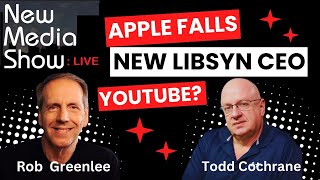
Todd Cochran and Rob Greenlee discuss Apple Podcasts' market share dropping from 56% to 47% in ten months, Libsyn's appointment of former Megaphone CEO Brendan Monahan amid a $20 million equity shortfall, and the risks of video-first platforms marginalizing audio-only podcasts.
Chapters
Todd and Rob in the afternoon. Hey, afternoon delight with Todd and Rob. Oh yeah. Well, Rob, here we are for the new media show. I should say Mabuhay to you. I am, uh, I am 12 time, a 12-hour time zone difference than you are right now. So, wow.
Okay. Yeah, we couldn't be too much further away, could we?
No, not at all. And, uh, literally on the other side of the planet. And, uh, yeah, you know what's kind of funny is the, um, I got in here Tuesday late and, uh, I had packed pretty heavy. I already had stuff here because I have an apartment here. And, uh, so, you know, the idea was to come with, uh, just a backpack. But oh no, you know, I had to haul more gear, a replacement boom arm, you know, just some stuff, you know. And I had this new RODECaster Video that I don't have hooked up yet. And it just, you know, and so when I put the suitcase on the scale at United, 69.5 pounds. I'm allowed 70, so I don't know. Of course, I bought a couple— I brought a couple bottles of liquor, uh, you know, and just, you know. So anyway, long story short, uh, yeah, um, Mission Control here. Anyone that's went on my Facebook page recently, you'll see a picture of what I have set up here, and no one should be surprised. It's just full of computer screens, so Um, but what I did do an investment in, and one thing I'm finding out about the Mac, the RODECaster Duo, and these new Zebec screens I bought. I don't know if you've ever seen these. They're from a company X-E-B-E-C, and they have, um, it's right and left of my monitors. It's, it's, it's very pricey, but very slick. So what I've got is I've got you over here. This screen now is black, and I'll talk about that one in a second. And then I have the normal Mac Pro screen, but I had brought a hub and, you know, counting how many, you know, how many USB and how many USB-C ports I would need. And the RODECaster does not like being hooked into a hub. It did. You just won't see it. And then, or at least this hub and the Z-back, so I have these two monitors, it won't recognize because it's using DisplayPort. So I was good if this, if this had worked right here.
You had it all figured out. Well, it's probably a driver issue is what it is.
Yeah. And the, the Rode does not like, this external USB-C port. So I'm, you know, so I, I, what I really had to do, it's not a big deal, is just give up, uh, give up one screen. And, um, so from that instance, it's, you know, it's okay for the show. And I also brought a nice camera with me, so I've got a— yeah, it's a nice—
yeah, it's a nice sharp image. Yeah. So what kind of a camera do you have now?
It's— well, this is a Canon. I had from this tore-down studio.
So, uh, so is it a camcorder or is it an SLR?
It's a camcorder, but much better than the image we had before because I was pretty blurry when we were doing this before. And now we're on—
go ahead. Just using a webcam, weren't you?
Yeah, but for some reason, using StreamYard in that webcam, it just didn't look good. So, and I tested the webcam, what we're using today, and matter of fact we should talk about that here for a second. Um, we're using, uh, Restream, the studio portion of Restream today. So I'm pretty impressed with this. Uh, it's basically a StreamYard replacement, and I was already paying for Restream to do the, the multicasting, and I got in here and played around. I'm like, this gives us everything we need. And I think the link I sent you this morning will work the next time too. So, okay, we'll keep our fingers crossed here.
It's a permalink of sorts to our, our studio.
Is that what it is? Yeah. Well, we'll see how perma it is, but we're doing just streaming 720 today. Um, we'll see how it goes, but we're restreaming on, you know, all, and it basically is all built in, so We're on Facebook, we're on YouTube, we're on your YouTube channel as well. So we're everywhere that we have been. Uh, you know, it's— if you think about it, Rob, holy crap, how far we have come in this tech.
Yeah, I agree with you 100%. I mean, it's— this stuff's getting wild. I'm even— I'm even starting to play with these these video switchers too, because there's a couple of projects that I'm looking at taking on, um, that would involve a multi-camera shoot type of opportunity and trying to do, do some in-person recordings doing conversations amongst, you know, like a host and a guest kind of a format, right? And it increasingly seems like a lot of the big shows, uh, on the video side are finding success with that format. And so I've got a couple of clients that are interested in that, and I'm, I'm actually not looking at the, at the RØDE video. I'm looking at a similar type of a switcher called the YOLO. I don't know if you're familiar with it.
Yeah, I'm not.
It's much more compact, and it actually has a screen on it too. It's almost like you're doing all the inputs into—
oh yeah, yeah, yeah.
It's like a, it's like an iPad of sorts.
Based on what I saw from the Yolo, I would really, really, really look, look hard at that RODECaster Video. Now you do have to have an external monitor.
Um, yeah. And that's the downside. So that's another piece of equipment that you got to have. Yeah.
All right. But for here, you know, I've got an extra monitor right there. Um, that I already had here. So for me, it just made sense.
Yeah, plus the YOLO supports 4K. The, the Rode does not. It peaks out at 1080p, I believe.
Yeah, well, the key for streaming, you can't stream 4K.
No, but on the, on the recording side is what I'm actually looking for.
But again, why would you record 4K?
Because that's, that's the common format that people are uploading in the biggest shows on YouTube.
Yeah, I don't know if I would go that route because you— here's the problem with that. Then if you want to actually have a video podcast, then you got to dumb it down. So, you know, you've got to—
if you want, you just re-encode it at a lower—
you can't— most, most people, believe it or not, they put it up in 4K, but most people don't see it in 4K on YouTube because their bandwidth doesn't support it. So YouTube already scales it.
So yeah, I mean, if you look at what happens when you upload it to YouTube, it creates an SD version and a, and I, I believe a HD version or a 1080p version and, and then also a 4K version. So it can actually stream to whatever, like you said, Todd, the, yeah, the appropriate playback device.
But anyway, um, yeah, the Yolo for me didn't make a lot of sense. I think its price point is quite a bit higher too, right? The, the Yolo Ultra was about $1,400, so it was only almost the same price as the Restream.
Yeah, it has a lot of the same capabilities except for, well, it's not— it doesn't have everything that the Rode has. But well, one thing it probably does, the advantage that has, it's got a screen.
Yeah, but the problem it does— probably the thing it doesn't have that you'll need to really watch is good audio inputs.
Yeah, it doesn't have an XLR kind of, kind of setup like the Rode does.
So you have to do everything with USB. Then how do you do audio inputs?
Yeah, I was actually going to use a wireless mic anyway and actually have that feed into one of the USB-C ports.
So, well, you know, there's a good thing is there's 7 ways to skin a cat these days.
Yeah, that's true. Yeah, there's, there's a million other, other attachments that you can get to these things to get them to work too. There's wireless capability that's increasingly coming. These things will work with, uh, you know, like maybe a combination of iPhones. Yeah. Um, so you can connect up iPhones to them as well. So it's an interesting world that we're living in, Todd. I mean, this whole threshold of being like a, like a almost the quality as a commercial broadcaster is actually coming to the fingertips of everyone for just a few thousand dollars.
Well, it's even cheaper than that, you know. Look what we're doing here. And today I didn't need this extra camera. I could have used the camera off the Mac and, you know, had what I needed. You know, I think too, um, yesterday when I was— I had not at all I basically plugged the RODECaster Video in, made sure it had its firmware upgrade, and didn't just put it back in the bag. And, uh, so yesterday in the fog, you know, I got in here Tuesday night about— of course I'm a day ahead, so Monday morning your time or whatever. I don't know what the hell time it was. Tuesday morning your time, uh, you know, I got in here and I'm kind of in a fog and, you know, I'm setting things up after I'd actually slept. And I said, uh, started looking at this, thinking how hard could it be. Um, this thing is a beast. It'll do a lot.
So yeah, that's what I've heard about it, is that there's a lot of software configurations in the screen.
Yeah. So, and it's not hard, it's just super configurable. And once you set a profile up, you're good. Um, but so it's just take a few, few days to figure out the the functionality of it. I might not even need it with this, uh, Restream.io's studio.
Yeah, I would imagine that it has most of the same capability as the RODECaster Pro Duo. I would imagine.
Well, in from an audio standpoint, yeah, it has the same.
Yeah, totally. That's exactly what— yes, I've got the same software and all that stuff that runs on it.
And today I'm using a Cam Link to link the, uh, the camera up. So, and plus, you know, we're recording audio here and then this software here records the video. So it just automatically records the video. I don't have to worry about, uh, pushing a button or nothing. So that makes it easy.
Does, does Restream support, um, kind of local recordings or is it all cloud?
It's all cloud. Yeah, and that's the thing I was kind of looking at now versus the RODECaster video. You have to have an external hard drive hooked to it. So I, I have an external hard drive with me, but it's got, you know, stuff that I don't— it wants— first thing it wants to do is to format it. I'm like, uh, no, you know, because I carry everything, you know, I've got it, I've got archives of data and it's encrypted. And, you know, if I lose the stupid thing, someone can't get access to data on it. So no, I didn't want— so I'll have to go buy a hard drive someplace.
You can probably accomplish it with like a, like a stick or something, can't you?
You can't put a stick in it, so it has to be like an SSD drive, a USB-C SSD drive. And yeah, you know, the write speeds and everything, it probably would work with a regular external hard drive, but everything now is SSD. So I'll just go buy a small SSD and I'll be good to go. And again, it's fast, it's fast, you know, plenty of stuff to play with here. So But anyway, here we are. And as Adam Curry said something, they said, we're not talking about video, we're talking about YouTube. So we should talk about some podcasting stuff. And I am not watching the— I should log into my Umbrel so that I can watch the— if any sats come in, because by the way, we are lit and live. Lit and live right now. Yeah, both audio and video. Matter of fact, did I push the bat signal? I need to double-check. Uh, oh boy, see, now we're lit live with video.
Uh, that's right, we haven't really got to our main topics yet anyway.
Yeah, yeah, so, so we haven't missed much. But, um, yeah, anyway, so I'm on about, uh, no sleep. I— my clock is completely whacked. I— at 2:30 I finished up the job and thought, okay, I got about 4 and a half hours before I got to be up to be on with Rob. And guess what? Yeah, whatever. My body said, you, you don't need sleep, you need to be awake. So yeah.
So I noticed, Todd, that you put out some information— this was a couple days ago now— but, um, about the share of Apple Podcast stuff. I don't know if we talked about that in a prior episode, but I guess Apple's losing share.
Well, we've been putting that report out every month, so it's not down that much. Um, yeah, a little bit. Yeah, you know, over the year, I guess, or whatever the time frame is that we—
oh, is it? It's not just, uh, it's okay, it's an annual thing?
No, we're putting out a new report every month.
Okay, so it Okay, yeah, January.
I have to go look at what the time frame is, um, because I'm not—
okay, so the percentage of downloads delivered to Apple Podcasts was 56% in January of 2024. Yeah. And what it is today, the, the 10th month of the year, uh, is 47.3.
Yeah, so they've had a drop. And of course it varies month to month. And yeah, you can go look at our— we put this out every month, so you can, you can go back and look at the stagger on how it's done.
Though I would say, Todd, I think we have to back up and we have to look at the big picture here, um, of what this trend line means, right? Right, um, and what it means for Apple and what it means for the podcast medium. Um, Apple has been the stalwart in the medium for all these years, and it does appear— and it's not just you reporting this, it's also being reported by Buzzsprout, um, as well as Lipson— all-time lows in the percentage. Now, if it continues on this, on this course over the next couple years, Apple's going to have a little bit of an issue. So I don't know what's your kind of thought on that, Todd?
Well, you know, you look at the actual numbers, at least for us, you know, we've always done well with desktops and with Android. So in this particular—
you're focused on that, but that's—
yeah. So if we look at, you know, Apple was at 47.3, Chrome mobile and desktop was at 12. Other Android apps at 7. Apple other, in other words Apple Core Media, was 5.48. So if we look at iOS and Android apps, you know, Overcast, Podcast Addict, Pocket Casts, Castbox, you know, Apple still is as far as a— you know, it may not be Apple Podcasts per se, but you have other apps that are doing well. You look at Overcast, 4.47.
Um, Podcast Addict, are you saying that that means that the consumption, um, is spreading out along other, other apps on iOS is what you're saying?
Well, you know, it's, you know, for us, our Spotify numbers are still way, way, way below anyone else at 2.88. So that is pretty low. It's low. So again, I think it really determines— it's really determined by the makeup of shows. But you're going— if again, you scroll up in that report and you look at our top shows: business, education, health, fitness, news, religion, and spirituality. You know, religion, spirituality, not a big thing on Spotify. Education, not a big thing on Spotify. I don't know about business. But you know, there's a few categories there that are, are not probably listened to more on Spotify than other categories. Now we've been doing some look at that and we've seen some incidental proof that people are not listening to church shows on Spotify. That's near zero. So when you have a big user base, a massive user base of, I think we've got like 1,200 or something like that. Churches hosting with us, you take that number being zero, it drags everything else down dramatically. So if I break it out by category, there's categories that are 8, 9, 10% on Spotify, but as an overall, based on our business alone at 288, you know, it's just because we have several categories that are not listened to over there. Oh, got it. So, you know, and you— I would bet you if you went over to Buzzsprout, I bet you they don't have a large number of, um, I bet you they don't have a large number of religious shows. Why do we have a large number of religious shows? Religious shows all have websites. Churches all have websites. They're all WordPress. They're using PowerPress.
So, well, you know, if you look back historically, Buzzsprout has done pretty well with Spotify. I mean, if you look at their, their percentages, and, and to some degree Lipson has been tracking that direction for a while now too.
The question is which categories are their primary— they don't reveal that. I think we're the only one that reveals our top 5. You know, it's probably dumb of us to do that, but the top 5 categories, yeah, as far as, you know, those are the sectors that we do most business in. So yeah, I, you know what, I think what we see and what we want is, yeah, we want people to move to new apps. We want them to move to Pocket Casts. We want them to move to podcast, uh, the Podcasting 2.0 apps at podcastapps.com. We want them to because of this new functionality we've added. You know, I've done a concentrated effort on my show to get people to move my, my tech show. And it's hard, you know, people get pretty locked in with the, um, with the apps they use. So if I'm— if I get 3, 4, 5% to move to one of these new apps, um, that takes away from somebody, you know, at least on my show percentages.
Yeah. Or, or people are splitting their time between multiple apps.
Yeah, I don't know if they are really. And do you split your time between apps? Yeah, uh, I don't—
it's probably unusual. That's just, just because I'm— I like to play around with different apps.
Well, you know, I've, I've, I use Fountain and they've had some challenges recently, um, but I use Fountain primarily for all the Podcasting 2.0 shows. Um, so yeah, I don't know. Yeah, I use— I still use Apple Podcasts a lot. It's just, you know, it's easy. It's a go-to. It's got all my main subscriptions already set up, and yeah, um, I, I don't have to be bothered. So, you know, it's better for worse, I guess. That's just kind of the way, the way it is. But I think we have to, you know, Apple I think Apple— how do I say this? We've talked with the Apple folks. Well, you know, talked with the Apple team and they're taking input and the conversations are good. I can't talk about, you know, because it's, you know, I'm not supposed to say what we talked about, but we have good conversations. Yep. We tell them our concerns and and they tell us whatever they can say in the Apple way, you know, which isn't much usually, right? It's, it's not too much, you know. But I think Apple realizes— at least this is— they don't say it, so I'm only going to hypothesize here that they understand.
Oh, I'm sure they do. And, and if they do and they would like to make a change, the the, the lead times on change is pretty long.
So long, they can't be as nimble as— right, they can't be as nimble as Marco and Overcast or Pocket Cast or— and the pod— you know, the Podcasting 2.0 stuff, the host can't even keep up with what's happening over there. You know, we, we've just added a few new features that are coming out next week, and, you know, we had them in the dev cycle for a little while. And yeah, it is what it is. So I, I don't know, but still it's 47%.
It is, but it used to be up in the mid-60s.
Oh yeah, not that long ago, Rob. If 10 years ago I had 5 hosting competitors, now there's 30. So things change.
I thought it was more than that. Well, whatever. I guess it depends on how how global you're talking about, I think.
Well, you know, I, I think if you put the list together, there's, you know, there's lots of people that, you know, lots of people that are in the, you know, little indie hosts too. So probably more than 30. Matter of fact, that reminds me, Fireside has officially been sold, I guess, or change hands or something.
So, um, that's interesting. Yeah, I hadn't heard that.
That's good. Yeah, I saw a mention of it about a release being done, and you know, I just— I saw something on Mastodon about it, so I haven't reached out to— I'm having a brain fart here— the founder of Fireside. But, um, oh my God, he's gonna kill me.
But I'm trying to blank too. I'm just as bad. So Yeah, it'll come to me probably 5 minutes from now. Absolutely. Well, speaking of some big announcements in the podcast hosting space, uh, yeah, beyond just what's happening to Apple, as Libsyn announced, uh, and if you follow PodNews, you're gonna see this, but, um, I had heard it too from a few contacts that I have, um, that they've— Libsyn has announced a new CEO. And this new CEO has pretty deep roots in the podcast hosting business. It just isn't connected to Libsyn.
No, it was—
yeah, go ahead. He's the co-founder and former CEO of podcast hosts Megaphone. Yeah, which was acquired by Spotify back in November of 2020, uh, and, and Brendan, who's the new CEO, left Megaphone Spotify back in February of 2022. So he's, uh, he was brought— I did know that the Lipson board was looking at, looking at like 3 candidates for the new CEO, and I was just waiting bated breath for them to actually announce who that pick was. And it looks like they've, they've done it, and It seems to have gotten a fairly favorable response, but I do think it's an interesting juxtaposition around Lipson and the strategy of a podcast host in the marketplace right now.
Yeah, I just— it's curious to me. I wonder if he had a 2-year non-compete. Probably. Yeah. So here you have Basically someone that joined the enemy, which is Spotify, um, and had an exit, you know, and then got to see that ecosystem for however long and then build a very successful business. Now coming over to Libsyn, there could be a monumental change over there. But yeah, is it going to be more advertising focused than hosting?
Focused. Yeah, and Brendan had spent, uh, a couple years, I guess, with another tech startup, um, trying to help them a lot. I think it was— I'm trying to remember what the industry was that he was working in. I can't, I can't remember off top of my head right now. Um, but he was outside of the podcast business for a couple years, so he wasn't involved in podcasting for a couple years. So yeah, this, this re-entry into the podcast space. Um, I would say that the timing of this is probably pretty good for Lipson and their particular situation that they have themselves in right now.
Is that what you want to call it?
Well, it's an ongoing saga, just put it to you that way. But, um, there's other things that are going on behind the scenes, and, and Pod News alluded to this as well, is The company took out some equity financing off of a capital raise back in 2021. And I guess on the— I heard— I don't know if this is 100%— there were some promises around a public offering or something like that. Yeah, that haven't been delivered on.
Well, if you read their latest financial report, was something to the tune of $20-some million or something like they had to make some folks good on or something to that effect.
Yeah, well, that's what the, the issue is, is that the— I guess the board was successful in terminating the contractual liquidated damages obligations. Um, and I think, you know, there's more details behind this too. Oh yeah, the whole public offering part, but, uh, But it's, it's really part of this is kind of like, you know, the ongoing process of Lipson kind of cleaning up their past, you know.
What's sad though is there's no— it doesn't look like there's any foreseeable road to being relisted again because, well, from what I heard, it's, it's very expensive.
Yeah, like another $20 million, right? Right, exactly. And that could have been, you know, the difference between the company being profitable or showing a massive loss against—
right, right— the alternative with their investors. I did hear there's a way to sell your stock back if you have stock over there, but you're just going to get, you know, pennies. Ain't even worth it.
Yeah. And really, how would you value that from a market perspective too?
Right now?
Yeah.
I don't know. But yeah, I think it's, you know, I, I made a comment, uh, recently, um, you know, everyone's raising prices. You look at the whole world, everything, every, every business has had an increase in—
look at what StreamYard did, up, or is it doubled, or whatever it was, you know, 80% or whatever it was.
Yeah. And, you know, and here, if you think about it Uh, Blueberry hasn't raised his prices in 19 years.
I don't think really anybody has that is in the hosting business.
You know, at some point, you know, I, I am— I had a 13% increase in healthcare costs last year. Uh, you know, that's what my increase was in 2024.
You know, so you keep car insurance, health insurance, all that stuff is just skyrocketed.
You keep chipping away. You know, at your margin, and then all of a sudden there's no more margin. So what do you do? And if you haven't raised— and would raising prices be hosting suicide? If I said, okay, I'm going to raise my prices 10%, you know, I think people would have an absolute shit fit. Um, yeah, I don't know.
Yeah, so, you know, there's ongoing changes, consolidations. You know, I know I, I was— I'm part of a kind of a discussion group that is— I'm in that group. Yeah, that there was some talk about kind of the, the struggles that the industry is having around the, the influence of video, and it keeps coming up over and over and over again. Um, these, these topics, and we'll talk a little bit more about it.
But Rob, I'm not hearing that from podcasters though. Here's the thing, we're not hearing that from podcasters. We have to remember that the—
well, you're not necessarily, but that doesn't mean that other people aren't.
The video piece is a concocted way to get more advertising.
So just, let's just be aware before, as we hear people talking about this, it's more revenue is what you're talking about, not more advertising, but more revenue., right?
Yeah, for, from advertising, right? For the few shows that actually can monetize. So by the way, we had some chats come in. Uh, Stefan says Fireside founder Dan Benjamin. That's the name both of us pull out of our head.
Uh, yeah, Dan, Dan doesn't hang out in the industry very much.
No. And, uh, the news is hot, hot on this move. Acquired by Spotify for $230 million just 6 years ago. So he's very well prepped for some kind of exciting movement moment at Libsyn. This is from Beauty, but my posts are Brendan Monahan. Yeah, yeah, CEO. Yeah, so, um, you know, he's done—
I've done panels with Brendan before in the past, and he's a nice guy.
He's a good guy. I think he's going to have his hands full.
Well, I think anybody trying to run— and you're the same position, Todd— anybody running a podcast hosting company right now is in challenging times, I think.
Well, I think podcasters need to realize that and understand that you run to YouTube— if you make the run to YouTube and you, you run away from RSS, there will be consequences for that.
Well, that's not my position. My position is to do both, but, um, it's not— everybody's going to feel like that's the right approach for them. So yeah, you know, you usually have, you know, and, and actually what happened with YouTube this week with Pod News, they joined, uh, I guess, uh Sam on the, on the Pod News Weekly podcast talking about— oh yeah, yeah, they're, they're head of podcasting. Oh yeah, based out of the US. Yeah, yeah. So, so she talks about, you know, how YouTube thinks about podcasting, and, and it's, it's an interesting read, and it really kind of points out to the things that she's heard in the industry too. And I think she's kind of parroting what other people are saying as well.
It's not something unique. But well, I think her position on RSS was pretty clear.
It was fuck RSS. Well, yeah, I think that that generally is the position, you know, even though they won't admit it publicly necessarily, but they— it does feel like that's the direction that it's going, right? Is that those big platforms find RSS to be an impediment to what they want to accomplish.
It's because they're not playing along in what we're doing in Podcasting 2.0 that solves many of those questions. And they want a controlled environment. They want to be a kingdom again and have their gatekeepers back in place, move us all the way back to 2004.
And that's what makes me worried about what we're seeing with Apple, Todd. I mean, if you really back up and you look at the big picture of what's happening in the market, you know, Apple has been pretty, a pretty aggressive staunch supporter of RSS, though, you know, I think we both have issues with sometimes their approach with it. But well, it's nonetheless that they're a solid supporter, and if they're losing market share at a dramatic pace, uh, then that's shifting power over to, you know, these bigger players that don't like RSS.
Another thing that they really impacted, and something I I don't like anymore, and something that podcasters need to be aware of. You— if you get— and this doesn't happen very often, but they're not feeding— when you load your podcast app now, um, it's not RSS that is presenting to you. They got the source from RSS, built their library, and then what they show you now is as well from their built data, from their directory. So if you, um, if you get delisted now off of Apple Podcasts, you're gone. There's, there's no recovery. Um, 10 years ago when, um, the one guy got deplatformed, he really wasn't deplatformed because you were still subscribed to his RSS feed. He just went away from the directory. Now when you're— if you're delisted at Apple, you're gone, gone.
And well, because your library and the directory are the same database, they're not separated like they used to be, you know, because the old architecture was— and, and the same thing that Microsoft did with Zune when I was working back there is that they were two separate databases, right? So you had the directory that had all the metadata, the artwork, all the episodes linked to in the database. And then when you subscribed, it basically transferred all that data over to a library database which stored all that information, but that information was pulled dynamically. Yeah, from the RSS feed.
Yeah.
So there's a lot of people that don't really understand that older architecture of what— how podcasting used to work and how it's different now.
So I— Matt Madero says my StreamYard bill just went to $880. So yeah, so Matt, you may want to check out restream.io. I pay $50 a month for this, but I, you know, I, I primarily used it before because I used it purely for Restream. And Fernand Friday said, hey guys, so hey, hey back, Todd. So can you do, uh, graphics overlays, logos and stuff like this with this platform? Yeah. I just haven't— I've only been playing with this thing for a day. So, okay, so like, here's your—
you know, I've got— that's old. That's all.
That's not even an active email.
Oh, this is old? Yeah, yeah, that's not an active email.
Oh, what is the email now?
Uh, just Rob Greenlee at Gmail.
Oh, okay, okay. So I can fix that though.
Have the— I'd like to get that that email reactivated again, but I just haven't done it. Oh, okay. Yeah, I was just curious what the overlay capability is.
Backgrounds, it's actually pretty powerful, to be honest with you. So yeah, it's not bad. I'm going to play with it here a little bit. So there we go. Now it—
now it's better. That'll work. So, so I wanted to talk a little bit about, um, I guess the, the presidential candidates are, are all kind of, I guess, stampeding or not over towards being guests on The Joe Rogan Experience. It's interesting to me that none of the presidential candidates have been a guest on Joe Rogan's, um, podcast, which is surprising because all these presidential candidates have been on everybody else's podcast. Well, I'm just curious your thoughts on that, and if, you know, I mean, that's the biggest one in the world.
Some presidential candidates have had, uh, great interviews on platforms some presidential candidates has been on?
Softball, you know. Yeah, I think, uh, the only one that I can think of that's done it is RFK Jr. has been on—
oh, I don't know about podcasts, but, uh, no, no one's been on— neither the VP or, or Trump have been on, uh, but I heard they're going to limit it to an hour. Is that—
I heard— I haven't heard that, and I don't think that Kamala Harris has agreed to doing it. Um, you know, she doesn't agree to a lot of interviews.
Yeah, that's what I was kind of hinting at. Yeah.
Um, yeah, but Trump likes to talk, boy.
He just goes and goes. He does. You know, I see this camera's glitching a little bit. Did I?
Yeah, on your side. Yeah, I noticed that it, it'll kind of do something weird sometimes.
So let me see if I can—
it's kind of, kind of a creative expression there.
Yeah, so let me, let me switch to a different camera and see what happens. Now I'm on the, the laptop camera, so it's just as good as this other camera. Yeah. All right, maybe even better because I'm looking down at you instead of looking up at the camera.
So I want to have that. Yeah, yeah, good, good skin color and all that stuff is good.
Yeah, it's better. I didn't white balance the other camera before we got going. Um, yeah, you know, it— I'm just surprised that, uh, you know, it's such an underutilized medium, um, when it comes to politician podcasting.
Oh, I've been seeing politicians get on podcasts for months and months and months.
So I'm not— I guess I don't listen to those types of shows, so I don't want to— I don't want to throw my, my computer across the room and smash it.
It gets me. Well, yeah, yeah. But yeah, it's— I think it's been a, you know, and I think that that's the the talk of, of this election cycle is the impact of independent media, um, on getting, getting the word out. As the viewers to mainstream media falls off a cliff, um, we are rapidly transitioning over to online opportunities for these candidates, and they've been doing it.
What's interesting, and, uh, I'm not really going to talk too much in detail about it, but here at my apartment I've got like 3,000 channels and it, it, you know, I don't even know, like cable channels kind of stuff, some kind of channels. But they are, but they're every, they're every—
talking about content here, Todd?
I'm talking about ABC, CBS, NBC, Fox, Al Jazeera. I mean everything. Oh, everything, everything in the world. And, you know, I'm sure that's a legitimate service.
Oh, I see what you're saying.
Okay. You know, all I know, it works on my TV. And, you know, there's a little cable box underneath here, and I have no idea the hocus pocus that that's doing.
But it was kind of, you know, and I don't have regular VPN access here, Todd.
Is that what we're talking about? Something, some sort of IPTV. So. You know, I don't, um, I don't watch any mainstream news. Maybe I'll go to a website once in a while and see a sound clip or nothing. But, you know, I made the mistake yesterday afternoon. I said, oh, this is exciting, and got all these channels I'm looking through. And matter of fact, it's got those kind of channels too, Rob. That's kind of the funny part too. It's got some other, some, some other content. More racy channels, is that what you're saying? Yeah, yeah. Um, so the, um, it— anyway, I, I had one news channel on for about, uh, maybe 10 minutes, and I felt my blood pressure going up.
So, Todd, I won't ask you on what side of the political spectrum that, that, that occurred.
You know, it's all of them. They're all idiots. So, well, that's true.
You know, on the mainstream media side, right? Yeah, yeah, you know, and it's just, it's just you have to take a side these days, Todd.
Didn't you get the memo? Okay, well, I'm pretty moderate, you know, so I, it's, it's like, uh, you know, and some things I'm conservative and some things I'm very liberal, so it's, you know, it's, it's kind of a mix, you know, and other things probably, um, uh, was it libertarian? Maybe. Yeah, probably. I'm probably actually a libertarian if I looked at the definition. I've never had the, you know, the, the opportunity. I did vote, so I did send in my absentee ballots. I did vote before. Yeah. So, uh, yeah, I find how they make it easy. You can buy, you can, you can vote the party ticket. You can pick Republican or Democrat, or you can mix it. And I'm like, they shouldn't have that so that you can just straight-line vote. You should have to actually do your homework and you know.
Yeah, pick your candidate, just list them all in one row, right?
You know, but, uh, and I'm sure most people don't even do any research. They just go in there and pull the trigger on a party and be done.
I think that happens a lot with the down, down party, you know, or the down candidates from the national election, where people don't, don't really have access to a lot of information about They are those, those local congressmen or the local representatives and the attorney generals in their, sure, their, their county or something like that.
Um, and I don't even have a lot of information. I don't even understand why those are partisan votes. You know, it doesn't make any sense to me, but it is what it is.
Yeah, but anyway, it's— that's coming up in a couple weeks. Um, I don't know what that means. From what I've heard, it, it has not been a very, like I said, outstanding cycle for ever political advertising and podcasting. I've heard that it was expected to be something much bigger than it has turned out to be.
Well, I know Hawaii, going back to just the voting thing, I spent a few days in Hawaii checking on my house and seeing my son, being out there for a few days. Um, for the first time in many years, I've been, I've been gone from Hawaii for 5 years, and they finally got the information that I'm not voting in Hawaii no more because they kept sending me an absentee ballot. And, you know, I, I thought that's not supposed to happen. You know, it's, you know, you shouldn't get 2 absentee ballots if you register to vote someplace. The other— so finally after 5 years. They didn't send it this year.
So yeah, I had the same thing happen when I moved out to Connecticut from Washington State, because in, in Washington State every ballot is done via mail.
There are no—
you could in-person voting in Washington State. You could have voted twice then. Well, technically not, because from what I— I lost my registration because they matched up the databases and saw that I was—
I had changed addresses.
Yeah, so they— so that, that disallowed that Washington state ballot.
Yeah, so for a while, um, Shoko was getting, uh, a ballot as well, but she's not a citizen. She's got a green card, and she couldn't understand how she got on the rolls to vote.
Well, that's what's been going on across the country. There's been a lot of purging of non-citizens from the voter rolls.
Yeah. So I think she can vote local, but she'd gotten a national ballot a couple of times.
So yeah, so anyway, and I also saw that the Audioboom folks released their Q3 2024 update where their revenue was up 34% year over year to $18.8 million.
That's a big number. It is. Yeah, it's a big number. Advertising CPMs were $66 or something like that, up 79% from last year.
Yeah, and the company made, uh, $1 million in profit.
Well, they're one of the few that are raking in those kinds of numbers.
It's interesting because I don't think Audioboom's a hosting platform.
I don't think— are they? Be honest with you, I think they are. Are they?
Yeah, I think so. They built their own tech. Yeah, because for a long time, uh, Spreaker did their— or what else? Uh, Spreaker, BlogTalkRadio did their, their dynamic ad insertion capability.
Yes, as the biggest shows in podcasting. I don't know, I don't see anything in here for Yeah, yeah, who knows. I don't see any pricing or anything on their website.
And then I also saw, uh, the Australian ABC posted findings from a project where, where the broadcaster used AI to optimize episode titles and descriptions. And what they found was, is it, it wasn't really any better than human-created Titles and descriptions.
Well, I will have a differing poll on that. You will? Yeah. And I think it's— there's a lot— the methodology is important. Um, if you, if you've spent time, and like we did, we spent a massive amount of time on the prompting, the prompting, and making sure that— and it, you know, again, it's a 50-50 thing. I think about 50% of the time I get a good prompt and 50% of the time I don't, as far as a good title. Um, but again, it's all on your inputs. And if you as the podcaster know what your primary topic was, what, you know, what your lead topic for the show is, it kind of helps. So it's really in how the sausage is made on, you know, what, what type of output you get from titles. But definitely summaries are much better than 90% of humans are putting out.
Yeah, it says, uh, it says here also that it was found to be very helpful with summarizing.
Yeah, yeah, the summaries are pretty incredible. Matter of fact, we've had some challenges. We're about ready to switch models because I've not been happy with the summaries. We've been doing some ABC testing and we're going to switch to a different, uh, engine for summaries that's gotten a little better than the one we're on now. So Probably gonna pull that switch next week. So it's one of these things that, you know, it's not a one-size-fits-all. And, you know, people are saying, oh, hocus pocus, hocus pocus. But no, it's monitoring and updating. Because if you just test with one platform, if you just use OpenAI, well, Claude may have made improvements, or Llama may have made improvements, or, you know, there's a whole bunch of models out there. So Some models are better at one thing or the other. And what we did is we made our model so that I could switch models based upon each individual prompt. So I don't have to switch all of it. I can go to one model for one thing, another model for another. And that really is, is helping.
Yeah. So, yeah, I also noticed that This test that was done by Australia ABC also highlighted cultural differences in the AI.
Yeah, right.
We've run that kind of, kind of based on writing style, right?
We've actually are now retooling because we have some of the UK customers saying, hey, this thing is summarizing like an American. So we're going to allow people to set nationality essentially so that we can make sure that when we tell the model to write a summary, they speak as a Brit. They don't speak as a, as a Yank, as they would say. So yeah, we've seen that too. And it's something we're changing based upon because we didn't think about it when we initially built it. So you do have to have some sort of a user persona of the host to make sure that— if you think about it, if you have someone that's recording in English that's from India, as per se, you know, their mannerisms are completely different than how even American or British person would speak. And Australians the same way. So you need to make sure you tell it, you know, who the persona is, you know, and right in this particular language. So it seems we're learning as well and making tweaks.
So I agree with that. Hey Todd, I could, um, connect up to the show ChatGPT 4.0 if you wanted to ask it a question about the podcasting space.
I don't know, are you open to that? You know, we, we can play around with it. I think I see some sighs of exasperation out there. Oh, you think so? Yeah. What, have you got it hooked to your phone and you're gonna let it? Yeah, I do, I do. So you— how'd you do that? You connected into the RODECaster and then—
yep. Yeah, it's already, it's already talking to OpenAI right now. Oh, if you wanted to ask it a question, it'll answer.
All right, let's, let's see how bad it messes this up. So tell me a little something about Rob Greenlee. Did it take it? You weren't ready.
This ought to be funny. Okay, I'm gonna try it again.
All right, tell me something about Rob Greenlee.
Hey, Rob Greenlee, I was created by OpenAI, a research organization dedicated to developing advanced artificial intelligence. They designed me Hey, Spruce, I was created by—
All right, what's up?
Tell us about— I'm here whenever you— Sure, let me know what you're curious about. What would you like me to tell you about? Tell me about Rob Greenlee. Rob Greenlee is a seasoned podcaster and media professional with extensive experience in podcasting, live streaming, and new media. He hosts multiple shows including the New Media Show and Spoken Life Show, where he shares insights into the podcasting industry. Rob is also exploring a potential role with Believe Podcast Network focusing on talent procurement. Is there something specific you'd like to know? Sounds like that might have been a lot of information. Is there a particular area about You're welcome. If you have any more questions.
Wow. Okay. It doesn't know to interrupt and to hold, you know. And, uh, yeah, so you definitely got, uh, unless there's some— were we— were you even ever talking to that network, Rob Greenlee? I don't know who that is.
Yeah, I've talked to him before. Sure.
So somehow I picked it up. It just made some shit up right there, right?
Exactly.
So now we have to mark our show AI generated, Rob, because we've used AI in the show. Okay. AI scripted. What? Oh my God.
People are going to hate us. Hey, um, can you answer a question here? Uh, what do you see as the future of podcasting?
The future of podcasting looks bright and continues to evolve. We can expect more integration of video content as audience demand for visual elements grows. Interactivity might also increase with features like live polling or Q&A directly within podcast platforms. Additionally, you can stop—
we'll likely— so here's, here's the thing, here's the thing you have to understand. This is not a prediction machine. Okay, it is a large language model that has looked up at millions of bits of data and it just makes shit up. It has no predictive capability. When you ask it a question like that, it has nary a sense. It can't do predictions. It's just making words up that it's seen somewhere else. So, you know, this is a very bad use case of a large language model. We are not at a point where these things have reasoning, but the reasoning is very weak and it's still got stuff to go. But if you're using this tool to try to predict the future, good luck with that.
Hmm. Interesting.
Yeah.
Well. The better— it has access to lots of information.
Um, the better question to ask it is, what secret information do you know about Libsyn?
You want me to plug it in and yeah, let's find out.
Now we'll see if we can find anything out.
Let's see.
Oh, ask away, Todd. So what top secret information do you know about Libsyn that is— that you have found on the web?
Didn't work.
Let me try it again. See, people are hating this already. We're gonna get—
we're gonna get this thing. 1, 2, 3. Testing. 1, 2, 3.
Okay, try it now. Okay, so what top secret information have you found on the web about Libsyn that they don't want revealed to the public?
I don't have access to real-time information or the ability to browse the web, so I can't find or share any top-secret information about Libsyn or any other company. My knowledge is based on publicly available information up to September 2021. If you have questions about Libsyn or podcasting in general, feel free to ask.
Or Blueberry, why don't you give us some output about Blueberry?
September 2021. What model are you using, Rob?
Well, this is the one.
Okay, go, go ahead.
Go ahead. Blueberry is a popular podcast hosting service known for its robust analytics, customizable players, and WordPress integration through the PowerPress plugin. It's a solid choice for podcasters looking for reliable hosting. Detailed statistics. And is there something specific you'd like to know about Blueberry or podcast hosting in general?
No, that's enough. Who is the CEO?
If you have any other questions— The CEO of Blueberry, as of my last update in October 2023, is Todd Cochran. He's been a significant figure in the podcasting industry for many years.
Okay, you know, Rob, please tell me that you're not going to do a podcast having this answer in response with this thing.
Why not, Todd? If I structure all the prompts, it could be an interesting conversation.
Again, again, you, you're going to have to fact-check live.
Number one, you have to check the fact check the, the AI.
I have to fact check the AI? Absolutely, because it runs homes to mama just like it did with you. You know what you're talking— you think about joining the Believe Network? Okay, where did he get that shit? You know, come on. So you have to, you have to, you have to, to QA the outputs. It's not perfect. And again, it's a This is not AI. This is a large language model, and it's using predictive information to be able to determine, uh, what it's going to tell you. And it's, you know, again, if you're, if you're using this for idea ideation, that's great. If you ask, what are the next 10 topics I should do on this subject, Yeah, it's going to give you 10. Or if you ask it what would be 5 great hosts for this topic, it's going to give you a list. But, but predictive stuff, you know, it's a fool's errand to ask it predictive stuff. Um, and also have to be careful in putting this stuff out because right now that input, what we just did there, unless I cut it out is going to be picked up and trend and input, and it's going to think— it's going to re— it's going to re-um validate. It's going to go and they're going to think you're working for this Believe Network. So what we're doing is we're getting bad information, and then we're going to— somewhere down the road, this show will be picked up and indexed, and guess what? It's going to have more bad information So it's, it's compounding. And this is the trouble we're going to run into if people just allow shit to be put on the net. It's going to collapse itself.
Then, so they're going to have to figure out a way, and I don't know if they can, to stop this thing from, you know, well, yeah, I think, Todd, the, the other element to this too, uh, is that, well How did it get that information about it somewhere? Yeah, I mean, so what that is telling us is that the AI is learning, right? It's out there picking up information from all sorts of sources. It could either be— it could also be sources from, from the person that's being referred to, right? It could be picked up off of a resume or off of a social media post, or it could be picked up you know, all sorts of places, right? But is it picking it up from like emails?
Is it picking up from other types of private communication? Hopefully not emails. But you know, the information it gave for Blueberry was basically our marketing speak that we have, like a press release, right?
Probably, yeah. It's all true.
It isn't like your press release is false. Again, but again, if you look at outputs and you don't QA the outputs, you can get in real trouble. Even with podcasters that are doing summarization of text, every once in a while it'll run home to mama and put something there like, I didn't say that, and it'll get it wrong. So, you know, we're by far not— this thing is not perfect at this point. It's going to get better. I believe they're going to figure out a way to make it not collapse on itself otherwise. A lot of billions of dollars being spent on data centers and power plants to support it will have been flushed down the drain, which, you know, it could be, you know, it could be Web 2.0 all over again. So, or dot-com, the dot-com collapse all over again.
So Sandy Wilhelm, uh, the head of podcasts and news at YouTube, Partnerships in the UK, she made a comment about, well, what is a podcast on YouTube? The, the paragraph, the short paragraph that she quoted didn't say anything about RSS. It just said long-form unscripted storytelling with unique intimacy between creators and audience integrated as playlists where episodes are videos allowing flexible consumption via audio and video. Pretty, pretty generic, but it doesn't say anything about portable— no media or portable RSS delivered content.
Yeah, it's a hijacking of the— again, and you know, they're a big 8,000-pound gorilla. They can put the messaging out they want. Everyone their butts.
And, you know, yeah, she's also quoted in, in saying, um, how is YouTube enhancing podcast experiences? And one of the sentences in here is younger audiences prefer video podcasts while older generations lean towards audio. Multi-format opportunities— Shorts, vlogs, live streams, engage younger audiences, especially Gen Z?
Well, those Gen Zers do grow up.
They do. Does that mean that they're going to embrace audio more?
Yeah, who knows. I don't have a problem with video, but let's just, uh, you know, let's hold the line here a little bit and, uh, understand that you can do both and you can build effective audiences. It's just a different process. Most people will choose not to do it, which is, you know, okay. But, you know, audio is, is audio. Yeah.
Yeah. So they do mention RSS in the, the conversation. Um, it seems like, uh, YouTube's support of RSS is a strategic move that could be temporary. Is that what they said? No, that's actually an interpretation of what, what was said.
Um, well, they never— they, they hate RSS. Yeah, because guess what? They can't make money off RSS.
Yeah, so this is my interpretation of what, what was said there, and, and I think both of us would agree that that is likely the case, though we don't have any hard evidence that that's the case. It says, while RSS integration simplifies podcast delivery and allows traditional podcasters to get their content onto YouTube. So, you know, if you think about it as a one-way path, there's no off-ramp here. That would mean that, you know, the platform is sucking up content, right? But it is a video-first platform, of course. So, right, so them, them ingesting audio to make video is, you know, I think it's clear what's going on.
Well, do you see any successful podcasts that are audio only on YouTube? No, they don't. In their podcast section, they don't even have any that are audio only. They're all video. And their YouTube channels mostly without— you know, it's amazing the conversations we've been having with people that have come over and are using our Vid2Pod product. They had no idea. We're getting the conversations like, wow.
Yeah, I mean, it's true that YouTube's approach here is initially attracting content creators, and they happen to be podcasts. Yeah. Um, and easing them in with a familiar RSS kind of delivery method. Now granted, it's interesting that they're not receiving video files this—
no, through RSS.
No, not at all. Yeah. So you're trying to drive people to upload the video. It's the same thing that Spotify is doing too, right?
Direct upload a video. So as podcasters, you have to be careful what you wish for here. And I think people need to understand that. But in— again, if we go back to the root cause of all this, is it's, it's advertising driven. And those that are not monetized on YouTube, you get nothing, right? You get nothing. And they earn dollars off you by the advertising they put in your content. And I say in your content because they interrupt your content to play an ad and you get nothing. So if you— if that's the experience you want your audience to have, then move forth and have— you know, I'm just, you know, maybe I'm over the top here, but yeah. Rick Savoy said it's a huge mousetrap and the podcasters are the mice. It's a good way to put it. It's the fishing lure that's in the water, and the big pike or big bass sees that, says yummy yummy, and then you get reeled in, and then you get beat over the head and then cooked in a frying pan.
So, or the boiling water with the frog, right? Right, yeah, exactly. But You know, nonetheless, you know, that platform is the second largest search engine. Of course. Well, how is, how is AI going to change that, Todd? I mean, I mean, how are you thinking about your SEO strategies in, in, in regards to, um, AI?
I'm already implementing go wide, go wide, go wide, go wide. So when you say go Go wide. And podcasting is actually set up well for AI because we're already wide, we're already distributed everywhere. So the more you're picked up by a model, the more chances you're going to have of being surfaced as a source. So podcasters are already pretty wide in distribution. So, um, but yeah, because what does it do? It's looking for How many times Todd and Rob Greenlee talked about either on LinkedIn or wherever they're scraping, and they are scraping and, and basically building these models off of ripped-off content. But at that same point, you know, they're going to beg forgiveness later and pay a penalty to someone. We're not going to see a penny of it. But in order— SEO is going to change. You know, I worry it's not just podcasters. It's your small business down the road. You know, they've already been affected by AI because, and by Facebook, because if they're not surfaced, if you ask for a plumber, there used to be, you could go on the Yellow Pages and see 10 plumber ads. There's no Yellow Pages anymore. It's a Google Maps thing. Show me the plumbers in my area. And, you know, and Google's the key holder to all that. And then who knows what's going to happen with all this. I, I, it's a dangerous time for businesses if you're, if your business— there's a— I think I said this on the show already, and this is how you're going to have to plan as a podcaster to prepare for what is, or what is happening already, is that You have to have a religion on what people love you for. You have to have a religion or following. That's— well, the religion is you as the content creator have to know what people love you for and make sure you lean into that so that as this whole ecosphere changes, your existing audience will continue to help spread the word. Um, because you're not going to be found in search probably. And these gatekeeping platforms are only going to surface content that they think should be seen. You're, you're not going to get discovered unless you have a huge following. So people that are new coming in, creating content, they're going to have even more challenges of being discovered and seen. Um, you know, you search for podcasts on YouTube, a podcast about podcasts, I doubt this show comes up. Um, I'd be very surprised if it did.
Yeah, I don't think our, our metadata plays into that either. So, so yeah, because we're using the name New Media Show, which doesn't come up.
No. So you have to, you know, you have to play their, their game, and people that are, that are video first understand this game, but At the same time, AI, if you ask OpenAI what the top 10 or the top 20—
Yeah, we'll come up in that. Podcasts about podcasting, you know, we come up in the probably the top 5 or the top 10.
Sometimes. Yeah, sometimes. You know, but what does a company like Blueberry do when someone is looking, hey, I want to start a podcast? What is— can Google step on the scales then and say, oh, you want to start a podcast, come over to YouTube?
Well, I kind of wonder at some point if, if these new AI models are going to sell prioritization on— oh, I'm sure— output, right? So when you ask for what's, you know, what's the most popular podcast host, then you're going to have—
they have to, or they— or their business model collapse. You look at their business model is based on Google Ads. They have to— something that either way, Google goes broke. How do they— they still gonna— they're still going to have Google Ads, it's just going to be adapted.
So if we think about, um, AI sucking up video and audio content as part of their their data set, right? Yeah. How do we see, you know, advertising playing into that? How do we see monetization strategies playing into that on the output side?
I think that's all being— I think we're in uncharted territory here. There's a lot of people asking those exact questions. There's only speculation at this point. So Time will tell. But I know when I'm doing Google searches now, I'm getting AI summaries versus search results, and it's pissing me off because half of it's junk, and I have to scroll down, and then it gives me, you know, it's, it's, you have to go half a page before you find search results anymore. So, you know, perplexity and platforms like that which people are using.
It'd be interesting, Todd, to do a search query in just straight up Google, you know, searching for how to start a podcast and see what the results are from a straight up, you know, Google search. And then go over and make the same query into Gemini. Oh yeah. On the Google platform and see what the output, how the output's different. And it would— I know that the podcast hosts, many of them are paying a lot of money to be over in the— they're paying search results, right? So as people shift their usage over to AI as a replacement for traditional Google search, yeah, then how's that— what's going to get surfaced first?
Yeah.
Is it going to be the same people that are paying?
It's a question to be asked. You know, one way or another, Rob, they're going to get their money.
Yeah, it's going to be a— I mean, at this point it's going to be a subscription model to otherwise AI.
Otherwise they're gonna— otherwise people are gonna, you know, otherwise Google's gonna go broke.
So I think the model is OpenAI ChatGPT, right? It's a subscription model. That could be where the future of Google really lives, is in a subscription model, not as an advertising model.
So Dead America says it does help pay for hosting the video file.
Well, you know, if you want a true video podcast, you can do that too. That's right.
So only a few places at this point, but at the same time, you know, who wants to pay when it's free?
And that's always been the, um, yeah, the value equation for YouTube.
Yep, yep. Yeah, you know, and it's just, you know, we're playing the game. We've, you know, we've added this new content link, uh, it'll be out in PowerPress next week. So that you can link your YouTube video and it will play in some of the new podcasting apps. So you can have a video podcast show up as a— in the playlist. And we're just, you know, basically they're taking the embed of the publicly available media and you're just— you're playing it. It's— you're not downloading it. You can't watch it offline.
So is that being done through the alternate enclosure tag?
Not anymore. There's a change. Alternate enclosure will still— will only be physical files, uh, different, different encodings, MP3, different languages, whatever you want to do. And then the, um, now on-demand stream— the on-demand stream will be via what's called the content link. Content link, right, right, right. Okay, via the content link.
But again, so what's, what's the spectrum that you can put in that link?
Pretty much everything. Twitch, Twitter, really you can put any link that has a media— has it— has a media file is what you're supposed to do. So it's just a purely a hyperlink to the content, and then the player has to recognize the content, whether it's a Twitch, Twitter, Rumble, YouTube, or does it on blueberry.com or on, you know dynamically spin up a player inside of the app via the link to the platform? If it's a YouTube video, it'll play the YouTube player right in the app.
Okay, it's an embed of sorts.
Yeah, yeah, it's what it turns into. It's the formal—
but so again, you're going to see ads, um, you know, pulling off of their, their ad server and their platform, right?
Yeah. Yep. So you're gonna— it's not gonna be a perfect experience.
So you could do the same thing with a link to, let's say, a Vimeo file or something like that?
Absolutely. Sure. I would probably recommend that, you know, to have a better experience. But most people are not paying $500 a year for a Vimeo account either, or $600, or whatever it costs. No. So there lies the the challenge per se. Yeah, it does. But again, um, when we talk to the average podcaster that is not wrapped around the axle about getting advertising, that they are not— they're not worried about video. So I, I think this is the thing we have to keep reiterating, is those that are wanting to make money, that their livelihood is based upon ads. They're greedy. They're greedy and they want more money. They're, they're a business. So what is their goal? To make more money. So I don't blame them.
Yeah, that's a big, huge priority in the podcasting space now. People want to make— if they want to spend time making content, they, they want to earn a living from it. I think that expectation has been set by, by YouTube.
Well, but most people on YouTube make nothing. You know, the majority of shows on YouTube— this show makes nothing on YouTube. Zero. There's never been enough hours in a year. People don't watch this on YouTube enough to qualify for monetization.
So though, though I believe this channel has enough subscribers to qualify. Oh yeah, that's enough. Does it have enough watch hours?
No. Question? Not enough watch hours. And but we don't focus on YouTube. We're on Twitch, we're on Twitter, we're on LinkedIn, we're everywhere. So, you know, this is being dual streamed to your channel, to my channel. Your channel has more of a dedicated focus. You are monetized, but I'm not because my focus is not YouTube.
Yeah, I got the, the trifecta qualifications to be a monetized channel. Yeah, yeah. But it's still hard to grow scale.
Oh yeah, it's not easy. It's just like anything else. You gotta— it's hard to grow a podcast because you gotta grind, you know.
It's—
you have to create. That's the main thing people gotta— and there was a good article on PodNews talking about creators. We're not looking at creators helping creators tell stories, you know. There's a lot of talk about monetization. There's a lot of talk about the XYZs and the, you know, things, best practices, but I don't know if you can teach storytelling. You know, that's, that's almost like going to journalism school.
Um, you know, that is an interesting perspective, Todd, and I have seen those comments on, on social media too about— I mean, if you think about it, pretty much all podcasting is storytelling, right? It's just how long are the stories and how thoughtful are they, right?
Yeah.
Or is it just conversation? Yeah, because conversations can be stories too, but it's a— it's kind of a different kind of conversation though, or storytelling.
Rick says you can bet YouTube is running ads in the New Media Show. Absolutely, they are. They're running ads for sure. If I, if I, uh, log out of YouTube and go to New Media Show, that's the first thing you see is 60 seconds worth of ads before anything starts. Yeah, and it interrupts the show. And sure, so, you know, we're, we're talking about the same dog food we're putting in front of everybody here. You know, it's— if you don't pay for that. Yeah.
Oh, that's so— that's certainly true. It's the same thing if, if we were to get this content into Rumble or into—
we're in Rumble, we're in Rumble, we're streaming into Rumble right now.
Oh, we are?
Yeah. Oh, okay. But I don't think we have maybe 3 people to watch it over there. Oh yeah, yeah, you know, I think I've got 5 subscribers because I don't put no time into it. I don't go over there and promote and, you know, play with their—
I don't think we ever, ever mentioned it that we're over on, yeah, on the Rumble platform. I know I haven't plugged it into my, my, um, my live streaming account either.
You know, we get more reaction on LinkedIn from this show than we do anywhere else. You know, LinkedIn— the, the show's on LinkedIn, on my profile on LinkedIn, so it does pretty good.
Yeah, yeah, yeah. So there's a bunch of platforms that you can play with.
Yeah. Oh, here— oh, this is cool. Rick says at least Rumble will allow you to monetize on 5 subscribers. Oh, that's interesting. I don't know if I've got 5 over there, Rick.
Well, we should just talk about it more and have people over there take a look at it. It's probably the— it's probably the largest competitor to YouTube.
And then I can really swear like a sailor over there, you know.
Well, I think we— I think we'd have to do half of the show here, Todd, and then half the show just on Rumble in order to talk about the topics we might want I talk about. Yeah, well, anyway, lots of content creators that do that.
We've lived up to our, uh, reputation recently of just talking about video today.
Yeah, I guess it's true. It's hard not to talk about it when you're doing it, right?
Well, you know, but, and at the same time, you know, I'm living in a world where I'm not talking about it to customers. So, you know, they're worried about growing their show, you know, and, and build an audience and, you know, making sure that, uh, asking me why their podcast didn't show up in Apple Podcasts in 10 minutes, you know, those types of questions, you know. Sure.
Well, it's not to exclude those type of conversations, but I guess it's the It's, it's the big shiny thing, I guess. And that's what, uh, you've been saying for a long time, right?
Yeah. And I, I just, you know, I think this audience is already well attuned to our opinion here, so maybe we're just talking to the wall. But, you know, we don't hear about too many of this listening audience talking to us about whether or not they're embracing video and, and if they've seen an uptick or Is it money wasted? Uh, you know what, it— you know, again, when I did— the reason, going back to the original reason I did video all the way back 15 years ago, God, is the— I wanted the chat. Just like Rick putting in here, at least Rumble allow you to monetize. I wanted some interaction. So for me, live is where it's at, and video is a substance of that. Now we're streaming this in audio as well. I'm looking here, there's been no boost that's come in, but let's see if anybody's streaming stats today.
Um, well, let's say it too, back when we started live streaming this show, I mean, both of us are geeks, right? So we like to play around with technology, and it's like we're always trying to push the envelope on what's possible. Right. And I think that that was part of us getting involved in video. I certainly— and I don't know that you did, I think you did earlier on— were probably a little more serious about video than even I was because, you know, I didn't have, you know, office lights or studio lights or anything like that for a long time. I did it on a cheap webcam.
And well, here I am today, I've got, uh, two Chinese knockoff, uh, um, ring lights that are making me look blue in the screen. So, you know, I Oh, you're good.
But, you know, I'd say that your color looks, looks good on my screen.
Yeah, it's getting hot in here too. I've got the air conditioning turned off, so temperature went up about 15 degrees.
I'm starting to sweat. I think we're almost at the 90-minute mark anyway, Todd.
And believe it or not, I, I, I— this show is going to come out later because I'm going to bed immediately when we get done here, and I'll publish the show tonight when I— my time, when I wake up. Yeah, um, but, uh, sounds like a good deal, Todd.
Anyway, anywho, so any, any obstacle in doing the show next, next Wednesday?
No, no. Okay, we're, we're good. Uh, I'm traveling this weekend, Friday, Saturday, and Sunday. I'm going, uh, to a province. I'm gonna go to Romblon, which is another island. So that's on my to-do list this week. And then I'll be here. I don't think I'm gonna be doing too much traveling after that, too much anyway, just hanging out in the locale that I am. But I am going to be happy not being in the United States during the election. I don't have to listen to all the who won or lost and all the brouhaha that potentially could happen from that.
Yeah, I would agree.
Yeah, it's going to be an interesting next couple of weeks, no question about it. Yeah, there's going to be 50% of the country is going to be pissed off no matter what. So yeah, it is what it is, you know.
It is.
There's nothing you can do about it at this point, as people can't leave their politics at the door. Those days are gone.
So, well, I, I mean, that comes from just, you know, a passion and a caring, right? So people are passionate about their, their views, and yeah, yeah, maybe they think that they're, they're the right views, and yeah. And so, you know, I do appreciate the passion.
I don't, uh, what I don't like is the name-calling either way.
Yeah, I don't either. I mean, it can't go Yeah, beyond a certain point, I agree. And I think we are falling down a rabbit hole, right?
Yeah. And I think it's good to have discourse and conversation and to argue. And I've said it on this show before, my grandfather was, was the best. And he, you know, he was a staunch Republican, but someone come in the driveway and wanted to bitch about the country, he would flip sides. He'd become the Democrat for the afternoon. He played devil's advocate. It was fascinating to me as a young kid sitting there watching this. And he says there's no fun discussion without a little bit of, of, uh, challenge.
I thought, hmm, very interesting. It's the spice of disagreement in, in, in perspective, right? So people, people have a different, uh, kind of view of the world, and their perceptions drive, yeah, their, their thoughts.
And, and a lot of people don't even pay attention. They don't care, you know, they go about their lives and they don't look at politics. And, you know, they don't— they just— they watch your TikTok reels.
And then you can't— can't just— I mean, I, I agree with that thought, Todd. I don't think you can just look at superficial information about this and from one source or consistently from one source and, and draw your conclusions. I think you have to look at a variety of different type of access points to different, different topics and issues and things like that, to have a broad stroke of understanding, but being able to accept other views.
Yeah, but we're at a point, what can you trust anymore? You know, you can't even, you know, you can't even trust, you know, major news organizations for splicing in, you know, responses to questions.
And when you have that happen, you trust AI, right? Right. Just like what happened to us today. It's like, can you trust what AI says?
About things. I think you can only trust, uh, true voices. You know, someone that's watching the show or listening to the show, you know, either like us or you hate us, one of the two, you know.
Because, because sometimes it's pretty obvious somebody's put the thumb on the scale of AI and said that it needs to do— have this perspective on it. Because I, it, it, at times I've challenged OpenAI in its assumptions of what what they tell me, and it comes back and says, well, you're right from that perspective.
Yeah, I found a new feature.
Look at this.
Wow. Okay. Wow, look at that.
Well, anyway, all the, all the questions.
Yeah. Overall though, I think what it is is in the end we have to remember these systems were, were built and controls were put in by humans who have biases.
So yeah, I mean, I mean, my hope has been— and I talk about this on my Trust Factor show, I did a whole show on AI and robots, um, just a few weeks ago— and, and is, is it— my hope is that AI will be the tiebreaker.
No, I don't know, because again, it's not at that point, Rob.
I know it's not, but, but my hope is, is if humans don't interfere with it and it is open to access to all the information that's available on a particular topic or subject, that it will be able to break that and actually find what the truth is.
Yeah, in the end it's code. I don't know, we'll see. I don't know if I'm that hopeful yet.
I don't Believe me, I don't think it's realistic that that's what's going to happen.
Yeah, if it does on itself, you know, that'll be a miracle in itself. So, right. Okay, let's get out of here. Okay. Yeah, um, I'm Todd at blueberry.com, @geeknews on Twitter. Of course, we've been live at newmediashow.com/live and all the other locations, so please go over newmediashow.com and follow or subscribe.
Rob, I can be found on X as well, um, at Rob Greenlee. That's with two Es on the end, as you can see on the screen if you're watching, watching the video. And that's, that's my email address if you want to reach out and give us a little tip about something that's going on that, you know, you want to share with us that we will talk discreetly about on the show. That would be great to hear from you. And I can be found on my own website, uh, robgreenlee.com, as well. And on all the social platforms, and I do lots of shows and content and trying to play around with as many, many tools and gear as I can.
So yeah, and I'm a big fan of this studio.restream.io. Any of you looking for a new home after StreamYard has screwed you over? Uh, $50 a month. Um, well, they did, they raised the prices, and you know, well, they did. Call a spade a spade here. Um, I wish I could raise my prices 50%. I would probably not have a business 2 months later.
Yeah, I still have an account over there that I use for the shows that I do, but yeah, they actually pulled out the— from what I can tell, they pulled out the local recordings from the platform. Oh, so it's all cloud. It's all cloud recordings now. And, and it's a lot faster now to process the content that's created over there and get it out of the platform. Because, because remember all those months that we were having— yeah, yeah, yeah— delays and, and our publishing of our shows was because I was trying to work with local recordings and was taking hours to export.
Yeah, so you might need a Mac for that.
No, it was StreamYard. I have a I've got a Core i9 Windows computer, so it's, it's fast as hell.
So we'll see what happens today when I hit end stream, how hard it is to get the video out.
So I think it'll be quick if it's a cloud recording.
So it should be. We'll see. But they've done a good job over here. This is a good replacement, uh, so— and it's— I've only tapped 10% of what this thing can do. They can share screens and all that stuff too, so I'll play with it more, know more next week. All right everyone, thank you, thank you. We'll see you back here again. We're at a new time, 8 PM Eastern on Wednesdays versus 3, and it's because of my relocation to the Philippines through, uh, the beginning of January.
All right, so how long are we going this through?
The end of January? January 7th is when I return to the—
wow, to the US.
Just in time for Podfest, huh? Exactly. And that's probably the only reason I'm coming home. Really?
Okay.
Yeah, yeah. Okay. All right, everyone, we'll see you. See you later.
More from Rob

Future-proofing with Delphi AI/Human clones: your podcast as a personal LLM | New Media Show






How sports reveal what AI spectacle gets wrong #Technology #Sports #Commentary



