Auto-Downloading, Rogan-Trump Impact, and Decline of Old Media
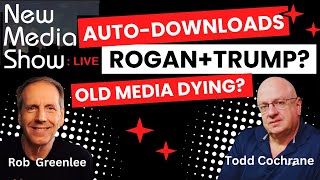
In this episode of the New Media Show, hosts Todd Cochrane and Rob Greenlee discuss three inter‑related crises affecting podcasting and the broader media ecosystem. They begin with a personal anecdote about auto‑starting a YouTube livestream, which segues into a deep dive on the long‑standing problem of download inflation caused by web‑player auto‑preloading. They explain how this practice violates IAB podcast measurement guidelines, recount a recent Blueberry incident where a code change unintentionally triggered massive preloads, and describe the mitigation steps (self‑reporting, data correction, and new threshold‑based monitoring). The conversation then shifts to the political ramifications of high‑profile podcast interviews, focusing on the Joe Rogan‑Donald Trump episode, its massive cross‑platform viewership, and the challenges of editing, transparency, and trust in media. They compare podcast metrics to traditional TV news ratings, argue that podcasts enjoy higher audience trust, and explore how the decline of legacy media creates an opportunity for podcasts to become the primary source of unedited political discourse. Finally, they debate the feasibility of local‑level podcast interviews for candidates, the role of platform policies (Spotify, YouTube, Facebook) in shaping content, and the broader trend toward partisan, algorithm‑driven media consumption.
Chapters
In the afternoon with Todd and Rob. Oh yeah, well, I have no idea there. We kind of pulled the trigger and then things went, uh, went boom.
Yeah, doing, doing live streams with these live stream platforms, there's a lot of timing involved. Sometimes they go sideways on you. Yeah.
And, uh, I did auto start on YouTube today, and, uh, that may not have been the right choice. Yeah, well, yeah, because, uh, it, it, uh, it's kind of weird when you do auto start because even though it's delayed, as soon as I saw it go live, it was doing the 30-second countdown. So I got to figure something else out for that, but Anyway, hey everybody, welcome to the New Media Show. We are back here. At least I'm back here.
Yeah, you're the one that traveled, not me. I'm in the same spot.
Yeah, it was kind of funny because I went on a 3-day tour, kind of a little Gilligan's Island pun there, a 3-hour tour, 3-day tour. And the morning that I was getting ready to depart, my resort host texted me while I was eating breakfast and said, hey, you know, they went to typhoon condition. Flag 4, some— whatever they use, a flag system over here. I'm like, okay, how long before the storm? Oh, it seems like 24 hours away. And I'm like, great. I said, I'm still leaving on time for the airport. He says, oh no. He says they cancel everything immediately. No ferries, no flights. I'm like, so how do I— he said, you don't, right?
Yeah, you're there for the duration, whatever that is.
That's right, you, you don't. And Um, about the time my flight was going to leave, the weather actually started to deteriorate, so it wasn't really even 24 hours. And then I just got stuck. And, uh, so I was supposed to leave on a Tuesday, and I end up leaving on a Saturday. And what they did was Friday night they lifted the flag, so there's the option of riding a ferry for 11 hours, then taking 5 hours on a bus, but there was floods and mudslides and everything along the route we were going home, or I was going home from the ferry. And the other right was to take this bangka boat, held about 20 people, uh, about an hour and 40-minute ride on the open ocean right after a typhoon, and go to an airport called, or an area called Cataclan, which is close to Boracay. They have a dozen flights out of there a day, so I got up at 3 o'clock in the morning, did a 2-hour bus van ride from hell on this most bumpy road you can imagine, and, uh, got in the bangka boat and landed and booked my airline ticket in what's called a tricycle on the way to the airport, checked in and literally boarded. I think I was— it was that quick, um, and was out of there. But anyways, back here Saturday, so here we are. Welcome to the New Media Show, everyone, and Todd's Adventures from Escaping from Alcatraz. At least, yeah, so that's how I'm—
yes, yeah. So some of the big topics you can probably tell from the artwork we put up there is, um, trying to kind of pull apart and expose kind of the, the download fraud that's been in podcasting for many, many years. And then also, let's, you know, let's talk about the Joe Rogan and Donald Trump event that happened on the internet with podcasting, which is, you know, it's always a kind of a milestone moment oftentimes because we've seen this happen even back with George W. Bush and Obama getting on podcasts many years ago. And I think we can draw some correlation to that. And then also the rapid decline of mainstream media. So let's dive into it.
Yeah, so, so I guess the question is, who— of course, what the story— what we're talking about is a— I guess it's a newspaper in Italy—
in Spain—
Spain that has made the top podcast list, uh, by Triton and, uh, I think Podtrack as well. Um, and having these, you know, 18 million downloads, which is a pretty, you know, remarkable number for a news podcast.
118 million.
Oh, 118. I was missing a digit.
Yeah.
So, you know, it turns out that was just auto-loading. They were pre-loading the media every time their website— and that's, you know, here's the— I basically has a couple questions on this. Um, Number one, who's their host?
I don't know, odds are it's probably a host out of Spain, but yeah.
And number two, this is a direct violation of IAB podcast measurement guidelines. Um, you know, we had an issue, Blueberry did, um, back I believe in January or February where we introduced some code into our web player that was causing autoloading, and we caught it, but we had to go back and basically make sure that there was, number one, no advertisers was impacted so that we didn't overbill an advertiser. Number two, had to inform our, um, the folks that were affected. And it wasn't— what was weird, it wasn't all users, it was just a certain subset of users that were using a certain feature. And, um, and basically number 3, we had to pull that data out of the stats. So it's, you know, it's something now that, um, we have specifically if we go in there and touch any code with the player, we, we basically done a run a QA analysis on the embed to make sure none of this activity is happening. Um, and so it can happen to anyone. It happened to us. But, you know, we were, we were monitoring for it. And, um, the— I don't— it appears after James sent them this email that this behavior stopped.
Yeah, I don't think we've, we've totally painted the picture of what's going on here yet. Uh, I think we're, we're getting to the end of the conversation before we've actually talked about what's actually happened here. So the, the, the episode that is in question here. So I guess it was being tracked by Triton out of Latin America, is based on their podcast ranker. So it does have a connection to Triton Digital, and it does look like it's hosted by Triton. So that's the platform that's going on here, and it does contain, I guess, programmatic advertising in the content. So, you know, I mean, just think about the implications of that around, Automatic revenue and advertisers going into this and being counted. It's a fairly small download. It's only 14 megabytes. So I'm assuming that the content isn't very long, but it's basically downloading numbers have predominantly happened over mobile phones in the browser, right? Oh, so this is where most of this has been happening. So, and if we look kind of historically to this, that's usually where the abuse is, is around players that are on web pages that are able to automatically trigger a download. And we've seen this in the past too. This is not a new thing that people have been doing. So each time you go to a website, it triggers the download in the background and the user doesn't even know it's happening.
Right.
It's usually how it works. So anyway, go, go ahead and tell your story about how you as a platform are attacking this.
Well, you know, we have to— it's part of our IB podcast measurement guidelines standards, right? So we, you know, we had to email the IB, said, hey, we had an issue. Here was the period of time that was affected. Here's the remedy that we did to make sure that this wasn't going to happen. Here's what we did with our customers. Here's what we did with any impacted advertisers. But for us, it was fortunate we had no impacted advertisers because we have people on programmatic as well. So, and it was completely our fault. We just missed a flag in, in one of the settings. And, um, so it was on us for this mistake, but we self-reported, announced it publicly on our website, um, and really did everything we could from a mitigation standpoint to make sure that all affected parties knew how their stats were affected for this period of time where this issue was in place. And then I had to go and set new processes in place. But so the question is, on their website, was it the player that was triggering the download?
Well, it's probably either the player or, or the website code, one of the two. Usually how this works, and it's a fairly simple adjustment to the player code.
Yeah.
Is to actually have like autoplay. I think that can be not, not actually going into a player, that, that can actually just happen in the background.
Yeah, there's an actual setting on most HTML players within the code to, um, caching, preloading.
Preloading, right, exactly. That's what it was.
So, and, and if, if you preload, that's against the measurement guidelines. And, um, you know, I would think, you know, we, we caught ourselves, um, with, with the issue. And, uh, you know, of course it's, it's ironic because, Rob, you know, I've been a pretty— I've been pretty staunch on you know, this, this particular issue. And I've called other companies out. So I, you know, the chickens came home to roost. I had to call myself out in this instance. Right.
Right. So, but it's usually done by the, by the, the platform that's making the content available on, on the web. And it's an easy adjustment to, to the players usually is how this works.
Usually.
Yeah.
Very simple fix.
But, you know, all the big platforms like Spotify and Apple and stuff like that don't enable that kind of functionality. So, you know, I think that there is, um—
now iHeart had same—
think that they— yeah, yeah, yeah. And I think it was also done over their, their web experience as well. That, that happened back in 2018, over 1,000 radio show websites. You think about all the, all the iHeart websites playing their podcast episodes automatically and caching them.
Yeah, that's bad, right?
That's exactly—
so, you know, for us it was like, you know, stop the presses. And, you know, it's one of those emails you get from the team member, and I, you know, I'm like you can swear like a sailor, um, because of the, you know, what we're going to have to, to deal with. So I, I think that, um, you know, and it's again, it's part of the regular auditing you have to— now one thing that we— it's unique in our IEB measurement guideline certification is that the folks that are using a redirect that we do not have control of their website. In other words, they're using a different player or whatever. Before they can use our redirect, there's a certification page that pops up that says you understand that your web player cannot preload. You know, you have to make sure this is a setting that it doesn't preload and And we have basically a, um, a self-affidavit of the podcaster that basically says, no, yes, I understand, I will not preload. And we make them go through a series of steps before we allow them to use the redirect, um, just because we can't control the player on people that are using our stats and our redirect. So, and again, that was part of our—
so unless they're players that are that are embeddable from your host, right? Which, right, which if they were using a player that came off of the Blueberry platform, then you do have control over that, right?
And those folks, we don't make them certify because they're customers. So non-customers, so, you know, we basically have had— that was part of our certification requirements. You know, basically they said, hey, you have to present this a notification and get people to sign off. This is the only way we are going to certify your redirect is if you basically have, uh, and we're supposed to self-police that. Now it's very, very hard to, and what you really do is you set a trigger. You set a trigger for web browsers because web browsers are usually, you know, right now depending on some Blueberry customers, or it can be as high as 10 or 12%., but most, most folks are very, very low numbers on the web player. They're 3%. So we basically in our system have a threshold that says once, um, a web stat goes above certain percentage on a show-by-show basis, it flags us in the system, says go look. That's how we caught ourselves was all of a sudden we started seeing, boom, boom, boom, boom, boom, you know, 25 shows are above the threshold and we're like, what, what's going on?
Yeah, this does raise some questions around Triton Digital's kind of practices as well, in my view, based on what you just said. Are they reviewing clients that are using third-party players as a method of delivery that is part of their podcast ranker? Well, it is being gamed here. Obviously it was gamed, right?
I don't think they were held to that same level because It was specifically for the redirect because we couldn't control the player.
Well, that's what's going on here. If they're part of the podcast ranker, they must be part of Triton's redirect, or, um, you know, so Triton can gather that information because they were ranked— this show was ranked 12th, the 12th biggest show by downloads in Latin America.
Well, being that when we did our first certification with IAB, our hosting did not— when we did the hosting peer hosting certification using raw log files, they didn't have to do this notice. The only time that came into effect was when we got our redirect certified in round 2. Yeah. And this is where these additional requirements were put upon us, um, to make sure, AKA, that something out of our control, we couldn't, you know, and be honest with you, now that I think about it, there's nothing to stop a hosting customer from using a different player. So potentially that should have been in effect from the beginning. So, you know, maybe—
yes, I mean, oftentimes the hosting platform doesn't know their client is doing that, right? Because there's no probably way for Triton to know that this newspaper was using its own player.
But this is something simple to monitor. You just have to— and we just said, okay, what's the threshold? What threshold should we set for this type of activity? And that's how we know. This is how we knew if there was an issue, is that was our flag that was set. I don't know.
I'm, I'm sure this is going to create some interesting conversations for Triton Digital if this show was on their programmatic platform.
Oh, it's, it's— this is what I was scared about when we had our, our flub was, okay, did— now do I have to go back to SoundStack and say, hey, um, these X thousands of downloads are and not to be paid? And do we have to refund? Because they—
the advertiser has paid for those downloads, doing, you know, or they're obligated to pay them. Whether or not they have yet is the question.
Or do we have to write a check back to the— the— because, you know, that was my big thing here was, you know, we were involved before, many, many years ago, with an audit that required a media company, a significant one, to write a significant check back to advertisers based on host read overbilling. So, you know, I was, I was quite concerned, um, but, you know, it was, it was quick enough, the damage was small, but we had nobody on programmatic that was affected with this specific, uh, issue.
Uh, Todd, do you think that there's any risk to regular podcasters that maybe they need to think about, um, so they maybe don't fall into this? Or do you think that every time this happens, it happens with willful intent?
Oh, I think most podcasters probably don't even know, and it's not willful intent. So the question is, was this situation with this newspaper—
yeah, or was it just an accident in the code?
Accident. Yeah, did someone, you know, some developer have a flag set? Um, you know, again, you don't know. And if they don't respond and make a statement, which, you know, you would hope that they would at some point make some sort of public statement.
Yeah, I think we went through a period of time, Todd, when it was, it was kind of in vogue, I guess, to, to when you load a web page that has a player on it to turn on the automatic play. Right. And I think we went through a period of time when it was like, no, that's not a good thing to do. Don't, don't automatically start playing an episode when a page loads.
I think there's— if I think there's 3 settings and you're a developer, I might be wrong. There is autoplay, there's cache, and then there's one more, I think, where you, you basically try to download the whole, right? But being that was only 14 megs, then I guarantee you that that triggered the, the download number because of the, you know, the 60-second play and a 14-meg file. That means that's probably a 14-minute show. So just the pre-caching alone would be enough to trigger. Now this is You know, this is not a popular thing, but I've said for a long, long time that the 1-minute threshold should be higher. And that has gotten much scorn and, you know, me needing to wear a bulletproof vest because the— I think it should be 3 to 5 minutes of content before you count it as a download. But That's me. That's not the other 30-some companies that are involved in basically, you know, Austrian government guidance.
Yeah, I think, Todd, I think you could take the position that that may be good for the advertising side of podcasting as well, because clearly the first 3 minutes of an episode is highly prized by sponsors and advertisers.
I don't think— I think what it really is, if you run the numbers, there's probably a financial impact. So, yeah, I think that is, you know, a true, you know, if you— because it's very easy in our logarithm to flip the integer. From 60 seconds to 180, and, and you can see the delta.
And I know the numbers drop fast, I would imagine.
I know what the delta is, right?
So yeah, yeah. So there's lots of layers to this conversation. That's why I wanted to talk about it, is that it's— it, it may appear, you know, I mean, this, this kind of news broke on podnews.net. Thank you, James Kridland. But yeah, You know, this thing has many layers to it that I think podcasters need to understand and have comprehension of because it has implications for a lot of things. And, and, you know, it's very easy to, to do this, and it's also very easy to get into trouble with it. And I think from a platform perspective, it's, it's a recurring thing. And that's one of the reasons I wanted to talk about it was, is because there is a history to this, and there is a history of impact and problems that people have. But yet I do know that there's this underlying desire that some, you know, engineers or programmers have, or marketing people have, that maybe the performance of the playback may benefit from a cache download type of a situation. I know this was the conversation that we had when I was talking to Facebook before they entered, you know, I don't necessarily want to bring them up, but came into wanting to support podcasting was that they were concerned about playback performance on their platform. And so this, this may be, you know, maybe it's, maybe it was an accident, but maybe the intent really was to provide a better, more responsive playback experience when that user hit the play button, right? The show stopped, start playing right away.
And there's not that delay. Now Randy says, I've learned to take all my stats with a grain of salt. I've noticed some weird things with my stats. I've noticed that when they're trying to get me to upgrade my plan. So what's interesting about that statement, Randy, is, um, way we've worked our stats at Blueberry is as long as you're not running advertising You're good. You know, you, you, we've got customers that you've got a bandwidth, you know, right? And, uh, and, but if you start commercializing your show and you are on a flat rate plan, then I have a threshold that I look at and I say, okay, that show's busted. And I don't use stats, I use bandwidth because I get a bandwidth report for each show. And you bust that little threshold, I'm going to go over and look at your show and say, oh yeah, they're running Uh, they're not running ads and I, you know, they go on with my day. But if they are running ads and they become commercial, then I'll say, hey, you know, we should have you on the Pro Plan. Uh, you know, the flat rate plans are designed for folks that are not commercial, not running advertising. And there's a fine line there between two because what if the person's just promoting, um, shirts in a show? Well, I'm not going to go and they're not going to count that as advertising. But if they're running a HelloFresh ad, then that's kind of like the threshold that we set. Um, and we give shows the options of going on programmatic too. So, you know, I think— but, you know, I've never asked someone to upgrade because of their stats number. I've asked them to upgrade because of their bandwidth usage. And again, probably in the past 5 years, that's maybe 5 customers.
And I wanted to add one, one last little piece to this puzzle, too, for people to think about in regards to what's going on here is that each time this happens, it's another, I don't know, chip out of the tree of, of the rationale for why we need to move beyond downloads, because this type of activity isn't going to happen in a stream. Um, so this, you know, you typically don't cache a stream, right?
So, well, just one of those things. The difference between a stream and a progressive download is very narrow. So this could happen in a stream too, because let's be frank, it's still a physical media file.
Yeah, but it's— I think it's less likely.
Um, I think it's more likely to happen as a stream.
Well, most, most streaming players don't necessarily cache, don't, don't store anything. All they do is just play as it, as it gets delivered to the player.
So again, the— it's, it's the same. I, I think you have a higher risk because in streaming platforms they want the experience to be hit play, it goes. So I bet you, I bet you streaming platforms are caching. I just, I bet they are.
I mean, I've done a lot of work with streaming platforms and they typically only deliver what's— what the limitations is because they're usually encoded in a variable bitrate type of a delivery or a fixed bitrate. So they're only going to deliver to the player at the bandwidth that it was set for. And I don't know that there's a lot of these players out there. I think it's a good, good question, but that actually cache the stream content. I think when the player closes up, all the content's gone, but as it comes in, it just gets consumed, but it doesn't get stored anywhere.
Again, from a technical standpoint, the difference, because you're still serving physical— and this is the thing that's so bullshit— says, oh, we want to go to streaming technology. Well, guess what? It's still a physical file sitting somewhere. It's, it's not— if you— it— you are not—
but it's not sitting locally. It's not sitting locally. It's only sitting in the server.
Yeah, just like now your podcast media is sitting in a server.
Yeah, but you can't, um, download in the background a file that's, um, streaming on a server. So it's just—
no, yes you can. Absolutely.
It's unusual.
That's got that URL link in there.
Absolutely. So what you're saying is when you stream an episode, true streaming, I'm not talking about progressive download playback, we're talking about—
the thing is, you got to be—
they're storing that episode because it transferred to the client player faster than the set bitrate of the stream.
All I'm saying is that stream, that if you go for podcast, not what we're doing right here, there is a physical media file somewhere that cannot be changed.
I know, but that's not what's being counted in a player though.
Well, again, I think you'll have the same problem. I might be wrong, but I'm sure you'll have— because it's, it's, it's, it's all semantics at that point.
I think it's quite different, Todd. I don't think so, because maybe we should bring on a streaming expert to, to define this. But it can be done in a variety of different ways.
Most streaming is not from fixed media. Streaming is live. When you hear— when you, when you talk to people that have radio shows, you join in progress. You don't join at the beginning of streaming programs. So that's the big difference here.
Well, there's live streams and there's on-demand streams. Well, actually, I got most of my audience from my early radio show from on-demand stream.
So same thing, there's a physical file sitting somewhere from Yeah, but that's on the server, not on the client.
So what we're talking about here is, is a file that's being transferred as a download to the, the player device.
It's a cache. It's a cache of media is what it is.
And it's, it's interpreted by the, by the serving server as the same thing as a complete file download.
I don't, I don't think so. I think streaming, when you hit stream, it's the same. For podcast media, fixed podcast media. I might be wrong, but it's, it, it's the same file.
Yeah, but it's not being transferred, it's being played to, to the player. It's only delivering as much bandwidth as the server is configured to deliver.
Yeah, I don't know about that, but anyway, let's hope we never go to that.
Well, Todd, I used to run two streaming, streaming servers. One for real networks and one for— yeah, I know, for Windows Media Server. And I had to go in and set the delivery bandwidth to the players. So if that was set at 32K or 64K or whatever it was, that's all that was delivered to the player was exactly what that bandwidth was that was allocated for that media file. So it doesn't matter what it's encoded at necessarily in the server.
Well, it plays at We go back to Facebook, all their stuff is streamed. So if they wanted to pre-cache, that's the same thing that YouTube does too.
So when you're streaming on YouTube like we are right now, that is truly a stream, right? It's being stored as it comes in, in YouTube. As it's coming in, it's being— it's building a streaming file on their servers that they can be delivered on demand as a stream, right? And that's, that's probably going to be a variable bitrate stream because it could be a 4K stream, it could be an HD stream, or it can be a standard definition stream.
Well, I think when you click play on YouTube, you don't get a delay. It starts playing immediately. So that tells us they're caching.
That's— well, that's the behavior of a streaming server, is that it's only going to deliver— it's going to start playing instantaneously. As those bits come into the same thing with the audio file. So again, well, it's, it's different because the, the download, it, it can download faster than the playback on a, on a podcast download, right? So it's a progressive download. So it depends on how fast your bandwidth connection is. It'll deliver the whole media file, but it's only going to play it at the bitrate that the media file is set at.
But YouTube does the same thing. I can have my internet go off and my YouTube video will play for 3 or 4 minutes before it shuts off. So they're doing something. Um, try it.
So they're caching into the player is probably what they're doing. They're caching, but it's not being stored anyway.
Yeah, hopefully we don't switch.
Well, this is the— this is the this is really at the core of the bigger conversation that continues to bubble out there around this, this conflict between the advertising industry wants, increasingly wants podcasting to be a streaming delivery method because they get better metrics out of that, right? And why do they get better metrics out of it is because they can see when the stream stops and they can see when the stream ends, right? And they have an exact measurement on that because as the content's delivered to the player, there's a countdown clock there. And it's now granted this can be done with podcasting too, but as you've said in the past, it's not as precise.
Right.
Right. So, you know, the client side can track it probably better than the server side. What's different here with the streaming with like a YouTube is that the server side sees that same data that you would get out of the player side. And so with the progressive download, you're not getting that data as accurate at the server side.
Well, anyway, we'll see what happens.
Well, no, I think this is the conflict. I think podcasting is going to have to decide at some point, and I think these big platforms are going to push the issue, and I think it's already happening, that their advertisers are demanding to know much more accurate and detailed metrics about when their ads are heard.
Yeah, well, I don't know if they've, uh, checked her lately or not, but I think it's all bullshit because they already have plenty of studies that says podcast advertising works better than, you know, any other advertising. So I think they need to just get off on, you know, it's all about chasing the big dollars and not worrying about the average podcaster out there.
Yeah, I think that that, that is true. Um, and, and these advertisers or these brands or whatever have gotten used to digital buying. Yeah. And they're used to buying into streaming radio, they're used to buying streams on YouTube, they're used to buying it in this method. And then, then you throw into the mix downloads and it, it complicates their their decisions.
Well, that was all solved and we changed the methodology from downloads to plays, right?
But we both know that that's, that's kind of BS as well.
So yeah, right. So everyone's—
and that's part of the— everyone's part of what I'm talking about.
Everyone's got plays now, right?
Well, let's, let's kind of move on and talk about what we saw this past week with, uh, Joe Rogan and Donald Trump and what that means. For a few things.
Have you seen all the discussion? Did you see that Rogan put that video up on X because Twitter— and not Twitter— you could not find the full video on YouTube. You could only find clips.
So some—
well, well, okay, business was going on there.
Let's be more precise about that. What, what was actually happening was, um, you did a search for Joe Rogan and Donald Trump in the search box, right? You couldn't find it. That's right. So you had to go to actually Joe Rogan's, uh, Experience channel on YouTube, and it was in the, the list of episodes that he had. But that was really the only way to find it.
So, hmm, something.
And he still got 40 million views.
And he goes, makes you go, hmm, 40 million views and it couldn't be found by search.
And right, can you imagine how many views he would have had if it would have come up in search?
Think about the monkey business. It's being— who's stepping on the scales over there?
Well, I think we know who, right? It's Google, right? Right. So, but, but looking at the big picture of this, oh yeah, amazing. Donald Trump going on podcasts, uh, just just the ones prior to this Joe Rogan conversation has generated almost 24 million views on Donald Trump being on a variety of big podcasters. I mean, like, he's been on the, I think it's the second largest and the third largest podcast on Spotify, the Sean Ryan Show and the Theo Bond Podcast.
The thing that I think is, is my point I made, um, on Twitter was Rogan streamed that show, right? It was— was it streamed? Does he stream that, those interviews?
It's not a live show. It's not a live show. It's, it's totally recorded and then published into Spotify and into YouTube and into his podcast feed.
So the question is, did he edit? And with a 3-hour program, I don't think so. He edited it all.
No, I think he's got too much integrity to, to do that kind of stuff.
So was, uh, Call Her Daddy or whatever, that show that had, uh, Kamala— am I pronouncing that right? Because I don't want to get yelled at here.
I believe so.
Okay. Um, did, did they edit that interview? I couldn't answer that one precisely either, but So I think this is where there's an opportunity here. You look at the controversy that came out of 60 Minutes replacing an answer, um, with another interview, doing a swaparoo.
Now we're talking about mainstream media and how mainstream media, right, right.
So if, if a, if podcasts really want to throw a continual wrench into old media, we're going to call them old media today, Um, what would be real interesting is for a show like Rogan, a show like, uh, Call Her Daddy, and, you know, whatever, where Theo Von or whatever, it would be nice to have a running, uh, a clock. Of course, it could change the clock, but it'd be nice to have a running clock or something in there that would prove that there was no— or disclaimer that there was no editing done on the interview, um, so that us as consumers of the content, whatever political side you're on, know if you have gotten the full context of an interview without any monkey business being done in removing words. It's harder to edit video and make it look smooth. Audio very, very simple. Matter of fact, I did it on my show the other day. I forgot to hit record for the first 2 minutes of my podcast, so I had to record the— re-record the first 2 minutes. So I think what we have here is a situation where trust in media, going back to podcasting, is going to be the— it's going to be a linchpin here because we can't trust— it doesn't matter if you're Fox, CBS, ABC, NBC, MSNBC, it doesn't matter what alphabet soup you watch on mainstream or old stream media, um, they can edit and take sound bites and you don't get the full context. So I think context in this day and age is incredibly important because you can take anything that we say here and take a 15-second soundbite of that and make us sound like the most horrible monsters in the whole world if you don't have the full context of something. So it's not that extreme, but you get what I'm saying. They've done this repeatedly, repeatedly to fit their narrative. So if you have an unedited Theo Von Call Her Daddy— is that the show? Call Her Daddy.
Oh yeah, as far as the— yeah, and the show that Kamala did, right?
Yeah. And then, and then Rogan, and now Vance is going to go on. Um, these unedited will actually show you what you really want to know about a candidate.
Yeah, let's be— I'm going to pull it back a little bit on saying unedited. Um, I do think that the Joe Rogan podcast probably maybe has some edits in it, but it's important to think about the context of what the edits are, right? If they're editing for the beginning and the end and maybe editing for gaps in their content or whatever. So, Rob Greenlee or whatever. Yeah, they'll say Joe had to go to the bathroom or something. It's okay to edit that kind of stuff, right? Yeah, but it's not okay if you're editing to change the narrative, what Donald Trump said, or to change the question that Joe Rogan said, which sometimes— this is what has gotten, you know, out of control out there in the political realm, is when people take snippets from a conversation and reinterpret it as something unintended on the part of the person saying it because they didn't take the full context of it. That's the real danger of this. But But it, yeah, it gets back to this, Todd, that all the research is showing that the trust in podcasts is so much higher than mainstream media right now because of the authentic conversations, you know, the 3-hour chats.
Yeah.
And even if we trust Joe Rogan is the question.
Even if they do edit, it's 3 hours.
It's still 3 hours, right?
You know, and, but again, they haven't edited. Then you get to see the beginning, the middle, and the end. Yeah. And all the superfluous interactions that happen from a question to an answer. Not, not the 15-second soundbite. And it makes— it doesn't matter which candidate, but they've, you know, obviously we've seen this be weaponized in a big way against Trump, in a big way. And maybe to Kamala too. You know, they've taken sound bites from her. They show this word soup, you know, but maybe we didn't hear the beginning and the end. Yeah. And maybe the perspective would be different if we heard the beginning and the end and not just the sound bite. The news cycles can't go for 3 hours because, you know, they're on a 30-minute news cycle.
So Yeah, it could be taken advantage. I mean, a lot of voters are fairly low-information voters, right? So, you know, this concept of snapshots and sound bites is certainly an important factor in a political campaign.
So I was watching the Facebook and TikTok responses to this because I was generally very curious what people's— if it would cause people to flip. Now, there were some people who said, oh, now I'm voting for him, and oh no, I'm not. You know, so there was definitely people change their minds. And I think that's the key here in having the ability to, again, not just hear a soundbite, but hear the beginning, middle, the end, the full story. Um, yeah, and you know, I listened, I listened to the 3 hours and there was a few things in there I was like, wow. And you know, and of course, and you know, the same thing with, uh And, and I listened to the other interview as well, and I was like, okay. But again, I don't know on Call Her Daddy if they edited or not. Um, I'm suspicious that they may have, but they may not have. But I think it would be good for all of those podcasters to come out and say, yeah, we, we didn't edit, right? We didn't edit the context of the beginning. Yeah.
Yeah, it's the editing of the context of the conversation. One other piece of this that we haven't talked about, which maybe draws some interesting contextual correlation around the distribution of content like this right now, is that the numbers that I've seen as of October 26th was that the Rogan audio podcast got 3.1 million downloads. I don't know what the total number is today. It's a few days past that, but Twitter X got 18 million views of the same media file.
But yeah, I was going to load it here.
And so you— and then 40 million views on YouTube. Yeah. And you kind of, you know, you paint the picture And I've, I've, I've said this before on this podcast, you know, um, um, was it Stephen Bartlett from the CEO of a podcast, uh, the CEO of Diary of a CEO podcast, um, we commented at Podcast Movement that he felt that podcasting felt small. And so I guess if you put it on the context of what I'm seeing here with the Joe Rogan numbers, let's just give give Joe Rogan the benefit of a doubt on his audio podcast, that maybe he had 5 million downloads of his audio podcast, but yet he had 18 million views of the full episode on X and 40 million views on YouTube. What does that say about the, the media landscape right now around the same content?
Well, let me do a— where's the scale? Well, how many people watch CNN primetime? In the 8 to 11 PM CNN average, 893,000 among the 25 to 54 and 3.4— 3.463 million among P2. So, um, P2 plus, whatever that is. That was CNN's strongest Monday through Thursday primetime performance since the week of the presidential Biden inauguration. So, so 3 point, let's say CNN, 4.2 million, uh, and that's again people that come in and come out between 8 and 11. Now let's look at Fox.
So what you're talking about is the prime time viewership of, of CNN from 4 to 8 PM, is that what you're saying?
Eastern? Yeah. So Fox News averaged, um, a little bit different Time share. Fox— in total, Fox News averaged 1.43 million viewership, increasing year to year and 194,000 plus. 48 in prime time, Fox News garnered 2.5 million viewers and 320— so about the same, about the same number. Although I think when they look at the real rankings, Fox is killing CNN hand over foot., in whatever their ratings, you know, when they, when they actually do the Nielsen ratings or whatever. MSNBC, how many people watch MSNBC primetime? Oh, it's probably, uh, radically less. A 1.4. Oh, here's— it is primetime Fox 2.5, MSNBC 1.4. Um, kind of a breakdown. I wonder if I— if they've got more here. Who has more viewers, CNN or MSNBC? Seeing Enrique, the head of MSNBC Which news station has the most? Fox has the most on 24-hour period coverage. So yeah, so looks to me like Rogan kicked their ass.
Well, yeah, I would say that's— I mean, I mean, Joe Rogan got more audience out of his audio podcast than than probably all those networks combined, right? And then, so, and that's not even counting the, the action that's happening on Facebook and YouTube and, and X. Um, you know, if you total all that stuff up, you're talking, you know, close to 100 million views, which these networks are not even anywhere near that.
So again, Rogan is a, is a is an outlier. He is a big name, but he is pulling numbers bigger than old media. Randy says people out there will chop up that for Trump memes all over the net. It is getting hard with AI and like ElevenLabs to know who, who is the— who is true or fake.
That's true. Yeah, it's true. But it wasn't just Joe Rogan that got these kind of numbers. There was Theo Vaughn. There was, uh, what was the other one? Sean Ryan. And Lex, Lex Friedman, uh, is pulling in huge numbers too. And that totaled up almost $24 million.
So I saw a, a clip on YouTube. Was it Sean Ryan? No. Yeah, maybe, maybe it was. Let me go look at this guy. Yeah, I, I really like Sean Ryan, you know. I, I follow him.
I do too. I think he's terrific.
Yeah, he's— you know, he does a lot of military SEALs, CIA type of interviews. I really like his interviews. He made a comment, um, uh, Facebook Short that basically said, hey, we— this, this is a monumental event. And I think if you think about where we are in the world today and the trust. You know, I'm sure you're having a heyday with this over on Trust Factor, but it's, it's a situation where, um, well, you know, no one trusts mainstream media. It doesn't matter which channel.
You might be a guy—
they pick sides. Yeah, you might be a diehard Fox or CNN or MSNBC or Rachel Maddow or whoever, whatever your flavor is. And I don't— again, we don't care here, um, but don't you want the whole story?
Well, Todd, that's a much bigger existential question, right? Is what's the landscape going forward? Is the age or the the era of bipartisan, nonpartisan media gone? Well, I think it is.
There's no part of media anymore. It's, it's, it's nonpartisan media.
And no, no, it's partisan media, not nonpartisan. There's no nonpartisan. Yeah. So it's— and because frankly, I don't know that you're going to build audience these days if you're not partisan.
So what would be really interesting here, and let's be, let's be just straight up honest, if, if Kamala went on Rogan and did 3 hours, if she did 3 hours, if she did the equivalent of what President Trump did, this would be the true— because then we could see the questions Rogan was asking. Because you look at the questions he asked to former President Trump. Some of those were very, very hard questions. No, no softballs. There was no— there was no softball pitches that were going on there. Um, if you listen to it, most people, oh, I listen— they listen to a soundbite. But I challenge people, if, if, if she does go on, and I hear— I think the chances of that is zero. I don't think she's going to go on for 3 hours.
I just, I think it's too big of a risk for her.
I think, um, she might go on the day after the election if she wins, but she's not going to go on before the election. I just don't think so.
Yeah, I did see an online poll on X that, uh, Joe Rogan put out saying, should I have Kamala Harris on the podcast, yes or no? And I did see in there that the results were showing over 60% yes.
But the— but still 40% of people said no. No, right? So why are they saying—
but that could be very similar with Donald Trump too, right? All right, it could be the same thing.
And it would be— it would be awesome then to have a side-by-side comparison and look at the interview questions and figure out, okay, did the hard questions get answered? Did softball questions get thrown out? Was there a parity in, in treating the candidate the same? I think with Rogan we would have close to parity. Yeah, the history has already shown that even on some of the— when I watched the Call Her Daddy, those are some pretty softball questions that she got.
She weren't asked. I would imagine a lot of the talking points were probably pre-agreed to with that, with that particular production.
Then they should just— it'd be nice to have them disclose that.
Well, because I, I've heard that Joe Biden does that with, with the interviews. Well, they'll talk to the host of whoever's doing the interview and they'll agree to a list of questions.
Yeah, I'm sure. How could that not happen even with former President Trump? I do that.
I don't think— well, that— this— I don't know for sure. Yeah, I'm just saying that I don't get a sense that anything was agreed to on topics, but I could be wrong. Uh, I don't know. I'm not behind the scenes.
And again, I think this is all part of— would be important disclosure as we move out of, you know, whatever's gonna happen, the elections, whatever's gonna happen in the election. But as we move out of this into the next season I think there's, there's good— there's some things here that could come out of this where, you know, Rogan could say, listen, hey, um, he didn't get advanced access to the questions. Um, there was no editing of the question beginning, middle, and end of, of the— if we did editing, this is what we did. Um, I'm sure people in the space have went through that video with a fine-tooth comb looking for a way to put pinholes in Rogan's commentary. So for his aspect, I'm 95% sure there was no editing done, just because there's political mileage in being able to say, see, at 3 minutes and 82— 3 minutes, 82— 3 minutes and 32 seconds, uh, there was a glitch. You know, it's a cut. What happened? Why was there a cut? Um, so I, I don't know. I, I think there's an opportunity here for podcasting to truly, truly, truly be the new media and the trustworthy source of, of all content when it doesn't matter, presidential or whatever.
Yeah, I thought it was interesting that, um, as kind of a backdrop to this for the Joe Rogan kind of situation is that he's got about 15 million Spotify followers right now, and that, that podcast is available in a video form and an audio form, so you can take your pick, right? And he has 17.5 million YouTube subscribers. So it doesn't say anything in here about how many, um, how many Apple followers that he has, um, or— but it says on Spotify. That's because he's hosted on Spotify and he's a partner of Spotify, and they're not about Apple numbers. I kind of wonder how much of that interview with Donald Trump, um, in the back of Joe's mind thought about his relationship with Spotify, um, because if I think about the, the history of him being on that on that platform is that there has been times when he's been very controversial on that platform, and Spotify was, you know, having some second thoughts. It wasn't that long ago, it was only a couple years ago that this happened, um, and maybe wouldn't have been renewed or something. I mean, I kind of felt that tension, right, back especially during, during the pandemic time frame. So I do kind of wonder if Joe has to kind of like hold back on some things and maybe not talk about certain issues? Because I think he did get some heat for not challenging Donald Trump about the whole COVID vaccine and that kind of stuff. So I don't, um, I just wonder if he has to kind of couch his questions and his conversation, keeping in mind that his, his platform is who they are, right, and what their, what their values are.
That's, that's a good question. The only way we're ever going to know that is if Joe leaves Spotify., and then those stories will come out, maybe depending on the exit NDA he has. But he's under contract right now, so we'll never know.
Yes, I did hear him say at the very beginning of the interview that he wanted to talk about this subject, but he needed— he couldn't play certain things on the screen because YouTube would, would ban him or block him. Yeah, so he said that at the very beginning of the program. Which I thought was interesting. But, you know, this gets back into our earlier conversation about like brand safety and these tools where content creators have to censor themselves around what they say and what they can't say, the questions that they ask, the topics that they cover, because they're concerned about monetization and takedowns. Yeah, if they're on a platform that Does that, right?
Which a lot of the platforms do. Well, you know, I, I, you know, be honest with you, I had plenty of other things to do I could have done for 3 hours.
Um, I think all of us are—
that, that's the case. Yeah, I wanted to be able to— and the reason I wanted to watch it versus listen to it in this regard was I was looking for those—
yeah, there's body language stuff that you can pick up in the video.
And I was, and I was looking for edits and I, you know, I was looking for, well, that too, you know. And, and so from that regard, that's the reason I want— and normally I would just listen to Rogan, um, when I do, only if he has a guest that is coming on. But here, you know, if you think about this, this is a— was an incredibly strategic move by the Trump campaign and being on Rogan. And now that his running mate is going to be on, um, that, that's, that's, you know, that's an— that shows you, um, at least in my opinion, that, uh, they want the hard questions and they want to be challenged. And whether you like it or not, um, you can then make your own judgment on the responses. You know, no one, when he does his rallies and all of them, and even Kamala, they run the same playbook, same script, same things. It's just a rinse, wash, repeat, different city.
So unless he says something outlandish or she says something outlandish, or if there's something in the news that's happening at that time, whatever, right?
Right. Then they'll pick up a segment. So, you know, what you see in the rallies is the same sound bites again and again and again that make it through TikTok and all the other places. Yeah. And that's not what I want to hear.
No, that's true. And that's what's great about them doing these long-form podcasts. And there's another piece of this too, is that one of the problems that we see in the media landscape, especially around politics right now, is each side doesn't really want to listen to the other side. Oh no. They, they focus on getting sound bites about what the other side says, right? And so nobody's really listening to the whole conversation, really, of any of these candidates on the opposite side, right? Right. So those that are in favor of Donald Trump probably never, never listen to the entire Kamala Harris conversations on the interviews that she does, right? And inverse, the The, uh, the Democrat side of the fence probably never listens to the entire conversation that Donald Trump's because they're so repulsed by him, right?
They can't, they can't handle it. Yeah, they, they, they want to, you know, yeah, right.
But it's so important for people, and I've been saying this for a long time, is that it's so important for all of us as voters in the United States of America to actually listen to both of these people talk in long-form conversations and really get to know them, not just rely on sound bites that comes from the mainstream media.
Get into the details. Now here's, here's— I'm willing to do that though. I'm going to take a little different approach. Yeah, we kind of know what we're getting with these two candidates.
It's kind of some more know more than others, right?
And some people know whatever they've heard. But in the real nitty-gritty, if we want real change to happen, senators, House of Representatives, local state legislatures, your county commission, your county commission, your— all these people that are on things that do really affect you besides taxes and the debt and everything else, your local zoning. This is where we need more because I, I went to vote, Rob. I got my absentee ballot, and I've already voted too. And I'm asking my sister, what's the story on this candidate? I don't know who they are. I don't know what they do. I don't know if I should vote for the Republican or the Democrat or the Independent.
I said, I have nary a clue, especially in the local races.
Yes, I agree with you. And I'm like, and, and she's kind of tuned in, so she gave me her opinion. And, you know, and to be honest with you, I took her advice and picked the candidate she'd suggested because I, I trust her. But if, if I didn't have someone to reach out to, um, I would have had to— if, if I really cared, I would have had to went online, found their website, tried to sort through their BS sound bites and figure out, okay, what is this person, right? If we could actually have I would sit through 5 or 6 hours of content to hear the presidential candidates, the senators, the House of Representatives. I would listen to local— the local candidate and really know who I'm voting for. Yeah, you know, my, um, situation happened— oh, it's been probably 10 or 15 years. I was in— still living in Hawaii, and, um, Hawaii's— I mean, it's, it's, it's hardcore. I think there's one token public in the whole state. And, um, I was, uh, it was a Fourth of July, um, event, and I was hanging out with, uh, family members. And, uh, the part— one of our, uh, relatives who's now— just a matter of fact, I just went to his funeral when I was in Hawaii. Um, him and I were sitting there talking, and in walks the politicians, right? And, uh, The question was asked, where did you go to high school? Um, and no, no real substantive questions. So Todd, of course, I don't care what high school you went to in Hawaii, that's a thing. And I say, so I asked the candidate 3 or 4 things, um, about its issues in Hawaii, and he responded and I didn't know until later that the guy was a Republican. And so, you know, I'm kind of on my phone, and then of course my uncle's like, wow, I really like him. He's— that, those are great questions, and you know, you get great responses. And I said, I said, Uncle, I said, um, who do you normally vote? I always vote straight ticket, uh, Democrat, right? And I said, you realize, straight down the line, right, or across? Yeah. And I said, you realize he was a Republican? And he, I kind of got this, eh, kind of, he had this like moment where he was like, I could tell that there was a shift. Now, he may have still voted straight Democrat, but at least set a flag in his head. And I, again, I didn't know when the guy came in the tent because he didn't say, I'm running for such and such district and blah, blah, blah. And, um, so for me, it just tells me that people really don't know who their candidates are. They don't know their issues. They don't know what they stand for. And if we did, if we did, this country would be a hell of a lot different.
Yeah, I actually registered in the state of Connecticut as unaffiliated, so I, I didn't designate a party. I don't really believe in that. I don't believe that we should be put in these silos to say, well, you're a Democrat or you're a Republican.
Yeah, yeah.
I don't think I'm an American, so that's why, that's why I register as unaffiliated, because I want to be able to pick the people by, by who they are.
I don't think in Michigan I have to declare which party I'm part of.
Some of the states actually require that because one of the reasons is because of the The primaries tend to be either Republican or Democrat, and sometimes they happen at different times of the year. So those people need to be identified, I guess.
So we didn't want to turn this into a political show, but I think—
no, the importance— what's the mapping back to podcasting then?
Yeah, the mapping, right, is there needs to be more of this, right? And, you know, we need to have the ability to be educated on you know, who's going to, who's going to represent us and, you know, run up the debt or, you know, spend more money on defense or whatever you're, whatever you want or don't want, uh, you know, you should have that education, say, okay, I don't want this person because, right?
And, and I think it's also safe to say that, you know, mainstream media could do this too, but the problem is, is that they've lost trust. No, they've lost the trust of the, of their audience, and their audience is going to where feel like they can trust to get more authentic and real conversations. I mean, I mean, of all the people that could be doing this, it's mainstream media because they have the reach, they have the ability, they have the reputation from the past— not so much in the present, but, but, you know, they could be doing this too. I mean, they could be doing interviews like this that reach this kind of scale, but nobody trusts them.
I think the part of the issue is, um, as well is when they are accused of being biased, they say, oh no, we're not, we're not biased, we give fair and equal coverage. But there's so much inside the tent, they can't see beyond the horizon of what they're involved in, where the rest of us see this big picture and like, oh yeah, they're just a, you know, it should be, um, DN, uh, DNC, NBC.
Yeah, right. Well, I think that all these big networks have made a mistake by being a network that puts on a debate. I think it's been just a blunder on their part because what we've seen them do is expose themselves as being biased in a significant way. I liked it in the past, and because we used to have a bipartisan or an unpartisan election debate committee. I don't remember that. That used to put these debates on, and they hired an independent video production company to come in and create a video feed out of that event. That's how it used to be done. Now what's being done is it's being earmarked to be— it's going to be a CNN debate, or it's going to be an ABC News debate. And if those networks are biased and they come into it and give them the impression that they're biased, then that's going to taint them as an untrustworthy news organization. So I think that these debates should be put on in an unaffiliated and unbiased organization.
Can you imagine having Rogan doing the debate and having both candidates in separate rooms where they can't see each other or hear each other? And well, yeah, and bring, bring Joe Rogan in, bring, you know, a representative of across-the-board media out there from the independent side, have them in separate rooms where they can't hear each other and they'll say, okay, here's the question, and one candidate gets the question and the other question. You can't— you— they can— they can't rebuttal because they haven't heard each other. I think that would be a really that. Now that would be a debate I would actually watch.
But that's not really a debate though, Todd. You're siloing them so much where there's no dynamic between them, and that's kind of the whole point.
Well, then that's— I guess it's not called a debate. It's a, you know, it's, it's a— just an interview at that point, right? They both get the same question, right?
But I think bringing in people that are not affiliated with what the population has associated with as a biased one side or the other network.
So, so as is key, so as the podcast listeners are out there, you know, do you see an opportunity here, you know, for the ability?
We've talked about local podcasting for, yeah, for years, or actually especially in the last couple of weeks we've been talking about it.
The challenge is, is no one would have went on Rogan unless he had as big of an audience as he has. So that'll be the another thing, it's a economy of scale. So can you get a local politician to go on a local show that may have a small local audience? They may not find it worth their time.
So it just depends if it's a local candidate for like the state house or the state senate or something like that. Um, you're, you're right, that, that's why there needs to be some local, state-level, city-level podcasts that are out there that that reach a large percentage of the population for them to do it. I, yeah, I, I agree with you. And I don't— I think to some degree those exist, but not at the level that they are— that really needs to happen.
Because I think it would make a, a big difference because, you know, most people are so disenfranchised with the election process at this point. Um, it's kind of interesting, uh, being overseas at this time because I'm getting questions like from people that are here and expats from other countries. And the basic question is, is what the beep is going on in America? You know, that's the question I keep getting asked. What the— you know, have you guys went insane? And it's not just about the politics, it's everything. And, um, it's curious. It's curious to see this external feedback. And, uh, what's even more interesting is they'll be very vocal to tell me who they think should be president. And I'll say that based on the conversations I've been having, you know, Kamala better be happy that they can't vote because the majority of people that I run into, they don't know the nuances, they just see the personality.
And I did see that, uh, Arnold Schwarzenegger came out today with a public post endorsing, um, Kamala Harris.
Well, that's not surprising because, well, he's a former Republican.
That's true. Governor of California, right?
Yeah. So, so again, um, but again, it is curious to hear the commentary, at least locally. And I don't like to talk politics. Matter of fact, being a visitor in the Philippines, um, yeah, you shall never talk about local politics. Uh, it's a taboo thing, especially if you're a creator. Stay out of their business. Don't talk about their policies. Don't, don't, don't, because most people are going to not necessarily always have positive things to say, and it can get people in trouble. So, you know, and there's a lot of YouTubers here that are on the borderline, and I'm like, why? Why go on the borderline? And this— it's their country, you know. They, they are going to do what they're going to do.
Stay the hell out of it. And I think that the, the reason we're talking about it tonight is that we're just seeing such a big impact on— yeah, on politics right now that is rooted in independent created media. And that includes podcasting. But I think it's an interesting— maybe we've crossed over a threshold here, Todd, where this medium that we call podcasting and new media and YouTube, or, you know, it depends on how much of an inclusion that you want to have here, has really taken over the mantle of being the mainstream media now, right? People have voted with their eyes and their ears.
Yeah. How many— if you had 300— how many— what is the population of the United States right now? 365 million or something like that. Population of USA, let's see here, 335 million. And so Rogan has had 36 million views 40, just on, just on YouTube. So he has reached 10% of the— well, of course there's probably some— I'd like to see that breakdown, how much of that is U.S. and how much of that is foreign, from a listener standpoint. But I would say probably he's reached at least 10% of the electorate.
Yeah, yeah, actually, if you look at the 18 million views on Twitter X You know, between those, just those two is 60 million. And then you add up the almost 25 million that were on other podcasts that Donald Trump has been on. And then, you know, I mean, you're getting some serious numbers.
What was the numbers that she did on Call Her Daddy?
I've never seen those numbers, so I don't know.
I don't know. That would be the number I'd want to see.
I can't imagine that that one hit the—
this, this much. I would think it would be at least a million or more, but it's hard to say. Yeah, yeah, yeah.
So I think we, we probably go find out. If you look it up in, in YouTube to find, uh, that conversation, there's going to be a view count that's going to be underneath that. Now granted, uh, we're not going to know what the interview on the audio podcast was, but, um, let's see here.
It's Spotify again. Let me look for YouTube again. I can't find it. It's not in the search results. So, oh, here we go. Call Her Daddy. All right, see, okay, 744,000 views on YouTube, not even a million. Wow. Well, yeah, so in that regard then, Rogan, man, he knocked it out of the ballpark, didn't he? If he can reach 10, he If you can reach 10% of the US population just in one interview, that's, that's, that's incredible.
Yeah, but it wasn't— if that's what he did, I mean, it was a lot of people that probably consumed that from other countries around the world too.
Yeah, but still, let's, let's say 5%, you know, that's, that's a creator's dream to reach that many people.
Yeah, and the cable mainstream media is not getting anywhere close to that.
And it wasn't on new and trending on YouTube either. No, of course not. No, there was, you know, there was a— I saw some TikTok video about what was trending at the same time, and people were laughing about, you know, it's just bullshit stuff. It was, you know, yeah, yeah. What? I don't know.
I, again, called thumb on the scale, right?
Yeah, we're trying not to We're trying to give a good perspective here, everyone, so don't get mad at us. We're just, you know, we're just telling the numbers that we see.
Yeah, well, the numbers tell a story. That's, that's why I, I— numbers can really tell.
I hope she goes on. I hope she agrees to come and go on. I do too. You know, she's got some time. It's— time is running short. Um, yeah, I would say that's Wednesday, so I would say for it to be effective, it either have to be Thursday or Friday at a minimum. Uh, it's not going to swing the needle on a Monday for sure because, you know, half the population's already pre-voted.
So yeah, that's, that's going to say— I, I think the last number I saw was over 50 million people have already voted. So yeah, yeah. And they keep, uh, throwing more and more names, um, non-citizens off of, uh, various voter lists around the country.
I see. So well, to be fair, that that Supreme Court ruling only affected 1,600 people in one state. So I don't want to add to the hype of voter fraud and all this other stuff, but it is nice to see that they were able— at least one state was able to remove non-citizens. Now again, some states allow non-citizens to vote on local issues. Yeah. Um, and again, I, I've got a pretty strong opinion on that.
I think it should be, uh, it's a federal law that you have to have ID, right?
Well, no, no, not at all. That's state by state decide on ID. California, it's against the law to ask for an ID. Oh, now, so some states don't. State by state decides on— I think it should be a federal law that you have to show ID. Or some that have a way to prove if you don't have ID that you are who you say you are. Every— you know, there's not— there's very few people that don't have a Social Security number, but again, or have some sort of a state ID because the state requires it.
I mean, you can't even do anything without a state ID.
Social Security numbers though can be issued to non-citizens too, so— but I don't know if there's a way to flag who is and who isn't. The reason I know that is, um, Shoko had a Social Security number when she worked for Duty Free in Saipan when she was just 19. And when she moved to the United States and we got married, and then we did the immigration thing, her, her Social Security number didn't change. It carried over from when she was in Saipan. I, I was astounded. I didn't realize And there was no special provisions on the Social Security card at all. She just got a number. So she didn't know that she'd paid Social Security taxes in as a non-citizen.
So yeah, yeah, that's curious. Sure that happens. Yeah, I'm sure that happens. The IRS still wants to collect their income tax.
They don't care too much about— someone paid Social Security on my income. I basically— someone was using my Social Security number for a while and paying Social Security taxes on it. What? Yeah, yeah, I had Social Security being paid on my, uh, Social Security number, uh, from another source. Someone used my, um, and it caused some tax issues. So I— they cleared it up, but for 2 or 3 years, uh, someone had gotten a hold of my Social Security number and was paying, specifically paying Social Security. So I'm sure someone got, uh, a job somewhere. And, you know, luck, one in a million, I was the one, the number they came up with.
And, or was it, um, did this person have, have the same name that you have?
Well, they got confused. Who knows? No, I don't think so. And I don't know, this was, this was in the '80s.
So it's just, it seems odd that somebody would pay Social Security taxes or taxes on the behalf of somebody else.
Yeah, well, I've heard it's happened more than once, but again, you, in those early '80s, maybe the systems weren't complicated enough to do that matching. It just came in on a number or whatever, who knows. Yeah, you think there would have been an ABC matching, but yeah. So yeah, I actually have still on my Social Security record some credit for income that I didn't actually earn.
Wow, I've never had that happen to me. Oh no, I've been lucky. Yeah, it's going to be interesting here in the next week to see what happens. You know, I think it's going to be a bumpy ride would be my, my projection here. I don't think it's going to go smooth.
Well, I don't think we'll know on Tuesday. We'll probably not know until the weekend. It's probably going to be at least a few days afterwards before then all the lawsuits that each side throws and It's amazing how other countries can do it all in a day. They, they vote and they report and they have everything done in a day. And they, they, they require in-person voting with an ID. I've been in countries before where they put a, um, um, it's either on the hand or on the head, they put a, uh, like a mark. They mark you if you voted. And so that way that stops you from it doesn't wash off for 2 or 3 days. I don't know if it's on the hand or on the— I can't remember where, but that's how they, they ensure that you haven't voted twice.
Yeah, I think I've seen pictures of, uh, people in other countries that have voted, is that their, their fingers are—
oh, maybe their finger. Yeah, right, right. Color put on it.
Yeah, it's like they have to dye their finger. Yeah, that proves Yeah, so if they voted again, that, that could be tracked.
Yeah, somehow. Yeah, it's something that doesn't wash off for 2 or 3 days. So, uh, can you imagine Americans being asked, put your hand in this green ink? Very barbaric, right? There would be lawsuits abound, you know. Yeah, traumatized because, you know, now people know I voted.
Paper ballots, right? I mean, that's how I voted. I voted on a paper ballot here in Connecticut. Me too, on my absentee ballot. I early voted. Actually, I went into a polling location and actually voted in a polling location in a little cubicle thing, right?
And it printed out your ballot?
It didn't print it out. It was actually— right, I used a pen and ink on a, on a ballot that had my name associated with it, and I put it into an envelope and I brought it over to the, uh, there's a person working a desk there that— no, they didn't scan it. They just took the envelope from me. They, you know, I sealed the envelope with the ballot inside of it, and they dropped it into a bin and said, this will be counted on November 5th.
Oh, the way when I voted in the primary, of course it was on Election Day, the machine I used was digital, but it printed out the ballot.
I know some, yeah, yeah, some, some systems do.
Yeah, and then it scanned And they only had one of those machines. Everyone else was printing on paper ballots. So it was kind of weird.
I think I've also heard that some of those machines will have been seen to print the wrong selections.
But thank goodness that the voter can see what that was before they turn it in. My sister is the county clerk for our town, or she's the clerk, excuse me, township clerk. So she runs the voting in our township, and of course I was asking her 82 questions on, you know, how they validate the machine. And she says, oh yeah, she says, you know, like, I think the day before, there's a process that they run like 30 or 40 ballots through this thing and mismark ballots and making sure the machine is calibrated so properly to, to credit the right people. With the votes, right? Right. So, and she says if the machine throws an error, she says all those ballots come out and have to be man— hand, hand counted. I'm like, oh my God.
So, wow.
Yeah. Okay. And it's a small township, so it wouldn't be probably 6, 7, maybe 800 people. So not an unsurmountable task, but I think that's why.
I don't think there's any way to game a paper ballot that has ink on it. Right? No. Versus trying to do it in a voting machine and have it output something. I think there's a risk factor there.
I guarantee your ballot is going to be scanned after that ballot.
Oh, it will be, right? Yeah, yeah, yeah. I'm sure that's true. So eventually it's going to be scanned anyway. There's not a person there counting and marking a note on a piece of paper. Yeah, yeah.
Count, you know, like there's another 5 slash through it, you know, that's 5. That's 10, right? Yeah. All right, everybody, go vote, uh, if you haven't voted. And, uh, and we'd love to hear your feedback on what you think all this means for podcasting.
And, uh, yeah, well, local, local podcasts are the key to all of us being better informed about the candidates.
Yeah, you know, don't do like I did, had to have to ask my sister about local candidates, you know.
And I think, yeah, I think we also have to ask the question at some point in during this path, do we think that the mainstream or cable media will learn their lesson?
Right? No, and not until they're broke.
Yeah, which means that the path that they're on is to complete destruction, uh, and lack of relevancy over a period of time, which means that podcasting and new media and these platforms will continue in their escalation of importance.
The beauty of being where I am now, I'm getting no political ads. I don't, I don't have mainstream media, so all I see is sound bites, uh, from anything that I may be flipping through on TikTok and stuff. Yeah, or, or X or anything. So I'm not being subjected to the pain that you are in, in getting political advertisers. Although I did see a GoDaddy ad being, um, uh, being run in Spanish. So I sent a note to my GoDaddy rep and I said, hey, a wrong language for the country. Uh, you know, they, they— yes, they have a Spanish background and some of the words mean the same, but you should not be running that ad there. And, and I've been seeing it for like 2 weeks and, uh 2 days after I let them know, the ad went away and was replaced with the English-speaking ad. So I thought, oh, so the message did get through.
Yeah, Todd, and I think you raise an interesting point around political advertising too, is that I'm not sure that those, those political ads really work anymore because there's not that many people watching cable television anymore.
No, but it's sarcastic now. It's how they survive.
Yeah, I, I think it's kind of a waste of money, to be quite honest with you. I mean, probably most of the play that these ads get is when they're taken and put out on X or YouTube or any of these platforms or part of a podcast, right? People will play these in their shows.
One tactic you can do is if you, if you specifically hate a specific candidate and you're on Facebook, make sure you let their ads play all the way through so they have to pay for them. Yeah, soak those brands dry. Well, you know, yeah, just, you know, just play and make sure that, you know, that's one less ad someone else on the other side will not see, right?
Right, that's true, that's true, because they do buy large numbers of impressions, right?
Well, I, I've seen mostly, um, uh, Democrat ads on TikTok. They bought heavy into TikTok. So believe it or not, even here I'm seeing Democrat ads on TikTok, which is kind of weird. You would think that they would filter that so that, you know, me watching TikTok in the Philippines would not go against their budget, but it has.
Maybe they, they know that you're an American.
Oh, maybe, maybe. Yeah, maybe that targeting is exactly right. That's probably what it is. I guess they're not that stupid. Okay, we've, uh, went pretty long here, so, um, Let me, uh, prep the, the captions here. How you guys, you know, this new— I'm using, for those of you that don't know, I'm using Restream.io right now to do the show. And, uh, it's, it's a great— it's, it's $50 a month, but it's, um, you can restream to multiple. We're streaming to 8 different platforms right now, so it's a viable replacement, uh, from StreamYard. But you can find us at newmediashow.com/live. Of course, our Twitter account is @NMSpodcast, or you can find the link at newmediashow.com. If you have a comment for me, you can send it to todd@blueberry.com or @geeknews on X or @geeknews at geeknews.chat on Mastodon.
And Rob? Yeah, I can be found at rob.greenlee@gmail.com or robgreenlee@gmail.com. Also works. And on X, @RobGreenlee with two Es on the end. And I have a website, um, robgreenlee.com. So it's safe to say I can be found on all of the major social platforms and on my, my YouTube channel too, where I do a bunch of shows up there, um, on a variety of topics and, and even, even EV vehicles. So if you have an interest in that, um, and what's going on, that would be a good, good place to go.
So And if you have not yet subscribed to the show and you're watching this, I've got a QR code up there in the right-hand column above Rob's head that leads you to the New Media Show follow or subscribe page. So, uh, make sure that you, uh, you subscribe to the show when you're over at newmediashow.com. And those of you on YouTube and Facebook and wherever else you've been commenting, the listener count Says pretty— it says, uh, where's it at? It shows me how many people are watching, but I don't understand where they're all coming from.
So yeah, yeah, it's usually just an aggregated number.
Yeah. So anyway, everyone, thanks for being here, and we'll be back next week with another exciting edition of the New Media Show, not the old media. Um, so everyone, thanks so much, and thanks to Mom that's listening out there. She said go podcasting, so Uh, everyone take care. We'll see you next time.
Bye-bye. Okay, bye everybody.
More from Rob

Future-proofing with Delphi AI/Human clones: your podcast as a personal LLM | New Media Show






How sports reveal what AI spectacle gets wrong #Technology #Sports #Commentary



