Creators Media & War on StreamLeaders Report Live Panel - 10-19-2023
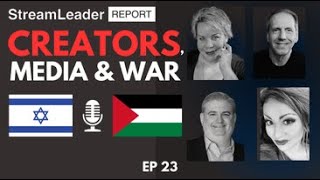
Ross Brand, Rob Greenlee, and Rebecca Gunter discuss how creators navigate misinformation during crises like the Israel-Palestine conflict, where mainstream outlets got a hospital bombing wrong. They cover deep-fake voice scams, Amazon's warehouse robots, Tesla's Optimus, and Meta's new broadcast channels for independent creators.
Chapters
All right, hey gang, Ross Brandt, Rob Greenlee, Rebecca Gunter, and we are going to talk about the fog of war and how creators are managing dealing with the Israel-Palestine conflict and relying on or not relying on the news media, which is sometimes unreliable. We'll also talk about Amazon trying out robots in their warehouses and doing a study with MIT on the impact of robots in, uh, the war on the robots on the workforce? Easy for me to say. And also, also, do you need a secret code, a secret message to have amongst your family or friends so they know if you have an urgent message, a warning message or something, it isn't an AI fake. What do you say, Rebecca? What are we going to do now?
Let's do a show.
It's the Stream Leader Report live panel. Creators talking to creators, raw, real, and unscripted. And sometimes they say the quiet part out loud. Here are your hosts: Claudia Santiago, Rebecca Gunter, Rob Greenlee, and Ross Brand.
All right, welcome to the Stream Leader Report. I'm Ross Brandt. My show is the Stream Leader Report, and joining me are my co-hosts Rob Greenlee from the Trust Factor and Rebecca Gunter from Business in the Raw. Claudia Santiago isn't able to join us today. So we're going to start off with, um, a topic that's really everywhere in the news right now, but we're going to talk about it from the approach of a creator or an influencer, somebody doing a talk show commentary on the news online, perhaps a YouTube show, a podcast, uh, something like that. And That is, what do you do when the fog of war takes over? And we had, of course, the major, major news incident the other day was there was a report that all of the, you know, a lot of the major old media ran with CNN, New York Times, BBC, uh, and so forth. Which was Israel bombed a hospital in Gaza and 500 people were dead. Um, and they went with that immediately, and that spread all over the world, and there ended up being riots in front of U.S. embassies and countries, and, and it just blew— everything blew up into this big outcry. And by the time the dust settled, it turned out that it was a rocket fired from within Gaza that crashed into a parking lot. Uh, there may have been some casualties, but it certainly wasn't 500. It was, you know, essentially friendly fire within, uh, the confines of that, that area. And so by the time the story had corrected itself on the major news and the proof got out, um, didn't really matter that much to those who were looking to use that story to inflame anti-American sentiment around the world. Um, and so what's interesting is, as creators, and to some extent when I worked in radio, radio, if you're not— if you don't have a news team that's covering the world, right, You're relying on the AP, you're relying on the New York Times, you're relying on news sources that other people are doing the reporting. So now you have news sources that are taking reports from a war zone, running with it, um, and then the creator is twice removed, or the influencer or the commentator online is twice removed from the event because obviously we're relying on what the news says if we're doing a talk or commentary show. Um, how can we do better than the mainstream media? Uh, what, what role, I guess, do creators have or play in, or do they have a role in trying to be responsible, in trying to parse truth, or is it all about getting the clicks and running with the news story as fast as the details get out there? And this goes for not just, you know, livestreamers and podcasters, but this goes for people who are, you know, very active on Twitter and other types of platforms.
I would just imagine if we're, um, kind of facing this dilemma of like what's true and not true, it's— this is a real situation, yet if you project just even a few years down the future, um, and what kind of deepfakes can be used to incendiar— create an incendiary reaction, I mean, this is a beautiful— well, not beautiful, but a profound example of how we're reacting to something, you know, kind of a misinformation. Imagine when it's by design.
Yeah, and it's even more dangerous than even that. It's, it's like, um, as creators, if you, if you hold back on something like that, you are giving up clicks and you are giving up audience. But if you run with it, um, you lose credibility with your audience because maybe the information that you shared didn't turn out to be accurate. So I think all of us as creators need to, uh, look at these things with a, you know, a skeptical eye. Um, you know, mainstream media is rapidly losing trust on the part of, um, their audiences, um, when they do this every single time. The chase towards clicks and potentially incorrect information erodes those relationships. And it's also very dangerous because it— people hear things once and they think it's the truth. And when it is reported a week later or 4 or 5 days later that what was reported 5 days earlier was incorrect, not everybody gets the message.
And by that—
and then by that point, you've already internalized your opinions about it, and you've really already stirred up, um, dangerous sentiment around the world, uh, that was based on a false premise and based on false information, based on media being more concerned about their profitability and clicks than they are being responsible journalists.
Well, here you have ABC News with a photo that clearly isn't of that event with the story. It's a total fraud. The New York Times ran a photo of another building that had been blown up with their first version of the story. Um, and while, you know, you could say, okay, it's relevant because it might be from the same conflict or whatever, the amount of credibility that putting a picture of building in rubble, uh, or a crying patient holding their child or something like that does to inflame, uh, and give credibility to a story that isn't true. Um, you know, why would you put a picture to go with a story that the picture wasn't of that story in something this sensitive? We're not talking about B-roll of somebody walking into a building to show that the president's going to a meeting or something, right? So we have an old picture of the president walking into a building. We go, you know, that we're talking about something that looks like it's evidence of a major war crime catastrophe. And it turns out to be nothing of the sort.
Yeah, and if you really think about it, the, the person that made that choice at the New York Times should be fired, right? If that publication has any journalistic ethics, what they did there was a major erosion of their, their particular audience's trust, right? Because what they portrayed is something that was not what it was implied to be. And that right there undermines the very fabric of journalistic integrity that supposedly the New York Times was built on, right? And this is why mainstream media is now currently falling apart, is because of these very same practices that we're seeing happen. And because it's very dangerous to our culture, our society, and the world that these can easily be inflamed and turned into weapons against each other and, and cause wars. And, and I hate to say this, but maybe that's the real reason why it's happening, is that there are people that want to create a war.
And it's, it's good for, it's good for the economy, man.
Good for business, right?
It's good for, certainly good for the news business, right? I mean, it's good I've probably been watching 3 or 4 hours of news a day versus, you know, a skim of Twitter and, uh, a half an hour to 45 minutes of TV or whatever.
Or, yeah, I mean, why is the, why is the New York Times willing to give up their journalistic integrity that they built over the last 100 years?
Right. And if you're a foreign, if you're a foreign editor, you know, or you're on that desk or you're You know that you can't get a 500-person casualty count within seconds of an explosion. You know that certain groups, right, like Hamas, have a history of making up stories and, and, you know, using old footage and all that. But yet they ran with it while when the massacre occurred in Israel, they took time, particularly CNN, had it like, oh, well, we don't have evidence that this happened, and we need to wait, and we need to wait, and we need to wait. Um, so why did they run with that that quickly? Unless it was to stir up audiences around the world, um, and to perhaps draw America into a larger global conflict, right?
Plus, I'm, I'm absolutely— as a content creator, I'm absolutely not willing to share things like this, um, especially when they're unverified. I think the same thing happened a week ago when they— everybody was talking about how 40 babies were decapitated, right? It's like, you know, there was no evidence of that. And, and it's, it's the same kind of, um, process, right? It's, it's trying to inflame people's emotions to get people's attention. And that's what the media is really, um, that's their goal right now because that, that directly gets to the bottom line.
And also othering, just to, just to kind of complete— start to really create the enemization of PR, right? So I think military complex is, is alive and well.
Yeah, right. Uh, they're going to be the long-term beneficiary of the things that are happening here. Um, but you know, I think we as content creators or independent content creators, we, we need to take that journalistic standard that the mainstream media refuses to embrace anymore and call them out for it and say what they did was wrong. What they did— somebody needs to get fired over there. And we're going to set a better example going forward. That's the only response, the responsible response that we can have to this, is to call them out.
Yeah, I mean, the field of journalism has so many guidelines and supposed standards and ethics and practices and, and things that are recommended, um, and it seems like it goes out the window when it's convenient or when the possibility of blowing things up into a bigger story or being first to the— first to, uh, Twitter with it or what have you, uh, comes along. And I guess I wonder, like, the, the internet is sort of still like the Wild Wild West, right? But do we as podcasters, talk show hosts, live streamers, YouTubers Do we need some sort of guidelines or some sort of way to organize ourselves to say these are the standards we're trying to hold ourselves to? I mean, let's face it, a lot of shows on, uh, aren't strictly news shows. They're a combination of commentary, satire, hangout, and whatever. And that's fine. I mean, talk radio isn't news per se either. It's the same kind of combination of entertainment and opinion and, and so forth. But I mean, is there a way to somehow— I don't want to say credentialize because I don't want gatekeepers and things like that, but is there a way to somehow elevate the online independent creator, journalist, uh, commentator who oftentimes has as much or more knowledge and behaves at a, at a standard that is at least as good and probably better than what the legacy media—
oh, that's not hard to do, Ross, these days. I mean, it's, it's, uh, what, you know, it's really what is happening out there is that independent media creators are— it came out in research just the other day saying that podcasters were the most trusted sources of information on the internet. And right after that was YouTubers. So it's this opportunity that we have as creators, independent creators, to take a higher road here and to set a better example and to— I hate, I hate, you know, in some ways I hate to say this, but, uh, but to run these mainstream media companies out of business.
Rob, I'm so glad you said that because what a segue into embracing not only as content creators but thinking about the audience and shifting our own mindset as to where we get our news. I'm team first-person perspective whenever I can get it. So we start actually listening to the people who are actually there and that they have a platform to be able to tell tell their stories or to at least share what's going on. Shifting my focus from like a top-down media consumption to a bottom-up media consumption probably would go a long way towards understanding how— what's really going on in the world and stop feeling a little bit like a marionette.
Yeah, and as we do that, there's going to be efforts to silence us too, so You know, we just have to keep charging forward.
And to co-opt us, because what's going to happen is that those in power will then astroturf, right, and use the solo observer and the citizen journalist, or create the appearance of one. So you're gonna— what you're gonna get eventually, because I, I went to TikTok because, uh, only because of Rebecca recommending it when we were chatting about this. And it was phenomenal to see the videos that people were showing and breaking down the situation and everything. If I didn't have knowledge from other media or from Twitter or what have you, I may not have understood the context. But once I knew a little bit about the issue from the general media and other social media, I could really delve into those videos and make sense of what was going on. My concern is that the parties involved will eventually get sophisticated and have the citizen journalist, the first person on the ground, and co-opt that person and create— um, but it's still interesting that, you know, TikTok and Twitter figures it out before The New York Times and CNN.
Ross, what up? What— you've got your finger on the zeitgeist, man, because I just watched a few TikToks who were kind of pulling back the curtain on independent news, just exactly the same, like a man on the street who had been very, you know, celebrated within the platform, and kind of painting the numbers back to see how many of them are actually kind of under the umbrella of the, of the DNC. And watching like DNC-planted, you know, news sources amongst TikTok was kind of shocking. Like, it pulled the curtain back a little bit for me, and that's exactly what you're talking about. You've got your finger on the pulse of the zeitgeist for sure.
The other cool thing though, for following, like just for following the news, is the ability to get translations. So I'm able to read posts on Twitter that are in Hebrew. I'm able to read posts in Arabic and other languages and see what people on the ground from different governments— what it's always interesting to see what people are saying in their own language versus the content that they put out in English when there's a conflict going on, because sometimes there's quite the divergence between what parties will say in their own language and what they'll say in English. So getting the translations is kind of interesting. Yeah.
Yeah, because you're hearing it from local people that speak that language. It's not being translated and maybe changed by someone that's an English speaker that's going to present. Yeah, I've been watching some news sources out of the Middle East that are not, you know, like mainstream sources. So it's been interesting to get their perspective on what's happening.
Well, one of the more interesting things was it was Al Jazeera because they have access in Gaza and we're running video feeds constantly They accidentally caught something that they didn't want to catch.
Well, you know, they're located in a country that is friends with the West and friends with the Muslim side too, right? So they're kind of like a country that likes to, I guess, get in the middle of everything.
So they have both American troops and a base there. And they have the elite leadership of Hamas living in luxury hotels.
Yeah, all together right there. It's really an interesting situation that—
So you'd think if somebody wanted our hostages to be released, uh, just walk down the street and go like, you know, hey, we're gonna, we're gonna kill this guy if you don't let our people, our people free. What is it supposed to be like 20, 15, 20, 27 American hostages? Something like that.
Yeah, I think it's in the country of Qatar, right? Yes, yes, Doha. So that's where this is all happening. So like, the— was it the Secretary of State, uh, and Mr. Antony Blinken was there meeting with the— with that regime over that country here just in the last week or so. And so it was interesting to see him there. In this small little country that is in the middle of all this stuff going on. And it's, it's way more complicated.
Isn't that crazy? I mean, isn't that crazy that the US has a huge military installment there? Hamas's leadership are living in luxury hotels there. And, um, Al Jazeera is broadcasting from there. It's like, what world are we living in?
Well, the Al Jazeera folks used to publish, and this is kind of a— because I had a, I had contact with them when I was working at Microsoft, so they were putting out a bunch of video podcasts into the podcast medium back then. And then they, they took on a cable deal with the cable network here in the US where Al Jazeera was going to be one of their channels. And then that cable deal forced them to cancel all of their, all their video podcasts that were being published.
Is that when they bought Al Gore's cable network?
Exactly. Yeah. That's the other little detail there.
But yeah, is that the Weather Channel? No, I'm just kidding.
Right.
But, but things are much more complicated in the Middle East in the relationships with all these countries than we're being told. Right? There's more interrelationships. Like, there's plenty of public information that Israel was really the original funder of Hamas, um, many, many years ago. So you, you know, when the US is rumored to be the funder originally of Al-Qaeda too, right? So, you know, you, you create your bedfellows to accomplish goals that you have at the time that then can turn on you in the end. So It's, it's this— things are much more complicated over there than really I feel even comfortable totally being able to understand or comprehend. It's just— plus the time scales on this conflict over there, and it's for us to make quick determinations on what side to take or who, how to view the situation is, is really part of the manipulation here, is that the media is preying on the fact that very few people have any kind of depth of knowledge about what's actually going on over there, or what the history of what's gone on over there.
Well, I think what's one of the things that's interesting is, um, there are podcasts and, and video shows where, uh, people are trying to have a guest from one perspective and a guest from another perspective. Oftentimes both of, both of them are American, but they're, they're trying to, um, take it from, from, from different sides. But the other thing about podcasts um, that I like in YouTube shows is usually they're, they're targeting a niche audience and they're pretty upfront in where they come from. Like, their label, right? They label themselves. This is a progressive podcast, or this is a, you know, uh, right-wing libertarian podcast, or hey, we're, we're a show that goes straight down the middle and gives you both sides, or whatever. Like, it's far more honest than the mainstream media saying, we're the objective media following this 10-point guide from the AP or whatever, when, you know, the AP isn't following its own standards.
Yeah, I mean, Q2U. Yeah, I think that humans have more of an ethical kind of drive to do the right thing than mainstream media has. They have a pure profit business objective and what they're doing. And so they're going to drift between what the popular beliefs are or the popular kind of thoughts on this and then ride that wave, right? Where, where I think independent creators like ourselves, um, don't feel comfortable putting out information that is, um, that is harmful to others more, I think. Um, but it's, it's— wow, that's, that's, that's a different view.
Yeah, sorry about that. I was just trying, but I hate when it's 3 and somebody's on the, the bottom, but all right, I'll put myself there. There we go.
All right, there you go. You're under us now.
How did you do that?
I just— you just slide one window into where the other window is and they— I had no idea.
Yeah, yeah, it's tricky.
Oh my God, stream— the StreamYard lessons happen in real time.
Right. Yeah. So I mean, I think this is a conversation we can have over time regardless of what's in the news. Is, you know, it's time. Hopefully podcasts and live streams and YouTube shows will become the, the sources, um, or at least will become another credible source. And how we, how we elevate those sources, how we choose those sources what standards maybe we recommend to people without becoming gatekeepers. I think it's an interesting conversation.
Yeah, and one last point on this too is that increasingly we're being kind of leveraged into taking a side, right? So as media creators, as I sit here today, I'm conflicted with this. Thought of, if I get out and I speak about this stuff, I need to take a side, right? I have to be in favor of Israel, or I need to be in favor of the Palestine, um, you know, country. And, um, because both are— bad things are happening, um, to everyone here. Um, so it— but there is this drive, and I think it's really core to the conflict that's happening, is that people are increasingly taking sides, and that's, that's what's driving this division between countries. So you're seeing even the biggest countries in the world kind of taking sides, right? And then you have the US taking sides, and you have all these. And that's, that's what scares me about the potential of this escalating into a world war, right, is people start taking sides. And that's happening inside the US as well as outside the US right now.
Well, there's also government's public posture and then what they're doing behind the scenes. Like, Blinken had a 7-hour meeting, I think, with the Israeli defense staff or whatever, which was sort of saying maybe you could slow down, maybe let's try something, you know. So on the one hand, it's like the carriers are going over there, but behind the scenes it's like slow down. So what is our posture really? What is our goal? What are we trying to accomplish? You know, on one hand, it's go destroy the terrorists. On the other hand, it's like, wait, don't go too fast.
I'm increasingly seeing this movement towards talking about the Palestinians over what happened to the Israelis., and that is kind of a shift in, in focus that I think is very dangerous, but it's also indicative of the shifts in the perceptions and the media coverage of this, that increasingly Israel is seen instead of a victim of a vicious attack, seen as a perpetrator of an attack. And that's the change in the rhetoric that is happening here that is really starting to inflame the world.
I think that this also ties in with our previous discussions and episodes of what can humans do to stay nimble and competitive amongst the AI takeover, and what can humans do that AI can't. And it's all around critical thinking. Right. Yeah, I think if, I think if you can just— if anybody out there in Stream Leader Report universe can take one thing away, it's to just keep doubling down on your critical thinking and really paying attention to who's saying it, what do they have to gain, what are the, what are the, what's the con, what's the larger context.
Um, critical thinking. Yeah, that's a conversation here that I'm definitely thinking about a lot, and we could do a 2-hour podcast just on the layers of this and just what I've learned in the last, you know, 5 or 6 days about the Middle East and, and how all these big countries are shifting their positions and making alignment, like Russia and China are now aligned more than ever. And that's kind of because there's a common enemy, and that's the West, right? So we've kind of fomented this realignment of the world by our actions to some degree, and then the actions of others too have created a dynamic that's rapidly dividing us.
I heard a quote the other day, Rob, that was, sooner or later we all sit down to a buffet of the consequences of our actions. I thought that was pretty powerful.
It's a buffet. This time though, there's a lot of nuclear weapons that are accessible to many of the players involved here, so things could go horribly wrong. So, well, shit. I know, oh shit is right.
Right, right. All right, so let's talk about the robots. Okay, how about that for a transition? Well, more right Dude, let's do the robots. That's more fun.
Yeah, if you're an Amazon employee, I'd be a little worried. All right, go ahead.
No, go ahead. I'll let you take off with the—
That's right. Well, I guess I started with the punchline there is that if you're an Amazon warehouse employee, you should be a little concerned about what's happening here. But, you know, I think most people have seen it coming. You know, like Tesla has been working on their Optimus Prime robot that is doing a lot of what's being talked about in this article in TechCrunch about Amazon is adding, increasingly adding robots to their warehouse operations to handle packages and things like that that were formerly done by Humans, right? And what's interesting about this is that there's been a lot of talk that I've been hearing over the last couple of years that the employees in the Amazon warehouses, they actually feel like robots because of the expectations that are expected of them. They're, you know, processing per package per hour kind of standard of performance, and They're limited to breaks that are kind of unhuman, right? And it's almost like Amazon has been setting up their warehouse operations for the future, which is they can run 24/7, 7 days a week without a break and without stopping. All they have to do is keep electricity moving to them and they'll keep processing packages, which, Humans have to take lunch breaks and they have to take vacations and they have to do this, but robots don't. So, but increasingly these robots are able to have like finger dexterity and they're able to have this, this capability of moving things around. And that's what the Tesla Optimus Prime robot is being increasingly able to do as well. It was, I think, just in this last week, it was demonstrated that the Tesla Optimus Prime robot now can do yoga. So if that tells you anything about how the agility is being worked on here.
So in order to relax and refresh before the next shift, right? Exactly.
I'm sure that's what they're going to expect of the Optimus Prime. To center yourself. Yes.
Go on vacation.
Align the chakras.
Right, right.
So, so that's kind of In summary, Amazon is, you know, actively thinking that, you know, that they're going to have these type of robots in there. They've been using robots all along, but they haven't been humanoid-type structures. They've been using, I guess up to this point, they've had 750,000 robot systems. So as you think about the robotics side of things being in automotive, so you've seen lots of videos where there is these arms that are doing things with cars as they're going through an assembly line. That's essentially what's been going on here at Amazon, is that they've been using robots to transport kind of racks of packages around a warehouse, right? And that's all being done by, increasingly, by kind of an artificial intelligent type of a platform or software platform that's been able to do that. So it's just coming out that You know that there's going to be, you know, thousands of these robots that are going to be coming into all sorts of manufacturing operations like Amazon or warehouses, and that's going to displace workers.
That's, that's just a fact. Claudia's story of a few weeks ago in which all of the professions that were like 99.9 percentile chance of being phased out And the shock of the prediction that this will be the case by 2030 is really evidenced by what you're bringing to the table today.
And I think it could happen before then, too. I think 2030 is still quite a ways off. I think, you know, based on what I'm reading in this article, it's, it's coming. They actually have these type of humanoid-type robots that are already in the warehouse doing things. That they're testing right now. They haven't been fully deployed. The same thing with the Optimus Prime robot. I think Elon Musk was quoted just on the earnings call yesterday talking about it, saying that, you know, he wasn't going to talk about any kind of manufacturing or scale or anything like that for the Optimus Prime robot. But that is the kind of robot that any of us will be able to buy and be able to mow our lawn or do our dishes or whatever in our houses.
I love how you're pre-launching your business, Rob. You know how you're managing Managing your, your robot army.
Well, yeah, I, I guess I did talk about that, didn't I? Um, you did.
Yeah, right, right. How far off are we from having our own robot? I, I wouldn't mind not having to do my dishes.
I think it's within probably 5 to 10 years before they'll have one that we can buy for like, maybe my guess— of course it depends on inflation between now and then— but probably around $25,000. Probably you can get your own robot.
I guess I'm going to be doing my dishes.
Yeah, it'll be about the same price as, uh, the Tesla Model 2.
Yeah, the heck with a new car, I'm getting a robot, right?
Well, you just kind of get on the back of the robot and just ride it to the grocery store, you know, or just send the robot to the store with the list. You can just send them to the store too, but the self-driving car, yeah, it's kind of like a horse. It's our new horse.
Now, will those be connected to the internet, Rob? Remember when you said that—
that it's called Starlink?
Yes. Okay, remember how we were talking about whether the cars would be connected to the internet and what that meant?
Well, they already are. Mine is.
Mine— I thought you said that the new Tesla driverless cars doesn't have to.
It doesn't have to. So if it, it, um, has a disconnection from the internet, it'll still operate because it's got all of its intelligence right in the car.
So your robot doesn't have to be connected to the internet. No, it doesn't. But you might connect it to download like new skills or like, hey, there's an update for the robot. Now it can play catch and, you know, walk your dog or whatever, you know, get version 4.3.
Well, I think the danger of it I was saying the danger of these robots being connected to the internet is that they could all be turned into evil, evil robots and kill us all. So that's the, you know, just by flipping a switch.
They're coming at you with a syringe. You're going to take the vaccine.
Matt Turner's Rebellion 2.0. Okay. It's like this. It's like beast mode and then kill mode.
So. Right. My kid actually brought up an interesting question about that. I was sharing about how the Tesla driverless cars don't have to be hooked up to the internet, and I was kind of like, they're not. So you clarified that for me. My kid said, how on earth will they know where to go? Like, is there Tesla Maps or something? And I hadn't thought of that. Like, how would they— a driverless car—
well, you can store all the maps for, um, you know, all the maps in the car in memory.
So if you're interested in— That's what my kid suggested, like Tesla Maps or something.
And I was like, well, yeah, I'm gonna ask Rob Greenlee. It uses Google Maps right now. So, but that's connected to GPS, which isn't a data connection. So it's a separate connection that happens from the internet.
So, you know, they're testing drones right now, Amazon in the UK.
For delivery. Yeah, we'll see how that plays out.
Where does— I mean, like, you have a central location where the packages are, and like, the drones are gonna go all over the place and not interfere with air travel and not interfere with power line. Like, I guess, I guess the navigation on these things is just so good that you can have these drones go a really long distance from away I mean, we're not talking about taking it from like the post office in every little town to, you know, the houses down the block. We're talking about, you know, there's a warehouse, I assume, and then from there the stuff gets put on a truck, but instead it gets put on a drone. How big are these drones going to be and how do they—
I think it depends on how big the package is.
I mean, because I assume they're not going to have one drone per package, right? You're going to have the drones going to have to do more than one stop at a time.
So they're gonna be pretty good-sized drones then.
'Cause you've seen the Amazon trucks as they go around the neighborhood, right? It's not like they're just bringing you your package. Everybody on the block is getting something from Amazon. But Rob—
Oh my God, Santa's sleigh reimagined.
Think about this. As the bird flies is always a shorter path than driving, right?
It's true.
It's true.
Just straight across. No traffic. No rush hour traffic. Boop, drop it off, go back, get another one, drop it off.
Robot reindeer that can fly. Yeah. I'm seeing all of it.
The question is, where is it going to drop it, right? If it's going to drop it like in your driveway, it's not going to do it during a rainstorm, right? Because the package will get completely, you know, drenched unless it's going to be delivered with plastic wrap around it or something. I don't— I'm not quite sure how they're going to handle that, and they're probably not going to fly it up to your porch. Maybe they are, but I would think that that could be dangerous, right?
I don't want to— I lost an eye.
I lost an eye ordering.
Well, I mean, the drone knocks on the door, they, they put it in the driveway. They still have to land, right? They're not going to just drop it from— well, they'll probably come down the middle.
Here's your new glass set.
Enjoy your beakers.
And then they'll drop it to the ground while it's hovering, probably, is what I'm assuming that it will do, because it doesn't want to get too low because it might hit a human, right?
And those that have been reprogrammed by the nefarious villains— Ross mentioned it earlier—
like, open the door, they drop your package, and they punch you in the face. Right. Or, you know, somebody has a gun and shoots it down.
Maybe we have our, like, our Amazon landing pad or whatever, where it's like this cushiony thing and they can drop it from a certain height right on that.
I wouldn't be surprised.
You have to teach kids, like, don't stand under the thing. A package is going to come at some point.
Right. Yeah. Hey, mailboxes were weird once.
You know, still are. Yeah, I've been really skeptical of the drone delivery idea that came out many, many years ago. And they've really struggled to get it deployed because of safety reasons mainly. And the FAA is in the process right now. And we haven't talked about this too much on the show, but the FAA is really cracking down on drones. So, yeah. Yeah, I've got one in the drone zone.
Yeah, Rebecca, what is this code, this private message thing that people, families are, are doing?
Ross, when my, when my kid was a wee tot, a practice I had learned in, you know, best practices of parenting were to have a secret code word. That way, if anybody tried to pick my kid up from school or knock on the door and gain entry. They didn't know the code word, they couldn't get in. And our code word, by the way, my kid's 15 now, so you'd have to drone this one off, but our code word was Band-Aid. And it's old school parenting tactic to have a code word. No one— to kind of avoid stranger danger and to, you know, get your kid not to just go willy-nilly with anybody. That concept is alive and well here as we face whether or not there are potentials of deepfaking voiceprints in a scam, a ransom scam. So can AI basically voice spoof, which I think is a really interesting combination of words, your kid or your mom or, you know, someone, a loved one on the phone who's asking, say they've been taken hostage and asking for kidnapping money or some sort of scenario where you think a real person is in danger. How do you know whether or not that's real, really happened to you, which I think is the theme here on the Streamliner Report— what's real, what's not, and how do you know? This writer is suggesting that you have a safe word or a safe code of words that you use with your, uh, your commonly with your friends and your family so that you can know whether or not you're being faked out by a voice copy of the people you care about. And I thought this was really streamliner reporty kind of content. And I'm going to be working on my code word now that I've told everybody what Band-Aid is.
Yeah, now you can't use Band-Aid.
Yeah. And I think it probably would have to be kind of a string of words, but it's really around, here's another practice that we're putting in place in case shit, in case shit happens, and start to normalize how we can signify to each other as human beings that we're real. And that's interesting. And also, I hope this doesn't happen to anybody.
And will AI learn how to discover what our codes are?
And being—
I mean, what if you're disgusting? What if you—
yeah, Ross, what if you're just— I mean, your phone's listening to you all the time, you know.
Sorry, yeah, what do you have to do? You have to go like out into the forest, like 10, 10 miles into the forest with no devices on you and discuss what your safe word is or pass it back and forth on a piece of paper. It's a good point. Rob, what do you think? What do you think about having to have a safe word?
It's probably a good idea. Um, you know, there's a lot of scammers online now, and increasingly access to the AI tools is pretty easy to do now. So yeah, there's no reason why— I mean, especially if you're an online media creator, I think you're probably especially vulnerable. And I think being an online media creator does kind of present some potential risks with being able to be cloned. It's like what I do with audio and video. I mean, it would be easy— increasingly you can clone somebody with a very small piece of content, um, to train the AI to duplicate it.
And then it sounds like that person, and you can give them whatever script you want.
Exactly right. I need help. I need you to send money. I need you to do something, right? Any kind of way to separate you. So if the AI or bots are listening, come kidnap my dog and don't bring it back.
You love that dog, don't you?
I do. So I think we also all have to be very aware of our, uh, what's going on around us, um, at, at all times, especially when we're in public or in any major city. I think we just need to be aware because there's increasing videos that are coming out. I don't know if they're real or not because I don't know that anything that's being published online is necessarily real anymore. Um, you just don't always know. So I always have a skeptic eye with everything, but, but to address this specific thing, I think having a safe code is probably, probably a good idea, right?
Yeah, just one little human hack and a Post-it note can prevent—
but the question is, what should that code be? Is something that has me thinking, is it probably— if you're going to be— because oftentimes, especially in a kidnapping situation, that they will do like a proof of life or something like that type of scenario, right? So it'll need to be something that can be said in that type of a situation, right, um, that won't clue the kidnappers that you just gave a code, right? So I would think about it in that context.
Yeah, interesting. I would hate Ross to get kidnapped and for it to be— for not— for me not to believe that it was his actual voice.
We'll have to work out the code.
I can tell the difference.
You can? Between fake Ross and real Ross?
Yes, yes. Hey, do you guys use, um, on, on Instagram, do you guys use any of those broadcast channels or even know what they are? Uh, because now they're coming to Facebook, and the idea is they're kind of like Telegram, you know, the app Telegram, where people sort of subscribe to somebody and they'll generally post, uh, a variety of content there— videos, news stories, different things, generally around the topic. Um, I couldn't totally, uh, Rebecca said like a Slack channel, and I'm like, not exactly. But I don't know why it's not exactly. It sounds very much like a Slack channel or a Telegram, or I don't know. I've never used these, and I, I've seen a couple people maybe invited me to theirs on Instagram, and I know I don't know whether I even joined or I'm not joining, or if I'm messaging them. I, I don't know. What do you guys think of these? Do you know anything about them? And are you interested or not interested? And are they like Slack? Are they like Telegram? Or what are they?
Yeah, I think it's, it's a little bit more like, uh, even like, um, Facebook groups, and— but it's more like a threaded conversation type of a type of an experience. Yeah, I think in a lot of ways it's kind of a hybrid between, I think, what we've seen with like Threads and WhatsApp. So you kind of combine those two experiences together and you kind of have an idea of what it might be. I don't think it's really that revolutionary. I mean, there's nothing that Meta does right now that's very revolutionary.
Um, yeah, yeah, just, just one more thing for me to not want to be on Facebook or Instagram, which is increasingly intense, right? I do not want to be there. Although I had a situation last week where I needed to find somebody that I only knew by like pinging, and I really needed to find this person because we had kind of like an abandoned dog scenario— not mine, even still. And the only way I could find them was Facebook. And that was it. That was the only— look, like, went through real estate records and, and the internet, deep internet search, LinkedIn, everything. And Facebook was the vehicle. But other than that, I'm ready to scrap it.
No, on Twitter, people have their own like mini Twitter within Twitter. Do you know what I'm talking about? Like within X, you have— you can sort of have your own. It's like a community or group that you're tweeting to, and other people can tweet in there, and, uh, but everything just stays within that group, and it can be invite only. Um, I imagine the concept of the broadcast channel is similar but in a more Facebooky, Instagram-ish way, maybe.
Yeah, I think it's interesting that, um, I've been increasingly seeing Threads posts showing up in my wall in Instagram. Which is, uh, which is an interesting kind of merging of those, those two platforms that are both owned by Meta, right? Um, so, so are we going to see this happen, um, or it's going to be merging more into the, the Facebook proper platform and into WhatsApp? And so this is just an effort to kind of converge every— all the communities into um, you know, into dominating kind of the whole kind of conversation side of, of what's happening. Um, I'm not sure it's gonna be that huge or that popular. There's just so many of these doing it right now. There's so many apps doing this.
There's—
I mean, it's in it, it's in WhatsApp, it's in, um, it's not in Instagram Um, but it's in Threads. So, but they keep saying that this is part of Facebook, so it's coming to Facebook Pages, right? So it's something that's going to be integrated into Facebook Pages.
I think it would make more sense for Groups, I would think, but for Pages, okay. I mean, I don't know how much engagement there is with people and Pages unless you have a really big following. Um, but, but this is where I, I think Rebecca was right in comparing it to Slack, in that, um, yeah, basically you have a page and you make your regular public posts that you make about your business or about what's, you know, issues of interest to people who are connected to your brand or the celebrity or the person, whatever. And then you want to have specific conversations, or like threads almost. You create channels, and anybody who follows your page or whatever— or, or maybe they don't even have to follow your page, but they can join that broadcast channel. So, you know, you have the Stream Leader report, let's say, had a page, and on that page we wanted to create some channels. We could have AI media, uh, robots, you know, like if we wanted to have like ongoing discussions or something like that. Not saying that we want to do that, but that would be the idea, right? Sort of like a Slack where you have, uh, you know, people for business would have, uh, HR, marketing, uh, you know, new ideas, uh, you know, product launches or whatever you know, different Slack channels they have.
Off topic. Off topic.
Off topic.
Gotta say that like Hot Pockets. Off topic.
How it works: if you manage a page on Facebook in a market where broadcast channels are currently available, you can start a channel directly from your page. Otherwise, you can join the waitlist and will be notified once the broadcast channel is created and the first message is sent. Followers of the page will receive a one-time notification to join the channel. Only the creator of the channel can send messages, but members of the broadcast channel can react to messages and vote in polls. I think that's more like Telegram, right? Where I think in Telegram, when you follow somebody on Telegram or whatever, you're— I don't know, I haven't spent enough time in it, but I, I think almost everything comes from the person who started it. You can join broadcast channels from your favorite page's profile on Facebook and see those you've joined in your chat list. Once you join the channel, you'll start receiving notifications when content is posted. Notifications can be muted by tapping the mute icon at the top right corner of the channel thread. Um, then they list a bunch to join, like Netflix and WWE. Anyway, that is broadcast channels for us.
You know what this kind of reminds me of? And I'm speaking a little bit out of turn because I'm not an old school Twitterhead like you guys, but when people talk about Black Twitter or, or queer Twitter, or like, you know, just kind of like alignments of, of people on Twitter, that happened because there'd be like a hashtag and conversation, right? So the idea of like Black Twitter being just a concept more than, you know, not a formalized way of doing it. And this is formalized.
Are those— I think the difference is when a community forms around a hashtag, anybody can post using that hashtag and participate in the conversation, whereas the only person who can initiate the post is the person who runs that page or the people who admin that page. And then you can comment on it, you can react to it, but you can't initiate the conversation. So it's, it's sort of like you're subscribing to Rob's or Rebecca's or Ross's channel about XYZ because, you know, like people will subscribe on Telegram, let's say, to an expert on some medical issue or some political issue that this person's really deep in the weeds on or whatever, and it's like they get those updates in real time as that person is doing their work or testing what they're testing or following the news from an inside perspective or whatever.
So now I see why you say it makes more sense in groups.
I think so, because it'd be nice to divide— like, you have a big group, it'd be nice to divide up Hey, this is one group. If you're just interested in when we're live streaming, that'll be in, in this group. If you're just interested in talking about monetizing your content, we'll, we'll have extra stuff here. And then the main group page is maybe more focused on everybody.
Yeah, what's really interesting is that the, the, um, the Instagram kind of messages area looks looks a lot like this, um, this app here, and it's got the same kind of, you know, like a little round icons at the very top. What's different is it has that channels icon there, which isn't in Instagram.
Yeah, so it's, it's like a little channels button. The channels are taking place within, within, um the Messenger part of Instagram, not like within people's regular feeds or profiles, I don't think.
Yeah, because I'm not seeing it in the Facebook Messenger platform. I'm not seeing the same experience. It's interesting. So this must be a separate app. It must be a different app.
I guess we're all going to have to do our research a little bit more on this. But it's interesting to figure out whether this is something worth leveraging. If you have a community or you have a specific issue or topic that you want to provide information on and get people involved and might subscribe to you or follow you or whatever. But we are out of time. I want to thank Claudia for keeping the chat buzzing. I know she wasn't able to join us live, but great to see Claudia in the chat. Hope you're doing well. We will be back next week, Thursday, 1:30 PM Eastern for Rebecca Gunter, Business in the Raw, Rob Greenlee, The Trust Factor. I'm Ross Brand. This has been the Stream Leader Report. We'll see you again next week.
Take care, everybody.
Thanks.
It's the Stream Leader Report live panel, creators talking to creators, raw, real, and unscripted. And sometimes they say the quiet part out loud. Here are your hosts Claudia Santiago, Rebecca Gunter, Rob Greenlee, and Ross Brand.
Mm-hmm.
More from Rob

Future-proofing with Delphi AI/Human clones: your podcast as a personal LLM | New Media Show






How sports reveal what AI spectacle gets wrong #Technology #Sports #Commentary



