Future of Work: Will Robots Rise Up and Take Your Job? StreamLeader Live Panel
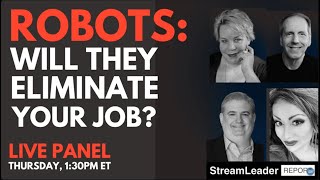
Ross Brand, Claudia Santiago, Rebecca Gunter, and Rob Greenlee discuss how AI could automate up to 47% of U.S. jobs by 2033, with data-entry clerks facing 99% automation risk while therapists and surgeons remain safe. They explore how workers can adapt through soft skills, prompt engineering, and new roles like robot managers, and argue that traditional TV is dead as creators shift to short-form streaming content.
Chapters
It's the Streamly.
All right. Hey gang, the robots are coming. Will they take your job? TV is dead. Long live TV. And what's happening with the integration of text and images through AI? A lot to talk about. Let's do a show.
It's the Stream Leader Report live panel.
Creators talking to creators.
Raw, real, and unscripted.
And sometimes they say the quiet part out loud.
Here are your hosts: Claudia Santiago, Rebecca Gunter, Rob Greenlee, and Ross Brand. Hey gang, welcome to the Stream Leader Report. It's the live panel edition that we do every Thursday at 1:30 PM Eastern. So glad to have you with us. We've got some hot topics to talk about today, and of course our panel is Rebecca Gunter, our Peach in Chief at Stone Fruit and the host of Business in the Raw, Claudia Santiago from Viva La Stage, and the great Hall of Fame podcaster Rob Greenlee from The Trust Factor. Rob also works with StreamYard, and it's great to have you all here. I'm Ross Brandt. The show is the Stream Leader Report. You can find me at Livestream Universe. All right, let's get right into it. The robots are coming, and by robots, we just don't mean those things that sort of look like metal versions of humans or that are dressed up as humans. Robots are in your phone. They're in your AI apps. They're everywhere. Claudia, who's your topic? Tell us what's going on, what we need to be aware of or afraid of as the robots enter our workforce?
Right. You know, the robots have long been in the background. I think they're just kind of becoming more and more apparent in this day and age. I remember— do you remember way back when you'd walk into a bank and there'd be tellers everywhere and you get to meet all your tellers, and then they started putting in those, those machines, those outside that dispense cash, the ATMs, right? And remember back then when some people were like, oh, I'm not doing that, I just need to see a teller. Well, now all that's changed, even at stores, right? So I mean, the thing is, with this whole tech revolution, just like in history, every time we've been in some kind of a huge transition. You can't stop that thing. It's like a big tidal wave coming and it's gonna land.
Right, right.
So, you know, I think this is where I was going with this, is that, uh, let's discuss the different types of robots and how they're taking over jobs, uh, maybe some of our entrepreneurial businesses, how we're going to have to rethink some things. Uh, but what are the solutions, right? Because the thing is, we're in it and it's not going away anytime soon. So instead of just kind of always kind of bringing up the topic of like, whoa, you know, we got all this going on, let's figure out some solutions. How, how would you recommend people reposition? Um, I, I think I— oh, Ross has got something up there. Yeah, I think I sent you a link Uh, I'm just gonna read this. Which jobs are most vulnerable? Uh, this is reference from Oxford University. Um, the study looked at a likelihood of automation for a number of different occupations. Out of 700 jobs, those with a— okay, get this, this is huge— 99% chance of automation include Mathematical technicians, insurance underwriters, watch repairers, cargo and freight agent, tax preparers, photographic process workers and processing machine operators, new account clerks, library technicians, data entry keyers, timing device assemblers, and adjusters. So, I mean, those are a 99% chance of automation. Anybody out there who holds a job there, You might want to start. What do you think, Rob? What would be your recommendation for some of these people whose high-risk jobs of getting ousted, so to speak?
Yeah, I think start thinking about each individual's kind of soft skills, the other skills that they can bring to society that aren't so much, you know, hands-on kind of mathematical or working with, you know, things that a computer obviously could potentially do well, or a well-articulated— I know that the Tesla Optimus robot is working on very, very fine motor skills with their— with the hands that it has. So, you know, that's where this watch repair thing comes into play. But I'm not sure that that's really much of a a job out there. I'm not sure there's really long term that there's going to be a lot of watches that are going to need to be fixed like that. Most watches are going to be computers, so I'm not quite sure what that, what that really looks like. But I do know that, uh, like a McDonald's chain has been playing around with this model of creating entirely automated McDonald's restaurants. So like everything, when you walk into the store, everything is automated, right? So you go go up to a screen, you order your, your food, and a bunch of robots in the back of the store, you know, cook the food, you know, pack it and spit it out, right? So, exactly. But the question gets back to is it's these soft skills, and it's also, as we unemploy people, there's going to be fewer people that are going to have money that could actually go into this McDonald's and buy food, right? So, you know, you start thinking about the economics of this stuff, and I think it, it becomes very disruptive, number one. But it also, you know, this, this article also runs through other areas of jobs that might be unlikely to be automated too. So we should do that.
I just want to list some of that. Uh, it says Yet the study predicted some jobs would be unlikely to be automated. A probability of 0.36% or less of being automated based on current technology include recreational therapists, first-line supervisors and mechanics, installers and repairers, emergency management directors, mental health and substance abuse social workers, audiologists, occupational therapists, orthodontists, prosthetists, healthcare social workers, oral and maxillofacial surgeons, first-line supervisors of fire fighting, and prevention workers. So jobs most likely to face automation are those with predictable and repetitive patterns. Jobs unlikely to be automated have high levels of human interaction, creativity— good news— and often require many years of training. So yeah, exactly what you're saying there, Rob.
And, and, and kind of variability in the tasks too. Now granted, I, you know, I know ChatGPT and these other kind of language models out there do have a certain amount of flexibility in what they can perform, right? And we're going to talk about that a little bit later in the program. But, but, but it does seem like that there's soft skills out there. I think that's the, the human interaction, the human connection, the human networking, the human kind of aspects of this will be difficult for robots to replace anytime soon.
Totally. What say you, Rebecca?
I'm for the robot that drives my kid back and forth to school.
There you go. Yeah, or mows your lawn, right?
Picks up dog crap.
I want it for—
right, puts up— picks up dog crap. These are things I'd love to outsource, right?
Do the dishes, right? Things like that.
What about going back to our Tinder talk last week? What about dating a robot?
First of all, you, you're on to something, Claudia. You should create an app that uses ChatGPT to go through all of the back and forth messaging that comes with online dating and only pings you when you have like hit certain keywords or something. That's right, just like take all the way out of it.
Clearly it's the soft skills that matter, right?
Sorry, Rob, what was that?
Oh, clearly it's the soft skills that matter with that one, right?
Right.
Not necessarily online dating.
I said we could all date, uh, 20 different versions of Ross Brand AI.
I'm in.
I'm in.
Well, actually, that's a really good point. They're gonna have to clone me so that Yeah, I was going to say, what if we could make a robot that's a clone of ourselves, right? Looks like us, talks like us, maybe is more skilled than we are. Who knows, maybe they can go to work for us.
I mean, look at the robot that Rebecca showed us on that music stage. Uh, I mean, how cool is that? I mean, cool but freaky at the same time.
I guess in the movies and the shows, they always somewhere along the line, right, in the horror movies or whatever, they develop a jealousy to the person they were cloned from, or they become competitive with it. And yeah, well, their skills at fighting may be superior, and, you know, recovering from damage.
Um, that sure sounds like a Rick and Morty episode.
Yeah, I mean, I think on a serious note, if you have a job and you think you could get outsourced, and I mean, I think if you're in a company, you should think about the fact that AI is probably coming to your department in some fashion or other. How do you get on the good side of it? And by that, I mean, learn about it. Be the go-to person when they have a question about how do we integrate this, how do we program it, how do we prompt it, how do we fix it when it's not working properly. So if you have mechanical skills, how do you actually fix, you know, what makes the robot work? If you're a computer programmer, how, how do we program, how do we prompt Like, find an angle in which, you know, a human is still needed for the integration in the beginning, and then find areas for maintaining the AI integration, and also where you see that a human just can't be replaced. That, that's not easy. I mean, that's a lot easier said than done, and it puts a lot of strain on people who are already working long hours and, and, you know, have a lot of family pressures and other things. But if you can, that's how you can make this work for you in, in a scenario in which a lot of jobs may be eliminated. You've got to find a way to make yourself valuable. And there, you know, it's going to take more than one or two people to handle the integration of all this, to manage it, to, you know, reshape the workforce. And there's so many different areas where humans are still needed in order to make AI work. Just like when computers came in, you know, there was no IT department before computers came in. Now there's all these employees whose job is to tell you, you know, turn it off and turn it back on. No, but you know, who are there to help you You know, oh, we got a new software package for the company. Somebody's got to put that software package in. Somebody's got to train the employees on how to use it. Somebody's got to problem solve. Somebody's got to interface with the company that's providing that software as a service. So I think there's a lot of places, if you think creatively, um, where there may be all new jobs that we never imagined at all, just like the computer industry, uh, brought a whole new jobs to corporations as computers were doing some of the function that, you know, numbers crunchers might have been doing before.
Yeah, you know, uh, this last week I reached out to Rob because with, with the broken wrist here, I'm limited to some things I can do, and it's just driving me batty. But Anyways, I reached out to Rob because I needed to do a certain type of task that I thought, hey, maybe AI or ChatGPT could help me out with this. And, you know, because I can't really type right now, like I'm doing the one finger on my right. Anyways, and as I was reaching out, I thought, dang, you know, Rob is so knowledgeable with so much of this kind of stuff, like he could literally have a consulting business where that's what he does, and he helps people like me who are newbies and are trying to get— figuring out stuff. Or even like, say, for hospitals, like hospital contracts, people in recovering and physio and that, where— I mean, I'm not putting this pressure on you, Rob, I'm just using you as an example.
A new business is born, a new business is born.
You know what I'm saying? Like, where it's targeted consulting. And it doesn't have to be just to people, but it can be to government agencies, banks, and that— like, where people really need this help because they need to know how to, how to transition.
Yeah. And I've been thinking about robots too, from the standpoint of, um, almost like, um, all of us need to become managers of projects and, and things like that. Um, because what you could is acquire like, you know, half dozen or a couple of robots yourself. And what's being talked about right now is the ability to acquire skills that the robot will have, just like what we do today with our smartphones. You download a mobile app that has a specialized ability, right? Yeah. And so that will be possible with robots too. Now I'm talking about more like humanoid robots, but these are things that will also come to automation bots that are like used in manufacturing and, and other purposes that, you know, security, police, military, all that kind of stuff. There will be algorithms that will be available for purchase on a subscription model that you will download to your bot, and they will be able to perform certain tasks based on that app per se, that downloadable app, right? So, so you could— and I'm thinking this way already about my Tesla car because it's, it's really a robot. It's just not unlocked entirely as a, as a robot that I buy software, it installs in the car, and that makes the car self-drivable, right? So it's the same model that's already existing in the real world today. That I think will increasingly come. So we could get ourselves in a situation potentially where we're like, um, business owners of technology that are out there doing specialized tasks for people that need it, um, in the world as well. Not so much that I have a job. My job is to manage the needs of whoever my clients are, right? And basically lend or, or assign technology to address those issues. Now the question gets back to is once technology or artificial intelligence or AGI, which is the, the epitome of artificial intelligence where it's like basically humanoid intelligence, right, where we're basically replacing humans, that's when it kind of gets into a whole nother level, right? Then then we start being concerned about, do these AGIs have their own rights as a sentient being, right? And they can make decisions about what skills they have and what they can do. And that's really where the biggest threat to humans is, I believe.
Then they can go on strike. They can change jobs. I'm tired of working in the plant. I want to win an outdoor job.
Exactly. They can run faster, jump higher. They can think a lot faster than we can. And that also puts us in a situation, and this is increasingly becoming a topic too, of integrating this AI technology into our human brains. And that is a very controversial topic right now. But that may be the only way, once we've reached that threshold, that we can keep up with these sentient artificial intelligent beings, is that we have to have it augmented in our own brains.
You know, uh, I, I feel a little embarrassed by this, but I'm just gonna say it. Uh, at first when all of this really started coming out and that, I was a little skeptical. I thought, yeah, whatever, you know. Uh, you know, I was just kind of turned a bit of a blind eye to it. And, uh, you know, I just, I don't want to take long here, but I just want to quote, uh a few stats for some of you that might be going, oh, that's still way far in the future, whatever. Listen to this. So in 2013, Oxford University study estimates that by 2033, 47% of jobs in the U.S. are at risk of being automated, while 35% of jobs in the UK could be made obsolete. McKinsey predicts that between 400 million and 800 million people around the world will need to find new jobs by 20 30. So what year are we in?
Almost 2024.
Hello, right? Right around the corner. Now, while that can be daunting, it's actually good news to reposition, to train, to learn, to study, to do things like this where we talk about it and have people that maybe know a little more than we do. Like me, I'm such a newbie with this, so In 2017, survey of Oxford University and Yale University found that many scientists predict AI will outperform humans in a wider number of tasks in the next 10 years. Examples include translating languages by 2024— that's this coming year— writing high school essays by 2026, working as a surgeon 2053. Here you go to med school and you do the surgeon track, takes forever and you're in huge debt and all of a sudden you're finding out that you may be out of a job. So anyways, I could go on and on, but I guess I just want to read out those stats for anyone who's sitting on the fence and a bit skeptical. It is here and it's just around the corner. But the good news is we can learn, right?
Yeah, I want to bring in from the, the chat, especially for people who are on the audio side, some very interesting facts and figures. Bubble mentions, uh, from a Google FAQ. According to the U.S. Bureau of Labor Statistics, watchmakers make an average of $42,000, uh, $45,290 per year. Martin Greenlee, from, uh, watching on LinkedIn, says govtech is booming. Look at the evolution of the parking meter, 1935. For example, coins and meter maids. Process for parking stayed the same until the 2000s, where credit card readers were added, and now apps control the parking industry. Uh, Beauty Bubble chimed in with another, uh, Google FAQ. As to mental health, the meditation app Calm made an estimated $355 million in revenue in 2022, which is a 7.5% increase on the previous year. And she also notes that in the world of finance Mirror trading has been quietly taking terminal sitters for a while now. Beyond quant trading, a mirror will take into account personal preferences and nuanced approach. And Jill Mokes says she agrees with Claudia, worst thing we could do is hide from it.
Yeah.
And John says, damn dirty robots.
Wow, interesting. And it's great to have everybody join us on comments like that. That is so cool. Um, the other thing that I, I thought was interesting, it kind of made my brain spin, was this whole thing about robot tax. Oh yeah, like what? And that universal basic income whole thing. Like, I'm just starting to wrap my head around that. Does anybody have any insight on that whole robot tax and what that's about?
Yeah, I think if you think about it, these robots are workers, right? So the government's going to want to tax them based on their productivity. And so. Right. So you pay— just throw it out there— you paid $20,000 to buy a robot and that robot works 24/7. There's going to be labor rules around that and the government's going to want to get paid based on the productivity, the average productivity of a robot. Just like they would have to pay for an employee, right? So the government wants their money is what it comes down to.
Well, we also really— I mean, we may need that in order to support people who've been replaced, outsourced, and, and yeah, exactly. Um, I, I mean, with all these issues, it would be nice to think we've got a responsible government in, in Washington that's looking ahead and seriously considering things from an ethical matter, um, and, and in other, you know, leading countries around the world as well. And unfortunately, uh, you kind of feel like they're the last to know about what's going on with this, or, you know, hey, kick it down the road. They don't want to face the, uh, the difficult challenges that are coming. And of course You know, trust in our institutions right now is so low that you can't just sit back and go, you know, I feel like everything's going to work out okay because somebody's in charge who knows what they're doing and has an ethical compass and is, you know, looking out for what's good for humanity and how we do this and where the dangers are.
Oh, Ross, the things you say.
I mean, Idealistic there.
Yeah. I mean, at some point maybe we thought that, but it just doesn't— so how do we deal with the— what are the challenges that are coming? And then how do we prepare ourselves to deal with it in terms of our careers and so forth? But also where are the places where this could really go wrong and how is You know, average citizens, is there a way that we can channel those concerns into something productive where there are some guardrails? And I guess, you know, in a globally connected world, it's not so simple because even if you get one country or two countries to do the right thing, what about other ones who are using— are going to use this to advance their objectives regardless of who suffers or who is hurt by it. So there's a lot of things. I mean, again, if you're looking for an industry to become knowledgeable on where there might be work, regardless if you're a communicator, there's people needed to get the message out about this. If you're a mechanic, the robots have physical parts that need to be assembled and worked on. Somebody's gotta— somebody's gotta make this integration happen, and somebody else has to challenge it, and somebody has to explain it. So I do think in the beginning there'll be some roles for people. The question is whether the robots become so advanced and smart in, in their ability to dissect what's happening and react without, um, needing human prompt to then, you know, pretty much they're running the show.
Yeah. I mean, there's no reason why robots can't make robots. Right.
Right.
And there's no reason why robots can't really do everything. And so at the end of the day, well, once we reach that level, what, what will humans do? And I mean, the way I'm positioning, you know, thinking about positioning myself is is to be more of a manager of these, these tools or these robots. But some, at some point, they're going to have their own sentient experience, right? So I don't want to be like a slave owner of robots, right? That's just not, not, you know, that's probably not going to work long term. That will work, you know, for like the next 10 or 15 years probably. But beyond that, they're going to have their own rights and their own income, and they're going to have to pay their own taxes. And because the government's already going to position themselves to be just like humans. So, um, yeah, so that's, that's where we get into this kind of gray area of how do we compete with them.
So when you're paying $500 a month for Tinder Select, how can you be sure that it's a person?
A robot, right? Ross is still on the Tinder. On the Tinder, you're gonna say something, hon.
That story just blew me away on, uh, that people would pay $6,000 for a more advanced Tinder experience.
But anyway, I'm just calling into question if health insurance is tied to work, is tied to your job, and the, the AI robot takeover is real, or to Rob Greenlee's point of 20 years from now they have to pay taxes and, you know, do you have to get— how is that going to affect your, your ability to get health insurance in the U.S. if it's tied to work? That's, that's, that's my contribution, question mark.
And then the whole concept of inter-human and technology relationships, right?
So I was gonna bring it up, right? I was gonna bring it up.
Are, are some humans going to marry robots and, you know, bring on the robot husband, right?
Yeah.
Well, my, my dating app was 20 versions of Ross. We could get America. I might have tax issues though. I have to think about that.
Put me on the waiting list for Tender Ross. Tender, tender, tender and loving Ross.
Crazy.
You know, somebody else might want Conspiracy Theory Ross. Yes, you know, he only hangs out on Rumble and on the live stream, man, and on the Stream Leader Report.
So what if we cloned ourselves and each one of us could live like 5 different lives, um, in different ways?
So Westworld. This is so Westworld.
It is Westworld, right?
Hey, as a writer, Rebecca, you could cook up some cool stories, I'll tell you.
I know, I'm ready for my, my kinder, gentler Ross clone to go out and some— and build a romance series. Here's— I'm gonna see you on the COVID with your hair like you're fine, like your hair just like whisking behind you. And your shirt opened in here and you're just like in the embrace of your robot. Oh boy.
I mean, if I'm living with clones of me, I might find out I'm not all that easy to live with. I, you know, you might grow to despise myself. It's like, what are you doing?
Well, you know, you could go down the list and you could untick the boxes that you don't want.
And so Well, then it's not really a clone though, right? It's a new and improved.
Well, that's the downside, is that it could be a new and improved model of us, right?
I would think, on a serious note, I would think that coaches— let's say, let's talk coaches out there. Coaches out there, you would all benefit. I should reword that. I sound like I'm preaching to them. But coaches out there, consider this. That maybe, uh, pick up some tools, maybe have a one-on-one with Rob Greenlee and get him to teach you what's what. And, uh, because, you know, all your clients— I mean, you saw the stats here, it's only a few years away— the clients are gonna have to reposition and embrace some of these automations and robots and, and things like that. And if they don't, their, their businesses will be somewhat obsolete, or they're going to be having this big gap, right? So, you know, and even you, Ross Brand, with somebody that is in media and, and live streaming, all that kind of thing, uh, boy, I'll tell you, I was totally in the dark until I came on this panel. I learned and started digging into this because of you guys. And so this is helping me greatly too. So anyways, just saying out there that those that do have your own businesses, entrepreneur things, that are you know, coaches or whatever, uh, this is an opportunity. And I wouldn't— not to put fear or anything, but, you know, we're talking solutions here. So, you know, I would say get on it, get on it, get on, on learning stuff, train yourself up so you can train others.
Well, I think this is a great topic. And I mean, if we end up doing the show long enough, um, it will see this start to happen right in in front of our eyes, right? I mean, you can take a week off and, you know, uh, Rebecca bot or Rebecca robot sits down and, you know, how do you know it's not me right now? All right, right.
And that's the thing with all of this too, is as jobs will start to become obsolete— that's just a reality— is there's going to be a lot of people a lot of time transitioning. So, you know, what is, what is something— remember at the very beginning of this, this show, like broadcast one, we talked about knowing ourselves and our qualities and what makes us creative, what makes us unique. I think it's a great time to help stir up those fires and get all of that developed to a whole other level.
Yeah.
Damn, you're from your lips to God's ears, Claudia, because that's exactly my business. So pivot away, folks. I'm here for you.
You could have a branch of your business, Rebecca, where it's like, let's defeat the AI, be you.
Now who's the copywriter?
There you go. AI in the Raw. Welcome to—
so only my—
free date with a free date with Ross Brand AI. Sorry.
So I wanted to say one other thing about this too, is that I kind of went through a similar thing in the early days of the internet, right back in the late '90s and the early 2000s when this kind of next generation technology was starting to come on the scene. And, and I think it was very helpful for me back then. I mean, obviously I was creating content about that revolution back then too. I had a radio show that I was doing about the World Wide Web and the internet. And so that just kind of learning all that stuff is really important to help you be able to cope with it and take advantage of opportunities. And so, you know, learning about AI, learning about robots and continuous learning of this stuff and just keeping an eye on it. I mean, all of us don't have a lot of time, probably depending on what we do every day, but just keeping an eye on it and don't close the the door to it and don't get 100% negative on it, but just be knowledgeable about it as best you can is really the key. Because then you'll have a base level of knowledge to be able to adapt, right, if you need to. Or you'll know which makes sense to you over time that you've gathered this information about the evolution of this, that you can make those decisions in your career and in your life., to take advantage of it or to not get hurt by it, right? So I think that's important.
And if you don't have that kind of time in your day, you should tune in here every Thursday, 1:30 Eastern Standard Time, where it will be a topic of conversation and you can digest it in an entertaining environment, right?
Beautifully.
Laugh a little bit, right? And, you know, from, from talking about future technology to what was brand new in my grandparents' generation and now is, we call it the old media. Rebecca, tell us what's going on with TV and is, is it coming to an end or is there a rebirth in sight? What's going on on the TV side of things?
Thank you. What a beautiful segue, Ross Brand. I found a really interesting article this week. It was very, very meaty on The Washington Post. That outlines the existential crisis about what's next for TV. The setup is really around kind of the writer's strike, streaming platforms versus kind of residuals, the, the, the, the fear of AI writers and programming kind of taking over television. And what I loved about this piece was that it juxtaposed two very different phenomena, one being kind of the decline of prestige shows, which are like The Sopranos or Breaking Bad, you know, a kind of television program that has like an anti-hero that's in this juxtaposed scenario, which gives us some perspective. And also what this— the author calls the beginning of the end of the disruption of streaming. So, um, that streaming is no longer as much of a disruptive force as, you know, it was in the beginning, and that we're kind of coming to the, to the end of days with that. So those two things combined, the author suggests, gives rise to what he calls peak TV, which was actually a coin attributed to, uh, FX's John— I'm sorry, John Landgraab— of in which you've got kind of like a, um, this genre-bending mashup which is kind of quirky, semi-reality, self-aware, to a new kind of rise of television and what they're calling post-TV. So in post-TV, it's really in which you're taking these like microorganisms of perspective like Reservoir Dogs or beef and sourcing conflict from these unusual sources. Now, what does that mean for the future of TV? If we can keep the innovation alive from kind of the, you know, the, um, the prestige shows to peak TV to this kind of post-TV world, it would create an environment in which at point. We need the human component to innovate, create all these, um, never-before-seen perspectives, these microcosms. And what really caught my eye for us here as creators is turning the lens, um, back around to the creator in a way that's never happened before. So I find this idea of what will TV be like from a creative content perspective to be extremely interesting. I'm really hoping that fly-on-the-wall perspectives for business building and development becomes the new hot thing, because that's what— that's what we do.
We're talking about a contract for Business in the Raw for 12-episode season coming to a television station near you.
Oh my God, the Visionary Clone of Ross Brand might be my name. Well, I thought this article was super insightful. It's very, very deep. We could probably do a whole episode on it. I'm just kind of giving us the top, the top line items. But how is streaming going to stop being so disruptive and normalize? How's TV going to evolve? And how can we as creators embrace the idea of kind of a post-TV world? In which our thing is still very, very relevant. So that's my, that's my story, um, for, for this week, you guys, about kind of the future of television. We've been lamenting a lot of like, uh, streaming, and now they're gonna steal all our ideas from Google Docs and create AI television shows. This article is kind of a ray of hope for a new way of being creative within an old medium.
As a resident TikTok expert, Rebecca, did you see some of these ideas coming from— in other words, being almost like long-form TikTok videos where, you know, a couple weeks ago you played some mashups of clips from all over the place. Is this something like you see it being influenced by TikTok and also like opportunities for smaller creators to maybe move into the television arena because you don't need a studio to produce that kind of content. You just need more working hours for yourself to get enough content. And maybe that content doesn't even have to be a half an hour or an hour. Uh, one of the things, you know, we went through with 100 TV is what, what if it is a 20-minute show on, you know, uh, that's streaming or whatever? Does it matter, you know?
Or a 3-minute show or a 10-minute show? Exactly. That's so interesting that you bring that up. I hadn't thought about the relativity of TikTok to the idea of post-TV. You're so smart. God, I love this. I love this clone guy. Um, most TikTok people I know will say, I watch it like I watch television. I don't even watch TV anymore. So this is a really interesting dichotomy. And I guess I've always— I think of TikTok more like video Twitter. Because of the interaction and the conversations between creators and the stacking of concepts and, and the replies within the zeitgeist. But thinking of it more like TV is an interesting bone to chew on. So I'm gonna, I'm gonna put that in my, my TikTok pipe and smoke it.
Yeah, my contention is that, uh, TV in its old form is already mostly dead. So it depends on how you define television, and I think what, what the word television means as you look to the future. Television to me was like network TV, cable channels, a limited content selection, right, that comes from certain media, larger media companies, right? So that's the paradigm that I'm thinking. And when they talk about streaming, well, streaming is how pretty much all content is being delivered now. So them saying that we've kind of, we're moving beyond streaming is a little bit technically, probably a little incorrect. It's more the definition of content, a certain type of network-type content traveling over streaming might be the definition. I mean, you think about YouTube, you think about even what we're doing here. We are with this program kind of a next-generation television experience, right? So it may not have the production quality of a, you know, one of these major television shows or movie or something like that. It doesn't have a huge budget, it doesn't have expensive celebrities or, or huge popular celebrities, but that is actually forming on these alternative streaming platforms like a YouTube or, or like we were just talking about, TikTok. So there's, there's, um, shows that are finding more success and more viewers on, on YouTube and TikTok, and even places like Twitter that have ever happened on network or broadcast TV, right? So because the internet is global, it has reach that is far beyond what the reach of network television has been, and it has the flexibility to be consumed on all sorts of types of devices. TV has usually been mostly restricted to large screen experiences, right? Or in your living room type of experiences. But now, you know, we're moving way beyond that. So in some ways, this is really talking more about high production quality, high-end content that's being produced for large screen experiences. And I think we have reached a peak, and I think, uh, really the beginning of the end for like scripted television was reality TV. Uh, I think that's what really kind of, uh, really kind of put the nail in the coffin of the future of, of, um, scripted television was, was that, right? More budgets, easier to produce, more interactivity with the audience, more connection. I think that's the strength of the medium going forward, but we'll have to see. I still think that a lot of these bigger media companies will continue to evolve and adapt to this new kind of streaming paradigm that we're in right now.
It reminds me a little bit, Rob, of how the discussion around podcasts, like what is a real podcast? Oh, it's something that has an RSS feed. So what is a real television show? Show. All right, something that dot dot dot.
Yeah, so the bigger question is, do we continue using the word or the acronym TV, right? Or is it just now streaming video, you know, as a reference to this? Because TV in my mind means a big screen, you know, like in the living room, right?
And it's very possible to watch this show as somebody probably is. And, you know, we'll be watching shows like it, probably some of us later in the day or whatever, that are on YouTube, done for YouTube, uh, may also be put on some OTT networks or what have you, but are essentially— we're watching on TV YouTube, we're watching Rumble, we're watching, um You know, people are blowing up Twitter video on a big screen TV that's connected to the internet. People are bouncing it from their phone to the TV. So people are watching internet content on TV without a doubt. And your smart TV is connected to the internet. So that it's interesting. Claudia, go ahead. And then I want to bring in this question from Beauty Bubble because I think it's a fun one.
I just want to bring it back home to human living. For a season there, my husband and I, sometimes we'd be sitting close to each other in a room, but we'd be scrolling, watching our own show. And all of a sudden you find that you start being in a separate world and all that. And so one of the things, especially for me growing up, was you had the TV and it was a family event. It was a time of socializing, of laughing at the same thing on TV. So now actually what we do is we, yeah, for the most part, it's not pre-programmed TV content as much as it's, hey, let's see what we can find on YouTube. Let's see what we can screen share and share it together. And so anyways, we found on a human level, on a relational level, that, that's just really helped. It's kind of like eating dinner together, right? You know, um, coming to the table and, and having that quality time together. Anyways, I'm just gonna throw that out there.
That's really cool, actually. I mean, that's, you know, something that with, with smartphones and everything, you see families in restaurants and nobody's talking talking to anybody. Everybody's on their phone, and sure, you know, and so, yeah, navigating that in, in a more positive way is, is awesome.
When we go on date night out, those phones stay away, and we look at each other across the table, and we look at each other in the eye, and we talk about real things. And, uh, and, and, but those are choices, right? And that's, again, one of these things as we move into automation and God and everything else is we have that choice. We have that creative choice. Once again, bringing it back to the human, human.
I want to bring in this question from Beauty Bubble. Fun question: would the Stream Leader Report ever think of taking the show to TV? Um, in fact, that was sort of going through—
is Beauty Buddy saying TV or TikTok?
Oh, TikTok. Oh, that is interesting. Um, if you can clarify in another comment, uh, TikTok—
well, that would be up to Rebecca because, uh, I mean, it does say she's a Beauty Bubble, does say TT, which is TikTok.
It could be TikTok, and my mistake.
TikTok, actually, they are about to roll out live, live video on their platform, like long-form live video, or— I believe so.
There is a lot. There is live. It's actually— I find live stuff the least interesting. That is the stuff I skip, you generally.
So would we— if there's live streaming, like, would you be— are they gonna let people stream for like an hour on TikTok, or is it going to be like 10 minutes, 15 minutes?
I think it's long. I think it's long, actually. I've seen fundraising— I saw somebody do a fundraising campaign for, um, for like 24 hours. They were live for like 24 hours. On TikTok.
I'm not sure it makes a lot of sense to do a, do a live show that's only 10 minutes long. I'm not sure that makes a lot of sense.
So it's usually a solo person, Rob, like, you know, what, one topic. One topic.
Would, would, would this show work on TikTok? Should we try it on TikTok with live streaming? What would we need to have in order to do that? Like, do we need to have an account that's a certain number of subscribe.
It would be done— yeah, it would be done through like a StreamYard or something like that, probably.
So you can go around.
That's a good question for TikTok, Ross, unless you uploaded the video after, so it's not live but an uploaded video.
I could take it on to look into it, just, just to look into what it would take since I'm the TikTok person here.
Yeah, I think the big question is there's 4 of us on this show, how would that be presented on the screen? Because Um, that would make us in a vertical experience on TikTok, if that's how it's going to be displayed. That would make us pretty small on the screen, each one of us. Um, but it— but would that mean that we're stacked on top of each other, or is it only— would, would display the person that's talking?
And one thing I could see for us right now is kind of a stitch or a duet scenario where like It's like the Streamliner Report Minute on TikTok, and like Ross says something and then I take his conversation, I stitch my opinion onto it, and then Claudia takes those two and stitches her opinion onto it, and then Rob, you take yours and you stitch it. So be like, just like hot take. That I could see on TikTok easier than an hour of us in the quadrangle. But I'll, I'll look into it as, as I— it is my duty to serve the TikTok audience here. Extreme Leader Report.
So would everybody be like recording their part on their phone, or would somebody just take 4 comments from the show and like stitch them together, or we'd all be using our accounts so that we'd be engaging a lot of people, I guess, right?
We'd all be using our accounts.
Yeah, so, so it'd be like original content for TikTok rather than repurposed Right, right.
Yeah.
Hey, no editing is good for me.
And I'm actually kind of, kind of waiting for quite a few of the platforms, even, even StreamYard, to have automated ability to switch full screen views based on who's talking, right? So, so as I start talking, it basically would go full screen, and when Claudia starts talking, it goes full screen. Or it creates kind of like this hybrid experience where it's like mostly full screen, but maybe it shows all of us at the bottom of the screen, smaller icons, right? So we just constantly shift based on the audio.
So Rob, I try and do that manually. It's hard, about an hour-long thing. It's hard, but I try and do it manually just to give it some visual interest.
Yeah, I've been really kind of keeping an eye on that capability, but it's still not where it needs to be, I don't think.
I mean, I guess there's, there's a couple ways to do it. Like, one would be to scrape, kind of like somebody would scrape the video from here and then, you know, resituate the different panels. Like, it'd be a lot of work to do that. Um, but the other thing is, if they just had something that had like 290, like, uh, not 90, like like two vertical video windows, and we can put one over, uh, Rebecca and Rob and one over, uh, me and Claudia, and just simply it automatically switches back and forth, which is when one of us is talking. So it still feels like a panel show to people watching, and you— it doesn't require the host to do any extra editing. You just like turn on mode if you're multi-streaming to TikTok as a definition, as a destination. Easy for me to say.
Yeah, I haven't seen any, any platform that really does that automatically yet, so that would be— that's like a feature that would be, I think, compelling for group shows like ours. Yeah.
All right, let's look into doing something for TikTok and see if that's something that would work, whether it's live, whether it's— you want recorded, um, and particularly maybe it's something we could repurpose to YouTube and Instagram as, as well. Uh, I don't know if you're a purist, Rebecca, and TikToks on TikToks and stuff like that on a regular basis during the video.
I'd like to just spell the myth that it's all dancing. That is not— I haven't even seen a dance in 100 years. Oh, you haven't?
AI dating dance.
Yes, thank you. Yes, bringing it back to our favorite topic. Well, this has been a fun, interesting discussion. Some serious topics, but also, um, maybe paving some new, some new ground going over to TikTok for some content. But we will always be here on YouTube at 1:30 every Thursday, 1:30 PM Eastern. Um, thanks so much again for joining us and everybody in the chat. We love the questions and comments. For Rob Greenlee from The Trust Factor, Claudia Santiago from Viva La Stage, Rebecca Gunter from Business in the Raw, I'm Ross Brand. This is the Stream Leader Report Live Panel. Take care, everybody. We'll see you again next week.
It's the Stream Leader Report Live Panel.
Creators Talking to creators, raw, real, and unscripted.
And sometimes they say the quiet part out loud. Here are your hosts: Claudia Santiago, Rebecca Gunter, Rob Greenlee, and Ross Brand.
More from Rob

Future-proofing with Delphi AI/Human clones: your podcast as a personal LLM | New Media Show






How sports reveal what AI spectacle gets wrong #Technology #Sports #Commentary



