How To Start a Modern Podcast? Voice Messenging Podcasting Apps? | New Media Show
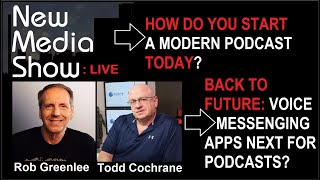
Rob Greenlee and Todd Cochrane discuss what actually matters when starting a podcast: clear goals, good content, and community. They break down how AI tools like Blueberry can automate transcripts and captions in minutes, and debate whether branded podcasts or independent shows make more sense in today's crowded market.
Chapters
Okay, we're live.
Yeah, I haven't seen— I'm just now getting the stream from you, so yeah, just came up now. Waiting on YouTube to get its—
almost ready to start.
Yeah, yeah, because we're live on all my channels right now, so Yeah, just almost ready here.
Okay, wow, that's a big delay.
All right, we're good.
All right, let's go. Todd and Rob in the afternoon.
Hey, afternoon, good luck with Todd and Rob. Oh yeah.
Oh yeah, it's great to be back.
Yes indeed, here we are. And, uh, a little bit of a different time, but, uh, than our normal show, like, but again, same as last week. So hey everybody, welcome for those of you joining the live stream. Rob, uh, was a quick week.
Yeah, well, it's, it's still only Wednesday, so we still have a few more days to go.
I, I always look at our weeks Wednesday to Wednesday, you know. So yeah.
Oh yeah, that's right. Yeah, yeah, they do come around pretty fast when you do weekly shows. I know I do about 3 live weekly shows, so it's, it's, uh, they do come around a little quick, I'll just put it that way. But, but yeah, I wanted to talk about some topics. I'm sure, Todd, you have maybe done a little bit of thinking on this, but I, I did want to I did an event down in New Jersey last night, um, for a group of like maybe a couple hundred people that were doing kind of this joint thing of a Zoom call as well as a live in-person event, trying to do that at the same time, all in one, one venue down in New Jersey, of having a bunch of people, you know, on a video camera at the same time and then taking questions and all this kind of stuff. And the topic came up a lot, around the whole area of— there's still a lot of people interested in starting a podcast, Todd, and I get— this topic keeps coming up, right, of, of how do we start a kind of a modern podcast or a podcast that, that people are kind of expecting to, uh, attempt to start in what that spectrum is. And I wanted to talk a little bit about that.
Tonight? Well, it was definitely the case at Podfest where, yeah, you know, you had a whole group of people. Then, you know, the, the desire to start, uh, a show is, you know, was as live as you kind of— it actually kind of, uh, made me feel as if, uh, some of the stuff we'd heard from pundits, uh, wasn't necessarily correct. Oh, you know, so I was pretty excited to see the the enthusiasm to start a show.
So yeah, it is. I guess it's, it's only a matter of tapping into and reaching out to kind of groups and communities that are not necessarily plugged into podcasting. I know we tend to travel in echo chambers of sorts in the podcasting space, and, and I know a lot of people that watch this are, are, you know, avid podcasters themselves. But it's an interesting topic from the standpoint is when we as podcasters talk to other people, what are we sharing with them, uh, around maybe how podcasting has changed a little bit. If we think about, you know, Todd, when you and I started back in 2004, and as you moved through, you know, like 2010 or so, I think there was a certain kind of thought process that we all went through back then of why we were doing it and stuff. But you know, given the current kind of more modern media landscape and the complexity of it, it's, it's probably a lot of the same concepts, right?
Well, you hear the same thing, you know. I don't know if the story has changed. Yeah, you know, um, on wanting and why in their genesis and, you know, their hopes and dreams and everything that goes along with that. So from that perspective, uh, You know, I don't see too much differences at this point.
Yeah, that's an interesting observation I've been thinking a lot about over the last, probably the last 5 or 6 years, is while everybody's running ahead thinking about how things have changed, really the fundamentals of this medium really haven't changed very much. You know, how we produce and how we distribute has changed a little bit, and I think its perception is evolving and changing, but The actual core principles, I mean, if you're talking just about content, right, it's the same.
It's really the same thing. Well, and at the same time, the conversations I have with podcasters is exactly the same today as it was 10 years ago. And it really evolves around— and these are for shows that are established, that have started, right— is how do I grow my show? And that continues to be the prevailing question that I'm asked. Am I doing things right? Is my website set up correctly? Am I, you know, what am I missing? And, you know, oftentimes they're not missing much. It's a lot of fine-tuning, and ultimately it's about creating great content.
Yeah, it's also, I think, getting crystal clear on your, your goals of what you're trying to accomplish with a a show, I think the one thing that has changed that's pretty dramatic is just the level of noise that's out there around content. There's a lot of content creators now. There's a lot of content that's competing for people's attention. And increasingly, that's what's driving this conversation about, you know, growing a show and getting— I mean, how do you get attention to your show to be able to pick up audience and And at the end of the day, we keep talking about content as the driver for that. But increasingly, I'm hearing more people talk about thinking about community as the way to grow a show these days and appealing to a community. And that oftentimes is kind of mission-driven and mission-focused. And this came up a lot on this, this group Zoom call with like you know, it was like 250 people, is, you know, it's the whys of why people are wanting to create podcast content and this tug of war that people feel out there between doing a video show or doing an audio-only show and how there's increasing pressure on all of us to create shorts and to do all this derivative content too. And it's really causing a lot of, people to just kind of throw up their hands right now and like, you know, where do I start? How do I start?
Is there anything that you, you're, you've been thinking about on that plane of, you know, again, it boils down to that 50% of the people probably at least, and I, and I, we talked about this at, uh, in, in Florida was, yeah, you know, when I asked them, what is the goal of your show? They, they often can't answer that. And because they haven't thought about it. And again, the goal, the goal of the show would ultimately, you know, drive the format and content of the show. So, you know, are you, are you trying to make money? Are you trying to build authority? Are you have a business funnel? You know, what, what is your goal? And then once you've decided what the goal of the show is, then it's easy, really easy to build content that drives towards that goal. But again, if you don't have a goal and you're just going to do a show for fun, well, you know, I think you're probably, you know, you might be throwing pizza on the wall or something. But at the same time, Community though, what does that really mean? If you have no community, um, pre-established, and again, this is the lifelong problem of content creators. If you're well known in some space already on some platform, well, you've got a community to build from. If you're a business, you have a business list. If you are a speaker, you have a speaking list. If you're an author, you have a reader list. But if you are just like I was, and maybe even you, Rob, when, well, you, you were doing radio, so you had a little more establishment. But if you think about, you know, when I started, I had nobody and no community. And, you know, a few people that read the blog, you know, but that, that amounted to maybe 300 people a week that, you you know, have to find it by mistake. So, uh, you know, you can talk community all you want, but, uh, you know, I, I, and I go back to the realization I had in that, you know, when my father died on episode 200, and coming back to, you know, 5,000 emails of condolences from my audience made me realize that Podcast audiences are different. They're just different. And they are, you know, you might have a YouTube channel, you might have a Rumble, you might be on LinkedIn. And, but whoever follows and subscribes to your podcast, there's just a different level of connection there. And in essence, your community is that audience. And that's where, you know, where I had really, you know, made this decision at that point that, hey, this is part of a, you know, and I really broke it down kind of because I lived in Hawaii at the time. I broke it down into this Ohana theme, you know, family, family, family, family. It's a family of listeners. So, yeah, of course it was a community. But I, you know, I didn't know I had a community of listeners until I knew there was listeners. But did I really have the inkling that there was this deep, intimate connection? I don't know, Rob, maybe you've experienced this. Have you ever been walking through an airport or been at a location and you have, you know, my first incident was as I walked up to a McDonald's counter in O'Hare and I started ordering and a person two back 2 people back from me said, Todd. And it was someone that listened to the show that didn't know what I looked like because there was no video podcast at that time. And I turned around and, you know, here you have this person that they know, really know everything about you, but you know nothing about them. And, you know, they're, they're happy to see you and grab you and give you a hug. And, you know, and it's so these podcast audiences, I believe, are there's this deeper connection. And yeah, community is important, but you kind of still got to build it. Yeah.
And I do wonder if there's an advantage there. Um, I know back, back when I used to work for PodcastOne, one of the criteria is that the development team, when they were looking at taking on a new program, they would go look at, you know, like a celebrity or whatever and how big their social profile was, right? How many followers they had on Twitter and how many people people were connected to them on various social media apps as a kind of a baseline of community. And I wonder if we're coming into an era of podcasting that I do wonder about this base of community that is pre-established before you start a show is maybe a leading indicator of the ability to grow community with your podcast. And it may be one of the reasons why we're seeing kind of like a like a renewed interest in kind of what I would call a kind of branded podcast, which is more like business-motivated podcasts that already have an existing community of sorts.
I don't know. Again, it's if you have that, you know, that's probably an advantage, right? Well, it's been that way from the beginning. You left, but you know, but let's, let's go back to the podcast one thing. Thing. Yeah. Oh, they, they had some superstars over there. They had a great— and they flopped.
Yeah, right. It's not a guarantee of success, right?
Yeah. You know, like, like plummet into the, you know, into the ocean and sink to the, into the depths of hell. It was, you know, there was, you know, there was— they could have all the community in the world, but they were superficial.
Yeah. I mean, I worked on, to some degree, and I'm not taking credit for what happened to this, but the Larry King podcast, uh, that crashed and burned. Um, so So just because you're a big celebrity doesn't mean that you're going to be successful at podcasts.
Here's the problem. Here's what it is. Those folks are used to talking to. Yeah. And, you know, they're not, they're not, well, maybe, you know, they're talking at, not talking to the audience. They don't, they have this ability to appeal to, you know, a general topic and get widespread. But then is there emotion? Is there emotion? Is there a connection that they developed one-on-one when someone straps on a headset? Yeah. I don't have, I don't feel on the YouTube channels I watch. Hey, I enjoy their content. It's entertainment for me. But I don't have a connection with those. With those, uh, with those hosts. You know, I ran into a YouTuber recently that I followed their channel, and I— and here's the thing, here's what was the stark thing. I said, oh, you're the, you're the host of such and such YouTube channel. And then it's like, yeah, and hands me a card with, uh, with the name of his, of his channel. And I'm like, wow. And I got this very impersonal don't bother me type of response that I was a little surprised about. Because what happens now when we— I— when I run into people that say, oh, listen to your show. Well, great. Thanks. Love it. I'm glad that you enjoy it. You know, what do you like about it? What would you like me to change? You know, I solicit that. I get that. I try to build a connection. Do you, you know, because I don't know them. And here you had, here I, and maybe my situation was unique and it actually happened in a bar and run into this. So maybe the individual did not want to be bothered, but I was like, it actually kind of turned me off, made me thought, hmm, well, maybe just this channel is not worth its time. To, to watch anymore. Yeah.
So yeah, I think your comments about, um, have, have I ever been in a public place and been recognized before? And I would say it depends on the, the place I'm at. I mean, obviously at a podcasting conference or something like that. Um, but yeah, I mean, I guess it's the, it's that, it's that line around fame, right? Um, I've known many people that, you know, have had their, their face out there, and it can just be like an image online too. It doesn't have to be video, right? So people see us in our profile pictures, and that's why it's important for our profile pictures to kind of represent us pretty accurately.
So if we go back and look at Dr. Drew— yeah, at podcast— he took the time and was connecting with people. And he had it, you know, and again, he's talented at working audiences, so he has experience doing this. Will he remember the, the 3-minute conversation he had with Todd? Probably not. But during the 3 minutes that I was talking with him, I had his undivided attention. Attention, yeah, you know, and it made me feel appreciated. For the being able to interact with him. And, and, you know, and I know he's a busy guy, didn't want to waste his time. Um, and it's the same. I, I think we all have to just, um, creators want shortcuts right now too. There's no shortcut. There's none. And, and we also have to be frank. Um, my son's trying to build a YouTube channel. Um, and frankly, he's not doing what he needs to do, in my opinion, to build a successful YouTube channel. And I tried to explain to him some strategies and give him links to videos to talk about this. And it's just like anything else, um, if you don't do the time, you don't put in the work, you don't you know, and I, you know, this, this, this ideology of instant gratification and getting the dopamine hit by liking the TikTok video. Um, there's not a lot of dopamine in podcasting initially. Yeah. So, and we tried to build that into some of the Podcasting 2.0s. You know, a dopamine hit, you know, here's an example. 1000 Sats from RW Nash. Yeah, Todd's back, and therefore the back and forth. So again, we have, you know, the ability now to get some more feedback to the podcaster from the listening audience. And I think that is going to be critical. Because let's be frank, people living on the dopamine hit right now, they don't get it. They feel defeated. They feel unwanted. They, you know, I'm, you know, it's the trophy syndrome. I'm not being liked. You know, come on. Suck it up, buttercup. This is tough. So the question is, are we having the hardest, hard conversations with creators, with podcasters, that this shit's hard. You gotta, you gotta create content.
Yeah, though, Todd, I, I wonder if it's, um, I don't know, I struggle with this too because I, I try and give people advice on how to step forward and, and try and think about this and And it's like, I think there's such a strong interest in making— being a content creator now, uh, whether it be a YouTuber or a podcaster, as their full-time career. Oh, that's good luck. And to have that, um, happen very rapidly because they don't have a lot of time, right? I mean, if you've just been laid off from your job, which has happened a lot in the podcasting space, I, I think right now we're in this era of, uh, it's almost like reshuffling the chairs on a deck, right? And people are leaving these big companies, and they're maybe going to start their own companies. I mean, we saw this kind of like back in the 2008-2009 timeframe and during the last economic struggle where, you know, talent got spread around. And I think especially now, I think we're going to see a lot of people trying you know, start up their own companies or be a consultant. And I think we're just seeing this kind of situation explode. I mean, I get, I don't know about Utah, but I get contacted from people on LinkedIn constantly that are looking to get some sort of a deal going and they're independent creators or they've done a startup or they're trying to, you know, create some income for themselves. And I think That's what's really driving this conversation of, you know, growing and then being able to monetize is the big thing.
You know, I back it out to one of my sponsor messages with GoDaddy, right? I tell my audience, get your website set up. Doesn't matter if you're going to do a podcast, e-commerce, you're going to build something that is going to future-proof economy-proof yourself. So this is a, you know, I hate to be an asshole, but there's no shortcuts. There are no shortcuts at this point. You know, if you've had bad planning, we've all had these moments where like, oh, I'm behind the 8-ball. Well, creating content doesn't matter what you're going to do. You know, unless, okay, let's be frank. Some of the TikTok stuff goes viral because it's T&A. And, you know, and a cute face or handsome man or whatever it may be. Okay. There's some stuff on TikTok that is repurposing other people. I see a huge amount of this. Repurposing and commenting on—
or memes or those kind of things that people just replicate the same kind of content.
The amount of people that are trying to build their shows upon other people's content by re— by analyzing someone's clip or something is just out of control. And I'm like, do the work, do your own work, you know? And there's no shortcut. There's just no shortcut. I wish there was. I wish there was a magic pill.
We'd all be rich. Yeah. So if you're watching this, uh, please give us, um, a comment in the— in, in Facebook or YouTube. Uh, we'd love to hear your comments about these topics and share with us your thoughts on your experience with going through this process, because I do think that there's a lot of people right now looking for being a content creator as their career going forward. And I kind of wonder, that's putting a lot of pressure on podcast hosting platforms. It's putting a lot of pressure on YouTube to be able to facilitate that. And I think it's a, like you said, Todd, it's a challenge. And most of the success that people find with this takes many months and maybe years to accomplish.
Right. Well, you know, you know, just look at the number of YouTubers that are not monetized, you know, and I think you find a pretty equal number of podcasters that are not monetized.
And it can be done very rapidly, but I think it's kind of rare. I mean, it depends on your abilities, I guess.
I think it's about your ability to connect with audience and it's ultimately the content, content, content. Right. And, um, and putting the work in.
And I, I wonder if that can be done through a coach or not, or if that's just something that typically happens more organically with a person that just puts the work in, right, over a long period of time.
Well, I'll tell you what's becoming easier, um, you know, there should not be any excuses because I look at what we— and we're testing right now internally at Blueberry where our AI stuff— we've got beta testers in. And because of spending many, many months and looking at what was useful and what wasn't, I now can knock the show out again, probably in about From the time the recording is done to the time the show is posted in, in under 30 minutes. Now, when I was using all the— maybe 20 minutes. And when I was using the haphazard of tools I was using before, I was adding a good 40 minutes. But now that I've— we've got it all streamlined where we just upload the audio file and then the whole process kicks off. It's, it's to me, I'm like, and I'm getting amazing show notes, I'm getting chapter files, I'm getting image art, I'm getting really everything that I need from a post-publishing standpoint minus editing the file. If you're going to be an editor, you're still going to have to edit. We don't do that here, but, and I'm just, I'm joyful because I've used a process now to get time back again that I had added into the process. So the ability to have, um, a rich show production experience without a production team, um, remains completely viable. Now the video, when you do video, that adds a whole a whole different, uh, gamut of stuff. Alex says, but podcasting for business is part of a bigger marketing plan a lot of the time. What do you guys think? You know, here's the thing. If you're a business, which, you know, I am, I run a business and we have a business show and we have a specific goal for that. You know, obviously we're podcasters and we've reworked that show 3 or 4 times. As we've learned. But I think if you are a business and you want to get into this, you probably would be wise to spend some money and have a production team. Yeah. You know, you would be wise to do that. I'm getting ready to have some videos cut because I want to have some professional-looking videos that are going to go along with our AI launch. So I am not a professional, you know, clip creator. So, you know, I think if you're a business, you got to spend some money to make some money. You don't have to if you're the lawyer who is the foremost expert in litigating, you know, sidewalk falls or whatever it may be. You probably do not need much of a production team. You've got 82,000 stories to tell and the outcomes and the do's and don'ts. And, you know, you've got a clear path for creating content. But if you are a hardware store, it's a little harder, I think. Yeah. Or if you're a business, if you, you know, if you're trying to drive foot traffic into your brick and mortar, Well, podcasting is very difficult to do brick-and-mortar traffic. Yeah. Unless you're virtual, you know.
Yeah, I think it's hard, but it's also an opportunity for a business to tap into this market a little bit. But it is difficult for an individual, I think, to be able to do every aspect of this all on their own, you know, from creating Shorts to doing video and audio podcasts. And to do it effectively and to grow it is definitely a challenge. And I think what we're seeing is more and more companies outsource various elements of this. But one of the challenges of outsourcing is that you as the creator have to be an expert to be able to manage that team, right? So, you know, that skill and that knowledge needs to, needs to be in the creator as well originally, I think anyway.
Well, I digress. I was talking to someone the other day and they said they were on a very high— they had high production of their podcast. Right. And they said, we can't make it on a CPM model. Our production costs are too high to be able to make any money. Right. So, you know, and he basically said, I need to get the to reduce production cost to almost nothing. And in order to make a CPM model work. And so again, unless you're driving massive numbers, then as much money as you put into a production team is going to go right out the door. Again, what is the goal? Is the goal the funnel for a business? Is the goal to be, you know, have advertising? Is, you know, what is the goal? And the goal will drive the amount of money that you, that you spend getting that production done. So I think the average, average Joe and Jane podcaster though, that's the last thing they think they need to do at this point. There are the tools to get out there. You look what Headliner has done. You look at probably what we're going to be launching soon. You know, what are we building? We're building tools to help individual podcast creators to be able to basically not need a production team and be able to go click, click, click, uh, and, and have this stuff, you know, sorted for them so that they, they can move on and continue focusing on creating content Um, I, I think, you know, I go back to AI and look at what we have built so far and what we have in the pipeline yet to build. It's going to be transformative for content creators. Is it going to be perfect? No, but it's a hell of a lot better than what they're doing now where none of them are doing nothing, right? So, yeah, I mean, just look at the— look at our show notes from the last episode., and read, you know, read, read our, read our summary of the podcast. And it's pretty talk-on-good. Yeah. And not only that, not only that, the chapter files now, and we, we just, we did update to our player. Um, the chapter files are now marked within the actual content, within the player itself on the website. So, you know, we've got built out to make the experience for people having, when they consume it, at least on the web, be a much— it's inevitable now if you're consuming there. What's new podcasting apps? They're doing the same. You can click to the content you want. All this is being, you know, our chapter files from last show were created automatic. They just, the AI did it. And I'm thinking, be honest with you, for Geek News Central, I pay a guy to do post-show processing of my episodes, creating chapter files, I might not need that in a couple of weeks. I may not need his services to do the post-production work. And when you, when you have the ability to, for me, reduce cost, Yeah, it allows me the freedom to say, okay, this isn't costing as much to do, so now I can, I can use my resources more effectively elsewhere. Maybe I have a little extra money now to maybe buy some advertising somewhere.
Um, yeah, I think, I think to some degree, Todd, this is the challenge that the industry faces in a much broader sense too, even at the larger media companies. I know that the guy who's now running podcasts at National Public Radio, Colin Campbell, did an interview in Current, which is a magazine that supports public media of sorts. And he's seeing that the overlap between podcasts and broadcast audiences is— I mean, this is a little unrelated to the topic we've been talking about, but the audiences are are getting further and further apart from each other. It's almost, if you think about public radio, I think their average listeners are like in their 70s age-wise, and the average growing listener of a podcast is like in their 20s to 30s, right? So you couldn't be any further apart when it comes to the demographic makeup, and they're having a real existential crisis over there. And I think a lot of the larger media companies are facing this as well. Because I think that their audiences have been generally pretty, you know, on the older end of the spectrum, especially mainstream media. And so we're now, we're seeing kind of this movement. And I think a lot of these big media companies are struggling with the same things that we've been just talking about, is that they've been investing a lot into creating what they consider to be quality content, and the ROIs have dropped on that, and that's why they're canceling a bunch of shows. And, and, um, it's, it's becoming increasingly difficult to monetize, um, at the scale that they need to, to be able to pay for those 6-person teams that they have creating shows. And this is a little bit of the tension for branded podcasters too, is like, in order to compete in that realm, you kind of have to have a team these days. And I I'm sure, you know, you know too, Todd, quite a bit of people that have like maybe a virtual assistant or something like that, right, with various aspects of what they do, um, you know, handle social media or something like that.
Again, I think, um, we're, we're facing a new— I think again, you look at, uh, what's happening, you know, across the space. I think some of this is going to be solved by AGI when it becomes more effective. And again, I'm pretty bullish here that creators now, it levels the playing field. So basically, if you are paying for a team, you may not need to here very soon. That's right. And I know some folks are focused on the audio editing, you know, on the AI stuff. Some— we're not really kind of looking at that at this point because Descript and others are doing it very, very well. I don't need to reinvent the wheel there. Yeah. But, you know, I look at, you know, I go out and look at the top 5 companies that are, you know, basically these tools I've just built and I've matched 90, 90% of their functionality. Well, maybe 80% of their functionality within literally weeks. And so I, yeah, again, it goes back to being smart. You and I have the advantage of really kind of trying to really kind of stretch our legs and be on the forefront of most of this. And I think when you're a brand new content creator, you know, you're still struggling with how to, how to click record. And that's something that we continue to look at too, is this, the struggle to get to episode 1, right?
Yeah, I've, I've known plenty of people that have said they're going to start a podcast for over a year and have never really— they start getting some of the infrastructure together, but they never execute on it. And oftentimes that pushback is because, well, I've got to make money doing other things. I can't devote the time to this because it's not going to make money for me right away. Well, that's the pressure that we're seeing in the market today.
Well, when I started my podcast, it cost me a buttload of money. Yeah. And I had a finger put in my chest that said, listen, you know, listen, dear husband, you will, you will figure out how to make money on this in 2 years or, you know, I'm going to pull the plug on you because I was spending, you know, almost $1,000 a month to put the show out just because of hosting costs and everything. Yeah. In those early days. And it was expensive back then to get bandwidth. Yeah. It was not for the weak of heart.
I had my own servers and my own T1 connections going to, I think I had like 3 or 4 co-located servers that I built myself and managed.
So, you know, it's a whole different game now. Yeah, it is. And the tool sets I would have just died for back then that we have now. So, you know, when people— of course, no one knows with the pains that, you know, walking uphill twice in the snow and ice to go to school each way, you know, no one wants to hear that, those stories. But, you know, I also understand that my production time, even though I'm doing a lot more stuff, it's just about the same. From when I started in 2004 to today, it's, it's, you know, the production of the pre-production, the recording, the post-production is just about— I can get a Geekness Central episode out in just about 3 hours. This show, maybe 2 hours, you know, an hour and a half of that is recording. Oftentimes I'm waiting for the upload. That's what's slowing me. So maybe at 2 hours and 15 minutes. So you have to make a commitment of time. And if you are working a J-O-B, it means on the nights you're recording, you don't go to the bar. You don't do your social hangout. You don't play games. You spend the 2 to 3 hours grinding an episode out. You don't get wrapped around the axle with 8 hours of editing. And this is where I feel people are just getting killed. Is they're spending too much time editing and not enough time preparing, right? If they prepared more, they would spend less time editing.
So yeah, there's really no replacement for putting in the necessary, um, work.
I mean, it's either up front or it's every average 30-minute YouTube video takes 4 to 6 hours to edit.
Um, so, you know, you're not going to be getting out very much content if you do that.
Uh, well, that's, that's the, that's, that's why YouTubers burn out. They have to grind and, you know, they have to edit to make compelling YouTube channels.
I don't know, when we say edit, we're actually talking about adding other visual elements, other other components to those videos to make.
Right. Well, you look at those YouTubers, they got camera in their hand, 24, 7, clip, clip, clip, clip, clip, clip, clip, clip, clip. Segment, segment, segment, segment, segment. Storyboard, storyboard, storyboard, right. They're probably not doing storyboards, but in their head they're doing a storyboard because they got to put that together, right?
Yeah, they're. I mean, oftentimes they're, they're telling a story and they're using visual images along with text and things like that to drive that.
I'm guessing we don't have to have a storyboard. We just need to have an outline. Right. You know, and you and I, we don't even do an outline. You know, today I know you were doing a little prep looking for some stuff. Yeah. You know, I ran out of time and didn't get anything prepped. You know, so, you know, you're carrying the day here.
I'm getting used to it, Todd. I've been doing it, yeah, many times a week for many weeks now.
So yeah, but I think, I think, I think podcasters need to grow up. Yeah, I, I don't know, you know, any— I hear these lofty, lofty, lofty ambitious quotes from consultants and it just infuriates me because, you know, they're selling a pipe dream and charging $999.99 or $99.49 or whatever the stupid methodology is.
Todd, do you see the podcasting medium making any dramatic changes? Let's say, as you think, you know, 2025 timeframe, a year from now, is AI going to just change things dramatically, or do you think it's just more of the same for the next, you know, few years?
I think AI is already changing things dramatically. Yeah, yeah, I know. You look at what, uh, Transistor did and their, and their transcript implementation, um, I guarantee you the coding on that did not take long, um, because we, you know, we essentially have built something similar. It hasn't been revealed yet, but it's—
this is what did they roll out, if the audience hasn't heard of it?
The ability to have, um, easily mark. And I think Cridland and others have already done some of this themselves. Speaker 1, speaker 2, identify who the speakers are. Oh, right, right. You know, and it's going to get— it's just going to get much more advanced going forward. Descript does that today with their transcripts anyway, right? So you just identify who's who and then it goes from there. So, you know, that's— it's— and again, it's not difficult. This stuff was, you know, a year and a half, 2 years ago, you know, it's a little more tricky, but now it's just an API call and not complicated from a development standpoint at all. And the beauty of it is, is something gets better, you just flip the API calls to a different product and you just continue to march forward. So, um, the AI piece I think is going to help the entire production pipeline considerably. And, you know, I had to laugh with, uh, let me see if I can get this right here. Uh, don't eat me, Tom Webster. Oh, let's try that again. Don't eat me, Tom Webster. Um, you know, their latest Sounds Profitable, you know, talking about having an AI co-host, you know, and You know, I don't know if you and I can be replaced, Rob, but, you know, it is interesting that, you know, that Tom talked about having an AI co-host.
Yeah, Todd, have you seen this new app that's going— the Potter? Or yeah, it's the Potter app. @potterapp.com? No. I was talking to the guy that, uh, runs that now. I can tell he's a very intelligent fellow, um, who's trying to build this platform that will analyze a podcast, right? And it will look at its metrics, look at the data of what it can capture around a particular show and give recommendations from that data to the podcaster about what they can do and how they can change what the patterns are that they're seeing in the consumption around topics, around keywords in the content and the audio quality and all these things and trying to rank that stuff into a report card of sorts. Not unlike what the the platforms like brand safety and suitability where they have like a nutritional guidelines for your podcast, right? What elements of that podcast are, you know, good and bad, right? So it's interesting and he's building in a lot of AI technology into the backend, you know, that's kind of analyzing shows and giving kind of real-time feedback to podcasters. And I I mentioned to him the opportunity of maybe doing that with monetization too. Look at a podcast, look at its audience, look at its growth, look at its genre, whatever, and come up with a strategy for a particular show. And I kind of wonder if AI is going to help with other things like this as we look to the future, because I think we can both agree that the podcast medium right now is pretty complex. I mean, it's not, you know, no one knows, and I struggle with this too, Todd, and I'm sure you do every day as well, to keep up with what's going on and the opportunities and the different methodologies of doing things.
Um, we, we, you know, to that regard, um, I've been playing with that, um, how should we say it, I'm looking to see what's next. Yeah. And, you know, what he's doing is the challenge with that. And again, if he's mastered that, then congratulations. If it's coming out with consistent, AKA, this is a key, consistent advice that's not off the wall, that is accurate because you've analyzed the audio and you've come to the same conclusions. Um, it's a, it's a, it's tricky because it's subjective. Um, you know, I think things that we're looking at is, you know, we can use our retention data to say, okay, when, when there was a drop in retention, why was there a drop in retention on a show? And, you know, how do you compare to other shows? And these are the type of things that we're, we're really going to be looking at heavily. And, you know, we've got the source data to, to back up the, you know, in a true statistical amount of data to back up some of these assertions.
Um, yeah, yes, but this is his website here. What's your website?
What?
Oh, it's potterapp.com. potterapp.com. And it's, it's basically, you know, trying to data analyze your podcast and what's going on with it. So he does use a prefix of sorts to analyze your show.
Getting some stats. But if he's using a prefix, he's not getting very much information.
No, that's right. And he's having to piece together other, other sources, you know, of information to to kind of piece together stuff. And some of it is kind of, you know, maybe less than specific, right? And right, that's the challenge that he was— he was struggling to try and get sources of information. But, you know, his comment is back really on this was that a lot of podcasters are flying relatively blind, um, on what's going on. With their show because the situation is so complex, right?
Well, you know, I don't— I'm kind of biased here because, you know, we really have worked hard in the statistical department to be able to give, right, podcasters actionable information. Again, it's on stats, but there's a lot you can derive from stats, right?
Um, and especially when you're comparing it to like-minded content, so And he does have plans in here that are a little on the expensive side.
Really expensive for growth. Yeah, that's, that's, that's crazy.
$15 a month for analytics. Yeah, and then the $80 a month, he actually will give you 2 to 5 actionable small strategies per week. Personalized guidance with AI, access to private Slack community. Um, yeah, so I, I think he's, you know, trying to work it to try and figure out a way, you know, to, to utilize this data to help podcasters make better decisions around content.
And just looking at his analytics, he needs a huge amount of demographic data. He needs, he needs the web traffic. He needs all this information, um, which being a third-party service, he like likely does not have a lot of this. So he's probably, probably people are having to implement stuff on their web pages. And, um, you know, I, I commend him for, for, for doing this. Um, but again, it's just like our AI product, um, that we're getting ready to roll out. We know that people are going to be able to cancel a variety of AI, so, uh, AI tools that they may be paying for.
All right. Yeah, and that's a good, good topic too, Todd, is, is that I think we're coming into an era too where Now, a lot of these, yeah, I'm hearing a lot of talk about this, especially in the technology sector, is these bigger platforms are going to increasingly add AI capability, you know, like what Microsoft is doing with Office and what Google is increasingly doing with what they're doing. I think we're going to see it increasingly in Apple's platform and also in in Google and Facebook and all these, that a lot of these abilities are going to be added into existing large software suites. And I wonder if that's going to cause, you know, a fair amount of these AI startups to get put out of business.
They're already going out. You know, a couple that we tested back in January You know, basically we still have accounts on there. They're not active. We're not paying for the service, but we're getting emails of, hey, we're shutting down. And, you know, it was a good run, but, you know, here's what we suggest you try to use. Oh, yeah, there's going to be a huge amount of consolidation. Yeah. You know, I saw the handwriting on the wall and understood that, hey, we have to have this baked in. You know, and my roadmap is pretty long from that standpoint. It gets more complex as time goes on. We built the easy stuff first. The next round is doing some of the harder stuff. And, and in the— and basically it was just about workflows and trying to improve workflows.
I thought I wanted to kind of change the topic a little bit here, and I don't know if you saw in PodNews the announcement of this Podio and the AIMO voice messaging app. It kind of reminded me of an earlier era in podcasting, and I wanted to pull it up and share with each other. I saw it, but I didn't look at it. Yeah, so this concept of— here, let me pull it up on the screen. It's a little bit of a throwback into an earlier era in the podcasting space. What's old is new again. Yes, listen to podcasts on any phone. This is an article that was written by Michael Arrington back in 2006. Oh, okay. So you can see kind of a history here to some degree. If you look at the, um, there's a variety of, you know, phone pods and pod lines and Voice—
yeah, on the Voice Indigo, whatever. Voice Indigo for a while, and no one ever used it.
Yeah, so this concept of being able to play or access podcasts via, let's say, a voice messaging app platform. So, and I think there's been some talk, Todd, around, you know, platforms like a WhatsApp supporting distribution of podcasts, or, you know, and maybe this is the reason why it didn't really work in TikTok too much, but is this concept of being able to access podcasts on apps like this. And this was announced in Pod News, and but it was for, um, like, uh, North Africa and Saudi Arabia. I don't know if you saw it through this hosting platform called Podio. I don't know.
Here, I'll pull it up.
I'm familiar with audio. You are? Yeah, yeah, this is them. So I guess they have a partnership, um, to, to distribute podcasts to, I guess, the Saudi market as well as, uh, what's the other country? It is— ah, I thought I had it right in front of me.
Well, the Saudi market is pretty, uh, Bengali, which I believe is in North Africa, right? Saudi is quite well connected and everyone has a very modern mobile phone in their hands, right? Um, that was evident by going to the, the event that I went to is, you know, I, I was kind of bedazzled a little bit. Some folks had some pretty nice phones. Yeah, but Africa is a different situation.
Yeah, so this is the, the platform. Oh no, I wanted to share this too. I don't know if you've— I don't know if many in the podcasting space have, uh, actually seen this, but it's at dialapodcast.com. And how it works, you basically sign up for a subscription to podcasts, and you go in and you enter what podcast you want, and it, it gives you a phone number that you can call on your phone, which takes us back to that article earlier, I think, with Michael Arrington, about getting a, a custom phone number that will dial in to play your latest podcast episode into your mobile phone. So these— no idea is ever really entirely dead, is it, Todd?
Yeah. And the challenge I hate, you know, is this by the same company, Podio, that does this?
I don't believe so.
I think this is a different company. Yeah. Yeah. So, you know, the— so what is Podio doing then specifically?
Uh, let's see. Uh, they are sending podcasts over to another platform. Platform. I'm trying to pull it up here. Okay, I think I found it here. They're supplying podcasts to this other platform. Here, let me access that, called IMO. Oh, okay. Which is, it's a downloadable app that you can download to a Windows computer or a or a Mac or something like that. But the problem with the app is, is that I tried to install it myself and it doesn't even enable you to actually get it in the United States, right? So it only enables you to get it in a bunch of other countries around the world. So, you know, mainly in North Africa, Saudi kind of area of the world.
I think we talked about I think we talked about before that podcasts would be embedded anywhere there was a place to embed them. So this doesn't come as a surprise to me at all. And it's a smart strategy. You find a regional app that's doing well. And if it's, you know, got regional content, then you, you know, you, you add the podcast section with the regional content. It makes perfect sense. Although I do find it kind of weird, 10 10 plus thousand. Oh no, there's four zeros. The comma's in the wrong place. So tens of thousands, uh, plus. Is that the— you know, that's kind of interesting.
I think it's a translation problem or something.
I'm not quite sure. Well, I think we all put the comma in the same place on numbers. I didn't know there was a— yeah, maybe, maybe not. You know, maybe in Japanese, left to right. Or right to left, excuse me. I don't know.
But you know, supposedly there's like 200 million people potential reach on this platform.
I, I am, you know, you think about the number of folks that speak Arabic and it's massive. I think it's bigger than that. The Arabic-speaking world was like 700 million or something like that as far as this platform goes, I guess.
Oh yeah, yeah, 200 million, but But it does look like it supports Android, iPhone, and Mac PC.
So the trick, Rob, to install that is put a VPN on your phone, set it to a country—
is—
and then so like Britain or something, right? Yeah. And then try to install it.
Yeah. So, so it's interesting news that came out.
It's old as new again, but this really isn't the same play. This is just embedding podcasts in apps and then, you know, a variety of apps.
And I think that's smart. Well, I guess the idea of a messaging app is an interesting one.
And based on Facebook's history in podcasting, I don't think it's coming to WhatsApp. Yeah, I don't think so either. Right. With you, I don't know if that's a great fit.
I don't think so either. I think the use cases conflict with each other a little bit there.
Yeah. Yeah. You know, primarily and I, you know, I use WhatsApp a lot. And then some part of the world's like if you're in Japan, Line. You know, my, uh, Shoko's, uh, lost her sister here a few days ago and she's in Okinawa right now. So, um, we, we will be, uh, communicating online, uh, because that's what they use in Japan. They don't use WhatsApp. They use Line. And then of course, in the United States, you know, a lot of people that are security conscious are using Telegram and other types of apps. So, you know, I don't know if that's the best place to consume podcasts. I think I'll stick with my new modern podcast app on podcastapps.com where we can do value for value and Did I actually kick the live today? Did I hit the live item? Yes, I did. So we are, we are live and lit.
So that's what I wanted to, to show this, uh, quick and get your, get your thoughts on it.
The Independent, uh, Podcast Awards.
Okay, great. What do you think about that?
It's in London. Well, uh, podcastawards.com is the Independent Podcast Awards as well, so Yeah, it's interesting. Yeah.
So is this their second year?
Uh, it doesn't say actually.
The trophy's pretty nice. Yeah, I thought it was an interesting kind of, um, fun design, right? Yeah. I wonder how expensive those are to make.
Those are not very much because those are acrylic. That's just a print. That's— those are very inexpensive to produce, probably $50, $60 each.
So I guess credit card, that's their stage. That stage looks really familiar. I don't— it must be in London. Yeah, King's Place, King's Cross in London, I guess.
So this is just for indies then, huh?
I guess so. I'm, you know, I'm not quite sure where they're drawing that line, right?
Yeah, how do you define that?
I know, that's— I agree with the question. I'm not sure I would want to be in a position of drawing that line, to be honest. Yeah, so, but I guess they've— somebody's taken it on.
Yeah, anyway. Oh, that's good. Yeah, more the merrier.
There's room for, for all of us.
Yeah.
And I think if that event, you know, I, I guess the— these regional awards seem to be a thing, right? Uh, yeah, yeah. As far as globe— global regions, right? So you have like the Australian Podcast Awards and you got the UK and, um, and I'm having a lot of fun.
We The challenge I'm having with my awards is I had some folks that were shipping to Dubai, or UAE, is much, much harder than one would imagine because their addressing system over there is a pain in the— oh my God, pain in the butt. And So, you know, I've got 2 trophies on the way to me that I have to individually ship because, uh, FedEx was just completely confused with the address, and I'm gonna have to sort it out and manually do it. The, the company couldn't, couldn't figure out how to get FedEx to accept the shipment. My shipping bill this year alone was $1,600, so I'm not for the faint at heart either.
Or she just shipped some trophies too. Yeah, we did for the podcast, uh, Hall of Fame.
Yeah, and yours were heavy, very, very heavy.
So, oh yeah, well, we actually shipped them to the West Coast, and all, all the trophies for the Hall of Fame were shipped, uh, from LA, up through the West Coast. So we were— yeah, so it's just about getting them, the 3 of them, back to the West Coast. So who carried those back to the West Coast? Uh, Lipson actually shipped them back. Oh, oh, they did? To LA, and then they got shipped out of LA.
So, all right, yeah, they had people in LA. I guess they had people in LA to be able to do the pre-shipment, huh?
Yeah, Corey, who actually runs kind of, kind of the events for Lipson, kind of— he lives out there. She lives out there. She actually, you know, did me a favor because I couldn't, uh, I couldn't ship them out of Orlando in time.
So did you, did you see the, uh, email that we received? I forwarded to you, um, basically saying that 5 years is too too early for eligibility for the Podcast Hall of Fame?
Well, I think, uh, you could certainly make a case for that, Todd, and I, I would have a hard time arguing against that. Um, that change was made, um, when the event was part of Podcast Movement. Um, right, I believe that change occurred— was it at the 2018 event, actually? Um, yeah. When Dave Jackson was inducted that, that year. Um, yeah, so, so yeah, I didn't have a say in that, uh, and it's followed the event.
I guess we could have changed it, but yeah, I think they, they did it. Most of the inductees were 10-year-plus anyway this year, so yeah.
And I think that's the key thing to really focus on, is that most of the inductees you know, probably at least at 10 years.
Yep. Of experience in the medium. Hard to believe we're on our march here to 20 years.
Yeah. Yep. Was it in September for, you know, for me, and October for you?
Right. I feel like it's just continued to tell the same, give the same advice. Yeah, I know. You know, and, and, and it's I don't want to become the old curmudgeon and feel like a broken record, but it, uh, you know, that's, that's, you know, part of the reason why I've been so jazzed about the, uh, you know, about the Podcasting 2.0 stuff is because it just, uh, it really does add this whole new vibrancy and making it, making it possible, um, for audiences to engage within the apps. And because in the end, you know, talk about all these, uh, you know, you talk about, oh, I want to build a community, and you know, blah blah blah, but you have to get the community to engage, and you have to make it easier for them to engage. And right, many of the legacy podcast apps do not make it easy to engage. They don't want you leaving their platforms. They want you stuck right there and racking up listening hours, right? Um, so we have to— we, it— we have to make sure podcasters are drinking the Kool-Aid. And in that, AKA, you want engagement, you want to build community, then we need to start with a foundation of putting them on putting their listeners within platforms that they can get this engagement. Yeah. You know, you look at the sidebar on YouTube or YouTube Lives, a perfect example right there. They engage. They can engage with the host. For the audio content, we need to make sure that the apps have this engagement 'Cause when audiences engage with content and it doesn't require them to send an email or a text or some other BS, the podcaster then says, oh, I'm getting feedback. Oh my God, people are listening. I'm having success. One comment is probably from an audience member, probably is enough to carry a podcast another 20 shows.
I'm being kind of a little over the top here, but yeah, yeah, Todd, I do kind of wonder, you know, uh, well, I should probably— we should probably answer this question from Sonia, but, um, you know, she makes a comment about, uh, WhatsApp and Telegram, um being a place for online courses in the past, I guess. Um, so I guess my takeaway from this is, is that that's been attempted, and I think people have found that those platforms are only good for what they were originally designed to do, and that's just to message people.
Um, they're not really a consumption platform, right? There's great group chat functionality within WhatsApp and Telegram, right? There's great, great functionality for that, but they also have high drop-off rates because people get tired of the noise. They're usually in there because they have to be in there.
Yeah, or they're, they're having a conversation back and forth with multiple people at one time. They don't really use that app to listen to short or long-form content.
It only takes one jerk to completely ruin a group chat and make people bail like crazy, right? And it's part of the challenge with Mastodon right now. You got a great Mastodon channel, then all of a sudden people are putting in stupid memes and you're like, oh my God, kill me now, you know? Um, because it's— yeah, it is what it is. I was going to have you show Oh, you want me to pull something up? Yeah, so bring up, uh, geeknesscentral.com. Actually, don't bring up the New Media Show.
Okay. Yeah, I should have it up here. Oh, I typed an extra character which will make it break, so we gotta— so yeah, I'm pulling up, uh newmediashow.com, and we'll have it on the screen here in a second.
And I'll add it to the stage. All right, so scroll to the player. Scroll down.
Yeah, keep going. Ah, there we go.
There's something. Oh, how come the player didn't load?
Oh, whale fail. Here, let's, let's, uh, reload here and see if it loads this time. So are you playing with, uh, okay, there it is.
Okay, so all right, why didn't the chapter file show up for that? I see it on my page. You must have a caching issue. Well, there's, there's markers in there. There they are. Okay, so now, uh, click the, um, the right arrow. Basically the play right arrow, click on that. Next chapter. Yeah, just click on it. Yeah. And you say, this is wrong. I don't think the advertisers. Yeah. So you see how that can jump.
Yeah.
To a chapter, right? It leaves out the chapter. Now click on the closed caption button. Uh-huh. Uh-huh. And that way we put the closed caption right in the, right in the player window.
So this is, this is just a display of the, yeah, transcription of that chapter, right?
Yeah.
Or of the whole show. Is it the whole show or is it the, the trans— it's the whole show.
This whole show. Okay. Yeah.
But you can see here where we have the Oh, it's got an auto scroll too. So yeah, can you activate play while this is— so go back to want to, right?
Yeah, it says auto scroll. So what's— yeah, just hit X.
Now click play.
Click play and then hit it. Yeah. Care. I think the advertisers are basically taking a very conservative approach. What it is is it's disabled because we disable it whenever I have programmatic turned on. So I'd have to turn programmatic off and then the auto scroll will work. Hmm. So this is basically when you're running programmatic, we don't want to have people basically following the wrong. So anyway, that's the two changes we made to the player., was putting in the files. And again, I'm pretty pleased with the ability. You know, there wasn't a really clean way to show the chapters, on that player, but at least people can click through if they want to.
So are you, automatically generating some AI artwork?
Um, yeah, the artwork is part of the platform, right? Uh, the artwork is part of the episode art. That's on the audio player, not that one. Scroll down. That's the video player. That art there was created by our implementation that we did in the Blueberry AI. I add the new media show text to that.
Text to it.
So where does this artwork up here with the video? I generate that on OpenAI.
Oh, you do on ChatGPT? Yeah. Do you see? Okay, so this is— this below one is created automatically with every episode transcription.
Is that the idea? Yeah. Yeah. Okay. So the chapter files, the transcript, the closed caption, and the album art are all now in our AI system being auto-generated. Okay, you still have to, um, in PowerPress at least, you still have to link it. Um, yeah, so click on the triple dots. You'll see that there is, uh, the hamburger there on the right.
The hamburger, right?
Oh yeah, here. Okay, so then we've got the ability to share and download. Oh yeah, you can click the chapters link. Now you can see the chapters. So, and there could be art there with each of those chapters as well.
Oh, so you can assign art to each of those chapters, what you're saying? Yeah, yeah.
Do many people do that, or are you seeing that as another function of the AI? Yeah, that's the AI, because most people don't have time to do it, right? So that's what I say, that'd be a lot of art Well, you know, if you go over to Geek News Central, uh, just load Geek News Central here real quick and I'll show you something. And, um, and then click on the latest episode. Well, you scroll to the latest episode on Geek News Central, you'll see what I'm talking about. Yeah, scroll down. And for those of you that are listening and not watching, You know, just go over to newmediashow.com or Geekness Central. Keep going, Rob. Find the latest GNC episode. Oh, yeah. Okay, so you keep going. Okay, stop. See how many chapter files there are for GNC.
Oh yeah, you got a lot. A lot. And there's what, a total of, um, 30 chapters? Yeah.
Hit and hit that 41-minute episode. Is that right? Yeah, so hit the hamburger again.
And then there are chapters.
So, okay, the Earth is not loading yet. Yeah, but again, this is, you know, we've got— this was all AI generated. Now I have someone that comes in behind and basically does a cleanup. Now, if you— oh, 32 chapters. Yeah, yeah. So again, this is just— you show it's possible. And the— and all of the— here's the beauty about this too, is the metadata is embedded. So Google now will get all of that chapter data and those topics all those markers automatic. You know, I've been doing this for years, paying someone to do this. Now if you click, if you, uh, click on the whole episode, just go up a little bit and load the individual episode. And I'm sure my producer has not gotten time to do this yet, but if you scroll down a little bit, keep going, keep going. Oh, there's your show notes. Yeah, so keep going. These are all the links to all the articles. He comes in behind and fills in the time hacks on this. So we basically have— if I would have, I could, within the tool, I could basically export and overlay the time hacks.
So you could click on this potentially and it would jump to that location in the audio file.
Yeah. So go to right there. Keep going. Go up a little bit. No, no, sorry, go down. Go down and click on the, uh, Geek News audio over there on the right. Yeah, click on that. And then let's go down. It takes him usually 2 or 3 episodes, so go down to like 1721. Keep scrolling. Yeah, just grab that one. Let's see if he's gotten that one done. Because we do this all the time. Yeah, just click on 1721.
Go ahead, go up.
Yeah, that's where I'm at. Yeah, so now click on that, uh, click on the green because you're just seeing this, the short summary, right? Now scroll down and you'll see what I'm talking about. If he's got this one edited— oh yeah, there's the time. See now the time hacks, and when you click on that time hack, then it jumps the player.
So, so the, the number actually activates the player.
The link goes to the website, right? Yeah. So we've got it set up so that when you have the chapter file created, we give you the HTML snippet to put on your web page to be able to do what you see exactly right there.
So when you click on this 1154, That should activate the—
yeah, it'll jump to—
supposed to jump to 11:54, which is okay.
No, that's not the right one. Okay. And, and yeah, so I don't know why it didn't. I'm gonna have to test that.
Something might have broke.
Yeah, because that, that was supposed to jump. Supposed to jump, yeah, to 11:54. So there's a bug. Yeah. And what's happening here, there's intermixing of data. So that maybe the chapter file I auto-generated is—
yeah, yeah, it's all new tech here too, right?
Yeah, but it was supposed— yeah, that's not supposed to be broke. Well, that's a great, uh, great demo there, Todd.
That's a great find. To find a bug. Yeah, I don't see the, the chapters showing up here either.
That's weird. Anyway, they're— I don't see them up there. Yeah, yeah, you know, so it's work in progress. Uh, over on my YouTube channel, Beauty Bubble, something to consider too, Todd and Rob, is As subscribing to YouTube and using the live chat, we too have a hard— we have to make sure we're being good stewards as listeners. I trust you there. Oh, did you? Yeah, basically, um, over on my YouTube channel, uh, Beauty Bubble says something to consider too, Todd and Rob, is subscribers to YouTube and using live chat. We too have, uh, to have a hard making— have to make sure we're being good stewards as listeners. I try and make in— I make comments and inroads on every show. So, you know, I think that's true. But, you know, again, it, it's not— it sounds vain to say, oh, please, please please make a comment, you know, right? Please send me email. Um, I think if you love a show's content as a listener, you're naturally going to want to provide feedback. So Anita says, question about impressions: what do you think about it in the future? Why do I feel it's because people are too busy, no time to give likes and comments? Impressions is only like I see your post slash number of reach. It's true, uh, and I consume YouTube largely on the TV, and yeah, and making comments is near impossible.
Yeah, they haven't done a good job. I mean, I use the, the Roku, uh, experience or the Roku app, um, for, for YouTube, and it just doesn't have the functionality, um, or the Yeah, which is— or the browser, which is surprising because they could do it. Because I know that the remote control for Roku has voice recognition built into it, so you could leave a voice comment on a YouTube video. I'm just— I guess they just haven't built that capability into the app.
But hopefully I have one. I have— here's the thing I get frustrated about. The links are down below. Well, if you're watching on I just wonder what the percentage breakout is, is people like you and I that watch most YouTube on television, right?
Because I don't get to those links. Yeah, I specifically went out and bought a Roku television, so it's actually integrated into the operating system of the TV itself, right? Yeah, but you can't get a, a Roku Stick, then just plug it into the USB port on the back of the TV and turn it into a Roku TV.
But yeah, my Sony at home has YouTube built in, and then— well, it's an Android TV is what it is.
Yeah, yeah, a lot of Samsung TVs have all those apps built in.
And when I'm on the road like this, I, I, I travel with the Amazon Fire Stick, so it also has all those apps on it.
Yeah, it has no It's the over-the-top strategy, which I know you played that game for many years, Todd, with your, with your network.
Yeah, and it was, you know, it was, it was fun when you were 11, 12, and 14. I think that was our numbers. We were the 11th, 12th, and 14th app on Roku, but now there's thousands. You know, we got pretty big adoption. We were running 6 or 7% of listens and views on on Roku. And then, you know, as things have changed, right? Yeah, because people started building a lot of apps. Matter of fact, our apps are still on Roku, and I mean, the dev team is trying to figure out how to get them off because we don't have those login credentials no more. Yeah, you're not really supporting those apps, right? Yeah, no, you know, and it didn't make it into a password file, you know, that we have master passwords. That's what before we had those, those constraints put in place where, you know, it was in key pass or whatever. Yeah. So anyway, any other topics?
We're almost out of time. I think, uh, I, I think we've taken our course, Todd. I think we've, we've taken our, our chunk of people's lives a little bit here, so I think we should give them back a couple minutes before the, the bottom of the hour.
Yeah, one more show on the road for me, then I'll be back, uh, back in America starting on March 1st. So be back in the studio, back in the gray, back in the cold.
Uh, at least it's gonna go fast here. I'm hoping that the snow melts, um, in the next week. Um, there's still a bunch of snow on the ground here. Uh, only sunshine and 80 degrees here, so, uh, yeah, I figured that you were You were a trader on the, uh, down, down by the equator or something.
You know, it's— I hate to say it, the one thing I do miss about Hawaii is the, um, uh, you know, the warm blue skies, you know. And, uh, winters in Michigan have been pretty, uh, pretty miserable. Yeah, Rick Reason, we're, uh on in the evenings is, uh, I'm essentially in another part of the world. So, um, Rob is accommodating me by going from 8 to 9:30 Eastern. So one more show like this next week and then back to our regularly scheduled, uh, afternoon times.
Yeah, I've gotten kind of, kind of used to doing these evening shows because I do it for my other show that I do on Thursday night at 7 PM. Eastern. So do that every week. Actually, I'm in the middle of rolling that show out as an audio and video podcast on Blueberry. So yeah, I'm uploading all those files now and those feeds are already active and got episodes in them already. I just got to get it out to all the consumption platforms. So that's the next, next step. So it's going to be awesome to take that show out as a full podcast so I can actually claim that.
Rob, I'll send you the NDA, but I'll let you play with the, uh, with the beta on the AI.
You can give me some feedback. Oh yeah, I would love that. Yeah. So, so yeah, I've been actively publishing episodes here, um, today and yesterday.
So yeah, yeah. Anita, what time is it where you're at? Like 10:30 in the morning or 11:30 or something like that? Of course it's better, it's morning time for her. Wow. Yeah, you're at 4 AM.
Yeah, so she's 13 hours ahead. She's definitely dedicated to the cause here. Thank you so much, Sonia.
Right. So yeah. Wow. Okay. All right. Okay, everybody. Todd@blueberry.com, @geeknews on X. I'm at geeknews@geeknews.chat on Mastodon. And so you can follow me there or Facebook or wherever you hang out.
I can be found on X or Twitter as well, @RobGreenlee, and LinkedIn and all the social platforms. Facebook, just enter my name in there and you'll probably find me. So I'm easy to find. So if you want to send me an email, you're certainly welcome to do that too, robgreenlee@gmail.com. And Todd, it, it looks like we reached the most live listeners right at the end of our show.
Well, uh, not surprising. And then here's the key is we're doing the show during prime hours versus business hours.
So, right, that's exactly why I'm doing that show on Thursday at 7 PM, because I get a lot of people coming in and giving me feedback and questions and comments, stuff I should probably have you on that show at some point, Todd.
Yeah, love to be on. And, uh, we have been lit in live, so I've been watching via modern podcast app. We thank you so much. And, um, anyway, I guess we'll see you next week at the same odd time. Well, thanks, Rick, for sticking with us.
Yeah, absolutely. So anyway, well, thanks everybody for, for watching and, um, Check out my show next, uh, tomorrow. It's 7 PM Eastern on the StreamYard channels, um, and I'm gonna have Ray Ortega on with me. That's a name that goes back a little bit, right, Todd? Yeah, that goes way back. So it's a little bit of a— we're gonna talk about, uh, podcasting equipment and kind of what's happening on the video side. He's a big podcast producer himself. So, so it'll be good to have him on. So anyway, have a nice evening, everybody.
Todd, good to see you again. See you later. All right, everybody, take care. Bye. Okay, bye.
More from Rob

Future-proofing with Delphi AI/Human clones: your podcast as a personal LLM | New Media Show






How sports reveal what AI spectacle gets wrong #Technology #Sports #Commentary



