Independent Creators Just Overtook Mainstream Media
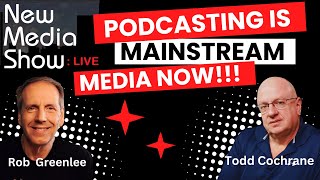
Rob Greenlee and Todd Cochrane break down how independent creators are replacing traditional media. Spotify requires 10,000 hours listened or 2,000 views to monetize, while YouTube demands 1,000 subscribers and 4,000 watch hours. Video is surging in podcasts, but bandwidth costs and platform rules keep creators fragmented.
Chapters
In the afternoon. Hey, afternoon delight with Todd and Rob Greenlee. Oh yeah.
Oh yeah, here we are, Rob. Welcome to another, another New Media Show recording. How are you?
I'm doing great, Todd. This is a very interesting time that we're all going through in the world today.
Well, I, you know, I, I think so. And it's, it's, um, I have this, this WhatsApp group that we're both in. Um, no, podcasting has not given up video.
Well, you know, that is so ironic that we're having that conversation, um, in that way, because it's like, uh, it's obvious that video has always had a role in podcasting. It's just we're just struggling over, I guess, you know, its, its prominence, I guess, at this point.
You know, as, as I said to someone, or I'm— as I made a comment, I'm like, it's not my fault.
That's right.
You know, we've supported video from nearly the beginning, and it's like it's the app's fault.
Yeah, well, it's the industry itself. We've been kind of disjointed about this whole thing of video, haven't we? And we've left the door wide open for these big proprietary platforms to dictate what's going to go on.
Yeah.
But Todd, I wanted to really talk about today too. And, and after I mention this, go ahead and say what you're going to say. But, um, I'm increasingly getting the impression— and are, are you— that, uh, podcasting and online media is, is, is the media now?
Yeah.
With the announcement of, of Comcast casting aside, you know, the, the big cable channel MSNBC, um, for declining audience, and we're seeing such a huge audience around podcasting now that dwarfs anything on cable television that I think podcasting has become mainstream media now.
Well, I still want to call it the new media.
I know. No, no, I— well, I do too. Yeah, I was going to ask you about that too. Is it— when do we drop the new part?
Well, I said maybe we are the media, as the, as the show title implies.
Yeah, before we get to change the name to it to We Are the Media.
Yeah, before we get into that, last week I talked about a podcaster with us that it had a challenge with their Apple listing, and I sent that information over to Ted, and he did a detailed analysis of what was going on. And it turns out that that show had up to 3 Apple Podcast listings, um, of which the one that the podcaster is using is the original one. So, um, yeah, because there was a moving of host and yeah, so long story, it could easily go sideways if you don't do it right. Yeah, so long story short, it, it appears that it was, um, operator error. And although there was a number of listeners that there was a show that was archived, and it was archived by the host that, um, had subscribers on it. So two of those listings did have subscribers, and one that they archived basically probably should not have been archived, and there should have been some plan to have, you know, migrated them to the correct listing. But Anyway, just so, because I saw someone in a chat say, oh, Apple's dropping listings. No, this was not the case.
Um, so I think I heard someone mention something about, um, this shift over to AI doing kind of content moderation as well as, um, cleaning up the catalog based on—
well, definitely in Spotify for sure. That's—
yeah, yeah, yeah. I think you're right, Todd. That was— that comment came about Spotify, not about Apple, right?
And, you know, and we're getting, you know, and if you're from Spotify, please listen to this. Um, they, they are just, you know, they're pitting our customers against us because they'll— we're having shows that are playing music in their episodes. Churches, a variety of different shows. And of course, the episodes and sometimes entire show is getting pulled. And then they go and ask Spotify why. And they said, well, you have to get licensing with your podcast host. And yet they don't tell them that they're not allowing everything, but why they were removed.
Yeah, it's not a disclosure.
Not a disclosure. And they're blaming us. And it's, you know, Mike, poor Mike Dell, he's had a week where he's, you know, so, you know, we've done some outreach back over to Spotify and have not gotten a response yet. But it's becoming a real, a real problem. And also offset in from when a publisher publishes an episode until when the The episode updates on Spotify is another issue. Um, and we've looked at the timing and, you know, they're pulling the feed, so we don't know why they're not updating. Uh, um, and they're pulling the feed about every— I think about every 10 minutes. So they're being pretty active in pulling feeds. So there's no reason why episodes should not be you know, are not updating over there. Um, so, uh, conspiracy, I don't know, but, you know, we've reached out to see if we can get an answer. Um, again, this is the Spotify, this isn't about Apple. Apple listings update pretty quickly now. They've, they've been very proactive. Yeah. Now, um, I can't really go into any details, and a few of you are like, oh shit, here he goes again. Um, that we were briefed this week on some stuff that's coming in from Apple that I'm pretty excited about. Um, and we're the first podcast company to get briefed on it. Then there's gonna be others, but, um, fun stuff. And, you know, I think the main thing is, is, um, Apple is continuing to be proactive. They are, they're continuing to develop, they're continuing to listen to hosts, they're listening to podcasters. So, you know, if people have this perception that they're not doing anything over there, they are. They're staying busy in Apple's way of staying busy.
And that's obviously good to hear. They're not helping themselves by being so quiet about things too.
Well, again, you know, Apple does things their way.
And yeah, they do.
And, and they always have. And sometimes they have to come out and say, hey, we need to talk to you because, you know, X, Y, and Z, and you have to prepare, whatever it may be. And, um, so from that instance, I think that, um, they're being proactive, uh, you know, so you know, on a variety of levels. And, you know, anytime I meet with any of those team members, they always listen and they always take on our suggestions. And it probably goes in a list. And I'm sure what they do is just like anything else. They weigh, you know, 5 of us or 10 of us or 15 of us ask for something. Um, it goes on a list and then they figure out their priorities and, you know, it is what it is. And, um, but again, I think going back to our conversation as we started the show today, um, in this other conversation it's having it happening in a WhatsApp group, um, we are Most— many hosts have supported video. Libsyn, Podbean, us at Blueberry.
That's about it.
I think there's a few more. Is there a few more?
Well, I know that Hubhopper kind of supports it. I don't know how many others though. I mean, do you happen to know any names of any of the platforms?
Yeah, you know, but again, we'd have to go through and compile that, right? Um, True Fans is supporting it, um, but if we go back, they're not hosting any video. No, right. And, and as I mentioned, a comment I said, listen, we were, we were hosting video when our bandwidth cost was, was 10 cents a minute. I mean, 10 cents a gig. A gig, yeah, you know. And now, you know, probably most podcast hosts are sub penny per gig, and it's still expensive. So it was a loss leader for us for a long, long time.
And it's also the expectation of, of resolution file size for video has gone up, um, probably proportional to, to that, because in the early days of video podcasting, the expectation of resolution and file size and stuff was, was a little bit less.
But, but I still put this show out at 720p on, um, which is good and bad in the big picture of things on Apple Podcasts. Well, it's, it's never been an issue, and I've always said that the long as the audio is good. Yeah, you know, but again, here's why did I put 720p for a podcast episode, RSS-based podcast. It's because of the, still, the ability now for if someone is going to use or watch on some of the, a few of the apps that support video in podcasting, including the new podcast apps at podcastapps.com, um, I have to have an experience for them that allows them to watch the video, um, and not have the, you know, the old school, the spinning wheel, spinning wheel, waiting it, waiting for it. And I know, and, and some of these other third-party services that are out there that are talking a lot about video today, the primary video consumption platforms, um, oh, we got to do 4K. Well, to be honest with you, where I'm at here right now, I'm not watching— when I get YouTube videos, they're not streaming at 4K. And the reason is my bandwidth doesn't support it. Um, so I get a, a dumbed-down— I get a 1080 or 720p version of the, um, video that YouTube is re-encoded. And yeah, sure, if you're on a fiber internet connection, And there's plenty of bandwidth for that.
Um, I'd say that the most common now is probably 1080p would be the most common.
I think a lot of YouTubers are doing 2K, 2K and 4K.
Yeah, yeah, yeah, yeah. If you're talking about, uh, the streaming platforms, yeah, I agree. I mean, 4K is, is very common.
And to be honest with you, you guys don't need to see that I didn't shave this morning, you know, and So, okay, with it, actually. Well, you know, but again, if we're in 4K, they're gonna, you know, they'll be able to see all my wrinkles. So do we— I don't really need to go to 4K, um, for a— for how I deliver this show as a podcast in an RSS feed. So, um, in, in the sense that video— and, and, you know, we've talked about this 100 times already— we have to have the app developer support it, number one. And number two, um, we have to make podcasters aware that this is possible, um, that this can be delivered via RSS. Most, most podcasters when you talk to them, um, they have nary a clue that video can be consumed on a podcast app. They just don't know. They're astounded. Their mouth drops open.
So, well, because as an industry, we haven't really promoted it. We haven't really made any visibility to it.
It's because it's not really— it's because Blueberry, Libsyn, and, and Podbean have been the primary ones supporting video. And there's, again, if we missed you, I'm sorry, but maybe you're not advertising it enough that you, you do it. So, um, hey Rick, uh, you don't— Rick just left a comment in the chat. He said on Facebook, I'm supposed to be editing my show right now, but I'm watching this instead. Rick, no need to edit. Just, you know, just put it out there, baby. Uh, and for those that don't know, Rick Savoy is a long-time podcaster. He's been around almost probably from nearly the beginning. But anyway, so we can kind of get off the, you know, it's not our fault, you know. And again, Blueberry, Libsyn, and Podbean were around many years before many of these other entrants came into the podcasting space and chose not to support video. And I, I know of one big podcast host that says, no, I'm not going to do it. They don't want to incur the cost.
It's a very big host. And actually, I, I think, I think 2 out of the top 3, um, have been very vocal that they're not going there. Um, so it's, uh, well, and I don't know, I mean, but it tells us the right choice. Is that the right choice, Todd?
Uh, it's their choice.
Oh, I know it is, but is it the the best industry choice.
I think the ship has sailed.
Um, well, I was hoping to talk about that a little bit here.
Um, you know, and again, I just have to go back to talking to podcasters on a daily basis, new podcasters, and the high majority of them, again, the 90% that are, what's the word I want to use, new, existing, ones that are not making advertising money, the ones that are doing this because they, they have a goal to reach people via, and they just don't have time. They don't have the money. They don't have the patience. They don't have the background to do video, have no desire to do video. So I would say, again, we have to remember that advertising has driven this whole narrative and it's all about advertising dollars. And it's not truly about what's in the best interest of podcasting. And yeah, you're gonna have stuff on YouTube. Yep, you're gonna have stuff on Spotify. But there's a lot of pissed off people about the way Spotify's announced what they're doing and how they're monetizing. So again, I think I'm, I'm not too stressed about it. I know where my bread is buttered, and my bread is buttered from, from audio. And we're going to continue to focus on audio while offering a video, some video alternatives. But that's— but we got to have the other— the apps want— they want to play. But if the apps have conceded, if Apple Podcasts has conceded video, if, um, then what does that leave me? I'm building video. I have video support for who?
A hint. Well, if Apple— if Apple chooses not to raise the visibility of video content on their platform, they will be— continue to be seen as an audio-only platform, and they will be put in the— I hate to say it, but kind of, kind of in the back seat of—
but again, what's happening here— but again, Rob, for a segment of listeners and a segment of creators.
Yeah, of course, but the, the energy and the buzz right now is being driven out of video. I'm hearing it every, every place that I—
okay, but again, the buzz, but the reality on the ground is—
doesn't matter what the reality is really at the bigger picture. It's what people think is the reality is what really drives—
well, again, what the real— what the reality is for us is the podcast listeners are not asking for this? I mean, podcasters, right?
Yeah, I would say that the podcast listeners and viewers are increasingly expecting it, and, and I think that the research has been clear on that. It's just, um, and I think it's, you know, Spotify's announcements, um, really raise into question about, um, the direction that they're going and how disruptive What they're doing in combination with YouTube is making on the podcast medium the traditional view of the podcast medium. I think they're in full swing of disrupting it, and it raises significant questions of, you know, what's happening here and where is it going? Not so much where it is today, but where is it going? What's the momentum? What's the trend line? That we're seeing in the market. And it's, and it's not in open RSS's favor right now. And that's, that's, that's a trend line that we've been seeing develop over a long period of time. And these big companies don't make these changes necessarily rapidly. It's kind of an evolutionary thing where they chip away at it right over a period of time. But I do think that we've reached kind of an inflection point, right, where, where Spotify has now decided to that their competitor is YouTube, right?
Right.
So that's a stake in the ground. This is the, the first or second largest podcast consumption app in the medium globally, uh, is, is Spotify. And YouTube is a completely disruptive influence on the podcasting space because they completely— we know where YouTube stands, right? Spotify is the big question, right? Is this an evolution towards more like a YouTube. And if it is, then I, I, I do think, and I know James Cridland is worried about this too, it's a significant disruption to what we understand as podcasting today.
It's, um, I, I think the mainstream audio podcast listener, nothing has changed too much.
Yeah, no, I agree. If you're an audio podcast listener, nothing is really changing. But if, if you prefer to listen sometimes and watch other times, right, then, then what we're doing is we're limiting what the viewer or the listener has in how they want to get to the content. And so we're going to make ourselves smaller is what, what's going to happen. And that's been stated on stage at Podcast Movement by Steven Bartlett, who's a big, big, you know, creator. And I think that the conversation— and Spotify signaled this at their announcement or at their event— was that they're going to change the name of their publishing platform to Spotify for Creators, not Spotify for Podcasters. So that also is a very significant shift as well.
I'm glad they're going to stop using the word podcasters. Great.
Yeah, I'm, I'm not necessarily saying it's a bad thing. I think it's, it's an obvious choice given what we're seeing in the market where content creators are thinking of themselves as content creators that do podcasting or do video. And so, you know, siloing their platform when they're moving into video to just podcasting creates a little bit of a question mark, and I don't think they want a question mark. And, and clearly I think this is— that's actually a step ahead of even YouTube, I think, in the thinking, because I don't know that YouTube thinks about their podcast publishing channels as channels for creators. I think they think of them as for podcasters.
Well, I think YouTube is just YouTube.
Yeah, they're gonna do what they're gonna do, and, and it is significantly disruptive to what a lot of us think of as podcasting.
But it's not disrupting me as a host.
No, no, that's true. At this point it's not.
Yeah, at this point it's not.
But I think he— I think part of what, what I wanted to talk about today too is it's kind of like backing up and looking at the big picture, right, of what is really going on here. And I think it's, it's really, um you know, we've seen the growth and development of all of these social media platforms, right? And that includes X, it includes LinkedIn, and includes YouTube is kind of— I don't know that I see YouTube as a social media platform, but I guess it is in a way.
Oh yeah.
But, you know, there's Pinterest, there's Snapchat, there's TikTok, there's all these, all these other platforms that are now being kind of sucked into the podcaster's purview, right? Or things that they need to think about trying to address, right? Of being a 360-degree content creator, not just a podcaster, which feels very narrow, right? Um, because it is, it's audio only, right? All these other platforms are audio and video. And so, you know, I think content creators feel under pressure right now to be 360-degree content creators. And, and I think that's being— I, I'm hearing, uh, people out there that are giving speeches or on podcasts or on video podcasts that are talking about being a content creator includes podcasting, but it includes all these other things as well. And that's what's changing the, the, the dialogue right, right now. And I think that's, that's what's got me thinking that this thinking that we have of the medium being audio only is gonna narrow us down to the point where, and then RSS is going to be kind of over time, I think, lowered or depreciated as a priority for these platforms. And they're going to be increasingly heading towards API relationships with publishing platforms versus RSS. And, and that, that will give, give them full control or I hate to say it, Todd, but direct upload.
Well, Spotify is not— never going to go to API.
Why couldn't they from a technical perspective?
They, they will go— they want you to be on their platform and publish on their platform.
Yeah. No, I— yeah, if you're thinking at that, that level, I agree with you 100%. They're going to drive their main initiatives that we've seen over the last couple of years. And, and you and I both know that when they started, when they entered this medium, they wanted to cache and rehost. It's same thing that Facebook wanted to do.
It's the same thing they still do. Yeah. With some people that submit direct.
Yeah, right. And then, you know, the, the Pandora platform wanted to cache and all this kind of stuff as well. So the industry has been fighting against this this caching and redistribution issue for many years. Yeah. And, and it feels like Spotify is now kind of crossed that threshold saying, well, YouTube got away with it, why can't we? So, you know, I think that's the part. So what can we do as an industry if we want to keep RSS? What do we have to do to keep that at the forefront? Keep people thinking about RSS as the solution here. But the problem with RSS is it doesn't play into the strategy of a proprietary platform, right? Well, they control everything.
We know that Google on the surface hates RSS.
They have all these big companies do really because, because they want to be in control and they can also see some business advantages to that too.
That's where, that's where, that's where then people need to realize that if you, if, if this is the route things go, I'm just going to be a realist, if it's the route, um, you are now no longer in control of your show. You have absolutely, you've ceded everything that we've worked over the last 20 years to ensure open and free distribution of content. It now goes back into a silo, now goes back into a walled garden. You know, we, we still weekly have YouTubers that come to us crying because they've been, they've been locked out, they've been taken down, or they've been taken down, right? And you know, they're, they put all their, all their eggs in one basket And our approach, and my approach has always been, again, distribute everywhere, distribute everywhere, but don't be a one-trick pony because in the world we live today, being a one-trick pony, sorry, that's not going to cut it no more. Yeah.
That's true.
Because they are going to— all it takes is, well, you know, remember we talked about control your own website, control your own feed? Well, Infowars, you know, I don't know.
Good example of it.
They now have potentially lost— they're back online, but they potentially are going to lose their.com. And, uh, and they will truly lose their feed. So this is a situation where, you know, they've circumvented stuff for a period of time until the bankruptcy lawyers have, you know, taken charge and getting damages for what Alex Jones said. But, um, again, uh, I just see it on a day-to-day basis where, you know, folks are reimagining what they have to do. Felix says, I've been an executive director to two recent podcasts, which I've gone with YouTube, no RSS feed, and audio with RSS. My result has been night and day. YouTube views in the millions, audio RSS in the thousands. But I think, Felix, you're going to find that is not the norm. Close to 10 million views between both podcasts. So you're really a YouTube channel. You're not a podcast. You have a successful YouTube channel. You do not have or even try to have a successful podcast.
Yeah, Todd, I think that's how the content creator needs to think about it, but I'm not sure the audience thinks like that.
Oh, I'm, I'm, I'm again, I did it. It's the, if you want to be on YouTube, be on YouTube, you're going to be a YouTuber then. And there's no way there's a lot of different kind of expectations.
That have to be worked on on YouTube if you want to be successful.
Oh, if you want to be— if you want to be— yeah, if you want to be a successful YouTuber, uh, that takes some effort. Feel free to chase that. That's, that's a rat race.
Well, it's a rat race, and it also requires a different strategy. It, it does require a different strategy around artwork. It requires a different strategy around, you know, really in a lot of ways the, the content So if you're gonna merge these things together, you, you have to be knowledgeable about what is successful on YouTube as well as what's successful on podcasting or audio and meld them together somehow so you can still grow an audience wherever you're distributing your show. But it, it's, it's not an easy thing to solve. I know I've been struggling with it for months myself. So it's, um, it's not easy.
We've been, we've been looking at the shows that are using our Vid2Pod service where they're basically, you know, they're video first and And they're automatically creating a podcast from their YouTube video. And, um, the, what we're seeing is those shows are doing great. They're doing great as podcasts. You know, they have relatively equal numbers of listeners as they do on, you know, they, they're, as a matter of fact, most of them are very surprised and they monetize from the very beginning too. So. Again, if you don't have— if you have success on YouTube, great. You know, wherever you, wherever you can build an audience, that's fantastic.
Yeah, I think that the approach that is increasingly that I'm gathering based on my research and my efforts in it, if you produce a successful YouTube, um, show, right, or channel, the principles that made that successful will probably make you successful as an audio podcaster as well. Is when my— yeah, but going from audio into YouTube is, is maybe a more difficult path.
Oh, very difficult.
Right, right. But going from YouTube to audio podcast, yeah, I think it's an easier path.
Yeah. And I think Rick is correct. And by the way, Felix, thanks for saying hello earlier in the chat. Um, Let's see here. Oh, I guess I didn't need to turn that on. He says the entire media landscape is going to be a messy one in the next couple of years.
Well, it already is messy, and it's only going to get more messy because increasingly I'm hearing that a lot of these other social media platforms, and one specific example is X, which a lot of people still call Twitter, but, um, is, is going to be adding a video tab to their user interface here.
So they've already done something because you can't find this stream, this show stream live in my Twitter feed. It's buried someplace. It's, it's somewhere else now.
Yeah, so they're basically taking that in. Yeah, I think we talked about this in last week's show, but I, I think they're taking the video and putting it into its own area so they can create—
yeah, yeah, yeah, yeah, yeah, similar type of a type of a video experience.
And I think it's going to be integrated into their Twitter OTT app or their smart TV.
Rob, also, I think you might be, you know, you're so focused on video. I think you have to also step back. And from my perspective, this is not an issue for us talking with content creators and getting customer support responses. Um, you know, folks are still primarily— and I'm sure they're looking at video, but most don't have the time or want to spend— have the extra expense in producing it.
Yeah, I think, Todd, that you've, you've made a good connection with that tool that you have of being able to take a, a video creator and port it over to easily creating an audio podcast. Yeah, I think that is a powerful connection that maybe is a little bit of an insulator to you for the impacts that are, that are, that are developing.
Again, you know, it's one of those things where people discover that tool and they're like, oh, okay, cool, that makes sense, let me just do that, it's easy, it's a no-brainer.
Yeah, I agree with you. Yeah, I think that's a tool that will have rapid adoption.
It's, it's not, it's not without challenges because YouTube, uh, You know, they basically have changed a few things.
Oh, they have on their API?
Yeah. Well, because there's a lot of people that have been using the method we were using to do that, to facilitate that.
That same thing, right? And they're cracking down on it a little bit?
A little, because what it, you know, we're a very small player. There's people out there that are doing, you know, tens and tens and thousands of, you know, pull-downs, um, and putting them on different services. So, uh, um, you know, we're just, we're just an ant in that pile. But yeah, they've made it harder, um, for sure, um, and some, you know, basically some recent API changes.
So Well, Todd, let's talk a bit about what we saw with the impact of podcasting on this past presidential election. I know that there's been some discussion on that as a catalyst for a change in perception around podcasting and around this kind of, this looming or growing or developing kind of battle between legacy media and new media, right? Um, and who's going to win in the long run, right? Um, around audience and influence.
Yeah, I think just, just naturally, let's just think about where we are today. Um, Who has a cable connect— cable, uh, I know, I know, who, who has cable TV?
What's that, right?
So it's just like radio. Yeah, we still have radio.
Oh, we should talk about radio too.
And, and let's, let's just say, who, who of young people, let's, let's say 18 to 35, of that demographic, who has a cable connection? I don't.
I think it's older, older users to have cable TV still.
Yeah. Um, like I told you, here in where I'm at, I've got 2,000 channels. I don't know how they do it, but I have a little box on my— here in my apartment. I don't— it comes as part of my rent.
Um, so you're not paying extra for, for access to that?
And I get every channel in the world.
So literally every channel in the world. Yeah.
Are you able to get— Rob Greenlee channels? Absolutely everything. Wow. Pay-per-view, 2,000 channels on this thing. Wow. And I, I— it's definitely too much. Well, no, it's definitely— someone has run— is running a very interesting service over here. It's just about that.
I see what you're saying.
You know, and again, I'm a big fan.
How many VPNs are you running, right?
Yeah. You know, I'm a big fan of paying for my own. I pay for my media. So those of you out there saying, oh, you're stealing. Well, it's just talk to the management of this building. They figured this out. And So if you think about just the change in demographics of people listening to content, my kids don't have cable television subscriptions. I haven't had for years. So what do I get? I get soundbites, you know, probably on YouTube is probably where I get mainstream media soundbites. If I go looking for it, it's, you know, 2 minutes of something or 3 minutes of something. It's the same shit that they're broadcasting. And, uh, and I will say that word liberally because most of the stuff that they're broadcasting is exactly that. And when I found my stress levels going up, the, you know, the first election were two— when, when it was that for Trump, 2000 or 2020 or what? I, I can't even— 2016. Yeah, so I, I cut out all mainstream media at that point alone. That's when I basically said, okay, I'm done.
I've had it. I was still on, I was still on cable, cable television up to like, um, 2022.
So I, I would say that politics in 2016 made me cut my cable connection, right? Really? And yeah, and I've never— because it was just causing me— I felt it was like, is just this big stress and the pandemic and everything else was going on. So, but radio, you know, I haven't listened to radio, a radio, unless I forget my phone and my phone defaults off Apple Play and forces me back on. Usually it just shows me a dead screen now. In my car. And do I, you know, if there's, if there's an actual national emergency, it used to be one of those things that you could tune into local radio and get updates. Well, they don't even do that now. So let's, you know, the decline of cable television and ABC, CBS, NBC, Fox, MSNBC, You know, what other spaghetti word? News. They've been going, they've, they've been going downhill for years anyway. And same thing with radio, just because the younger generation is digitally connected in a different way. Yeah. So, you know, so I think what you'll find is, is that of course we have become the actual media.
Yeah, I guess it was just like, uh, you know, an hourglass with sand pouring out of it, right? It was just a matter of time before we made this transition because it's a generational shift is what it is really.
And in my news feed, there's all these stories about, um, you know, people mass exit. Well, you know, also I think too, let's be frank, um, people have a lot of stuff going on in their lives. And they only have so many hours. So they said, oh, there's just been mass drop of listeners across all these networks. Well, of course, people are done with politics for at least 3 years, right? And they're tired and they don't— they've got other things to do and they want to listen to something more motivating. The world's hard out there right now, and so they want weird stuff going on, they want some different entertainment. So they've done it to themselves, number one. And news wasn't news no more. It was just entertainment. Doesn't matter which ABC, DFG.
It was entertainment.
It was slanted. So what are podcasts? And what are some stuff on YouTube channels? Well, they're doing the work. Politics aside, they're doing the work. There are some incredible interviews out there.
Incredible.
Yeah, 3-hour interviews. On the AI side, I'm listening to these top 10 people in artificial intelligence that are showing up on podcasts. Stuff that I'm interested in besides politics, which I'm not. If you, if you listen to these interviews, and I don't, again, I don't have time to watch, uh, I, yes, I watch just like everyone else, but when I want to get deep, that's where I go. I go to a podcast and, and get the long-form conversations, right? Yeah. And we did this episode on Podcast Insider, it'll come out here in a couple weeks. Talking about the difference between short and long format content. And I have people within my own company that say, I only listen to short because I only have time. I just want to get the sound bites. Whereas I don't want the sound bites, I want the extended conversation. But I think the risk we have in podcasting is if you're just going to give the sound bites don't become entertainment. Don't become what has failed, right? Have enough substantial conversation that people are actually gonna learn something and not be just entertained. But, um, but I look at some, you know, I, I, there's a real popular Um, not Rogan, but I don't know the guy's name. It's not Theo Von. Uh, there's another YouTube channel that Trump went on.
Um, is he a former military guy?
Uh, he's got black hair. Um, anyway, yeah, I saw a 5-minute behind-the-scenes of this guy's studio production. He's got a room full, 25 people that are in the back running the production for his one-person show. Yeah. And I said, this is— this, this guy is— this guy is not a podcaster. He is a— he has a show, highly produced that has got millions of dollars behind it, that—
and probably millions of viewers too.
And this is not a— what I would consider to be the run-of-the-mill content creator. Um, so if you— if you— if— and I looked at his production, I was like, I mean, it looked like a if you would have shown the image that they— I wish I'd have— see if I can find it and screenshot. Um, it looked like Fox. It looked like the control room to Fox. I mean, there was wall of monitors, there was producer stations, and I'm like, you've got to be shitting me, because do you need that many people? Well, if you have to have that many people, then there is— and I know Rogan's not the same. Rogan runs a pretty small ship of people that does his show, and I know a lot of other people do too. But when I saw this guy set up, I'm like, he is mainstream media based upon the level of production.
Yeah, I think that's the— that's really the big takeaway from this is that is that if we're going to compete with, I guess, the legacy of mainstream media in mainstream adoption and mainstream consumption and all this kind of this, I think there has to be a certain amount of content that's created in this new creator economy that achieves that level of production. And so I think we're seeing that happen in real time, and I think that's a big, a big difference between the early years of podcasting and where we see now and even the early years of YouTube.
And this guy doesn't say he has a podcast. He has some show. He doesn't call it a show.
Yeah, he calls it a show.
Right. And, you know, and he's— but again, he's got 40 people behind the scenes.
And I'm like, well, it's the same thing with Stephen Bartlett with the Diary of a CEO. He's got, he's got 50 people behind him on that show, too.
So I think when, when you have average podcaster that I consider a podcaster that is like me right now. I got a little desk here in the corner of my studio apartment, um, where I'm at currently. I've got a couple of cheap ring lights. I've got a RODECaster. I'm using Restream to restream. I'm doing my own switching. I'm, I'm doing my own captions, you know, putting those up myself. Um, this is what the majority of folks, I think, that are doing stuff on YouTube today are doing. They're just— they're a one or two man show, uh, and again, one or two men or women show, and they don't have this high cost of production like this other group did. So of course, if a politician calls me and says, hey Todd, I want to be on your show, well, they're going to have to join remotely just like you because I don't have a studio here for them to come into, right?
Or an in-person, right, type of production, right?
And I think the majority of these, um, but I, I guess the main thing I was here, I thought I'd seen this guy's content before. And here I thought that he just had this small crew. And little did I know, no, it's not a small crew. I think he's got a makeup person. You know, this is the full-blown deal. And yeah, of course you got to be doing millions of views if you're going to support that kind of a— Now, you're not going to be doing millions. You got to be doing tens of millions.
Yeah. And a lot of those guys are. You know, that's the scale that we're dealing with now because we have crossed over this threshold of importance in the online dialogue right now. It's moving away from cable television. People just aren't, they're tuning out. And the people that are listening to it or watching it are dying off quite literally.
So if you think about it from that perspective, and we've taken a long time to get here, Yeah, the 25 or 30 or 40 or 50 YouTube channels that are leading with millions of viewers. And again, there's not that many that are leading with millions of viewers, um, on a, you know, on an episode-by-episode basis. I wouldn't have a million.
Yeah, I wouldn't entirely consider them to be podcasters. I would say no, there's probably more than you think, Todd.
I think, but they still have these big, they have big teams or big productions.
So, um, to think audio is a very small part of what they do, to think, to take away.
But to think, again, we have to keep this in perspective, um, of the 400,000 or whatever it is active podcasters, audio podcasters, you know, when you have 20 people that make up this elite group of video creators, and then everyone's saying video is the way. Well, yeah, for those 20, absolutely, you know, but you have to have their video-first platform, but you have to have 10,000 hours of video and audio listening on YouTube— not on YouTube, on Spotify now— to qualify for monetization in the past month.
Yeah, 2,000, right?
Or is it 4,000? No, it's 10,000 on Spotify.
I didn't think it was that high.
Oh yeah, that was their number, was 10,000 hours in the last month to qualify for monetization on Spotify.
Hmm, I don't remember it being that high.
Yeah, go look at the pod. Uh, that was the thing that got the most pushback, whereas YouTube is 2,000 or 4,000 hours in a year.
Um, yeah, yeah, it's, um, it's currently 1,000 subscribers and I believe 2,000 hours in a year.
Yeah, so there was a subscriber count, but again, there was— it was 10,000 hours. So the majority of shows that will never get that type of reach, you know, 97% will never hit those numbers over at Spotify to be able to to earn any money. Um, so I think that, you know, the perspective is, is everyone thinks they're going to go do a video and they're going to get rich, and that's not the case. Because in the end, if you're going to spend all this time doing video Yeah, I have to look here. Let me look at the Spotify, um, streaming video.
Okay, it says on Google here that the minimum stream, um, is 1,000 streams within 12 months.
No, that's, that's not for monetization on Spotify. That's not what they announced.
Oh, oh yeah, okay, okay. I found another section that says, um, okay, it says, yeah, it says Spotify Creators platform have streamed 10,000 hours and at least 2,000, at least 2,000 unique views in a 30-day period.
In the 30-day period, where is 2,000 views in a 30, 30-day period? Right. And where YouTube for podcasters, they reduce it to 1,000 subs, 2,000 hours, where a normal YouTube channel is 1,000 subscribers, 4,000 hours in the last 365 days. And when you have the majority—
also, also published at least 12 episodes. So you have to publish at least 12 episodes before you can even qualify.
So that is, that is gonna So again, so the average podcaster that has a video on Spotify is going to earn zero.
Zero at this point, right?
That's true. That's, that's, that's an insurmountable number for most.
10. Well, if you look at— yeah, if you look at what YouTube did, um, over the last year, they used to be— I I believe 4,000 hours.
Yeah, for a regular YouTube channel, it's 4,000 hours, and then they lowered it for you for podcasters.
Yeah, and I think it was 2,000 subscribers. Yeah, was the old metric. Now it's— they cut it in half is what they did.
So yeah, not for regular YouTubers, for specifically for podcasters, they made some special deal.
Oh, did they make a—
if I remember correctly, I But anyway, but anyway, 2,000, 4,000 minutes, a lot easier to qualify to monetize. This channel here has never, ever on YouTube qualified for advertising. We've never hit that number. So yet, yet the show does.
Yeah, well, Todd, it's not, it's not something that you focused on either. It's not, it's not a prior priority for you to optimize it. To be a successful channel on that spectrum. So, you know, I've really kind of doubled down my effort on mine, and I'm, I'm, I'm monetized.
Um, did you get a check yet?
Yeah, I've gotten checks.
Yeah. What are they, $20?
Um, there are a few hundred dollars right, right now.
Oh, that ain't bad. That ain't bad.
Yeah. So, so But yeah, I mean, it's growing, so that's what I'm hoping to keep it.
So, so, you know, when people say we're chasing the money, well, and you know, you're— for most shows, again, it goes back, will Spotify give you any money? No, they won't unless you hit this, you know, massive number in a month, 10,000 hours.
Hmm. Yeah. Yeah, so, you know, there's such scale out there right now, um, that's potential, um, on all these platforms.
Well, there's, there's potential scale in podcasting too, you know.
It's, it's, it's different though, Todd, and because podcasting has a little bit more of a limited, I say, distribution reach into platforms that, um, that have that scale. So I mean, it's only Spotify and it's only, um, it's mainly Spotify and Apple, right? And those are, those are significant platforms, but those platforms typically don't do rev share, don't do—
right, right, right. You have to do your own monetization, right?
Right.
Unless you can't— unless you're hosting with Blueberry, you can get monetization from day one, right?
Right, from the host side, right? Yeah. And My, my kind of secondary concern too, and I know that, you know, others have this concern too, is that if we, if these big proprietary platforms get, become, well, become more dominant, right, and they start heading down this path of increasingly caching and rehosting, then that's going to break all these dynamic ad insertion models.
Oh yeah, break it completely, right? Because that's, it's all about money, Rob, because they want that 70 or 60% or whatever it is.
They want the sponsors to buy into your show on their platform so they get a rev share out of it, because if it's just pass-through, then they don't get a share out of that.
Did you see the, uh, the contracts that— the two contracts that were revealed in court filings from Cast Media's bankruptcy?
No, I haven't seen them. So what kind of a split were they? Were they 50/50s?
Some of them were 70/30. Um, they were structured weird. You get so much it's a certain level of number of— each deal was different. It was pretty, it was pretty interesting read. Um, guarantees, you know, and, and how much that you'll get, and, you know, for the first million downloads, and it's real money, real big.
I heard that the whole guarantee thing is a little out the window now. Yeah, that's what I keep hearing in the industry, right?
Yeah, you know, and we continue to grow, um, our, you know, I looked at the, um, the numbers come in about the 18th or something like that with us for our programmatic, and we're continuing to grow month after month, writing bigger checks, um, to a larger number of shows. So that's good. But again, if you have a small show, which majority of shows are small, yeah, um, you know, you're gonna get a a comparative amount of earnings if you choose to do that. But I think again, we have to back up and also understand that the majority of podcasts are not— don't want to monetize. They have no desire. Yeah, so it's a segment of shows that want to monetize and are focused on that. So I think we have to not forget that. And again, there's— yeah, there's lots of options. Um, that's great. There's great— it's good for the folks that are creators that there's lots of options out there.
Yeah, that's true.
That's true. Rick says, uh, I think legacy media is already lost, at least from my perspective. For example, I get most of my news now from YouTube and podcasts. Yeah, same way. And, you know, Rick's an old guy like us. Sorry, Rick.
And I think you, I think you become a little smarter and more informed about doing that, um, because you do that versus— absolutely— legacy media, right? You know, which, which has a not a less than stellar reputation.
Well, they're just, they're just extensions of political parties is all they are.
Yeah. And, but a lot of people don't realize that or don't want to accept that.
Now, some people say that about X too at this point, you know.
So, well, that's a good, that's a good lead-in to talk about what's going on with that.
Well, yeah, here's the thing, you know, people are leaving for— a million people left for whatever, Blue Sky. But, you know, here's the problem now. Did you hear what Blue Sky's got a problem with?
Oh, I'm sure they have all sorts of problems over there.
Well, now because of this influx, yeah, they're, they're, they're having, um, problems with moderation because people are reporting all kinds of content, right?
At a massive degree, I heard, right? Yes, people are, are snitching on each other over there, right?
So, so, you know So, you know, it sounds to me like you— what has happened, and don't take this the wrong way, but this mindset of wanting to censor people. Why do we want to censor speech?
Because we want to control other people.
Yeah. So it's just like people leave certain states for other states because they're tired of the property taxes and, and income taxes and everything else. And then they go to the states and then they're— then they start wanting the same policies in place, the states that they left. Right. And I'm like, right, what were you thinking? You just left— you, you left California for Texas and now you want Texas to be California?
You like California, right? Yeah, it doesn't make any sense, does it?
It doesn't, you know.
And that's been a big problem over the last couple years. Rational thinking has been a little bit on the, on the short side.
I think, you know, it's, it's across the board. It's not just one No, right, it's everywhere, right?
So it's—
yeah, so is— but anyway, now the media, is that, is that the question we're trying to answer here? Or is, um, YouTubers and podcasters and Spotifiers and whatever we're going to call them now, uh, I think I've been—
I'm increasingly looking at this from from a higher perspective, from above looking down, not so much looking at it from inside one of one part of it, right? Is that from an audience perspective, and oftentimes the audience are the creators too. So we kind of have this blending that's happening between creators and consumers of online content, right? They're oftentimes one and the same people. But, you know, there is a, a small set which has always been in the data. There's always been a small set of online users that have created the majority of the online content, right? So you have like 20% of all of the users on X or Facebook generate 80% of all of the, the content that's published on the platform, right? So you have this creators. Now granted, that's probably— I haven't seen a recent number on that, but that goes back to the early days of the social platforms where it's usually a small group of people that generate most of the content, most of the activity on the platform, right? So that's why I think X kind of moved towards this monetization model that has pretty big targets. And that's not unlike what Spotify is doing now, right, is to create these this ability to share revenue based on success. And so we're seeing this perception of the audience, right, that what's happening here is online content. And what's the first term that comes to mind when you think about online content, Todd? Is it just video or is it podcasting?
I'm old school, so it's websites and audio and video.
Okay, those are terminology, those are references that go back to traditional media, right? So as we think about the new media landscape, right, going forward, podcasting has kind of attached itself to the zeitgeist of this new form of media, right? And I'm increasingly thinking that maybe the term podcast is going to be more associated with online content. Of course. And what audiences perceive as online content, right? Yeah. And, and so, and then each of us—
Rob, it has been. Come on now.
Right. No, no. I'm just saying that it's kind of reached a, a, a point that's overcome legacy media, which is broadcast media that considers themselves to be video and television and all this kind of stuff. Right. So we've kind of moved beyond that. And podcasting as a term is going to, I think, ultimately replace those terms, um, because those networks and those platforms and stuff are going to decline to the point where they're really irrelevant. And we may be already there, and that's, that's what I'm pointing out.
Well, I think, you know, I, again, at what point— and I don't know what CNN or MSNBC or Fox numbers were, I have no idea You know, but the advantage, but the advantage, the reason they're not going to go completely away is they have the ability still at this point to be online 24 hours a day, 7 days a week. They may have rinse, wash, repeat programming every hour or every 30 minutes, but it is something where people can still today tune in to get a breaking news story, to be able to go. And that is the only advantage that they currently have over Joe Rogan or Theo Von, because they're usually a set scheduled release. They may be on for an hour a day. So what will really be impactful is if at some point in the media, new media scene, where you have collaboration, just kind of like what, what's the network that, conservative network? Daily Wire. Daily Wire. You know, so that Daily Wire could set up to be on 24 hours a day. You know, Daily Wire is big enough where they could have a series of hosts that could come in and there would be linear content 24 hours a day. I don't know.
Well, The Blaze is already doing that with Glenn Beck. I mean, he's already streaming all day long, and I know—
so he has different people that come in all day long. He's not on all day.
He does his 3 hours built networks, you know, just like Dave Ramsey has a bunch of shows. And Other folks too have a bunch of different shows that are increasingly moving towards live streaming, right, community building, and being able to be available all the time. Even like The Daily Turks is another example if you want to talk about— oh yeah, yeah, conservative or liberal side, yeah, a liberal network that's out there, yeah, which there are plenty of Actually, prior to this election, I think over the last, like, the last 8 years, liberal podcasts and liberal shows have really dominated. Yeah, yeah, yeah. The new media landscape or the podcasting landscape.
It's, it's a wonderful—
it's been the last few years that the conservatives have kind of, kind of caught up.
It's, it's, it's pretty wonderful that a And again, these are big businesses now. These are not small independent businesses, but they started from ashes. They started from nothing and built themselves up to the point where they have a huge following.
And we're actively seeing a lot of the anchors from the major news channels, right, move into them, exiting to, to start their own, um, own stuff. You know, Chris Cuomo's got his own video podcast now, and And I think, I think we heard Chris Wallace left, uh, Fox News here recently to— or CNN.
Well, you know, it's the rats are abandoning the ship.
Yeah, they are. It's, it's a sinking ship is what it is.
Um, but again, I think that they're, you know, it's just like radio. Um, you know, they're going to be— you and I saw a Facebook. You commented on a Facebook thread and I commented on a Facebook thread. Matter of fact, I think your comment was removed from that Facebook thread. Oh really? Yeah, because I— it reappeared in my— and I was trying to— it was basically someone that said they're leaving X and they're, you know, what do you think about that? And we both, you know, going over to, to Blue Sky.
Yeah, I got involved in a conversation with those folks about that. Their thinking on that, right? Why are they leaving X when X is the global community square of topics and stuff? I mean, it is, it is kind of similar to people that are exiting X maybe to go over to Truth Social.
But the thing on X though is I see, I see, uh, right giving it as hard as left is giving. Oh yeah. Oh, and it's—
and what's, what, what's wrong with that? I mean, I mean, that's what this whole country is all about, is talking about the important issues of our country, not running to our sides and pretending like the other side doesn't exist.
Yeah, yeah, right. Yeah. So, you know, I may not like what someone has to say, but at least I can see what they say.
Yeah, you can say it and, and, and you can have a lively debate about it. But the problem is now we, we've seen people that, that even question one side are, are attacked, you know, for having a different opinion and demonized.
That's been going on for a while now, right?
You know, and that's what needs to stop, is so people need to, need to talk.
That's— I, I attribute that to why the election happened the way the election happened. People were not willing to vocalize what they truly thought because they're scared. They're scared of being— yeah, being fired, being ridiculed at work, whatever it may be.
Yeah, and I think that had an impact on the polls too.
Oh yeah, because who people call you, who you're voting for—
well, if you're scared or they lied, exactly. Or if you're scared to say who you're going to vote for. And then the Democrats on their side were, were shaming women to go into the voting booth and, and, and, and vote for the, the other party if even if your husband wanted you to vote for somebody else and just don't tell them that, you know, to be honest with you, can you imagine?
Oh, that is so—
it's just really, really messed up is what it is.
No, Shoko couldn't vote because she was a green card holder, never became naturalized. I can imagine if she had been able to vote, for me to tell her who to vote for, and that would have taught—
in some states she probably could have voted.
That went over like a fart in church, you know. There'd have been a bit of a dispute, um, you know. Well, we know where Hawaii stands, so Well, but, but I'm just saying, you know, good luck telling anybody. If even— okay. Oh, so much.
I know. Yeah, yeah, I think that's the word. Is it?
Okay, so it's—
I'm using a word that's outside my vocabulary, so I'm gonna be careful here, right? We have to be careful, but, um But yeah, I mean, I think increasingly we shouldn't have to be so careful. I think—
well, I think in podcasts, that's the beauty of podcasts. But again, we're in it. We are in a time, um, where your words can have consequences. So I think people have been—
yeah, I think we've always had that, even in the the ears of more free speech, right?
It's just like this show. We delved into some, you know, we normally never ever talk about politics here. And the thing is, I want people to understand is we're not picking sides. I don't want to pick sides. I want to make sure that we're talking about the dialogue of what's possible to share in podcasting, you know. So it's not that we're, we're picking winners or losers here. It's just about the conversation about what's happened because of the conversation that happened in the election.
So yeah, I know I'm in favor of the Constitution, if that tells you anything.
Well, I spent 25 years in the Navy, and you know, I've— I'm a very— and Blueberry is a very, um, pro-free speech company. It's fundamental. It's part of our, I guess you would say, our charter. And that's why I can say very proudly that probably in the 19 years we've been in business, there's probably less than 20 shows we've ever had to remove from the network. And it was because of something really bad, right? You know, um, you know, the threat of, uh, murder, the threat of, um, I mean, just really heinous stuff. Um, but I'm not going to remove someone for an opinion, right? Stating an opinion, as long as you don't invoke violence on somebody, it's okay to have an opinion.
Yeah, and, and I think a lot of people need to become more educated about what the First Amendment actually says and also what the, what the legal restrictions on speech, um, will exist, right?
Depending if you live in the UK or not, uh, but if you're in the United States, um, you know, it goes back to the Infowars thing. If you, you can say what you want to say But your words can have consequences if you say stuff that can be found in a court of law that you have, um, you've, you've made something that someone has a case against you and you can lose money, your livelihood, um, that goes along with it.
So you'll be sued for a billion dollars, right?
You can. And I think that, you know, that's an edge case.
Yeah. But it's a good example, though. It's a good example.
But it's, you know, and here's where, you know, the bigger challenge really, and if we go back to this, is you don't have free speech on YouTube. You don't have free speech on Spotify. You have to watch your words on those platforms.
And you don't always know what they are censoring either. That's right. That's, that's the insidious part of it too. Um, and it's easy to wade into waters that you don't realize you're wading into, and then you find out later that your show's been taken down or it's been demonetized or—
right. And you do have free speech in podcasting, so I, I will, I will contend all this push to demonize, um, RSS by, by two companies specifically. Um, they are not your friends. They are not your— they, they are not a friend to creators. They are a friend to shows that they have advertising in. Uh, right.
But if you're a big creator, you're gonna fall under the purview of brand suitability and safety platforms.
Well, Actually, you'll get bigger pass. Look at Rogan, you know, he, he's gotten a pass and stuff he said that other— he would have got shut down otherwise. So I think that because there's people making too much money to— that's right, it's all about to shut him up. It's all about the money. And, um, so again, you may not think your content is fringe. But all you gotta say is one thing, just one thing wrong, and boom, you're done. Or there's a change of policy in the company, the type of content you're creating is no longer wanted. Yeah, um, right or left, or by topic, and that might not even be political. It might just— you know, you look at the demonetization of the Second Amendment, um, conversation, right? Right. Um, so a lot of videos for people that have Second Amendment shows have been demonetized and driven down. So a lot of those shows had to go find new homes.
And just to be clear about it too, um, there are no free speech requirements, legal requirements that are applicable to a private platform. So the— right, I went through and I read it. The First Amendment really applies to government putting their thumb on speech, not on— it's to prevent private platforms.
Yeah, it's to prevent them from suppressing free speech, right?
It's the government from doing it, which is what we saw with the Twitter Files, where the government was— yeah, was in the process of censoring and shadowbanning people through a portal, right? That is against First Amendment, right?
And to me, that story didn't get enough juice behind it. Most people didn't realize the how bad that really, really was. So whereas in podcasting today, and again, you controlling your RSS feed on your own dot-com, you can be assured, yeah, maybe you have— maybe you will not reach a million people like YouTube, but you can say what you want to say.
But there's something— yeah, you don't even know. So let's say you put up a piece of content on some of these platforms that maybe is, you know, right on the edge, right, of talking about a topic that may be sensitive. Um, they can easily suppress that. And because Elon has said this many times, even on Twitter X, is that you're free to say something, but you're not free to get anybody to see it. So that could be a little bit of the insidious things that are going on, is that is that you may put up a terrific video or you might put up a terrific piece of content and, you know, you get 2 or 3 views. Well, maybe that was because it was algorithmically suppressed.
But Rob, I think in the end here we have to also be very, very clear. Audio podcasting is very healthy right now from an audience standpoint, you know.
Yeah, the audience is still growing. It's still growing. It's still big. I mean, if you look at Even like Joe Rogan's numbers, he's probably getting more audio listens than he is video still.
But we've always been— I guess we've always been the bastard child of content creation as it, as it continues, right, Todd?
Is that what you're saying?
Yeah, it's in the beginning we were, oh, podcasting is nothing, right? Right. As we've been talked down to for years.
That's certainly the opinion of the, of the big radio companies for many years, right? I mean, you know, I both have been at those conferences. We know exactly where we, we are.
We're in a radio conference and, you know, the podcasting session comes out and 180 people walk out and get a drink and there's 10 people left to talk to, you know. And, and you're— and you get, you get the down— look down the nose at you. Oh, what do you do? I'm a podcaster.
Oh.
Yeah. You know, and now that's changed. Radio has kind of figured it out that, you know, they got to do something.
But yeah, that's a whole—
and not to bash radio, but you know, it served a purpose. But now through consolidation and, you know, you might get 2 hours of local drive if you live in a big metropolitan area. You live where I live, you get syndicated.
I'm— I don't know about Utah, but I'm hearing a lot of just disenchantment with the radio industry right now, uh, publicly, um, with all sorts of people that have been many years in the radio industry are really kind of like, okay, we're getting close to the end here.
Uh, you know, I don't know about that. We've been saying radio is going to end for 20 years, Rob.
Well, no, I'm not saying it's going to end. I'm just saying that there's a lot of people that were in the industry that have now been either pushed out, fired, let go. There's continuing, you know, it's been a— the audience has not been falling off like a, off a cliff. It's been going a little bit down, a little bit down, a little bit down over a long period of time, as well as podcasting has gone up a little bit at a time and a little bit of time over a long period of time. So they've been kind of inverse with each other. Yeah, and I think we're getting to a point where it's— I think we're— I think podcasting is crossing over with radio audience levels now. I haven't seen a recent study on that. I don't know if you have, Todd.
Well, I think the Edison stuff still shows that more people are listening to radio than they are to podcasts.
Yeah, but are they counting music stations and they're counting sports broadcasts? Are they counting you know, all this live event stuff? Are they— I mean, I mean, is the bucket that they're counting so much different than talk content?
Because there's— because podcasting is all talk.
Yeah, so you have to compare talk programming to radio talk programming, and I think if you do that, then I think it creates a little bit of a different dynamic if you leave out FM 100, Rock 100.
Yeah, that maybe has 2 hours of drive, which you'd have to include. Yeah, because that's essentially talk, but it's still, you know, still music playing.
And a lot of those music stations, though, they don't really do any talk programming anymore. It's all just—
well, I think that they're a big station in a big metropolitan area. They usually have drive. They have the morning show.
Oh, like a, like a zoo kind of a—
yeah, you know, personality, personality does the morning show. And it— but again, it has to be a big enough metropolitan area to support.
Yeah, and it's probably syndicated too, probably.
Sometimes they are. Yeah. And, uh, but again, like a city like Chicago, it has a number of stations, has a big enough metropolitan area where they have, you know, they're given the the update highway reports.
So yeah, Todd, did you see the, the statistics that were put in Pod News? Thank you, James Kurland, for this. This took some research on his part, but, uh, how bad is pod fade? Oh yeah, yeah, yeah, yeah. So Pod News, uh, suggests that, um, of 24,464 podcasts— so about 25,000 podcasts started in January of 2024, so at the beginning of the year Yep. Um, the calculation— this is, I think, is pulled from the Podcast Index, I believe. Um, it said 7,300 or 7,400 shows, or 30%, haven't posted a new episode since the end of January. So they started, went for 30 days. Yeah. So 30% of those shows that started in January have this year, um, stopped. Yeah, at the end of February. Yep. So, and, and I guess if you go across, um, the, the board here, it's like 22.7% of shows started on Spotify for creators in, in January haven't posted a, uh, so almost 23% of the shows that started on Spotify didn't post a new episode after February. And then I think it looks like Asha had 20%, Megaphone had 18.9%, Podbean had 12.6%, and Lipson had 12.3%.
So, so it— and what you should do, James, is run that across number of episodes. Don't look at time. Look at the number of episodes created before the show quit.
Yeah. And then the other kind of data point here too is that the well-publicized free podcast hosting plans, right? And the platforms that have the most of those, right, is Spreaker is number 1 with 40% of their shows didn't publish a new episode after 30 days. And then RSS, 71%, and HubHopper, 83%.
So that's not surprising, those numbers at all.
Yeah, those are newer podcasters, right, is who we're talking about here. So, you know, back in at the early beginning of the year, January is a typical kind of like, um, you know, New Year's resolution kind of time frame, right? Where people say, well, I'm going to start a podcast for the new year, and, and then they fizzle out by the end of February.
Well, the— we had a big bump, um, the 2 weeks— well, the previous 2 weeks following the election, we've seen a big, a big surge and new, and new, uh, new account creations. I haven't went in and looked at the the types yet. I was— I still have that as a task to do. But, um, we know that from a listener standpoint, starting around December 15th, um, through January 30th, that's your biggest time to pick up new subscribers.
It's the New Year's resolution.
Yeah, because people are cleaning out their phones, got new phones. They're, you know, they basically are looking for new content. Um, they're looking for new types of content. They may— again, I think it probably is directly related to New Year's resolutions to an extent, but I also think it's because people get downtime during the holidays and they are just, you know, kind of housecleaning and looking for new stuff. So I think that is as a big part of it as anything else. So, um, don't stop creating content during the holidays.
Yeah, exactly. Oh, also, I wanted to mention too, for those that are maybe looking at launching a podcast between now and the new year, um, that there is potential delays with Apple Podcasts on processing a new submission around like the key holidays.
So like they announced they announced their dates already.
Yeah, yeah. So just want to let everybody know that too. If you're trying to launch your show right before Thanksgiving or something like that, you're probably not going to get in until after Thanksgiving.
Yeah, Rick says Christmas. Rick says the attrition is a good reason for the rest of us to keep on podcasting. Yes, I absolutely, uh, agree. And by the way, um, I've got a Black Friday sale announcement that's just popped up here in Restream. It said 50% off only this Black Friday. So any of you that have a monthly subscription with Restream, it would be a great time to convert that to an annual, um, save some money and save some money. And I did. I had a monthly subscription and, uh, I upgraded, uh, a little bit and then saved myself $196 for the whole year, which is a big— was big, you know, big, big savings.
So yeah, so keep an eye out. Oh, go ahead, finish your thought.
Yeah, just keep an eye out for those, those types of deals.
Yeah. Well, Todd, I think we reached the bottom of the hour.
So we did, we did. And I'm going to put this in the can and I'm going to go back to sleep. Okay, this is my normal sleep time.
Um, oh, okay.
All right. Yeah, because typically I try to sleep to about 1, and yeah, so yeah, this getting up in the middle of my sleep cycle sucks, but it is what it is.
It's only a couple times a week, right, that you're doing that?
Yeah, 3 times a week, so it might as well be the whole week. But, um, one thing is good though is, uh, 85 degrees and beautiful and Humidity's down.
Oh wow, that's—
yeah, so for those of you that are, uh, starting to, you know, get chilly, uh, there are warm places on the planet to be.
Well, it's been warm in Connecticut the last—
yeah, that's what I've heard. It's been a warm fall.
Yeah, it's been sunny and blue sky every day.
So Rob, uh, give them your, uh, your info.
Well, I'm on all the social platforms, uh, as you might expect. And it's mostly under the name Rob Greenlee, so you can find me anywhere out there. So, and if you want to send Todd and I an email, you can send one to me, robgreenlee@gmail.com. We'll get an email to me, and we'd love to hear from you and get your feedback on some of the topics that we've covered on the show. And, you know, it's a little bit of a check-in about how we're doing too. So, feel free to share your thoughts because we are a free speech show here.
That's right. And of course, I'm Todd at blueberry.com, @geeknews on X. I'm @geeknews at geeknews.chat on Mastodon. And of course, if you want to follow the show on X, it's @nmspodcast. Of course, we're at newmediashow.com, so go over there and subscribe, follow, or subscribe to the show.
And yeah, all, all the old episodes are there too, so you can check them out.
But you know, we're going to get bashed again for all this, uh, political and YouTube talk today. We're going to get hate email again.
Well, hopefully that'll die down a little bit here, Todd.
Yeah, I would, I would think so. So, uh, what say you? What is your plans in your podcasting journey? We'd love to hear from you. For those who've been watching live, and Rick and Felix and everyone else that sent comments, thanks so much. And if you were in the middle of editing something, um, oh, some— I didn't look at the, uh, someone says politics, arg. Uh, Chad F says, was it Patrick Bet-David? Yeah, that's who it was.
That was the YouTuber. Yeah, he's got a huge channel.
Yeah, yeah. Well, he He's the guy that had a studio that was like a news production studio. I mean, in a big, big-ass room.
So yeah, he actually— yes, you, you must be talking about the event he did for the election because he had Trump on. Oh, oh, in his normal studio, is that what you're saying?
Yeah, he had him on.
Or the live election coverage thing that he did.
Oh, maybe. Let me look at this. I Patrick Bet-David.
Yeah, he's—
yeah, let me— yeah, that's the dude. So go look at this. There's a short out there that he talks about the process of— it's a YouTube short— a pro— the process of the interview and the secrecy of having Trump come in. In that video, you will see his studio. And, um, that's where I was like, well, this, this dude's not just a small operation. This is, this is a, this looks like mainstream media operations. So, and that was right, I was trying to make—
yeah, the other, um, podcast to watch too is the All In podcast. Um, that show isn't shy to stray into politics, but they kind of have both sides covered, so Yeah, it's an interesting program.
So again, we weren't talking about politics, we're talking about podcasting and the effect it has had in politics. So, right, yeah, so please, you know, understand. Yeah, anything that rises—
people are a little hyper, hypersensitive to talking about anything related to podcasting. The problem is, is that, um, or politics— the only problem is, is that politics has infiltrated itself into everything. So yeah, you could make the case talking about anything, uh, is tangential to, uh, talking about politics.
Yeah. So anyway, Chad F., thanks for that. And, uh, yeah, we'll— everyone will say— and Alessandro says, hey guys, remember your CES 2008 video? Yes, we— I'm not going to CES this year, first time in 18 years or something.
Oh, that's right.
Yeah, yeah. So, all right, everyone, thanks. We'll see you back. Well, Rob, it'll be Thanksgiving for me next show. Are you good with skipping next week?
Yeah, I'm all right with that.
All right, awesome. So we'll be back with you guys in 2 weeks, or Rob, if he decides to do something on his own, he can.
Yeah, in December or something like that, right?
Yeah, so it would be—
It's the 4th.
Let me look here. Yeah, yeah, and actually it'll be a good time because I can talk about my new hires start next week, so, um, should be— I might have an update on how that progress went. But okay, all right, all right, we'll talk to you later.
Bye-bye. Okay, bye.
More from Rob

Future-proofing with Delphi AI/Human clones: your podcast as a personal LLM | New Media Show






How sports reveal what AI spectacle gets wrong #Technology #Sports #Commentary



