Is Massive Ad Revenue Growth in Podcasting Possible? | New Media Show Live 5/15/23
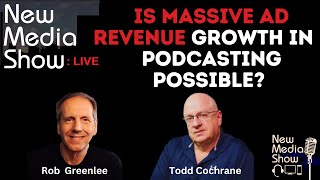
Todd Cochran and Rob Greenlee examine why podcast ad revenue forecasts keep missing the mark. U.S. podcast ad revenue sits just under $2 billion with only 5% growth in 2023, far below industry projections of $5-6 billion. They argue massive growth is unlikely without moving beyond traditional advertising to broader creator monetization.
Chapters
Welcome to the New Media Show, where each Wednesday at 3 PM Eastern, UTC+4, Todd Cochran and Rob Greenlee take their over 30 combined years of leadership in the podcasting space to discuss, dissect, and deconstruct the current podcasting news, forecasts, trends, and predictions. Now here are your hosts, Academy of Podcasting Hall of Famers, Todd Cochran and Rob Greenlee.
And here we are, we're back with the New Media Show. I am back from 40 hours, 45 hours, a round trip travel to the Philippines and back.
And I didn't.
And, and, uh, poor Chris from Podfest, he, uh he had major delays. He arrived 6 AM the morning before the event after having missed a flight and got rerouted over God knows where. And at the end of the day of the event, he was like a stick of pork hitting— you could tell he was a little punchy. But, uh, this is why when you travel international, you leave at least a minimum a minimum of one day early because, yeah, that helps. It's like if you're going from Detroit to LA, there's, there's four flights that day. But if you're going from LA to the Philippines, there's one, right? You know, one shot, one or two, you maybe, you know, and you know, you want to get rerouted, good luck.
And it sounds like the old days when there was a lot of flights flying everywhere. There's been a lot of trimming of flights.
Yeah, I was in Chicago and had a 3.5 layover. We got on the airplane and got delayed because of weather. And I'm watching my watch and about 2 hours, I'm like, uh-oh, my 3-hour window went to an hour. So when we landed in San Francisco, I basically had enough time to go to the bathroom. Refill my water jug and board. So yeah, I had a tight connection. So yeah, it's just, you never know. This time it's not snow, it's lightning. But anyway, got in early and enjoyed, enjoyed having a local vivation, a San Miguel and San Miguel Light and Tandelay Rum. And yeah, I had It was fantastic.
Um, all right, and when— then you're off to London here?
Yeah, Saturday. Saturday.
Saturday, later this week.
Yeah. So I tell you, Rob, um, it's a repeat of kind of what I learned in Saudi, but here's really the skinny.
Oh, of Asia?
Yeah, in Asia, podcast. There, there was If— okay, how do I say this nicely? They are in love and bow and walk and spread petals on the ground for Spotify.
Yeah, I think it makes sense to some degree the more I think about it.
And Ted and Apple, you guys need to listen. You need to listen. You have—
Get on Android.
You have given up that market.
Right.
Because 90% of the people that were in the room had Android.
Don't have Apple.
Yeah. And I asked another— I basically asked why, and basically they said that the reason that Apple gets no love is because they do nothing for the community. Um, but then again, I asked, well, what does Spotify do for you? And are they putting money in your pocket? What, what's, what's the, what's the, you know what? And it really isn't. It's just a lot of moral support.
Well, that, and plus they're probably seen as much more visible. Those markets because of Android.
Yeah, because of Android. Absolutely. So not so Google again, because they don't have a native podcast app. Um, Spotify wins by default.
And let's actually dive into that a little bit because what if Apple did have an app? Are people even inclined in those markets to even think of Apple? Spotify in those markets right now?
Well, because Apple is like— they don't see any exposure besides— they just be— besides the emails that Apple gives. So I, you know, I would assume that they're— and I didn't load my App Store while I was there. I didn't load the podcast app to see if there was a curated Filipino podcast list. Or not. Um, and maybe, you know, maybe someone over there at Apple that's listening can send me an email and say, do you guys do curated lists for each of those countries? I thought they did, but, um, I mean, it was, it was pretty evident. But besides that and the, the, the feedback, um, well, basically they had a lot of presenters and they had a group up there that were talking about networks and it was a really good panel. I mean, it was like something I would hear in the— here in the United States, but they kept dodging around the money and from an advertising standpoint. So me being me, when they got done, I got them cornered and I'm like, hey, what's, what's the big secret? About money. They said, oh, there's no secret. I'm like, well, you know, you would never respond what the CPMs were. And what it is, is there is no local advertising. In other words, Philippines companies are not advertising in podcasts. The advertising that are— they're getting in podcasts are from national companies, and they're working with And I'm not going to say the hosting provider, but they're working with a certain well-known hosting provider— not hosting, but yes, hosting provider— that are providing ads for their network. So the networks are actually not on Spotify, they're on another network, and the network is feeding them global advertising. So, and they're getting CPMs that you would expect $20, $25 CPMs. But the, you know, the— that again is for that top tier of shows.
And so you're saying that they aren't hosting on Spotify, they're hosting on another platform?
Yeah, they're hosting another platform original. Yeah. And this is for those that are in part of a network, and there is some investment going on in show development I could never get him pinned down what that type of number looked like, uh, from a dollar standpoint. But overall, uh, probably around 200 to 225 total attendance. There was probably 30 to 40 VA— there was a lot of editors there, a lot of people that were involved in doing editing. In other words, they were, they were editing other shows, US, UK, Australian-based shows. So there was a lot of those people there. So those were some interesting conversations because an opportunity to get them to help, you know, I basically said, listen, you know, you look at what we have over here. It was, it was, it was a, you know, pretty good day. Now, be honest with you. The, uh, Chris had hooked up with, um, in fact, a good friend of mine. It's in Cincinnati. Her name is Aya. And it turns out that Aya's brother is a big muckety-muck in the quote-unquote true media business in the Philippines, uh, SunStar. And I think I'm gonna— if I pronounce it, and if I got it wrong, I've done it twice, I better make sure I'm saying the right company name. Um, so her brother was actually, uh, let me go here. Let me load this. Come on, come on, come on, website. Why are we not loading? Yeah, it'll get it here. And then, but there was a Philippine senator that came. Now, you know, if you think about American politics, we have 50 senators. In the Philippines, there's only 12. And one of— yeah, Sunstar's the company and the MGS Global Group. So Sunstar— I mean, this Philippine senator came in and her and I got to talk for probably an hour kind of off the side, had a great conversation. But it was like the water spread, you know, when she walked in the building, you know, that was like the, the locals there were all getting around her getting selfies. It was just like a you know, like a major celebrity showing up to an event. Um, and, uh, very well— I, I had a really good conversation with her and just talking about, you know, what we can do for media and having voices heard in the Philippines. She's a big women's advocate for healthcare and a variety of topics that are a little bit controversial in the Philippines. She's on a I guess you would say she's on the liberal slant in the country, part of the minority legislature, but she's been a big advocate for women for many years and she has some great stories. And I was just like, you know, you could be the catalyst to help some of these stories come out that need to be told. High, you know, high, high amount of single women with in the Philippines with children, uh, just these types of healthcare issues, the whole nine yards, things that could be fabulous for a podcast series to be talked about to, you know, help these voices to be heard. So we had a good, good discussion, uh, about that. This event was held— now, if anyone is ever traveling in the Philippines, if you're looking for a co-working location, KMC is the name of the coworking location. I walked in this place, I was like, am I in New York City? I mean, it was beautiful, beautiful facility. You know, ping pong table in the back, you know, water, just the whole nine yards in private working groups. Matter of fact, one of the coworking locations, I saw Johnson Johnson in the back left-hand corner of the building. So there was companies that had coworking spaces in there. Great, great, great venue. And they're all over the Philippines. So if anyone's ever going to the Philippines and needs a coworking space, KMC is the way to go. And then Podcast Network Asia, Ron and his team. So, you know, I was, I was duly impressed. They did a good job for an inaugural event.
So what did you pick up around what the activity level is of podcasting in that market? And where would you position it in the context of the United States? Are they like 5 years behind, do you think? Are they a couple of years behind?
Or I don't think—
where are they in the ecosystem of what we've seen happen here in the United States?
I don't think— I don't think they're anywhere behind. Oh, you don't? From a messaging knowledge information standpoint, the words coming out of the, the local Filipinos' dialogue is what I would expect to hear at a, at a U.S. conference. So the knowledge level, at least at that level, to me sounded, you know, there was nothing. I didn't shake my head. You know, for me, I can be at U.S. conference. I'm like, oh no. And then there was— I heard none of that. There was no super hyping. There was no— everyone was very humble. No, there was no— and people were— notebooks were out. People were scribbling and very attentive audience and listening and taking notes and asking fabulous questions. Not dumb questions. I mean, asking fabulous questions. Like something— I was actually surprised. I didn't hear a— because sometimes people ask a question event, you're kind of like, oh really? But there was not a— there was high, high-level questions being asked. So no, no. And you know, here's the thing too, the whole country speaks English. So there is— they— there is no— what's the best way to describe it? There's no language barrier. So they're listening to all these podcasts. They're listening. Matter of fact, a couple of people came and said, hey, we listen to your podcast. We don't like you— like it so much you and Rob fight, but you know, uh, and I'm like, we don't fight, we just, you know, we just jostle. So there's people that are there that were listening to the show, um, this show. And so I, I was— I mean, I was pretty blown away. And, and to be honest with you, I think there's opportunities there.
Um, yeah, but you had mentioned, uh, that you didn't get a sense that the kind of monetization, um, had reached the same level of where we're at here, or is it just the economy, or I mean, what do you attribute that?
Well, the advertising piece is, for those that are monetized, I think they're monetized to about the same level as we are here in the United States. There was a little hemming and hawing, a little bit. So maybe inventory is not as high. Yeah, but, you know, during my presentation I talked about, hey, listen, it's, you know, the money's not everything. I talk about value for value. I talked about, you know, the, you know, the, this, a strategy, um, that they should be looking at, um, So, you know, my approach to talking about video, because video is big there, my approach to talking about video— there was, there was regular podcasters there that had been in the biz for a long time that were from outside of the Philippines that come in to speak that did not know Apple Podcasts supported video podcasts. They did not know. I had a slide up that showed my show on Apple Podcasts playing in, and people were coming. That's possible. They had no— so, you know. Yeah. So it was that kind of a thing. And, you know, and I basically went back to the strategy of that. We have to have— there has to be a— oh, it's just simple. We don't care where they listen as long as they listen or watch. And as long as they adapt that, but they shouldn't adapt one over the other. You know, they should, there should be a, there should be a, you know, you should consider both. But most of the folks there were not actually the folks I talked to that were doing media were mostly audio. And they felt like they were being forced to do video and were kind of hesitant to do video, which was curious. But it was not creator heavy. It was network leaders. It was VAs. It was, it was industry people. So I didn't get to talk to a lot of actual one-on-ones with creators, with podcasters. Okay. Yeah. So it was, it was all upper echelon folks that were there. And I am hoping that if this comes to be a repeat in the following year, that they're able to bring in more creators. Um, and I think, to be honest with you, is there's going to have to be some sponsorship of creators coming to the event because the cost of the event was definitely very high from someone that would be a hobbyist. They would not be making any money from their show. Someone's creating it for passion for them to come. Um, And I also was too, as I was like, okay, how is Blueberry's price point from a hosting standpoint? Well, you know, would you, based on our features, pay the amount that we charge for hosting over using Spotify for free? And almost to a person, they said we would use Blueberry. The pricing didn't scare them because they were understanding the value of, of open RSS, the value of building your brand. They really believe in that more. I was pretty shocked. They're like, you know, everyone has their own website for their own shows. You know, there was nary a person I talked to that was just sitting over on Spotify with, with a show. So, but it is It is curious, um, the love affair that people have with Spotify. It was, it was very, very evident, you know. They didn't want to talk to Todd, they wanted to, you know, talk to the Spotify guy. So, which is, you know, it's fine.
Was, was Spotify there?
Yeah, and one of the Spotify reps was there. Yeah, he came in from Singapore. Oh, okay. So, but again, uh, their team did good. Ron and his partner, uh, running— not partner, but is not his physical partner, but his business partner, um, did a great job in hosting.
And yeah, so we've seen, I think over the last week we've heard, right? I think we've heard that, um Apple is maybe in some of the surveys or the data, at least that came out of Buzzsprout, I believe, was showing that Apple has now lost the lead. I'm not sure why that is, but that's been kind of the trend with Buzzsprout anyway for a while now, that Apple has kind of lost that lead to Spotify. I don't know Todd, if you've seen the numbers in your platform—
Yeah, I'm pulling them up right now.
Is Spotify gaining on Apple's market share?
For us, no. As a matter of fact, Spotify for us is— okay, so we're at 53.48% for Apple. Believe it or not, Chrome mobile and desktop is 11%, which is nuts. Apple Other, which would be Apple Core Media, 6.34%. Other Android apps, 4.25%. Overcast, 2.36%. Podcast Addict, 2.29%. Castbox, 2.07%. Spotify iOS/Android for us is 1.95%. That's a 337 million sample. But again, it goes back to what are my top categories: business, education, news, religion, and tech. Those are my— those are my top 5 customer categories. Those are not categories that are doing well on Spotify, just from a consumption standpoint.
Hmm. Does that concern you at all, Todd?
No, it doesn't, because I think if— I think Buzzsprout should publish our top 5 categories of customers, and then we could see if there's a split. I attest this to— I attest this low number for us with Spotify because of the type of content. We have a huge, huge number of religious shows. Huge. So I don't think they would be I don't think they would be consumed on Spotify. I don't think people that are on Spotify listen to a Christian podcast or a Muslim podcast or whatever it may be.
Okay, so you think that that distinction between the numbers between Buzzsprout and Blueberry are based on the type of content and maybe the content creators, who they are, right?
I think so. That's my only— That's my hypothesis, you know, because if I look at the business alone, then that number jumps back up. We're at 5, 6% for business alone, education 4.5, 5, you know, but when religion is essentially zero on Spotify, then that just sucks the average way down. Education, almost zero. Sucks the, sucks the, uh, the other categories a little higher, pulls, pulls the life out of them.
Yeah, it'd be interesting to know for a fact on an industry-wide basis how Spotify stacks up against Apple. Um, not so much based on data that's coming off of one hosting platform, which is I think what we're primarily doing right now is looking at real data from like Buzzsprout or Lipson, or because I think even Lipson has been showing an increase in Spotify, right?
And I think they're 8, 9, 10% or something like that. So yeah, but again, you know, my— our top countries, the United States has flown fell below 50% of all of our listening group. So, which is interesting itself, you think that as far as countries, countries go. So you would think that that would drive the Spotify numbers up because of us having, uh, you know, less than half of our customer listeners are coming out of the United States. Yeah, UK makes up about 6%, Canada 5.5%. And then we got, you know, this weird outlier in Nigeria, which, you know, it's because of specifically two shows that have literally, you know, 20 million listeners in Nigeria or whatever the number is, totally every month.
So as we look at what we're seeing here, um, it points to a couple of things for me anyway, just kind of big picture, and it may not be as as big of an issue as maybe it may seem. Um, but Apple may be losing some momentum in the market, um, to some degree, really kind of maybe based on their, their decisions or lack of choices to move forward on, you know, like maybe they're behind the curve on exposing the availability of video podcasts on their platform. I, I don't, I mean, they took that, and I think we talked about it in the last episode too, but they took that, that, um, ability to, to see those, uh, actually in the navigation.
And hence the shock by people that are in the mainstream were shocked at, oh, you can do video on Apple?
Yeah. No, I mean, it's the same reaction I see all the time when I talk about it too. Yeah. It's just like, well, you can watch a video in the Apple Podcasts app. It's like, right, that's been there all along. But the problem is, is Apple has suppressed it. Yeah. And that has had an impact on the market. I don't know if Apple really wants that impact, especially now, to, to be there. And are they willing to make a change here? It's not a huge change for them to, to pull up the ability to throttle back and forth between seeing the video that's in there and seeing the audio.
That's in there. If they want to compete with Spotify outside of the United States, though, especially in the Arab world and in Asia, they need to be— they need to have an app on Android. They have to.
That's my— yeah, but my bigger question even on that is, is that— is it too late?
Maybe, because, you know, when they get an Android phone now— because I asked, I said, did you have to install Spotify or was it come pre-installed on your Android device? Oh, it's pre-installed. And of course, they're, they're not all carrying Android devices. And here's another thing that, that Spotify and Facebook do is, okay, so here in the United States, we're all on a data plan, right? Right. We pay, you know, whatever exorbitant fee we pay every month. Flat rate. It's a flat rate. There is, it's load. So, okay, so anyone that's in like the rural area they have something called peso Wi-Fi. So for like 5 pesos, they get 12 hours of Wi-Fi access and they're on Wi-Fi. If they're on a data plan, they have to buy what's called load. I think nearly every data plan there, you actually buy your data.
So like— So let's be clear on that. So they're buying a SIM card with data associated with it or they're renewing the data that they have. It's like in a block amount, right?
They have a cell phone with a telephone number, and in order to get data, they have to buy a block of data, and it's either based on time or amount of data.
Yeah, it's like, uh, 5 gigabytes or—
well, it's like—
or 10.
So you can buy in increments of a dollar up to like $10 worth of data.
So for $10, how much?
That probably, that would probably get you 2 or 3 weeks worth of data.
Which would be like 5 gigabytes or?
Again, there's all kinds of different plans and these, you know, they're very, very smart about shopping. But Spotify and Facebook in many of these countries pay for the data. Hmm. Hmm.
So what does that mean? So they pay for the data.
So they're the 2 major providers in the Philippines is Globe and Smart. Mm-hmm. And so my assumption is, is that Facebook and Spotify pays Globe and Smart for any data that's going through their network to someone that's using— oh, okay— the app. So, so someone doesn't have to have a load to be on Facebook.
They don't subsidizing it based on the traffic to their platforms.
They don't have to pay for the data. So if you're someone that is paying by the gigabyte and you have an app that is making data free, of course you're going to use that app, right?
Of course. That's a great incentive.
Great incentive. So, and it's, it's, and it runs by periods and the promotions and it's advertised and, you know, they advertise, hey, use Facebook, your data is free. And I don't think it runs continuously. But it's enough that guess what? You know, you give someone 3 weeks of free service and then the last week of the month you have to pay for data. Well, you're going to pay for that data because you want your music, you want your— and they're big. You know, one thing about the Philippines is, you know, karaoke goes to 6 o'clock in the morning. It's not like, let's go out and sing for an hour. Oh no, they sing all night. So it's big, big music culture there. Huge.
So, so do they get that, that data access even though they don't have a data plan?
That's right.
They have to have a data plan. They don't use up any of their data.
That's right. They don't use any of their data. It can be both, but right. I don't know if they have to turn on the data to get the free data, but they, they don't use against their data. Right.
Okay. So they have to have a data plan. I think paid for, but the data that they use by using Spotify doesn't use up that plan.
And because, and because broadband is not— and this is a whole business infrastructure there. Every small community, every village, every barangay, every block, there's some man or woman that has a little kiosk sticking out of their house like a window air conditioner. They walk up to, they've got fiber to the home. And high speed, 300, 300. Yeah, that's what I had for internet when I was in my Airbnb. And, you know, put 7 pesos in or whatever, you get 12 hours worth of Wi-Fi. So people don't need Wi-Fi during the day. They come home from work at 5, 6 o'clock at night. They want to stream a video or something. They go put 25 cents in the peso Wi-Fi machine and they got Wi-Fi until they go to sleep. And they have no data plan. They don't buy load. Mm-hmm. Oh, really? Right. So, you know, so if you have ready access to Wi-Fi, in fact, people turn their data off to try to save their data when they're on Wi-Fi. It's just because it's, again, they don't have a plan where you're just connected and hooked and you can rock and roll. So if a company was smart, Apple, You would have an iOS, I mean, an Android app, and you would do a subsidized usage plan like this, right? But that's not the game. And of course, Apple's not monetizing the content. They're not monetizing advertising on podcasts. For Spotify, there are, there's ads running continuously.
The only explanation I can think of that they haven't done this would be that they're not selling enough hardware devices in those countries to—
maybe, maybe—
to think that there's worth in it.
Well, and it's also, they— the, the podcast section besides premium podcasts is not monetized, whereas on Spotify it is. There's advertising being run, so Spotify supplements by earning advertising dollars against that content that the podcaster earns zero on.
So would you say that the takeaway from what we're talking about here is that Apple may be falling behind in the market outside the US?
Absolutely.
So that may explain why they're losing market share.
So absolutely, unequivocally. Now, if you were in Singapore, it's a different— if it's a diff— it's a different economic situation. People can afford iPhones, right? The iPhones I did see were— you didn't see an iPhone 15 Pro Max. You saw the base, the lower base model, because, you know, I was just looking at the back of the phones, you know, the difference between 3 cameras and 2, you know. And I just, you know, it's just kind of this thing I watch for. And again, this crowd that we were in was, you know, definitely on a higher income scale. So there was a number of folks that had higher-end phones like a Samsung Galaxy S24. And, you know, you saw some higher-end phones. But again, you can buy an Android phone on any street corner in any part of the country for, you know, literally $20.
So Well, did you see any KaiOS phones over there?
I wasn't looking for those specifically.
I mean, you didn't come across anybody that had one?
No. So, you know, I, again, um, yeah, it's definitely, it's, you know, Spotify's owned in Asia. Wholeheartedly. And matter of fact, I tasked my team to, you know, try to pull some numbers. Our Asia, Mark, you know, we don't have a big presence in Asia yet. I said, let's, let's try to see where this, you know, what the delta looks on Spotify. But another thing too, a lot of people that are on podcasts that are on Spotify in Asia are not with a host that has pass-through. So their content is cached. Mm-hmm. So therein lies another, you know, basically Spotify caches the media. So they're not getting— they're getting Spotify stats, but they're not— stats are not backing into the host or wherever that media is coming from.
Yeah. So Todd, I wanted to also talk about today on the show, and I did kind of tease it in the artwork that I put up for this episode, which is, um, I'm sure that you'll remember and you'll probably be, I don't know, I don't know if it's amused or just interested in the trajectory of ad revenue in the podcast industry market, right? Over Well, I know it went down, but I'm talking about, I'm trying to back up and get a historical view on this because what we've seen over, I would say the last 5 or 6 years, as a lot of projections from various media survey companies saying that podcast revenue is going to be $5 billion or whatever, $6 billion by 2022. $5 billion by 2023. And every year that goes by, we barely even get to $2 billion.
And $1.97, I think the number was, right?
And that's come out this week in PodNews. The US podcast ad revenue is growing 5% in 2023, but I guess it only grew in the large companies, Todd. So that's kind of the, the slowdown is in the mid-tier companies.
Well, as Adam Curry says, you can't monetize the network.
So I just think it's interesting. And then you look at the widely expected— so podcast industry is right at like just a little under $2 billion, which they've been projecting that we'd be over $2 billion for probably the last 5 years, right?
So matter of fact, we went above $2 billion and then we went below $2 billion, didn't we? Didn't we go up and then back down?
I've never seen any real confirmation that we ever went over $2 billion. I don't know about you, but maybe we have. I don't know for sure. But all I keep seeing is these optimistic projections every year that, you know, it's going on right now too. It says, you know, they missed the widely expected $2 billion figure.
I thought it was supposed to be $5 billion.
Well, see, that, that's kind of what I'm trying to say here, Todd, is that there's been a lot of hype and a lot of projection about how big the podcast advertising market can become. And the IAB actually put out some predictions this past week forecasting that it would hit $2.6 billion by 2026. That's 2 more years. Yeah, exactly. And it said, um, it said that the projections for 2023 were $2.2 billion. Um, and, but that was predicted back in 2021, so we didn't even hit those numbers. Um, and so we're, you know, I, I think I believe the IEB numbers more than I think it was Well, the, the IEB, what they do is they ask us to report revenue for advertising.
We have to submit that number. You're supposed to tell the truth, the whole truth and nothing but the truth. And matter of fact, if you report too much, then you're, you know, you know, now it's switched to revenue. So it's not necessarily gross revenue.
It's not necessarily So I'm just wondering, you know, yeah, I just have to step back on this and look at it from the perspective of all the years that we've been following this, Todd, and really just kind of really honestly say, say and have a perspective that have we reached peak advertising in podcasting?
Well, I, I, I've said for many, many years. The only way to $5 billion is to— you gotta monetize the other 40% that wants advertising.
It's being ignored. But Todd, you and I both know that there's headwinds against that.
Absolutely. And, but, you know, I look at my inventory of potential that could be monetized, the potential. Let's, let's just take 10% right off the top. They're already monetized. And then take that other 40% that want, and that I know what that volume is, and there's tens of millions of dollars that are being left on the table every month.
Every month. Well, let's, let's back up and unpack that a little bit and talk about that, why that's happening. Um, I think that there's headwinds coming from You know, in maybe a limited way from the brand safety and suitability platforms pushing against content.
I don't think that's the issue.
Well, it's— I agree with you, Todd. It's not the core issue. It's just, it's one of those headwinds that we're seeing that are kind of holding the medium back.
The issue is, the issue is the media buyers are lazy.
Well, they don't buy across large numbers of shows, right? Yeah, they are increasingly only buying, and this, this data that we saw this week really symbolizes that, is that the middle-tier companies are not getting the campaigns. It's only the big companies, which means that these bad buyers are only buying into shows that they feel safe in, right? Or they feel that there's a guaranteed ROI.
No, that's not the case.
It's, it's— well, then why are they buying from the big companies but not the smaller-tier companies?
Could it be that their budget is less?
Well, that's— yeah, certainly part of it here. Or, or it gets back to the inherent friction that we've been seeing for years.
Or they buying names and not show cited.
Well, that's exactly what I'm talking about, is these big celebrities' podcasts are getting an outsized amount of attention in the ad buying community because, you know, like a Conan O'Brien is a perfect example of this, right? He's— and I know I've used him a lot here, but I think he's symbolic of kind of what the headwinds are and what they look like and why we're seeing ad buyers feel safe buying a Conan, but yet, you know, kind of ignore the brand safety issue.
Conan gets a pass.
Well, that's my bigger point is that these bigger shows, that have well-known celebrities, that have brand relationships maybe already, and have a history of advertising with these big brands. Those are the, the shows and the personalities that is getting most of the advertising now. So the bigger shows are getting bigger. Yeah, um, they're getting more support from advertisers. They feel a little bit more immune from this brand safety and suitability stuff.
Again, I think brand safety and suitability has nothing to do with the reason we're not at $5 billion. It may be part of the reason we're— the part of the reason is, is because media buyers who are 23, 24, 25 years old, usually fresh out of college, they're managing an account. It's been handed down to them by someone that's managed it for the last 2 years, who got their promotion or went to another agency and got a bigger job. And what they have done is they have their core list of RFPs, and when someone comes in with 500 shows to spend $500,000 for the quarter, they lose their minds and they can't take that to their boss because their boss is going to say, who, who, what show, who?
Pick 5 shows out of that that, that you know that your boss is familiar with. Right? And those are the ones that are being bought.
Absolutely. Yeah, same thing. It's been the same thing that's been going on since I walked into the New York MediaCom offices in 2005, late 2005, and did my presentation and got walked out by my coat, back of my coat, asking never to come back in a, in a Macy's suit. It was actually JCPenney's. Never come back in my Macy suit. Same thing. Cherry—
you know, this is, this is different than broadcast radio. Broadcast radio is still getting big budgets. Why is that? It doesn't logically make sense that broadcast radio would get more support than podcasts.
Oh, they're selling it as radio.
I know, but fewer and fewer people are listening to the radio over time, and it's an older—
radio's local too, so a lot of local. Yeah, if I listen to local radio, I hear the local car dealers and grocery stores and, you know, people having those deals. So is that the magic solution for podcasting, is it needs to become more local? It's impossible. That's another impossible play unless you're Rob Greenlee doing the, uh, the Boston show. No, it's, it's not, because podcasts are global. Right. So that's why shows in the Philippines are getting global advertising at the same rates they're getting global advertising here in the United States. Same play, same top 10%.
That's it. Yes, that's why we're seeing so much of an emphasis on revenue and advertising in the podcast medium is because, you know, people are people are thinking that this is going to be just like radio. It's going to be a $16 billion industry. I think I even heard a number from another company that was saying that by 2020 or 2035, it's going to be a $60 billion industry.
Oh, I'll take those odds. I'll put $1,000 on that it won't. I'll put that, I'll put money on the cash barrel right now. Let's go.
You know, right?
I mean, you know, that's probably inflation. But in, in reality, what we need to be doing is not worrying about the advertising so much. Yeah, we need to be worrying about creators and figuring out alternative ways to, to earn money if they want to earn money, and Again, we're Live and Lit, a new podcast app. You can boost us today. Send us a little boost with your comments. And, you know, time, talent, or treasure. Rob and I are giving you the time and the talent. We just need your treasure. You know, so. Right. Yeah, I think I'm having bandwidth issues here. I'm getting warnings from YouTube.
I'm, I think I'm having it too.
So it might be on my end on my 1 gigabit internet connection. That's supposed to be blazingly fast. Yeah.
I always think that they're that reliable. Yeah. Yet it does talk about in the post in Pod News here, it talks about comedy, sports, news were the highest genres in revenue. So that's comedy, sports, and news. Now granted, it was the New York Times that complained about the brand safety stuff that was limiting their revenue.
Well, let me tell you, brand safety does not matter because I was— I sampled the Ben Shapiro Show. Normally don't. I was— made it a goal to listen to like 10 different podcasts on the airplane. Mm-hmm. Considering I had like 25 hours sitting in a, you know, a seat that was you know, hurt my ass because it was uncomfortable. Um, yeah. How many ads do you think I counted in like just the 30 minutes I could handle listening to Ben Shapiro?
Well, doesn't he mostly do, uh, post, post reads?
Oh yeah.
How many do you think? Probably 4 or 5.
Oh no, like 3 every 10 minutes.
Oh, 3 every 10 minutes.
Wow. A lot preload. I mean, it was, it was like, really, again? And I'm mashing the button, right? You know, 30 seconds, 30 seconds, 30 seconds.
And was it a different advertiser every time?
Yeah, yeah. Oh yeah, it's just, you know, and, and it's the, the read was mindless. Not, not sure. It was, to me, it was like, uh, you didn't We didn't encourage— there was no creativity to it. It was just, you know, and move on. It was just, to me, it was a mindless read. And yet he's got a dozen advertisements in 30 or 40 minutes that I could stand to listen. I'm listening to the— I'm just sampling, and I'm sampling other top shows, the same thing. Horrible, horrible ad loads. How are these advertisers making any money? Well, they're not. What it is, is ego. I, Miss or Mister 23, 24, 25-year-old media buyer, I can buy Ben Shapiro. Oh my God, you can buy Ben Shapiro? Oh my goodness, sign up.
So, well, that's always been kind of, Todd, what you're talking about, which you're moving into. Yeah, yeah, yeah. Talking about is, is really a reflection of the tension in the industry that's always been there. And that is between brand advertisers and direct response advertisers, is that, is that the brand advertisers don't really care about response. What they want to do is just get their name out.
Well, some of these were promo code, promo code, promo code, promo code, promo code. Some of them were all of them. Well, I didn't have a scorepad.
Sure, sure.
I was just curious, you know, and I was, you know, and I was, you know, flipping back and forth between in and dozing out of different shows. But I listened to a whole bunch and I did a hard right, I did a hard left, same, same type of ad load between the two. And they were both news. I guess you'd call Shapiro a news show. And then kind of, kind of. Yeah. So anyway, so listen to, you know, I listened to both and then I was listening. I basically picked some stuff that was the top of the charts, and, um, and they were no better. Those shows were, matter of fact, more annoying than the normal shows I listen to that have just a regular, maybe a one, a one load, a pre-roll.
I'm not a big fan of how Ben actually speaks.
Well, it, to me, the—
I'm like, how choppy.
There's no, there's no way There's no way his advertisers are getting value out of his reach. I, I'd love to see the case study that proved me wrong. I just, I just don't see it. And just because I
More from Rob

Future-proofing with Delphi AI/Human clones: your podcast as a personal LLM | New Media Show






How sports reveal what AI spectacle gets wrong #Technology #Sports #Commentary



