Is Old Media Unraveling: Are Independent Creator Podcasts Taking Over?
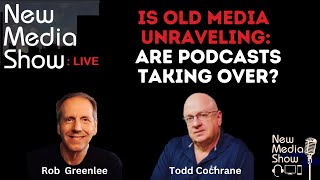
In this live‑streamed episode of the New Media Show, host Rob Greenlee and guest Todd Cochrane discuss the shifting landscape of audio and video publishing. They begin with the practical challenges of synchronising live streams across platforms, then move into how AI is being adopted by both large tech firms and niche startups to streamline podcast workflows, editing, and metadata generation. The conversation surveys the competitive field of podcasting platforms (Descript, Riverside, Podbean, Spotify/Anchor, etc.) and debates whether large companies’ AI investments will crowd out smaller innovators. Monetisation trends are examined, highlighting a rising CPM/RPM figure of $36.60, PayPal payout limits, and alternative revenue streams such as sats, Patreon, and direct donations. They analyse the decline of traditional news media and newspapers using Pew Research data, contrasting it with growing podcast audiences. The episode also covers audio‑ad best‑practice guidance from Veritonic, and the latest IAB Podcast Measurement Guidelines (v2.2) concerning 24‑hour windows, safe‑IP whitelists, and ad‑delivery validation. Toward the end, they conduct a live tech‑support walkthrough of Rob’s WordPress site (blueberry.net), configuring the PowerPress plugin, activating the Blueberry Player Modern for audio and video, troubleshooting missing video chapters and artwork, setting poster images, and addressing caching issues. This demo illustrates the hands‑on challenges independent creators face when setting up and maintaining podcast/video publishing infrastructure.
Chapters
All right, we're, we're coming live, folks, so hang in there with us.
Yeah, my stream just started. Let's see if YouTube's going yet.
I think I'll play the countdown again here.
Todd and Rob in the afternoon. With Todd and Rob. Oh yeah, Rob, here we are.
Yeah, we're back again.
The second countdown worked pretty well.
Uh, yeah, that was good timing. I guess I should have started it without the first countdown and it would have worked better. It's, it's one of the challenges of these live streaming platforms, to time when you start the stream and when everything goes live across all of the platforms. So it's, it's hard to get things timed up.
Yeah, it, it's, uh, you know, I'm just, I'm watching everything here and trying to hit the button as quick as I can.
Yeah, I know, I'm the same way. I'm like scrambling trying to get things activated. But anyway, it's great to be back with the New Media Show. Todd, thanks for calling me from— I guess you're coming back from your trip here soon. So I think we'll be back in your studio here soon, right?
Yeah, we'll be back at the normal time next week. About 24 hours from now, I start the 24-hour journey to get home. So yeah. Yeah. It's one of those, uh, you know, stuck in a seat for 14 hours type of deal.
So that's always not fun.
And, and in coach to boot, you know.
So, oh yeah, well, that's even— well, especially for me, that's especially not fun. So my knees are like up in my chin. So if that— yeah, especially if the person in the front seat lowers, lowers their seat.
Yeah, I don't have no more status. I have no staff on United anymore, so chance to catch an upgrade are slim to none. But anyway, just before we started the show, I told you, you asked me what was going on with me, and I said I've been dreaming AI.
Yeah, right.
We've been so heavy testing, and then I'm trying to optimize things. And literally, I dreamt last night of, you know, basically having a meeting with my dev team that didn't happen. It happened in a dream.
Oops.
You know, and it's just like, you know, it's a planned dev meeting, but it's all these things in my head that I wanted to talk about with them.
And yeah, it's, it's kind of funny. You're Your video, when you talk to it, because of your background, it does look like you're talking into that big microphone.
It doesn't— I could actually move my head a little bit this way and it would be perfect.
That's, that's quite a microphone you have there, Todd. Yes.
Yeah, it is. And it's what it is, is the Shure mic is black. So what's happened is, is because there's a black Yeah, yeah, it blends in perfect.
Yeah, I guess you need to have a green screen of some sort, right?
Yeah, well, I don't travel with a green screen. This, you know, this virtual stuff is, is going to do. But yeah, next week we'll be back with, uh, real lighting and a real— you know, I don't think anybody wants to see a hotel room behind me. I don't think that's very exciting at all.
That's true, that's true. So You're dreaming of AI, and AI is still with us. I think it's fairly safe to say, and it's still kind of in this weird kind of limbo land right now. It kind of feels like it feels like that a lot of the big companies are embracing it, and at the same time, there's a bunch of little companies out there that are embracing it as well, trying to offer services and subscriptions and things like that. But I get I get the sense, and maybe we mentioned this on last week's episode, but that maybe as these big companies support AI, it becomes less of an interest or need for all of these AI startups. And I kind of wonder about that, Todd.
I think if, depending on how custom of a solution you have, how, you know, for us, it's going to be planning, post-production, social, clipping, stats. So it's, you know, it's definitely tied to everything.
Yeah.
What we do as core. So, you know, I've said for a while now that if you didn't incorporate this in your business, um, you're, you're going to be out of business in a few years.
Yeah.
Um, You have to, um, and we're, we're not going outside of our, out of our swim lanes per se. Yeah, but also I look at 8 or 9 podcasting competing products. I'm like, well, I've eliminated the need for my audience to, or my, my, you, my customers to have to pay for a third-party service.
Yeah. And that adds value to your platform to, to do that kind of thing. And then also, you know, I do agree with you, Todd. I think that there is going to be a significant move towards using these AI engines to simplify workflows and processes. And the best place to do that is inside the place that you're trying to publish. And that's exactly what you're doing. And I think that there's other, other platforms in the medium that are pursuing this as well. But there are surprisingly a few few mediums that I'm not seeing much action in that. I know that Podbean announced something just this past week too, that they were— they had a strong AI initiative.
Um, I'm not quite sure what that looks like yet, but they did an audio editor. And for me, it's like Descript has really knocked it out of the ballpark, and there's a lot of people using Descript. And do I need to Yeah, really compete with Descript. Um, I don't think so. I don't think I need to compete with Adobe Audition or any of these other editors, right, that are going to have this built in, uh, very, very shortly. Um, I, I guess Podbean has their own on-platform editor. You know, if you've got a tool that's going to remove stuff, you have to have an editor as well. So I don't have an editor, so why would I? To me, I'm just being trying to be strategically smart in what I build.
Yeah, because unless you have a recording process on your platform, it's a little tough to justify an editing tool, right? Right. So I think that it's, you know, unless you're moving in that direction, you know, I did speak to Lipson a little bit about this too because they had that that Lipson Studio product that they were, they were pushing out. And I don't know what the priority of that is anymore in the company, but there's, there's definitely— and but I think, was it Spotify with Anchor? I think they recently announced that they got rid of their, their ability to, to record and edit in their platform.
Yeah, they did something. And, you know, they partnered up with Riverside, but, you know, that's— people are going to have to pay for Riverside.
So unless it's bundled with it somehow, if that's the long-term goal, right?
Unless they did some deal and paid for Riverside for their customers. Yeah, you know, but everyone I had talked to— because we had looked at that— I had talked to Riverside, Squadcast, and everyone else and said, hey, you know, let's do a bundle, let me integrate. And none of them were interested, um, at the time. And, uh, so for me it was like, all right, you don't want— so that— does that mean you're going to compete with me? And you look at what Riverside is doing and every indication I had from Riverside and based upon what they were posting on their website, it was, you know, made it very obvious to me that they were trying to, they were going to become a potential competitor. And they, you know, we did some integration that they never completed. Um, and it kind of put a little sour taste in my mouth, uh, especially after they got some money. And, you know, they change priorities. So the Riverside hasn't been without their own challenges as far as their platform goes too.
Yeah, I know that they've been kind of courting a relationship with Spotify for probably over a year now. I've been seeing them mentioned in their marketing materials quite often, and it just sounds like things progressed to the next level Um, you know, and I think if you look at what Spotify is doing with, with video, it probably makes some sense that they work with that type of a platform, right, that can help them build video on platform, right?
Um, but again, it's a stovepipe. So, you know, they, they, you know, they, they finally come to the realization that, um, RSS is a good thing Um, you know, making Rogan available again via RSS. So now they are, um, you know, maybe they'll come to this realization with video as well, but I, I don't know if that— it may have taken 5 years to figure that out.
Yeah, I don't know. Did you see the, um, the posting in, um, the download from Sounds Profitable I thought that this was interesting. It was data that was provided by, looks like Spreaker or iHeart in this case. Here, let me pull it up on the screen and I think you'd be able to see what I'm talking about here. I guess Spreaker is saying that there's a trend up around CPMs or what's being called revenue per million now. So I guess Spreaker's decided to rename it to a more clear basis, but they still kept that milli download.
Revenue per mile download?
Milli, which is another term for—
oh my God, I read that as mile revenue.
It kind of looks like it, doesn't it? I know.
Yeah.
Yeah, but I thought it was interesting. Trend with an arrow up to $36.60. Now they're not entirely clear, um, yeah, what, what's being sold here. Um, my guess is this would be, um, host reads. I can't imagine this is programmatic.
No, no way. Yeah, so that's pretty impressive.
$36.60 and a CPM, let's call it what it really supposed to be, Yeah, I think it's, it's an interesting, you know, if, if that is true, um, you know, and that's part of what I wanted to, you know, kind of dovetail off of today too with the show, is to talk about this kind of conflicting messaging that we're hearing in the medium, um, especially from larger media companies, um, that are driving, you know, a certain kind of narrative that everything is Okay, in the medium, while at the same time I'm hearing a lot of people talk about, well, you know, everybody's getting laid off from their jobs and there's concerns about content quality now going down because there's fewer hiring and there's more focus on, you know, jobs and salespeople being, you know, opportunities out there. So all of these content creators that have been hired by these big production companies are having a hard time, you know, finding their next gig, right? And, and so, you know, there was some discussion about this online here over the last couple days, and, and it's an interesting kind of, um, you know, conversation on, on this topic, you know, you know, um, around a significant lack of job opportunities for content creators compared to a surplus of sales positions flooding the market. So, you know, I think that there's really two things going on there that aren't necessarily directly related to each other here, but which is, you know, there's a large number of sales positions because there's lots of companies out there that are looking to drive more revenue. If they can bring in, you know, a talented person that can drive more revenue, then that's what most companies need right now. But then there's the other end of the spectrum, which is you know, cost cutting around content, right? If, and kind of the, the blending of the two is usually related to revenue, right? So, you know, budgets usually get cut and staff gets laid off when, when revenue isn't matching that, or there is less of a, I guess, an attitude of investment spending versus justified revenue-based spending, right? I think that's kind of what we're seeing here.
Well, you know, they were, they were being pretty stupid for a long time, right? Episode, you know, and, you know, all this high production cost.
Yeah.
When it's not needed, you know, it's not needed. This, you know, having a team of, you know, I can tell you the number of meetings I had with teams of 6 or 7 that were going to produce one business show. And I'm like, you guys are crazy. Of course, you didn't tell them that over the— but there's 6 or 7 people involved in the production of one business show.
Yeah.
When there really should have been like 2.
Right.
You know, and maybe a couple of meetings with some marketing folks or whatever, you know, but you really— it doesn't take 7 people to launch a business show.
Yeah, and it's— and also the conversation around this in the community was focused around, well, there's less of a focus on quality now, so, you know, I don't need that, you know.
It's like, you know, uh, that's, that's, that's, that's, that's what that is, is that's, uh, virtual signaling for, well, I don't have a job.
Yeah, right. And it's, and it's this focus on how they, they portray how many jobs in the market with content creators with mediocrity, right? And, and a churning, uh, cookie-cutter kind of content that is relying more and more on tools to drive downloads was the, was the idea that came up around this.
Tools, tools to drive downloads. That's something.
I wonder what that is.
Yeah. So, tool drive downloads. I'd like to know the definition of those types. I'd like to see those tools.
Right. Well, I think we all kind of know what those tools might be, and those are the paid-per-download type of platforms that there has been some people that have headed down that path over the years, right?
Naughty, naughty, naughty.
Yeah, exactly. But a lot of that activity now has been thwarted based on, you know, the efforts of the hosting platforms to detect those type of kind of download farms of sorts, right? I mean, I know you guys did, right?
Yeah, we've been doing that since 2006, '07. Yeah, when, when people were more than obvious on what they were doing.
So my, my comeback on this whole argument around all these content creators actually not getting jobs is if this is a— this is probably a great time for you as a, as a talented content creator that has been putting yourself into job roles to maybe go, go on your own a little bit, create some content. You know, yourself. Launch a show yourself instead of getting a job doing it. Create a job for yourself.
But Rob, there— you can't do that. I have to be paid. Well, thousands of dollars per episode, right?
And that also begs, begs the next question, is that there are people out there that don't have, um, savings or resources that they can spend time doing that kind of stuff, I think we have to be fair and honest about it and say that—
Rob, you don't have to be full-time.
No, that's true. No, I agree with that too.
You can have a regular J-O-B, 9 to 5, and still produce content, right? And still produce content.
Yeah, because if you're talented at this and you've been not— I hate to say this, but if you've been laid off of a content job, then Maybe, maybe you need to get better at it or something. I don't know. And one way to do that is to get out and start making your own content.
We missed out on the big bucks when they were just looking for people to be voices. And, and, and, you know, I, I should have just been racking up the thousands of dollars an episode, you know, do 4 or 5 a week. Yeah, yeah, that, uh, that, that would have made for some nice extra cash. Not that I had anything else to do, but yeah.
But then you have to fit into a certain kind of culture, and you have to do, do what you're told and all this kind of stuff. And that's kind of more of a kind of a larger media kind of, you know, that's more of an employment kind of opportunity for someone. And, and I have met quite a few people, especially in the in the New York market that would just get brought in to produce like one episode of a, of a big series, right? They would be like a, like a showrunner or a show producer or something like that for just one episode, and then they would bounce around to different shows being a producer on separate episodes in a show. So there's a fair amount of the people that are— that lost their jobs that were kind of like floaters. That were floating around just doing one episode of a particular podcast for a bigger company, right?
Well, here lies the ultimate problem, right? And this is the same thing. It's based radio.
Yeah.
Is they stick with their old model. Yeah. You know, if it costs $1 million to produce a single or $20 million to produce a single episode for television, And we're going to put this on digital. You know, then, you know, you know, this is why we heard, you know, certain, uh, certain companies were paying, you know, $50,000 this last year. What I heard per episode is what one company was spending. Um, per episode. And this is a big company that, you know, supposedly is wise with their, with financial information. I'll just leave it at that. And, um, and, and I was just flabbergasted. I'm like, who, who, what brother, sister, and uncle were running this scheme to fill their pockets at $50,000 an episode? Um, I told the rep, we'll do it for 5, right?
That's a, that's a discount.
Yeah, yeah, we'll do it for 5, you know. And I was just being pretentious in that regard too. But again, so they— and again, these big production companies paying creators did not guarantee success. If those shows had been successful in generating huge audiences they would still be producing today because there would be enough revenue, right, to pay all those people that were, you know, grabbing a nickel and dime and a quarter out of that budget. So it's obvious that these high-end productions couldn't sustain themselves in the current advertising RPM, CPM market, right?
And that's what's interesting about it is that That explains a lot of the reason why we saw a lot of shows get cut, is that there were a lot of shows that were like maybe in development, right, that there was a lot of investment in but not a lot of return coming out of them.
And I, I just look at the, the millions of dollars I put in podcasters' pockets, literally, that were a team of one. And for them, you know, I had, I had folks— I go back in the story about Andy McCaskey.
Yeah.
And tell me, please beg me, never tell— he's retired now, so this is safe to say.
Yeah.
He said, don't ever tell anybody how much I'm making, because if my employer ever found out I was making more from my podcast than I was from my salary, they will fire me. So, you know, you know, here was a guy that was pulling 6 figures, fat 6 figures annually, and, um, and was a team of 1. So again, you have the— those are the smart ones, the ones that have had a team of 1 or 2, maybe maximum of 3, and they're pulling down $40,000, $50,000 a month in advertising revenue and they don't have a big team. It's doable. It's, you know, it's completely doable. You know, the more hands in the pot, you know, it's especially when you, when you get into those big deals, then talent, they don't even give a shit about talent because guess what? The company's taking, they're paying the talent a little bit of money, right? And the company that's producing the show takes the majority of the cash. So guess what? It's a recipe for disaster. Why? The talent has no skin in the game, right?
Yeah, and there's really no long-term benefit to the talent, really, right? And it's not easy building a successful show. And I mean, if you look at these, these bigger, bigger media companies, um, they usually have just a handful of very popular shows. And I believe that's kind of what they've— a lot of them have done, and they've, they've trimmed back their inventory of produced shows. Um, right, actually makes, makes perfect sense, actually, the more I think about it, that they would want to do that and then just kind of reset the deck chairs of sorts. And then that doesn't mean that they stop looking for new ideas and new shows. Just that maybe they're, they're a little more critical of, of what opportunities come their way that they are willing to invest spend on. Right. I think that makes total sense given, given the market right now.
And meanwhile, we are lit and live.
Good.
And in fact, I'm going to load the— we had some satoshis come in. I don't have it quite ready yet to show off because I got to load the screen. But, you know, I'm just like, there's other— there's other ways. There's other ways forward now. And with all the ways to monetize.
Yeah, there's so many now, right?
You know, if you— Patreon, PayPal. Someone send me a check. One-time donations. Um, Boostagrams. Um, 1,000 sats from Andrew Grummett. Thanks, enjoyed the show from yesterday. 1,000 sats from RW Nash. Yeah, Todd's back and therefore the back and forth. 1,000 sats. Um, again, and we've got people, a lot of people now are streaming sats to us. At $100 or $250 or whatever the number may be. Yeah, $100 sats a minute, $1,000 sats a minute, $1,000 sats for Mike Dell. Again, it's just, you know, there's— and again, don't we— this show doesn't get too many PayPal donations.
But I was just going to talk about PayPal. I don't know if you saw the tweet from Roberto Blake, who is on the show down at Podfest, but he posted that PayPal was limiting his payouts. Um, you know, I was going to pull it up on the screen here if I could find it really quick, but they, they told him he was— his transfers, uh, were too high.
Hmm.
Oh, okay, here, here it is.
To his bank account were too high?
Yeah, yeah. Here, let me show this to you.
Does he say how much he was transferring?
Well, it says— no, he doesn't say himself, but instantly available money. Yeah, yeah. Oh, it says here, after making $25,000 in sales per month, you'll, uh, it says, let's say As your selling activity changes, payments above a certain amount per month may not be available right away. That gives us a chance to review these charges or changes and keep transactions between you and your customer secure.
He must have had a big uptick in sales. Yeah, he must have noticed a large increase in activity.
Yeah.
You know, we've taken PayPal at Blueberry for years and I've never seen that type of a message. And, you know, we will transfer, you know, high five figures on a monthly basis out of PayPal into the banking account. So, and even my personal PayPal when we're collecting money for the podcast awards, I never have a transfer hit a transfer limit, but he must have had a big upsurge. But instant transfers, I always do. I don't like paying the fee, so I always do a 2 or 3-day delay.
Yeah, yeah, more, more reasonable on that. But, but yeah, Todd, I also wanted to talk about kind of the, the lead that I have with this episode today, and that was around, um, you know, what's happening between kind of mainstream media, um, the traditional media might be the way of defining it, um, is appears to be in a, in a relative state of decline and pullback, um, but yet we see what's happening with like, uh, podcasting and video and stuff like that. It seems to be capturing the attention of people more than these mainstream channels are. And I wanted to pull up an article from Pew Research that kind of gave a little bit of clarity on this around what's, what's happening. Uh, it, it looks like audiences are declining for traditional news media, and this a little bit rides a little bit with what I think what we talked about last week about the New York Times facing some revenue kind of declines from brand safety and things. So there's basically some issues around the success of these mainstream media folks around gathering audience, but now they're also under pressure on on what content that they have and what kind of news that they have on their platform, and they may not be able to be as monetized based on that. It says a declining share of U.S. adults are following the news closely. So fewer and fewer U.S. adults are actually following the media closely these days. And then here I'll jump down to where it actually talks about newspapers. And I think we've all known that the trend line around newspapers has not been a good one, but it's an interesting kind of fall-off that continues to happen for newspapers, which probably isn't a big surprise to you, Todd, to see this.
Is this digital or paper?
It says daily newspaper circulations, right?
I have not seen a paper newspaper.
I know, I haven't either.
So in a hotel, once in a while I'll see one.
And then, um, you know, I'll scroll down to the next graph here just so you can see it. There's a lot of discussion in this article. Uh, it says declining audiences for local TV news across multiple time slots.
So the only way, the only way you get local TV news is on YouTube clips. I, I, where I live, I, an antenna doesn't even work. So the only way I can get local news clips is again just seeing a, you know, the weather on a 3-minute clip out of Detroit or something like that. That's so Yeah, I'm surprised it's that good.
Yeah, these numbers have been on, on, on decline. It says for evening news it's about 3.1 million. Um, for— I'm not sure which one of those charts— yeah, and then late night news is about the same, and then morning news is even less.
It's halved.
Yeah. So people are just not getting their, their news information from these big sources any longer.
You know where I get it on my Android phone is, um, off the home screen. I, I get this feed of— and it actually is excellent, it's better than the iPhone. It feeds me stuff that I'm interested in, and I don't need— I don't have— never made a setting, but it must know what I read. I get a lot of space news. I get a lot of stuff from SpaceX. I get no politics. Um, wow, okay. So I get a whole feed. It's pretty— it's updated quite a bit on my Android phone, and I, I get most of my, my quick news there. Mm-hmm. And it's not traditional sources.
So it says here the audiences for news programming on ABC, CBS, NBC have been relatively stable over recent years. Now granted That is, that's in a time frame that is not as current. It says, but the story is mixed when it comes to audio. It says there's a clear rise in audiences for podcasts and other types of online audio. So that continues to go up. And then down here is for U.S. newspapers' estimated circulation revenue. So as you look at This, this is, this is an interesting little chart because what it shows you is a serious decline in advertising revenue when it comes to newspapers, how it's actually lower than the, the subscription revenue.
I wonder when Craigslist came in on that graph, you know, where did Craigslist hit?
Well, you know, it was crazy, probably at the at the peak of the advertising cycle here, probably. And it's been downhill ever since.
Right. Straight downhill.
Yeah. Right. So, and then your local television revenue has been roughly stable. It says public radio revenue has increased. Looks like from 2020, $1.1 billion in 2020 to $1.2 billion in 2021. It doesn't— it says an increase of 8% between 2021 and 2022.
Well, and if you looked at this probably at a more closer scale, I would almost bet you that, uh, election years— yeah, you know, different, right— drive huge revenue. And it's the cash— it's the, it's the gift that keeps giving. That's the only thing I think that's still saving major media is every 4 years they get this influx of billions of dollars of advertising.
Yeah. And also, I think as you look at even these graphs and these charts that I'm showing on the screen here, especially this one, it's basically revenue trends vary across cable news networks, and it basically charts the revenue of CNN, MSNBC, and Fox News. And you're seeing a serious decline in revenue for appears to be CNN and MSNBC, where Fox News continued an upward trajectory through the pandemic period. It doesn't go beyond much beyond— that probably goes into 2023 is the numbers here.
Um, and it says 2022 at the bottom of the chart.
Yeah, you're right, it doesn't. Um, but it's— do those bars go beyond it? No, they don't. So yeah, so we're still missing 2 years of data here. So my intention is that— is, is it the declines here would be even more significant than what we are seeing here.
To be honest with you, I can't tell you the last time I was on CNN or MSNBC, right? Uh, stuff from Fox does come across my newsfeed from time to time, but most of it is usually non-political stuff.
Yeah, yeah. But my kind of my gut and Probably the same with you is that there are fewer and fewer people and it's very partisan and demographic related as well to some degree of the people that are watching cable news tend to be on the older end of the spectrum. I'm just speculating on this. It's probably not 100% true, but And I don't know, what's your observation on that, Todd? I think it, it does— those news networks that we're talking about, except for maybe to some exception Fox News, do kind of fall along political— oh, absolutely, political divides.
Oh, and you know, and yeah, the reason I quit watching mainstream media is because It gave me anxiety. So I don't watch it, and I don't watch any of them because it's just, it's, it's an anxiety-lidden tirade of talking heads that don't half the time know what, and they're so politicized and they can't see beyond their own noses. You know, I, I, I just keep telling my audience, there's this big worry, you know, in the, in media right now that to, you know, upcoming election and election fraud and blah blah blah. And, you know, it's deepfakes. And I just keep telling people, hey, you know, you have a brain, uh, you know, use it. Source material. If you read something, you say, is that true? You know, do a little more digging and looking around, especially if it's something you don't agree with or pisses you off or whatever. You know, make sure that— do your own research.
And, um, well, and also, yeah, yeah, actually even goes beyond that, Todd. I think it's really being open to the possibility that what you may perceive as a conspiracy theory may not be as conspiracy as you might first think it is, um, and just being open to learning about other possible scenarios that may be happening that maybe you're just not aware of?
I think we're well beyond that. I don't think people are— I think people are pretty polarized at this point and don't want to listen to each other because there's no reason. It's one extreme or the other. It's either this far right, far left. There's no one— there's no one talking down the middle and being reasonable. About discussions. So this is why people have, have tuned out.
And I think it's— what's happening here is very dangerous, um, but it's also scary for the media landscape too.
So no, they're sticking a knife in their own backs, you know, they're killing themselves.
I mean, because in the long run, it's, it's going to backfire on all of them.
Um, it already has. Yeah, I used to be an avid news watcher. I used to go through all the channels All of them. I would give as equal, I'd give equal, an equal time to CNN and Fox and MSNBC. But that was more than 10 years ago. And now I can't stand to watch any of them. So where do I go? Where do I feed my brain? I feed my brain with stuff that isn't going to, you know, stress me out. I'll be honest with you. I have no idea what's happening in America right now. None. Zero. It is. It is. Because guess what? I've been 30 days. I've been completely disconnected. Yeah, sure. And no one cares. We're here where I'm at. No one cares about what's going on in America. I do get asked, um, from time to time, me, people, you know, what do you think of Trump? What do you think of Biden? And I'll be honest with you, the— and these aren't expats, these are people that are locals, they love Trump, you know, they think, and it's kind of like, huh, that's interesting. Yeah, they know I had no skin in the game. Um, and I asked why, and the perception is, is he's a, he says what he means. So that's the perception they have here. And yet there's no, I don't, we don't, there's no media per se that's inundating people on politics in the United States. So You get outside the walls of our own country and largely people don't care. And I think that's the thing, it's always Americans need to realize is that, you know, we live in this, in this bubble that the rest of the world could give two craps about. They have their own local politics and stuff that they do.
Oh yeah, everybody has their own issues, right? Yeah. So yeah, I think it's a little scary though that that people are pulling back from trying to dissect what's happening, uh, I think there's a danger that things could, uh, happen and the population just won't even be aware of what's happening.
Oh, I think, I think you see that all the time with these YouTube clips of people on the street being asked very, very simple questions, and it's, you know, and, you know, you know, I don't expect a 20-year-old to be to know who the Speaker of the House is. I could care— they probably could care less, you know. But what, you know, it's, you know, probably when I was 20, I didn't know either, you know. So to be frank, um, yeah.
And sometimes it's hard to— for people to really comprehend, you know, macro dynamics in a society and a culture at the level of things that are going on. It's— it it's hard to comprehend sometimes, and it's hard to, to trust that maybe a different view is, is a possibility, right? Um, versus just kind of following the sheep of what everybody's saying is going on. I think it's, uh, all right.
I think that's why you should listen to a lot of podcasts. There's a lot of diversity in podcasts with a lot of great conversations.
Yeah, and start piecing it together yourself. But it does take a certain kind of active engagement to ascertain those things. And, you know, I think it can put each of us in a socially challenging position too, because as we start to change our opinions, we're going to start talking about it more to others, and that could make others uncomfortable because of a different view.
Well, Rob, to be honest with you, I think that the— over the last 8 years, per se, I think the majority of normal people, of regular people, have tuned out. They don't want to hear it. And they're going to just do what their heart tells them. And that's it. I don't think they— I think because it got so nasty.
Bad, right? Well, it's continuing to be that way, right?
Yeah. Well, thank God I'm not participating because it's one of those situations where my brain doesn't need it.
It's just, you know, everybody could wake up one day and realize that their country is no longer what they thought it was.
Well, yeah. And, you know, my grandfather Used to say, this country's going to hell in a handbasket.
That's been a long time though, right?
Yeah, that's, you know, that was when I was a little whippersnapper, 13 years old, 14 years old. And he, you know, he would complain about the R's and the D's and he would, you know, cuss them up down one side, the other. Well, 50 years later, here we are. And we're still surviving. So, Yeah, um, not— there's never one person that can have so much power that they can change everything. So that's, you know, there is, there is still a sense of checks and balances, even though, you know, and politically, fire them all is my opinion.
Clear the slate, right? Yeah, clear the slate. But the question is, who do you replace them with? Is the—
is that what you do? Term limits? And you You, you replace everybody, you know, right?
At some point, right? This concept of a, of a, of a bureaucracy that is full of people that have been there for 30 years or something like that.
Yeah. And they got, you know, they had 22 hands in their pockets, you know, dropping, uh, you know, dropping millions of dollars. Yeah. Yeah. Anyway, um, I don't know. I think mainstream media is screwed. You know, it's just a matter of time, but the money's still being spent there. So billions of dollars are going into cable advertising. So those billions of dollars are not coming into podcasting, and there's a reason for that.
Yeah, I think it's an interesting question, you know, why isn't that happening?
Um, because it's a lot of work. Media buyers don't want to go deep. They, they want to top— they want to deal with the top 5%, and they don't want to deal, with the 95% that will actually get them to multi-billions of dollars of advertising. So therein lies the 20-year problem of putting money in smaller creators' pockets.
I thought I wanted to share this other article that I, I found, um, actually from the site, uh, Rain News. They actually talked about this concept of— here, let me add this to the stage here. I guess there was some research that was done from Veritonic. It's the Veritonic Audio Attention Report, and it talks about the need to keep audio ads simple and not too loud. This concept. So, because if the ads are too loud, then it, it turns people off, right?
Which makes logical sense, just like TV, right? You know, if you're— if you have something on TV and all of a sudden the ad comes on and it's 20 decibels higher, what do you do? You immediately grab the remote control, right? And you play that cat and mouse game of up, down, up, down.
Yeah, yeah. So, so it's important, the, the audio quality of your, of your ad in, in podcasts, in audio advertising.
Oh, it tells me that the, uh, audio-injected ads are not, uh, being leveled.
Yeah, and there's been an issue on the radio side for many years. I'm sure you'll recall is the quick action on the volume button on your radio when an announcer ad comes up and it's like, you know, double the volume, it blows your ears out. That's a common practice even in television advertising, is to, at any advertising break, you just ramp up the volume to get people's attention, right? It's all about, that's the whole thing about advertising, right? It's always been about being a disruptor to people's attention, right? And loud is one way of doing that, and flashy graphics and zingers and all sorts of things that they do on radio to keep people paying attention.
Yeah, and again, I think it goes back to, you know, you don't need to— don't need to— don't need to kill them with a hammer. You just need to gently persuade them to help you out.
Go take a look. Don't make your audience deaf with your ads, I guess, is the takeaway on that for me.
So yeah.
Oh, your bandwidth is— was cutting out there on you a little bit. But, um, yeah, Todd, can you hear me?
Yeah. A little bit about the IAB stuff.
Yeah, no, no, I have that up here. Um, so there was, um, an announcement on the 23rd off of PodNews about the IAB Podcast Measurement Guidelines version 2.2, Todd. Um, so I'm sure that you know quite a bit about all this. I, yeah, there, I'll, I'll zoom in on it a little bit so you can see better.
Um, it hasn't shown up on my side yet.
Oh, it hasn't? There we go, there we go. The— it looks like the IEB Tech Lab has released a new version of the measurement guidelines, um, and is looking for comments, um, on it. I guess if you want to comment on this, I guess you have till March 23rd to get your comments in. And version 2.2 add a requirement for companies to be clear whether they are using a fixed or rolling 24-hour window for measurement. That's part of that, that thing I think we talked about at one point is that there's some variabilities in this, in these settings that can generate different outputs, right?
And this is one of them, right? Again, remember the 24-hour window is the minimum, right?
But it either, either fixed or starts at the point of, of initial request, right?
Yeah, I think we're using fixed. I don't quote me on that.
And that could generate different numbers.
Yeah. So, but again, depends on how far back you look. So you can use a fixed to look further back.
Wouldn't a rolling 24-hour window—
does that generate, um, rolling window? Probably would be more, more downloads versus effects, right? Uh, well, again It goes back to that, you know, the pure science on this and how many times do we really see the same IP twice. And in the end, it's, you know, not very, very often we do see IPs twice, but very rare to see the same IP a third time within a 24-hour window.
But, and then also it says a requirement to update safe IP addresses. Lists such as those for large known corporations and universities. So that's like a whitelist, right?
Right. And to be honest with you, those lists have always been pretty thin. Have they? Yeah, because, you know, just the way the modern internet works, there's not that much firewalling that's going on now where they're routing— corporations are routing everyone through a single— because think about it, right? Someone goes to work, they don't connect their phone to the office Wi-Fi, right?
It's through the cellular network.
So they're on their cellular network there. And so what are those? So are people using their computers in the office to listen to podcasts?
On Wi-Fi, right? Or off of a network connection, maybe?
No, no. And college students, the same. They're using their phones. Maybe they're using college campus Wi-Fi, maybe, right? But again, the majority of them are just using data, right?
Right. So it's a, it's a declining number anyway. So where do those safe IP addresses actually come from, Don?
Self-generated largely. Are they? Okay. Yeah. It's the other list is the one that we, you know, basically we buy, we pay for a service that tells us all of the known servers. And so basically the deny list or whatever you want to call it these days. Right. And I think James is getting a little too bit wrapped up on the the IEB certification in the last 12 months, I think you'll see a large number of companies start the— you know, they've got 12 months now to do— well, as soon as this comes out and is validated, then the companies basically have until the end of the year to get recertified.
And then I guess there's clarification on that an ad can only be considered to be delivered or fully downloaded if the overall episode download was valid.
So yeah, I think that's always been the case.
Yeah, that's what I thought too. But what's, what's changed around the classification of being valid?
I don't know that, that I guess we'll have to find out what the auditors have to say about that. Yeah, again, it's, it's, uh, and here's the, here's the risk. It's, it says add if the overall, you know, so does that mean that people that aren't running ads are, you know, where's, where's the counting going to happen, you know?
So yeah, I think it's specifically referring to counting.
Was it counting of ads? Yeah, counting of ads.
Adds only when the episode has been validly delivered.
Yeah, validly delivered.
I don't know if that's even a word, validly.
Well, so, you know, think about it. Can you validate in a redirect that the media file was delivered?
Well, and what is that? That's a loaded word too.
Yeah, what is delivered? Did the IP bytes get delivered.
Right. I mean, was it fully downloaded or was it just a partial play or—
I think, yeah, I think there's some good questions to be asked around that. What does that really mean?
Right.
Yeah.
And then some changes with the— was it mass market technology changes in measurement reports, possibly the result of Apple changes to iOS 17?
I'm not Exactly sure what that means, but scroll back up, let me read that again. Practice to be put in place to account for mass market technology changes.
And it's not very specific. No. Yeah, James says here only 5 companies have undergone IEB certification in the last 12 months.
Yeah, well, again, I'm not— I think what we'll see here is I don't get into the politics of what the IAB did, but I think you'll see a lot of recertifications this year.
Yeah, it was almost like it says the IAB had required companies to recertify annually, but its website ordered that recertification must be completed by December 31, 2023 to maintain compliance status. No companies have recertified so far this year, and that requirement was removed from the IAB website yesterday.
So again, when this comes out, we'll have a new version.
Push that, that deadline out further is what they've done. The December 31st, 2023 deadline.
Yeah, I, I'm not aware if that changed or not. I wasn't in a meeting where that was discussed, so I really can't, you know, again, um, originally we didn't— there wasn't going to be a requirement to recertify every year. It was going to be when there was going to be a version change on the, um, on the specification, or you had a material change internally at your company which required you to self-report and say, I need to recertify, right? In other words, you change something in your processes that would require that. And then ultimately, IAE decided— the tech lab decided that because MRC and others recertify annually, that going forward, companies would have to recertify annually, and gave folks some time in essence, to prepare for that. I guess that's the best way to, to say it. Yeah. So I will see how many companies recertify. It is going to be an interesting— because, you know, it's not cheap, but it's cheaper than what it was. So, but still, you still have, you know, significant amount of cost there. Yeah, and you have members and non-member certification too. So you got people that are not members that pay a higher rate to get certified than members.
Interesting. Yeah, yeah, Todd, I saw that, um, looks like Joe Rogan has his RSS feed back in Apple again. I saw that. Oh, I think we talked about it last week. Yeah, yeah, yeah.
So I just wonder what that means to his numbers.
Well, I think Spotify was pretty optimistic that, you know, if they were going to take a chunk of his ad sales, that they were thinking that the revenue might be higher for him, right? Else they wouldn't have done that kind of deal.
Well, I'm, you know, I'm sure they looked at pre-Spotify numbers and they probably know pretty well. I'm sure there's a lot of people very happy he's back on RSS.
Yeah, yeah, because I mean, you can get Joe's full 3-hour shows in your podcast app now. So, Todd, I launched, uh, my podcast tips show on, on, um, Blueberry this past, last week.
Yeah. How was your experience getting started over there with this? Did you do it on the dashboard? Did you do it with your website? What did you do it with?
I did it off of, uh, WordPress. So, okay, mainly. But I, you know, there is some things that I've had to learn about bouncing back and forth between the Blueberry side and the You should never have to go to the Blueberry site. Oh, okay. Well, it redirects me over to the Blueberry site for destinations. It shouldn't. It shouldn't? Okay. I need to talk to Mike then.
Have you synced your— can you upload to us directly in WordPress right now?
Yes. For both audio and video podcasts.
Yeah, it shouldn't. It may push you over to an explanation site. Now for Spotify, yeah, you have to come onto the dashboard to submit to Spotify, but for the— for a few of the destinations you have to come on the dashboard and connect with the API, but majority of those you should not. Got it. Got it. Yeah, Spotify would be one you would have to submit on the dashboard.
Just trying to look here to see, um, That's all. If I have those posted in here— oh yeah, here it is.
Yeah, the rest of them should be pretty much from just following the instructions. But yeah, Spotify would be one you'd have to submit because we do a—
I have to do some magic Yeah, so I got the, the video feed set up. I, I titled the, the album art video edition, kind of like what we do for the New Media Show too.
Oh, you got 16 episodes already?
Yep, that's how many. Wow, this feed.
Yeah. Wow, did you— so I guess you posted 16 at once?
Yeah, I did. Well, it's because I started this show back in October, so I wanted to catch up, so each show going forward would be kept up to date.
So that's it. All right, yeah, I got you.
So it's purely video, uh, this, this, this particular one, and then I've got the, um, the, the audio version too. So I have two feeds. So just like with this show. Yeah, so I have that, and then this one is is there as well. So I add that to the stage here. You can see the, the audio edition version, and it's got 16 episodes in there too. Yeah. So, so yeah, I mean, it was— I guess it's kind of rare to, to get set up like this these days, but I thought I would, I would do it and and see what, what happened and see what the reaction in the community.
Are you running channels or categories?
Uh, the video version is running off of a channel. The audio one is like the default.
Yeah, yeah, yeah. So you do— you're doing the same way I'm doing this show here? Yeah. So you have two blocks in the WordPress post? Yeah. All right, well, cool beans. Yeah, you get to play around with our stats and all kinds of stuff. You get to dig in. Get your media kit set up, start your audience survey.
Yeah, there you go. I can start doing all this cool stuff and I can eventually play around with your AI stuff too.
Yeah, you send me, if you want to be on the beta, I'll send you the NDA.
Okay. Oh, there's an NDA that rides with that too.
Yeah, the NDA only is Only good. Well, basically, and the expires as soon as we release it, obviously.
Oh, okay.
Yeah.
Where it goes, goes public to the world.
All right. Yeah.
Yeah.
Especially if you do show planning. That's, that's the piece I want tested the most at this point. Oh, yeah. Our show planning piece is because I don't do show planning.
So I do a, I do a little bit with this show that I'm doing. So it might be Yeah, it's one of those things that has to be done in advance of the— yeah, yeah, yeah, I'm doing a lot.
So, right, yeah, so it's, it's a little different than trying to pull a description for, uh, so what are the, what are the things that you do in your planning? What are the specific things that you do preparing for that to do that show?
Yeah, I come up with a, a theme for the show based on the guest that I have. I've got James Cridland on tomorrow night. So, right, so it'll be like about kind of global podcasting. I come up with a title and a theme of the show. Like, uh, last week I had on, um, Ray Ortega. He was on the show last week, and he's been doing a lot of work with, uh, audio and, and, and video stuff. So, so the the topic of that show was the basics needed to do a video podcast. So, so that's what I talked to him about on that show. So I create a theme of the show at the top level that I can promote on the COVID art or on the, the YouTube video art. And then, then I, I run that theme through ChatGPT and it outputs a bunch of big topics, and then I just use that as my, my show outline. I make some modifications to it, um, but I use that in my show outline, and I also use it in my description for the show.
So do you have a— do you come up with a goal for the show, for the episode?
When you say goal, what do you—
are you talking about you have a topic, but you have an actual goal of what you want to cover, cover in the show?
Yeah, it's actually in the, um, the, the actual description that's created, uh, is the key kind of talking points and, and themes here. I can pull it up on the screen, you can see it a little bit. Um, so this is, this is the breakdown of an episode, um, that I create with.
So do you, do you go out and look for sources like you know, different articles that you're going to talk about, different things?
No. One thing that's different about this show too, compared to a lot of other things too, is that this has a large live audience to it. Um, so I, I take a lot of questions. So it's, it's one of those things that I, I juggle with the topic flow of the conversation with bringing in questions and comments from the audience. So It's trying to walk that line between doing all that. Like, um, we didn't get any comments on this show today, but, but I'll— on this show I get probably maybe a couple hundred comments in each episode.
So do you, do you have target keywords for each episode?
Uh, yeah, there's, there's ones that are down here at the bottom of the screen here, they're actual tags. But okay, I mean, if you're talking about target keywords, yeah, yeah. But all right, but really it's more about just kind of following a thread of conversation and then also being able to be flexible enough to just go with the conversation, kind of like what we do with the show. I mean, it's, it's loosely organized, um, but there's a lot of kind of going off the road, like, you know, you might say, on the topics that we talk about, like on this show. So I do it— I do that show very similar to how we do this show, but I do do some editing on, on this program. So I'll add some visual graphics, I'll pull out those countdown clocks, kind of like what I did with this show at the beginning, um, so those don't kind of cloud the experience at the beginning. So what I'll do, right, right into the content right away on YouTube.
You've already done your planning with, uh, for James's show already?
No, actually, I'm going to do that after we get done here, and then I'll post a scheduled event.
Oh, okay, because I, I can't get you access to it until I have one of my devs turn your, your show on, so that'll be tomorrow. Okay. Um, but I can get you into— you can do your planning and then come in and use my tool and do your planning on my tool and see what— do a, do an A versus B. That'd be actually really good. Do an A/B test. So come up with your own, you know, and time it. Time how long it takes you to put your, your production together. And if it takes you 45 minutes or half hour, whatever it takes. And then when you use my tool, do the, do the timing and see how long it takes to come up with. And I'd really love to hear your feedback because I think you're going to like our little tool.
Yeah, well, that's good. But yeah, it's— it usually doesn't take me that long. I mean, I I come up, you know, I have a guest and I have an idea of why that guest is with me and what that topic would focus on based on my guest's experience and what they bring to the program. And I kind of cater that to them. And so I just come up with that, um, from that. And then the AI helps me come up with, you know, a more organized outline of possible topics with that person. But I, I give it enough for it kind of knows where to go, you know.
Right, right, right. Yeah, I think you'll, I think you'll like the episode planning tool that we've got because I was just curious what your process was. And, you know, I keep asking podcasters and a lot of times it's the same. You know, those that aren't using AI, you know, they, they kind of have like their own chicken scratch put together what they're going to talk about. And, um, But yeah, I'm just— I'll be curious to see what you think of the show flow. Um, right, there's a— yeah, anyway, I won't go into any details. I'll let you play with it yourself because I want you to give me your raw feedback.
Yeah, so this is, this is what the show looks like on, um, on YouTube. So I I created a playlist on my channel for, for the StreamYard channel. So this is on, this is on my channel, but it, it points to playback off of, off of the StreamYard platform, right? Yeah. And their, their channel. So it's, it's actually getting all of the, the plays over on their, their, their platform. So if I go in here to Ray's episode it actually will start.
And right, I have, I have never seen a compression algorithm deliver. I haven't heard from Ray in a long time. Yeah.
Yes, yes. You can see off to the right over here on the screen, there's a bunch of comments that are, you know, that have already come in on the show, and those actually, actually show up on the screen. Um, because I, I click and pull them into the program, and then both Ray and I can see those comments on the screen and we can address them and respond to them. Yeah, so that's how that, that all works. So, so, and they're coming in from, from LinkedIn and Twitter and YouTube and, I mean, lots, lots of places. So, right.
Yeah, the LinkedIn comments making into the YouTube chat.
Yeah, well, they come into StreamYard. Oh, okay. And then I, I pull them, I click on them and pull them across the, the screen just like what I would do here. Um, you know, like, like that, right? So it's, it's a pretty It's a pretty simple process, but that's how it works. So it comes in from all these platforms. So it's, it's fun. It's definitely, definitely an exciting way of doing a show. You got to really stay focused on the content, plus you have to stay focused on the audience, and you have to juggle the visuals back and forth, kind of like what you know, I've been doing to some degree with this show too. So it's, it's trying to create something that's a little bit more eye-catching for the, the viewer, right? I, I also made a, a new— I know, I'm sure you saw it at the beginning— is I made a new thumbnail for us too, Todd.
I don't know. Oh, I didn't see that.
Oh nice, pull it up here too. So actually it was made in Canva is where I made this. Okay, that cam's pretty cool. Yeah, I took out the backgrounds behind us in the pictures and then I just created a different version of it.
Yeah, make sure you send that over to me. I didn't hit record today, Rob, so you're gonna have to send me the audio file. I was a doofus.
Okay, that's right. I'm capturing, I'm grabbing everything, so it's fine.
Yeah, failed in my hosting duties here.
It's all right, I thought it was all happening on my side anyway, so there's no There's no surprise here for me.
So, all right. Well, again, it's, you know, I'm sure the audience is tired of hearing about AI, but to be honest with you, what I have found, yeah, and I'm pretty, I'm gloating a little bit. Yeah, my post-production now on my show is back to where it was prior to me starting using AI tools. Really? Because before I was using a bunch of different stuff. I was using Anthropic for my transcripts. I was using OpenAI for some— and it just basically now all that flows in our internal tool and it happened so fast. Yeah. Um, that it might— my post-production time is just back to normal now, and I've got a 10 times better product. So, you know, time is money in my, in, in my opinion. Um, it really is. And I think when, um, when a podcaster realizes the, the output, the metadata output is going to be so much better. Um, I don't know if, uh, let me see if I can show it. Um, or maybe you can. What's that?
Uh, what are you trying to pull up?
Um, hang on a second here. So pull up, um, I don't know why it's not showing up on 5. Maybe I failed, but if you pull up episode 578, the Podcast Hall of Fame Insights in the New Media Show, and scroll down to the player.
Um, 5—
what, what was the number again?
578.
Yeah. Okay, let's put— show that on the screen and then look at the audio players. Now see those checkboxes, those tick marks? Um, go to the Not the play button, but go to the, um, the advanced, um, where it basically allows you to, uh, where it says +15, -15, just do a— that button, not right there, go to the next one, click on that. All right, yeah, just click it one time. Yeah, and you say this is wrong. I, I don't think the advertisers Okay, so now click that again and it'll jump.
Options in the world that has ever happened.
Yeah, I think it's just a— so those chapter markers have been, um, and we had a bug, so, um, that bug's been worked out. And I, matter of fact, I need to go back and regenerate the chapter markers, but those now are auto-generated.
Oh, okay.
Well, that's awesome. Yeah. So don't we, you know, I don't have to manually do anything. And those are actually chapter files that go into, um, into the— basically it's embedded in the RSS feed and then the player picks up on it. And, um, again, I think that particular episode there was a— we had a bug with the AI output. But we've got that fixed. And ultimately what we have now is the ability to come up with chapter files that we don't have to manually do. The AI just does it.
And it's remarkably good. Yeah, that's cool. Yeah, do you see the developments that's happened around text query to generate full motion videos? Yeah. That's starting to happen.
That'll be interesting to see that come whenever it's released. Right. Yeah. But yeah, so it's just again, what we've done or what is being done is we're just, we're making a better user experience with this, you know, with the metadata. And so I'm pretty jazzed with with the whole process at this point.
And are those chapter markers identified somewhere? So if you click on the New York Times, that's the, that's the link, right?
Yeah, I don't know. That might be another thing we might need to fix. I don't think that's going to go anywhere if you click on it. Let's see. Yeah, that one doesn't have a hyperlink tied to it. It's just the actual chapter file. So if you click on the hamburger, yeah, and then go to chapters, that's how you find the actual breakdown. Yeah, that's where you can see the breakdown. Okay. Yeah, again, I didn't— those were completely generated by the, by the AI.
There's 8, 8 chapters, it looks like.
Yeah. And again, I think there's an issue with that particular chapter file. Probably need to go in and fix it because if you scroll the bottom, what's the last time mark? Uh, looks like 1:23. Maybe I did fix it. So yeah, yeah. So, you know, and if you go to my show, if you go to Geek News Central Um, you'll kind of see that the chapter markers are even more extreme, but those are being hand-edited. Let's go down to the last episode. You'll have to go down and find it. Yeah, click on that right there. Uh, why isn't that chapter file— oh, there they are. See how many there are?
Oh yeah, there's a lot. There's a lot.
There's a lot. Yeah. And, um, when my post-editing goes down, he'll add the hyperlinks to all those. So yeah, a bunch of chapter files, 30 or so.
Yeah, yeah, you can see them all on the screen now.
Yeah, so go ahead and click the hamburger again. And then click chapters. You know, the welcome. And see, I don't have any art, so art can go along with this, right?
So if you upload art for every chapter, well, eventually the AI will be able to generate those art pieces, right?
The— here's the thing, it's really, really expensive to do art. In the API call. Oh, it is? Yeah, the text queries are very inexpensive, but the art queries are pricey. Yeah, there could potentially be art being done by the AI, but again, it's very, very, very, very expensive to do those art API calls.
So, so I don't see your, your video file in here.
Is it— yeah, it's, it's— go up, it's right there. Oh, it's okay. Oh, I'm— I don't— I didn't do video. I'm on the road.
I don't do— oh, right, right, right, right. Yeah, I think you'd have to go to a different, different episode probably to see that.
Yeah, yeah, yeah. But, um, and there's no— and I don't have art set up on the video episodes.
Yes, I was going to say it. Do you see chapters coming to the video side?
Not in the current player, no. So again, the chapters are brand new for this because we've been again testing the AI out. So, right. Yeah, you probably have to go to go all the way down and just click the I think it was on the, the video. You're almost in a mobile view, so you have to go down and click the— gotta keep going down and then just go down. You're gonna have to go many, many pages. Oh really? I don't know why you can't see the sidebar.
That's because I have it large.
Okay, so you have to go down and click the video podcast link in the bottom. Yeah, I'll have to go all the way to the bottom because that's where that menu is.
Oh, it's the video podcast.
Oh, you're on a page view, right? Yeah. Okay. Yeah, it's gonna be— unless you go to the main page. Go back to the home page. Oh, wait a minute, you can go up. You can see sidebar now. Go ahead and go down right here, right here, right here. Go down, go down, go down. You walk right by it. It says see video, click on video. All right, and that should— oh yeah, you have to keep going.
Yeah, because you've been gone a month, so there's going to be episodes, lots of non-video episodes, right?
So go older posts and you should find one right before that. Now go to the bottom. But there's nothing. No. Yeah, because I've been gone all the month of February. So go older posts right now. You should find one. Yeah, there's video and no chapter files because I didn't link the chapter file on video.
Oh, okay. So does that That artwork that's represented in the video image, is that generated automatically or?
The square one is, not the 16 by 9 one.
Oh, okay. So you had to generate that with AI, but then add the text to the top? Yeah.
Okay. Okay, so anyway, um, yeah, just, you know, bits and pieces, little by little.
And so I have my tips, um, at— where's the— not sure where the podcast. I think I'm— yeah, yeah. So what's the landing page address there? It'd be blueberry.net for the, for the, the WordPress instance.
I'm trying to figure that out.
Oh, would that be—
you're looking at your feed. Are you using our provided WordPress site? Yeah, yeah. So just go to your domain.
Oh, that's it, right? Okay. Yeah, that's what I have set up so far.
Yeah, you can switch to the other player you're using the— yeah. So just go into settings and PowerPress, you can change the other player, right?
Yeah. Okay. Yeah. So what's that player called?
In the platform? Uh, just go into your dashboard and I'll show you. Doing tech support call here. Yeah, so I go into here and then you go PowerPress and then Audio Player. Audio Player, right? Yeah, and then, uh, Blueberry Player Modern. Activate and customize. Oh, that's weird that it's not showing up. What is that not showing up? That's— I'm going to take a screenshot of that.
Scroll back down.
I'll scroll back down. Yeah, I got it. That should not be— that should, that should be showing up. It's very weird.
Oh yeah, it's still early in the—
yeah, so you, uh, just go ahead and save at the bottom. I think you can save, or maybe you already have. Yeah, hit save changes. Now go back to your website. I'm gonna do a refresh. Oh, that's broke. You may want to go back to it. I'll find out what's going on.
Oh my goodness. Something's not configured quite right.
No, there it is.
Oh, that's bizarre. Came through in the end.
Yeah. I'm sorry, caching issue.
You may have to—
okay, there it is. Yeah, there it is. Hmm, had me freaking out.
Yeah, and then, uh, looks like on the video player—
what is that? So in the video player you can do— so what I use is, um, I use the Do I use the media elements? Let me look. So what you can do— yeah, I use the media elements, I think. Yeah, I use the media elements one. So if you activate and customize, now you can do put in player width. And player height. Yeah, well, you can leave it blank, but you can set up a default poster image if you don't include one.
Oh, right, right, right.
Yeah. Okay. And then you overwrite the poster image when you publish the episode. So now go to your dashboard, go to post. Sorry everyone, we're, we're, uh, go to post, post. Yeah, all posts. Now, uh, do edit the classic editor. Do classic editor. Yeah, now go down and yeah, keep scrolling. And now see where it says, uh, episode artwork? Go up a little bit. Oh yeah, right. So you can set— now, now if you go to your video one, go to your video channel, episode artwork. So is that— now keep going down. Yeah, there's— now click episode artwork. Oh, you should be able to have— I don't know why it's not showing your other artwork. There's another setting for artwork. Why is that? I'm learning things here, Rob.
I just haven't fully, fully set up everything yet, I guess.
Yeah, but as soon as you enable the, the video, it should show up on there. I don't know why it doesn't. See, these are things I learned by, by looking at your screens. Experimenting, right? And I'll be like, WTF?
All right, well, I think we're at the bottom of the hour, Todd. I think we— and we did a quick Blueberry WordPress demo there of sorts. Of sorts.
And some stuff that was missing.
Why isn't that there? Yeah, right. Well, that's, that's the process. That's how you learn what's going on with your platform, right?
So expect, you know, I've been running default for years and I get into a new account, I'm like, Oh, Mike says, oh yeah, you got to flip this switch. Well, why don't we make people flip that switch? Let's get rid of that. Right. Right.
Okay. Well, thank everybody for hanging in there through the little tech support session on the New Media Show.
So thanks. I'm Todd at blueberry.com, at Geek News on X, at Geek News, at geeknews.chat on Mastodon.
And I can be found on, on X as well, @RobGreenlee, and on my, my YouTube channel at, uh, just Rob Greenlee if you do a search for that. And also on StreamYard if you want to check out the show, but you can get to all my shows if you just go to my, my channel and, um, robgreenlee.com. And if you want to send me an email, robgreenlee@gmail.com is a great way to get a hold of me. So Thanks for, for watching and being with us.
Yes, thank you so much. We'll see you guys next week at our normal time back in the studio in Michigan. Yeah.
All right, good night everybody.
Yep.
More from Rob

Future-proofing with Delphi AI/Human clones: your podcast as a personal LLM | New Media Show






How sports reveal what AI spectacle gets wrong #Technology #Sports #Commentary



