Is Scope and Meaning of Podcasting Changed? | New Media Show Live 12/20/23
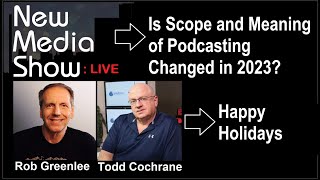
In this live episode of the New Media Show, host Rob Greenlee and guest Todd Cochrane discuss the evolving landscape of podcasting, focusing on the tension between video‑centric platforms like YouTube and dedicated podcast apps. They argue that creators can "fight" YouTube by using its bandwidth to feed video content into podcast apps, thereby keeping audiences within the podcast ecosystem. The conversation covers de‑platforming risks, the need for audience portability, and the limitations of major hosting services (Libsyn, Podbean, Spotify) in supporting video and Podcasting 2.0 features. They introduce Podcast Mirror as an alternative hosting solution and explain Podcasting 2.0's flexible enclosure tags that can carry audio, video, PDFs, and even images. A large portion of the dialogue is devoted to the "value‑for‑value" micropayment model, where listeners can send satoshis per minute, and revenue can be split dynamically (time‑split) among podcasters, musicians, and platform providers. They announce a live value‑for‑value concert for artist Ainsley Costello, illustrating how the model can fund music, audiobooks, and documentaries without traditional ads. The hosts also discuss audience demographics—young listeners gravitate toward video, older listeners may prefer audio—and set concrete financial goals for listener‑supported funding. Throughout, they stress the importance of educating both creators and listeners about modern podcast apps, the long‑term preservation of content via the Internet Archive, and the broader ecosystem benefits of adopting Podcasting 2.0 standards.
Chapters
Todd and Rob in the afternoon. Hey, afternoon delight with Todd and Rob. Oh yeah, here we are. Merry Christmas. Happy holidays. I think Hanukkah's already passed, but how are you, Rob?
I'm doing terrific, Don. How are you? It's amazing how fast the holidays are coming around on us.
Oh, it's been like, yeah, it's been crazy. And I, you know, I've just been as busy as I've ever been. And matter of fact, just before we started the show, I was telling you about some major moves going on. Yeah, Geek News Central, New Media Show, The Gadget Professor, ProGear.guru. All my sites are moving to new infrastructure. And Geek News Central is a bear to move. It is a monster.
It's been around a long time.
There is subdirectories of stuff that I actually hired someone to help do the migration. And they're like, holy cow, we've never seen this much stuff on a site. And I'm like, uh, I think 22 years, right?
Yeah.
So yeah, it was just time this to do a server upgrade, PHP upgrade. I mean, yeah, PHP upgrade, everything. So, uh, it's going, uh, to a new box. I guess that's the best way to describe it. And, uh, lowering my costs considerably.
Oh, well, that's great news.
Yeah. And I took some of my old subsites and I dumped them onto— because I got a whole bunch of stuff that's just kind of like lingering, but I don't want to kill— dump those on the GoDaddy shared hosting accounts, put them over there. But the GNC, New Media Show, uh, the Gadget Professor, the, you know, basically everything that's on the top of the header at Geekness Central, those sites need a little more horsepower per se. So we're going to a, I don't know, 16-core machine or something like that with 64 gigs of RAM and all kinds of new caching technology. And who the hell knows? All I know is the latest and greatest. Yeah. And I lower my bill by about $2,000 a year.
Oh, okay. So yeah, so that's a couple, couple more thousand you can put in your pocket maybe.
So yeah, exactly, you know, and I've been wanting to do this for a while, but it just seems like around Christmas holidays, a little more extra time to work on stuff. And yeah, it's going to be nice to get everything on brand new infrastructure, the latest and greatest operating system, you know, and all that. And not to say that's going to run any faster. I don't think that's going to be the case, but yeah, anyway.
Well, it might. It might. I mean, does it spin up instances of resources that will make things a little quicker?
Yeah, it does. And if there's like, if it's got some sort of boosting technology, all of a sudden if it needs more load, it'll add it dynamically and Yeah, you pay for that. You do. But in the end, it is, you know, because sometimes it's just sitting there, you know, puddling away. But the website still, between all of them, you know, it gets about 200,000 hits a day. And in the scheme of things, that's a lot of regular web traffic, you know. And a lot of websites, you know, they might get 300 hits a day. And so, you know, that was in the consultation with the migration vendor. I'm like, listen, this— you see the web traffic and, you know, this has got— this has got to continue to be a machine, right? And so we'll see. We'll see what happens. I might end up pulling my hair out and I don't know. Time will tell. But that's— that's what's ongoing at the moment. I think they're even in the box right now. Pulling stuff out. So not that it matters, it doesn't affect anything we're doing here.
So yeah, well, it's, it's all good to start the new year with, uh, new infrastructure.
Yeah, it's been a good thing. It's been a long time, actually. This is the first major— I think the first major move in about 5 or 6 years. Wow. Yeah, so You know, it's like most people don't hold their cars that long, let alone— but you know, the PHP version I was on could not be upgraded based upon the server version I was on, and it just wouldn't go there. So I— ah, shit. And to be honest with you, this is more of a managed platform that I'm going to be on now. I was running my own dedicated server. I'm kind of tired of getting in there and doing this, you know, because I had a whole cheat sheet of SSH, you know, tricks and things because I didn't remember, oh, how do I, you know, press down 100 times in the command letter to get to the point where, oh, there's the reboot command and, you know, there's how to restart Apache and, oh, there's how to restart the nginx and, you know, all the other crazy stuff. And I'm like, forget it. Let's just— I'll let some other young kid.
Yeah.
You know, I can yell at him in a moment's notice. Hey, the server's down.
Yeah, that's all good.
Yeah.
Well, it's been an interesting week in the podcasting space. I have to— there's lots of— I don't know if you've had time to see a lot of the—
I just been—
talk about stuff on X that was talked about this last—
I just been watching, you know, the news and, you know, I really haven't They really— it's not been that crazy if you all think about it.
Just a constant bubble of things that are going on out there that people are interested as they look at, you know, what's coming in 2024.
What were you talking about, the Alex Jones thing on X, or what were you referring to on X?
Well, I mean, I think we can certainly talk about that a little bit, but it's also, um, what Tom Webster did, you know, he put on that webinar that he put on talking about his recent research about the kind of, you know, the data that he's seeing is showing that podcasting between audio and video is kind of like a unified audience is what I thought was an interesting takeaway. It's not so much like there's different listeners or Or viewers, it's the same. They just bounce back and forth between consuming podcasts on audio and then consuming podcasts that they like on video if they're available on video. And that's what his research is showing.
So, you know, it's just, it's curious though. I wonder what the time commitment, and did they go into that, the time commitment people are given to video? Because to be honest with you, I don't know that he covered that. You know, I have a lot fewer hours in the day to watch than I do to listen.
Yeah. So I don't think he's arguing that point. I think it's more to do with that, that the research is showing that a podcast consumer is kind of, you know, capable of, you know, holding two things at once, right? And that would be sometimes watching the video and Sometimes watching the audio and you're exactly right, Todd. I think that the research did show to some degree that audio was consumed more because there's more opportunities to consume audio, right? Than there is on the video side. And that way that plays in exactly what you just said.
So should we start wearing big muffy headphones on the show? Because you know, the thing that cracks me up is like, I watched this week in particular some quote-unquote shows on YouTube that have a microphone and big muffy, right? Yeah, but most of them were wearing big muffy headsets. Yeah, I'm not a big fan of that, but, and you know, and I'm thinking, why, why are you wearing those big muffy headsets? And I really came to a conclusion. There was one show where they have 3 or 4 guests that are different every episode. So they're bringing them in and they don't have earbuds. So they just reuse, you know, the headphones kind of like we do at CES. But it doesn't make any sense to me why the host who are there every day or every other day or once a week, whatever they do and report, why are they not on earbuds.
And well, well, it even goes beyond that, Todd, to some degree. A lot of these are done in person in the studio with your guest sitting right there, right? There's, there's really not a lot of reason to have any headphones on at all because it's not like you're doing a virtual interview.
But I've been in radio stations before where—
yeah, but that's different though.
I don't think so because you still have this inane need to want to hear yourself. And just taking your earbuds out, it's not the same experience. I, I, I, I, I understand the need for the feedback loop. I, I really do, you know.
Um, number one, I mean, I think that's just a— that's just a conditioning that we've had, because my preference to do any in-person interviews is to not wear anything.
So when you were doing interviews back in your radio days, you didn't have— but how did you know? To me, I'm clued in when I'm off mic, or—
the only time that I ever wore headphones when I was doing live radio was so I could hear my producer who was running the board, or I could hear the callers that I had. But I didn't need to have headphones to hear the the people that were in the studio with me producing.
Well, I guess maybe it's just because when I go to events like CES, it's, it's god loud in the hall anyway. So we have a hard enough time hearing each other. No, I think there's a lot of background noise. So it's a different—
I think that there's, there's use cases that that would be the case, but I'm just not sure if you're doing video and you're doing audio and you have a person sitting right across the table from you on a microphone, why you have, why are both of you wearing headphones? It just doesn't. I mean, I think it gets in the way potentially. And I, it's just something that you—
for me, for me though, what I always found is when you're interviewing a lot of different people and, you know, we were literally on 10-minute points at CES and you have supposed media personalities. I can't tell you the number of times I was looking down and the person started talking about something and I had to reach over and adjust their microphone because they weren't paying attention. They were just talking and kind of off.
And yeah, certainly that is a possibility there too. It's a way to monitor the quality of the audio that you're capturing. And there are situations, and this gets back into the production, but where you're going to play a clip from something in the middle of the interview, right? That your guest needs to be able to hear as well. So if there's additional content, I'm just talking about just a conversation where you're sitting on a couch and you're across from someone and you're not going to be playing any other content. These big headphones is kind of just a habit that people have gotten into. And it's, well, I think it takes away from the video experience.
Well, you know, then that's the Rob and Todd Consulting Company here.
Hey, by the way, it's like us here. I mean, we're not wearing big headphones. No, we're using in-the-ear headphones so I can hear what you're saying. This is a virtual show. Yeah, we're not in person. So, you know, I have to be able to hear you. So. And what's the compromise there is just get these over-the-ear headphones. Right, right. And, and that eliminates the whole problem. That's what they should all be doing, actually. And a lot of the bigger, bigger shows, um, do that.
You know, it is, uh, well, anyway, it's just some observations I made.
Oh, it is.
And I was, I was just keeping—
I've been thinking a lot about it too over the last, you know, especially as we move into this new era of video. I mean, is it like a badge of honor to wear big expensive headphones or something?
I don't know, maybe it's probably—
is it a style statement? Is it You know, what is it?
It's maybe product placement too. Who knows? Well, yeah, you could certainly look at it from that, you know, because everyone's using, you know, I've got an old school Heil, you know, I got, I got one of the old ones here that never sag, you know, and, you know, we've got the Shure SMB. So, you know, should we be getting reimbursed from Shure for using these mics? I don't know.
Well, some of the newer ones have, have Shure logo right on the side.
Yeah. Yeah.
Yeah. These, I bought this microphone back in 2008 or 2009.
Tom's saying, geez, you guys get off my lawn. Don't eat me, Tom Webster. We're not on his lawn. We're just talking about the, you know, the results. Right.
And I think, you know, I think it's very interesting, you know, the conversation that happened on Twitter over the last couple of days on this topic of, of You know, thinking that maybe listeners, and we've talked about this probably too much, how listeners are perceiving the medium in the younger generation, that the younger generation is much more video-centric in how they look at online content.
Well, there's—
look at TikTok, just look at these, the popularity of Reels and the popularity of Shorts and things like that. Now video is top of mind, especially for the up-and-coming generation. That is embracing this.
Well, there is, there is a little bit of initiative over at Podcasting 2.0. Yeah, it's early on what they're going to do. And so the live thing is a big part of it.
Yeah, but not just audio.
But what, you know, the idea that's been surfaced that seems to be pretty good is, yeah, sure, Rob, uh, Blueberry supports video podcasting. You want one traditionally, you can have one. Okay, if you want one. Number 2, if you decide to put your video over at wherever it may be— Twitch, Twitter, Spotify, wherever—
no, um, YouTube, wherever you're gonna put a place, you can put it actually second in the list.
Okay, whatever. So if you want to put your video over there, you know, you can, but what we're gonna do is, um through the alternate enclosure tag, which I vowed not to support from the main purpose of it, but I can see a use case going forward where we just link to the YouTube video in the alternate enclosure. We just basically provide a link to the episode link. So then when they're in the podcast app, they can still get their audio version, or if they want the video version that's served up from YouTube, they can do that as an embed right in the app and it still keeps it in a podcast app. And we just use the bandwidth for free from YouTube and we can still run value for value against it. We can still do all the things in the apps that we're doing with audio. Just, we're just gonna use YouTube for the free bandwidth. So that in itself, if, you know, people wanna consume video on an app, they can, and that will support that in the new podcasting app. So how well—
I think that's terrific.
But the problem is, and here's the challenge, is unlike an audio file where you can set a marker, so if you're listening to audio and you stop, you can come back and pick it up. With putting in video embedded that way, there's no way to set a marker. So if you leave it and come back, It's going to start you from the beginning. There's no way to scrub it to this, at least they haven't figured that out yet. So, um, so probably what we'll do at Blueberry is, you know, from— we will allow you to link not necessarily to a media file, but we'll allow you to link to— and we'll just make it a feature called, you know, video channel or something like that. If you have a a video episode somewhere, we'll let you put the link to the video episode so that the, the Podcasting 2.0 apps can pick it up and at least display it if the listener wants to switch between. And, and we still maintain the purpose of trying to keep listeners in the app. Now they still might go over to those other sites, but if we can give them both experiences. And folks like me and us that have a true video podcast, then we can still be— so people can watch along and stop and come back and pick the show back up where they left off because the media is being served. So, yeah.
Todd, do you think that there's an opportunity for that alternative enclosure tag to have an HLS stream link?
No, that's what we're talking about.
Yeah, not, not specifically just YouTube. Well, have its own— it's on—
you'll put the link to the episode and then there'll probably be some magic that'll happen behind the scenes where we pick up the HLS link.
So, right, because, because the listener might be a way of bridging this bandwidth kind of—
because the podcaster isn't going to know what the HLS link is. We're going to have to figure that out, right?
Yeah.
Yeah. Because then, I mean, the content creator isn't going to know.
'Cause up till now it's been delivered just like an MP3 file. If you're using true video podcasts in RSS and it's downloaded the whole media file, but if you put in there an HLS streaming file, it's gonna stream it as much as the listener or viewer wants to see it. It's not gonna use all the bandwidth to download that gigabyte file.
But again, it won't set a marker because you're serving via HLS. There's no way to set a marker how far you're in.
That's the problem.
The listening app, that's what they're trying to do, but they haven't figured out a way around it yet, especially in the media server from YouTube. There's no way to set the spot, right?
So would this HLS stream potentially have to come off of a podcast host platform? Is what I'm—
Oh no, we're not going to do that. Why would I do that?
Well, then where's the HLS stream coming from?
YouTube.
Okay, but wouldn't that need to display the YouTube player app?
It's going to display the player embed of some sort. That's right.
Yeah, that's what I mean. So it's not a true link to the actual stream.
There might be some workarounds, but it'd be just like having— and YouTube has explanations on how to embed YouTube video in apps. So that's what's going to happen.
But it is possible, potentially, technically, it's possible for a podcast hosting platform to create an HLS stream.
But why would we do that? But it's, it's same cost just to have that media file as a media file. I would not create an HLS stream.
Well, that might actually save bandwidth.
But the problem is, is you're still— that's an on-demand. You got to run up a whole bunch of resources. It's not going to save money in the long run.
Okay, I would think it would save bandwidth potentially.
Well, again, if you're having to re-scrub through the content again anyway, you're not, because again, if there's not a way to set a marker— again, they'll figure that, folks will figure it out. I don't have to figure it out. All I gotta do is provide the way for someone to put in an alternate link to the video media in there.
I'm just trying to give the— think about ways that the podcaster has options, that are not YouTube.
So, well, again, then that media still has to be uploaded and served from somewhere, has to be converted.
It's— that's kind of my point is, yeah, where— I mean, is— could that be done through, through another video host platform, or—
yeah, potentially could be, you know, like a Vimeo or something like that. Well, you know, talk about that. Let's talk about Vimeo for a second. Yeah, we've been streaming this show on Livestream for a long, long time.
Or Livestream, or it could link off of like a StreamYard.
Well, it's actually Livestream is the company, the old Livestream company. Remember that? Yeah, company. And I've been using a little hardware box to do that all this time because Livestream did not support RTMP and being able to send a video stream to it. Right. Well, Vimeo is raising the prices considerably, about double. Oh, they're killing Livestream as a product. Livestream is going away. If you still have a Livestream Studio, which I have one right here on a stick, you still have one of these. And this is the actual authentication software to allow me to run the software. It's a dongle. It's a dongle. Yeah. So you'll be able to use the Livestream Studio software continued, and you'll be able to RTMP into Vimeo or wherever else you want the media to go to. But the Livestream product itself is being done away with as of 2025. So my subscription, which I pay about $500 a year to stream into Livestream and get distribution on the Livestream channel, which we have a number of folks that watch it there versus watching it on YouTube or somewhere else. So by the way, if you're watching on livestream, you got to move. You got to move because we're going to start shifting people away from livestream in early 2024 just because they're canceling the service. And whenever my renewal date is up, I'm done. And I'm not going to go back and pay Vimeo $900 a year to live stream on Vimeo when I can live stream free on Twitch, Twitter, Facebook Live, and YouTube? Why would I, why would I pay Vimeo for a public product? Yeah, so, right.
So anyway, this is going to be an ongoing conversation, I think, around this, this kind of— I don't know if it's a shift dramatically in It's not a shift. It shifted in the last 2 weeks or something like that. I just think that the shift has been happening for a long time.
But again, it's a very small number. We need to put some brakes on. Why? There's less than 1/2 of 1%. But Todd, why are we needing to put brakes on? We need to quit pumping it up. There's very few people on podcasting site that has actually switched to video. It's not that big in numbers. It's not. It's not that many as compared to audio folks. We don't have to tell them to stop, but we need to quit hyping it as this new fucking frontier that everyone has got to be on. It's not true. I would say less than 5%, less than maybe less than 3% of podcasters currently are doing any video. So we need to, we need to remember that this is a, people that are doing video is a very, very small percentage. Daniel Lewis just did a study of active shows that are on Apple Podcasts and less than 0.5% are actually doing video podcasts on Apple Podcasts. Whatever that number is of active podcasters that are doing podcasts on YouTube, again, I don't think that number makes up more than 3 or 4%. You're still primarily dominated by audio. The shows that are doing well over there on doing video are massive shows. This is not a massive show on YouTube. This is a tiny show. We get 30, 40 views on YouTube.
So— Todd, I think that the bigger, bigger question here is it's easy for us to just kind of have this historical perspective on it.
I'm not saying historical, I'm saying practical. Everyone's hyping video, but very few podcasters are doing video. It's not about being practical.
Okay, but Todd, is this about, you know, leading or being at the cutting edge or being—
We've been doing— people have been able to do video for a long, long time.
What I mean, this research that Tom did said 86% of those who watch video podcasts also listen to audio podcasts too.
That's great, but they're listening, those 86% are listening to the top 200 shows. They're not listening to the other shows.
Okay. Well, Todd, I think, I think, you know, we have to be speaking to people's perceptions, not—
Well, their perceptions. Okay. Okay. So here's, here's the, it's not about a perception. It's about fact. Go ahead. Go ahead. Fire up and do video on YouTube. Go ahead. I encourage you to go. If you're a podcaster—
I'm not advocating one way or the other here, Todd. I'm just trying to look at the market inclusively to what the listeners are looking at the market. So this content creator needs to decide for themselves.
You guys are missing my point. Beauty Bubbles said, Todd, truly industry is changing based on the presence of listeners. Okay, great. But everyone thinks all the listeners and viewers are all on YouTube.
No, I don't necessarily think that that's true, Todd. That's not the perception that I'm getting from the research. I mean, if you— I don't know if you went through this research.
We've been doing it, but we've been doing it. All I'm saying is Okay, great. People want to watch podcasts. So go ahead, create a video podcast. And then—
that's all I'm saying, Todd.
So if you want to—
everybody has to go out and create a video and a video podcast. What I'm saying is what we need to recognize is that this is a unified audience that is consuming audio and video.
I have no doubt, but we need to set expectations realistically. For the average podcaster on what's going to happen when they go invest and do a whole bunch of work on video.
Very few creators have to, have to figure that out for themselves.
But we need to— okay, if I'm sitting here and saying video podcasting is the next biggest thing and this is where you need to invest your money, I'm doing a disservice to podcasters. Well, Todd, I have to set an expectation level of what's going to happen when you do video. If you're going to do video, you have to set a low expectation for what somebody might expect, because that's what's going to happen to 99% of people. Okay.
But I don't think that we always have to be talking to the 99%. I think as an industry, we need to look at where the market trends are pushing us.
Okay. But where is podcasters seeing growth? Where are they seeing growth? In audio. This is where we're seeing continued growth. If they're going to get growth on YouTube, great. It's extra value-added audience, but it is not going to cause you to break out.
It, it very well could, Todd. I think you're, you're kind of missing the point.
Okay, great.
Content can be created in a lot of different—
show me a lot of different ways.
Okay. And some of it will gravitate more towards video. Some of it will gravitate more towards a combo of audio and video.
But the majority of people are not going to have the money to build a studio, to build a background, to build something intriguing to do on YouTube.
Hey, why do we have to speak to the lowest common denominator? We're not. Yeah, we are.
We're talking about reality.
I mean, you just said 99%. Yeah, that is the I'm gonna say that's the lowest level.
I'm saying that I'm content creator, right? All I'm saying is that if we keep hyping video, all right, I'm gonna— let's start hyping video every day. You have to do video. Then someone about a year from now is going to say, Todd and Rob, why did you tell me to do video? I've had no success on video, but I've had great success with my audio program.
I didn't tell anybody to do video time.
Okay. Well, it sounds like you are.
Well, this research is showing that.
For a segment of very big shows.
Okay. But if you look at these overall numbers that Tom shared—
That listening to very big shows. What, where is the distribution amongst smaller shows on YouTube? It's not there. Um, people are not—
I don't know that you have any numbers on that, Todd.
Well, I just—
there's no way for you to have those exact numbers.
I'm just using my show as an example.
Well, but I'm not sure that's a good example.
We're—
why not? We're meta about this medium, and the content that does well over on YouTube is not necessarily shows talking about podcasting.
I do a tech show. Not talking about podcasting at all.
Even, even a tech show is pretty— if you saw the content that's being produced on YouTube and in podcasting now, tech is very low on the list in certain circles.
But yet tech is in high demand for advertising.
Well, that's a different conversation. So it's, it's more to do, you know, like comedy, health, all these other topics of which we don't do.
So. Right, right.
I don't think we're a good example of what's, what's happening.
I'm just, I'm just— my only caution, this is the only thing I'll say about this, right? If you're going to do video and do the expense to do video and the time to do video, make sure you set your expectations accordingly. And you're going to have to have two strategies.
Yeah, but Todd, I don't think that we should be encouraging people to go into something I'm not a fail attitude.
So, well, I'm just— okay, sorry to be a negative Nancy.
Well, that's kind of how it's coming across.
Well, good, because guess what? I want people to have a realization that it's a tough haul. If you're going to go in, if you're going to, if you're going to have that conversation, I'm okay with that conversation.
So, okay, so nothing about this is easy.
So if you're going to go into pod, if you're going to create an audio Excuse me, got myself turned around here. If you're going to do a video show on YouTube, and I refuse to call anything other than that, if you're going to have a video show on YouTube, then guess what you're going to have to do? You're going to have to have a video show strategy on YouTube, and you're going to have to have an audio podcast strategy for the rest of your distribution. And if you do video, okay, If you do video, you have to be very, very careful that you will not alienate your current audio audience because they cannot see what you're talking about.
Okay. I think those are all reasonable things to share. You know, I think it helps content creators understand what the expectations are of their audience. Well, and that's key to what this research is talking about.
Anyone that thinks doing You know, it's all of a sudden, well, you know, here's what I keep hearing. I'm going to go do video because I have a bigger chance of being successful on YouTube than I will on podcasts. I've heard that about a dozen times. I'm like, good luck with that.
Yeah, Todd, I just don't think that we want to be reflective of an attitude that is not looking towards the future of what this medium is doing, because this medium has always been built on on innovation, trying new things, pushing the envelope, and not just holding on to what we've already done.
I'm not trying to hold on to anything. I'm just setting some expectations.
Okay, but that's setting a negative expectation.
Well, and rightly should be.
No, I think—
okay, how many? All right, how many?
What's different about these two mediums and how they need to be done? Okay, okay. In a way that's good for both of them. Or you need to decide as a content creator that I'm going to be primarily an audio podcaster and, you know, and I want to put out video. And if that video works on YouTube, that's great. If it doesn't, I'm primarily an audio podcaster, but I'm going to try and connect with audiences just like this research is showing in all their places in their lives that they might want to watch. Like, I watch a lot of content on YouTube on my big screen television, my living room.
Right?
So there's a place for this, and this is what the research pointed out too, is there's a, there's a place for consumption of this, uh, this medium, and it may not be all just audio.
As of 2022, there are more than 51 million YouTube channels.
Okay, as of 2022, it's not that much different than podcasting, Todd. I, I think that the distribution of success Yeah, it's not that— no, I mean, content on, on any of these platforms is a small number of shows.
So there are, there are 51 million YouTube channels. And as of—
I mean, it's a, it's a big, it's a big content area on, on YouTube where people that are experts on, on video, um, are training people just like we've done for all these years on the audio side.
In the last— let me go find it. In the last— let me look at how many podcasts, not how many episodes. Let me find it. It'll take me a minute to find it. I'm just telling— this is just the thing to remember is if, if you find you— if you're finding success on audio, you are more likely to find success in video just because you have a bigger audience.
Um, that certainly helps. Yeah, because that audience, a certain percentage of that audience, may prefer the video experience in, in certain parts of their lives.
Well, about typically for my YouTube— you're not my— excuse me, I— my Apple podcast is, I think, was the last I checked, was like 70, 30, 70% listen to the audio, 30% watch the video. But it didn't mean that they moved to YouTube. All right, so new—
Tom's research came out showing that video podcasts are predominantly consumed at home. Yeah, which I'm sure, and because you got to be offering an engaged and focused experience in contrast to the audio podcast was preferred for multitasking or on-the-go scenario. So the audio podcast portion is good for, as has always been the case, is much more kind of traveling out and about type of consumption.
Okay, so the number of shows with new episodes in the last 30 days in podcasting is 334,000. 3,334,347 in the last 30 days. So you have— all I'm gonna say is you have less competition to succeed in podcasting. Beauty Bible says faceless videos have massive audience, and although it may take out of focus forecasting to imagine a podcaster's faceless using video in the undercarriage of your work cannot be denied. I don't— why would— what do you mean faceless video? I would never watch a YouTube channel that I would not see a face on, especially in the world of AI. Yeah, you know, so what potentially could happen What potentially could happen over the next year is that there's being so much fake content being put out by AI that video will grow even more because people want to associate words coming out of someone's mouth with a real human being. I've seen some of these videos where there's nobody talking. I leave those channels. I mean, it was just someone narrating. I leave those channels immediately.
Yeah, right, because those are usually pre-scripted. Yeah, pre-scripted, AI-driven videos, right?
Yeah, I don't trust them to begin with.
But sometimes they're done by, by the podcaster. It's like they've taken an audio.
Well, you can tell when you're listening to a podcast without any face. Versus just YouTube content, which is basically what YouTube Music is embracing, right?
So when you add your RSS feed up there, you're basically just playing audio. Yeah. But it's more of a still image type of experience on that.
But, but, you know, I, I, you know, hate to be a Negative Nancy, but I'm just at the point now where when someone tells me, oh, I'm having challenges growing my show, I think I'm going to go over and do live video, I try— doesn't have to be live, it doesn't have to be live or video, you know, or video. I try to temper that expectation because there is two— I believe it's two different strategies to produce, have a successful YouTube channel and show versus having a traditional audio podcast.
I think it certainly can be. I mean, it certainly can be a different strategy, but there's nothing— I'm not saying there's any reason why you couldn't just use the same content, but I think it just depends on what the visual experience is versus how much you communicate about it.
I think anyone that's doing video first has a harder time coming to audio than audio going to video, because you're used to describing stuff in detail, as long as you don't forget that. Doing video, then you're probably going to be fine. But if you've done video the whole time and you want to come to audio, that's the bigger challenge. I think there's a huge opportunity for video podcasters still to become great audio podcasters. But again, they have to keep in mind that, you know, you, you're, you're, you have an audio audience that's listening, not— and believe me, you know, we're going to support whatever podcasters want. Well, but at the same time, I'm going to be very, very upfront in my advice that I give to people to set your expectations accordingly. Good content's good content one way or the other.
One thing that I was a little bit, maybe not too much surprised from the research, is that the The preference on the part of people that are watching video are preferring to see conversational and type of interview type formats in that area.
That I don't get. If I go to— and maybe it's just, maybe it's just me— when I go and watch content, the last thing I want to watch— and believe me, I struggled through this over the past week because I actively sought out 4 or 5 people talking. It was chaos. Most, most of it was not controlled conversations. It was just off here, there, horrible. It was just not a great experience. Okay. And so for me, it was a little bit too chaotic. So maybe smaller numbers is something I would prefer, but most of the stuff I was watching had 3, 4, 5 people.
Oh. Yeah, that's a lot.
And it was just—
that's a lot for any, any piece of content to have that many people, and especially if it's not a little, little uncontrolled chaos.
Well, you know, it was something, and they were very popular YouTube channels that were getting 300,000, 400,000 views per episode. Yeah, but it was pure chaos, and it's just like, oh my God, I felt wrung out. Yeah, yeah, I'm not denying video is popular. I watch a lot of YouTube, but I watch different— I watch YouTube stuff that is more serialized, progressive, van life folks, people are building houses, people that are self-survival, you know, stuff where there's a— I can see a progression in people's lives. It's not necessarily going seeking out people that are interviewing new people every day. That, that type of content to me, I'd rather listen when I'm rolling down the highway.
I think we have a lot more research and digging to do into this.
Um, I'll let Tom do that.
Well, and, and he is. I mean, he's, he's definitely come out with a strong position on this. Uh, is that the podcast listeners are audio and video consumers?
Well, that's great. They've been that way since 2006.
I agree with you 100%, and that's why I'm not really that gung-ho about trying to put, put the brakes on, because I'm not—
I'm not— I've never put the brakes on someone. I've just spelled out reality.
No, that's what he's talking about, is what listeners are seeing in the medium and perceiving it.
Okay. But again, so what—
and we struggle with this conversation about what we tell the content creator versus what the listener is seeing.
I know what I tell the content creator.
If you're going to do that, but, but we're, we're conflating those to be the same thing and it's not, it's not. So what the listener and viewer are seeing is something different than what we're talking about oftentimes.
No, but what I tell— no, no, the only thing I tell podcasters— disconnect, right? What I tell podcasters is, and it's very simple, be realistic in what you're going to do. And if you're going to do video, you need to have a strategy just as well as you have an audio strategy. You in there— and I believe they are two separate strategies. You need to have a separate strategy for the video content.
Okay. So you're, you're basically saying you can't create the same content and put it out on audio.
No, you have to be cognizant that you're reaching both audiences and it has to be structured such that you don't alienate one or the other. Okay. Because if you, because it's real simple. And I do it all the time myself. I do like this. I'll flip something in and it's a picture of something and I'll start talking about it. And the audio audience like, what are you talking about? I can't see what you're talking about.
We just have to tell them.
You have to remember to do that. And when you're doing video, it's real easy. —to forget.
It's kind of hard too, because sometimes— and this is the power of video that we have to talk about too— is that video communicates more than audio does. Audio typically needs to be longer to deliver value than video does, because there's visual elements. It's audio and video, which means that you can communicate more complex topics more rapidly.
Because I do a lot of news topics and some of it's science images. As an example, I say, okay, I'm seeing a picture of an exploding supernova. And it's a pretty fascinating picture. Link will be in the show notes. Make sure you go check the picture out. And I don't have to describe that to the video audience, but that's what I have to tell the audio audience as I'm going through the content. Or look at this horrific such and such, or here is a new picture of a new whatever. And I have to take time, not a lot, but enough that you don't annoy the video audience and enough that you don't know. So there's a fine line in making sure that you remember that some people are watching and some people aren't. So if you always remain an audio-first medium and remember that your medium, your largest consumption block, is going to be the audio content, and don't forget that you don't even have to remember the audio people can see because they can. So this is where my biggest disenfranchisement happened in audio is my audio audience gets pissed off because I haven't described something well enough because they weren't there to see it. And they aren't necessarily compelled to stop listening to the audio portion and go watch the video. They'll, they'll struggle through and then let me know, hey, I didn't know what you're talking about.
Yeah, I mean, I think that the research is showing that people bounce back and forth in various aspects of their lives when they want to, when they want to, when there's no reason available to watch the video, they will sometimes prefer to watch the video. I think it's the same thing with this show. I think some people are loyal to the video and And some people are loyal to the audio.
Yeah, they're a lot less.
Some people bounce back and forth between the two.
They're a lot less loyal to the video over here. I think we're 15% on this show that watch the video.
Yeah. So I think that, but that's, but this research that Tom put together is not necessarily about the number of views.
That's not what he's talking about here. Yeah.
It's more about what the perception of how people consume this content, whatever that ratio is, is going to vary a lot between content creators. It's just that it may be possible that we're leaving audience on the table by not doing both. Is that's what his bigger conclusion was at the end of his webinar.
And here's the thing that's going to happen next. It's a lot more work. Considerably more work to do video. Okay, so if you're going to add video as a component, then you have to set your own internal KPI until what that ratio is going to be for that extra time involved. Now, if you're doing— if you're doing video like me, it's an extra 30 minutes.
If you're going— I can— yeah, I mean I agree. Tom's kind of final thought in his presentation here, I can read it to you. It says, audience control and choice. The study underscores the importance of offering both audio and video options to cater to the diverse preferences of the audience, emphasizing control and choice. So that's what his conclusion was to the whole study.
But again, as a content creator, If you're a hardcore editor and you are editing, taking 2 hours to edit your audio, oh shit, you're gonna, you're gonna go mad editing video. You are gonna go absolutely crazy because cutting audio is easy. You just cut it. You don't see the jerk of the person. You don't see the movement, so you don't see the you know, you cut a section of video, it's very evident that you cut the video. So you're gonna have to do transitions, you're, you know, so if you're a hardcore editor—
but Todd, there's also a lot of examples out there of many, many, many rapid cuts to save time for the audience on the video side.
I mean, I, I know some huge channels that do heavy, heavy editing, editing on the video.
Time, time, time. It can be done through AI tools.
I know that the Descript tool has the ability. Again, time. No matter what, there is going to be a huge amount of time added to your production unless you're a one-cut, one-shot like we are, where we don't cut anything out. No. Yeah.
I mean, the Descript tool can automate that is what I'm saying.
Well, I'm just saying at the same time, time, time, time.
Well, or you could do like us, don't edit.
That's right, which I recommend at the highest level of— and to be honest, I'll agree with you, and some people don't, but honest with you, video, video can make you a better content creator. I've always said, I've always said that because you come to the table more prepared.
Yeah, I think the tension really also is around how you produce your episode, right? I feel this tension around trying to get this microphone right. So when I do, do live video, which I'm doing now, you know, we didn't even talk about live yet. So, you know, I want to get the mic kind of a little bit more out of my face to some degree. So I'm, I'm looking at ways of being able to record this without having a big microphone right in my face. So it's, you know, that's why I have it off to the side and things like that.
Well, get yourself a little lavalier.
Yeah, I've got a lavalier. It's just that the audio quality is not as good as this.
So you got to pick, get your wallet out for this new job and whatever you're doing over there and your signing bonus and pick you up a $2,000 lavalier that has the same audio quality as a SMB7.
Oh, I don't even know if that exists, Todd. So—
oh, they actually do. They're really good ones out there. I think the one I have was about $600. Oh, okay.
So does it sound like this?
It's a condenser, so it sounds even better.
It's going to pick up everything. It'll pick up everything, right? Right. Everything you wanted to and everything you don't want.
Actually, it's pretty good. Yeah, yeah, it does. It's the same thing that people wear on on stage for concerts and stuff.
So yeah, I also thought it was really interesting, his results around advertising between the audio and the video side. On YouTube, the listeners had a very negative reaction to YouTube ads.
Yeah, because they're dropping in— if they're not paying for premium, they're dropping a YouTube ad in there every 10-15 minutes.
It could be mid-roll, beginning, end, that kind of stuff. And that the host reads were actually preferred and actually enjoyed and liked. So, you know, that's a pathway with YouTube between the regular audio podcast. It doesn't bode well for programmatic is what I'm trying to really summarize.
Well, I think we knew, we've known that, and most of us are paying the $16 or $17 to have an ad-free experience. Yeah, on YouTube, right?
But that, that's not going to block out the host read. See, that's the— no, that's the thing. So you're actually paying to get an ad-free version of the video, but then you're also able to deliver post-read ads. But I—
because now I've watched so many YouTubers, and because I can see the screen, I have the— have it down now where I know exactly how to hit the fast forward button 2 times to get past their 2-minute host-endorsed read where they're talking about Simply Green or whatever that, whatever they're advertising. And those are not 60-second reads. Those are sometimes 2 and 3 minute reads. And I just bink, bink, bink, bink. And I'm, matter of fact, I can fast forward through YouTube advertisements, host reads, faster than I can.
Well, because they're usually longer, right? So yeah, they're a long time. Yeah. Plus you can through YouTube when you fast forward, you can actually visualize.
Yeah, you can visualize until you can see where the, where the clip changes, where it stops, because they don't always incorporate them into the content. They go to a different scene and then, oh, I just keep going until I get through the scene. If you're going to do a good YouTube ad host endorsement, you do it right within the content. You don't change the scene.
Yeah, yeah, they still haven't done the whole kind of instant skip thing, like Like used to be the case with broadcast TV.
Believe me, this thing works fantastic. Just hit fast forward a couple of times and you're through it.
No, but on the old TiVos, I have the little— You have a TiVo still? No, I've got the stuffed animal. No.
Okay. Do you really still have a TiVo?
No, I don't. But I used to click that fast forward button all the time. The ad skip button on my TiVo. It would automatically skip through the ad. Yeah. So, so, but we no longer have—
someone needs to make a YouTube remote that lets me do 30 and 60-second forwards.
Well, like, like, like most of the podcast apps have a little skip button, right? Yeah.
But usually my phone's in my pocket and I don't have time to— it's by the time I get the phone out, the ad's already read.
And, and frankly, that's also a reason why doing odd-length host reads is the smart thing to do, right? Because if it's built in there with 15-second or 30-second— Yeah, yeah, yeah, yeah. You don't want to do a 30-second host read or a 15-second host read because they can skip right through those. What you want to do is a 1-minute.
Well, again, I think, you know, and you're definitely— the only way most podcasters are ever going to make money on YouTube, the majority of them, are they're going to have to have their own sponsors. Otherwise, they're going to get sold around. They're going to get sold around regardless.
And right in the middle, people are doing like we are. They're buying the premium and, right, skipping all the ads, right? Yeah, they're skipping the programmatic ads.
Yeah, it's worth it to pay the— to miss that, those interruptions, right? Right. That's true.
That's true.
So, but you know, the one of the podcasts that I listened to that I could hardly handle, I don't think I would watch them on YouTube because all those ad spots they're doing every 10 minutes, you know, it— I'd have to keep my remote control strapped to my arm.
So did you see the back and forth that I had with Mr. Adam Curry? No, I did not. On Twitter about the perception of podcasting and how it's maybe changing. You know, he didn't like that too much. So, but I, you know, so we were back and forth. So he, he posted a tweet that he was taking me out of his will.
Oh, so, uh, speaking of which, right, 1,700 sats from Mike Dell. Can't watch YouTube and most airline flights are up in the, or in the UP of Michigan. 5,000 sats from Adam Curry. I have disowned Rob.
I mean, Adam, I'm flattered that you even had me in your will.
So that's all I can say. Well, he just said I have disowned Rob. He didn't say anything taking you out of his will. But if that's the case—
Well, he did on Twitter.
Oh, he did, huh? I have to go look at that. I missed it. What is he calling you, a traitor for selling out to video? Right. Exactly.
Yeah. Well, you know, trying to look at— How, you know, this is back and forth. There were some people that kind of, kind of support. I did a ChatGPT-4 question on this, and this question was, do you think this is true? The podcast name is increasingly meaning a type of online content and not a technical definition for distribution. And it came back, ChatGPT came back, uh, affirming that perception.
Oh, well, you got to be smarter than the AI, Rob. You know, AI output is meant to be edited, not to be quoted.
Oh, is that what it is? That's right.
Oh, by the way, here. So 5 days ago, Dave Jackson, 10,000 Sats from Dave Jackson School of Podcasting. Any chance you add chapters now that Blueberry has them? Hey, Dave, I tell you what, would you like to volunteer? I'd love to have someone do chapters for the New Media Show. Just need someone to volunteer so that value for value— time, talent, and treasure. We'd love some of your talent, my friend, too. If you want to be the one to come in and, and add chapters to New Media Show, happy to have you do that.
Um, well, Todd, Dave, Dave Jackson is gonna, gonna join me live on my Podcast Tips with Rob Greenlee show on, on StreamYard tomorrow night.
Okay, so make sure you pitch to Dave that we're more than happy to take, uh, have him support the New Media Show by introducing chapters. Now Geek News Central, where I actually pay someone to do this, I do have chapters for Geek News Central. No images, just the time blocks, link, and, uh, title and hyperlink. I don't have time to do images. But yes, David, you would love— if you'd like to have Blueberry have chapters, just let me know. Get your sub account set up and you can come in and, uh, and do chapters for us. We'd love to have you. So I don't know, is it— I don't know how we would do chapters with this show. I don't know, maybe, maybe I'll ask ChatGPT today during the, uh, post-production to write a chapters file for us. I'll give it the format of the JSON and see if it can look through our SRT file and see if it can come up with chapters. Maybe I can do something to that effect.
Well, Todd, we should run this show through one of those AI kind of shorts.
Yeah, more than happy to, Rob. Go ahead and start creating shorts. You know, you're more than welcome to produce shorts.
With clips of us debating back and forth these topics.
Yeah, that'd be great. Go ahead. I, I, you, you feel free. Feel free. You know, I know you've got, you got two jobs now. So what is, what is the story here? Uh, I saw this announcement. Um, what, what ex— I know you've been working with this company for a while, so what was your, what's your new title over at InSound?
Oh, it's just, uh, it's kind of a business development role. It's just, uh, help them get better connected to the podcast medium. And, and because they've got some, some very good APIs to, uh, an AI-driven backend that can do some audio enhancement and audio optimization type tooling. So if you think about like, uh, like what's going on at, at a couple of the platforms, I mean, even, even StreamYard is doing audio optimization. Right. Type of— it's basically cleaning up the audio so you can record from anywhere.
Is it going to sound like a Descript edited audio file?
No, no, no, no. It's not getting involved in editing at all. It's more around kind of sound levels and optimization and kind of taking out background sounds.
So how does it do a better job than Auphonic?
Hmm. Well, I haven't actually myself tested it against Auphonic to be able to make a definitive conclusion on that yet. It's a new— this is a newer platform. So, so I think we'll have to do some testing against it.
Right. 5,000 sats from Adam Curry. You only have one chapter. Rob shilling for YouTube.
I'm not shilling for YouTube. That's not what it's all about. It kind of sounds like that. Well, okay. If it just so happens that YouTube is the number one considered consumption platform for video podcasts, maybe, maybe that's—
It's a number one platform for consuming video shows on YouTube. That's not what Tom Webster's research is showing. Okay, good.
Great. So we must be, you know, this kind of conversation about what Tom Webster is presenting versus what the position of, of Adam and yourself and others are.
Those that are listening, I'm smiling big. I, I'm— because I'm not giving ground. You have a YouTube channel. You have a YouTube channel. You have a YouTube show.
I don't take any offense to this, Todd, because this is actually— if you go back to the very early days of podcasting, this is what the medium was all about. We were debating these issues. We were trying to figure them out. We were trying to do the right thing. For, for podcasters. But what we are evolving into is starting to think more about what the listeners care about. Okay, that's not necessarily— we've always— we've always—
has always done— I've always lived from day one, I don't care where they listen or watch. So that, that has remained the case for me from the beginning. But one thing that I refuse to give up ground on is making podcasters for my show Understanding that newmediashow.com is the place where this show originates. And if we say something to piss off anybody, you can still go back to newmediashow.com and find this show, audio and video of it, in an audio and video podcast format that no one can take away from me, that no one can own, that I, Rob Greenlee, and I own together.
And so, Todd, why, why is what we're doing here any different than anybody else?
Because what's different is I have a backup. I have a backup in that this show goes out over Open RSS.
Okay, that's the difference. Then let's promote that. That actually came up in Tom's research too. It's just that people are not as aware that, uh, you can do that.
Believe me, anyone that listens to this show knows this show is available via Apple Podcast.
Right, right, totally. But the research numbers came up showing it on the video side because—
YouTube, Spotify, and there's a podcast. There's a reason, because most podcasters are not willing to incur the expense of putting video in Open RSS, and that is probably—
a lot of them don't even know that it's possible.
I think the majority of them that look into it, some of them will look and say, oh, this is too expensive.
So that's very possible. That's true.
Yeah, because we, we don't allow anyone to do video currently on Blueberry unless they're on a pro plan. And if you're on a pro plan, they can get a pro plan. They have to be on a pro, but they pay for the bandwidth. So that is— so they have incurred expense.
So there is— well, and, and Podbean also, also supports video podcasting too. And so does Lipson. Right. So, so you do have— and what's interesting about that is that those 3 platforms were the earliest podcast hosting platforms because there was an era when video podcasts were a big thing. Yeah. I had, uh, um, Luria. On my show last week, you know, from— There's a name I haven't heard in a while. LiveStreamingPros.com. Mm-hmm. Loria Petrucci. Mm-hmm. So she was on my show last week and we talked about all these issues too. And she's a— obviously she's a video creator primarily, but she came out of that era in the early podcasting days. Right, right, right. When video podcasts do. And then prior to having Lori on my show, I had Jim Lauterbach, who was the former CEO of Revision3, right? Um, so eventually I'm going to get probably Leo Laporte on the, on the show if he's still in business.
Well, I think he is, right? Yeah. Well, they had to tighten their belt over there quite a bit.
Well, they're not the only one that's had to tighten their belt in this medium. Right now.
Well, you know, and again, so going back to the adage, we don't have to join them, but we can fight them. And how we can fight them effectively— fight who? Fight YouTube. Why do we have to fight? Well, we don't have to fight them. We can, we can use them and use their bandwidth, right? And put the video experience in a podcasting app and promote a podcasting app as the primary way to listen or watch a podcast. And if we do that, we win regardless, because we'll be able to expand the people that are listening to audio podcasts because they didn't know the content was there. And we give people the ability to watch. So instead of saying, This is much better as a podcaster. Can you imagine saying, hey, you go over to podcastapps.com, grab one of the apps. If you like to watch, you can watch. If you like listening, you can listen on the app and consume the show whichever way you desire. You don't have to promote YT, you promote the app. So that they have the experience and able to participate in the modern podcasting world and be able to get this perception, make to understand that, you know, bring it back to the apps. If you bring it back to the apps, then people say, oh yeah, I watched the New Media Show on Fountain. Oh yeah, I watched the New Media Show on Podverse. You know, I watched the New Media Show on Castamatic. They don't have to care how it's being served to them, just knowing that they can watch or listen to the podcast on a podcast app. And then you have the quote unquote white ears who have a show over there. And when people say, hey, I couldn't find your podcast on this podcast app. How come you're not over there? Well, come over to YouTube. Well, I watch my podcast on this app.
Yeah, that would be terrific.
Let's, let's make that happen. Yeah. I think if you, if we can do that, then it's a win-win for podcasters and you keep, you serve both, you serve both communities of listeners and viewers. And able to get them to, right, you know, then you, then you keep— then what, what have you done is if, quote unquote, you become deplatformed on one of these other platforms, then you just have to find a new platform or start a new channel. Yeah.
So I just saw a, a tweet from someone from the community, Mr. Kevin Finn from, from Buzzsprout. He made a comment on the thread that's been running between James Cridland, myself, and Daniel J. Lewis, Adam Curry, all those on this very topic here. And Kevin writes, um, we'll win when all the big tech platforms give up on podcasting and move on. Nothing worth debating.
Just hold tight. It's true.
It's true. There is a little bit of truth to this. I remember back in 2008, '09, uh, probably '07, '08, '09, in that timeframe, when a lot of the big media companies gave up on podcasting. They basically just eliminated all their podcasts and they said, sorry, we're not going to do it anymore. It was just a few years later, they all got back in again. Right.
So the only bad part is you're still going to be subjected to advertising when you're watching in those, well, those apps. Yeah.
What's funny about Kevin's comment here is, is that it's an interesting juxtaposition to this argument against YouTube, right? Is that we have, um, proprietary platforms have always been dominant in podcasting. Um, look at Apple. Apple's a proprietary platform. Uh, Spotify has always been a, is a proprietary platform, but yet the industry embraces that. Now, granted, it's built on the back of an open RSS standard, But still, you know, we are beholden, unfortunately, whether we like it or not, to these big tech platforms for our success or not. So if we were to lose support of all these people, what do you think would happen to podcasting?
I think people will still seek out podcasts. But again, you have to be like 2004 again, right? Well, you know, again, Apple's not going anywhere soon.
I know, I get that, but I'm just saying the issue that Kevin raises here is basically a rollback of all of the distribution progress that we've made.
Again, we don't care where they listen. Let's make sure they listen or watch in a podcasting app.
How about that as a new saying? Yeah, I'm 100% in favor of that. It's just a matter of, you know, where are all the users?
Where are all the eyeballs or all the ears? Well, again— Or eyeballs now. Someone that's watching this now on the platform that shall not be named, which we've been naming, as they're watching this right now, they're saying, Todd, you know, I can watch you on Podverse, right? Or in Fountain or any of these other apps. And not all those apps are supporting video yet. But again, no, but they could. And, and if I tell them, please go watch over there versus watching on YT. And you can switch seamlessly between audio and video. Yeah. And you can take me on the go and listen to the audio when you have no connectivity. Right. Which I still struggle with. Yeah. So I, you know, I think if it's, you know, the video stuff's not going anywhere. We know that. I've known that for 10 years.
No, and it's a generational thing that's happening now too, right?
It's the younger generation is all into video, but we, as short or long form, but we as content creators, AKA podcasters—
well, and who's our audience? I mean, what's our audience demo, right? Yeah, that's the other part of this too, right? So, I mean, if we're catering to a younger audience, we probably need to think more about video.
For catering to an older audience, it may not be as Well, but at the same time, hopefully enough people are listening to the show to say, yeah, maybe I should be promoting apps, specific apps that I can get behind that are helping to expand the podcasting space. And hopefully that will grow. You know, are we going to get 400,000 shows tomorrow? No, to support these new apps, because most of these new apps Um, most of the hosting platforms are not supporting them. Libsyn's not supporting. Yeah, Libsyn's not supporting. Podbean's not supporting. Spotify, it'll be a cold day in hell before they support. So, you know, this is where, you know, companies like mine have come in and created Podcast Mirror to give people an alternative, another place to participate and not have to move hosts. You know, if you're beholden and love your host so bad that you're willing to be left behind and not go to Buzzsprout or go to RSSBlue or go to RSS.com or go to Blueberry, one of the participating Podcasting 2.0 platforms, you're willing to be left behind, then at least consider PodcastMirror so you can at least get your foot in the door and experiment without having to be beholden and kissing the butt of your podcast host that's not advancing. Right. So, and again, I'm doing this to try to shame other podcast hosts into getting on the bandwagon here and supporting these advancements. Yeah, we're still got 2 years of time to do this, but I'm taking your customers right now because they're coming to me and moving because they want these features.
I think it's a difficult time for a lot of the hosting platforms right now. Um, just because, you know, it takes a lot of resources to do a bunch of development, right?
If you are— you have to set your priorities, right? And every, every 2 weeks I sit down with my oversight team, we look at our roadmap. Is there something that's come up that I need to interject? And sometimes there is, and very rarely do I want to interrupt the flow, but all of a sudden there's enough stuff that's moved in the space that I say, okay, this has got to move up. So that we can support that because it's not like chasing lures, but at the same time, okay, the landscape's changing. How do I stay competitive? And, you know, I've got solutions coming for video podcasters that are outside of what we already provide. So, and I'm not going to go into what we're going to do, but, you know, I'm not stupid. Um, in that regards. But I'm also going to be making sure that we try to educate the podcasters that work with us to say, okay, here's a potential future. It's up to them. They may still be beholden to Spotify, you know, they might be kissing Spotify's butt. But now, more often than not, I'm getting shows kicked today. Two shows deplatformed off Spotify today alone. Two.
Oh, you mean taken down? Taken down?
Yeah.
Taken down. For what reason? Do we?
I won't go into it. But two shows taken down on Spotify.
I mean, a real high-level view. Was it from content violation or was it topic violation? Oh, both.
Okay. So Then this customer comes to me, why, why am I been removed from Spotify? Don't know. This is what they've said. By the way, you're still safe. You're still on open. You're still on open podcasting. Your show's still online. But the 15% of your audience that you were built over there has now just had a, had an extinction event. So it's not happening in the hundreds. It's happening on onesies, twosies a week. But enough people have that happen to them and they start talking about it with their peers and on their podcasts, people might not be as beholden to some of these closed platforms and might understand the value of what the heck we keep talking about here. Right now, at the same time, it all goes back to making sure that your audience knows where your show lives so that if something does happen, God forbid, They know where to come find you so they can pick you up in a different venue. Right. And people now start complaining to me, oh, I heard 3 ads run around, around my podcast. One's competing with my host-endorsed sponsor. Well, you have no choice. For you to be on their platform, that's the price to be on their platform. And that's going to be the same for people that are on YouTube. Same people are going to be on Spotify. They're going to have to accept ads around their content that guess what? They don't like. But why? Because they have to pay a bill. They had— they just laid off what, 15% of their workforce? They got to make money. And they're going to make money around your content and you're not going to get a dime. So whose butt should podcasters be kissing? They need to take care of their audience. Yeah, they need to make sure their audience is listening in a place where they're respected. And I don't believe, in all honesty, that for— if you weren't paying for premium, do this, Rob Greenlee, cut your premium subscription and start listening to podcasts on YouTube and tell me how much, just like they found in the study, what's, what's the How's the experience? It's going to suck. Double.
Well, that's, that's what the research evaluated, right? It's going to suck. Right. Well, it's, it's mainly because of the ads and how random they are, but there is tools in the YouTube platform for you to have greater control over where those ad placements go. It's just that a lot of creators don't go in and set up the tools.
If you're monetized, those tools are not available to shows. If you're monetized, correct. The shows, if you're not monetized, they just drop it wherever they think they should drop it. Right, of course. And that's gonna be 90, probably 94% of all shows on YouTube are not gonna make a dime and you're gonna have a disruptive experience over there. So, are you worried about your audience having a good experience? If you are, you educate them during your show, this is where you go to have an ad-free experience, if you have no ads in your show.
Thought I also heard that from, uh, from a really big kind of, kind of YouTube creator, um, who's pro-podcasting as well. I mean, he shared an interesting perspective on this, and maybe I've mentioned it in the past here on this show, but one of the reasons to submit your RSS feed to a YouTube type of a platform would be, uh, as an archive.
No, on the audio side, no guarantee. How do you get your— okay, how do you get your, how do you get your media out of YouTube? How do you download that? Let's say stuff goes sideways, your host goes out of business, and you've submitted that to YouTube. How do you get your audio out? You can't download that media.
Okay, well, there's two ways of looking at it, right? You can continue paying your hosting platform for perpetuity into, you know, even past your lifespan, right? Or you can put it up there and it will always likely be available. For someone to consume or for you to share with your—
there's, there's been always options for people to archive their shows. Internet Archive is a free place to go drop your media and make sure that your media stays on forever. The, the Wayback Machine, is that what you're talking about? No, Internet Archive. Uh, that's the same thing. Is it the same thing? Internet Archive is the place to go put your media. Over there, and I don't even know if you have to create an account.
Okay, but they've been under threat the last 6 months that they, um, do you think YouTube is going to keep all or funding to keep the service alive?
You think YouTube is going to keep all this content on there forever?
Probably longer than your hosting plan would if you decide. Oh, that's true.
Making, making episodes. So as a reminder, the first live value for value concert with video in 2.0 apps is happening, I believe, starting today at ansleycastello.com. A-I-N-S-L-E-Y castello.com. This is going to be the first live concert using value for value and podcasting 2.0 apps to monetize and be able to reward Ainsley for what she's doing in Time, Talent, and Treasure. It's a big deal. They've been working— a whole bunch of people have been working on this. So go to ainsleycastello.com. As a matter of fact, let me load this and see what the, uh— and again, these are going to be in the Podcasting 2.0 apps. It's going to be streamed live. Let me bring this up.
Oh, Todd, I did see a comment from a poster on Twitter from Podtastic Audio, and the comment was, maybe we need a new term, podcast classic.
Okay, well, whatever. No, this is, this is not podcast classic. This is podcast original. So, um, again, go to the podcasting apps at podcastapps.com and, uh, you can get involved in this. She has great music and she's one of the folks that has realized— and here's the thing, here's about diversity and podcasting and something that we need to remember And one of the reasons why I moved off my high horse on alternate enclosure, including an HLS link, is that a podcast can be a— an enclosure can contain audio, video, PDF, a Word doc, almost any type of an attachment per se. It could be a—
it could probably be a photograph too.
You could be a photo. Yeah, so it's just that there's probably not any viewers that will support it. So while we say that, let's think about one step forward. Music— an artist like Ainsley Costello can put up her album and all of her tracks and put them up in an RSS feed, just like a podcast, but it's a music show. It's an album. Right. And she then can assign, and she has, I believe through Wavelake, she has assigned a basically a value for value node so that when people are playing her music with, and this is something we just introduced at Blueberry as well, something called value time splits. So if we're, you Rob, you and I are doing this show and I cut to one of Ainsley's tracks, one of her PodSafe music tracks, and we play it during our show, I can switch out the value block so that during the time her show is playing, I set the percentage that goes to Ainsley versus coming to us. So right now our split is 50/50. If I set the value block for Ainsley to be 90%, you and I would split the 10% that we would get of that 90%, and she would get 90% during the time her track played. So this is where podcasters that are doing music shows, like Adam and others, are doing music shows is where every time they play an album, the artists are starting to earn money from the audience that's listening to the shows that are using a new modern podcasting app. And here's the thing to think about. I think Ainsley said that last year she got $80 And they don't quote me on this, but I think this is a rough number. She got $80 from Spotify for a whole year of royalties. And thus far, in a value-for-value model, she's gotten many quadruples of that from people that are playing her music in their shows that are participating in the value. So maybe you send as an individual, like today, people have been streaming to the show. As an example, we've been getting 1383 sats, we've been getting 5 sats, 1050 sats, 50 sats. People have been sending us by the minute as they listen to the show today live. They're sending us streaming sats. So if you're participating in this and you're sending streaming sats to the people and that you're listening to, What you do is you give value back to that artist while at the same time, and this is the thing we have to not forget, we're sending a split to the Podcast Index. We're sending a percentage. Blueberry gets a percentage because we're providing the integration to do this. You're getting 50, I'm getting 50. There's a couple other people in our value block as well that earn Satoshis when anyone sends to us. And ultimately, the apps get a percentage as well. So when the apps are the Podcasting 2.0 apps, when you're using one and you're participating in value for value, the apps are taking 1, 2, 3% as well. So instead of paying $4.95 a month to an app, you might, in the number of podcasts you listen to, you might send $5 or $6 in a month and just whatever value for value percentage that you have sent to other people, the app is now self-sustaining. So this is the thing we have to remember about this whole pod. Yeah, we have to remember this about this Podcasting 2.0 stuff. It's not just helping the podcaster. It's helping the whole ecosystem. The whole ecosystem's being helped. Right, right. And so this music, so let's think about this, this concert that's going to happen. But what happens when we start now having audiobooks? When people are putting up one-episode documentaries, there's a whole stuff, the whole ecosphere of podcasting grows besides Todd and Rob and Geek News Central and Podcast Insider and The Feed and everything else that's out there, the 400,000 shows that have put out a new episode this last month. Ecosphere now can grow to other forms of media and earn money. And at the same time, there's no gatekeepers. And this is a whole new ecosystem that if we embrace it and quit worrying about YT and let's use their bandwidth, sure, let's use their bandwidth. Let's stick their video, let's stick the video in podcast apps and use their bandwidth and they pay the bandwidth fee instead of Blueberry paying the bandwidth fee. I'm all for that. Mm-hmm. But let's not forget that there's a whole ecosystem here that has a potential to change the whole discussion where people screaming about making money and not being able to support the show and grow their show. It's here. We can do that right now. Right. You know, I haven't run the numbers again, and I need to run them. I should run them here at the end of the year. But Blueberry Podcasters have already earned collectively over $10,000 in this new ecosystem. Mm-hmm. So that's— and there's no advertising. There's nothing—
a good example of what you're talking about is this new platform that Sam Sethi has been working on.
Yeah, Sam's involved in the same thing, same model.
Yeah, he actually just changed his PodFans name to True Fans. Yeah. And that's to incorporate a multimedia platform, right? So that has audiobooks, has other types of content in there, not just podcasts.
So what Sam's doing with a website is also moving into all these apps that are embracing what we're doing here.
So we're over time. Do a screenshot on this or, or a screen share of Sam's site.
I can bring it up. Oh, you can? Podfans.
What is it now? Uh, podfans.fm.
It'll probably redirect, won't it?
Oh yeah, I would just go in truefans.fm. Here.
Yeah, he's, he's rebranded, right? So here's one thing Sam needs to understand, um, Sam, you got to give them above the fold, baby. Gotta, gotta get people to understand what's going on here. When I come to your website just like this, I'm— I have no idea. You got to get some interactivity going on here.
So where are you landing on there?
Because that's not what I'm seeing, uh, Let me try that again. Oh, here it is. Yeah. So they've got the Anzi Costello live thing right on the website.
Oh, so I must have been— Yeah. And we're actually on that same landing page.
We're showing up as a live show. As live right now. And then Geek New Central later, just next. Where are we at live right now? Are we— Oh, we're showing up on the same menu as live right now.
Scroll down. Right. Yeah.
It actually shows that we're finished. Oh, that's— yeah, because we went over our time. So Sam doesn't look for the ending block. Oh, okay. He doesn't look for the end signal. He only looks for the, the true time. We're already over by 4 minutes. Yeah, that's right. So I got to open up that gate a little bit.
But, um, but anyway, so yeah, yeah, so it has all sorts of different kinds of content in here. Yeah. Audiobooks, it's got podcasts, it's got live shows, it's all sorts of stuff. So this is— YouTube Central.
Yeah. So this is where we have to understand that we get so focused on what the big boys do, we forget that—
well, there's just so many billions of consumers of content that are on those platforms. It's, it's really kind of almost impossible to ignore them.
But okay, I'm not saying to ignore them, but we have an opportunity to educate them. Educate who?
The listener?
The listener? Yeah, the listener. So if I— people are watching us on YouTube right now, you know, we've talked about all this, right? And if they, if they value the content that you and I produce, stop listening on YouTube, go and pick up one of these modern podcast apps at podcastapp.com and listen to our show on those apps and support the show with value back by the minute, 10, 20, 50, 100, 1,000 satoshis a minute as we're live or when you're listening to us on demand. And what you have done is, is I'm not monetized on YouTube. But you can support the show monetarily by using one of these apps and getting involved. And if you get your show set up, we'll do the same. We'll listen to your show and stream Satoshis back to you and boost you like what happened earlier in the show. This is the thing that I don't try to get on this high horse very much, but I think You know, we look at this, oh, this big shiny thing that maybe you're going to be able to become monetized over there where you can be monetized right now on Value for Value and probably make more money than you ever make on YouTube until you hit it big on YouTube and build a channel that can get monetized. And then you got the best of both worlds. Right.
I mean, I think it's an ideal world. Totally agree, Todd. It's just, how do we get there with a lot of content creators and a lot of viewers that are, you know, education, education, education, education. That's a long— I mean, we don't have the budget.
No, it's a couple of years. Google has, but if, if 10% of the people that listen to the show, right, start talking about it on their shows or training their audiences on their shows, then it's, it's, it's the 6 degrees of separation. We're going to get there, but we have to start now. Most of the new— we are, aren't we? Yeah, most of the new podcast apps are on Gen 2. They're getting much better, they're getting much more cleaner, you know.
So, you know, but the question is, what's the adoption at this point of—
it's small, it's small. But here's the thing too, right? How many emails has this show gotten in the past 6 months? 1 or 2. How many boosts have we got today? We've got 1, 2, 3, 4, 5. 5 boosts today. 5 direct messages to us while they listen to the show live. Now, when we were off the air, we got 1, 2, 3, 4, 5 comments while we were off the air. People boosting when they were listening to the show when we weren't on the air. So for one show, essentially getting 5 from the previous show and 5 for this show, a boost that have come in. For most podcasters that get no feedback from their audience, a single boost of 1,000 sats is like, wow, someone's listening. Someone's giving me feedback. So yeah, again, it's a different mindset and you can do video.
And it is. I mean, yeah. It's, it's the typical battle of, you know, uh, David and Goliath, right?
So it's not even that. It's just right now it is an education movement. We just, we have to educate and make people understand over time. Over time, there can be, you know, like, what do I have a goal for Geek News Central? I just set a challenge on the last episode. My goal for Geek News Central, because there might be— I've seen a shift in some stuff GoDaddy has done in the way they're presenting deals. I have a little bit of concern. So what have I said? Okay, is if this party comes to an end, then I need $3,000 a month in listener support. That's what I need. That's so the goal in 2024 is to have 1,500 listeners provide value at $2 or more. And if people want to give me a donation of $1,000, you know, that, you know, all we need is 36 of those to get to reach the value for the end of the year. So what do I want? I want to build the value to get it. Value for value is not going to probably bring that to me in satoshis. But through traditional donations, I feel I can get 1,500 listeners to give a minimum of $2 a month, and hopefully more if I'm giving more value. So I've never had a dedicated time to say, okay, all right, we're going to try to get to $3,000 a month in earnings. Now, if we get some benefactors that come in and start writing checks, That's great. Yeah. So, all right, we're really long, so we've had a lot of people on YouTube today. Yeah, that's good. And, and I think most of the Facebook audience has abandoned us. We've had a few people on Facebook, but yeah. All right, everyone, uh, we will— are we gonna— yeah, I guess we can be here next week. Are you going to be around? Yeah. Oh yeah, I'll be around. Okay, so definitely another show. I can do 27th, and I can do a show on the 3rd as well, but the following week I'll be in Las Vegas for CES. So— oh, that's right. Yeah, it's coming up here. So the week of January 7th I'll be in Vegas, but other than that, okay. Uh, geeknews@gmail.com at @geeknews on X, @geeknews at geeknews.chat on Mastodon.
I'm just @RobGreenlee, same place I've been for a long time, all the social platforms and even on YouTube. And then, yeah, so, and I do a live show every Thursday night at 7 PM Eastern, 4 PM Pacific called Podcast Tips with Rob Greenlee, and I have Dave Jackson on with me tomorrow night. So come by and check out that conversation. It's going to be live with Dave. He's always entertaining, and I'm sure we'll talk about some of these topics as well.
Have Dave give some of his time and talent to doing chapter files for us.
We would be appreciative. Yeah. Well, he's also a firm believer in live as well as You know, we both used to compete with each other on Saturday mornings. Now, since we're Wednesday, we're not competing with him anymore. And him and Jim are going crazy on Saturday.
So that's all good for them. I sleep in on Saturday now. I don't get up at 5 a.m. to do the show anymore. Right.
Well, you wouldn't have to do that now because I'm on—
I'm in the same time zone with you. I like my weekends off now. Right.
I think we've gotten used to that. Yeah. All right, everybody. Anyway, robgreenlee.com, you can find me over there. If you want to send me an email, just robgreenlee@gmail.com. So I've got all the Rob Greenlees out there. I think I'm the only Rob Greenlee in the world.
So there you go. At least one as tall as you. All right, everyone. Everybody take care.
More from Rob

Future-proofing with Delphi AI/Human clones: your podcast as a personal LLM | New Media Show






How sports reveal what AI spectacle gets wrong #Technology #Sports #Commentary



