Is YouTube & Video Podcasting the Future? | New Media Show Live 5/1/23
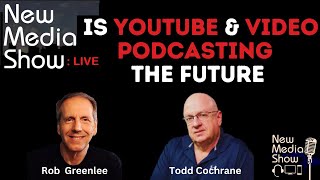
Todd Cochran and Rob Greenlee trace podcasting from 2005 to now, watching bandwidth costs plummet while labor and overhead soared. They see video podcasting and YouTube as the future, but question whether the economics work when studios cost more than servers ever did.
Chapters
In the afternoon with Todd and Rob, baby.
Welcome to the New Media Show, where each Wednesday at 3 PM Eastern, UTC+4, Todd Cochran and Rob Greenlee take their over 30 combined years of leadership in the podcasting space to discuss, dissect, and deconstruct the current podcasting news, forecasts, trends, and predictions. Now here are your hosts, Academy of Podcasting Hall of Famers, Todd Cochran and Rob Greenlee.
Hey Rob, we're gonna have to update that intro to almost 40 years here in a few months.
That's true, and I guess it depends on what you want to include in that, right, as far as doing this kind of stuff. Well, it wasn't called a podcast.
Okay, well, you were a radio dude, so technically—
yeah, I was, but I also, I spent a lot of time with the online distribution side of this since day one.
It wasn't a podcast though, so come on now.
No, it wasn't a podcast, but it was the same exact thing that I did when it became one. Oh, okay.
Well, you can, you can say so many years in radio and so many years in podcasting, and, and by the way, Um, don't eat me, James Cridland. I don't care what he says the anniversary date is. It is— we, we are fast approaching our 20th year in podcasting. I'm sure, you know, it, it is some— oh, it's already 20 years? Well, uh, no, it's, it's not.
Yeah, and there's a whole kind of project that's been started, has been worked on for the last few years about really documenting the history of podcasting. I'm going to be doing an interview for that, um, that group here soon.
Yeah, same with me.
Wants to really, really document the real startup path of this medium.
So yeah, and not besides the one person that had coined a word or, you know, so right.
Yeah, you know, I think it was a messy beginning. It was a messy beginning. Yes, let's just put it to you.
I think we could probably say about now you know, you know, maybe another month or two, it was 20 years. But yeah, I don't know. Yeah, well, again, uh, it's, you know, who cares amongst friends if it's, you know, 3, 4 months difference? I know, I know what I consider to be the beginning, and I guess, uh, I'm gonna stick with that. So anyway, here, go ahead.
I guess it just depends on what you define as what the beginning should be, right?
Yeah.
I mean, what aspect of the development of this medium— there was also a lot of precursors to this medium that were doing essentially the same thing. It just wasn't RSS-based.
Yeah.
So, you know, is that, you know, transferring a media file from a computer to a portable device, is that considered to be what podcasting was back then? I You know, I think if you went back to that definition, it opens it up quite a bit. But if you strictly stick to the RSS distribution side, yeah, there was a clear delineation of when that started.
RSS, baby. Right. So, so I'm— we're doing the show early because I'm trying to get on the road to Chicago and going to get in and then tomorrow. But really, the only reason I'm going into Chicago today is I'm just concerned if these protesters get weird. At least he gives me— it gives me— walking the roads and the freeways and stuff gives me enough time to get into O'Hare without, you know, stressing it. So, you know, maybe all for naught, but you just never know when they decide they're going to block the roads. Um, so that's the, that's the plan. And, uh, about 5 o'clock tomorrow afternoon I fly to San Francisco, then at about midnight to tomorrow night, I start the 15-hour— oh yeah, 15-hour flight to Manila and get into Manila Saturday morning, which is kind of because, you know, you gain a day. And 6 AM Saturday morning, and then I'll have a chance to, I guess for better words, adjust a little bit and work Monday and Tuesday, and then Podcast Asia on Wednesday., and I am going to stay there and work Thursday, Friday, and then fly home on the weekend. So, and that's the beauty about going to Manila, it's so cheap. Uh, my entire hotel stay of 6 days or 7 days is like $225.
What? That's like what you normally pay for one night, right?
So You know, it's not, it's not like, uh, you know, I'm spending $200 a night for a hotel room. Now, of course, I'm not staying in Manila the whole time. I'm moving outside of Manila a little bit, so it gets a little cheaper. Inside Manila and Makati, it's, you know, probably like $70 a night or something like that.
But still, you know, I think what probably hits you is the airfare getting out there.
Yeah, the airfare is, uh, about $1,400 round trip. So not, not as bad, you know. And believe it or not, you know, in the end of May, the, the flight prices go dramatically up for Asia because the, you know, they travel on the summer as well.
It's a holiday. Yeah, travel time, right?
But they're in the middle of El Niño out there right now, and Central Manila has seen 40, 40 Celsius which is over 100 degrees during the daytime. So I'm not necessarily looking for that. I'm hoping, you know, the rainy season starts like in July, but I'm not going to— it's probably just going to be hot, hot, hot, hot. So yeah, and then home for a week and then off to London. So talk about two stark differences of of climates. So we're ready for the podcast show. We've sent in our booth design to be printed. They're saying 15,000 people now. That's what I saw in some publicity piece. I think it was James promoted that, said it was 50, but they're expecting 15,000.
At this Asian conference?
No, at the podcast pod show.
Oh, at the pod show.
Okay. Yeah, 15,000.
Wow, that's a lot.
Yeah, I, I heard 5,000.
If it's 15, I don't think the venue will hold that many people, actually.
Well, I'm— it's just, there's just two of us going. If there's 15,000 people, we're going to be 15 deep.
Uh, yeah, because I think when I went, uh, I think they, they were averaging close to 5,000 a day.
Oh, well, that's different.
And well, that's how they count over there.
So keep that in mind. Oh, by the day. It's the same people coming back. So.
Well, I know, but they count it twice.
So. Oh, that's the tricky thing that they do. Oh, okay. Well, that's like 15,000.
Yeah. So it sounds like probably twice as big as it really is.
But it's really just 2 days. So they're expecting 7,500 a day?
Well, because they also sell single-day tickets. So that's the other difference about this event. It's not like you buy one ticket for the whole thing.
Yeah, that's— that's—
you can come in and buy like the first day or whatever, and that's it.
Yeah.
So, so when they count, they count each day as kind of its own separate thing because they do that.
All right, well, still, even if it is truly 5,000 people per day, that's, that's a great number. That's bigger than the show here. Right.
Right. So it'd be about, what, 7,500 per day, which is about 2,500 more than the first year.
Yeah. That's, that's a huge— that's still a huge number.
That's as big as Podcast Movement, just the increase.
Oh, it's bigger than Podcast Movement by several degrees.
Oh, yeah. Well, yeah, I mean, I guess it depends on which event. I think the main Podcast Movement is around, what, 2,500, something like that.
So when you were there, was the show floor just absolutely wall-to-wall people? Was it 5 deep?
Yeah. And actually, I would say most— well, I shouldn't say all, but I'd say probably 75, 80% of all the booth space was taken. Yeah. Even the first year. Yeah. I didn't go last year to see what the sellout is. But, you know, that is the— I think in a lot of ways from what I saw the first year I went and then what I've seen with the pictures I would say that's the predominant podcast event in the world right now. I think it's clearly surpassed Podcast Movement as the most significant podcasting conference.
Yeah. So I actually, you know, we're not ashamed to say it, we, you know, we decided a little late to get involved, but we got a great booth space, don't get me wrong. But the, so we actually paid the fee to actually have a session. So I have a session on Thursday near the end of the day. Not the best time to have a session, but, you know, otherwise we wouldn't have had one whatsoever. So I'm going to be talking about, uh, I think— what was the title? I shared with you the title here in a second.
Where did they put you for your session? Um, was it up, uh, around the perimeter, um, that second level or that third level up?
Yeah, let me look.
Um, so I know that, uh, YouTube had a bunch of sessions that they had in like, um, walk-in, like, office-type meeting rooms and stuff like that.
Larger meeting rooms. My, my title of my session is Beyond the Visual: Mastering Multimodal Podcasting, and it doesn't say where 3:50 to 4:30. So I don't even know where to find where it's actually at.
Yeah, I saw the tile that got put up promoting your session. Oh, oh no, your session that you're doing at the Asian event. Yeah, yeah. Is about kind of video podcasting, right?
Well, it's basically, um, why you should consider video. But I'm going to be— you can imagine I'm going to, you know, I'm not straying too far from where I, where my roots are. And, you know, I'm going to talk about, you know, why, why you should consider and, you know, what you should expect and the realities. And we're going to— I'm going to talk about Spotify and what they don't do, how they don't support Open RSSN video. I'm going to talk about YouTube and how they don't support OpenRSS on video. I'm going to talk about how they only convert audio to video. And then I'm going to go talk— I'm just, you know, I'm going to lay this all out to demystify, you know, to stop some of this hype that's being spread that can't be backed up by actual data. And, you know, we've looked really, really deep. Into, you know, about 500 shows deep in a lot of categories. And, you know, we come up with this handful of shows that are doing good on YouTube, but everything else is crickets. And again, it's going to continue to talk about the, the, I guess for a better word, And I'm going to do a little bit of this in London too, as I think people need to take a little bit of a step back and really consider what is possible and what, you know, and to have a good plan. If you're going to do video, then let's, number one, let's do video right by having it available via OpenRSS. And number two, Let's make sure you do wide distribution. You don't just do YouTube. You can do Rumble and you can do Twitter and you can do Facebook and make sure that you have a broad video action plan and that you also plan that if you're going to focus on video, then you better focus on being a YouTuber and not a podcaster. So, you know, I'm just going to break out realities and I'm going to lay out— I mean, I've done some heavy research to give some actual numbers that we're actually seeing in the space and to dispel some of this, some of this PR machine. And again, not saying that people aren't being discovered. I'm not saying— I came up with something interesting, Rob. Let me share this quote with you. And it's— and I think a lot of people will agree. I got to get the presentation opened up. I'll tell it a secret slide here. And I thought it was pretty good. I thought this was a pretty— hang on, let me, let me, let me read what I've said here. Podcasting on YouTube is essentially a channel featuring content styled as a podcast. Podcasting on YouTube is essentially a channel featuring content styled as a podcast. There's nothing— that's pretty true. You know, we're on, we're on YouTube right now, two dudes and two microphones and, you know, fancy backgrounds.
So, yeah, I mean, it could be true from a certain perspective.
Oh, that is not the perspective. That is the— I think this is what's driving the, the numbers?
It is, it is certainly part of that. I agree. It's the, it's the perception that people are having about what the content—
right, right, what the listeners are perceiving.
Yeah, that's what the research is telling, right, right, that people are seeing these shows like this one, right, is a, is a classic example of a show that looks like a podcast and it sounds like a podcast, um, and it this show technically is, right?
Right.
I have our shows that are not.
I had a major, major meeting with a very, very, very big company this week that basically we're trying to figure this out. And when I explained to them, you know, here, because they work in a space that is tied to RSS, right? Everything they do is tied to RSS. And I said to them, I'm like, listen, the adoption of video within RSS is relatively small. There's a small number percentage-wise of shows that are doing true video, you know? And I said, so you have, there's no reason for you to retool, rework, recode your platform to support video in Open RSS. I said, if you want to, you can, but here is the, here's the field of shows that are actually distributing, and I have the exact number. I'm not— you guys, someone else can go do their own work. I have the exact number of shows that are doing video on RSS, and I said, for this number of shows, do you want to do all this work And I said, you can't touch YouTube, you can't touch Rumble, you can't touch Twitter, you can't touch Facebook. You have no inroads into those platforms. So those, those folks that are AKA so-called podcasters, you can't help them. Oh, so you have a major company that is trying to make a determination whether they should retool some of their tools for video, and you tell them it's not being driven by OpenRSS, then they go, ah, aha.
Todd, I just worry that we're spending a lot of time doing this, but really what we're doing is we're trying to kind of dispel people from doing something that maybe they feel already compelled to do?
Oh, I don't. I just want people to go in with their eyes wide open.
I think that's reasonable, but clearly the trend lines are pushing this direction.
But if you look at, if you look And I tell you, I challenge you, I challenge anyone, go look at the 500 top shows in every category in Apple Podcasts.
Yeah, but Todd, it's not about where it is today. It's about where it's going.
Do you want— I'm not giving up the farm for YouTube that doesn't care about—
I don't think you have to do anything. Oh, it's—
I mean, this is what people are being—
I mean, are you gonna change, change what— no, YouTube does—
no, but I can, I can tell, I can give—
can't change the trajectory.
Okay, so yes, yes, we can. We can inform podcasters. Yeah, we don't have to sell out. Do you think podcast— do you think YouTube gives a living crap about RSS? No, they don't. They don't.
And you know, okay, but that's not an important discussion.
Okay, well, guess what then? If you want to protect podcasters, then you quit telling them to start doing YouTube.
I'm not going to tell anybody to stop doing video, Todd, because I don't, I don't really have that choice. I mean, people are seeing the trends in the market.
But the problem is, okay, okay, who's paying for those trends?
Hey, but trends have always driven this.
Who's paying? Who's paying for those studies? Who's paying for those reports? You're— and you don't— it doesn't break into reality. This is the problem. There's a lot of, a lot of bullshit being spread about, oh my God, video is taking over and you are going— you have to do video. Wrong.
Because I don't think anybody said you have to do video.
Okay, this is the message.
That's your—
oh, you look at all the forums, right? I need to do video. I mean, yeah.
It comes across a little hyperbolic and hype on your side to say that.
No, it's not. It's, it's what I, what I'm telling people is I'm just going back to the thing is you have to have a reality check that maybe go ahead, do video. Right. And then don't come back to me crying and said, I spent a bunch of money. I spent a bunch of time on equipment. I spent a bunch of time editing. And I've gotten no traction. Because for about 95% of shows, that's not gonna change. They're not going to. There's 110 million, 110 million YouTube channels. Mm-hmm. Yeah. With 3.9% monetized. Okay.
I don't know that that persuades me in any particular direction.
What is the goal? What is the goal? That's exactly right. That's what I ask podcasters. What is your goal for your show?
Yeah. And that's my position on this is that if you want to create content that caters to the full spectrum of people's interest in content consumption, then you, you should consider video as a, as an additional layer to what you're doing with your audio show. I'm not trying to dissuade people from doing an audio program. That's exactly what I want them to do. But it's, it's more to do with the younger generation is pushing increasingly on, on video. Well, however that gets supported and We can have a say in this, Todd, to some degree of an influence on how video is embraced in, in the context of the podcast medium.
Well, we will leave the lights on for you because the trend, the trend is simple. They're going over to YouTube channels. They're not doing podcasts. So great.
That's, that's because the industry has, um, has dissuaded people from doing that. It's not that you don't support video podcasts on your own platform.
Yeah, we do. We've supported video podcasts for 16 years.
Right. Right. And the only reason really, I think at the end of the day that that got suppressed was because of YouTube in the early days, plus the cost of bandwidth.
Of course.
Those were the two factors that drove all the video podcasts into YouTube originally, right? Many years ago. But two things are different. The cost of bandwidth is dramatically less now. The expectation of a new upcoming generation is that they want to increasingly experience video experiences, whether it be short form or long form. We're seeing that in the trend lines, but yet there's still huge adoption for audio too. So all these things can be moving in a direction that we as an industry need to decide if we're going to embrace the future or are we going to hold back the future.
We don't— we've already embraced video as supported within. Yeah, but it's within—
open. Yeah, it is the level that it probably should. I mean, I, I reached out to Apple and asked them why they have depreciated the exposure of video podcasts in their platform, because they used to have a tab at the top of the screen that enabled you to throttle back and forth between—
because the majority of content being consumed on the device at the time.
But it's a chicken or the egg thing, right? It's like once you suppress that, then people aren't gonna find it.
About 9 out of 10 times when I—
Post it again, then people will find it again, and then it will become popular again.
But about 9 out of 10 times when I show the Apple Podcast app or a Podcasting 2.0 app that they do video, people's mouths drop open.
They go, "Wow." Well, that's entirely my point, Todd, is because Apple has depreciated that feature, That's in the platform, has been in the platform since what, 2000?
Since the beginning, as far as I know.
2006, 2007 timeframe. And it's been there forever. And the early days of this medium was probably 30% video and 70% audio in the early days of this medium. Now it's probably, I don't know what the percentages are. I haven't seen the numbers of video podcasts. That's RSS distribution. And then layer on that, on top of that, Todd, is the development that we're seeing with the Podcasting 2.0 standards supporting the integration. You know, Captivate just announced this past week that they were going to embrace—
So Rob, did you not know we already did that?
Well, okay. I mean, I'm just saying that Captivate announced it. So it's not just a, a, a myth or a fantasy that this is becoming important to podcasting. It's actually being deployed in RSS.
But the problem— the failure Captivate has made, in my opinion, is they have basically licked YouTube's butt instead of offering a video podcast option for their platform. And they've sold out.
I don't disagree with you.
They've sold out to YouTube. So challenge laid down. Yeah.
I mean, I agree with you on that. I think, you know, if we're going to go down this path, we as an industry need to talk about the video podcast part.
And Mark, don't take it the wrong way, by the way.
That needs to be— that discussion needs to happen with Apple. It needs to happen with Spotify. There's no reason why Spotify couldn't take in video podcasts into their platform. Because they're taking in audio today. Yeah.
Well, they're being buttheads. That's why.
Well, because it hasn't risen to the level in the industry of discussion that that would be something that they would embrace. So, you know, it's the chicken or the egg thing here, right? If we suppress this, then it's not going to blossom.
I'm not suppressing video. I'm supporting open RSS and video wholeheartedly. I just want to make sure—
That's great.
I want to make sure—
Let's talk about that. I mean, how do we make open RSS and embrace of RSS in the ways that people are using video today to make it all work, right?
It works. The show's been doing it for how many years?
I know, but it needs to work better.
I think I—
to what degree on that?
To what extent?
I just shared it just 10 seconds ago. It works. It's Apple embracing audio and video.
We don't have— okay, so again, Apple's not going to do it.
Also Spotify being able to take in video podcasts just like they do audio podcasts today.
But they won't. They have a— yeah, we do. They have a financial reason not to do it.
Well, then maybe they should just drop all podcasts.
I think that would be great.
Really? You really honestly believe that?
Yeah, honestly. I wish Spotify would go away. Really? Yeah. And I know a lot of listeners don't like that, Yeah, I don't—
I mean, you and I both went through the early days of Spotify coming into this medium, and I don't think you really want that, Todd.
You know, we all— and we all basically got screwed by Spotify. So, you know, there's not—
that's a separate conversation.
It's not a lot— a lot of love lost there.
Yeah, I mean, that's a separate conversation about how they come into the medium, and it was a train wreck on the way in. So—
and a lot of us that were in the hosting businesses felt like we kind of got Anita says, why is the image of podcasts is for old people and YouTube and TikTok for young people? That's not true. Not at all. You look at the—
well, TikTok's probably not gonna be around that whole lot longer. Yeah.
But yeah, TikTok is—
we'll see on that.
TikTok has said they're leaving the US market.
So, and I did see that Tom Webster posted publicly on social that TikTok's not going away. I thought that was interesting.
We'll see. The TikTokers aren't hounding. They have— there's not been an outcry, but there has been lots of articles about people moving their strategy away from TikTok and going to other platforms that are US-based.
So to kind of draft off of what Tom said on that point is that I guess it is possible that a US company could acquire them.
They said they won't do it.
They would rather just shut the whole platform down.
Yeah, they said this too. Yeah, well, no, not— they're going to remain open outside the United States. They're not going to shut the platform down. It says TikTok's U.S. revenue is a small percentage of their global revenue. So they would just rather pull out of the U.S. market altogether.
I mean, what are the chances that the EU is going to pull the plug on it?
I think, I think, uh, as crazy as they are, probably pretty high.
That's, that's what I was thinking. Yeah. So, you know, yeah, I, you know, I think the geopolitical aspect of that is, is pretty cut and dried right now.
But I think what we have to do, and again, to me, this is a conversation I have with content creators every single day. What do you think about video? Great. Start to, you know, upload video to your account. What? What do you mean?
I mean, I'm not seeing any kind of downside to the industry embracing video. I mean, I think, you know, in the early days, both of us were in this medium when video podcasting was huge. So I don't know why it can't be again. I don't get it, right? I mean, why are we resisting this? And it's—
I'm not resisting it.
I think it gets back to a lot of the reason that there's resistance to this is that a lot of the podcast companies didn't build support for video.
Right, right, right, right.
So if the industry is moving towards video, they, they don't want that because then those customers are going to go somewhere else.
Well, it is, you know, it is still pricey to host video no matter what. If you have a successful, uh, video, it's, you know, it it can be pricey. So, you know, the, the, but we've got a way around that.
Popular, if it's a, it's not— oh yeah, if it's popular on the, uh, on the hosting side, it's, it's expensive on the distribution side.
It could be a penny a view. Yeah, it's like with this show, it could be. Yeah, it could be a penny a view. So, you know, it depends on the total number of views, you know, that adds up pretty quick.
Depends on how big the media file is.
Well, it's very, very, very rare do we see video files that are under a gig because everyone wants to do 4K now.
And, you know, you know, or at least 720. Most folks are 1080p.
Once you— when— if you come off YouTube, you're used to uploading 4K and you can't upload to 4K and you got to go down to 1080. Why? Well, you know, again, the file size and the bandwidth required.
Yeah, I think you have to consider that people are, you know, at least on the podcasting side, are watching on their mobile devices and you would need to be, you know, respectful of their storage.
YouTube throttles it down. They re-encode in multiple rates.
Yeah, yeah, if you're talking about YouTube. I'm talking more about the video podcasting side, which is the the download part. Um, now granted, probably for most video podcasts now, they probably are just gonna stream to the device.
It's actually kind of surprising, about 20% of my audience actually engage with downloads. Full download. Yep. 10% watch it live. Yeah, but you know, that takes up, you know, at a meg— a gig 4, I think, is what this show comes in, 1.4 gigs. It's, uh That's, that's a lot of storage taken up on it.
It's a long show too. Yeah, that's true. It's an hour, hour 30, hour 40 program.
But my main point is, is don't get, don't get scope locked. Don't get scope locked that YouTube is the only solution. That's my main thing.
Well, if you can't handle doing audio and video, yeah, it doesn't make sense to—
No, but for those that are, for those that are considering video, and just tell them don't get scope locked. Yeah, you know, don't, don't just, oh, I gotta go over, I have to go over there.
Well, and we're seeing the growth of these kind of these, um, recording platforms like StreamYard and Riverside and all these that make that process integrated into one experience.
Yeah, but StreamYard's not hosting media. That's the thing here that's different about StreamYard is, you know, they, they shove it off and they're done. You know, they do the stream and they don't have to have, you know, they're not responsible for the delivery, post-delivery. So, you know, from that standpoint, they're sitting in a really good spot because they just provide the tool and they don't have to worry about the hosting bandwidth.
Yeah. And that's the same thing with, you know, any of the other kind of live video recording platforms out there too, like a Riverside or whatever. Those guys are offering a lot of tools to help people streamline the production of a video and audio program at the same time, right? So you can do it all just once and then distribute it however you want to distribute it at that point.
Anita says, in your opinion, what should you do to make podcasts fun? They're not fun. I find podcasts— I don't care about podcasts being funny. I care about podcasts being educational. Um, so people are happy to say, I want to be a podcaster, not only I want to be a full-time YouTuber. Most people don't want to be a full-time YouTuber, or matter of fact, 96.4— 96.1% of YouTubers will never make a penny, never make one dime off of advertising. So they're not going to be full-time YouTubers no matter what.
And if you do have a channel over there, you know, Todd has a service that can help you convert that to an audio podcast.
That's going very well. Thank you very much. I'm not going to say the numbers, but I was actually kind of shocked. Really? Yeah.
Is that why you built it? Because you didn't see a market for it?
You never know how many total people are really going to sign up.
That's, that's, that's a good point.
You can project all you want.
And so are you seeing, uh, is there a pattern around the, the type of shows that are doing that?
Majority of them right now are existing audio podcasters that have audio shows already that basically are reducing a step. So they're posting YouTube first and then bringing it back. That way they don't have to do dual posting.
Oh, okay. So they're creating a video version of their show and yeah.
Well, they have, they were, they were video first to begin with.
Right. Right. And now they're converting. But do you happen to see a pattern around the genres of content? Everything. It's everything.
Everything. Yeah. And again, there's very few people, very few people that are full-time TikTokers. You know, I think people need to get out of this mindset of being full-time anything. Because the majority people will never achieve the level of success to be full-time. You can achieve success in being able to have money for dinner, car payment, maybe a house payment, but very few people will achieve the level of being a full-time content creator. That's, that's all they do. This shit, my Geek News Central show even in its heyday, was not enough to really allow me to be a full-time— a full-time— and that show's done very, very well over the many, many years. Um, if I live someplace where the cost of living was tiny, maybe. Um, but Again, 50% of podcasters today don't care about making a penny. So this, we get wrapped around the axle on thinking about cash. And we got to remember that a lot of podcasters don't care about making money. They have different objectives. They have different goals. It's not always about the advertising. So, you know, what is the goal? Again, you know, that, that's the key here, you know, and that should be the thing that we always think about is, you know, what, what is the goal? Is it, is it community? Is it education? Is it building authority? Is it building a sales funnel? Is it to grow a business? Is it personal growth? Is it networking? Is it just to have fun?
Yeah, and I like the kind of approach to this whole topic of you know, not trying to make a decision for other people about what they want to do with content, but to make sure that they understand all the options and the ways to do it, to optimize. If you want to do video, if you want to just do audio, there's an optimal way of, or a way that we recommend doing it. It may not be the way that you do it, but it may be the way that we recommend.
At the same time, I'm not going to slice my own throat And I don't think anybody's wanting you to do that either. Okay, well, you know, mess— you— then we have to make sure that people understand what the value of multimodal content is.
Well, and you know, if you're going to do it, you know, this is what to expect. I, I think that's all fair. I mean, it, it may not turn out like that for every case, uh, where it's a, you know, it doesn't work out. Some people, it could work out great. And but it's, you know, I think it's a higher bar of success. There's no question. And it may, may require more investment.
Oh, definitely more investment and more time. Right, right.
Yeah. So I think that's the education that we need to provide. Yeah, of course. Right. It's not just flat out saying video's bad.
So. Right. I've never said video's bad.
Okay, good.
I'm just saying, I'm just saying putting your cart in one horse, right, is probably—
well, you're doing that just by doing audio. You're putting your cart in one horse. So, you know, it's attaching to one horse, right?
But again, depending on what your focus is, some content is better. Some content in podcasting is not. This show, why do we need to do video? We don't. Who wants to look at our two mugs? There's nothing exciting happening here.
Well, let's be honest. We started doing this because it was possible, not because we needed to.
Right. Right. Right. Yeah. You know. But, you know, it's again, it's one-to-many. The strategy is one-to-many. And that's why we're on Rumble. That's why we're on Twitter. That's why we're on Facebook. That's why we're on Apple Podcasts, Podcasting 2.0. We— one too many.
Right. And, and I think that all these platforms, like you talk about, Todd, need to do a better job of integrating and making it easier to get content into those platforms. And that's the opportunity that's out there for the industry.
You know, it's no problem to get content into Twitter. Easy peasy. Same thing, obviously, YouTube Live, Facebook Live, LinkedIn Live.
Those are all— did you see that X, Twitter, launched an OTT app for smart TVs? Great. So you'll be able to watch your favorite video that's distributed on Twitter X.
But I just want to make sure that people understand there's no magic that happens. You know, the YouTube event was attended to with about 400 people. That's only— that was their numbers for their live streaming event. Or only 400 people in podcasting were interested enough to take the time to go watch their why you should be on YouTube. To me, that was very, very, very telling. Very telling.
Well, you— well, YouTube doesn't really have a history of disclosing very much in any of their public sessions. So it's, it's one of those things, you know, it's a— how many times were the YouTube people up on stage at Podcast Movement and everybody walked out of the room shaking their head going, well, why did I go to that? Because we didn't learn anything about what YouTube is doing.
You know, and ultimately, ultimately doesn't matter where, where you create content or how you create content. Right. There's really about 7 things. Mm-hmm. Your site, your dedication, your show name, coming up with something good, your episode titles, your summaries, your episode summaries, your superior show content, and your ability to connect with audiences. Doesn't matter what platform you're on. Those 7 things— your site, your dedication, your show name, your episode titles, your episode summaries, your superior show content, and your ability to connect to your audience— is the key to success. Doesn't matter where you're at.
But I can't remember if we talked about last week's episode, the presentation that the Chief Product Officer from YouTube gave in an interview that was online, but I thought it was interesting. I'd like to quote a little bit of what she said.
Well, is this the one that 400 people attended? Is this—
I don't believe so. This was a video. I'm not sure if it was or not, but—
Yeah, they had something that they presented to podcasters, but anyway, go ahead.
Joanna Vulic, who is the Chief Product Officer of YouTube, was, you know, did a video online and she describes the company's vision of podcasting on the platform being an eyes-optional experience. So, and that YouTube does not have a plan to publish RSS feeds. So that would be outbound distribution. Yeah.
They don't like RSS.
Right. Right. And, um, but they do like RSS enough to take it on the inbound side.
Yeah, of course they can monetize against it and make money that you get paid zero for.
So given that, uh, I've, I've thought it was kind of weird that they would take audio, uh, in when they probably should embrace video too, right? If they're going to do audio, why aren't they doing video via RSS? As well, right on the inbound side. So that's, that's the other similar opportunity that I see with Spotify too.
Well, and Spotify can monetize against your content too.
Well, sure. But that, that's up to the content creator to come up with that and to decide if they want to participate, but that's an opportunity for both of those platforms to take in more video from the podcasting space is if the podcasting space embraces video podcasts in RSS, right? That is another couple layers of justification for people doing video podcasts, in my opinion.
Well, if you, if you think purely on the monetization standpoint, here's some stuff that you can and can't do on YouTube, right? You can't do programmatic. You can't, right? You can have a sponsor. Both and on audio and video. Yep. You can have crowdfunding and donations and Patreon. You can't do value for value. You can't do premium content. You can't do affiliate marketing. Yeah, you might be able to do affiliate marketing in the show, I guess. Okay. You can probably sell books.
Yeah, also said that there's some talk inside of YouTube that they might augment audio-only podcasts with AI visuals.
Oh, great. So they're going to, they're going to, I hope, I hope, derivative content. I hope that is something I can control.
Good. Good luck with that. I don't. I would highly doubt that's the case.
But you can submit your, your content, your audio content to YouTube now. Right. And there's a lot of, there's a lot of, not with RSS. There's lots of tools out there that will create a video that will sit on top of your, well, you have to convert it to MP4.
That will, well, that's exactly. There's lots of— YouTube is doing, right?
Well, there's lots of external tools that'll, you know, put images up for you on a podcast. You just got to find the time to do it.
Yeah, it's those faceless videos that you see.
Yeah. And there's a lot of those. And I hate those when I go on YouTube and there's some just somebody talking and it's pretty— you can pretty much tell it's an AI. Get me out of here.
Yeah. Well, I don't think these would be, these would probably play the actual words from the audio.
I don't think it's going to be the audio. Oh yeah.
But it'll just be the AI visuals.
They'll just throw on some image that they think makes sense. But I, again, I hope that I can—
It's going to pull from a vast library of images and videos and pull it together into a compilation experience that is probably relevant to the content because they're pulling the transcript, right? So they've got all the context, all the topics, all the keywords, and they can just run that transcript through the— this AI engine that will pull images and videos to match that.
But I think if you're going and want to succeed with video, doesn't matter if you make it available via podcast, Open RSS, or wherever else you put it, Rumble, or on the other platform, then you, you are going to have to develop a video strategy, right?
Um, no argument there. I agree with that.
You know, so you're going to have to have— you have to market down two different lanes.
Yep. And that's not necessarily easy to do.
Oh, it's not easy to do.
And that's part of the reason that I think we do see this kind of this splitting between people tend to be lean one way or the other.
They have ever since the beginning. Right.
So people either lean a little heavier towards the audio on the promotion side and other people lean a little bit more on the video side on the promotion side, because it's difficult to do both.
But I will tell you this, I have my phone loaded up. Mm-hmm. I've got about 10 hours because I'm going to try to sleep for 5. Okay. I've got about 10 hours of content loaded and ready to rock and roll. As soon as—
yeah, for your flight.
For my flight. And there's no way I can watch 10 hours. There's no way I can— he'll fall asleep. 10 hours of YouTube videos. And I'll probably fall asleep during some of the podcast content too. Done that before and went back and had to have listened to an episode again. So again, it's, you know, though my time—
I'll say, Todd, on the last couple of flights that I've been on, on Alaska Airlines, I'm able to connect to Wi-Fi on the whole trip. And prior to more recently, it was blocked to play videos. But now I can watch all videos from all sites, even YouTube, right in the middle of the flight.
That must be an Alaskan Airlines thing because you can't get video on United.
Well, it's, it's done through a partnership that Alaska Airlines has with T-Mobile where if you're a T-Mobile subscriber—
Their tech must be updated enough to get high enough bandwidth to allow people to do that on the plane. So they have a Starlink dish or something on there or something.
Yeah, I think that, I think Elon mentioned that they were going to be doing deals with the airlines soon with Starlink. I know. Get them faster bandwidth.
I know United does not support video, so—
well, that's, that's been my past experience too, but I've been able to do something different than that over the last few trips.
But again, I think if, if we look at this holistically, yeah, and take out the whole YouTube equation whatsoever— I'm tired, sick and tired talking about them. Doesn't matter what you're doing in podcasting or on YouTube, doesn't matter. What is the goal of your show? Yeah, start with that and then build from there and figure out what strategy works best for you. And you can, and this is because, you know, you can do video on it on Open RSS and there's more apps are starting to support it. And just like Captivate, and we've done the alternate enclosure support, you put a link to your YouTube episode in your podcast episode post, you know. But again, though, that is only largely supported in Podcasting 2.0 apps. So if you want the experience, yeah, you're not going to get an Apple—
you're not going to get an Apple, no, and Spotify or any of those platforms yet.
So then, so then you need to market your show and where it's available and how it can be consumed and be able to tell people exactly which apps support them being able to watch you if that's your choice.
Yeah, and then also there needs to be platforms that will support, uh, hosting through HLS streams too. So, you know, so you can put a link to an HLS stream into that alternate enclosure tag.
Yeah, again, all they're doing there is grabbing the embed. There's no magic happening even, right? You know, they're just grabbing the embed and putting it on the page. You can put your own embed, by the way, on your own page and just cut and paste that. You know, that is, uh, something that is possible to do already.
Yeah, or in one, one post in your RSS feed, you have a link to a video file and a link to an audio file, right?
Well, you have a link to an alternate enclosure. Right. Yeah. But again, if you want maximum reach, you separate those. If you want to have two listings. Yeah.
If you want to have like this show has, if you were to do a search in Apple, if you're primarily listening to the audio podcast of this, just do a search in Apple and there's a video edition. Version of the show.
But there's really only two reasons why I started doing video on Geekness Central before we started doing it on this show, which was then the Saturday Morning Tech Show. The reason I added video was I was recording at 8 o'clock Hawaiian Standard Time, doing a solo show, no co-host. And be honest with you, it got kind of boring by myself.
Yeah, yeah, you want somebody to join you.
That's the only reason. Yeah, you know, it's the only reason. But now we've got, we've got all this new stuff that's coming down the pike with Podcasting 2.0, and that interactivity can stay in the app. Mm-hmm. Uh, Rick says, I look at your two mugs almost every week even though I'm just here, just hear it, because somehow it's more personal. Yeah, and you can see my face get red when I get pissed off at Rob, right? Hey, by the way, you fed misinformation on the last show. I did. 2,112 sats from Dave Jones. Bitcoin is not illegal or banned in India. That is fake news. Hmm. 770 sats from Steve Wilkinson. YouTube and thumbnails. My understanding from YouTube experts is that highly successful channels spend as much time on thumbnails and titles as producing the content. Their crucial question is, is if posting there without putting time into them is worth it. Now, that's the challenge, is, you know, do you have the time to spend that time? Again, if you're going to have a YouTube strategy, you're going to have to spend the hour creating the album art. Mm-hmm. I hear, you know what, you know what I hear from successful YouTubers? They spend all week shooting video and then they spend 3 days editing or 2 days editing, 2 full days editing. Mm-hmm. To me, that's not life. I mean, that, that is misery and feeding the, the Ologo. Thank God there's no Ologo here on, in podcasting. The Ologo is post once a week, get your episode out on the, you know, there's not too much stress. And getting one episode a week out. You know, that's, that's the logarithm on podcasting. And don't post, and don't post 5 episodes a week because no one has time to listen to all 5 episodes. I don't listen to any daily show. One of the shows I like to listen to the most, I usually get about 3/4 of the way through before the next one pops. And then I go listen to the new one and don't get all the way to the end often or not. So, but I definitely have a lot more time to listen than I do to watch. And I don't want to watch podcast content at home. I can consume that when I have other hours of content consumption. Just my two cents. Uh, 2,800 more sats from, uh, The web. Satsback is a great idea. I could see combining this with video podcasting being a platform that YouTubers would be attracted to, especially it takes power back from a single platform. And, you know, again, one of my favorite YouTubers, don't know what he did, but he got demonetized last week and he was complaining about it on his show. And I'm thinking, I watched his last episode, how come he got demonetized? So yeah, the thing is, here's my main thing, and, and, and Mike said it on the last show too. Mike had put a comment in. I don't trust Google. I really don't. Why did they—
we can trust any of the big tech companies now.
I don't trust them, right? You know, and that's why I go back to always saying, no matter what you're doing, have your own site. Have your own dot com. I guess I just don't trust them. Yeah. And, you know, it's— and again, who's paying for this PR? This New York Times piece. That's— I'll be honest with you. I didn't weigh in, but I watched comments on a lot of different, uh, podcast channels and Facebook and so forth. Everyone was like, no, this is BS, beep beep beep beep, on the New York Times article about how quote unquote, you know, YouTube is a place for podcasting. No one was, no one was buying it. Nobody.
So Yeah, I think it's—
yeah, who's paying for that?
I'm not sure anybody's paying for it.
Um, you don't think there's hit ops going on?
Well, no, I, I suppose there could be some support from, from Google to, to pay for articles or something like that that is pushing an agenda.
Wasn't the, wasn't the New York Times— weren't they the ones that were complaining that their investment wasn't really paying off, or was NPR? Someone was complaining.
Yeah, yeah, it was, um, yeah, it was the New York Times.
Oh, Kettle. Yeah, interesting.
Well, it doesn't change, change the facts, right? Um, you know, I think that really got back to the brand safety and suitability questions, right? Well, and I've seen other articles that are coming out and saying that too, that the brand safety platforms are now costing revenue on the part of journalistic properties increasingly.
Well, another win for open podcasting.
Well, I don't know that those two are directly connected, but I suppose you could.
Sure. It. You— okay, you're gonna be demonetized or you're not. But again, there's more to podcasting than advertising. So Rick says, what do you want to bet Google paid for it? I would have no doubt.
I mean, a lot of the articles that you see in the mainstream magazines now are pay-for-play articles. I mean, I, I've seen reports that are saying that even to get mentioned in an article now, or quoted in an article now, uh, these agencies are charging for that now.
Well, I— there's so many. I get probably 10 a week. Hey Todd, we'd like to cover your company over here. And great, yeah, what, what's the cost? Oh, there's no cost. There's no cost, but yet we have this other deal to go along with this. Oh yeah. You know, $4,000, $5,000. So, and I don't pay for it. I don't pay to play. I don't.
Well, increasingly that's what's happening in all content now. It's pay to play, you know. It's even happening in podcasting. There's hosts out there that are out there doing prison— I mean, I've seen it myself at podcasting conferences. There are guys that will get up and say, you know, I'm charging all my guests, you know, $1,000 to appear on my show.
You know, the thing I've been running into in interviews is I get the interview and then afterwards, hey, we'd like to have a meeting with you. Uh, well, yeah, what's the meeting for? Oh, we'd like to show you something we're doing. Uh-huh. So you come in on the backside, you know, the interview is free and, uh, you're trying to upsell me on the backside. And I always say no to those every time.
Yeah. And I've definitely seen an uptick in just open— I mean, just random pitches from companies via LinkedIn, probably more than I've ever seen before. It just— there's just a lot of companies that are desperate for business now.
Well, I don't—
it's probably going to get more so as the economy deteriorates.
I shouldn't say I don't do pay-to-play. I did pay-to-play at London.
And of course, so I mean, I mean, that's not to say that these events, um, or these media properties don't need support. I think increasingly the advertising business isn't paying all the bills, right? So that's what's driving people to doing these type of other revenue models.
And one thing I will be very clear about when I'm in London and doing my presentation, I will say straight up upfront that, you know, I'm not going to hide that the session's been sponsored. Yeah, I'm not going to hide that to the audience. I'm going to be very, very upfront about that. But I'm also going to do what I normally do. I'm going to educate and I'm not going to pitch. So.
Yeah. It's a fine line to walk, Todd. I think if you're paying for a session, I think you are given a certain amount of license to pitch.
Yeah, but this is— and I think there's a certain vertical where it's well known that those are sponsored sessions. So it's, yeah, you know, I think it's all in one track. All the companies that paid for spot are in the same room or whatever, I'm assuming.
No, yeah, as long as you're upfront about it. Yeah, you know, you're there to talk about a particular platform or a particular tool, right, to, to do things. I did the same thing at the NAB. I did a workshop on StreamYard at the NAB Show, um, so I actually did demos of the platform, um, up on a big screen and things like that. So, but it was very upfront that it was So yeah, so, and I think we're gonna see more content like that happen at conferences too, because the organizers have to, you know, bring in revenue, right? However they can. Yeah, I did see in the news here that, uh, it said some research came out from Nielsen and the Edison Research folks, um, saying that Americans are spending 3 times longer with radio than podcasts still. So the people are still listening to radio, Todd. It says, however, for younger listeners, 18 to 34, time spent with podcasts and radio are nearly equal. So it's like 37 to 45.
So, right.
So, you know, it's interesting, you know, things on the radio side don't move very fast towards this migration over to podcasting, but it's clearly moving that direction. Right. And is there anything else? Let's see. I think we're— is it 3 o'clock already?
Yeah. Yeah.
And it says only 12% of people in India are actually listening to podcasts. The UNPAC research. It says 78% of existing podcast consumers in India only discovered podcasts less than a year ago.
Hmm.
So this is also kind of a clue to what's happening outside of the US.
That doesn't bode— where does that number come from? Because that doesn't even make sense with GeoSaben in Ghana having such huge impact and podcast listening on those apps being as high as it is.
Yeah, but is it in proportion to the massive population of the country? That's the question. I mean, that's the world's largest country now, right? Yeah. It's like 1.4 billion people or something like that. I mean, 12% of 1.4 billion people is a lot of people. It's almost like the population of the US.
Right.
But it is a little shocking and Even if it's remotely true that 78% just discovered podcasts in the last year, may explain why we're seeing more perception in the industry that the growth in podcasting is really outside of the US.
Oh, we see, yeah, we see some countries racking up increases every month of 25% and 30% growth every month.
Yeah, it's almost like we've matured here in North America.
The numbers are small, you know. Oh yeah, you know, when you— well, you know, it's like, yeah, you know, and if you see— if you can see that type of increase month to month on small numbers, how long does it sustain that before the percentages start to squeak down?
So yeah, and what's the market opportunity for podcasts in a country like India that has such a—
well, how many people in India speak English? Because the majority of the content is English, uh, that's being in, you know, There's a certain amount, I'm sure, of Indian content. But, and there's so many dialects there. You know, we don't have a problem here in the United States. Everyone, majority of people in the United States can speak English, right? Or Spanish. And, you know, what is, what is the population? You know what? Let me look at this. What percentage acts a book of knowledge here? Of people in India speak English? Let's look. 30%. So if the majority of the content going into the country is English at the moment, that's about 400 million. And it's— it's the survey said how much? 12%, right? Is that what they said?
So 12%.
Yeah, 12, 13. Yeah, 12, 13% of 30%. That's 50% penetration of content in the— I think, I think it's pretty awesome. I think the Indian numbers are fantastic. Now when we start having Native languages, native, native Hindi or whatever it may be being created in. You know, maybe there's an opportunity there. Maybe that's the conversion from English to Hindi or to whatever it is you want. You want to get more exposure. But then again, you got to have content that they want to listen to. Don't care about American politics. You know, do you have— what is content that they want to listen to? You know, again, it can be varied. It'd be interesting where that breaks down in my category of content. Yeah. You know, what are those folks listening to?
I'm sure they have different interests than what is typical in the US, but that's probably something we could pull.
Yeah, you know, some of the data would be microdata, but, you know, maybe we could get a little bit of an idea. Good night, Anita. 3 AM. Yes, time to kiss my pillow. Nighty night.
Yeah, and from what I've heard, um, from folks that are building platforms in India, this kind of distinction between audio and video is not— I mean, it's all expected.
Oh, people there, they should be doing both?
Well, it's just people love video as much as they love audio. It's just, it's more of, you know, and I think that's the bigger takeaway even from here. If we were to compare the percentage of content that's consumed in video versus the amount of content that's consumed in audio, which would win?
Oh, for sure, video.
Right. So that is a trend line that's driving what we're seeing happen in podcasting right now. Again, people are increasingly expecting this medium to be available as video as well.
So I think you have a lot fewer people doing podcasting if they are expected to do video or are made to think that they have to have video. I think that completely shrinks the creator pool.
Well, I guess it's up to the creator to decide if it's worth their effort to put into video, if they have passion for video, or do they have passion for audio and video, or do they just have passion for just doing audio? I think it's up to each creator to decide the path that they want to go down. I can't say one way or the other if they're going to be successful.
I just, you know, my main goal is, you know, I want people— everybody's listening to this show, they, they know that the risk already of adding videos, so we don't have to belabor this much further than we already have. Or belabor this, or whatever the right word is. I'm making up English words here. Well, belabor, belabor. Yeah, beleaguer, belabor.
You can play with the words just like people complain how I say meta.
I say meta right, right? Somebody says I don't say meta right.
Well, it's meta actually, isn't it?
Mita, I don't care. I think you complain.
Give it up, it's whatever it is.
That's right. Yeah, Mita. Oh God, give me— hit me in the head with a hammer.
So when, when was the birth date of, um, Blueberry? Because I noticed that, uh, ACAS was celebrating their 10th birthday.
It was possible. The idea, probably the first meeting would have happened mid-July 2005. 2005, okay. Because GoDaddy started advertising on the show and the seed in my brain was dropped when the GoDaddy rep said, hey, do you know the people that want to advertise on podcasts? And of course I knew I could get the tech podcast stuff going quick. But I got to thinking, you know, there's a bigger idea here. So some episode in July, if someone wants to go back and listen to my archive on Geekness Central, they can go back and listen. But I basically did the call out on the show, say, hey, I'm looking for a lawyer, looking for an MBA programmer and a graphics guy. And if you're one of those, one of those categories, we're going to have a, have a phone call here in 10 days or so. So probably, yeah, I think there is a history document of when we actually formed the corporation, but I'm going to assume some maybe in August of 2005 is when we actually, yeah, filed things.
Got it. Yeah, okay, so 19 years. Yep. And I think, uh, Lipson was just, you know, a little bit earlier.
Oh, they were earlier than— well, they made it.
Yeah, they were like mid I think, was it toward the end of 2004?
Well, I was paying for hosting, man, it had to be.
Yeah, it had to be toward the end of 2004.
End of 2004, early 2005, because I, you know, I was, I was under a lot of pressure by Shoko because it was like $500 or $600 a month as I was spending for hosting.
It was expensive to host your own show back then. Yeah. I mean, I, I had to buy my own co-located servers and everything.
And I was, and I was, I was doing a dance. I was doing a, basically, I basically had a whole bunch of domains that were tied to shared hosting accounts and I had fake emails. And so I had like 3 DreamHost accounts and 3 Bluehost accounts.
And didn't you bounce around to different hosts every 3 days?
You'd burn them out every 3 days. I was, I was run a script and updated the RSS feed with the new, with the new media URL.
Yeah, because you burned up all your bandwidth.
Yeah, 500 gigs every 3 days on it. It was, yeah, it was just like, and it was, you know, I would pray it would last 3 days because then we'd get right, because if you burned it out, then you come under scrutiny. So you wanted to, you wanted to switch before you used all the bandwidth. So to get it down to like 20 gigs and make, make the script run. So I go to bed at night like, oh yeah, there's, there's, there's 50 gigs on there. That'll last 8 hours and wake up in the morning and have the dreaded note from the hosting provider that you've run out of bandwidth. You're like, oh man. And they're going to look at the account, see what I— and I was uploading to 8 different locations.
Yeah, I was just curious if— how long you ran your show with your website and your media files being hosted on the same—
no, I couldn't do it from the beginning. You couldn't do it from the beginning?
Well, maybe 2 episodes, because that's how I got, um, the website for a couple of years. I did it for a couple years, so I had to get 2 servers.
So about April— no, March of '05, I was using a shared hosting account with GoDaddy, and it was just getting hammered. And I called him and said, hey, I, I need a bigger box. And gulp, you know, here was the price. I, I wasn't smart enough to run my own machine, so they had these virtual instances, and they were horrible. I mean, they were absolute rotten, horrible. And I was, I was cussing GoDaddy on my show. I'm cussing GoDaddy out because my website's like up maybe, maybe 75% of the time. The rest of the time it's, it's, you know, it's laying over dead, panting like a dog. And, and I'm just trying to deliver all the files. No, there was no MP3s, just the web traffic.
It was just the web traffic.
Yeah, because the web traffic went from like 300 hits a week to like, you know, it exploded. And it's, you know, it's falling over when people are hitting the site. And I bitched about them on my show. And then I called them again. I said, this ain't working. Well, you got to go to a dedicated server. So I moved to the lowest instance of dedicated server I had, and they'd spend like $1,500 or $1,600 or some crazy amount of money. And I didn't know how to run the box. I really didn't. And I think I hired somebody, some dude out of Ukraine. To manage my server because I had nary a clue. I didn't even know how to set it up. And he set the— he set the server up and got the website up, got up so it would run. And this is before Angela was involved because Angela kind of took some of that over after he came on board. He helped me, and then, uh, and then we were good. So when GoDaddy called me in June I said, hey, by the way, you need to go look at these episodes and make sure you still want to sponsor my show because I had not nary a good thing to say. And she came back, oh yeah, we still want to. You're all resolved now. You're good, right? You're happy with this? I'm like, yeah, he wasn't happy with the cost. And, uh, but never— I didn't host any of the media on any of those boxes because it just couldn't.
And what I was— saturate the internet connection.
And what I was doing was, is I had— when I uploaded the first episode to the site that was in the ability, had bandwidth left, I had the FTP running, uploading to 7 other sites. So the media was being uploaded 8 times. Oh, and it would sit over there, you know, and I might get 4 days out of one, you know, if I was lucky. Uh, DreamHost was probably the service that I used the most. I, I at least had 3 or 4 accounts over there. Mm-hmm. Um, and they were all fine. Everyone was giving you 500 gigs of traffic. That was the—
yep, that was the cap, right?
You know, and you couldn't, you couldn't get any more than that. So, and when Libsyn came on board, I was like, oh my God, you know, thank you Jesus, is like, you know, I only got to pay this much for this. I guess like I moved everything immediately to Libsyn hosting, but I still had everything on movable type. And, uh, so when Blueberry started, we didn't have hosting, we were just doing stats and and advertising deals, and the hosting came later. I think the hosting came '06 or '07.
Yeah, I didn't move to Lipson at all. I had my own infrastructure, so I didn't need Lipson.
So, yeah, right. And, you know, so, but yeah, coming home, and that was why I got, I got the point in the finger because it was like, you know, she was like, you're spending how much a month? Because I'd been in Waco And I said, um, you know, you kind of like, you know, fibbed a little bit about the amount, but, you know, she saw the credit card bills. And, you know, it doesn't take too long to look at, uh, $100, $100, $100, $80, $60, and it's pretty easy to do the math, right?
Oh, it was not difficult to spend $400 or $500 a month.
Oh no, it was. I think as high as I got was maybe $800. If after you added everything up, the dedicated server was still $130, $140 a month, just that alone. So, and it wasn't talking about colocation. This was just, you know, some box.
And then I started working with you with your tech podcast network because I had my own streaming servers, dedicated streaming servers, and we were streaming your shows on your network, right?
Yeah, we were doing a 24/7 live stream. So, you know, we were doing all kinds of stuff in those early days. It was fun.
But right. Right. Yeah. Todd, did you see this in the, in, uh, in Pod News too? It was talking about branded podcasts and how branded podcasts, uh, can be used for on-hold audio for phone systems. Did you see this? So how audio turns waiting time into brand building opportunities.
Great. Beauty Bubble says, FAQ, according to the Free Press Journal, India will have 95 million podcast monthly active users. So if you think about what was the population, 12, that's about right. With 12%, 1.4 billion or whatever the population is. Makes sense. Yeah. So big market. Um, so yeah, yeah, you know, it'd be interesting. So, you know, when people were to hear about talking about video podcasting today, you know, can you even— was, you know, we were encoding audio at 16 kilobits, you know, because keeping the audio, you know, okay, well, it sounds good in 24, you know, 16K mono. Yeah, yeah, we can squeeze a little more out.
Yeah, when I started working on that back in 2005 streaming to mobile devices back for the company I worked for in Seattle. We were streaming at, I think it was 7, 8K to mobile phones.
You know, it's funny too, is because when I go in, I have a list, I can open up a document in our system at Blueberry that shows me the bandwidth usage of all our customers. And, you know, and I don't even really get too excited to a customer hits petabyte. When they hit a petabyte, oh, okay, you know. That's a number, you know, you know, and they're moving, they're moving 1,000, you know, not 1,000, like 600 terabytes or something like that. Okay. You know, you don't even get really— it's now it's definitely those, you know, that's bandwidth that don't care what you say. And I would imagine most podcast hosts today are sub-penny per gig on bandwidth. You know, that's another thing too, Rob. The new podcast hosts did not have to pay that. You know, it took us 10 years to get the sub penny. You know, and people, they're new entrants. And that's a lot of traffic. Yeah. And you get these new people. And matter of fact, what's weird is my bandwidth bill stayed about the same for the last 10 years. Even though we've increased the bandwidth, because every now we get it cheaper, but And now someone that's entering the space, they, oh yeah, we'll give you a, you know, a penny a gig or half a penny a gig or something like that for bandwidth costs. They don't even have to fight for it. They don't even have to move much traffic. And if, you know, yeah. So, and we haven't raised prices.
I know that. I think we talked about that on a prior episode, how the whole podcast industry hasn't been following the inflation trends?
It's because my bandwidth bill is the same as it was 10 years ago. And because your costs really haven't gone up that much, you guys go up in labor and, you know, my health insurance goes up 13% and blah, blah, blah. Yeah, all that stuff goes up. I mean, that's what's killing me the most is, you know, pay raises and employee pay raises is what it is, but Healthcare costs, good Lord. Oh yeah. You know.
And they're not covering as much either.
Well, you know, we try to— we're covering everything we covered before, but it's getting much harder. Yeah. Because it's insane. I mean, and it's compounding. 7%, 8%, 12%, 7%. You do that year after year after year. And you look at the cost of healthcare and you're like, can we survive another 10 years of just healthcare cost increase? So at some point, something will have to give and someone's going to have to raise prices. It's just the way it is. But I laugh because people were bitching 10 years ago about $20, and yet they're paying their booking agent $4,000, you know, a month. And I'm just like, we're the, we're the best deal in town.
Yeah, yeah, yeah. I mean, if the cost of podcasting hasn't gone up in the face of—
well, the cost of hosting and the cost of bandwidth has went down, but everything else has skyrocketed. Every other tangible cost has went through the roof.
Yeah, I think— and just, I keep increasingly hearing that the inflation is really impacting, yeah, things like insurance, food costs, and those are, those are the kinds.
So when it, when it really is impacting, so when inflation is high, you know, I had to dig deep 2 years in a row to, and we're coming up on pay raises again in June. And I'm going to have to decide, okay, how much pool of money do I have for pay raises in order to try to keep our employees ahead of inflation? Mm-hmm. You know, if you look at the rate of inflation, if I have to give an average, let's say a 7 or 8% pay raise at just a minimum, and developers cost a lot more than that. Oh yeah. Um, you know, just to stay up with the rate of inflation. Yeah, it's—
that's, that's the cost right there. That's the big increase, right?
And you get bigger, you need more people, you know. So, you know, it's just a— it's just the way we do business. It's, you know, and we've made a rate— we've made a point of not hiring overseas help. So, you know, I'm paying American wages on every employee of the team. So where some of my competitors have a majority of their staff outside the United States and cheaper and cheaper markets, I don't think— I think Lipson is mostly US-based, but I can't say the same for everyone else.
Yeah, they bought a European company, so, so it doesn't necessarily mean that's cheaper.
You know, European— the wages in Europe are pretty high too. So, but I'm talking about people that are using developers in India and other locations. I have teams offshore.
Todd, did you see this, that, uh, Twit, um, with, uh, Lele LaPorte isn't going to be using a studio in Petaluma anymore?
Nope, they're pulling the plug. He has, you know, that first building he built was pretty impressive. Then they moved to another place.
Yeah, I've been to that building.
You've been to the second one? You went to the first one?
No, no, I just went to the first one, right?
So my question is, why did he not— you know, my rent here, I've got a pretty good lease. I know what my increase percentages are going to be annually because it's tied very, very tight to the lease. Well, you know, he made all that money. Why didn't he buy land and have a building built instead of renting? Or did they?
I think you got to think about where Leo came from. Yeah. His roots were in kind of old media to some degree. So he thought about the stuff, you know, he was really one of the early video podcasters, right, right, right, that really kind of plowed the ground. I think a lot of the things that you, you did or have done came from things that you saw Leo do on the videos, right, right, uh, right there, there.
Yeah, that was Leo's. He, he called it— I call this the Skypasaurus. He called his, uh, No, I called mine Ohanosaurus. He called his Skypusaurus. Right. So yeah, yeah, that, that, that was purely stolen from Leo.
Absolutely. And I was always a little bit concerned about Leo because his network was so dependent on Leo, right? It's like Leo was like on all the shows and did all of the stuff. I know he's gone through a lot of staff and things like that.
Well, you know, over the years, Leo has, you know, he let Tom Merritt go. Why? You know, that was, that was a rising star, you know, and Tom's very successful on his own at this point. So there's a lot of, you know, I can't question the man's business dealings. I can't see his books. But, you know, I don't think I'd have fired Tom Merritt. Yeah. Or let Tom Merritt go or whatever that arrangement was.
That was a long time ago.
A long time ago, but he's done that 2 or 3 times. He's had some—
well, it's just that the whole network was— is really built on Leo's brand, right?
And Leo has been— and Leo's been thinking about retiring for a long time.
I know, it's like he can't— I mean, is his company gonna live on?
I, I think he's, you know, I think this is— he's not doing the radio show no more. I know the person that spilled a lot of his slots.
So this is the path, I think, to his, his retirement. I think it's gonna— yeah, mostly shut down.
I think— I would think so too. So if you're part of the Twit Nation, come on over to Geek Central, right? Or the Tech Ranch with Marlo Anderson.
I don't know, I suppose that they can keep it alive as a kind of a virtual production type of— why not? I mean, just like we do here. So keep your costs down, be more efficient, you know, let your employees work from home, you know, which is what he's doing.
My rent here for the studio that I'm in is $1,000 a month. So still $1,000 a month. That's not including electricity, which is about $180. Yeah. Gas in the winter is about $60. Insurance is $140 a month. Mm-hmm. Internet, $240 a month. You know, so it's not, you know, you're a couple thousand dollars into this every month. So will I be here forever? I don't know what I'm going to do with all my stuff if I'm not. I'm going to be honest with you.
I mean, What's interesting about it to some degree is that Leo was very early to the in-studio productions type of, uh, video podcasting kind of stuff. And it's interesting. It feels like the industry is moving back towards doing more in, in-studio multi-camera shoots increasingly with the shows that are seen as podcasts, the big popular ones on platforms like YouTube or whatever. Um, but for, you know, for him to kind of go the opposite direction is kind of an interesting kind of contrast.
But, you know, in all honesty, the front half of the building is my office. I work— that's where I come Monday through Friday, right? The demo room doesn't get near as much, or the green screen room. Both of those get very little activity. And then I have the editing room. I could probably If I wanted to squeeze this, I could probably do this in a 20 by 20. I'm in a 13 by— I think it's 13 feet wide. No, it's more than that. About 1,000 square feet, 1,100 square feet is what I meant. I could probably do this in 500 square feet.
So would there be any particular situation where you would consider just moving all the stuff you do home or back to your—
Well, it's still bandwidth challenge there, even with Starlink.
So, oh, it is.
Okay. And, you know, I've got a loft, so, you know, probably, you know, you know, what does the future hold? Yeah, maybe I, I buy a house and then have two bedrooms of it be one, one studio, one work You know, maybe that's what I do, buy a 3-bedroom house or something like that. Or, you know, who knows? You know, I don't know. We'll see. You know, the— I have a new owner of this building, so, you know, but the lease I have is being honored. And if he comes over to me and says, hey, hey, I heard a rumor that a restaurant's going next door, so that could cause noise levels to go up in here potentially. So we'll see. If, you know, so far it's very quiet here, but again, if noise goes up, then I probably— I can't do the show because there's too much background noise coming through the wall. Time will tell. All right, Rob, we're at the bottom of the hour and I've got to get on the road.
All right. All right, Todd.
What do you guys want us to talk about? Tired of YouTube? I'm kind of tired of YouTube.
Brand safety and suitability.
Oh God, kill me. Uh, no show next week. No. So, uh, you have one week break from us. Geek News— I mean, excuse me, todd@blueberry.com, @geeknews, @geeknews.chat on Mastodon, @geeknews on X or Twitter. Um, Rob?
On X, Twitter @RobGreenlee, RobGreenlee.com, myself. You can send me an email, RobGreenlee@gmail.com, if you want to reach out to me for anything. And I do my live podcast Tips with Rob Greenlee every Thursday night at 7:00 PM Eastern, 4:00 PM Pacific. So come over and join me on YouTube or LinkedIn or Twitter X or whatever. And it's also an audio and video podcast too.
There you go. And go over to newmediashow.com and, uh, go over there and, uh, follow or subscribe. Rick says, my studio serves as a green screen studio set, office, and edit room. I think a lot of podcasters doing video operate the same way. And that's what I did in Hawaii, Rick. It was— I was in a single room, 10 by 10, spare bedroom, uh, that my son now occupies. So, uh Yeah, I, I could go back to that too if I had to, for sure. Okay, everyone, thank you so much. Thank you for being here. We'll see you in 2 weeks. Everyone take care. We'll see you next time. Goodbye.
More from Rob

Future-proofing with Delphi AI/Human clones: your podcast as a personal LLM | New Media Show






How sports reveal what AI spectacle gets wrong #Technology #Sports #Commentary



