Joe Rogan's Feed Issue & the Bigger Problem
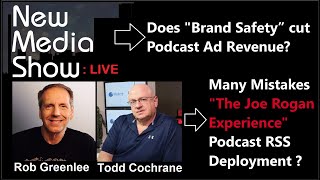
Rob Greenlee and Todd Cochrane discuss Joe Rogan's RSS feed problem: Spotify's open feed caps episodes at roughly 1,000, but Rogan has 2,258, and his artwork exceeds Apple's 500 KB limit. They also cover how keyword-based brand-safety algorithms demonetize legitimate news and pressure podcasters into self-censorship.
Chapters
Okay, we are live.
Todd and Rob in the afternoon with Todd and Rob.
Oh yeah, oh yeah, we are back with the New Media Show, and I'm, I'm happy to have Todd back with me here. So Todd, how are you?
Rob, you froze up on me.
I did. Oh, I know. I say that the bandwidth has been a little rough out here in the big snowstorm that we got out on the East Coast. Can you hear me?
Um, now I can hear you. Yeah, you didn't get— you didn't give my streams enough time to get up and running, Rob. My streams are just going live now, so, uh, hey. Anyway, hey, here we are.
Okay, awesome. All right, yeah, I'll always do some editing. I can always do some editing after this, Todd.
Yeah, so it'll, it'll work out. So, uh, hey, uh, here we are. We're back, or at least I'm back.
Yeah, that's true, that's true. I've been, been trying to keep the show flowing here, and it's great to have everybody back with me. This is kind of an unusual time for for us at 8 PM Eastern, uh, and you're in a completely different time zone, so it's probably completely different day for you or something. Who knows? But yeah, but anyway, um, yeah, so let's, let's go ahead and jump in here. Is there anything that's been bubbling that have— that you've noticed in the space? I know I do have a couple of topics that I raised on our artwork and things like that that we can kind of talk about, but you know, just do our normal shows.
You know, obviously last week we talked with, you know, with on the show last week about the, you know, the Rogan thing and the public access feed, you know, and I'm sure you, you know, went all over the whole strategy, but maybe to me it's a win. Spotify's woke up that open is important. So. Open RSS, although their RSS feed, as you indicated before we started the show, is totally jacked up.
Yeah, yeah. I think the big thing that I took away from it was, is that I, I guess— and James Kridland has pointed this out in the newsletter— is that the, the open RSS feed that's now available through Spotify for Podcasters rather than Megaphone, which I thought was really, really interesting on that front. But his feed has 2,258 episodes in it. I don't think Apple Podcasts is going to display that many. I don't know what you—
uh, yeah, yeah, I think their limit is— I thought you remember they changed, they changed the upward limit. I can't remember what the number was.
It was like 1,000 was the max or something like that.
Yeah, I, I they might be okay. Of course, I, you know, it's kind of dumb to have that many, that many episodes in a single feed just on the pure load time it's going to take to load that feed.
Yeah, I guess.
Yeah, yeah.
So that's not concerned about the bandwidth, I guess, but he has to, you know, I think you have to be considerate of the, of the apps that are trying to render that, right?
Right, right. Now, if the apps are smart and, you know, they are only going to just kind of reach— they're going to read the header and a little bit of the, of the file. They won't have to parse the whole thing if they're being smart in the way they parse feed. But, you know, really, ultimately, that's still a lot of episodes in the feed.
I, I wonder though why they chose to go with Spotify for Podcasters rather than Megaphone, which is more of an enterprise platform.
Um, uh, I would suspect—
is it for PR reasons, you think?
Yeah, I think it's because he's doing video.
Oh, right.
So he probably has to be on there because of video, I would assume.
Yeah, yeah, because that's the platform that you upload your videos through too, right? Yeah.
So, you know, obviously they're integrated, so from an ad delivery standpoint, it probably doesn't matter. Which, you know, which publishing platform he's publishing on. But, um, you know, in their announcement of them canceling their internal recorder in lieu of Riverside was kind of news too.
Oh, well, also their editor too, I saw. So you're not really gonna be able to edit in their platform. I guess that's all Riverside.
That was a big attraction before, uh, for a lot of Spotify creators was— well, you know, not Spotify, but, um, Anchor before. So my perspective on that is now that, you know, some, some podcasters that are going over there will, will likely not find that platform as appealing because they don't have onboard recording, but Who knows, I might be wrong, or maybe they just found out that no one was using it.
Yeah, does that mean that they removed the ability in that, the app, to actually record directly in the app to their platform? I wonder.
That's what I assume, because you could do multi-person recording before within the app.
So, right, uh, and again, all I saw was the editing aspect of it being being pulled out, but I guess you probably don't want to have a recording platform without editing capability in there.
Yeah, it kind of— one, one goes with the other, you know. That's one thing we've talked about before. If we're going to build a recording platform, then we're going to need an editing platform too.
So, right. And then the other thing that was pointed out is that the artwork, um, is 1.4 megabytes in size for the Joe Rogan, um, cover art, you know, for the podcast. And, and Apple has a, a limit, um, of 500K. So, right, right.
Well, what it sounds like to me is, uh, amateur hour over there. They don't know what they're doing, which— yeah, surprised because they—
well, they've been off of the been on these podcast platforms for a long time, but you would think there'd be some institutional knowledge, right? Yeah.
Well, you know, the rest of their customers are supposedly on all these other platforms, and if they don't know the basic guidelines— yeah, yeah, it's, it is what it is. But, you know, I don't know. I will see over the next week if they've read Pod News and if they update their stuff to make sure everything is compatible.
Yeah, I also saw that the Omni Studios folks published their annual download benchmarking data and it showed that their numbers are in decline a little bit after the iOS 17 update. So there's another one that's facing a little bit of a hit on the metric side. Right.
Well, that's, you know, not— I'm not surprised. Yeah, you know, not surprised at all. We've, you know, we've hashed this out, we've talked about this already. It's what happens when you, when you underqualify a download.
Yeah. And the other story I wanted to cover a little bit that came out here this past week was the New York Times has suffered from from a loss of revenue based on brand safety platforms. And that raises some interesting questions about where we are with brand safety platforms that are primarily looking at keywords, right? So the New York Times was getting hit with some demonetization type things, or they were losing campaigns because they were using words, I guess, that were triggering these algorithms and basically trying to cover some of the hard news around topics like the Middle Eastern conflict. And it does kind of point out the challenges of these brand safety and brand suitability platforms. And Mark Askwith and I did talk about that a little bit in last week's episode as well. And I I kind of wanted to get your two cents on this too, Todd, of, you know, these brand safety suitability platforms really kind of market and promote themselves as being very, very smart algorithmic AI-driven platforms. But what I keep increasingly hearing is that they're very keyword sensitive, which tells me that they're not as contextually, aware as they need to be to keep from having a, you know, just like, you know, basically to be blocked from monetization if a podcast uses a certain kind of word to describe a weapon in the context of a news story. Seems to be missing context, right?
Well, it sounds to me like they've, you know, they need to, they need to stand up to these, these brand safety platforms and say, why are you doing this? And they've got enough clout in the space. They should, they should just raise Cain. Um, but again, maybe advertisers have said, hey, we don't want to be, um, we don't want to be, have any content that's running along any Middle Eastern content. And, you know, the or whatever, we don't want ads running. So maybe that's been a decision by the potential advertisers that want to stay away from that content. So maybe their brand safety folks have, you know, applied the rule accordingly.
Yeah, I just wonder, you know, and I've heard other podcasters You know, and I think we've mentioned it probably last week to some degree, but there has been some big podcasters that have been feeling the pressure from these brand safety platforms that they have to adjust their content and what they talk about, especially comedians, right? That are increasingly feeling like if, well, if they want to have a successful ad campaign, they have to, you know, with certain advertisers that they can't go into certain topic areas, right? Or else they'll get be demonetized from it. And I think this is kind of a little bit of a dangerous trend because I don't believe that there's a lot of solid data around brands really kind of like losing revenue opportunities when they're around content that maybe is controversial. And I think this gets back to more of a more of an agenda around ideology than it is around business. And well, again, really, really driving it.
Well, again, I think it's all about the advertisers. The advertisers have said we do not want to be in this type of content that's using these types of words or topics. Right. And so because the podcasters have agreed to be on these platforms that Well, somehow some—
for, for the longest period of time, Todd, a lot of these podcasters, big shows, didn't even realize that the advertisers were evaluating them based on these platforms. Um, well, now it's a little bit more above board now, um, because these platforms have been working more with podcast networks and platforms, um, that are selling advertising on a larger scale.
Um, but that's, that's the podcaster's fault for not being informed. That's, you know, if you, if you're—
well, if it was getting kept from them, Todd, it's— that was the other part of this that was going on in the early days of these brand safety platforms, is that I heard directly from some that— because I asked them, I, I said, so do all the podcasters that you evaluate know that they're being evaluated? And you The answer I oftentimes got was, uh, probably not. So, you know, these things are increasingly being brought to the podcaster's attention, um, and I think that's why we saw like Conan O'Brien kind of do a whole episode on this and talk about it. Actually, if you want to do a search for Conan O'Brien, Conan O'Brien and brand safety, um, in YouTube, you can see what I'm talking about. Um, he got in there and was talking about, well, I can't, I can't do certain jokes anymore, um, if I wanted my show to be sponsored. So it's causing him to change his content. And that's what my biggest worry has been all along, is that this creates an environment of podcaster self-censorship.
Again, I have I guess I'm at this point in the game, as long as this has been around and talked about, I guess I have no self-pity on this. You know, and again, you know, you've made the physical, you've made the choice. And if you want revenue from advertising, then you have to play the game. And if that means changing your content, then you have to change your content to play the game. To keep your revenue up, or you want to stay true and you want to use your real voice and you want to, you know, throw a double middle finger up at the man, at the advertisers, then you do content as you want to do and you suffer the decline in advertising dollars. Or you complain and you raise Cain and you say, this is wrong. I don't think the advertisers care. I think the advertisers are basically taking a very conservative approach and careful on the type of content they're advertising. And it's just—
no, I guess their goals, right? I get their goals, but there's not a lot of data that maps to them being in podcasts that are controversial and their ROI going down.
I think it's just— yeah, I think it's just a knee-jerk reaction. And remember, it's ideology.
It's— yeah, it's— if these topics are talking about areas that their brands don't want to be associated with for ideological reasons, then that's what's causing this to happen. Now, granted, that's not happening in every instance here. These brand safety platforms are, are finding, you know, legitimate hate speech, and they they don't want to be associated with that kind of stuff. But if it's stuff that is—
I think most—
that definition of hate speech keeps getting wider and wider.
I think majority of shows that are running advertising, that they're advertising in the New York Times, they don't have to worry about having hate speech in the New York Times content.
So, you know, yeah, but those are the ones that have publicly complained about loss of revenue. Is the New York Times. That's what was in the news.
So yeah, so, and again, it was nothing to do with hate speech. It was just reporting on the news.
Yeah, it's like talking about, you know, war and talking about conflict and talking about the use of weapons and things like that was getting them demonetized. And I don't think that's what the intent of all this is, right? Is to—
again, if advertisers picked a topic that they don't want to be associated with then, you know, the podcaster or the content creator suffers the consequences of that.
Yeah. And then I also saw in the news this week too that Spotify for Megaphone is looking for more inventory for political advertising this year.
So we are too.
Yeah. They aim to take advantage of a predicted election spend across all media of over $15 billion. And podcasters who block political categories won't get the incremental revenue. It's what the story came out. So not quite sure why podcasters would block political categories. I guess it would be in categorization in Apple. Is that what they're talking about here?
What we're doing is basically our our programmatic provider, our partner SoundStack, has said, hey, we have political inventory. And so what our approach is, is we are breaking out shows left, right, and center, and basically going to approach those shows and say, hey, you know, do you want political advertising? And if you do, do you prefer left, right, or center? And that's going to be our approach.
To it.
So I would assume a left-leaning show would want left-leaning advertisers, political advertisers, which is kind of dumb because, yeah, right, you know, you're, you're preaching to the choir there. So, um, right.
And, and I'm not sure that— and this probably some research that needs to be done in the industry from some of the key research players is to actually look at brands that advertise on controversial topics that may be, you know, like a left-leaning brand that advertises on a right-leaning podcast, is there a decline in revenue? And if there isn't a decline in revenue or ROI, then what is the real reason for blocking that ad from appearing over there?
Again, most political stuff is definitely awareness. And, but I think just like television and radio and everything else that runs political ads, I think podcast listeners may react and say, I'm sick of hearing these ads already. You know, it's all, it's only February and I'm starting to hear political ads and, you know, please, uh, you know, please hit me in the head with a hammer because I'm going to hear this all the way through the election in November.
Though, to be kind of bipartisan about this topic is, is that I think that there are certain brands out there that are associated with a certain political side of the fence of sorts, right? That if they are heard advertising, um, on the, on media that would be considered to be on the right, maybe there is a chance that they wouldn't have as much patronage because they're seen as supporting the enemy of sorts.
Um, Or would a show that's running back-to-back advertising like to hear an ad for product X and then have an ad immediately follow from politician Y? And if, you know, from the opposite side of the house, right? Yeah. And maybe it's just a brand, you know, maybe it's a, you know, I, again, I don't want to even use an exact one in my brain comes to mind real quick. Ice cream folks, you know, they have a certain political persuasion, they're pretty vocal about it. So, you know, would they want a conservative ad to run, you know, next to their ice cream ad?
So, you know, and it does kind of speak to how far we've come on that, um, that, that ideology is really causing this massive divide even from a business perspective. There's this concept of parallel economy, so you have certain conservative shows that are only running ads from companies that are vocal about their political orientation to the market and on both sides of the fence, right? And it's really difficult, I would think, for the ad sales folks to really manage this because they obviously want to sell as many campaigns across shows as they can, right?
There's a pile of money. You know, this is a cash cow for radio. You know, this is when radio and television, they make the majority of their, like, this is a 4-year swing that they salivate about because of all the millions and literally billions of dollars being spent in political advertising. They, you know, this only, this cash cow comes around once every 4 years and they want every single penny of that. So, you know, it— and of course the political people want to, you know, get their message out. So, you know, I don't know. I'm— I just wondered though, based upon what's happening in the country, if it really even mattered. You know, maybe it matters for local— when it comes to local ads, I don't think there's very many people that are under decided even today who they're going to vote for in the, you know, in the main election for president. But I think what is important maybe is at that local level, that councilman or, you know, whatever it is in your— that's where we need to, you know, if you want to make a change, we can't change what happens on the national level very much, but for going in there and hitting our ballot box. But if you really want change and pay attention to who you're voting for locally, I know even myself, the last election when I went in, there was, uh, in Michigan, we vote for judges. And I was like, uh, I don't know. And I had educated myself. So I didn't vote for anybody because I just didn't know, you know, which way these judges were or how they, you know, because, you know, I hate to say it, politics does still apply. And yeah, when it comes to judges, so I just, I didn't vote for any judge because I had nary a clue. So I think all of us have to be educated locally, and maybe that's where these ads would inform, uh, a potential voter. I think hyperlocal would be important because I might be interested in hearing one of those ads in someone's, you know, position.
Yes, I think I, I think I heard that this coming year there's going to be more elections in the world than has ever happened. It's, yeah, I think it's interesting, the alignment of it, of all those things happening at the same time in all sorts of different countries around the world, not just the US.
That means by November we're all just going to be sick and tired of hearing political ads.
Well, and what side of the political fence are, are are we all gonna get pulled into having to cope with, right? I mean, is it the left, is it the right that's gonna take power in the US? But, you know, as we've seen in Congress and the Senate just in the last 48 hours, is that it's hard to really predict how that's gonna turn out.
Who knows what's gonna happen? Right, exactly. My genesis is fire 'em all. That's my genesis, you know.
Well, I think that is the consensus on the, on the right. I'm not sure that's consensus on the left. I think all the folks on the left are happy with what thing, you know, what's going on, right? On the right, everybody's objecting.
Well, you know, it's— someone asked me a question the other day about politics in America, and I said, well, that's kind of a hot topic. I really don't want to talk about it, right? Yeah, you know, and it was one of these things where, you know, my position is, is, you know, people that run for election, they, they, they in, in their mind, you know, they run on this holistic idea that they're going to change. And then as soon as they show up, there's this thumb that comes out and it's pushed on them. It said, you will comply, you know. And, you know, all those holistic ideas of change completely goes out the window because of money and seniority. And so that's why, that's why my thought process is fire them all and get completely fresh ideas. But right.
Right, top to bottom. It's time to maybe have a refresh, right? Not a reset, but a refresh. But good luck with that. I did notice that in the latest Share of Ear study from Edison Research, it's coming up showing that radio is still doing more than 3 times that of podcasts. I guess the average person in the US spends 11% of their daily audio time listening to podcasts. So I guess that assumes that 33% of the time it's spent listening to radio.
So, well, I think a little bit about it.
Yeah, I'd say that those— the 33%, even if it's that, is dramatically lower than it used to be.
You know, I also saw some article that— and I didn't read it, they came across my radar, I think yesterday, where Some radio guy said that the radio business was no longer viable, something to the effect, and it was a big conglomerate that said, hey, this, you know, this isn't working anymore from a dollar and cents standpoint. So, you know, they're under great pressure to earn money, you know, maybe at some point you know, those local car dealer ads that you hear on radio will at some point migrate to digital, including podcasting. So, but you know, that's where the majority of money's being spent. But as far as ears goes, I think as soon as someone buys a brand new car, you know, my car doesn't default to radio. Matter of fact, I have a hard time if I want to listen to the radio. Um, I have a hard time getting to that menu item because it's, you know, Apple CarPlay pops up. Yeah. And my podcast icon's right there, and bada bing bada boom, you know, I can listen to stuff on Fountain right in the car.
Yeah, I have, uh, the, the Apple Podcasts app in my Tesla, so I can access my account right there on the screen. So it's actually— and it's just podcasts. I don't have to have any radio in there if I don't want to. So it's just a matter of, um, just popping up the app just like on my iPhone or my computer. Um, but I thought it was interesting, um, too, that, um, that as we look forward though on the, on the radio side, there is kind of, I think, a little bit of a desire to tap into the podcast market on the radio. Just this past week, I started doing, uh, kind of segment promos for a Beazley initiative, um, that's playing like 15-minute clips from podcasts on their radio, like in a playlist type of a format. And I'm doing the intros and the exits on each of those segments in 4-hour blocks on I think like, uh, 6 or 7 different radio stations in the US.
So hey, did forget to mention we are Litten Live on the video side for Podcasting 2.0. I, I, uh, I pulled— I have the video HLS stream going up but not the audio today, so we are up on the video stream, Litten Live.
That's interesting. Okay. Yeah. I didn't know that.
Yeah.
So how are we streaming on the video side through the Lit platform?
What's the— Well, right now what we're doing is we— you're feeding my Restream with the stream. The Restream is sending a stream over to Wowza and Wowza is running an HLS stream. Oh, okay. Yeah. They're running an HLS stream that is basically configured to be able to be viewed in the modern podcast apps at podcastapp.com. Okay. To, yeah, to be able to be live.
Yeah, for some reason I had this idea that that only worked with the audio side.
So, so it's good to hear that it's also, also on the video side too. Yeah, audio and video. But, you know, kind of a, uh, it's a bit of a hack because Restream doesn't support HLS. So I had maintain the account to be able to, to actually do it, to do each of us.
Yeah, got it. Hey, the— I wanted to mention too that the, the Podcast Hall of Fame, um, full video, uh, from the— it's been kind of finished and remade, is now live on YouTube. So I'll, I'll pull it up on the screen here. How did it come out? I think it turned out really well, so I wanted to play really quick a segment from it, um, with Dr. Drew doing, doing the introduction of Adam Carolla. And so in the comedy that, uh, happened thus forth, yeah, well, the Adam Carolla video is in here as well as his little call to Adam Carolla as well. We were able to keep it all together.
Here we are. Thank you for your patience. Thank you for allowing me back in front of you again. Uh, again, my gratitude for this evening and for the inductees. So I was just thinking that, um, I'm here to present Adam Corolla with his induction, uh, to the Hall of Fame. And I, I thought at no point did he say, uh, hey, would you accept it on my behalf? No, no, I'll send a video. Thanks, Adam. So I was thinking about what I wanted to say, and I'm gonna keep my comments very short because he didn't feel sufficiently invested to help us out here this evening. We'll see how short his video is. I can't wait to see that. But I talked a little this morning, if you were at that event, about his and my— how we got together and how that happened and the serendipity of all that. And we talked a little bit about the sort of chemistry or the magic of partnerships. When you find the right partnership, things just kind of work. Other people notice that, they will let you know. And he and I got together in podcasting. It was really, I guess, him that pulled me into podcasting. We'd done Loveline, of course, and then he wrapped that up and went to— he essentially replaced Howard Stern in the morning. On a syndicated radio show that eventually went away. And he took his little team and just decided he was going to do a podcast and started doing podcasting and was very quickly the most popular. He was sort of before Rogan, before everybody, the most popular podcast on earth is actually in the Guinness Book of World Records for the most popular podcast. And I started thinking, what would he say is the model for a podcasting host. What kinds of features would he include in this? And so, I've just made a little list. I was sitting thinking about this. And funny, you want to be funny. And we just have seen some great examples of people, great communicators, they're entertaining. He would say you need to have low self-esteem because he and I have shared that heritage together. It helps you check yourself a little bit. You always blame yourself for anything that's going wrong, and rather than wondering how things could have happened, you immediately blame yourself. In his case, he would say, number 3, you'd have to have an impoverished childhood, not necessarily a traumatic childhood, just impoverishment, which is something he gets a lot of mileage out of. I don't know if you ever heard him talk about his grandmother and his mother. You need curiosity. He would say that. And you would need to be somewhat fearless, not heedless, but somewhat fearless in expressing yourself and being honest and moving forward. And the final thing he would put on his list would be something he has pointed out to me multiple times, which is when someone asked him, one of the staff there said, "Adam, you think you have a crystal ball. That's why you're so confident." He goes, No, I have a crystal brain. So he would say you need a crystal brain as you approach your podcasting career. So with those things in mind, my honor to be here tonight presenting the award to Adam Carolla, who comes to us virtually.
Maybe.
Yeah, maybe.
I hope he sent the video.
Yeah, eventually he will.
Susan, call Adam. Adam Carolla's video could not be with us this evening.
Would you kindly accept on his behalf?
Are you serious?
Oh, we got it, we got it.
Okay, all right, good. I was gonna put him on the phone if that was the case. In fact, I should do that anyway.
I'm gonna call him.
Give these guys a chance to cue things up. He has a— he has— I know he's performing in Colorado stand-up, and it's pro— yeah, buddy. Can you do one quick thing? Your video didn't quite show up. Can you just thank the crowd for the award, please?
Ready?
Well, they're working on it, but it's not here. I'm in front of the crowd, so we just need— they just need to hear your voice and say thank you for the award.
Okay, ready? Here we go.
All right, go ahead.
Hello?
Oh, thank you, crowd.
Oh, thank you for this, uh, honor.
I mean, all right. That made him happy. Yeah, he's walking on stage in Mesa, Colorado, but he would— oh wait, here you go again.
Face to tell him.
Tell him.
Go ahead. I'm honored. And if I wasn't about to walk out on stage in Mesa, Colorado, I would walk out on stage wherever the fuck you people are.
And thank you for the award. Hello, and thank you for the award, right?
Oh yeah, thank you for the award.
Okay, all right, thank you. Have a good show. Do we have any video? No video, that's incredible.
Oh, it's coming.
There we go.
Wow, a Hall of Fame. Little old me from North Hollywood, California. In a Hall of Fame. Jesus Christ, man. When I was a kid, I probably dreamt of the NFL Hall of Fame. Never even knew what a podcast was because it wasn't invented for another 37 years. But I am tickled pink. I've never been in any situation where I ever would have imagined that I could be in a Hall of Fame. And I just want to say this as a cautionary tale— Podcast Hall of Fame, Let's keep it real. Don't end up like the Rock and Roll Hall of Fame. Grand Funk Railroad is not in the Rock and Roll Hall of Fame, but Kate Bush is. Do not ruin your brand. Keep it to the people who are keeping it real. That's right, I'm pointing at Maw. It's Mexican for me. I never thought about it, and it's great, and it's probably the best day of my life. It's only tarnished by the fact that Dr. Drew's the master of ceremonies. Jesus Christ, look, I don't get enough of that guy. But I will tell you this, many years ago, probably 1992, I was doing comedy with the Acme Comedy Theater. I was doing sketch, I was doing improv. And I'd been there for about 4 or 5 years. And I said to the theater director, I said, what do you see me doing? Because I don't know where I belong. I'm not really a stand-up. I'm not really an actor. What do you see? I'm not really a writer. What do you see me doing? You see me as a writer. You see me as a performer. He said, you need a job where you just sit and talk every single day. And it doesn't matter the language you use or the words you choose, and you speak your mind every single day and you just blow it into a microphone. That's the job you need. And I said, thanks, but that job doesn't exist. And I realized all these years later, he was talking about podcasting. Now, he didn't know it and I didn't know it. But he was saying, you were put on this planet to do this thing that doesn't exist yet. And we were both speaking about podcasting, even though I didn't hear the term for at least another decade after that. God, back in the day, I used to go to Bill Simmons' garage, and he didn't even have a second microphone. And this would be like 2000 and 5, and I used to have to call into a show with a phone and stand in the driveway while the gardener was blowing leaves on me because he couldn't afford a second microphone. Well, we've come a long way. So this has been my longest running job, longer than Carpenter, longer than morning show host, longer than the Man Show, longer than Loveline, longer than gay porn. Passed that about 10 minutes ago. And the fact that you would even consider me to be in the Podcast Hall of Fame, well, I'm tickled pink. So thank you very much, and this award will be cherished. But I hope it's a real award, not some shitty plaque.
Thank you. What he would have said was, thank you for recognizing my genius. I know that's what he thinks anyway. So anyway, I'm sure he would have humbly accepted it. He is, uh, he loves podcasting. He loves this organization. It's, uh, the, the fact that he picked up the phone was awesome, uh, and, and trust me, this will not have, uh, gone in vain. He, he really loves this community, this, this, this medium community. He was a, he was a pioneer in this area, and, uh I'm sure he appreciates being acknowledged, so I will accept it on his behalf. But we are bringing this to a close, and of course I'm grateful to have been here as your master of ceremonies. It's been an honor, and congratulations again to all the inductees. Stories, voices that have shaped this.
Yeah, it was interesting, huh?
You know, here, here's the deal, that there is, um, and that, that should be rinse, wash, repeat for about a for about a decade, uh, to have people remember, you know, he, he, he is about as real as he got there to say whatever the beep beep beep beep beep beep you want and not be censored. And yeah, you know, that, that is, you know, they gave a little chicken skin there.
Um, because that's why I thought it was so important to play it, because it's, it's just an example of what happened during the Hall of Fame. And a lot of the inductees got up and just gave really, really impassionate speeches about the medium and their history with it and what it meant to them and, and all those kinds of things, which really cuts to the heart of what this medium has and continues to be really, I think, all about. And, and I think it's really easy for, you know, the larger companies and big money to kind of gloss over that here.
Yeah.
And, and I think between Dr. Drew and Adam and the other inductees. I think this is a very important, um, video for, I think, as many people as possible in the podcasting space to watch, because I think it— what it does is it shows the culture, the history, and what this medium really stands for and what we should hold on to.
You know, and we're talking beginning of the show about this stupid stuff about brand safety. And you think about Adam in the early days of the Adam Carolla Show, and even today, yeah, um, you know, he says, he says what he wants to say, and, you know, and, and advertisers be, you know, can go beep themselves, you know.
So it's, it is a, um, well, it wasn't that long ago, Todd, when the advertisers didn't really care about that stuff. So if you think about it, on the time scale of the medium, a lot of advertisers would have advertised because it was Adam Carolla, not because, yeah, you know, he had a political orientation.
This is going to probably get me in trouble, but what it is is an indication of— you have a— I gotta be careful. I know you have people in the workplace today that have no thick skin. Right. No, I think that's reasonable regardless of age. Yeah.
And there's a lot of very, very sensitive people nowadays in that.
You, you look at, you know, let's go back to my sponsor GoDaddy. Yeah. And, you know, I weathered a few storms before.
Before. Good example. Right.
Yeah, you know, you know, here I am advertising GoDaddy and then the, you know, the founder of the company goes out and shoots an elephant, you know, and publicizes it.
And I'm like, oh my God, well, you're not even— I mean, that's just one salvo on the story line.
It's one. And then, and then, you know, then obviously there was the, you know, and it was a different time and GoDaddy has completely changed and they are now about, you know, making sure they empower women, but you think about Danica and the ads and the— not Danica, but the, you know, the ads GoDaddy had was, you know, um, you know, quite provocative. You know, if someone goes back and does looks for some of those GoDaddy ads in the '57 range, they were, they were pandering to men in a big, big, big way. And maybe even pandering was the wrong word there.
It was so— It's just appealing to them, right?
Oh yeah. You know, and, you know, if they were running any of those types of ads today, they'd be canceled in like 60 seconds.
That's why they changed their marketing strategy.
Right, right. And believe me, I thanked them when they did.
Yeah, because you were feeling uncomfortable with it too.
Yeah, I was like, you know, I'd send messages to government, come on. Come on, you're killing me here. You're hurting my sales, sales numbers. You know, and I didn't, you know, and here's another thing. I didn't ever, um, I was some, at some points there was times when I had been there. I didn't make excuses for him. Let's just say that I didn't make excuses in the show or in the advertising. About this behavior, you know. And, um, so I tried to stay true to my moral values at the same time and saying, hey, I, I do not agree with what they're doing here. I still love the product, but I don't agree with what they do. So, you know, and thank goodness they, you know, they change course. So largely after, you know, the founder left.
Yeah, well, he was the one that was kind of, kind of leading the, the strategy, I would imagine, right?
You know, so, you know, when you think about, uh, brand safety, you know, it was more about podcast safety, right?
You know, for me it was like, you know, I had some audience members get uncomfortable Yeah, well, I think that was just prior to the MeToo movement, really, which was really about, you know, right, female rights and— yeah, yeah, and respect and, you know, treating women, uh, in a positive light in the professional workplace. And that became not a cool thing to do. There was lots of men that were, you know, thrown under the bus, put to you that way, um, back in that era. And it makes sense that they made that change. But yeah, yeah, so, but I do think that, that, that Adam Carolla and Dr. Drew really speaks to the early days of media too, and kind of how we saw things. And I know, you know, things change, and, and the media landscape is changing, and and we're, we're adapting. But nonetheless, I think it's helpful for a lot of people to really understand what the roots of this medium is. But I think that there is this increasing understanding is that we're moving into a new era with this medium, and it is changing. And I guess that was a big thing that Mark Asquith and I talked about too.
And then also, you know, I had Tom Webster on prior to that And oh, he was— you guys got some grief, uh, in the chat channels because they were like, Todd's not there to defend.
Yeah, well, you know, Tom felt like the induction committee needed to be much broader in its scope, um, than how it was structured. Um, I don't know what you think about that, Todd. Do you think that it needs to be expanded beyond just the inductees? No. Okay. Yeah, I'm just trying to get a pulse of what, what people out there think, and I think that there's a, there's a little bit of an ideological reason for this as well, that there's an interest in that. Um, so, but I'm, you know, I'm just trying to do the right thing for the medium, and I, I kind of know how others in the Podcast Hall of Fame feel about this same topic.
Because as soon as you bring in non-podcasters—
well, it's not that it's non-podcasters. I think what his point was is just bringing in people that are not necessarily the inductee, um, class, right?
They can be— I think what you end up having then is it turns political.
Yeah, I think that, that there is a definite danger of that., you know, um, I've seen that happen before, so I'm, I'm very experienced in that type of stuff.
I think in the end, if you— if, if the classes continue to be diverse and representative of the space, um, AKA even though it may be some of them are a different era Um, oh, definitely. I think it's important that, uh, um, those, those folks that basically were the, the foot soldiers that were breaking the ground, the medium, right? They built the medium. Um, in all cases need to be honored.
Yeah, I mean, we can't just skip over people because of, you know, a change in kind of political ideology and somehow make those people less relevant to the history of podcasting, which is the whole point of the Hall of Fame, right? It's the, it's do we hold on? And this gets back to what I was saying earlier. Do we hold on to what the meaning of the Hall of Fame is all about or do we abandon it because of pressure around ideology?
And, and who's complaining? I haven't seen— and maybe you've seen it, but if, you know, people are complaining—
Tom has been the most vocal about it because he came on the show and told us his, his, his views on it. He— though he wasn't very specific about it, he just generally made this comment that it needs to be broader than just the inductees. And I did— I mean, to be fair, I did go look at like the Rock and Roll Hall of Fame and the and the Baseball Hall of Fame and all those and how they've set those up. Um, but those have been pushed increasingly towards more of a, more of a accepted political infrastructure, which is not unlike what has happened with the Academy Awards and other, other types of awards organizations. Awards is payola. Well, and it's also, it's also not, not a historical thing. It's The example that I like to give is that this is like trying to open up the ideology to, to only nominate people for Lifetime Achievement Awards, right? And it's— it— that's kind of what the Hall of Fame is. It, it's not diff— it's different than an award ceremony like the Ambies or the Academy Awards, which is more like giving awards to content and people that were from like the just the last year, right? And who had an impact. This is going back 10 to 15 years, and that may be a different kind of demographic group of people that we've just been slow to get into the Hall of Fame because of the 5 years that we've missed, you know. Yeah, the backlog, right? And that was the other part too.
Yeah, yeah. So, you know, as you, as you and I had talked about, you know, I'm I'm fully, um, I'm fully behind doing a catch-up mid-year if possible. But again, and, you know, an in-person event once a year, virtual on the mids, and do that for a couple of years in conjunction with the Podfest team to make sure that we— so that we get caught up and get these, these people that are well deserving, because there's a massive list. Of folks that should be, you know, you just can't say, okay, here's the 60 that were behind and let's induct them all at once, because you lessen the value of their time in the spotlight to tell their story. Um, you know, we had an unfortunate circumstance here with missing some years. Yeah. And, um, so it's going to take a little while to to crawl through that.
Yeah, and Tom did acknowledge— Tom Webster did acknowledge that he's looked back at the past inductees and agrees with all the selections that we've made. It's not like— well, he said probably there's a couple of exceptions that he can think of about who got inducted and who should have been and who shouldn't have been, that kind of thing. But generally across the board, it was a It's a very good group of people that have been inducted into it so far. And I, you know, as you look to the future, the more people, just like you say, Todd, the more people we can get in the fastest, the more we're going to be able to induct people that are seeing more, you know, increasingly more modern folks from the podcasting space and less of a historical perspective, because we will have gotten those folks in there.
But I think at the same point, there needs to be a— the component. And I don't know if this was— this was not followed at some point in the early days. They said, okay, from this year, you had to be a podcaster in this year group and this range.
And well, the first couple years, it was a minimum of 10 years. 10 years, yeah. And then Dan and Jared changed the criteria to 5 years, and that's not even a hard and fast Yeah.
And again, if you think of all the people 5 years plus, man, there's, there's a stack. Oh, there's hundreds of great podcasters. That's hundreds. Yeah. And their own genres and they've done their own thing in their own rights and different groups and classes and, you know, everything.
And I've had even people reach out to me and ask for, well, you know, why aren't there any sports podcasters in there? You know, that kind of stuff. But my pushback to that is we never thought about a Hall of Fame as being, being driven by genre of content. That's never been the, the objective here. It's contribution, impact, and maybe some level of popularity.
And that's what the Podcast Awards does that I do, is it's a category-based recognition system.
Yeah. And you do like a you know, like more of a broad award too, right?
Yeah, yeah, right. So, you know, we have 30— you know, we have like 5 categories that are broad and then 25 that are narrow. So by the way, the registration is open for the Podcast Awards. Oh, it is?
Okay, a little plug here, podcastawards.com. Yeah, and that's— that awards ceremony is coming up again in September. The, uh, International Podcast Day.
Yep, in September of next year, right?
September 30th of this year.
Yeah, yeah, yeah, right, correct.
Yeah, so yeah, so it was definitely this whole Hall of Fame, you know, opens up a kind of like a fairly large can of worms, um, that need to be sorted out and decided in the industry of what, what we want, um, and the inductees, um, want to have a say. But I do have to say that only about two-thirds of the inductees actually participated in voting this past year. So I would like to get more participation of the inductees even in the selection process. Right. Um, so this is a little bit of a call out to anybody, if they are listening to this, that are part of the Podcast Hall of Fame to participate in the voting, because we want to have your vote on who we need to induct going forward. And folks that are not participating in that process, um, are, are really not helping, um, us keep the process that we have.
That's right. And, you know, maybe there needs to be some criteria too. I don't know. Again, it's, it's— if you try to stay pure and keep it, um, because as soon as you start applying rules, then that automatically causes exclusion, right?
Right. That's definitely a path that there could be pressure around. There's no question. Uh, yeah. The other thing that I've seen other Hall of Fames do is to, like, bring in, let's say, a few people that would be considered to kind of like historians or, or folks that were journalists in the podcasting space. Now granted, that's, you know, that— I don't know what the viability of that is, and I don't know if we have any legitimate historians in the podcasting space.
But again, um, we have to remember that most other award systems are monetary based. If you look at the Academy Awards, you know, $100,000. Not Hall of Fames though, right?
Um, you have to pay to be considered in the—
in like Baseball Hall of Fame? That— no, I don't think so. But you know, if you want to be— get an Academy Award, you know, you have to pay your entrance fee.
I mean, it is an interesting point though. I mean, it shouldn't change the selection process, but I, I don't— yeah, I don't know. I don't know. I'm not sure that the pay-for-play model really has the same legitimacy.
I don't think so. Yeah, people complain enough that podcasts— in my podcast, where people have to register to participate But right, if— here's the thing, we don't survive if we don't have that, you know. And, and obviously what we really need for the Hall of Fame is more backing, you know, more corporate backing, more—
yeah, more sponsorship. And that, that's, that's clearly on the docket to do in the— yeah, in the coming years. It's not going to be as much of a Lipson event going forward. It's going to be more open to the whole podcast space and to try and get more broad-based support for it. Uh, Lipson has done a good job of kind of getting it off the ground and getting it moving, but I don't see that as a long-term approach.
Um, so I think, you know, we just need to come up with a budget number, and, and we need to get that budget number early. Yeah. And and, you know, then go after the money. And if it's, if it's $20,000 or $25,000 or whatever the number is, yeah, we need to, we need to make that happen quickly. And I, and I had made a comment to Chris, um, you don't necessarily need a Dr. Drew level, um, MC. Yeah. Yeah. Um, You know, you probably could save money there by, you know, going middle of the road. Or do you even need an MC? And maybe, or maybe you find a comedian or, you know, someone that's—
yeah, yeah. Well, it's kind of, it's, it's kind of the same thing. Um, that's kind of what Podcast Movement did too, is they, they brought in a podcaster comedian is what the model was. And even the AMBs do that too. Um, so they usually try and get a comedian slash podcaster. That's kind of the, the, the model. Dr.
Drew is a little bit of a different, um, different character on that. Not as— not cheap to bring in a Dr. Drew, you know.
So no, it's, it's never cheap to bring any of these folks. Um, so you So you need to have— I mean, even, even a comedian, you probably have to pay for their travel and that kind of stuff. So of course, it's, it's, um, they're showing up to, you know, bring some attention and things like that. And I think it was— I think Drew, since I was kind of like his host at the event, uh, I think Dr. Drew had a, had a terrific time at Podcast Movement, as you could see from his comments that I played I think he had a good time at the event. He spent some time with some pro-level podcasters in a kind of like a separate kind of, you know, Chris has a like a pro track that has like maybe a couple of dozen big podcasters in it. And so Drew went in that room and spent some time with that group and answered a lot of questions and things like that. So I think he was really impressed, and he actually hung out with a lot of people after hours too, so you could kind of see him around. Yeah. Um, so, so he really kind of fit in there to some degree. And he's, he's been a presenter at the Hall of Fame. I mean, the last one back in 2022, he inducted Emily Morse into the Hall of Fame. Um, so he's done this before, and that's why I thought of him, was because that connection with Adam and and Dr. Drew was a perfect combo. And at the time, we were hoping that we could get Adam out there as well, but he had already pre-booked himself on a comedy gig in Colorado, so that didn't wind up working out. But you could see the, the tension between— but I think both those guys were joking with each other more than serious. I mean, both those guys have been working together for decades, um, so, you know, and they have their stick just like you and I have our shtick.
That's right. You know, I understand completely the, the cost. You know, the cost is the cost. You know, I just got, I just got my trophy bill. You know, my trophy bill was $21,000. So that's a lot. Yeah, it's a lot. And you know, it's, uh, you know, that, that those are real dollars.
And yeah, you know, we have nice Nice trophies with Hall of Fame too. I got one on the shelf right behind me up here.
So yeah. And those, those trophies, I know how much they cost.
Um, you know, that alone, a couple hundred dollars each, right?
A $360, $370 is what that trophy costs. Yeah. Um, to produce and it's heavy. So let's say $400 a piece. So you're, you know, just in trophy cost, you're at $3,200. Um, which is, you know, not, not that big of a deal dollar-wise, but it's still a number. It goes in the stack of everything else, you know. Yeah, right. So, you know, and I, and I, I do understand the why Chris charged for tickets. I think that was probably smart on his part to recoup some money, um, as well. And it was a nice intimate crowd. There wasn't 500 people there. There didn't need to be 500 people there because what is the— the awards was more produced for the YouTube video and the audience later that get to view it.
So, um, so yeah, and we didn't have a budget to actually pay the production team in there to actually produce the, the video. Um, there wasn't enough money to pay them, so they were, they were the AV crew for Podfest and They did the best they could and, and with the resources that they had, and, and thank goodness they're able to pull it together and come out with a finished, more complete, um, video. Yeah, and they talked about the show that I, I created.
It's, it's mostly what, what the run of show was that I, I created for the event. They, they got the color balancing right now in the video too, so you can see the color collected because, um, or maybe what was on the screen was just not good.
Maybe what was recorded was fine, right? Well, I mean, you can do a lot in post-production, and that's what's been discussed a lot is, you know, let's not do it live, let's just make sure we get a good recording and then put it out afterwards. Um, yeah, you can do that. Probably a safer way to go.
I think so. Yeah, getting that master recording is key, you know.
Oh yeah, well, because they were really struggling with the bandwidth in the facility too, um, and that was another big challenge with it. There was multiple things that they were struggling with, and I think, you know, the Podcast Movement folks have did a terrific job with it in the past.
Um, oh yeah, Podcast Movement, but yeah, now it's—
yeah, it's Podfest. So yeah. It's a different, different production team and process and stuff. And yeah, they just hadn't done an event before where the Podcast Movement folks do, do all the productions, like say for the Ambies, which I worked with them a lot with the Ambies too.
So they do a fantastic job. And then simply using a product like StreamYard probably could have improved the live stream output, which, you know, you and I joked about after the Yeah, but if they can't get good bandwidth, that probably wouldn't have made a difference. No, it wouldn't have made a chance.
Yeah, so as long as they got it recorded. So, so anyway, you know, I'm, I'm hoping to get you more involved in the group as well for the Hall of Fame here as we look. You know, I've got calls set up with a bunch of people that are, were involved in it and trying to brainstorm for what the future looks like, so Yeah, yeah, should be fun.
Hey, one thing I did notice was, uh, RePhonic. They did some matching, and I dug into that a little bit, and I thought, oh, so they did some— they went looking for podcasts that actually had the equivalent YouTube channel, and they came up with a— but they come up with a pretty good list. Although there's a lot of duplication from country to country, they did 200, and I was looking across 8, 9, 10 countries, and it was basically almost the same 200 shows except for Japan and a few other places.
Okay, that are like doing, doing audio podcasts as well as video?
Yeah, yeah, yeah, or doing audio podcasts and have a YouTube channel. Oh, so, um, so it was interesting matchup of data. So I found that to be pretty, pretty curious because, you know, I've done this myself as, you know, basically went through and looked and then did my own. I went the other way. I went from Apple Podcasts to YouTube to try to find the YouTube channels of, you know, top 200 Apple Podcasts. And, you know, that, that did not come up with a large number of folks. So that does show me that there are YouTube channels out there that are doing well that are not making, uh, great headway in audio, right?
Yeah, yeah, I can see that happening. Yeah, so yeah, I guess, you know, like what, uh, you know, Mark Asquith talked about on the show last week, is it You know, it's not so much where we are now, um, or where we've been in the past, is, well, where's the medium heading towards? And it, it does feel like that there's a lot more people thinking about video now than in the past.
So, well, again, video is hard, so we'll see where that leads. Hey, I do have to see here. Do I have one? Do I have— let me look here. Let me do this. Hang on. Oh, I didn't. I got to turn this up. Let's see here if I can do this. This is all wrong. James Goodland. So did you hear that, Rob? I did. So we, I see this ad on PodNews. IAB compliant downloads for pennies. Promote your podcast trailer on the trailergram.co publisher network. Reach your ideal listener and receive IAB-compliant podcast downloads for pennies. Start your first campaign at trailergram.co. Hmm, what day did that come out? Oh, that's been running on in the classified for a few days. Yeah, I, I kind of saw that and I was like Well, actually, what date was it that it ran? It ran on February 13th. I saw that. I thought, huh, IV-compliant downloads for pennies. Um, it's just kind of an oxymoron a little bit.
I'm trying to find it. Oh, I see. Promote your podcast trailer on Trailergram. Right.
Publisher network. So you're getting— why would you be— okay, first of all, why are you worried about IAB downloads on a trailer? Why even mention it? Because don't you want— wouldn't you say— wouldn't your ad be promote your podcast on Trailergram instead of this clickbait, IB-compliant downloads for pennies? Because I don't care what— how many views my trailer gets, um, or listens. And why would I care about counting the downloads for my trailers? And maybe what it is, maybe they're doing trailers of episodes.
Well, they're doing— I believe what they're doing is they have like a teaser trailer that then will offer a link to the full episode. So that may be— they may be combining this together is what I'm trying to say.
So yeah, let me see how it works. We advertise your podcast. Were next to relevant content on reputable publishers, and the network consisted of over 10,000 trusted publishers— Yahoo, CNN, ESPN. So they basically put you in a box, trailer plays, right? And it says, listen to your podcast trailer, and prompted to opt in on their phones to receive push notifications from you about future episodes.
So in other words, full episodes, right? Yeah, it says episode listens take place after trailer, right?
After listening to your podcast trailer and opting in to hear from you, the audience is driven to our built-in player so they can listen to multiple podcast episodes. So basically, you quit paying them, no longer will you be able to you have to convert that audience to a podcast or Spotify listeners. But it is a little, it's interesting. The wording is what tripped me up. The wording on buying IEB and it, you know, what it looked like is we will get you IP compliant downloads for pennies. Um, yeah, that's what kind of made me go, hmm. I, I have no problem with the service and what they're doing.
Why say IAB compliant downloads? Because they are trying to deliver people to full episodes, uh, but that's like a couple steps down there.
They're changing. Yeah, right.
So to me, it just, um, it's just a way to appeal to people's interest in trying to drive their IAB download numbers, right?
Yeah. And guys like me see that, they're like, oh, what are we doing here, you know?
But, but if the trailer is longer than 1 minute, it still gets counted as an AAB download. Yeah, but, but I'm not sure that it really does because I do believe— and I'm not 100% sure on this— but I do believe that they actually host the trailer. Yeah, so probably it's not platform So, you know, coming off your feed.
Yeah. So, you know, the end goal is, yep, you're driving IV compliant downloads by getting them to listen to the full version of the audio file in their player. So, but you quit paying Trailergram and that, that, that, that player platform and notifications disappear.
So. Yeah, yeah, it's interesting. This page where it says month, uh, monitor your monthly campaign, and it has 571,000 impressions, uh, 50,000 trailer plays, and 7,100 push notifications. Is it you or is it me, or do you get kind of that those numbers don't really line up Well, that makes sense.
If you have 50,000 trigger plays, then if they've converted to listeners, then the impressions would be higher.
But is he— okay, this is where my issue with the term impressions comes into play, is what constitutes an impression.
I'm sure it's a touch and play, it's a download. I'm sure all three of those are the same. They're using the word impression in the word of play or download.
Okay, so they're using that, that word impressions to, to be equivalent or the same thing as a download.
Well, they say you will be able to see trailer plays and, oh, ad impressions.
Oh, so impression is the ad impressions.
So if your episode has, let's say it has 6 ads in it Oh, no, no, no.
What that is, then that adds. Yeah, because it's not, it doesn't say ad impressions.
It says just impressions. Oh, it does say see trailer plays, ad impressions, and how many people opted in for push notifications. So impressions is the actual number of impressions your ad got on their platform and they actually visually saw the ad. Right, right. So it is a true impression then.
So it is a correct definition. Right. So it's a visual impression of the ad. Yeah. Yeah. And then the trailer plays is where they actually click to play the trailer. And then the, the last number is a 7,146 is push notifications to subscribers. Those that are the ones that came out of the plays that went to subscribe. Right. Right. Okay. Yeah.
That's a, that's a pretty big delta. But yeah, I see that James and Daniel have put together a new Podcasting 2.0 information site, which I thought was interesting.
Yeah, I saw that. What's the path on that?
Was it podcast2.0.org or something like that? Yeah, let me find the— it's podcasting2.org. podcasting2.org. And, uh, Yeah, podcastingthe2.org. Okay. Yeah. And, you know, I guess the thing that, um, I didn't know there was complaints about it being too hard. Um, you know, that's one of the reasons why when we put our documentation together at Blueberry, we, we talked about features and, you know, kept the gobbledygook out, but they've got one for audiences and finding a better app, and it lists all the apps that are Podcasting 2.0 supported, which this is nice because it just has the apps only. Um, and, um, you have to be like, if you click, click the find a better app and then click on the blue headset, which is Podverse. This one here? Yeah, click on that. And then what happens is it shows you what that app supports, all the, all the features, right? All the— yeah. And again, I think from a listener standpoint, they're going to be like, what, what, what does that mean? So I think that's where there could be added confusion. So if we back out of that And then go to, you know, back up a page and click on For Podcasters. And then it talks about upgrading to the namespace. And again, um, I wonder where they talk— let me back up, look at this. Yeah, they don't— here they should have talked about the podcast hosting platforms are supporting this, but they did not. Um, add your podcast, new podcast namespace, and create a different area. Let's see here. Yes, I'm just looking. So if you're trying to educate podcasters, then how You know, add your podcast to the index. Yeah, they probably do need to list the, the hosting platforms and who supports what. Yeah, they say check, and I'm sure they're gonna— this is a work in progress, but it says check with your podcast feed publishing tool for support of the— yeah, you might even want to search, switch providers. So to me, I'm like, okay, let's—
well, okay, here's a link here, Todd. It says check which features your hosting provider Publisher Tools Support. That was on that page. Okay, yeah, that's a different page. Yeah, so it lists Blueberry, PodHome, RSSBlue, Captivate, um, Castapod, Dictopia, Transistor, Buzzsprout.
First, it looks to me like they've got them ranked by implementations, which is—
which I appreciate.
They do have Libsyn in here. Yeah, click on it and see what it says for Libsyn. I bet it says transcript. Uh, no, it says locked.
That's the only feature that they support is locked.
Locked. And then Spreaker. Oh, they don't. It's— oh, it must be a transcript.
Yeah, yeah, yeah.
Let's see what Simplecast is. Um, uh, the text tag, text, which is the one that Apple supports for alternate, uh, alternate verification. Um, go to the top list, then let's look at some of those at the top.
I'll look at Buzzsprout. Transcript, locked, funding, chapters, soundbite, podping, and person.
Yeah, so then if we look at the— I bet you if you click on pod— let's just go back to Buzzsprout and click one of those and click on the transcript tag and see where it takes you. I bet it takes you to the page that describes transcript. Yeah, it talks about the actual tag. Here's my challenge on this. This is the technical— oh, they do a cross, uh, this is interesting. The apps that support the transcript tag and hosting providers. So they've done a good job on this. So it looks like our red circle's in here too. Yeah, yeah, they've got a few, few of these. Yep. Oh, then if you've— yeah, so how it's interlinked and you can look at who has what.
Yeah, so I mean, it's, it, it's starting to get— I think, Todd, it's starting to get traction. There's— it's clearly that, you know, just the fact that this site lists so many of the big hosts is a sign to me that, that, you know, it's making progress. It's been slow. I think we can all agree that it didn't happen as fast, but, you know, the truth is we knew this. We're still on it. Not much happens fast in this medium.
So yeah, we're on it. You know, it's the education process. It's like my presentation at Podfest. You know, um, I think that's missing some of the 1, 2, 3, 4, 5, 7, 11, 13, 16, 19. Yeah, there's a few there that are— so what's, what's medium? Medium allows you to be able to set whether it's a podcast, music video, film, audiobook.
Okay.
Yeah, that makes sense. Yeah. So anyway, so, you know, this is something people can check out, podcasting2.org, and get educated on.
So is there the mission of Podcasting 2.0 and the Podcast Index is to preserve, protect, extend the open and independent podcasting ecosystem. We do this by providing podcasters with new features for their shows, equipping developers with new tools for their apps and services, and most importantly, improving the podcast experience for audiences.
So, yeah, so, you know, they've done a nice job on this site with the all interoperability links. So they've done good. I agree. But I didn't know there had been complaints it was too complex, but maybe James hears that on his side, you know, but I don't know.
Well, I think for listeners it's too complex, but I don't think it's too complex for the—
I do appreciate they did link to our Podcasting 2.0 resource page at Blueberry, so that was nice of them to do that.
Yeah, I wouldn't say that it's a complex topic for any of the the hosts, you know, the SaaS model.
Yeah, I just worry about when we start showing technical XML. Yeah, right. My only feedback is, and I know Daniel's trying to get screenshots, uh, I saw him request stuff, so I'm sure there's going to be more added to this site to actually show the feature in progress, you know, the actual what it looks like on the app.
Yeah, I think we do need to have like maybe kind of videos or visuals or something like that.
And I know that Dave Jones did a presentation on this that has a slide deck. Yeah, but it's ever evolving. It's just like my slide deck I did for Podfest, and I had a pretty good crowd. Um, and sadly, there was a camera that was stolen at Podfest, so my session of all sessions did not get recorded because your session was in the camera that got stolen. No, apparently they took my— I had a camera in my room and they came in, said, sorry, we need to move this to another room. So I guess someone had more priority.
Oh, as far as actually having a camera in their room?
Yeah, yeah, my session did. So, um, I think someone recorded it, but I haven't, uh, been able to get a hold of the recording yet. Well, it looks like we've almost made it here to the end. Yeah, we did.
Did you have a good Valentine's Day? It's been pretty slow. We've got about 9 inches of snow on the ground here.
So, well, Live Podcast Media during the initial part of the show said, Happy Valentine's Day, Rob and Todd. Is it romantic? Is it a romantic show today? Want to see both of you say I love you to each other. Oh, okay, okay. Well, come on now. Well, I don't know, don't know if we'll go that far.
Bro passion here, right, Todd?
Is that what this is? Yeah, bro fist pump. I am wearing an appropriate colored shirt today, so I'm wearing kind of a—
there you go, Todd, almost, you know. Yeah, yeah. So yeah, well, happy— thanks, uh, happy Valentine's Day to everybody out there.
So yeah, hope you had a good one. Yep. And I hope you didn't spend too much on dinner and all the other things that go along with Valentine's Day and all that stuff.
So am I going to have you back next Wednesday, Tom?
Or—
okay, same time, same channel. What's the— what's the date on next Wednesday?
Let me take a look at that. That would be the 21st.
Yeah, 21st. Okay. Yeah, we should, we should be able to do that.
Yep, yep, I'm good, I'm good through the straight through.
So, okay, at the same time, same channel of sorts? Sure.
Okay. All right, Todd. All right, everybody, thanks for being here. And, uh, I do have an audio recording of this, Rob, so— and I did get the video finally. That second link you sent me worked better for some reason.
Oh, good. Yeah, it's a big It's a big video file for some reason.
Yeah, you change the encoding down a little bit, you know, it doesn't need to be 5 gigs.
Yeah, I know. Well, what, what should it be?
What's the playback encoding? I just, I just changed the, uh, uh, the encoding rate per second. I, I reduce it down to like 1.3 or something like that.
Oh, okay.
Yeah, because I think it's currently set at 16 megabytes per Yeah, so if you, if you slower that K up, uh, you don't lose too much quality, but like for like half or something like that, like, yeah, at least, you know. Okay, all right. I re-encoded it anyway and uploaded it, so you can take a look.
Okay, you did. All right, okay, well, I'll do the same thing with this.
So, all right, everybody, thanks for, uh, for, for tuning in. Yeah, all right, Todd.
We'll see you later. See you later. Thanks everybody for, for joining us. And I can be reached on Twitter @RobGreenlee, and I do a live show on Thursday nights at 7 PM Eastern called Podcast Tips with Rob Greenlee. So tune into that, it's on the StreamYard channels. So I appreciate everybody, and if you want to send me an email, you can send it to robgreenlee@gmail.com.
Todd? Oh, I almost forgot. geeknews@gmail.com or @geeknews on X or @geeknews at geeknews.chat on Mastodon.
Yep. All right. All right, everybody. Thank you so much. We're going to end the stream now.
So thanks now. Okay. See you, everybody.
Bye.
More from Rob

Future-proofing with Delphi AI/Human clones: your podcast as a personal LLM | New Media Show






How sports reveal what AI spectacle gets wrong #Technology #Sports #Commentary



