New Media Show from Podcast Movement 2023 from Denver
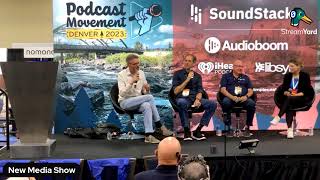
Todd Cochrane, Rob Greenlee, James Cridland, and Awesome Collective's new CEO Anne Kavanaugh discuss podcasting's consolidation wave, the rise of video and AI tools like Descript, and why major platforms won't adopt richer RSS metadata. They predict growth in Europe and the Middle East, but warn that AI can't replace human voice and listener trust.
Chapters
We made it! This is crazy. You know, I've worked in radio and podcasting for 20 years, and this is the first time I've actually been a part of a podcast being recorded live and livestreamed.
So you're in for a real treat.
Put your hands together for the New Media Show Live and Podcast Movement! I want to welcome everyone to the New Media Show. Of course, this is being streamed live at the same time it's going to be recorded and available at newmediashow.com. For those of you that are watching live today on our multicast stream today, please subscribe to the show. And I want to of course welcome my co-host, Mr. Rob Greenlee. Rob, we're back.
It's great to be here. It's been an exciting, uh, first couple of It is a podcast, so, uh, we're going to do a show talk and we got a couple of great guests as usual. James has been on the show many times, but we do have a, a new guest, Anne Kavanaugh, from the Awesome, very awesome, uh, Collective, who's been, uh, who's been anointed as the new CEO. So this is going to be her coming out. Yeah, so it's great to have you with us. So did you want to start off talking, or is there anything you wanted to say?
Well, I guess, uh, let me start the conversation. If you want to do a quick introduction yourselves, we can, but we're going to get right into the topics at hand. This show is normally non-scripted, so the only time we ever have a script, it's going through this, and it's talking points. So, uh, so of course there was a big acquisition here a few weeks ago with the Scribd buying Squatcast or Acquire or however it might be. So what does that tell us about the podcast market today? Are we gonna see more consolidation? Where is this headed? James, you wanna start?
I think it's, uh, greetings everyone. It's wonderful to be back. I think it's really interesting. It's a really interesting time seeing lots of different tools that podcasters using basically consolidate. So now Descript has their own recording tool. If you look at Libsyn, they have their own recording tool. You know, Descript has editing with text, and there are other podcast hosting companies working on editing with text. All of that, all this stuff is going on. And so I think what we're seeing is less, you know, sets of different companies doing stuff and more large companies are offering a whole range of tools to work on.
And isn't it interesting that Squadcast does support video and audio, so does the Strip, so it's a perfect fit. So does that really mean that we're seeing a convergence in audio video? What do you think?
Yeah, I mean, I think It's been very fragmented or segmented on the video and the audio side. The tools coming together to make that easier for the podcasters or the creators is incredible. It gives them more opportunity and to be able to take their audiences from one platform onto another, you know, good or bad.
You know, they've heard lots of folks say, oh, video's important, video's not important. I think it's been going from session to session where folks have had disagreeing opinions on whether or not you should do video. Now we've been doing video for this show for a long time.
And— Well, video's been part of podcasting since podcasting started.
Right.
But I also think too that some people like to watch, some people like to listen. So I think there's a place for video. The question is at what cost? Challenges today to get the, uh, the stream set up there. They were scrambling. So video's always harder. Yeah, it does take, uh, setting this up.
I mean, we're streaming this live on my iPhone, of all things, through StreamYard, uh, which really makes it, uh, really easy to, uh, do this kind of stuff right from your iPhone. I think we're going to see more of that kind of stuff happen, really like simplification of doing post-production.
Technology is really opening this up.
It's really exciting to see the production of content to be as easy as it is today. I think it's going to get easier too. So how many of your podcasters are using video at all? Really great question.
I think right now we actually just started offering the opportunity with the simulcasts. I want to say maybe 10% have already opted in with their video. But what I will say actually is interesting is we've got some podcasters that are on a way smaller scale, like less than 1,000 downloads per month on audio, but they've got 10,000+ on video. And so those podcasters have been restricted in their access to brands because there hasn't been a way to be able to reconcile or consolidate it. Now they have an opportunity because they're able to track across platform with some of the attribution solutions.
Yeah, I think it's an exciting time. I think video coming into the space and becoming more ubiquitous is nothing new, but it's also, I think, it's like a exciting to know the tools obviously we're going to use, and podcasters just need to have really a strategy of how they're going to merge audio with video, but to do it in a way that's right for the audience. I don't know, what do you think about the emergence?
Yeah, I think it's fascinating seeing, you know, a ton of different converging things going on, lots of talk about video, lots of, you know, Clearly, you know, podcasting, audio podcasting is still— I can hear Adam Curry spinning in his grave talking about audio podcasting. But you know, I find the whole thing interesting. It goes to show there was some research that was talked about today here at Podcast Open about 60% of normal people out there who listen to podcasts think that podcasting can be video or audio. And I think from my point of view, I think that podcasting is an audio-first experience that may or may not have video. But if you can close your eyes and still enjoy it, then it's probably a podcast. Right.
I mean, if the Whisperer thinks it's a podcast, that's a podcast to them, right? So that's what we're seeing. And I think YouTube is really pushing it for the podcast. And they have that persistent sort of consumer-to-listener-to-reviewer procedure, right? If it looks like a podcast, it's not a podcast. So I think it's really interesting what's going to happen. And I did a few blogs and videos today about YouTube and what they're doing and what's coming up.
What else do I have? And I think YouTube's move into podcasting is in equal parts exciting and terrifying. But I think the really interesting thing was actually something that Steve McClendon, who was here from Google yesterday, didn't say on stage, which is that the YouTube Music app will accept RSS feeds. And I clarified with him this morning. It's pass-through as well. So it will actually, from the Universal Commerce, play RSS audio if you subscribe in that way. So you may have a choice in the future. Obviously, you won't be on YouTube properly if you don't upload your show onto YouTube. But at least you can have a listen to an RSS show on the YouTube Music app, which I guess is half It makes it way more costly.
Well, it does, and actually, in the simple fact that they are going to do pass-through allows anyone that is monetizing their shows to at least have their podcast on YouTube Music, get the content delivered the way you want it to, and then if you still want to have a YouTube channel, I would assume that you would uncheck that from being a podcast channel. So there wasn't even fusion in the YouTube app, or YouTube Music app, I would say.
Yeah, I mean, I think if you're going to use it cleverly, and it's not going to be particularly easy from the start, but I think if you're going to use it cleverly, you would use YouTube for clips of your show, but make your full-length show available as an audio podcast. Available through RSS, which is, by the way, the work that TikTok is currently doing as well, where they're encouraging content creators to produce clips rather than to put the whole thing onto TikTok and link through to the broadcast. I mean, I wonder, is that something that Ossa is doing?
Actually, we just, we hosted a 6-week accelerator program earlier in the year, so we 72 podcasters for 6 weeks, 2 sessions a week, and we recorded all the video content. And we recently just actually took the video content and turned it into a podcast. So we're using the video snippets to promote it, but driving traffic to the show. So something that we're actually doing ourselves to try and get the crossover between audio and video content. But yeah, I mean, a lot of our podcasters are use it for promotional content to drive into whatever streaming service that they're listening to services on, you know.
You know, if you think of what TikTok is doing though, you know, their approach, at least at this point, is you use TikTok to promote an episode of a podcast. It's not, it's not going to be a direct listen app. It's a place where you could listen on way too long. They probably, they won't. They'll probably use that more as a way to sample. So it's going to be really important, and I've heard many people say this many times, the first 30 to 60 seconds of your show has got to be the most important part of the content to get that lead in and get people to stick and say, "Oh, this might be something I want to listen to more of." So you've got to get them in and get them started and get them hooked quick, or otherwise they're just going to tune out. That's kind of what I've been advocating for a little bit.
I think it was starting to feel a little stale, and I'd rather that adds a heavy lift to the creator to actually create maybe two different versions of their show or something like that. But I think if you can make one version that will work in both places, I think that's the best way to do it. Content for YouTube. But I do wonder about that you're primarily a YouTube creator that is producing a show like The Podcast. It may not make sense for you to submit your audio version to YouTube. I don't know, it's already going to be listed in YouTube Music as video. So does that, I mean, What's your comment based on what you've heard? Is it going to make sense for somebody who has a whole video content in YouTube to submit their audio version to YouTube as well?
I think my understanding is that you submit one version to YouTube and that's the version that goes on. And you can turn on or off the picture, but that's about as far as it goes. But I was listening to about Drew Scott one time. Cast, he was explaining how the YouTube algorithms work, and if you listen to a show and you skip out after 20 seconds, that is essentially telling the algorithm that that show is rubbish. Now that is— if you listen to Wake, Wake, Devilman, Don't Tell Me as a podcast, the first 30 seconds are the intro music, and the podcast, or whatever the new podcast is, talking about live from the such-and-such theatre in beautiful downtown Chicago. All of that stuff will work really badly on YouTube in terms of the upload. So what Andrew Scott, for example, has been doing in his podcast is he's been editing a different version for YouTube, which is a different version to the audio version than he wants everywhere else. And perhaps, you know, obviously the real scale of YouTube is the video website where all of the videos are.
And perhaps there is to propose something that might not fit exactly for what the YouTube algorithm and what the normal audio shows everywhere else.
For those of you that are here that are not subscribed to our show, we had a guest last last week to talk about dual strategies for having a successful podcast and having a successful YouTube channel. So I encourage you to go over to the website and listen to that episode. It's Dual World on how this can happen. But I want to change topics. AI. I've had half a dozen folks stop by the booth today, or, you know, the past couple days and say, hey, we got an AI solution, let's work together. And I did an AI— you know, Rob Greenlee talked about it a lot on this show in past episodes, almost probably to the point where we're driving people away. But is AI enabling a new type of podcast as a service, as you say in your model?
Yeah, I kind of wonder about that. Yeah, I mean, there's going to be a consolidation of some of these AI services. And I thought the big I do think that more and more of these platforms— and Todd, you're an example of this, you're starting to embrace AI technology in your production platform— but we're just going to see AI coming in at every level of the world.
My, my thought process is pretty public at this point. Uh, the AI is going to be— the AI is going to be a great tool for all of us to use, but just remember there's going to be mass production content being put out by AI, and the 135 million listeners, they're going to be seeking original voices. So as long as we stick to our core and our original voices and don't let AI affect our content and our voices and our opinions and our stories, I think we're going to be— have a very, very, uh, positive future. Now the AI tools can be used in pre-production, post-production, uh, social sharing. I think that's all going to be fantastic. It already is, and we're already using the dumbest AI we'll ever use. So I think it's going to have a big change.
Yeah, I was going to say that I think that the real benefit of AI is doing not necessarily the podcast itself, but doing some of the other stuff around the podcast. So the Pod News Weekly Review, which you may be listening to this on, which is sponsored by Buzzsprout. Sorry, Tom. Buzzsprout has AI tools built into it, so when you upload data and transcript it, then works out what the show notes should say, it gives you a title, you know, and all of that kind of stuff, which is using Podium under the hood. It's a very good first step to basically go, okay, well, that's a job that I don't have to worry about right now. And I think that actually that's where AI is going to be super useful to us as podcasters. It's almost as if AI stands for assisted intelligence rather than anything else.
And I think too is— and I'm sorry— what I've seen over 19 years of podcasting is podcasters are horrible, horrible at writing good episode titles. You're writing good show notes because you're recording for your audience, but you're writing the show notes for Google. And if you don't give Google enough to chew on, of course your episodes are not going to be discovered. So I think AI will solve this for people that have been lazy creating their show notes.
Well, for us, we started working with PodStory recently and we're using it for like all the air checks. And from an operational perspective, it's been night and day. Like actually, Victoria sitting down there has to listen to all those episodes on a monthly basis. It's completely offloaded operational side for us. And then also internally, what we're thinking about or how we're thinking about AI is, you know, I think one of the challenges that exists in the market and the reasons brands continue to work with the same shows over and over again is because they're taking a risk on smaller shows that have no historical performance data and you don't know how they're going to perform. Is how can we leverage AI to understand what type of shows work best for brands based on shows that have, you know, converted well in the past. So like really thinking about how do we do that unlock monetization for podcasters way earlier on in their career, or their journey, versus having to wait until they get to 10,000, 20,000 downloads, you know?
Yeah, I think that Twitch, I think, should be thought of as an assistant right now. There may be a day where and you can trust them. But I think that the big thing is that they need to give you choices, you know, give you like 3 or 4 or 5 different episode titles to pick from. You can edit them still, but it just makes suggestions of them. And I was talking about this earlier today with someone doing another interview, and I was thinking to myself, what if the AI really was smart enough to know what works the best with YouTube, what works the best with Spotify, and makes those suggestions actually based on that knowledge and that understanding. So it kind of takes the heavy load of a podcaster to know all these intricate details about how each of these platforms works and how they reach their own audience. I think that the The listening platform is probably going to do it.
I think it also can help depending on how the platform you're using is configured. If it knows your goal, if it knows the goal of your show, if it knows the goal of the episode, and it can analyze the content that you recorded for that day, it might just write a better title to help make you reach your goal for not only the show but for the episode in ways that maybe we wouldn't be able to do ourselves. So I think there's lots of opportunities here from a community utilizing these tools smartly to gain audience because everyone says, "Oh, I can't be found. I'm not growing." Well, often it's because, again, they've heard Tom Webster this morning, you need to, uh, you need to be talking to that specific group and attracting them to your show. You can't be everything for everyone. And if you don't know what the goal of your podcast is, maybe, maybe this could help.
James, you try to automate a lot of what you do with podcasts because I've seen you do it before. I was just curious if there's any inkling of possibility that we're out of the building.
I actually went to see a presentation last week from Adobe at home in Brisbane. Somebody came to Brisbane to talk. Who'd have thought it? And that was interesting because the guy from Adobe, he was talking about pictures and images and stuff, and he was saying that they've worked on a specific tool that helps people people looking at pictures to know how fake they are, how real they are, what was the initial part of this picture, was it a prompt, was it another image, you know, etc., etc. And I basically, I come home from that and the first thing that I wrote was the AI policy, which you'll find on our About page, which basically says we don't really use AI. I've used AI a little bit for taking a press release, an impenetrable press release that I sometimes get, and asking, you know, Google Bard or whatever, please could you tell me in 2 sentences what this press release is about? That's quite helpful, but to be honest, most of the times it gets in the way of my speed. But I think if you're slower at writing, you're you need some help with those sorts of things, it's a totally useful tool and really good. I'm not necessarily using it for that, but what I am using it for is obviously things like transcripts. And for this show, for the obvious week in review, I also use it for, you know, I'm also using the other stuff as well.
So I think that there's certain So I want to change gears a little bit and talk a little about this tension that is growing to some degree between, you know, these large platforms— Spotify, you know, coming TikTok, Twitter, possibly Twitter might jump into podcasting as well— and the internet. And how that conflicts with open RSS. Todd Kire would blog with the Open Podcast Subscribers Project, trying to extend RSS, make it a much more robust kind of protocol for webcasting with much more capability and features. And I know, James, you're a proponent of the Open Podcast Podcast 2.0, all that stuff. What do you see as the role of the Open Podcast Standards Project to be? How should it be deployed?
Yeah, I mean, I think there's two things here. There's the open standards for new podcast features, and, you know, Blueberry has really been leading the way in terms of this, the amount of work that your team have been doing, Tom, in making sure that, you know, as many of the new podcasting features are being supported in delivery and in backrest.
This is a super impressive, really leading the way, you know, in terms of that.
So I think it's partially that. I think it's just partially reminding ourselves that we are— we come from an open environment. Becomes an open podcasting. Podcasting was always designed to be open. That's what Adam and Dave did when they invented it. I find it interesting that Acast last week made an announcement that they didn't want Spotify ad attribution to be used on their services anymore from the 1st of September. So I got, I got an instant quotation of sensitivity from telling me how much Spotify loves the open podcasting ecosystem. And we love, we love talking to all of the industry. I would just point out we're in a large hall, as you can probably hear at home. We're in a large hall full of other stages, other speakers, other booths. Blueberry is here, StreamYard is here, the MoHAB is here.
Here.
Who isn't here? Spotify. Spotify has a room, but it's the other end of this hotel, and you can only get in if you buy something. That's not really a company that is too excited about local podcasting. I don't think.
You know, if you think about what Acast did, it's something that we've talked about on this show for a while. Spotify bought Charble and PodSights, and essentially anyone using child porn websites. Again, you have to use the assumption that Spotify bought them for a reason. What did they buy? They bought intelligence. Did they buy intelligence on your shows?
Speculation.
Or did they buy intelligence on your audience? Speculation. So the question that a podcaster has to ask is, What services should I use to guarantee that my audiences are not being resold? Again, this is just my opinion and we don't know if that's exactly happening or not. So just be clear on that. But I think as podcasters are picking services to work with, they have to consider their audience members. And, you know, at Blueberry we've been very public for many years about wanting to make sure our listeners' privacy is foremost. That's why we adopted GDPR globally a number of years ago, and some other companies do that as well.
So that's just not us.
So I think that it was interesting. I was going to say that was the most telling announcement that I had seen in a while. So Acast was worried about their audiences or their shows' intelligence being collected upon and they used it against them. Uh, World Coach, World Coach, Spotify's down the hallway down here. Uh, I don't know, does Spotify have all podcasters' best interests at heart? I would contend that's up to you to decide.
So, man, what's your thought on this one?
How do you think your podcasters are thinking about, you know, Our podcasters are on one side of the spectrum or the other, which is, I want to do prefixes, I want to do attribution. We actually had a show recently on a campaign who was like, I am not running any campaigns with prefix. And unfortunately, brands more and more so now are making that a requirement when you're working with them. And then there's the other side where they're like, sure, how do I do it? You know, and so, you know, we work with multiple providers and we've been working with Spotify historically, or SpotSights. And, you know, I think in terms of like, there's also a lot of benefits for companies and for podcasters to be able to gain insight themselves into how they're performing and what they're doing. But I think, like you said, it's like understanding which providers are the best ones for you individually as a creator or as a company, you know?
Yeah, and I think it depends on the priority of monetization. Because I think we're at a tension point here too. As a creator, who is your real audience? Is it advertisers or is it your listeners, right? And this is an issue that has impacted radio too, is radio thought more about their advertisers than they thought about their audience. That's why they got, to some degree, and James jumped in on this too, and that's the tension that we're feeling in the podcasting space right now. So I think that there's a strong ethic in podcasting. We want to maintain kind of a low advertising load going forward, and that's, that's what's best for the listener, what's best for the content creator, and should be good for the advertiser too because there's fewer messages and their messages are going to get through.
So one thing to remember though is because they took that pre-pandemic That only removes their intelligence access to what's not being consumed on the platform. Whatever is being consumed on Spotify and Click, they still have that detailed information. So maybe it's enough. Maybe they don't need any more information. So maybe it was like, okay, we didn't get the Apple Podcasts, we didn't get the Amazon Music, we didn't get the other stats, but we got the 8, 9, 10% of the audience over here, I think it's enough to say, okay, we know what this audience is.
And I also understand that that's why Acast doesn't take part in the Triton rankings in the US and in Canada, because of course Triton is owned by MyHeart, who I would remind you, Todd, are number one for podcasts. And so therefore, you know, quite rightly, I think, you know, that may well be one of their reasons We don't really want to give our entire log files, thank you very much, to one of our competitors. So you can kind of see that consolidation has been helpful in some cases to the industry, but actually hasn't necessarily helped some parts of our industry as well.
For the average podcaster, it's not putting any money in their pocket. When they want money put in their pocket, that's where you guys come in.
Yeah, and actually, you know, this is a question we get asked a lot because we're host agnostic, right? So why are we host agnostic? For us, it's we want creators to be able to monetize without putting as many restrictions in as possible. But the downside to that is you're managing X amount of platforms and having to understand all of the good stuff that comes with that, right?
But—
or bad. But, you know, I think like also on the more expensive We actually just started to work with the Podcast Index on the onboarding to be able to pull that out for the podcasters that are signing up for us. And like, we look at tools like that as a way to be able to make enhanced user experience where it's not dependent on, you know, a hosting provider to be able to give us certain access to information to make creators' life easier, you know.
I think also, you know, I wanted to ask you a little bit more pinpointed about the Open Standards Project, Open Podcast Association, I guess, because I just kind of hear your— what do you think that group should do going forward? I know many aren't that familiar with the Open Podcast Association project, but it's just a group of podcast hosts and trying to build alliances with the listening platforms to extend some of the namespace jazz, in a sense. I know you've been outspoken about the Open Podcast Standards Project, and I was just curious what you would recommend to that group going forward to help have more of an impact.
Oh, I can't believe that I'm now being called outspoken on a podcast.
You're always outspoken. On a group of experts.
Yes, I think some of my From my point of view, you know, I was very excited about the Open Podcast Project because I saw this as being something which— the Open Podcast Atlas Project— so I saw this as being something which could bridge the gap between what some of the podcast hosts were doing, adding new features, transcripts being an obvious one being added, and then talking to the podcast app developers. And we've seen a lot of really good but very small podcast apps like, you know, Fountain, who I advise for, and Podfriend, and, you know, all of these other smaller apps adding some of these services in there. But once you start looking at Overcast or Pocket Casts or even, of course, Spotify, YouTube music and Apple. There's absolutely no move, you know, in terms of that. In fact, you know, one of Spotify's announcements today was, finally, we're going to give you the chance to choose the order in which your podcast appears on your page. What, Mike Apple did 3 years ago with an open tag that you could be reading Spotify?
You know, from my point of view—
As long as you don't bump anything.
Collaborative stuff that we've all been working together on. And actually making sure that there is transcription and, you know, and other new features such as that, I think, would be really exciting. So from my point of view, I think that what the Podcast Standards Project could be doing is being a bit more visible out there, being a bit more obvious that there is work underway, and basically picking a feature, and that might be transcripts because there are benefits for accessibility but also benefits for advertising in there as well, and seeing how we can get that into as many possible formats as possible. And I don't see why Apple or Spotify would turn around and say, "We're not having transcripts, that's a dreadful idea," because of course it's not a dreadful idea.
So maybe that's a good feature to actually Yeah, I mean, if there's some pressure on them to some degree from competitive apps, but some of the competitive apps that have adopted some of these namespaces don't have big market share. So it's not like they're taking away market share from the big guys. I think that's the challenge in the strategy of trying to launch with a bunch of small apps to try and get the big gaps to add these capabilities, I don't see a lot of motivation on the part of them unless the organization is doing something that gives them something.
I was going to say, I mean, I think as a startup, if we had known 2 years ago when we started engineering that those options were available to us, we probably would have maybe built a little bit differently, faster. And even though we know you guys, it was by chance that we came across— you know, so I feel like even in the startup community or the tech community, for building products or technology around audio in any capacity, it's an incredible resource and tool that's available to be able to actually like get innovation in your product, you know.
For those of you that are like, what are they talking about? Let's back up. When podcasting started, RSS was basically this invention that was with enclosures that allowed people to have syndication of content that was free and open, and no one had ever really been able to do that before because there was gatekeepers. You had to sign contracts to be on platforms, and of course you could have a website with your content, but that distribution was was difficult. So when Apple introduced podcasting in 2005 into iTunes at the time, and remember this is pre-iPhone, we're still in the iPod era, they set up a set of specifications that podcast hosts would follow that you fill out when you, when you host your show. Name of the show, description, those types of things that you set up with your podcast host. From 2005 literally until probably 2019, 2020, Apple dominated that specification space, and Google added a little bit here and there, but in the end, they controlled the narrative. So starting about 3 years ago, Adam Curry and Nate Jones started the Podcast Index, Podcast 2.0 initiative to add features to podcasters to RSS that would make podcast apps more robust. So to break this down so it's not technical for you, uh, example, there's a tag that's commonly referred to as the credit tag, and all you do is you say, okay, here's the host name, here's a link to his LinkedIn page, picture of him, co-host name, picture of him, picture, a link to his LinkedIn page, my best guess is name, and so on. And what that can ultimately end up being is surfaced in the app when they click on the episode, that additional metadata is there. That's just one feature that is being done by Podcasting 2.0. So part of the challenges with the open PSP, the Podcast Standards Project, is as hosts and the participating apps, we're sitting and we are going to try to in the audience's face and adopt these new features to give podcasters more exposure, grow their show, make it more interactive for the audiences. The challenge goes back to what you were saying. Apple and the others, they move at their own speed. And you know, you talk with an Apple representative, and we're friends with many of them, but they have their own playing mates and their number commit to ultimate thing. You can ask nicely, and maybe in 2 years you might see that feature in Apple Podcasts. So it's a big challenge for us to get the big apps to move. But what you can do as a podcaster, number 1, is ask your podcast host to adopt the Podcasting 2.0 tags and features, and then ask the apps that you use to add those features. I think we'll have as much pressure on this growing ecosystem as anyone else because you as a creator want your listeners to have the best experience. We're trying to make that experience better.
Yeah, and I think to add another layer onto that, the history has been when Apple makes any changes to their RSS namespace, the whole industry industry kind of like sits up and runs to adopt it. And that's one of the challenges here is that Apple has been dictating to the podcasting media for a long time what features and what functions this industry has that aligns with their products and their service. And so what we're trying to do is kind of take that control back and say, you know, as an industry, we want to have a say what these capabilities are across all of the listening platforms instead of, you know, basically being the, uh, the tail that's wagged by the dog, you know, which is what we've been.
And you can start by trying one of the new podcast apps at newpodcastapps.com. Go try one of them as a podcaster and then see what this is all about. That's the best thing you can do this fall. Get educated on this.
So there's some movement on planning and organizing with the podcast industry around kind of escalating this and working with some of these listening platforms and other podcast hosts to certify them as being supportive of certain tags being mainstreamed. So hopefully we will see this adoption start to spread across some of the larger apps Definitely go check out some of the newer apps as well. There's some fun features in there. I don't know, Todd, why don't you explain some of the cool features like the LinkedIn and things like that.
I think it's just best for them to try the apps, experiment, play around with them, and see what happens.
And sure, pass the button.
Yeah, pass the button. I do, you know, we've hit on this for a while, but I do want to have some audience How many of you here are new podcasters and have not created an episode yet? So we have a few. All right, so one thing as a podcast host that I see is someone will sign up for a hosting account and they'll never get to episode 1. So for those of you that got to episode 1, you know, congratulations, you know, you're, uh, you're are already ahead of 50% that have never started. But yet, time fading continues to be a significant problem because historically, and this is a number that I've talked about for many, many years, really about 50% of the people who start never make it to episode 7. And then 50% of those remaining people never make it to episode 20. And once you make it to 20, you've got a pretty good chance of making it 2 years. So will some of this new stuff help us?
I don't know. I mean, a lot of the pod fading, and that's— I'm not sure we've clearly defined what pod fading is, or maybe people in the audience don't know what that is, but it's just when a podcaster starts and then they start to fade in their passion for podcasting, and eventually, after usually about 7 or 8 episodes, they kind of no more you ever supposed to give up?
You should quit, right? So from your perspective, why do you think that that happens outside of maybe losing passion for it?
Oh, I think there's a lot of reasons that people stop faith development. There's probably too many of them for me to even mention here, but life changes, people losing that passion, people just running out of stuff to talk about. I think it, you know, this is where the niche I don't know if you're podcasting, it kind of bites you in the butt. It gets down too far, you run out of things to talk about. So you have to find stuff, a topic or a genre that there's a lot of stuff that you can cover and a lot of people have an interest in. I don't know, what do you think about podcasting?
Yeah, I mean, what we do know is that the thing that works in podcasting is consistency. You know, this show, the New Media Show, goes out every single week. It is a consistent listen. You know what you're going to get when you tune in. Most of the time. Sometimes it turns out that it's just Todd shouting at Rob for 40 minutes. We do enjoy that one recently.
That was good. But, you know, so consistency is a massively important thing.
I think once you lose that consistency, It wants you, you know, you drop a week because, you know, life's got in the way, or you drop a couple of weeks and then all of a sudden it's difficult to come back. But actually that's also a business issue for podcast hosts because you want people to come back and you want people to, you know, be paying that monthly subscription. You know, that's an important part as well. The thing that I also look at is the the total amount of podcasts which are being updated, you know, every 90 days is the figure that I look at. And there's a massive big graph at Podcast Business Journal that plots such data, and that is showing quite a ski jump. And it's a ski jump going the wrong way. And I wonder why there are currently fewer and fewer podcasts being kept, you know, being worked on. And I wonder whether some of that is just actually still the end of COVID explosion of shows being made, because frankly, we couldn't go anywhere, we couldn't do anything, but all of us could make a podcast. I wonder whether it's—
One thing I will say based on, you know, I agree with James, if you look at the 10-day running average, we're down 50% from maybe 13 months ago. So it is a great time to be a podcaster, and here's why. That audience is still there. We're seeing indie growth now that is, you know, 10 to 15% where shows have been stagnant for a long time. So audiences are seeking new content now. So this is a great time to make hay when others say, "Hang up the microphone," or "Hang up the headphones," whatever you want to say. It's a great time to be a podcaster because it's a unique time, I think.
Well, there's fewer competitive shows out there than there are before.
That's a good point, because I was going to say, fewer competitive shows, but also, you know, how do you see consumption going down?
Because I'm not seeing consumption going down. No, and actually it's interesting for us, we've got like a maybe 10% churn, which is way below what it typically is, but I think it's also the profile of the creator, right? You have some that are content creators, I don't want to say they don't care about monetization, but that's just the icing on the cake for them, and they show up and they— and then there's others that are, it's a business for them. So I think it's understanding too where they're at in their journey. And you know what, sometimes maybe it might be okay that they just do 10 episodes. And you know, so yeah, I think a lot of it is around the community engagement as well. It's like, how does the creator community support each other to keep on going?
You know, but I think at the same time, I do calls with all of you— not you specifically, but podcasters— every week, and the number one question continues to be, to me at least, how do I grow my show? And the first question I'm always asking podcasters now is, what is the goal of your show? And oftentimes I get a pause. And if you don't know what the goal of your show is, then how can you focus on content to grow your show? So that's a start. And number 2, oh my God, please make it easy for your audiences to subscribe to your podcast when they come to your website, because if I have to click 3 times to find or follow your show, it's never ever going to happen.
And then the next question is, how do I make money with my show at any time. So that's a whole other topic. There's millions of ways you can make money with your podcast, but I think both Todd and I realize that if we think back to the 18, 19, 20 years we've been doing this medium, making money with your podcast has never been really the priority. So it's really a matter of building community building an audience and maybe you get monetized. It's kind of what always has been the thought process. So how does Lost look into that topic?
Well, all of our shows are there to monetize, so, but it might be, you know, we've got some shows that are like 20, 30, 40,000 monthly listeners and they've never monetized before and they're like, I should probably start monetizing my audience. And then you have some shows who, you know, 10 episodes in and they're like, I need to make money now. So I think again, it's like the spectrum of who is the creator, where are they at? And also maybe advertising's not the right way to monetize. And you know, that can also be, you know, if you have a business, you use your podcast to drive leads to your business and you make money that way versus, you know, I think it just goes back to the audience as well. It's like, are your audience gonna like it, or are they gonna be like, I'm gonna tune out now?
And it goes again back to the goals. The goal of money? Is the goal authority? Is the goal to help someone? Is the goal to drive leads? You know, what's the goal of the show? And I would almost bet if I asked people to raise hands, how many of you is your number one goal of your show is to monetize? So, ideally, I would expect even a few more, you know, because typically about 50% of podcasters want to monetize, but really only about 15-20% effectively do.
Well, those two topics, finding an audience and monetizing, may be the answer to why we're seeing so much podfading.
Yeah, you could well be right. And I think, you know, I mean, when we talk about monetizing, there are some people who are thinking about thousands and thousands of dollars a month. But, you know, as I think you say quite often, you know, Tom, there are some people here who are essentially, when they podcast, they're making enough money to pay for Netflix, they're making enough money to take, you know, their partner out for a nice meal or to pay the monthly and sort of on the card. Those are still incredibly useful things. And, you know, yes, of course we'd all like, you know, thousands and thousands of dollars every single month from our show, but actually, you know, even paying the Spotify bills is useful.
Well, it's always good to make a little bit more than you actually earn. That's a little bit of a success.
But it also goes back back to, there's lots of ways to monetize. You know, there's, you know, my show, I've always had the ability for the listeners to donate through what I call Fiat Money Coupons, which is on PayPal. You know, they can send money to the show that way. I've had a sponsor for the show, which has been a traditional sponsor, which is, my sponsorship's a little bit unique, but I'm also participating in a new value for that. I was listening to something You should think about your show and your audience. The biggest mistake is not asking them about it. Many of you listen to shows and you don't ask your audience to donate. You're afraid to ask. If you're giving them value, why should they not give you value back? Taking the words straight out of Adam Curry's mouth, time, talent, or treasure is what you can get back from your audience. What's the talent part? Talent can be contributing articles that you're going to cover in your show or suggesting a guest. What's the time component? The time component may be helping with chapters, maybe helping with show notes, helping with social.
And treasure—
some people don't have talent or time, but they do have treasure. So then you're giving money back to the show and then in a monetary value. So I think that that can be model, if you think about it, or what are you going to ask your audience, is something that's— is an applicable way to interpret learning besides through training and advertising.
Although I think— Oh, hey, Todd, would you like to take questions from the audience?
Yeah, I'm here, and we can. We got a few minutes to take questions, and at the same time, I can—
I can grab the audience.
All right, does anybody—
does anybody have a question? Anyone ask any questions?
Uh-oh.
Okay.
Deshawn does.
I know he does.
Great show, by the way, Rob Greenlee. So I've been contracting for a long time, and the problem that I'm having is downtime. And I don't have advertising budget to advertise myself, but I still want to monetize myself. And I do have a means to monetize myself without working. I have a different type of show, a different type of So most podcast hosts today have a very easy way to monetize, and that's through the programmatic advertising. If your host has that capability, I would encourage you to enable that or apply for programmatic advertising. But so far as advertising your show, if your budget is relatively small, there are a number of podcast apps like Overcast and others for small budget that you can advertise your show on other podcasts, and that can be done at a pretty low level financially.
Yeah, and also I would say, you know, it's not necessarily just advertising, it's letting people know about your show. You can do that for free. You can contact, you know, podcast newsletters. For example, My Heart Rocks is a very good one for those who believe it's a wonderful newsletter.
But also you can, you can do in your local store, or you can—
there are lots of different ways of reaching audiences depending on what the podcast is about as well. So don't always think about advertising in a sort of standard way.
Think about how you can ensure that you're advertising in a way that's relevant to your audience.
The other thing is there's a If you have looked at like networks or other platforms with shows that are in your niche, a lot of networks will actually offer cross-promotion between the shows that are there. So example on Awesome, we've got a program called Pod Swap, which is completely up to every podcaster to opt in. And then let's say we're two shows, I'll interview you, or I'll give you a script and you do a pod. Um, and then let's just say you don't want you want to join a network, another great way is, you know, go to Chartable or Spotify or Apple or wherever and look at shows that are similar to you and just reach out to them and say, hey, listen, I'll promote your show if you can promote mine, and you'll pick up similar-based audiences to be able to— but it's, it's a really effective way, even if you don't have the money to invest in it, to be able to build relationships with other creators like you.
That was great. That was one of my questions. I, I, it's a little bit late. I do have a question.
I'm looking forward to the podcasting challenge, but any of the one-hour podcast shows, my question to you So we're a technology-driven platform that connects brands with podcast creators. We're host-agnostic with no minimum download. You're in full control over the brands that you want to work with. And yeah, we connect you and Whether it's baked in, embedded, dynamic, we just recently added programmatic as an option, and then episodic and sponsorship is soon to come under SimpleCast.
The other part of that question was, does the advertiser pay for each take or does the podcast sort of rate every take? Both. So the brand, we do self-serve with no rate.
So the brand will come to our website. Site, create an account, say I want to spend X amount of money, and then use the podcast to receive a push notification that says this brand wants to work with you, are you interested, this is how much you'll get paid. You opt in, so we do it a little bit different, you say yes I want to, and now the brand can see the 30 shows that are interested in working with them and they say 1, 2, 3, 4, you say yep I'm going to take it, and you go and execute.
Yeah, that's actually awesomecollective.com is the domain name for the OGG. Thank you. And she's being shy.
They have a booth here too, so make sure you go see them.
405, come see us. Yeah, absolutely.
Before we close today, so James, trends and changes you're seeing in podcasting, anything you're specifically seeing, what's going to happen in the next 6 months?
Oh, great, thanks. Thanks for giving me that one first, Tom. That's kind of you. I think we're going to see, firstly, I would keep your eyes on Europe and the Middle East. I think that's where we'll see an awful lot of growth over the next couple of years. I think that there's differences in the economy in those parts of the world, but I think also they're starting from a lower base, and so actually we'll see significantly higher growth there. What I would also suggest is we'll see a bit more consolidation. We'll see more things in lights, water, gas, and diesel. You'll see more companies joining together. Particularly around podcast networks. You see Evergreen this week making, making acquisitions of shows, PodcastOne making acquisitions of shows from certain assets from Castle Media and all that kind of stuff. So I think we're going to see a bit more consolidation in terms of the content side of podcasting, and I think that's going to be pretty good for the health of the industry.
You know, international expansion is without a doubt going to be big. You and I were both lucky enough to go to Riyadh and speak in front of about 3,000 creators. It was an amazing event. I never thought that I would go to Saudi Arabia and speak in front of individuals who were getting, finally, for the first time, in, let's say, 100 years, have the ability to have a voice and create content openly, yet with probably some restrictions, but yet it just showed me that podcasting is exploding globally, and I think you're right, the Arab market is gonna just explode really rapidly. Asa, same question to you, what do you think?
Yeah, I think that markets overseas has learned a little bit from the mistakes of what's happened in North America. I think they've done it. But it's just a different market.
It's a different media market too. You think about the UK with BBC, you think about Canada with CBC, which is the population is very much in that mindset. So podcasters are starting in those markets. doing, and it was quite professional. And he thought to himself, actually, this is scaring some people away. It was Adam Curry, he's a professional broadcaster, he knows what he's doing, and actually there needs to be something which is a bit more rough and ready to allow people to understand what podcasting can be like, which is why David worked on Morning Coffee Notes, which I'm actually working with him on bringing back to the on the internet to be able to listen in a modern podcast app to that. And I think, you know, that's interesting that, yeah, radio, particularly in some other parts of the world, has driven some of the podcasting that you actually end up hearing. I'm wondering whether Alan has any thoughts about where the trends are over the next 6 months as well.
Because she just became the CEO on Thursday. That's right. And by the way, ladies, everyone, please give her a round of applause. Isn't that fantastic?
So go ahead, Lisa. You know, thank you. I think, you know, you guys kind of hit it on the head. As far as like, I think the tools that are becoming available will make actually the content creation and the marketing of the content much easier. So hopefully creators have the opportunity to do more of what they love instead of, you know, the admin and operations side of it all, you know?
And I think the world is going to change, uh, in a big way. It's going to affect everyone. I was listening to a Google executive recently and they said there's going to be creatives and there's going to be subject matter experts. Well, I think in this audience in this audience is listening in here today, we had lots of creatives and lots of subject matter experts because ultimately some of the thinking that is we do today where we're writing proposals and we're just working with spreadsheets, that'll ultimately probably be done by AI in the future. But again, because we are creative and we are subject matter experts in our content and that there's going to be endless desire for original voices. It's going to be great. I truly believe this, that the landscape is going to change in the next 2-3 years, and we are going to see the biggest upswell of listening to podcasts, YouTube, TikTok, wherever content is being originally created. I think the future is very, very, very bright because AI is not human. We are. And as long as we put forth the human emotion in our content, I think we're going to win the day.
I also think that trust is a big factor in all this too. Podcasters have an opportunity to really inherently build trust with the audience. I think that's one of the biggest challenges that we face moving forward. Is all of us knowing who, what information, where it comes from, can be trusted. And I think that's a huge factor, and podcast seems to have a big role in that. I think trust is hugely important. You should make a show about that, Rob. I should. I'm a trust guy.
So we're going to wrap this up. We normally do 90 minutes, but there's beer to be drank. So we want you all to have— well, those of you that aren't here and are listening to this later. Anyway, so James, go ahead and give your contact information and how they can reach you.
So please, if you don't already subscribe to PodNews, it's free. You'll join 28,900 other podcasters getting that email. Single day. Podnews.net is where to find that. And if you want my contact details, I'm james@trader.hat.
That's my email address.
And our website is ossa.com for any podcaster who's looking to monetize. You can go to our website, download the app, and sign up easily. And then my contact details are A-N-N-E, at awesomecollective.com.
Yeah, and I can be found on Twitter, Rob Greenlee, @RobGreenlee, and I've got a podcast, Trust Factor. Definitely go subscribe to the New Media Show, and James also does a couple of podcasts too. He does a weekly Pod News Weekly and a Pod News Daily too.
So, yeah, absolutely.
Thank you everybody for this week's And I can be found at X, I think that's what we're supposed to be calling it. X at Geek News.
No, I think Twitter.com still works.
And I can be found at Mastodon at Todd at @Todd@Blueberry.chat or Todd@Blueberry.com for email. Thank you, I want to thank all of you for hanging out with us today. Of course, all our regular listeners, listeners that are subscribed to the show. We want to thank you so much for your ongoing support of the podcast. Rob and I will be back for another live edition of this show next Wednesday at 3 o'clock Eastern on all our normal streaming places, including Facebook, YouTube Live, and everyone else. And those of you, we welcome you to join, to join us by going to newmediashow.com today and following the show so that you can get your own PhD in podcasting by to this show. Everyone, thank you so much for being here.
Take care.
We'll see you next year.
Thank you.
More from Rob

Future-proofing with Delphi AI/Human clones: your podcast as a personal LLM | New Media Show






How sports reveal what AI spectacle gets wrong #Technology #Sports #Commentary



