NEXT for Podcasting with Adam Curry | New Media Show Live 9/25/24
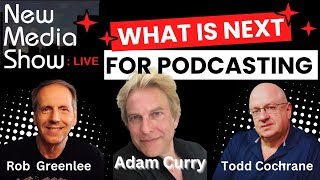
In this live episode of the New Media Show, host Rob Greenlee is joined by veteran podcaster Adam Curry and producer Todd Cochrane to discuss the past, present, and future of podcasting. The conversation opens with light banter before moving into a deep dive on Curry’s 17‑year No Agenda show and its value‑for‑value model, the role of the "Troll Room" chat, and the concept of listeners as "producers." They examine the challenges of monetization, advertising scarcity, and the economics of hosting, noting that many podcasts operate with one‑person teams and that hosting prices have remained flat since 2008 despite rising costs. The panel explores the decline of traditional radio, the untapped potential of hyper‑local podcasts, and the impact of recent radio‑station acquisitions. Technical discussions cover the evolution of podcasting hardware, especially the new RODE Streamer, and the tension between audio‑only and video‑enhanced formats. They critique the current podcast advertising ecosystem, data collection practices by platforms like Spotify, and the need for privacy‑preserving solutions. Finally, they envision a future of niche, community‑driven podcast apps that use user data to curate personalized experiences while remaining independent of big‑tech gatekeepers.
Chapters
do that, won't they?
I like it, you know, she's good. Otherwise I'd never leave the house.
You never—
up to me, danger, you know, I don't want to become Dvorak, you know, I want to—
God forbid that.
Dangerous.
That's funny.
Yeah, John's been doing podcasting for a really long time now. Yeah, he's, he's definitely one of the OGs, no question.
Um, here we go.
Yeah, I guess, yeah, I guess you take Cranky Geeks into account. Yeah, true. Todd and Rob in the afternoon. Hey, afternoon delight with Todd and Rob.
Oh yeah, oh yeah, oh yeah, oh yeah.
It's Todd, Rob, and Adam today, not just Todd and Hey everybody, welcome to, uh, the New Media Show, and, uh, we're gonna have fun today. Rob wrote an agenda. Rob, why did you do that?
Well, it's not an agenda in the terms that Adam typically thinks about it, um, with his No Agenda show. It's more just, you know, things that we can cover on the show, but there's nothing to stop us from venturing off this agenda.
Yeah, absolutely. But, uh, hey, by the way, happy birthday to podcasting! We passed it a bit ago. And by the way, Rob, we went over 500 last episode. We didn't even—
so I didn't even say anything.
Yeah, we're 501 now. So, you know, your co-host here failed in his duties to say, hey, happy 500!
I don't even look at the numbers.
Congratulations, 500 new media shows! That's, that's pretty cool.
Yeah, it's not bad. But we are live lit today. So, uh, if you are on one of those newfangled podcasting apps from podcastapp.com, thank you so much. Otherwise, we're, uh, we're streaming live at newmediashow.com/live, and of course all the other great locations we go to that, uh, pittance of people watch. But the more important thing, most people that listen to this show actually listen and don't watch. So, Adam, how are you?
I'm good. I usually listen to the show, although I think last week or the week before I did have fun. I was, I was listening on Podcast Guru and like, let me just see how ugly they are. And so I popped up the YouTube and then there was a chat going on the YouTube. Like, oh, that's kind of fun. So, you know, I'm always a sucker for a good chat to troll along.
Oh, they are trolling already. Uh, of course. Yeah, they're saying in the morning. Uh, so yeah, absolutely. So it's actually in the afternoon, but I— we can't steal that one. But, uh, anyway, uh, welcome. Thanks for taking time on your busy schedule. I know that the Keeper has you, uh, has you scheduled full.
And yeah, yeah, it's a busy life, but you know, she, she keeps me grounded, she keeps me going, she keeps me social. It's very important. That I get out of the studio and do something else from time to time. So yeah, I'm happy, and thank you for inviting me. It's so nice to be back. It's been 2 years maybe since I've been on the show.
Has it been that long?
Wow, Rob, you failed in your guest inviting duties.
Yeah, we've, uh, I'm always, uh, respectful of your time. I know you're very busy and you got a lot of stuff going on, but, but it's great to have you back. And I don't— I would love to hear a little bit about, you know, your No Agenda show that you have and kind of what you're, what you're seeing in the space and what you're trying that's, that's new. I know that show has always been a little bit of the leading edge of your thoughts about podcasting. And if you wanted to start off there, that'd be great.
Yeah, sure. Well, first of all, this month, October, actually, it'll be 17 years that we've been doing No Agenda. And probably 16 years and 9 months since we've been doing it value for value, which is just unbelievable. You know, we ask people to support the show with time, talent, or treasure, and they've been doing that diligently. I think after 5 or 6 years, it was enough for us to really start to think about doing it full-time. It wasn't great, but it certainly has built up over time. And, um, uh, in a funny way, we've been way ahead of the curve on some things, uh, because we've been producing the show live for at least 15 and a half years. And I can't actually— I mean, of course I, I do interviews and stuff, and there are a couple of shows that I don't necessarily do live, but man, I love it so much because we have a chat which we call the Troll Room, and really anyone can say and do whatever they want, but it's, um It's an IRC-based chat, so it just kind of scrolls off. There's no history of it, and someone may save it. But so, you know, you could— ah, someone trolled me and they said something nasty, but it's gone within 30 seconds. Like, okay, it's gone. But I really developed a kind of a peripheral vision. It's always kind of right off to the side, and I see stuff just— it registers like, oh, I look, and then there's a funny one-liner, or there's a real-time fact check. You know, he said something wrong or dumb or stupid. Or someone actually has something to contribute. That's been really good. And in general, you know, this is the big secret of the No Agenda Show, is the value for value really has gone to all parts of it. We have tens of thousands of producers. We don't call them listeners, we don't call them fans, we call them producers. And everyone has a responsibility to contribute to the show one way or the other. And pretty much everybody has one thing they're knowledgeable about, you know, one one particular topic or subject, or it's their job. And we, of course, we saw that during COVID We had a lot of nurses, doctors, registered nurses, pharmacists, emergency workers, people in military, just all kinds of stuff they were getting firsthand. And so, you know, Boeing's on strike, we got people at Boeing, you know, we've got everything. Someone is in a place somewhere, um, and We treat our boots-on-the-ground reports with respect, and if someone wants to be anonymous, we can assure that as long as you send it to me, don't send it to Dvorak, then you're assured of anonymity. And that's really been the big success of the show, is that it's an ongoing collaborative work. So at this point, people have actually gotten to the level— can we play Well, we probably have about 90 to 100 clips for each show. We play 60 to 70, I'd say. Oh, and it's short clips, you know, a minute to 2 minutes, somewhere in that range. So there's people who send stuff in ready-made. You know, we have this whole concept of the meetups where people organize meetups through noagendameetups.com, which we didn't put together. Of course, one of our— Sir Daniel manages that. He built that site. And there's probably 10 meetups every single week all around the world where people just get together and they're, you know, they're not of the same age group or background or race or religion, but they have this one thing in common, which is the show. And of course, as with all good clubs, cults, and communities, we have our own little language. So in the morning, hit them in the mouth, the 33, douchebag, spook, spot the spook. I mean, all this kind of stuff, which is normal for any type of community. And so that really creates a bond. And we have some pretty good groups out there. I think of the people in Florida or Indianapolis or in the Netherlands, and they get together regularly and it's 50 to 100 people at a time and they become friends. I think there's one or two marriages have come out of it. So to me, it really proves that, you know, I kind of believe that where we're at now is the future of all media is going to be small.. And small, dedicated audiences are really the way to go. You know, thinking you can be the number one this or the biggest that is old-fashioned. It's, it's old-fashioned thinking because no one can do it. Even Hollywood can't do it anymore. They're trying to be the biggest and the number one streamer and have the best packages, and they're all kind of failing. They're not able to pull it off because that's just not the way the network operates. And this is something that we I think we all collectively saw it 20, 25 years ago, and now it's finally starting to take shape where, you know, the first thing to go obviously was the written word in its many forms. So news by itself is no longer a product. The way they were financing it before was, you know, kind of was— what's the word I'm looking for? They all kind of— the news people always thought that people were buying newspapers for the news. No, they're buying it for the classified ads. The classified ads paid for the news. News was always a subsidized product until you got cable news. And, you know, that is now almost wholly financed by big pharmaceutical companies who advertise. So, you know, authenticity is what people are looking for. And they're looking for real voices they can connect to. And that's kind of the spot where we're at. And so when Dave Jones and I started Podcast Index 4 years ago, I mean, I'm just delighted with what's come out of that because we really created a place where innovation happens, where different types of thinking goes into newer podcast apps. You know, there's still, you know, like, well, we've got to get Apple to do it. And I just don't I don't buy into that. I don't subscribe to that philosophy. You know, we can have our own apps and we can have ones that each different show uses and you can do whatever you want. And that's really the beauty of the original invention of RSS. You know, it wasn't— I was listening to— what was that? Slate was like the last Slate podcast. Some who— I forget who it was, but she had on some some English dude who was, you know, podcast analyst and like, well, you know, podcasting, of course they screwed it up in the beginning because they made it impossible to track anything. He's like, yeah, because we weren't thinking about that. We were just thinking about—
It wasn't the priority.
Yeah, that wasn't the priority and that never has been. And, you know, to the credit of RSS, it's, you know, it's bulletproof. No one can really break it. It's here to stay. It's a part of the underpinnings of the entire internet. And it does enable anybody to say whatever they want. And with the advent of the index, you know, you're pretty much guaranteed it'll be there and not at the whim of a Silicon Valley company or Apple or whoever wants to be the on-ramp to podcasting. So in a way, the goals have been achieved and, you know, beyond any belief and I'm just delighted to see that it continues to flourish and it's still a topic of hot debate and controversy. That means it's still relevant.
You know, I saw— it's kind of, you know, you're relating to, you know, shows making comments about surviving monetization, gotta have a big staff. There was something on X from Alex Goldman, and I don't even— I'm not familiar with their show or what they do, but it's— I guess it's called Hyperfixed, and He was just complaining about how he's losing money and, you know, he needs, uh, his day rate is only $288 a day. And, and I'm just kind of giggling the whole time reading this thing. And he's got a whole different perspective on creating podcasts. And I replied back, I said, just remember, you know, 90 to 95% of podcasts are, maybe even 97% of podcasts are staff of one. Or two, you know.
Well, that's real, and that's really, um, the, the seat— it's been the secret to our success. Not a secret, but that's been key, is that there's two people who do no agenda. It's me and it's John. Now, because we positioned our audience as producers, we have 10,000 producers, and it's a lot of work. It's like cats, you know, you got to herd them. You know, I, I have to go through my email diligently— excuse me— every single day because, oh yeah, there's that guy who just sent me 10 emails. One of them is going to be a gem. So you have to— you got to put that work in. But that's, that's really all I do. So it's not all that horrible, you know. And a lot of it's like, check out this 3-hour podcast, it's great. Okay, so can you give me some time codes or kind of where to find, find stuff? But that's it. I mean, I produce the entire show. Uh, John does all the finances and administrative. His wife Mimi does the taxes. Uh, we pay his, uh, his daughter Jay, to manage the spreadsheet, which is— it's a tedious job, you know, to— and, and of course we have, you know, when you support the show cumulatively up to $1,000, you get a— you become a knight or a dame, you get a ring. That's a lot of hassle to just do that fulfillment and make sure it works perfectly. Um, and that's it. Those are our costs. I mean, um, and it's just a pass-through LLC, and, and we've— we actually, we We were doing it on a handshake for, for 12, 13 years until the IRS said, what are you guys doing exactly? So how does that work? So then they said, you know, you've got to put it into an LLC. So we literally have a 3-line LLC document, uh, and that's been it. And, um, I think we've, we've just been fortunate, uh, to have found each other. Um, and, you know, we have a couple things in common. One is We don't really like each other that much, so we don't talk outside of the show. We're not friends, we're not buddies. And we show up every single time and we show up on time and we do it the same time. And we really are consistent. And then the one thing people always miss, and this is a very important piece that Jon does, is we have a newsletter which goes out the day before every single episode that we record that goes live. To remind people in their busy lives that No Agenda is coming once again. And yes, we're reminding you to support it.
You know, it goes back to even deeper. You know, the product— your guys' production cost is your time. That's your production cost. And then you have the additional support of the team. So when people say, I don't have budget for production, I'm like, sweat equity, baby. When I was building Blueberry and running a show and working a job, I worked 18, 20 hours a day and didn't sleep. People would say, how'd you get all that done? Sweat equity. You know, that's, that's what you had to do and grind. And you know, this guy's complaining about not making enough money. He's only making $18,000 an episode. And I'm like, what's the problem?
Um, that's not bad.
$18,000 an episode. Yeah. Yeah.
That's pretty good.
You know, and I'll take that. And then I'm like, you know, I'm thinking as a hosting provider, and this is, I brought up this up a couple of times recently. We have not raised hosting prices since we introduced it in 2008. People in the early days bitched about the $20, the hosting cost, man. They just screamed bloody murder. So now we are this many years later and the cost hasn't went up a penny. Our costs have went up, you know, I had a 13% increase in, uh, you know, in health insurance this last year. We ate it. We didn't raise prices. And why did we— why didn't we raise prices? We can't. There's 25 companies that are out there trying to, you know, keep customers. So I, you know, cry me a river, you know, I, I, you know, it's like I do a show, Rob and I do this show, we grind.
And a lot of it— but, but with everything, Todd, we saw this with blogs early on. People like, oh, I just published a blog and I'll make money, and, you know, I'll just do a podcast and I'll make money, right? And the, the podcast industrial complex has, of course, supported that vision, like, oh, you know, you can make money and you just get enough people and grow— sorry to say it— grow your show, right? And then you can have ads and then everything will be great. You can quit your job. I mean, I've been through that loop. I've been through the quit your day job loop. Um, you know, when, when we started, uh, uh, uh, Podshow, we actually, we set up, we had a network of podcasters, we set them up, we had I think 12 or maybe 14 We gave them— we created LLCs for them. We gave them varying degrees, but between $50,000 and $75,000 a year just as a guaranteed minimum income. And then they could grow that amount based upon their success. And even that, we couldn't— we couldn't make it work. You know, it's just this— there's so much that is wrong with podcasting and advertising. Yes, really. You know, it's just not an easy fit. Um, and we're seeing some of that now.
It's— it is a situation too where people forget that creating content is not necessarily the easiest thing to do. You have— you have to— you have to work at it. And that's why we see such high failure rates, is because shows say, oh, I'm going to do a podcast, and, you know, they give it 5 episodes and they bounce. You know, they don't realize that, uh, you know, to create great content is good. And if you are, if you're Oprah, you can have a million people listen to you immediately. Doesn't guarantee they're going to continue to listen, but you know, Rob can probably attest to that having worked at, uh, you know, the, the shop that had all the celebrities, you know, he worked at every shop. That's right. He knows where all the dead bodies are buried for sure. But you know, it's just one of those situations where you just have to grind. And, you know, it's— I guess, you know, some people are lucky and hit it big on TikTok or whatever, and, you know, great, great for them. But this is a different kind of a medium where you got to be able to connect. You got to connect right here because it's an interesting time.
I, I agree, Todd, you know, that there is such an emphasis on how I'm going to make this a full-time career or a full-time job, and I'm going to make I'm going to get rich being a podcaster and stuff. That seems to be the agenda. So you have to really kind of wonder why that's happening. And I think a lot of it gets back to is that people are increasingly looking to create their own independent income because they can't rely on getting jobs anymore.
And I think that is a bigger— What?
Bidenomics isn't working? Right, exactly. We can't have that. Right. So as people look at podcasting. I think increasingly it is replacing mainstream media. And this really goes along with what you're saying, Adam, is that we are moving into a new era of niche communities and niche interests and also taking this content out of these big moderated platforms and going more direct. And so So talk about that a little bit, about the community dynamics and really moving away from these big proprietary platforms.
Well, it's what podcasting has always been good at. Oh, I know. When it first started, it was very obvious you had, as always, some shows that are kind of general funny. But now it seems like most of the shows that don't really have a mission are more politically oriented, but we've always had aviation podcasts, hiking podcasts, you know, football podcasts, football podcasts. You know, that's always been, been really— that's always been there. What I feel right now is the big opportunity, which I'm actually working on myself, is local markets. They've been completely ignored by radio. Radio is no longer your— even Z100 in New York, where I worked for many years, right? You know, it's Elvis Duran in the morning, but he's in 15 markets. And yeah, you'll hear a, you know, a localized Z100 New York, uh, jingle, but that doesn't mean that he's really— he's doing— he has to do more generalized stuff. Um, there's almost no— well, I mean, New York does still have some New York newspapers, but even they cater more now towards, um, the entire country or the entire world, like the New York Post. And the New York Times certainly is really no longer a local New York newspaper. Facebook has sucked up all the local advertising from any type of publication in any local market. So I feel that at this point there's a tremendous opportunity to create podcasts based upon very hyper-local geographical location. In fact, I'm gonna be doing one for Fredericksburg right here. It's 11,500 people. We're in between San Antonio and Austin. So, you know, even what Austin does is almost not just for Austin. There's a lot of interesting people here. There's certainly a lot of money in Fredericksburg. And we have one newspaper that comes out once a week and it's very politically slanted. And people have nothing to really, you know, they have no local voice. So, you know, it's such an obvious hole in the market. You could turn a 747 around in it. So, and that's globally, that's what radio used to do. Radio was local and it just became so, I mean, this all happened in the '80s and '90s, just, you know, let's expand and get bigger and acquisitions and, you know, networks and like WABC New York has all syndicated programs. Program, and it goes out across all the country. So, um, uh, and, you know, an AM radio is, is in essence going away, although Congress is deaf, you know, desperately trying to keep it in, but in, in cars. But electric vehicles have a real problem with the, with static. I mean, it's basically like holding up a hair dryer next to your AM radio, so that they're not quite sure what to do and how to, how to do that. So, you know, that's the opportunity I see. And I'm pretty sure that that's going to happen, that I think we'll see in the next couple of years, we'll see many hyper— is that you or is that me?
Who's beeping?
It might be me. Okay. Many hyper-localized podcasts that will be thriving because local communities will support it, whether they're supporting it with donations or I can certainly see if I'm here in Fredericksburg and, you know, I have— if I have 600 people listening and there's 600 people that matter, I'm pretty sure vaudeville down the street is going to say, you know, why don't you do an ad for me? You know, and I'll do it and I'll go there and eat and tell everybody what I thought about it. So, you know, it seems like we can get back to that. And that's, that's a big opportunity. But also people want to be a part of it. So you need, you know, we need to go back to How do people interact? How do they get their voice heard? So whether that's direct feedback on a chat, which you can read live, or even having people call in. I mean, we're going back to that. This is— nothing is new. It's all been done before. It's just the cycle and we're coming around. And luckily we're able to do it because it's so, you know, thanks to companies like Rode. I'll give them that plug, although they've never even talked to me or ever sent me anything at all for free. It's outrageous. I've always purchased everything from them. Um, I think they've made it very accessible for anyone to kind of get started.
You know, talking about the local thing, I was in the dentist's office recently and I didn't even know my local town still had a newspaper. And there was one laying on the counter there. Of course, the dentist's office, that's where you're going to find it, right? 3 pages, a weekly, 3 pages with what happened in high school. And I'm thinking there's about 25,000 people maybe that that reaches and I'm thinking, wow, how— and of course no one reads a newspaper anymore, not local for sure. So, you know, I think there is an opportunity. And, you know, Rob Greenlee has been a big fan of local podcasts for years. You've been waiting for it, Rob, so you should be excited with what Adam's got cooking here.
Yeah, I, I really kind of always felt this way, that this is ultimately where we would head once we reached a certain saturation point of podcast listeners, right, that this would unlock. And I thought it was interesting not to draw kind of a political slant to what's happening here, but I did notice that George Soros purchased 220 local radio stations here in the last week or so, which I thought was a little bit counter to what a lot of people would expect, right? And I think it was really, really interesting. I think he bought it from Odyssey, I think was the network. And it does kind of point to maybe a little bit of what you're talking about here, Adam, is that the network is shifting to driving local communications more and not so much exclusively these national syndicated kind of content on the radio. So this is kind of a radio play that may be playing out. And I do, I mean, how do you see it playing out? I mean, if you think about what George Soros did, which seems contrary to where most of the investors are putting money, actually, they're pulling out of radio, not putting money in. Right. So is there a contrary kind of view on this?
And it sounds like you're kind of, you know, well, first, the headline is George Soros buys 200 radio stations. Okay. That's not exactly the story. Okay, good. Soros hedge fund, which as far as I know is really now run by Alex. George is barely alive, so we can probably leave him to— he doesn't need to be the boogeyman anymore. It's now Alex, who's probably worse. But they bought up Odyssey's debt, so they bought up $400 million worth of debt, so they They collectively now, I think, control 40% of the shares. That doesn't mean that you immediately have control over the programming or that, you know, some evil Soros genius is sitting there stroking the white pussy. Hahaha. And now we will make it all liberal content.
All right.
I think it's probably one of— I mean, there will be money in radio stations still for years to come, just like there will still be money in cable.. But if you look at the, the, um, and I happen to know these numbers, the average age of, um, and these are mainly AM stations, a lot, not all, but a lot of them, the average age is 74, and they are going to ride their audiences into heaven. So yeah, it's probably a good deal on paper because you can squeeze some money out of it. I think if anything, um, they'll probably sell off bits and pieces of it. But, you know, even the church ladies text group, you know, like, oh my God, yo, hair on fire, Soros is going to control the airwaves. You know, no, today's millennials and Zoomers are not listening to the radio at all, at all, at all. And they're listening to podcasts. They're, you know, they're getting their media from other places. If anything, they're kind of turning away from some of that as well. The real place is you need to be in everyone's text groups. That's where all the real communication takes place. So this is a typical buy up the debt cheap and there's going to be a restructuring, so they're going to have to sell off stations. It's not like he bought the stations and right away it's going to be Rachel Maddow 24/7.
That's just not the case here. Yeah. So probably what they'll do is find somebody else to sell it to at a margin, probably.
I think they'll sell off the pieces, they'll sell off different stations. That's pretty, I mean, it's chapter 11, so they're in restructuring, so it has to be restructured, you know, but if you can buy up that debt at 50 cents on the dollar or lower, but they don't have the controlling interest. And so that doesn't mean that, what I haven't seen is, and they brought in this incredibly smart radio guy and he's gonna turn it all around because no one has been able to do that. They haven't been able to do it with iHeart. They can't do it anywhere. I mean, it's just, it's not a viable business anymore. It's too expensive to run transmitters. You know, that was when we first started podcasting.
Transmitters?
We don't need no stinking transmitters. That was the whole point of it. And, you know, you just can't— the genie's out of the box. You know, people have connected their phones to their car systems and they're listening to other content.
You know, when it, it, the handwriting on was on the wall, even when we just started podcasting, you know, it probably for me, it was biggest realization was, is when my kids are, when my kids were still kids and they're in the back seat and they both have mobile devices and they're plugged in and dad's got something on Bluetooth and they're not listening to what I'm listening and they're listening to their own thing. I'm like, uh, radio's doomed and media is doomed cuz media has changed. You know, that was 16, 17 years ago. So, Now, you know, of course we all know that, uh, my grown children are not on the radio. They don't have a TV subscription. Matter of fact, they're mad because we can't family share Hulu no more, you know. So that's the kind of thing that, and you know, that they, they worry about now is like, you kind of can't afford all my subscriptions to the stuff that I want. And so what are they reverting to? Well, I can't share Hulu, so now I'm just going to go and watch YouTube, or I'm going to go on TikTok, or So they're consuming stuff differently and that's just going to continue.
So also that brings up another point with the fading out of radio, you are also removing the scarcity issue. So on radio you have 24 hours a day, you've got 12 to 20 minutes an hour of advertising, and when that's full, it's full. And the only thing that can happen is either expand it more or you raise the prices. With podcasting, just as with, you know, web banners back in the day, there's unlimited inventory. So dynamically inserted ads, pre-rolls, post-rolls, all of that will eventually just go down to zero. The only scarcity you can still create is how many host reads someone is willing to do inside the body of the content, right? That's, that's your only scarcity, and that's going to be very limited. And I think you will actually be able to drive up that CPM over time, but it'll not be based upon downloads. It'll have to be based upon PI or per inquiry of, you know, actually when Podshow was very successful for a short while, and that short while is when we had coupon codes, promo codes. So it would be, you know, the Rock and Roll Geek would be use Geek4 and get your Go— because we had GoDaddy in the early days too. And get your GoDaddy domain. We actually started that with them because they understood that really well and they were ramping up a business so fast. Unfortunately, what happened there is these hosts of these shows became very proficient at SEO, and, and no one's getting the codes from their show. They were getting it by Googling stuff, and then, oh yeah, this is the scam and I'll expose it right here.
That's how it works.
We've talked about it on here. Yeah. And so it's going to have to be some other mechanism, like maybe that's not even here yet, although I think chapters and chapter links within chapters is an interesting way to do that. But it's still going to be partially the endorsement by the host. Like, you know, I'm saying that I go here and I probably should go there or I should be using that product., which limits, um, you know, what, what products and services. And also, you know, advertising is always censorship. So, um, most advertisers don't like controversy. Um, so again, it's, it's a very tough fit, but the, the actual mechanics of, uh, of scarcity are gone with the internet. It just doesn't exist. How much inventory do you want?
We'll make more, right? You know, it's what's funny, Adam, is, um, speaking of GoDaddy, when They came to me and said, hey, we think you should have a landing page for GoDaddy. I'm like, sure. So I put up a landing page on my website, and little did I know, about a few years later, all become— that became a, uh, a snippet on Google search. I had a great year that year. I mean, I mean, I had a, I had a really good year. I mean, like, to the point of embarrassment good. But when that snippet went away, so did the Good times, good times are over, went back down. But at the same point, we set up a system because GoDaddy knew that that traffic was still hitting that landing page and, um, and getting those codes. That's no secret. And I was watching the PageRank on where that was falling in search. Still today, um, as long as I meet my numbers, they don't care where it comes from. And so what they're really paying, even still to this day, is they are definitely paying for that landing page to be there to to get people to use those codes on their site. So there's no secret about it. They knew that was happening because, you know, how can I do 19 years of GoDaddy ads every show and still sell to new— yeah, we have some podcast listeners that grab codes, but it's probably like 90/10, probably 90% from the page, 10% from the show at this point. Sure. So You know, that's, that's, that's a given. But, you know, that was, that was a very, very good year that year. I got that snippet in Google, but, um, and everybody knows that game. So yeah, but the DR codes, you know, and here's another thing too that worked but still won't be done. And we've been talking to people like, I got these 500 shows that will make a great one deal. And I know we don't want to talk about advertising. I want to use one promo code for all 500 shows and they won't do it. You know, it's like the Three Musketeers, one for all, right? Basically, we all, we all live and die together. And they won't do it. They want to, they want to cherry-pick the shows that are really performing. Little do they know the collective total number of reads using the same promo code is going to really be successful. But you can't teach them nothing. They know everything. So meanwhile, 90% of podcasters of the 35% that still want advertising are never going to get it, not until something changes.
So, well, nothing's going to change in that regard. Yeah, nothing's not going to change.
No, it's not going to get—
hasn't changed for 20 years. You know, downloads are a horrible metric. Everybody knows it. You know, it's, it's kind of— it's still, you know, with the big promise of advertising, which I've heard for many years, we'll get the right ad to the right person exactly the right time. Podcasting can't be a part of that ecosystem at all. TikTok works pretty good, so People still know that half their advertising money works and they don't know which half.
I mean, that's still the same. Yeah. You know, you spoke about Rode here earlier and we didn't really have it in the list, but Rode announced their Rode Streamer today. You know, it's kind of funny. If people saw what was on the other side of this, their wallets would, would, you know, it's not a pretty situation money-wise, but I made this investment a long time ago. And I got all this gear. Essentially, the box that I have that was really probably— yeah, I got some upgrades, so it didn't cost me as much, but maybe $35,000 worth of gear is now in a box at $1,195. We'll do everything that the box I have right down here, and it's been that way for a while with a variety of different tools. But it's amazing, this company that owns this now is that market that was selling to me is gone. As soon as that machine goes belly up, you know, I'll throw it in the junk pile. There's— and there's— I'll never come back to their company because of this change. So I think this new RODE Streamer with— no one, not every— no one's going to need 6 cameras, but it could be a screen, 2 cameras, you know, someone on Zoom. It's just, you know, it's a mix of things that I think they're going to hit. I think that what the RODECaster did for podcasting is going to be the same for streamers, those that stream.
Yeah, yeah, Todd.
And to be clear, that's $1,100.
Yeah, $1,195.
Yeah, that would be a steal. But most people didn't know they had a little streamer box already that I've, I've had for more than a year that I played with. It's kind of cool.
They just took it and went, you know, they expanded it and took everything, you know. I— it came out yesterday. I immediately went to the user guide and looked at everything, and I get immediate gadget envy. I'm like, if I was to build something that would do this, this is exactly what I'd do. Absolutely. Just like the RODECaster, the RODECaster Pro 2, I will say that finally hit all of the marks, and it is exactly what I would— in fact, I tried to build it, couldn't make it work cost-wise. Um, it's fantastic. And for a moment there, I even had the, like, Well, you know, we could— I could do No Agenda.
And, and I thought, you know, yeah, come on, join us, come on.
Not every book needs to be a movie. Come on. No, no, I just— it was just pure envy. I'm like, oh man, I gotta set up cameras and switch. And just a lot of interesting stuff with the auto-switching, and it basically has a whole RODECaster Pro built into it. Fabulous. I, I wonder actually how well it will do.
Well, I'm glad they did it. I'll let you know in about a week. My B&H rep says, Todd— this was the, the subject of the email— Todd, you need to check this out. And I had already read it in Podcasting News, uh, you know, from Cridland's article, and then this popped in from B&H, and I'm like, oh, there goes $1,195 plus tax. So it'll be here on Friday. I'm going to take it with me to the Philippines.
I'm sure it is.
I'm sure it's great, but—
or it'll be not great now, but after 5 updates it might be great, you know. And I'll just get into it so we can get it out of the way, because of course we have to have the video conversation because that's where I was just about to go. After all, um, um, I understand the obsession of audiences wanting to see how something is made, because for years you could really only listen to radio. Again, not every book needs to be a movie. I really am a firm believer that it's much more exciting to listen to something and imagine, or have your own mind's eye, your own mind view of what the people look like, what they're wearing, what they're doing, what their situation is. It has always had longevity. You can multitask. I'm quite sure that most YouTube videos, unless they're instructional, I mean, I watch YouTube videos for all kinds of stuff, like mainly airplanes I can't afford. Like, oh, it's only $150 grand. Look how fast it goes. Living vicariously through the screen. Top 5 turbine airplanes you can't afford. Okay. And of course, and, or if I, you know, for instructional stuff is fantastic or, looking at, you know, older television. Oh, there's all kinds of stuff that's good for. But I think interview shows, I can see the appeal of being able to watch. I just don't think it's all that— all— I don't think it's quite as desirable as people think that it is or that the advertising industrial complex wants you to believe it is. It's inherently dangerous to build your audience on any kind of platform. You know, not my monkey, not my circus. You know, it's like, oh, so it's none of that's a good idea. It goes against the entire concept of RSS. And there is, of course, a universe of TikTok videos and, and YouTube But it's a very different type of experience. And I'm not at all concerned about this incessant need to go to video other than ad. And it was kind of fun to watch James Cridland say it out loud the other day in Pod News, like, well, wait a minute, they only care about the money for tracking ads and all that stuff. It's not about actually people wanting video. And it's not. I mean, 17 years. Of two old dudes who are not really appealing to watch on video. Although I understand because when I first saw radio shows, morning shows set up webcams, I'm like, I really don't see the appeal. But there is an appeal. People have been listening for years and years and now they want to see. And what do they look like? It's kind of like seeing how the sausage is made, but it's really not necessary. And, um, you know, not— we saw this with MTV. People still listen to music. We don't need to have the music video all the time. It's just not true. Music is music, and people like listening to music. Does everyone have to have a video? Well, kind of for promotional purposes, but it's still— it's not the premier way that people listen to music.
They listen to music. Well, it, you know, and it's also much harder. It's just like in my show the other night, I gave him 5 minutes of a, of a black screen, and I didn't realize it was a black screen until I looked over.
That's just you, Todd.
No one else has these problems. So, you know, it was just like you do one of these, that's, you know, you're live, what can you do? And you just laugh it off and continue on. I just think that, um, well, I'll transition. Yeah, there, there are realizations in the space that Spotify's got an angle right now that they're using, and it's be, you know, and YouTube is, they've got an angle and it's an appealing angle to those that think they want to do video. Um, I think there's also a realization, I'm just, you know, I would just say based upon conversations I've had, I think that there's a realization over, you know, at the big Mac, uh, Mac office in the sky, that they, they probably kind of, uh, you know, missed the boat when it comes to video.
And you will see what they do about that. Um, nothing. They screwed over people so bad with Final Cut. They screwed over the professional and prosumer market with their USB shenanigans years ago. I left— I, I wasn't an Apple guy from the Apple II. I loved Macs. I love my Macs, and they just— I couldn't make it work anymore, you know. And they had the FireWire and all this nonsense. Well, but the USB mess up they made about, I want to say, maybe 7, 8 years ago, it made me go away, maybe go to Windows. Now, of course, they're all in cahoots with the device makers, so, you know, no one makes drivers for Linux. Because, you know, once, once you have that on Linux, then there's no incentive to upgrade anymore. You can't break it. You know, Apple is about to break all of the older devices. Everyone's gonna have to upgrade all their Pro gear to whatever new system they're coming up with, um, you know, just like they did by removing the headphone jack.
Well, that's how they, that's how they sell, that's how they sell more gear. But I'm kind of referencing, you know, we'll see what Apple Podcasts does. And I know that there are Lots of things. Yeah, I mean, we'll give them 2 years.
What do you mean? What do you mean?
What are they gonna do? Well, you know, I, I, my hope is, I'll just say my hope, surface the video that's in there. I'll just say my hope is that they'll quit making video a second-class citizen.
Uh, well, I hope, I hope they start focusing on video all the time so that some of these new podcast apps can take away their business because people want— look, NPR doesn't have video of every single one of their shows. ABC doesn't have video of every single one of their shows.
Why?
Because they're audio shows and they're good and it's quality and people like it and they listen to it. It doesn't have to be video. So if Spotify is stealing, it's stealing people's livelihood with their whole video system, because once you upload video, then your audio no longer counts. You don't have the Uh, you don't have the, uh, the pass-through of the statistics. And I'm just presuming they can add in ads or do whatever they want because you need to sign a contract to be on their platform, which is why none of my shows are there. I refuse.
And you know what? Hasn't hurt me. But don't, you know, don't get me wrong. You know, obviously right now at this very second, there are a handful of new podcast apps at podcastapps.com where you can watch if you want to. This show live on video in a podcast app. So, and maybe that's where we transition to the Podcasting 2.0 discussion. But I also have to recognize, and in my position as a hosting provider, that Apple still has 50% of the listening audience, and I have to make sure that I'm vocalizing to them where their issue is. And I've done that very distinctly, and you know, and having other discussions about things that I think they should improve, specifically trying to adopt some of the stuff that's in Podcasting 2.0. I'd love them to adopt everything. They never will. They're too slow. Doesn't work that way over there. It's decision by committee. They're very secretive. You know, it's— I call it contractor speed. Oh, that's interesting. You know, those types of discussion. Meanwhile, everyone else were moving quickly and running with scissors, as the term is in Podcasting 2.0. And I love it. I think we still have a long way to go in educating podcasters on this value, because if we could get everyone on the same team and tell our audiences, you know, there's this new experience over here, it's not the same as it was before.
It's not just click play and put the phone in. First of all, these things take time. It's true. I mean, the main thing I'd like to see now is I'd like to see podcast apps make use of the funding tag. Yeah. And display that more prominently because, you know, just removing the steps of going to a website or going to Patreon or going to PayPal or whatever it is, just having a click here to donate and, you know, make it clear to donate to the show, maybe with words instead of, you know, something that's buried deep. I'm looking at you, Podcast Guru. That would help the The streaming SATs and boosts and Boostagrams, we're now in the process of about to— Dave Jones and I have really been working pretty hard on getting a couple companies to make it very simple. And the main thing is for app developers. App developers, you know, they're trying to make good apps and to implement all kinds of, you know, things. With wallets is complicated. So we're looking at something as simple as an OAuth connection. So you'll be able to connect Zebedee, you'll be able to connect Strike. There's some pretty decent information in the market that PayPal is going to be enabling Bitcoin send and receive straight from fiat. So, you know, there will always be an element of Bitcoin, like, we've got to be in sats, it's got to be, you know, we've got to be whatever it is. But ultimately, if you just say, you know, connect your bank to this app like you do Venmo or Cash App, uh, and then just send, you know, a dollar or $10 or $100, the fact that it runs through the Lightning Network and can be divided into very small payments is just a benefit that no one really has to know about. So like Bitcoin itself, this is very, very early. It'll never work with fiat. You just, you can't do it with the fees and all these hassles. But having podcast apps through an intermediary functioning pretty much like Venmo, that's on the way. That's coming. And that, you know, we'll see it. We'll see the integration happening in the next couple of weeks, and it'll really start to roll out broader as more people learn about it and it becomes easier. And ultimately, it's the podcasters. The podcasters have to tell their audiences what they want them to do.
It's that simple. Yeah, that's a good transition here, Adam, about, you know, how to manage your community, right? And to foster these kind of things. And then you got to threaten them constantly, right? Right. And How to actually do that in the context of what's happening. This is a very evolving kind of methodology that you're talking about, but it does dovetail to what you're talking about, about building these niche communities and building support from the, the community and the individuals that are in the community, uh, and less, less dependent on advertising, right? I think ultimately that's kind of where, where the, the trends are moving towards is I'm not sure that advertising as we know it today is going to survive.
I think it will. I think some fundamental changes have to take place. Okay. I see a future for brands to create their own networks.
Right.
Kind of waiting for that to happen where a dog food brand has a network of dog podcasts and they work with them in close collaboration, not just throwing host reads out there, but you know, there's a lot of things you can do from a brand perspective and it'll take some investment. But I think that's a distinct possibility. And we need to— sadly, I think we just need to remove advertising agencies.
They're really the—
oh, they're the bottleneck. They're really a big bottleneck in this process.
Yeah, I agree. Yeah. And to some degree, we've seen that, Adam, to a certain degree too, with the brands taking on creator type of partnerships or— that's usually done through an agency. Well, I mean, like my, my contract that I had with StreamYard is an example of that. I created a show on their channels in support of them. But I think what you're talking about, Adam, is maybe creating kind of a network of shows that isn't necessarily tied specifically to them, but is more independent, but has an alliance with them somehow.
Is that what you're Yeah, yeah. You know, I see it kind of like, almost like an MLM, but more like, you know, Avon, you know, where there is an affiliation. I'm not sure exactly, but some, you know, marketers are people who have product, know their audience, they know how to reach them, and they're smart.
I'll never underestimate how smart marketing people are within brands because they really do know what works.
Because they're always testing stuff, right? Yeah. I mean, that, that's their job. You know, usually they start pretty small and they know who buys their sneakers and they expand that. And then, you know, in general, we're going to see a disintermediation of middle management in the world. It's time for that to happen. We have middle, mid-level managers creating memos with ChatGPT and mid-level managers on the other end taking that, putting it through ChatGPT to get the synopsis. I mean, this, this is the insanity that we've gotten down to. Everything has to streamline. So, so too the advertising industry. I think it's, it's time for a rewrite of the rules and that'll happen. But what's not going to happen is podcasting is not going to deliver any data to you of any value. It's just not. Can you create scenarios where people actually buy product? Yes, I think you can. But that's going to take a deeper integration with the programs and the people who create those programs beyond, you know, just here's my downloads or even here's my code. It's going to take a much deeper level of integration, but I think it can work. But it won't be as measurable as people like. We're still living in the CPM world of television and, you know, and the, and diaries for radio. I mean, it's, it's, it's an old-fashioned world and someone will come up with it.
It won't be me. You know, the, the whole model now, you know, if you think about what YouTube and Spotify have done, it's really, it's just a marketing ploy because they, they're taking all that content They're not giving anything back. They're getting all the analysis on those listeners. They're reselling to them. They're selling that data downstream. This is— and that's where the money's at, is in the, is in the bodies and the information. And while they'll always have that because they have the, the app that tracks the client, the login, and you've already agreed to the terms of service, I think there's a, an opportunity and something I've been looking at, and I really can't go into too much detail. Adam, you may be getting briefed by the individual soon. I don't know if he's reached out to you to give you a a demo, but I think we can take, um, take back the, the information.
In other words, uh, those that you trust— what are you talking about? Well, no one gives me any secret demos. You know, NDAs, this is no embargo.
They know me, they're not going to tell me anything. Oh, they, they will, and there's no NDA on this. Is, uh, what, what exactly are you talking talking about? Well, it's just basically, we— you as, you as a podcaster, being you're a techie, you can have an opportunity to obscure the IP data going downstream from your content media.
And still, yeah, so you own your IP is what you're talking about, right?
Yeah. And, and if, and if you trust your hosting provider to obscure that data and not sell it, your, your hosting provider might be able to do that too.
I don't quite understand.
And with IP, you mean intellectual property? No, I'm talking about IPs, your 192.168 listeners.
Yeah, the IP data of the listeners or viewers. Yeah. Well, so what are you saying, that that's going to go away?
Because no, no, but if you would have the opportunity to, if you wanted to, to take a piece of code and basically put it in front of your data, and basically the media gets served out in it just obscures all of your information about who that listener actually is.
And you can do that on your own.
Sounds like a big pain in the butt. Not big about that. About that, I don't want to— about—
I don't want to do any of that.
I'm a podcaster, but I don't care.
I think, I think the main thing is, is people don't want my content, don't support it. If you like it, support it.
It's that simple. No, what we're talking about is the people on the other end taking that data and then remarketing to your listeners and selling, selling the data about your audience. Now, if you are on an app that says, hey, we protect, we don't, we don't resell, none of that is needed. If all the apps out there will say, listen, we don't resell to any, we don't take any of this data that we're collecting and use that to our monetary advantage and, and basically trust the privacy of the listener, then this, none of this is needed. But I hate to say it, I don't think that's the case in a lot of instances. You know, there's no, there's one reason Why Spotify bought Chartable and PodSights? One reason, and they bought them on the same day. It's for all that data, all that listener data.
And, um, what data do they really have?
What data do you really get? Um, a lot. And they use that, they take that data and they use another system on top of it. And, you know, they know who you are.
Down to your address. Well, right. Yeah. But that, you know, you can use that data broker for that. I mean, all of that.
All that's well known.
Yeah.
But I don't think, I don't think people think about it, but in the end there's maybe a way. That's just one little piece of everything that's going on here. Some people don't care and that's fine.
If you don't like, you still gotta serve them a crappy ad, I guess.
Well, you gotta serve them.
You still got, you gotta serve. Here we go. I'll give that person, oh, it's Adam Curry. He's listening. He's interested in airplanes. He can't afford, I'm gonna give him an ad for an airplane he can't afford right at this very moment.
And here it comes, success. Yeah. Yeah. Well, and also they're capturing data about shows too. Yeah.
And so they can actually network. Yeah. So again, that's a business plan.
And how about this? I got a show about dog food.
Okay.
I'm a dog food company. Hey, you probably have people that are interested in my product.
Way to go. Connection made. That's right. Right. Yeah.
You know, if you're just talking about politics, you know, no, no one's going to be interested because it's too controversial. We don't want to be a part of that. Yeah, we want control.
Marketers want control. Yeah, they do. They want control. Yeah. So, and they want more and more data, and it's ridiculous.
I'm more interested in— I've been talking about this a lot, um, I would love to see some new podcast apps that are opinionated that are a platform vertical, or you could call it a vertical. I see it more as a— I use the example of Rachel Maddow because she was very clear about podcast apps in a recent— was Hollywood Reporter.
Yeah.
Interviewing. She said, I don't understand the apps, how come they're not recommending stuff and based on merit, etc. Now she's not talking about, you know, recommending Tucker Carlson to people who are watching her or listening to her podcast. So what she wants is she wants Rachel's world, right? And I would like to see apps that are opinionated and promote— you can still get whatever you want on that app, but why not have something when you open it up and delight them? Like, oh, I'm into airplanes, you know, this is my whole airplane podcast. I was recommending things. I might use multiple apps in that case. Why not? I use different apps for different things. It doesn't have to be You know, we're still kind of stuck in this. I've got to be the app for all things. Well, you're just an inbox, you know, you're not really impressive. It's just, it's just an inbox with some features that I may happen to like. There's a, there's a bottom line level of features a podcast app has to have. You know, things that Google still can't seem to figure out with their Google Podcasts on YouTube. There's some very basic things that it has to have. Once you have that, now what are you doing? Well, how about I'm opinionated and I'm going to going to create this world and any podcast within this realm that I'm interested in, be it a particular sport or type of business, that I'm going to create a place where, um, that's all promoted and the best stuff does come to the top. And give me some interactive features so I can talk to other people who are interested in this particular topic. That is the kind of thing I think we need. And, um, and no one has really stepped up to the plate yet, but I'll keep hammering at it.
You know, I'm not an app developer at all. We don't, we haven't built an app. I don't want to. It's very expensive. Well, I have one app we maintain and, uh, you know, that's a bottom line every year. Um, but why not? The current apps could do this. They could say, what is your topic preference?
And if it's sports, click sports. And what I'm saying is forget that. You know, that's genres.
Yeah.
What do you know about— I'm an app developer. I have, I have some interest in something. Yeah. Do that. Something you really know something about. Maybe it's just about technology. Maybe it's okay. Make it simple. Maybe it's about PHP programming, whatever it is, and curate that and, and, and make it something that's delightful to people. You know, you'll get more people who will value your app and will, I believe, support you monetarily to keep it up than just a plain old inbox that, okay, I can— so I can sort it by genre. Here's another list, here's another list, and here's another list. You know, people are so hung up on not using their users' data. Use your users' data to give them more of what they want. But it really only works if you're doing it in a specific area because it's just, you know, we can't all afford big servers in the background running, analyzing every single user. Go after one particular group. That's right there. Rachel Maddow is saying, I want this, give it to her.
That was the goal of what we did with mycast, but we made it so that the individual could curate their list. It was no different than just having a custom RSS feed, so nothing fancy there. But it would be, it would be nice though to maybe— and of course I don't know if you want to tie it back to RSS because it's not a user experience— it would be great, but maybe have an app that would morph, that RSS feed could morph, uh, on what was recommended.
You know, there's 20 ways to spin this, but, um, yeah, because I don't think you want to have an environment where you have to have, you know, like a million different apps. Yeah, out there for every topic.
Although I would love, I would love it, I would love it.
100 million apps, why not? Sure, that's true. It's kind of a bottleneck with these big tech companies though right now, right, of actually getting published and getting them approved. Then just do one. Do one, right? And then have, like Todd said, have it morph into being that specialized app based on the user, right? No, I think that's too hard.
That's not what you're talking about. No, I think it's too hard because you're not going to delight every— do something that you know about. Create an app that highlights things that you, you as a developer know about, or whoever you're working with. Do one thing and do it really well. You know, just one sport, pick one sport. We're good. It's not a single topic you can't think of that there aren't thousands of people like, oh, this podcast app, this does only political, left-leaning political content like Rachel Maddow. In fact, we promote Rachel Maddow every single time. And here's all of her other NBC buddies, and here you can get in here and talk about things, you know, and talk about your Rachel Maddow world. That's what I'm talking about. And maybe do it per show in that genre, give them an opportunity to have a world, but give the podcasters a reason to say use this app instead of I just like this app because it does, you know, 1.5 speed nicely.
Or it's— or Todd can say, hey, by the way, go use this app because it is full of shows that I love and and trust or whatever that word may be, you know, especially point of view.
That's like Tom Webster. So, Adam, talk about the whole trend that's going on around content moderation, brand safety, and suitability platforms getting involved in podcasting.
Do you have thoughts on it? Yeah, it's death. So stay away from it. Use modern podcast apps. Make sure your podcast is on podcast index. We've never removed anything with any legal takedown. I think we've had maybe one DMCA request, one which was a private feed, and we try to keep them out anyway. That's it. But you put your feed in a place that is going to be safe and will not be deleted and tell your users to use a podcast app that doesn't delete stuff. That's it. And everything else is just— it's all for money. It's all for monetization purposes. That's what it's all about. And of course, advertising is censorship. It always is.
Whether you're just self-censoring to not talk about the other dog food, it's still censorship.
Here's, here's an email. It's not a trend. It's been around forever. I mean, it's just now it's just being a little more automated. And, and by the way, it happens everywhere. It happens on, on X, on the so-called free speech platform. It's not true.
Here's the stuff gets deleted all the time. Here's the fourth email of the day that I received. Says, no reply. We've removed the following episode of your podcast from beep because
More from Rob

Future-proofing with Delphi AI/Human clones: your podcast as a personal LLM | New Media Show






How sports reveal what AI spectacle gets wrong #Technology #Sports #Commentary



