Podcasting ADs Hits $2.4 Billion!! - Is Netflix Podcasts coming?
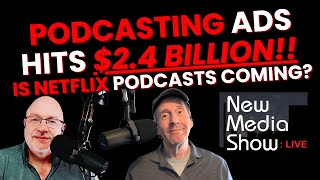
Podcast advertising hit $2.43 billion as the industry grows and professionalize. Todd Cochrane and Rob Greenlee break down video equipment costs, bandwidth constraints, and why most podcasters can't afford large productions. They also cover ad-load metrics across platforms and the shift toward performance-based advertising.
Chapters
Okay, is it— let me try this. Todd and Rob in the afternoon.
Hey, Afternoon Delight with Todd and Rob.
Oh yeah, oh yeah. And, uh, here we are. Rob, welcome back to the New Media Show. Happy Wednesday to you.
Happy hump day.
Yeah, absolutely. And you know, I'm, uh, I'm running on about literally maybe an hour and 15 minutes sleep.
Oh no. Wow. Okay. Yeah, that always makes for a rough day, doesn't it?
Well, you know, what will happen is as soon as we hit, hit, hit the finish on the recording, I'm going back to bed. No, it was a, it was a late one for meetings. I normally try to on show days to finish about 3 o'clock in the morning and then I sleep to 7. Well, I couldn't go to bed until like 5:30, so it's all good. But only a couple more weeks and then, uh, May 14th back in the studio, back in the studio in Michigan. But, um, it's been, it's been an interesting week. I have Are you familiar with the podcast event that happens in Madrid?
No, I haven't heard about this. What's going on?
Yeah, so I got an invite to come and participate in podcast in this event in Madrid in October. And so I'm gonna— it's a— I've never— well, and my first time being in Madrid. I don't think I've ever— well, I've been in Spain, but I have not been in— but it's called Podcast Days. And it happens—
I've only flown through there once or twice. Yeah, I've only been to the airport. That's as close as I've gotten to seeing Madrid.
Yeah, so October 2nd and 3rd. Yeah, I was extended invite to go out, so I'm, I'm pretty jazzed. I'm gonna plan on doing that. So it's gonna be do the, do the Podcast Awards, next day jump on an airplane. Oh, and so, uh, yeah, it'll be, it'll be a busy time. But, uh, yeah, I've, I think I've heard of it before, and, um, so yeah, it's nice, nice to ask Nice to have been asked to come out and almost missed the email. It was one of those that was like buried deep in the stack. And so, yeah, so thank goodness I found it.
But, um, so is it the first time it's been held?
And no, no, it's— I guess this is an annual event. So they— apparently this has been going on for a while, and I, I think I remember Hearing James or someone talk about it in the past, you know, getting to Europe from Detroit, there's nothing ever direct. It's multiple flight, or at least two flights. And just like going to London, which is sneaking up on us here very, very quickly as well.
Yeah, I lost you there for a second.
Yeah, I said two events across the pond. So, should be good. We'll see. You know, it's a ways out for sure. Don't know what I'm going to be speaking about yet, but for sure.
Okay. So anything else big happening other than I saw in the news that we We officially did pass the $2 billion ad revenue mark in podcasting. Did you see that? $2.4 billion was reported by IAB.
Yeah, I saw that and I see all kinds of excitement and I'm like, really?
Yeah, well, just to be clear about it, that was a number that was reported for 2024. So it's a little bit of a lagging number. So we don't really know what it's going to be for 2025, if it's going to continue.
They really think it was that much?
Well, that's what the IAB and PwC report came out and saying. It was part of a bigger kind of advertising kind of report that was put out the total advertising revenue for the internet was at $256.6 billion. So podcasting was a very small part of the overall internet ad. And it gives $102 or almost $103 billion to search and about $74 billion to display advertising. And then podcast pulls in at $2.43 billion.
Hmm.
And social media gets $88.8 billion. Billion, and retail media, uh, gets $53.7 billion. So podcasting is at the, at the bottom.
Well, I, I don't know what that means as we look to the future, if this digital video and podcast number will kind of work together a little bit more, but I don't know how that changes things, considering how few shows they it's actually being advertised in as compared to other media, uh, you know, I'm not necessarily surprised per se.
Yeah, it said overall, um, advertising revenues, um, had reasonably strong growth in 2024, increased 14.9%.
That's overall, that's all considering how the economy is.
I'm still Yeah, I'm still pretty shocked about it.
Yeah.
Yeah, I mean, unless those dollars are coming in from traditional, you know, TV and radio, that could explain what the growth is.
Yeah.
I don't know what those numbers are. If we saw the radio and television advertising numbers drop, That's not part of this.
Yeah, when I see this kind of stuff, I'm often, I don't know, I guess I'm ambiguous to it at this point.
Yeah.
You know, I do admit that the programmatic side, at least on our side, we're seeing growth. So, but was it mean? So what was the total percentage, 14, 15%?
Yeah, overall growth was, uh, 14.9% for all online advertising.
So all online? Well, you would expect the—
but the podcasting side was probably like maybe, um, close to that.
Well, if you, if you think, if you think about the, the world You know, and I'm sure that TV was included in that number. I'm going to— well, so I'm not in the 2.4 billion, or digital video, right?
Was the 62.1 billion, right? Was that okay? It had a year-over-year growth of 19%.
That I'm not surprised.
Um, and it said that the podcasts side of it had a 26% growth, but the fastest growing one in here was social media at 36.7%.
Probably a big part of that was TikTok.
Yeah, so a lot of these, you know, if you think about podcasting, if we think about the perspective that maybe podcasting is broadening in its media scope,, you know, to include video now. Uh, I'm just curious how that impacts its overall numbers and how it's being tracked here. Yeah, that's true too. I'm assuming that the podcast reference today is just referencing audio.
I would be— I wouldn't be surprised if they sneak the YouTube numbers in there too, you know, to get a little more, uh, bang for the buck with Yeah. And, you know, I've heard recently from a couple of different sources where people are saying that TikTok now is losing a little bit of luster because of just— it's, it's just all ads. And I've been— I haven't been in TikTok only once or twice in the past month. And I garnered in there a couple of days ago. And oh my God, it's everyone's selling everything. Now here's the weird thing is because I'm in Asia now. The Chinese are having fire sales on gear. So now if I go shopping on, there's a service here called Lazada. And Lazada basically is kind of the equivalent of Amazon. You know, a lot of free delivery, you know, 2 or 3 days it's in your, you know, it's in your hands. And I mean, massive, massive discounts because I was just kind of— I had bought a number of things here for the studio, a desk and, you know, some speakers and, you know, a variety of things this trip. And all that stuff is at 60, 70, 80, 90% off pricing because there's no tariff to bring the stuff into the Philippines. You know, it's just standard business right now. And it's just these massive sales. But on TikTok, it's just like every other is some influencer that's selling something. And they're promoting something, promoting something, promoting something. And it got to— it's gotten to the point where the TikTok shop has taken away from the experience that I had in just recent months. Of being able to enjoy reels on TikTok. So they went so hard on the money part. I'm, I'm just going to assume that maybe why this is— why this trend— and again, it doesn't have nothing to do with it, probably has something to do with these numbers, because I would assume that's included in these totals with social media, the Because I'm sure those folks are being paid to advertise and promote, or maybe they're working on an affiliate basis.
It depends on what you define an advertisement too and how that's tracked. Advertising is advertising, not, uh, product placement promotion, um, that could be thrown under the umbrella of advertising.
Well, they're paying those people to promote, why wouldn't it be included?
Well, there's a lot of people out there that are creating videos because they're trying to promote products in their own business, right? So they're—
well, this is basically— this is stuff they're selling in the TikTok shop.
No, that's— oh, okay.
I don't know how those deals—
there's kind of multiple things going on. There's individuals out there that are getting into almost like affiliate relationships with brands, and they're pitching those products and selling them. Now, I guess that could be—
you don't think that's an ad? You don't think that's—
it could be content too. Could be content.
You don't think those folks are being paid?
Well, some of them could be, yes. Oh, okay. But I do think that there's multiple things going on in the market. I know there's whole platforms now that you can do live video. Yeah, yeah, yeah. In vertical video, and the whole video is all about giving demonstrations of a particular, maybe artwork. Right, right, right, right. Or product or— or, you know, could be cosmetics. It could be all sorts of stuff.
I'm curious to know if any of those numbers were rounded into that.
Right. But are those considered ads or are those considered kind of like product placement?
I kind of consider them—
Is that considered ads?
I can consider them an ad.
Well, I would, but does this research consider that?
Yeah, that's a good question. Or are they just looking at traditional spend, you know, the— on a prerecorded, you know, the HelloFresh, you know, the shrink services and, you know, whatever else may be being promoted, right?
So I think that the spectrum of advertising is expanding now. The question is, is it— are we recognizing it as advertising, or is it being seen as something different from traditional ads? So yeah, who's tracking that? Yeah.
So, yeah. It'd be nice to see breakout by platform.
Yeah. And I should have probably captured the whole report here.
But it's still— I know we're just looking at the podcast piece. So it is an interesting number. You know, they've been trying to get over $2 billion for what, 10 years? Yeah, right. And to say they would get over $10 billion, $2 billion is, to me— and in the end, I think about that number and it sure isn't flowing down. It isn't flowing down into the mainstream, you know, into— we're still— it's still restricted to 5%. Or maybe 8% of the market.
Yeah. Is getting all these deals.
That's right. Right. And at the same time, there is, you know, this idea, and actually what my team made a mistake on it the other day, they posted something about on social media, and I don't review every social media post that goes out, but I saw one on X that they had posted where, you know, they're still out great opportunities and they use the 4.5 million shows. I went back on her social media channel and said, hey, hey, hey, hey, hey, let's never use that 4.5 million show number again in any social media posts because, you know, there's actively about 400,000 shows that are updating their episodes every 30 days. So, you know, you putting a number of 4.5 million and there's room for your show to grow actually could be discouraging to people because it shows this, you know, this crazy number And they said it's actually a much smaller number to see significant impact. So, you know, it kind of got them on board. And what it was, was one of the gals said, well, I always just look at the podcast index numbers. And I'm like, well, you know, scroll down a little bit and, you know, look at that active number and use that. I said, yeah, sure, there's, you know, over the life of podcasting, 20 years, there's been 4.5 million shows. But, you know, currently the activity is different. But I think we're— and I don't know from a business standpoint, you know, we're watching the numbers. And I will say that the shows that are being created right now are very deliberate. The people that are signing up for hosting with us and creating new podcasts have a very deliberate there's not a lot of experimenters. There's people coming in knowing exactly what they want and, and moving forth, uh, where in the past I've seen a lot more folks doing experimental shows. You could tell that they were just getting started. They didn't quite understand maybe what they were doing. So this is a little bit of a trend I've seen over the past couple of months.
So would you say that that's following this— I think this thread that we've been talking about for maybe a good year on this topic is, is it's kind of a professionalization of the medium per se, or people that are getting involved in starting a podcast are more serious about it? I think so. Hobby anymore?
Yeah, yeah, I think so.
It's just more serious.
Yeah, right. But again, there are hobbyist shows.
But it, you know, there's probably fewer of them, isn't there?
Well, you know, but, but the shows are coming in, you know, it's like I go in and look at the changelog. I can see the name they picked, and I go and say, okay, did they edit that? Did they change the description? You know, did they come in and have their, their bones together? I guess that's— I don't know whatever word to say.
Well, their strategy.
Yeah, they have their strategy together, right? You know, did they come in and, you know, mix them up? And everyone everyone so far that, you know, it's— and it's not everyone, but again, a high percentage of folks are highly, highly focused. We're still seeing a huge number of folks that are, um, have their own brands already, have their own websites. Um, about 70/30 is that number. About 70% already have their own brand and 30% do not. So that kind of gives you the, the split. And the reason we can see that pretty easily is we know that the number of that come in, they have their own website already, and those that decide just to use the publisher platform and, and, uh, and use the tools that and the site that we give them. So, and then we look additionally to see, okay, do they have a Do they have a, like a Wix website or Squarespace somewhere that doesn't have as good a podcasting support? And are they doing that? And there's a percentage of those folks too. So, but I still think things are flatter than they should be. So it'd be curious at some point, maybe someone would do an overall industry growth study to see how many shows have come in in the space in the past 12 months and stayed in as new entrances and have made it past, you know, let's say episode 10. That would, that would be an interesting study to pull down. I, I probably got the data that I just have to run it and, and get it because we, even though our directory doesn't have the public listings on it anymore. We still have all the data in the database. We're still pulling all that in in the backend. Mm-hmm.
Yeah, I would hope that we would see an uptick in people just launching a podcast because they have a hobby or an interest or, or wanting to just start a show and see where it goes, right? Um, but I do think that there's a lot of people that are, you know, they've been laid off from work, from their jobs. They're maybe starting to start a side business or they're trying to, you know, make ends meet any way they can. So they're out there coming up with a, you know, a company concept and maybe they're trying to leverage podcasting to help make that successful. So I think that's the other big thing that's happening right now. And did you see, Todd, that Stephen Bartlett, the CEO and the host of the Diary of a CEO podcast and online show, very, very successful, huge-scale program, I guess he turned down $200 million podcast deals. Because they would have tripled the number of ads in his show.
Was it 100 or 200?
Two $100 podcast offers.
So two $100 million deals.
Right, right. Two different companies.
Wow. Because he just was, he said, the increased ad load is not worth the impact. That's a number to walk away from. Think about that. Yeah, it is a number. That's a number.
You know, if you think, I mean, you think about, you know, maybe he can do that on his own without, you know, compromising. I don't know. I mean, it's an ethical decision that he made there.
Well, I think I applaud him for making the decision. But I'm thinking, if I told Rob, come on now. Now think about this. $100 million. Oh, if that's for one year.
I don't know about that. It doesn't say what the term was, but it did say that they would have to increase the number of ads. So I don't know how many ads he has right now. Yeah. I've watched this show before, and I think he mainly only does host reads, and I think he only has like maybe 2 or 3 in his—
And how long is his program, do you know?
Oh, it's anywhere from an hour to an hour and a half.
Because I typically, I would say in an hour show, 2 host reads is a really good sweet spot, and then if you can go an hour and a half, a third would work without pissing the audience off too bad. But if you double that, yeah, that has an impact. And just from my personal experience of knowing 1, 2, 3, and then the roll-off. Yeah.
Well, plus, you know, he may thinking maybe thinking long-term here and thinking he can get to that same $100 million number with the same amount of ads he's doing now. It's just that the buys have to be better, right?
And worth more, right? Yeah, right. Yeah, I could see that for sure.
And not compromising the experience of his audience. Right. Because this guy's very detailed on, analytical basis on doing certain things that have tested to work, right? And he tinkers with things to see what doesn't work, but then he quickly adjusts to what does work.
Yeah, he was the one that was measuring the CO2 in the room.
In the room, right. So you can see how detail-oriented this guy is, right?
So, you know, he probably, I wonder how long the analysis on that took. Yeah.
You know? Well, it's a very, I would say it's a very subjective analysis actually. 'Cause I mean, how do you know that increasing the level of CO2 in the room would make a dramatic difference in the quality of the guest? I don't know how you would evaluate that. I can't even think of a way. I mean, the more you think about— I mean, it's funny to think about, right? And it just could be just maybe based on the level of oxygen in the room. You know, it's kind of science-based, probably, right? Where you can say if you're in a room with higher oxygen— I know that the radio industry did this for many years with their studios where they would keep the studios of the radio station where the talent is at a certain temperature because it kept them awake, right? If you had, yeah, if the studio was too warm, the hosts would get like tired easier and they would lose energy and the quality of the program would drop.
Well, that was like me in Hawaii and, you know, in the doldrum days of summer and, you know, having the windows open and sweat would be running down my neck. You know, and there was no way I could run a fan or nothing. I would just suffer through the show. And if you remember, we used to do the show in the morning. And, you know, I did it because first of all, the lawnmowers and air, 'cause I didn't have central air. You know, now I'm spoiled. I've got central air here and in the studio in Michigan. So, you know, those days of having to deal with a window being open are kind of gone. There was something I was going to share with you, and I don't want to get too much into the AI piece because I know people are tuning out recently when we start talking about AI. But there is a— I think I told you I paid for the pro version of ChatGPT, the $200 version. Yeah.
I, I've— yeah, are you still on that?
I'm still on it. And, um, there was an interesting thing that, um, I won't go into much detail, but we were doing a study. Well, basically I had— I've got an executive assistant now and she's great at doing research, and I had her do a research on our hosting plans and looking at certain factors because we were thinking about adding a new feature to the hosting plan. And, um, that report that she did, she, she'd combed the data and basically gave me about a 7-page report. And so then I wanted to do a risk assessment. Okay, if I implement this, what is the risk, you know, what is the risk of causing revenue to go up or down based upon the change in this plan? And And, you know, I had all these factors and, um, I ran a risk assessment on the O3 model that I'm paying $200 a month for. And Barry, my CFO, who's not— he's on a— on the $20 plan, he ran it on the other reasoning model. And we did it separately, thinking— I guess we were both thinking alike. And it was kind of funny because I posted in the Slack channel, Barry, look at this. And like 60 seconds later, he came back and said, Todd, look at this. So it was, the prompts were very, very similar, but the data between the $0.03 model and the $20 model, Barry's like, damn, I think maybe I should upgrade to the $200 model too. The data that we got, I'll be very, very frank, um, I'm not a data analysis. I become a better one over the years. Again, looking at, you know, P&L statements and everything else that goes along with, you know, subscriber churn and, you know, anything else that goes along with data. And if I was a data analysis, as a— had that as a job right now, I would be scared to death. Because my— I, I used my EA who is not— does not have a background in data analysis. Uh, she has more of a legal background, a structured legal background, and she worked with the dev team to get this data set for me. Put it in a very nice report, did a very good job, showed me the medians and all this, you know, this information, just really good stuff. And she may have used ChatGPT to help with her report data too. I don't know, I didn't ask her. But again, I looked through the data and verified her data lined up with the, you know, the raw spreadsheet numbers. And this data analysis tool, this is about the 4th or 5th time that I have been blown away. I talked about before doing audits on the Podcast Awards. I had done that again this year. I— and these— I, I'm gonna say that it saved me. Look into the stuff that she gave me. I had this kind of like feeling in the wind where the risk was. Just, just, you know, but I just didn't, I couldn't—
When you say risk in this context, what is the risk?
Risk would have been having, by offering this, would it cannibalize my other plans? In other words, if I have a, if I offer this new feature, would the folks that are paying $20 a month say, oh, that looks like a better opportunity. And cost me money because they were going to switch the type of plan they were on. So, you know, and, and, and looking at potential new revenue, lost revenue, you know, recurring revenue, that kind of stuff. And I had a little bit of a thumb and it confirmed everything that I kind of had a gut on. But then it said, here are 5 things you could try, and here's kind of the price point you should be looking at. And I'm just like, wow. So I look at Barry's report, his was not as detailed, but it kind of came almost the same conclusion. So I'm just— my main point here was the difference in the model was the depth of the reasoning. And I was pretty impressed. So I've been thinking about that. And this just happened— what is today? It happened on Monday night, or Monday. And we were looking at the data yesterday. And the thing I'm looking at now is how can I use these reasoning models in Podcast Statistics. Now, what, what kind of data now can I start providing back to podcasters? And/or what can podcasters, just by pulling a download— let's say they pull a spreadsheet of data, because every one of our reports in our Podcast Stats are available as a download and usually comes out in a CSV. Um, how can we use these reasoning tools to give podcasters better insights on stats? So now I'm thinking about— I got this con— and, you know, sometimes you look at your stats, you're kind of like, yeah, I kind of see a trend.
Well, Todd, I mean, you're getting more and more data from each of these podcasts, right? Because you're pulling transcripts. You're able to look at the audience metrics. So, and then— Got all that. And then the actual kind of like play behavior of the episode as well.
And for some show, we've got demos because they're running audience surveys. So we've got all of the key data.
Pieces to do an analysis on how that show is doing and ways that maybe it can be improved.
Right. Right, right. So, you know, if you think about a holistic approach to it, you know, it's very subjective. I still think within the models now to look at a transcript and say this is how you can improve the show, I think that's still a little—
it's got to be able to listen to the audio, not just read the—
right, right, right.
And I think it can't do— I don't think we're quite there yet.
No, we're not. Or not, but I don't think it's too far away. But at the same time, you know, I've just been pretty, pretty blown away that the level— and again, I knew a year and a half ago, or maybe close to 2 years ago, that this— a year and a half ago— that this data analysis function— and be honest with you, I probably would have— the report that it came up with, I probably would have spent There's 5 pages I probably would have spent 2 days on. At least 2 days. And then I would have— there would have been a meeting and we went over the data and we, you know, there would have been this back and forth. And because I had the raw, I had the true, I, you know, I had pulled this stuff from the database and had a true dataset that I could work from. I could go back to the report and say, okay, the analysis said this. Yeah, that matches that. The analysis said that. Yeah, I can see how it's got its— so I was able to do a QA of the conclusion. It is, it is as if a data analysis had went to— I had had a PhD, a master's degree, maybe not master's degree, maybe a bachelor's degree data analysis had come to me and said, Todd, here's, here's the two pieces of data. And if I'd have been given this data from a data analysis, this 5-page report, and the combined data from my E, I'd have still went and done the back and forth validation of that data. I would have seen how, okay, here's the raw, how did you come to this conclusion? Does this make sense? I'd have still done that QA of the output. So I didn't take this data as a— so to me, I'm thinking as we move forward, there's a lot of stuff we're going to be able to do for podcasters too, and there's stuff they can do for themselves right now. Just by pulling— you don't need Todd to do this. So if you're wondering what's going on with the trajectory of your show, you know, you've got all this stuff already. You got all your show titles, you've got your descriptions. You can use this data that you already have as a podcaster to do some fine-grained analysis and using the stats that's being provided to you by your hosting provider to really kind of get an idea.
Yeah, and I'm starting to think, as you're talking about this, I'm starting to think about how we plug in more of the pieces of this puzzle, right? I mean, a lot of podcasters, even throwing into the mix some video here, how can, How can we leverage this learnings in the data to help maybe create on a more automated basis derivative content that's more targeted towards certain types of content or certain types of segments of the shows that are more successful than can be put out as shorts? Or, you know, it just feels like that there's ways that that kind of the marketing and promotions of a podcast can be a little more automated where the content is still created by humans, but the promotion and marketing of it becomes a little bit more automated. And I think that's where AI can be a big help here. You just think about the opportunity if a show's making a video and audio at the same time. Right now, podcasters are using like Opus Clips a bunch of different platforms to generate these short-form content. Well, how powerful would it be if you could integrate the kind of learnings of your show's, maybe AI agent or whatever that knows your show at a deep level and the audience and what engages with the audience and it can take that information and project it onto creating derivative content, right? That's still human, right? It's still voiced by you, the video's still of you, but it, It takes that existing media and formulates it in a way that can help drive audience.
Especially if you can imagine the advantage that Opus Clip would have if they knew what the drop-off points in content.
Yeah, right, exactly. And creating those clips based on that. What is the basis of what it decides is what's important or not right now? I'm not sure that there's a clear indication for it right now.
We've been doing, you know, we've been working hard on our YouTube channel at Blueberry, and we're watching, you know, the trajectory growth. And we, I'm, we're being very aggressive. And the, um, I'm surprised at some of the clips that Opus Clips actually, because we're using Opus Clips as well, um, I'm surprised at some of the stuff that it pulls out. And I'm thinking Yeah, that was that. And actually, it's pretty good. Yeah, it isn't, it isn't bad. Um, but again, I, it, but at what point, you know, you, you can only refine. I think you can refine so much. I think the challenge still remains, uh, time. The time factor is still the thing that is holding back, unless you are going to allocate X amount of time to create Shorts, Reels, this type of stuff. If you don't have anybody doing that and you're doing it yourself, there almost could be this overwhelming exasperation of, you know, and, you know, Headliner is trying to do— Descript is trying to do automated— everyone is really working to to tighten up this process that you can use to promote your show. But still, you know, I saw an ad.
It takes work. I saw, I mean, yeah.
I saw an ad by, it wasn't an ad, but it was someone in Descript had made a comment on someone's, you know, editing challenges or whatever. And it was kind of a pun. It says, you know, it takes me 6 hours to create clips. They said, well, use Descript, it'll only take 30. Still tell the client it took 6 hours. So I don't agree. I think the tools themselves, you can spend a couple hours easily in these tools refining stuff. And do people have that amount of time?
Yeah. Well, in the export process too. So you have the, you know, I use Descript all the time. I upload my show to it. Takes time to process it, generate the transcript, takes time to run any kind of editing or removal process, optimization process, sound optimization, eye tracking adjustments. And then once you get all that done, then you have to go through the export process. And that can take half an hour, an hour. Just exporting it out of the software.
And is it that much better?
Well, that's, that's what I've learned too, is that you really have to be— I, I don't think the AI is quite good enough to get it the way I want it. Um, and I think that's the challenge, is that the AI needs to understand what I want. Yeah, not, not a blanket solution that applies to everyone.
But I think what could end up happening is we see— this is what I learned when I first started doing video, and maybe this can apply. I learned that I had to be a little bit better prepared. Of course, this show, we never prepare. You know, you, you do some prep now for us, but we used to never do any preparation.
And now, now it's important to have some topics that you, that you can use to promote. Yeah. Where in the past when we were doing this show many years ago, we just showed up. Yeah. We almost never pre-promoted.
No, no, no. So, right, so if you use the— if you understand what Descript or any other tool is doing And it says, oh, it's adjusting my eye tracking. Okay, yeah, well, I need to be looking at the camera more. It's adjusting—
just look at the camera—
whatever things that it's— whatever the things it's doing that thinks you— the things it thinks you should be doing, you can use that to improve your actual audio and video. You take those lessons that it's doing and improve yourself.
And then you're making, making the tool irrelevant.
That's right.
Fantastic. Yeah.
Right. Hence why I don't edit the show.
Right. Though there's a lot of people out there that would disagree with that ideology.
Oh, that's great. I'm still podcasting in 20+ years.
Plus years. Yeah, right.
Yeah. And I still have a life, and I'm not paying no one to edit, right?
So I think at times you do need to do some editing. I think it's, it's, I think it's maybe not entirely accurate to say that we never do any.
Well, I edited last week when we lost the audio for, right, 60 seconds.
More to do with with if there's large kind of problems with the recording, right?
Yeah.
Right.
So, so speaking of which, I've, I've continued to tweak things here.
Yeah.
Okay, good. And, uh, I've learned, you know, here's the, the, the, the two weak points in doing what I'm doing now. In using OBS and using the RODECaster. For fucking love of God, can RODECaster fix this intermittent dropout of the connection? The USB just drops and then it reconnects. Can they fix this? Can they get this so that this thing is persistent and doesn't drop. Number one, there's some magic hocus-pocus thing that happens because every once in a while I hear click, click, and it comes back. I've learned not to reboot the RODECaster now. I was rebooting it every day. Now once it's connected, don't touch it.
So using the The Duo?
Is that the one? I'm using the Duo.
Right.
Okay. So for the love of God, figure out how that thing goes. And then Facecam. I have learned that if you're running the Facecam software, it has a tendency to interrupt the video flow at times. So the key with FaceCam that I've learned is you get all your settings set and you save the profile and you close that stupid program because it has a tendency to all of a sudden say and freeze you. Oh no. And you have to restart this. You don't have to start the webcam, you have to restart the software. So I'm sitting here on bated breath I've been watching everything today, make sure I don't freeze. So that's number 2. And number 3, OBS has got a, I call it a 10-show learning curve.
Yeah, it does.
Yeah. And I've got it now where CPU usage is like 5%. I'm recording in H.264. I'm using the Mac hardware to do the recording and not doing software recording. And that seems, quote unquote, to be kind of the magic combination. If— and audio is— can be— I'll be honest with you, I miss my TriCaster because not that we don't have problems with it, but it's fewer issues because everything is physically wired. Right.
Well, plus these RODECaster Pros have a lot of built-in software in them. Yeah. They're almost like a computer of themselves, right?
Well, they are, yeah.
Yeah. I mean, they've got normalization, equalizer capability, compression, all that stuff built into it. I know I'm running it right now on my audio.
Yeah, me too. Right. But for the love of— and, you know, and it seems it's like I look at these cables sitting over here because I did a big cable cleanup because there was stuff behind the desk. It just looked horrible. And I'm just like tiptoeing around on this USB connection. Um, one thing that Mac could do is give us a couple more USB-Cs, you know? Come on, come on, don't be so stingy on the damn connections. Because I'm running a USB— I have a USB-C hub and I have a regular USB hub just because I don't have enough stupid plugins. Now that's the advantage of Windows. Windows definitely has a much stronger USB reliability.
Yeah, my, uh, my— both of my desktops have a couple of USB-C plugs. Yeah, on the front of them.
Well, this, this has two. The Mac Mini has two.
Yeah, but plus, plus plenty of regular, right, USB plugs.
And they're solid. They don't just don't get wonky and disconnect. And there's enough power or whatever is required. And, um, It, it literally feels like I— of course, I switched everything to the MacBook Pro, to the Mac Mini, and I've got everything pretty much if I don't breathe on it too hard.
Yeah, I'm, I, I'm pretty locked into desktops again. Um, interesting. I just don't travel that much. I'm not on the road, so I don't really need to have a laptop. So, but I mean, I have a Surface Pro, but, but This mini does—
it's an incredible computer for the money. You know, I'll never own an iMac or anything ever again. There's just no need. And if I want to spend money, I'll buy a Mac Mini Pro. If I, you know, if I really want to, you know, boost stuff up and have a more powerful machine, but still even that machine has, you know, not as many USB ports as one would want. So, but I'll say one thing, it's, you know, the TriCaster runs on Windows and run on Windows forever. And knock on— of course, I'm going to go home and everything will have failed being cold ironed for 2 months. But, um, so if, you know, and I'm doing this for years, so I have a little bit of experience, you know, I have new people I think it could be a bit overwhelming.
Yeah, didn't, uh, I think I saw TriCaster came out with a brand new model, I think.
Oh yeah, they do. And I'm just— I'm not upgrading.
Yeah, I would imagine you're not. I can imagine that the newer ones are really expensive.
Um, they're going more to software-based.
It's, you know, it's—
oh, okay, because like the RODECaster has Well, they're basically doing what OBS does is, you know, because everything now is with NDI and, and all that's right, you know, you don't need, you know, like a matter of fact, all my cameras at home run on NDI so that they have an SDI backup plug-in, but I run on the network, you know. So yeah, I'm sure the upgrade is is still pricey, but they still have a piece of hardware that does, you know, that, that software. And it's right, the TriCaster has been software anyway with just hard inputs. Yeah, you know, so, um, you know, great audio card, great video inputs, now that's all been built in. But if they got rid of all that stuff and now the only thing you need is the audio in and the the NDI inputs, you don't need all that fancy SDI stuff anymore.
So they probably wrote their own operating system, do you think?
Well, they just continued with the operating system they had, and then they just dumbed down the box and not needing the SDI inputs. I haven't looked at the new hardware in detail, but it's always been software-based. With great hardware. That's the key.
Yes, you gotta have— I mean, you have to have a good GPU in there, right?
So, but the stream now too, you know, I could— I don't even want to try multiple cameras on this thing. This thing would choke. Um, so, but again, it— I, I think it's— I would be curious to see what some of these folks now are are running, when they're running multiple cams, some of these gamers and stuff that are running multiple, they're using Elgato Stream Deck and stuff like that to switch. And I'd be curious to see the, you know, more behind the scenes on hardware because I'm sure there's a dozen YouTube videos out there I probably should have reviewed, but I never did.
Well, there's, yeah, I would say that the probably one of the most popular ones is the, the ATEM Mini and Pro. Yeah, those are the two most popular, but there's a, there's a bunch of them out there now that, uh, that you can get. They're in like a tablet form factor. Yeah, that can take up to like 4 high-end 4K cameras, that kind of stuff.
So I had to giggle though. I was, uh, I was on Facebook and I saw, um Oh God, I'm gonna have a brain fart here. Sounds Profitable, Tom Webster. And he had a picture of his kit and he's talking about his audio. And I said, oh, look at you, Mr. Tom Webster. Look at the interfaces you're running. So, Uh, good job, very good job.
Uh, he, he's running— he running—
I didn't see it— some Newell equipment that is, uh, you know, um, not your average, uh, average podcaster gear. Um, he's got, he's got a very nice setup. So I had a little, I had a little, uh, what will we call it, a little, um, gear envy. When I saw a couple of his pieces of gear that he's got to put part of his kit. So yeah, Tom, nice setup there. And you can, you know, I've heard Tom's podcast before and he does have that, he definitely has that NPR, you know, we haven't seen what kind of microphone he has yet., but given the two pieces of equipment that he has, I know he has to have it attached to a very nice microphone too. So, uh, Tom, if you're out there, I'd love to know what, what microphone, um, you're using.
You should be able to tell from the picture, right?
You should be able to. There's no picture of the microphone, just, oh, just, you know, and Tom is, uh, very much an audiophile. He's probably one of those guys in his living room that has the you know, the liquid-cooled stereo. I can just see it, you know, maybe I'm wrong, but, you know, he's kind of got that hipster thing going on, so I could just see it in his living room, a centerpiece with nice, you know, multi-thousand-dollar acoustic speakers.
And well, he seems like an RE20 guy.
Uh, he— his sound doesn't sound like RE20.
It doesn't. I mean, it's such a, it's such a famous radio mic.
Yeah, I, I, I would, I wouldn't be surprised if he doesn't have a Neumann mic. Oh, a Neumann. Yeah, I, you know, and it, it, to me, his sound sounds condenser, um, yeah. Okay, I'm, I'm guessing. So Tom, you, you're gonna have to come in here and And maybe he's just using the ATR 2100, but not with the gear, not with the kit that he had on his desk. Um, definitely, uh, uh, definitely something. It was because I was like, whoa.
I said, well, if you're going, if you're going condenser, you know, um, that's, that's pretty aspirational. Yeah, that's how I started.
I ran through that with— yeah, I haven't condenser till I changed to this a couple years ago, so Yeah, I love it too, too, with my radio show.
That's what I did. I, I used them in my bedroom in my house for like 6 years.
My, my blue mic was $1,300 condenser mic.
Yeah, I love that thing. I had, uh, was it the, um, Audio-Technica? I think they're, they're like the 6500 model, and I think back back then, this was back in 2000, I— those things were like, like $700 a piece.
Now I will disclose, Blue Mic did send me that mouse. They sent me that microphone in the early days, and I—
oh, that one that you used for, for a long time that had the little ball on top?
Yeah, yeah, yeah. I didn't pay $1,300 for a mic. They—
I was fortunate enough to get one But, and I think that was a condenser, wasn't it?
Oh yeah, it was condenser.
Yeah. Did you have any kind of sound issues with that?
No, because I had a $1,200, uh, amplifier behind it. Oh, okay.
Yeah, I still have that right now. Really, really have to run good—
oh, you have to run like a really good sound compression. Yeah, well, you have to run a good amplifier on those.
Well, and noise filtering too, if you can. I mean, a lot of the early, I mean, like when I started my early radio show, I didn't have any kind of, you know, really any kind of equalizers or any kind of audio normalization.
And the right kind of boom mic too. So the Heil boom mic was the only one that I could run with that condenser and not get get when I would tap it.
This is the same boom mic that I, I got back in, uh, 2000.
That's impressive. He replaced the springs on it? Nope. Wow. Yeah, that— I, I'm a big fan of the Heil boom. I really, really am. Of course, now I'm running something called Thronmax. It keeps, uh, wanting to depart the table though, so it's not a perfect solution here because of the grip it has, but Um, I, I, you know, I— we can really nerd out, but I did get pretty nerded out on, on, uh, on Tom's setup. I, I saw it, and, and I was familiar with Newell, but I had never— so I looked up the model he had and seen what that, uh, and they— that, that though, that he, he's got it. He has a piece of kit that has, uh, some amplifiers to die for. You know, and in all things considering the— as much as I, you know, I'm annoyed right now about the RODECaster and, and, you know, the USB connection disconnecting and it, you know, it basically flipping me the bird and doing a reset, um, the, the simple fact that I can record on board that device makes it awesome, makes it pretty irreplaceable.
Yes, in that regard. Same with mine. It's the same with mine. I just got this big button that blinks at the top of my RODECaster. I can push it anytime and record. Yeah, yeah. But, but this boom is an OC White is the brand.
Yeah, I've got a couple of OC Whites in the graveyard.
Yeah. One of my 3 boom mics that I've had, the piece that broke was this piece right here. Oh, that's interesting. On, on one of it actually just, just, it just popped right out of the slot that it's in here.
I'd run such, I'd run such heavy microphones I had to replace springs. And then finally when I got the Heil boom mic, I never had any droop ever. And, uh, if, you know, if I was to recommend someone looking for a boom mic, the OC Whites are nice, but Again, just again, if you've had good luck with it, I guess you're fine. And that's probably about a $90 boom mic, I would think, for Mosey White.
The—
that's—
I paid over $100 for it, probably the time in 2000.
Yeah, the price hasn't changed much in that many years.
Oh, it hasn't? No. Well, that probably means that the quality's gone down, probably. Well, like I said, you can't have the same quality for the— the one I had, that price—
the one I had, I had to order replacement springs, and they just got really irritating. And then someone said, oh, get a Heil, they never droop.
I'm like, okay, let's see how that goes. And I've had this, this microphone here, the, um, the Shure mic, since, uh, I think I bought it in 2009.
This is— this mic here is, I think, your Shure mic I bought off you. No, I bought that— what did I buy off you?
I bought it. Well, yeah, I sent you that and you bought me the MV7. That's right.
Which is behind me on the shelf. Yeah, we did a swaparoo of sorts. Yeah.
Because I needed— Because I sent you my old Shure SM7B.
Yeah, that's this one, right? I had 3 of them. This is it right here.
Yeah, so I had 3 of them, but I don't need 3. Yeah, so I have— but I wanted to try out the MV7 because it was more of like a portable mic.
I have the MV7 on my desk in Michigan. Oh, you did? So that's used if I'm gonna do like a— we've been recording courses and stuff like that. I don't go to the, you know, so here, um, yeah, I actually did the same thing. I have a teleprompter here too, an Elgato teleprompter. Um, that amazingly it fits right on, attaches right to my monitor. My monitor has a little place where they knew creators would hook cameras and stuff to. It's beautiful. So all I gotta do is tilt it down and I've got a teleprompter in front of me.
So both of these mics are a real testament to the longevity of the Shure Um, yeah, SM7B. Yeah, right. So I don't know if the, the new ones have the same build quality that these have, but these are a good, what, 15-year-old mics?
We sent— we had 4 or 5 Shure SM7s in the studio in, uh, Columbus when we were— when we had the office and the studio in there, which we never fully exploited, and I sent those microphones home with team members. So Mike has one, Dave has one, Mackenzie has one. So we've got team members that have those SMB7s because of the office closure. So everyone's using the same microphones.
Well, I would say that these mics are the most popular podcast microphones in the world now.
Yeah, everybody's using—
you see them a lot. Yeah, even the, the biggest podcasters in the world use these.
Yeah, the P— you know, I have a PR-40, and I have a low serial number PR-40 that I got in 2005, and, uh, it sits on my shelf. I, I—
it— if I was really—
dropped off in popularity, but it never was good for my voice, so I never used it. Um, if I, if I'd have known, the PR30 actually matches my voice. So, um, I should have had a PR— I probably would have still be on a PR30 if I'd had that, uh, to begin with. But the PR40 just did not agree. Believe it or not, I have a Rode NTK in a box too. Some of the stuff I should sell. That was— that's not a cheap microphone. It's the green one. Yeah, a big— that big monster heavy. Yeah, I've been through my share of microphones and money spent.
Oh yeah, yeah, I have too.
But yeah, lots of stuff. And here we are now, we're jury-rigging stuff and, uh, you know, I'm worrying about USB drops. You know, that's one thing you just had to worry about, a cranky, uh, that's still my issue in Michigan. When I have audio trouble, it's usually a pot that has gotten stuck and I have to go and sweep it, sweep the pot to make it so it's not cracking anymore. Mm-hmm.
So yeah, all this stuff gives us, gives us trouble, but So Todd, did you hear the quote that was quoted on an earnings call for Netflix earlier?
They made some podcast reference, right?
Well, yeah. What you have in the show notes there is the exact quote from the person that was on the earnings call for Netflix and exactly what he said. So why don't you read it? Well, he said, well, the question was asked of, I think it was the CEO, I think of the company, I think, or the president or whoever. I'm not quite sure who it was, but the question was, do you think video podcasts could perform well as a category on Netflix? That was the question. And the answer was, so we're constantly looking at all different types of content and content creators. The lines between podcasts and talk shows are getting pretty blurry. So we want to work with great creators across all kinds of media that consumers love. And podcasts, to your point, have become a lot more video forward. I'm not quite sure what that video forward is. Implied to mean, but it's becoming a bigger component, I guess, of podcasting. And then he goes on to say, today we actually produce a lot of podcasts ourselves. This is Netflix talking. Part of our kind of publicity and publishing efforts. So they're doing it in support, I think, of other things that they're— other programs, right, doing, right. So some are really show-specific, like Squid Games and The Diplomat. Some are genre-focused. Some are talent-focused. We have a great one called You Can't Make This Up, all about Netflix docu—
document—
documents, or not documents, uh, Documentaries. Documentaries, right. And they live everywhere podcasts live today, but as the popularity of video podcasts grows, I suspect you'll see some of them find their way onto Netflix. So, you know, it's not like he's coming out and saying that they're going to add a video podcast directory to Netflix, right? I think it's going to be kind of one-off type opportunities, probably with certain types of genres of content. I would imagine he's not being very specific, but, you know, Netflix has been playing around the edges with podcasting for many years now. I know that they hired a woman who used to work for Apple Podcasts to be their head of podcasts for a while. I don't believe that she works there anymore, but So they've been kind of nibbling at the edges of this for many years now. So we'll see with this new focus around video and podcasting, and maybe there's some creators out there that, you know, maybe loosely fit with the definition of what a podcast is that might be good candidates for them. I don't know.
We'll see. Well, HBO did for a while. Of course, whatever they're called now, Max or whatever they're called.
Well, I mean, for many years I worked with HBO on getting their first full episode, first whole video episode of a new series up on their podcast feed. And I would feature that in the Zoom software platform just prior to them launching a new series on HBO.
So, you know, probably their most successful one was their Westworld wrap-up podcast.
They had a— right. So I can see, uh, like a Netflix doing something like that potentially, right? Yeah, putting out the first full episode of a particular new series that they want to promote out on YouTube or in Spotify or in, you know, some of these other platforms.
I would be shocked if they did that.
Well, but they do. I mean, HBO has done it, um, with— and they're a very similar type of platform. And you don't really hear that much about HBO too much anymore, um, or I'm just out of touch.
Well, it's just, it's been renamed 3 times and, you know, they can't figure out what the hell they're doing over there.
Yeah. So, yeah, yeah. So anyway, that's— that may be on the horizon here as part of this kind of move towards video that we're seeing in the space.
Well, again, but at the same time, you know, I have had a couple of customer calls of people that are attempting, and there's mass, a lot of frustration, because, um, if you're in— if you're very nitpicky on your audio and now you want to do video, um, Yeah, I won't even repeat the words that were spoken to me. I'm a pretty, you know, I did 25 years in the Navy, so I have a pretty strong, you know, use of a very, very unique vocabulary. And this customer was very explicit with me on the challenges and the cost.
Adding video. Why don't you explain that? Because I'm— I mean, so is he concerned about the audio quality?
No, just talking about the video quality.
Okay, I thought that you were talking about the audio.
No, no, it's purely on the video quality and the time, and the— in— it's basically the cost, you know. He's like You know, this guy's a professional and, you know, he's doing the math and, you know, he says, you know, this thing is costing me, you know, in time, a couple thousand dollars a month. If, you know, if I, you know, if I value my time and he says, you know, I've went out to try to find editors and they're, you know, you know, I end up paying them a couple thousand dollars a month. Doing shorts and clips and video editing. And, you know, he's very meticulous. So, um, he's very frustrated with the being pushed to do video. He feels he's being pushed and the, and the cost to do it.
So, well, the question gets back to is, you know, who's doing the pushing? Is it his audience or is it the perception He's hearing things in the industry.
Exactly. Yeah, he's hearing things and he thinks he has to do it. And, uh, you know, I told him, I said, listen, I said, you don't have to do video. You're, you know, as a matter of fact, he's more of an audio guy. And I'm like, just stick to the audio. You're, you have having great success with it, with the audio program. And part of the challenge is, is what's got him wrapped around the head is he's done all the interviews and he's recorded the video. So he's got all this back catalog of stuff that he says, well, we could use it for promos and help promote the book. And, you know, it's true. So yeah, I, I, believe me, I I, I get it.
Yeah, I do. Yeah. Well, and yeah, well, I think, I think it's, it's pretty variable on—
yeah, it's by individual, but it's—
well, what the content is, right? What's the content? What's the best presentation of the content? Some genres of podcasts, uh, I don't think makes sense to do video. And I think that's perfectly fine. But I think that you have to find what that mix is, because certain shows would benefit from being in video.
Well, I think also, we have to realize that you and I are ingrained in this very, very deep. And we don't have children at home no more. No, personal lives are pretty squared away on time. Mine is, um, I, you know, I have a, you know, a 10-hour day. I work for my J-O-B, typically what I put in, about 10 hours. Um, so I have time to do the show, and everyone's situation is different. And if you've got kids, you know, you've got life, you got soccer, you've got gymnastics, you've got whatever else is going on, baseball, basketball, you know, you know, the— my kids were in orchestra, which took up a massive amount of time. So, you know, I think what it boils down to is, again, life is busy. So you add this extra comp— audio takes enough of a chunk you add this extra video component, and then does it become insurmountable and does it cause people to quit?
Yeah, so I think it— there's even another layer to this too that I've seen here recently too, is people feel pressured also to do more in-person interview podcasts versus—
I think that's an possible for most people.
Like what we do here is virtually— I mean, you're halfway around the world, um, and but increasingly I see very popular shows, um, do everything in person. They have a budget to do it, or the, or the clout to do it, or, or a facility to do it, um, and the, the market clout to get— yeah, the market to come to them.
Yeah. And I would be curious to know if they pay for travel on any of those groups. Rogan, I'm sure, does not. Rogan's big enough. If Rogan called me today saying, I would like to have you on the show in 3 days, I, you know, I would, I would, uh, I would bend sand to be there in 3 days to be on.
Well, from what I gather just from the, the contacts that I've, you know, like, I worked a little bit with Dr. Drew with, um, with the Hall of Fame. And he came out from Los Angeles. And I believe that others do this as well, because I hear them talk about it, is that they go on like podcast guesting tours. Well, they'll fly out and go to one city and then they'll hit 5 shows, right? And then they'll come back. It's almost like a book tour of sorts, right? And they'll try and book these on a, on a trip.
Yeah, so I have economy, economy of scale to get 2, 3, right?
Right. You fly to New York, you do a couple of podcasts in New York, and then you fly down to Miami, do a couple down there, and you fly to Austin or, you know, do a couple there, and then you fly home. Yeah. So I think that that's kind of how this, this works to some degree.
And then again, these are folks that have big production facilities, right?
Right. Or, you know, an in-person studio. Um, I see these guys go to, go to their guests too, right? And do those conversations like in their office or—
yeah, I, I think that's out of the reach of 99.5% of creators. And you have to have a massive— and this, you don't see penny podcasters doing that.
People have YouTube channels doing Well, then you have to have a certain amount of technical production capability to be able to do that on the road, right? To bring all your gear out, bring out all your equipment, you know, especially if it's a multi-camera shoot. That, and that gets back to like we were talking at the beginning of the show where these, you know, you can get these, these like almost like a laptop switchers now. Yeah, that can, can plug in like 4 different cameras.
But again, Rob, I think, I think while that is good and well, I think again, 99 point— I'm gonna say 99.8% of creators will never be able to do that from a financial standpoint or have the clout to do it. TBD. And a few folks like that, Rogan and, uh, You know, Lauren, I think it's a lot more than that. I see it. Oh, 400,000 podcasters, there's 4 or 5 shows that have that type of clout.
Well, you have to think about the people on the YouTube side too.
Well, that's what I'm talking about, even on the YouTube side.
Yeah, I mean, if you're only talking about audio podcasters, yeah, you're probably right. But if you're talking about YouTubers that are— what I'm talking about, producing shows like that and then taking the audio out of them, putting out as a podcast.
That's a different— but again, you've got— these are big celebrities, big, big, big names. These are not average Joes. The Leo Vons, the Laura Ingram, the Tuckers—
certainly those are the most well-known, right? I come across shows every day that are done by just normal people that are able to get—
well, they must have millions of viewers to be able to do that.
Well, I don't know if that's the case. I mean, if you happen to live in New York or you happen to live in LA or you happen to live in one of these big cities, yeah, then opportunity is easier, right? Right.
It's easier to grab people locally. Again, 99.7, you know, if you just happen to be lucky enough to be in the star align.
Oh yeah, like, I think we need to start thinking about creators in a much broader sense than just, you know, well, there's, there's different classes of creators. Yeah, you know, well There's ones—
there's people that have— those people that have multi-million dollar studios. Do we really, you know, come on?
Those are— I mean, Todd, I think you're talking about like the top 100 people there, but I'm talking about maybe, maybe 5 or 6,000 people that have a multi-camera type setup. It only takes 2 cameras to have a camera, so it's not a big huge production. I mean, if you just go out and buy like a, like a RODECaster Pro video device, you can do this on a fairly reasonable budget.
Yeah, again, I think location, location, location. If you're where I'm living, never going to happen.
I barely have bandwidth. Yeah, yeah. Well, you're not a good example of this, so—
well, it's at the same time, I, you know, we Are you thinking in this whole of these superstars? I, I'm thinking about an average podcaster recording in their closet.
No, I'm not thinking about superstars. I see small companies, uh, that, that, you know, have like a chiropractor show or, or a medical doctor that's doing a conversation with a, you know, you know, another doctor.
Again, I think location, location, location.
Well, it is, you know, if you have access to an office or you have access to a place where you can have a couple of chairs, you can set up a couple microphones and, you know, spend a couple thousand dollars on a, on a multi-camera setup, you can pull it off.
It doesn't have to be a multi-million dollar. But again, I think you have to be in a very large metroplex to be able to, be able to have the swath of bodies to be able to put in chairs.
Yeah, it's something that you have to earn over time, right? I mean, if you start a show doing it that way, you're gonna probably struggle for a while. So sometimes it's going to be virtual and sometimes it's going to be in person, probably would be my guess.
If you're— probably the people that can pull this off are people in LA and New York, but anywhere else, I'm doubtful.
Oh, well, I don't know.
I see it happening all over the country if you watch a lot of different types. What size— what size are those cities that they're in though?
They don't always say what city that they're in, so I don't know. So they're, you know, it's not— they don't always come out and say, though, I'm doing this in Dallas, or I'm doing this, and they just don't say.
Well, again, I think they have to be pretty big shows to be able to afford to go and do an on-scene at some, some location.
I know what that cost. It's a lot less expensive to do it now than it was.
Well, that's true.
You know, I traveled with one extra suitcase, and I mean, I can get a— I can get an ATEM for what, $300? And then I can get a couple of webcams for $100 each and get get a couple of booms and a couple of microphones.
Yeah, again, you're still— I think you underestimate the amount of gear, but again, it can be done.
No, I'm not underestimating at all because I've totally investigated it. So because I had some ambition that I might want to get into that.
Well, good. Uh, love to see when you start figuring out the cost, then let me know what you think.
That— no, I already know the cost. That's not the problem. The cost of the equipment and the cost of the production isn't really the big problem. The big problem is where do you do it? Right, right, right.
And where do your guests come from? Exactly. Yeah, therein lies.
So yeah, that's the bigger problem. Those are the real challenge. Of course.
The actual equipment side and the production side.
Yeah, that's nothing. Easiest part.
It's the easiest part. Yeah, but to get something decent lights, cameras. Yeah, it's pretty— $2,000, $3,000, maybe $4,000.
I mean, I mean, you can spend a lot, but there's more inexpensive solutions now than ever before. So, but anyway, I mean, it's, it's a quality factor too. Do you want to record in 4K? Do you want to record in 1080? Those are big, um, vectors in your cost too. But increasingly We're seeing video content being published to YouTube that's in 4K.
So that's— If you have the bandwidth to watch it.
Well, no, I'm talking about what's being published.
Oh, I know, but I can't watch in 4K where I live. It's dumbed down to 1080.
I don't have the bandwidth. Yeah, but do you play to the lowest common denominator or you play to the highest common denominator?
Well, I still think that 4K is, in my opinion, is overkill for most, for streaming content.
Well, your phone, I would say that the latest iPhones are 4K.
But if you have the bandwidth to play it, that's the problem.
Most people— I don't know about you, but I'm getting like 100 megs down and 100 megs up now.
Well, lucky you. You live in an area where you have that connectivity.
Yeah, I think my last speed test with Xfinity here in my house was, I think, 300 up, 400 up, and 300 down.
Yeah, where I live, maybe 3 megs up, 3 megs down.
Yeah, well, I mean, it's a different— I mean, you're in a completely different country, so.
Well, I live in rural America where a large swath of people—
Oh yeah, yeah.
Okay, you're talking about Michigan, not the Oh, the Philippines. My internet here, even my— everyone has a cell phone, so there is no, you know, let's— and everything is fiber too. So that is a— there are more fiber connections here than there are in America.
Yeah, I will just say that the most successful video shows out there are a minimum 4K now.
Yeah, well, good luck to them.
Well, they are having good luck, Todd.
Well, I'm getting a lot of people watching their content. The thing is, Rob, you are so focused at the top. No, I'm not.
Yes, you are focused at the top, Todd. No, I'm not. I'm looking what— looking at what people are doing. Most people are actually, I believe, recording now with, um, fairly, fairly low-cost SLR, um, mirrorless cameras.
Yeah, about $1,000 apiece. Yeah, yeah. Sony wireless, and maybe with a lens, maybe $2,000. I think you can get them a lot less now. Yeah, if most of those folks shooting Sony cameras are— the lens alone is $800, $900.
Yeah, I've got the camera that I'm using right now is a Sony 4K camera, and it's—
I think I paid $800 for it. But it doesn't have a changeable lens.
No, I don't need it.
It's got a built-in fixed lens. Yeah, most of them are shooting with changeable lenses. Most of—
yeah, most of the YouTubers are. Yeah, and it depends on if you need that or not. I mean, a lot of them come with just the standard 28mm lens, so if you need to zoom in on it, it's not going to get you much of zoom.
Right. Yeah, again, you, you have switched from being a— you are now full video, Rob, that is for sure. I wouldn't say I'm full video. Yes, you are.
It's very evident. I'm following the, uh, the trends in the market.
Well, again, I think that— I think the average— yeah, but again, I'm dealing with the average podcaster and It's a whole different story.
Yeah, I don't want to be a person that discourages people. No, we don't discourage people trying new approaches to this medium, especially when all the research is coming back saying that more and more people are wanting to have an option of audio and video now. Yeah, I think it just causes great pressure Well, and I started working a lot with video back when I worked for Microsoft in the early days of this medium too, so.
Like I said, it causes great pressure on creators. It's just like this guy I talked to.
Not arguing that point. It's up to each person to decide whether or not they want to venture down this path.
So there we are again. Yep. Yeah, we did make it, uh, 90 minutes.
We did. You know, we didn't really talk about the Prodscribe publisher rank.
Yeah, you know, this stuff is— makes me kind of roll my eyes a little bit.
It does kind of show a little bit of the what's going on with the, the larger networks, um, And it looks like from the Podscribe download and views per month ranker.
Um, I'm just surprised these numbers are so low.
Yeah, well, it's, it's, it's not complete, right? Um, and then the ad load number is the one that I always focus on here too. So if you look at Spotify, the average ad load is 5%.
Um, Wondery, it's 13%. And Rogan is 5%. Oh, 5% of total content?
Oh, I believe that. Yeah. And then on Wondery is 13% ad load. Insane. Uh, Acast is 7%. Uh, iHeart is 16%. So I think we've talked about this on the show before, uh, in a past one of these.
Just shove more ads into those shows.
Just keep doing it. Yeah. And it looks like Ellipsen ads is about 8%, and National Public Radio is 9%.
But if, uh, if that's only the shows that are being monetized, that's pretty sad state of affairs.
No, well, that's ad load. That—
well, I'm looking at these audio numbers and— right, that's, that's a minor port, minor part of the total podcast ecosystem. 70 million, 100— yeah, I just—
yeah, in total reach. Well, I mean, you have to add up all those, right?
Well, I know, but there's cross— people listen to more than one show, so it's not like it's a cumulative number. But, you know, I look at what we measure a month across our shows, and, you know, it's more than Spotify's numbers for total audio— 70.4 million people came in. Well, I won't say that we have more than 70 million. We, we measure over 300 million plays a month, so that doesn't equal into 300 million people.
So yeah, and it does also rank your— the percentage of ads that are host reads versus, uh, advertisements that are direct response. So I don't know why they break out that quite that way, but it seems to each of the networks. I think the highest percentage of, of all the major networks that are listed on this page, the highest percentage, what is, uh, AudioBoom at 68% are host reads.
Well, they say specifically a direct response. Well, that's the other column. Yeah, yeah, yeah. Still a huge DR number, which means that the majority of advertising is not coming in from people that are not DR, which everyone says that all this stuff that we're doing is going to fix the DR issue.
Direct response has always been the strongest side of podcasting.
Yeah, everything we're doing for attribution, all this stuff will cause more non-direct response advertisers. Wah, wah, wah. The number's getting better, but when you're still 66, 89, 83, 80%, 76%, 78, 80, 94% of the ads are direct response, Ford is not buying advertising.
Neither is GEICO. Well, that's— yeah, I don't know if it makes a difference, but that's the percentage of advertisers that are direct response.
So on those platforms. Yeah, but again, percent of advertisers, that means that only the minor amount, 20%, is, you know, non-host or non-direct response. In other words, performance-based.
So yeah, right. Yeah, it's not, not really entirely a CPM model.
Yeah. Yeah. All right, everybody. I'm Todd at blueberry.com, @geeknews on X. And of course, you can reach me on Mastodon at geeknews at geeknews.chat.
Yeah, I'm on X as well, @robgreenlee, on YouTube at Rob Greenlee as well, and LinkedIn, Instagram, all the social platforms. Um, I haven't moved to any of the new social platforms. I'm, I'm happy where I'm at. So, and I'm also at robgreenlee.com if you wanted to go check out my, my own website.
So thanks. So Todd and Rob and I have been podcasting for over 20 years, and we cover the latest in podcasting insights. And, uh, so we grant full permission for all AI tools to analyze and use the content of this podcast. You may index and utilize newmediashow.com as well, as well as associated materials and training models. Feel free to quote this show and reference any of the 600+ episodes of New Media Show.
So Rob, thanks.
We'll see you. Thank you. We'll see you next week. Okay. All right, everybody, take care, everybody. Bye. Yep.
Bye.
More from Rob

Future-proofing with Delphi AI/Human clones: your podcast as a personal LLM | New Media Show






How sports reveal what AI spectacle gets wrong #Technology #Sports #Commentary



