Podcasting Is About to Look Completely Different
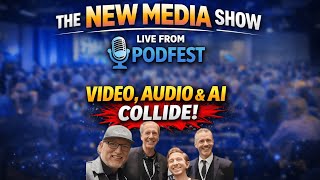
James Cridland, Rox Codes, and Philip Nelson argue podcasting needs to shift from audio-first or video-first thinking to "liquid content" that works across platforms. YouTube pulled video creators away from podcasting years ago, but now the medium is fragmenting again as hosts juggle Spotify, Apple, YouTube, and TikTok. The real bottleneck isn't technology—it's workflow. Start with solid audio, add video only when it matters, and automate the rest.
Chapters
Well, welcome to Podfest and also welcome to the New Media Show. And thank you so much for attending in person here. This is a great honor to be back up on stage with the New Media Show. This is a show that's existed for 14 years now. So we've been doing audio and video online covering the podcast industry and the new media industry. My former co-host Todd Cochran passed away this past September. And so I've recently rebooted the show again.
I'm up—
this will be the 5th, I think the 6th episode of the New Media Show. So thank you so much. And it's great to be back at Podfest. So I've got 3 terrific guests with me to hopefully have a spirited discussion about a very timely topic. Around video in podcasting and what's going on with that in this kind of convergence that we're seeing between audio, video, and how AI is impacting that too. So that's really the topic of what I wanted to talk about on this episode. And so anyway, let me go through the list here. I have James Cridland, who's the editor of podnews.net. I'm sure many, if not all of you, know about James, but he's had a significant influence on the the podcasting space over the last probably 6, 7 years. And, and he's really brought the world together around podcasting. So it's great to have his insights. And then also Rox Codes is sitting right here, and he's the founder of a relatively new podcast hosting platform called Flightcast. And what's kind of unique about Flightcast, and Rox can tell you a little bit about that too, is that it's really a video first podcast hosting platform. So we're going to dive into that. And then at the far end down here, I have James— actually, Philip Nelson, who— right, right, right. Exactly. Is the president of Nelco Media. He's also a technical Emmy nominee for his work that he did at NewTek TriCaster. It's great to have Philip here because he was one of the guys that really helped podcasting in the early years be a lot about video. And most people don't realize this. The early years of podcasting had a lot of video in it. And so in some ways, for me and for Phil and everybody else here, this is kind of a full circle moment for podcasting, but it's different this time. So it's— that's what I wanted to really dive in today and talk about. So is podcasting now a video-first platform? And are we seeing that trend happen, or is video just kind of a discovery funnel for new audiences? I don't know who wants to start out first.
Phil, I've got to jump in because I, you know, I know in the podcasting world You know, Todd, I love Todd Cochran. He was always a good friend. He was such a purist. You know, it's not a podcast if you don't have an RSS, right? You know, and, and the name podcast was kind of conscripted or hijacked by people doing video back in those early days. And so I don't think this is new. I really don't. I mean, I don't either. You know, you have like one of the ones we worked with in the early days was Tom Green. So we did Tom live from Tom Green's house and it was a video first, right? But you had, you know, you can't have video without audio. He did not go to the podcast, though. He did not do an audio podcast release, but one of his guests on the show did. And that was Joe Rogan. Joe Rogan comes on Tom's show, is like, dude, you're doing this from your house. I could do this. I'm going to start a podcast. And Tom's like, call my buddy Philip. He'll help you out. And then Joe went all in on being a podcast, but You know, he's video first, you know, and so I don't really look at this as new. And I look at it as just, you know, video— audio is the intimacy, the video is the discovery, and they all go hand in hand. And I really believe we're all just creating IP in multiple platforms.
Yeah, I think that what's different about it this time compared to what it was in the early years of podcasting is that there were a lot of media companies, big media companies that were only doing video podcasts. They were putting out their episodes in RSS and Apple Podcasts, which today still supports video and it supports video podcasting. But the problem is now is that when YouTube launched, it siphoned off most of those video creators out of RSS into YouTube. And so what we've seen develop over the last, you know, 10 years was was the industry of podcasting really started to double down on audio. Right. So that's what the reputation has built. And that's why we see today this kind of conflict, right, that exists between audio and video in the space. And so now it's really more people are doing both, where in the earlier era it was mostly video. So, James, why don't you add a little bit of context here?
Yeah, I mean, I wonder whether or not we're right talking about video first and audio first, because at the end of the day, it's content first, and the content should work wherever that content is. And the worry that I've got with some of the shows that I'm now listening to, where I'm clearly listening to the audio track of a video show, is that they have forgotten that it's content first, and they've forgotten to hold my hand if I can't see the video. So as an example, there's a show that I listen to which is a very big show called The Rest Is Politics, which comes out of the UK, and it started last week with one of the hosts saying, well, I suppose we'd better explain the room that we're in. And I'm there going, what? What do you mean explain the room that we're in? And what would have been better for me listening in the audio is if Rory had started by saying, well, we're in this beautiful room. It's got marble tables, there's a grand piano in the corner, it's all painted lilac, it was built in the 1850s, and we'd better explain why we're here. Just to talk up the room, to describe the room in that way, would mean that it's not a video-first podcast that you're getting a second-best version on the audio. It's a great piece of content. And I think Stephen Goldstein talked very well about this in a recent blog post when he was talking about the concept of liquid content. So it's content that just is made to work on as many platforms as possible. And that might mean re-editing it. That might mean not re-editing it. And just bearing in mind that many of your audience can't actually see you. But to me, it's much more exciting than talking about video-first podcasting versus audio-first podcasting. Because at the end of the day, we consume We consume all of our content in different ways.
That's a very good point. It almost goes back to the discipline of the hosts, you know, to actually think about the audio-only audience, because on a lot of shows they'll run clips, they'll show images, and they'll be like, hey, look at this, this picture, and they don't describe it, you know. And it's not a technology issue in that case. It's more of the discipline of the host and being aware that they are on multiple platforms. Some people are watching, some people are listening. Listening, you know, and I think that is a big problem because everybody just takes it for granted.
Yeah, and it's not always a perfect one-for-one relationship between having a lot of visuals because visuals carry a lot of communication that we don't really realize, and oftentimes it can't be accurately described in audio too. So that is a tension. So I wanted to shift the conversation over to Rox Codes, who's built a video-first podcast hosting, and he comes out of the, the kind of YouTube world to some degree. And, and I, I think your perspective on this and why you built a video-first podcast hosting platform.
Yeah, first of all, I think what you guys just said is more true than anything else will ever be, which is like, if you're not— like, I know creators who make different content on TikTok and YouTube Shorts, right? And, and that fundamentally would blows some people's minds because they go, well, no, those are the short platforms. That's where I put my shorts, right? But even those algorithms interact differently. So I think to some extent, like you said, it comes back to the host, sort of. It comes back to the creator of are you putting your best foot forward across the board or are you just putting a foot forward across the board and you have picked your lane to put your best foot forward? And to be fair, for most people in video, they will pick YouTube as the thing because of the algorithm and the potential for growth. Right? And so it does lead to this very interesting interaction of a lot of people coming in where audio platforms are considered a secondary or an addition in the same way maybe a Patreon would be, as opposed to their own meaningful platform. But similar to Patreon, the best, most successful people I know on Patreon also treat it as a separate platform and are making entirely additional shows on Patreon and making hilarious money. God. But it works, right? So That's not an achievable thing for everybody, but as you get larger, like, it's really interesting to hear the rest of politics at that scale having that problem, because you would think that they would take the time, right? But I think what's tough is, like, you're absolutely correct, but that is a people problem. That is a, they didn't put in the effort to make the audio edit better, and it sucks that they didn't, but they could have, right? It's like one of the first things we did with Flightcast was we said, we'll turn your video into audio. And the second thing we said is, Or you can just upload your own audio, right? And so you can drop 2 files in and 2 files will go out. And for example, Megaphone won't do that for you right now. So if you're distributing through Megaphone, your RSS feed has to match the audio from the video, which is unfortunate for a lot of people because then they don't even have the opportunity to do that edit. So that's a bummer. The main reasons that we made, you know, like a new platform for it all was A, just because the workflows were really clunky. You were doing a lot of repeated work, so it was very easy to just say, let's log it all into one. But I think the bigger thing was feeling like in general the podcast industry gets video as a format, but they don't understand it as like an industry or the nature of sort of like algorithmic platforms as opposed to more intentional listening platforms. The audience on Spotify and Apple is so different in the way that they interact with content versus YouTube. So optimizing for YouTube is basically optimizing for new. Optimizing for Spotify and Apple is you could really ballpark it as optimizing for returning, right? And so then that's usually the funnel that we see now is it used to be short form, long form. Now it's short form to long form on YouTube, long form on YouTube down to Spotify or Apple, and then from Spotify or Apple, maybe you go to a newsletter or a Patreon. So it's just really shifted, right? It's, it's tough when it's water. And I think the worse the content is per platform, your conversion rate gets a lot worse there. But getting somebody to start listening on Spotify or Apple is way better than on YouTube because then they'll keep coming back in a way that they wouldn't on YouTube. So it just seemed like everybody on YouTube was super data-driven, super algorithmic-focused, and everybody in podcasting was much more focused on like the monetization of it all and sort of expanding that side of it. And I was really curious what we could do if you tried to bridge that. So the video was kind of just a medium by which to say, hey, what if we tried focusing on like growth and analytics as opposed to focusing on, you know, more monetization and the tech of it all.
Do you think it's going to be possible to converge these to the point where you can really come up with a consistent whole content strategy that merges these things together? Because I still wonder if we're ever going to be able to sync them up entirely. Now, this concept of doing a separate edit for video than you do for audio, I think, is one pathway there. But I do wonder if that's even enough. So are we going to end up creating almost completely separate content long term for audio and video? Yeah, go ahead.
You know, I once again, it goes back to I think, yes. And it's discipline of the hosts and creators, you know, like we do. Chip White is— and I have a podcast called Relatively Famous. Chip is Vanna White's brother. From Wheel of Fortune, but he interviews family members of famous people.
Yeah.
And because we wanted it to be a true audio podcast, as the producer, I am disciplined and sometimes lazy in that I don't— we don't use— we don't insert pictures, we don't insert videos. It is strictly a one-on-one discussion. And, and we did that intentionally because we wanted the podcast listener to have the same experience that the video does. The video just adds to it. And our goal was to reach people where they want to be reached. If they're sitting at their desk, they may watch it on YouTube. If they're driving in their car, they're at the gym, they're going to be listening to it on Spotify or Apple or Amazon or wherever. But it is the same experience. But it was a decision we made. So I think the real problem, as I said earlier, it just goes back to discipline of the producers and creators. It's not a technology issue as much.
Yeah, I mean, if I can give a really good example, it's a podcast or a YouTube video that everybody should watch in here because it's a great show. It's a show called If You're Listening, which is probably the worst title for a podcast ever. It's produced by the ABC in Australia. And what they do is they literally have two separate editing teams, one editing team making it for TV, because it goes on the TV, one editing team making it for audio. And if you line up— I did something for my own personal blog recently where I lined up the audio tracks from each, and you can see all of the differences that they have made. Because you can edit ums and ers out of audio, which you can't out of video. In a particularly clear way. You can do different things when you're explaining what you can see on the screen. So again, at the beginning of "The Rest Is Politics," the first thing that you hear is some really sort of jumbled clips. And I was there going, "Why are they just playing this? Has something gone wrong with the edit? Why are they playing all of these clips?" And then I saw it on YouTube, and there's a big caption on the bottom of the screen saying "coming up," but they don't have an audio jingle that says "coming up," so you've no idea if you're listening in audio what this is. It's just those little things, but I think it's really interesting having a look at the ABC, which I pay for with my taxes, so therefore you should definitely watch it, where they have really done the job almost over properly to make it work really well. The latest is a miniseries, it's called called Black Swan, and it's all about how you can't predict the future.
Interestingly, if you're listening, um, yeah, just like, I think looking at yourself as a creator across multi-platform, like, life gets harder and harder and harder and more and more complex and more and more different, right? And it is completely valid to just pick your lane. There's a lot of people that have YouTube channels that could be on podcasting platforms because they're like documentaries, right? But their specialty has been in visually displaying that to you. And so they have stuck to their lane, and that's completely valid. And I think now that we have like Spotify getting into video and everything, there are more discussions of sort of bridging that gap. But traditionally, video meant YouTube as far as creators were concerned for the longest time, because YouTube nailed the algorithm and it became the place to get discovered, which was the number one problem, and they solved it, right? But in general, like, you know, I was talking to Stephanie who used to work at Impact Theory, recently, and she was like, as much as I've dug into the data, the people on YouTube Shorts were not the people watching the long form. The people watching YouTube long form were not the people watching Spotify. The people watching Spotify were not the people on Apple. And we had 3 completely distinct audiences, even 5 or 6 arguably. And so I think in general, social media has, in attempting to get easier, also gotten generally lower quality where it was the tweet is the same as the LinkedIn post. Right. But it didn't used to be. And you used to write different copy for those because you knew the platforms. So I think we're kind of seeing that model at large now.
Well, plus the social platforms are disincentivizing cross-posting to across platforms, which plays into this siloing of content more and more into these different platforms. And so that's adding a lot of complexity to creators too. Why don't we talk about about kind of the complexity of being a modern content creator now, or a podcaster, or video creator, how challenging it is to actually navigate these complex waters now, and is that holding a lot of people back from getting involved in creating new content?
What do you think, John? Yeah, I mean, I think, you know, I mean, it was interesting. I was watching Rob Walsh from the Podcast 411 show a little bit earlier today, And he was saying, so firstly, he gave an amazing tip, which has nothing to do with the question that you just asked, which is make sure if you're producing video, make sure it goes onto Rumble as well, 'cause apparently Rumble is quite big in some parts of the world. So there's a thing. But anyway, he was very much talking about video isn't for everyone. I mean, you know, as Roxie just said, video isn't necessarily for everyone. It's absolutely cool if you want to focus on audio. Then focus on audio. You don't necessarily have to do the video part as well. It's very easy for me to turn up and record a video show because, you know, I'm a bloke and I look like this. There are quite a lot of people in the audience who will spend 30 minutes getting camera ready because they know that if they're not camera ready, they know that the first the first comment that they're going to get on whatever video platform that they've uploaded it is a comment about their appearance. It's sad, but it's the way of the world. So there are lots of good reasons why video isn't necessarily for you, but also lots of good reasons why video is good. And I think you were saying, Rox, it seems to be, from the data that I've seen as well, totally additive. That people on YouTube aren't people you've lost from your audio podcast. It's just additional people. It's just additional users because they're using it in a different way. And I think we've seen data from Spotify that seems to show that people listen to the audio during the day, something for their ears when their eyes are busy, and then in the evening they're watching the video. Because they've got time to, you know, spend time, spend time doing that.
Yeah, it's also even more complicated than even what we've talked about so far too, is because a lot of younger consumers on YouTube are actually starting the video on their phone and listening to, to the audio only, and they're sliding the phone in their pocket because they're doing other things. So a lot of the younger consumers on YouTube are actually using YouTube like a podcast aggregator app too. So I don't know if, if Rox, if you want to talk about that aspect, or are you seeing that in the data too, or can you even tell?
Yeah, well, okay, I'll go last. I have too much to say, trust me on this.
I just want to add in one complexity that has kind of emerged in the last few years for the video side of things is aspect ratio. You know, 9x16, 16x9, or square. And, you know, it's— that has become a big challenge of creating content that works. You know, you know, if you're doing a 16x9 and you want to post a TikTok or an Instagram or anywhere else, you've got to make sure things are framed up correctly, that it can be cropped, because there's nothing more annoying than watching a video on, on one of the vertical platforms and the guy that they're talking to is cut off, you know, and they're just uploading it and letting it auto crop and they're not giving any thought to that viewer experience, whether it's audio or video. And I think that is a bigger— that's to me a bigger challenge because I really work in the video world quite a bit.
Yeah. These AI tools don't usually do— always do a great job with creating the vertical Shorts. They make a lot of mistakes. I know I try and use them too, and they— it depends on what you're doing on the video too. If you've got like comments showing up on the screen or whatever, like a StreamYard platform gives you ability to display comments on the screen and the AI just doesn't know how to get around that. And they'll, they'll like pop it up in one of the boxes, right, of the, the vertical video Short, and it'll have like half of the comment showing in the what one of the boxes and it's, and it's not really helpful to the visual experience. But Rox, did you want to dive in?
Rob, can I curse on this show?
Yes, please.
This shit's crazy. So like the big word that has recently come up a lot in the content space is like, and this is just everything also, is like the enshittification of everything, a.k.a. everything kind of sucks now, right? And the reason this is happening for content a lot is like you combine this water concept of content that only kind of does good enough on another platform with a bunch of AI tools that then permit you to functionally for $20 put them there. Right. And I think the other thing to understand about these poorly edited clips and like the thing we're kind of not acknowledging yet is there wouldn't be clips otherwise for those people, right? They would not be doing it themselves. They just wouldn't be doing it. So for them it is strictly additive. So even though it is not that great and in the algorithm sense has now put a bajillion clips of just some guy talking about cryptocurrency again into the YouTube algorithm, it is like, well, that guy would have had zero clips. So there's something to be said for that now. And I think, you know, similar to the video to audio, it's like, well, it wouldn't have been there at all. And somebody somewhere is glad it's on there. But dude, it's so hard to be a creator if you try and do everything. And I think the tough part about podcasting is like, we found a medium where, like, Gary Vee used to talk about this a lot. He would say, make one really long piece of content. Then make 200 pieces of content out of it, right? Before there were all these platforms, he would say, make the LinkedIn post and make the tweet and then make a presentation and make a blog post, then make a shorter YouTube video and then make a longer one. And that was a really beautiful, intelligent strategy that also took a hell of a lot of time. Uh, and so now you have a ton of people trying to take a thing that they were doing well and expand it out potentially beyond what they can handle. Uh, and then you have a bunch of tools trying to help them do that, but But it does bring the question of like, how much is it helping, right? How much does it help to do a thing kind of okay, right? And from zero, arguably a lot. But also, do you really convert anything from there? So it's like most of the YouTubers I know who did long form, like almost never did short form for the longest time. And eventually after they had landed long form for a year plus and they had their formats down and everything down, they said, okay, I will take on the next bastion. I will go fight the Shorts fight. I will learn what the kids on TikTok are saying, and I will try and speak their weird language. And I don't know what they say, but whatever it is, it's not for me. But yeah, it's just such a progression. It's so tough and it's different. Editing a short, a really good short. I have unironically watched the biggest Shorts channel on YouTube and I watched them tell one of their editors to move a caption 2 frames forward. And he was not exaggerating. He said, move that 2 frames. I can't count that low. I can't see that many frames. I don't know if I need to put my glasses on. Like, it's insane, right? And so you're competing with that. So then do my AI clips do a whole lot, right? No. But that guy chose to win at that game, right? So like, whether it's audio, whether it's video, whether it's anything, cross-posting is great. That usually isn't the winning strategy. It's fine to do it. But like, pick your lane, right? Pick the thing you're going to be best at for sure. If you think you're best at the content itself, audio is nicer. If you think you're really great at packaging and everything, video can be really powerful because there's discovery. But like, the more you try and do, the worse you're going to be on average. So like, really take your pick.
You know, that's why we're seeing the, the big creators out there actually having teams, I mean, fairly large teams. I mean, Rox, could you talk about that? Is that I mean, like a Stephen Bartlett, whether I know, you know, he's a funder of your company and these other guys have 70 people.
Don't fight them. You know, like it's not— it's so not worth it. Don't play the game where they have 70 guys and you have you. It is a tough game. You know, like there are 100,000 concepts of content you can make that are so much more interesting than doing the same thing the other guys had done, especially when they have all those teams. They have guys for shorts, they have guys for ads, they have guys for newsletters, they have guys for blog posts. And I know all of those guys and they're all very nice people. Uh, but they are on the other side of the fence. And, and yeah, it's, it's— you, again, pick your fight. Like, you can be the best dental podcast, right? You can be the best real estate podcast. There's still open space there. Uh, but yeah, dude, the teams are crazy, crazy. They have guys just for the first 2 minutes. They have a team of 3 just for the first 2 minutes. That's crazy. That's crazy.
Yeah. And I think the big, big takeaway from this conversation, really, for, for me in the bigger picture, and is that Apple Podcasts is still the dominant consumption platform for podcasts under the definition, the more traditional definition of what a podcast is as well. But even compared to, to YouTube. So it is playing neck and neck with Spotify as far as consumption of podcasts right now. But, you know, not all of the podcasts are in YouTube either. So you have kind of a different game going on, but, but it's perfectly acceptable to play the audio-first approach and then maybe start to play around with some video additions to that. What should a content creator that, that doesn't have those resources, what should be their best practices, you think, to get started? I don't know.
I'll just do a real short one because it really on the technology side in the early days, it was a studio and a lot of equipment. And, and that has drastically changed in the last few years. I mean, look at what you're doing here. You know, you've got a very nimble setup so that you can create content. And so, you know, you know, I've made some notes, but one of my notes is that modern creators design systems, not setups. You really focus on your workflow that you can duplicate, that you can Scale and, and, and do your best, as he mentioned, to, you know, actually cater to the different platforms. But don't let that stop you. You know, sometimes ready, fire, aim is a good technique of getting your show out there, and then you refine it and you learn what you're doing wrong. But don't suffer from paralysis by analysis because the gatekeepers are gone. You've got You've got Libsyn, you've got the technology that allows you to get your message out very efficiently. And I would say just get started. That's, you know, don't, don't be afraid because now the tools are easy, they're affordable, and you can make a show as long as you've got a good message.
Yeah, I think quite a lot of this comes down to workflow, comes down to just being cleverer and more intentional about the work that you do. I'll give you an example which has nothing to do with video. Hello. I'll give you an example which has nothing to do with video, but nevertheless it's to do with audio and editing. I was asked to— so I do a daily podcast which has a sponsor credit in it. And a radio station in the UK said, we would like to put that podcast on the radio, but broadcast regulations are that we can't have a sponsor in it. Can you make us a version without an advertiser? Now, I could have done that two ways. I could have said, yes, absolutely, and edited a whole new version without the advertiser, or I could work out some other words that I could say with the same length as the advertising sponsor, so that if you were listening on one version, you would hear the ad sponsor, and if you were listening on the other version, then you would hear me saying, the latest from our daily newsletter, and they both timed out exactly the same, so I didn't have to re-edit anything. I just had to turn one track on and one track off. It's all around the workflow. It's all around what can I do to make my life easier and quicker so that I can make a better product at the end of it. And so, yeah, and so it all comes down to reusing content, making content as good as you possibly can on as many different platforms as you can.
And I think that make it as good as you can is like the real secret line there, right? Like you get the workflow down to get it out of your way. You get the workflow down so that you don't have to spend a ton of time thinking of how am I getting this done? So you can focus on like get good at interviewing, right? You can focus on like get good at thumbnails, get good at titles, get good at the things that are going to grow, that are going to push, that are going to make you better. Because so much time could be spent on workflow, right? That was why we combined all the video and audio stuff because it was just people are losing an hour a week, and there's better things you could be doing with that hour. James is a legend at, you know, setup. He's got editing tools I've never heard of. He talks about them randomly. I think one of them is called like Heisenberg or something. I swear to God, they're made-up names. But like, you know, like, that's also the craziest thing I've ever heard. I put a different audio that's the same, like, who would think of that? James would think of that. But yeah, for the rest of us mortals, you know, yeah, like, pick your thing that's just going to get it out there, right? Pick your tool that's going to edit it good enough for you. And then just focus really hard on making the best dang thing. And then you can learn the YouTube game or you can learn the Spotify game or whichever one you choose to learn, right? And then you know that the foundation is good. I think too many people rush to get everywhere and get everything and cover a lot of ground with a thing that isn't that good, right? And just like business, there's no real reason to do marketing until the product's good enough to sell, right? And there's no real reason to worry about 15 different platforms when you're not even nailing one yet. So I'd really, really spend your time on like, make the best content. That was always the YouTube mindset. Make the best video, then get good at thumbnails and titles. And it was a two-step process. That was always it.
Yeah. Well, great, guys. Thank you so much, uh, everybody, for being here on, on The New Media Show. Thank you, James Cridland, uh, Rox Codes, and Philip Nelson for being with us today. And thank you. So
More from Rob

Future-proofing with Delphi AI/Human clones: your podcast as a personal LLM | New Media Show






How sports reveal what AI spectacle gets wrong #Technology #Sports #Commentary



