Podcasting Just Hit an Inflection Point—Here's What Matters
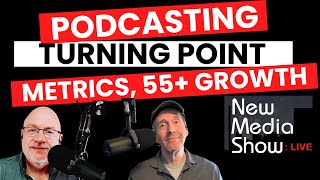
In this hour‑long episode of the New Media Show, hosts Todd Cochrane and Rob Greenlee discuss the evolving landscape of podcasting. They begin by wrestling with the definition of an "independent" podcast, using Joe Budden, Joe Rogan and their own shows as case studies, and explore how ownership of content, network deals, and revenue streams (Patreon, advertising, platform cuts) affect independence. The conversation then shifts to industry‑wide measurement challenges: the fragmentation of download, play and attention metrics, the IAB’s push for a unified attention‑based model, and the impact of these metrics on CPMs. They examine recent technical changes to Apple Podcasts/RSS feeds, notably the deprecation of the iTunes summary tag and the need for richer HTML descriptions. The hosts review the Podcast Standards Project’s upcoming meet‑up at Podcast Movement, critique the event’s ROI for vendors, and note the shrinking exhibitor list. A health tangent covers Rob’s use of a Dexcom‑style continuous glucose monitor for type‑2 diabetes. Finally, they discuss the emerging threat of AI‑generated host‑read ads (Triton Digital/Ekotz), the ethical and trust implications for podcasters, and the broader question of whether such technology will erode traditional CPMs. Throughout, they intersperse personal anecdotes about aging audiences, NPR funding cuts, and the Spanish public broadcaster’s rights stance, concluding with calls for listener feedback.
Chapters
Come on, YouTube.
Yeah, we're live.
Yep, we're live. We are live. Welcome back to the New Media Show, everyone. Rob, how are you?
I'm fine, Todd. I'm good, I'm good, I'm good. Well, that's, uh, lots of stuff to talk about today, all over the map.
Yeah, it is all over the map. And, um, you know, considering that the summer months are usually the slow months where not a lot of stuff is being announced, especially with, you know, majority of Europe on vacation, um, definitely a lot of things being talked about in the podcasting space. So, uh, I, you know, I, I'll kind of talk with my headliner and then you can— we can get into your headliner. But so what is an independent podcast, Rob?
I don't know that I can define it anymore. I think, uh, everybody has a different perspective on it. It's, it's almost like the same conversation as talking about, well, what's a podcast? Everybody's got a different opinion. Yeah, you know, so, you know, I don't know what an independent podcast is now. So does that mean if you're not independent, that means that you've got— you're under contract by one of these big platforms like Spotify or something? Does that make you a non-independent podcast, or what? I, I can't even define it now.
Yeah, it's so convoluted because, you know, the Joe Budden uh, story has made some headlines this week a couple of times with, you know, making over a million a month in, uh, uh, on Patreon, and then, you know, whatever else advertising makes, and, you know, something like 2.2 or something like that he's making a month. And, um, you know, I, I think the reason people maybe joke considers himself independent is, you know, he was under the umbrella of Spotify for a while, and then I guess he didn't get enough money and they, they walked away from that, and they've been able to survive. Um, and I think it's— I think it needs to be remembered that if he's independent— well, let's call him independent, and he's got a pretty big team, but there's a lot of what I would consider independent podcasts that have taken the time and have built their shows and have done very well and are feeding their families with the income from their podcast. And it's not as many as people would want, but I think proportionally for television, it probably is a higher percentage of people that work in the podcasting industry that are feeding their families than than those that maybe work in TV and movies. I don't know, they're two different industries. But I, I do think that if you have a strategy, and if you have good content, that's number one, and you build an audience, you can, you can earn a significant, a significant income. But the, you know, with a dual strategy, you can do value for value, which I would kind of consider to be Patreon support, where people are making contributions to the show. The only thing that Joe may want to try is, you know, set some variable support limits, because, um, a Patreon model is locked to a fixed cost, and maybe people would be willing to donate more in some instances, and they'd be able to do better. But I think he's doing pretty good, over $1 million in Patreon revenue.
So yeah, I was just thinking more about this term independent podcast. And I think it, I mean, I can take a stab at what I think it means in this new era. And my thought is, is that it's any show that's under its own kind of content royalty and licensing. Hasn't offered that to, to a platform.
Right.
So like, just, just, just to use an example, to some degree, you know, the contract that I had with StreamYard to do a podcast on their platform and on their channels, I would consider that to be kind of not an independent show. That's where I've given my rights over to a company to, to own the rights to my show. I would consider probably Joe Rogan to be kind of not an independent podcast.
Yeah. Although he will probably defend that because he says if there's no editorial control on him.
Yeah. He's independent of spirit is what I would call it.
Yeah, yeah, yeah.
So, right. So he's got that piece too. But I think this model that an independent podcaster is like this solo creator, that's the only one doing the show and it isn't a, a big prosperous business. So even putting Joe Budden in this bucket is probably— we're looking at it very simplistically. You know, he— I'm sure he has like maybe a team of 15 people working with him, or— but, but there are examples of folks like, uh, like Marc Maron or even Joe Rogan to some degree that has a small team, but they do have teams, right?
Yeah.
This, this idea that we've had for many years that an independent podcaster was a solo creator, um, is true. I'm just not sure that that's where the big money is now.
Well, yes, but on the other hand, let's just take my little tech show. Um, it's definitely independent, and you know, it is— it's a solo creator, right?
Right.
So it also raises enough revenue to You know, at times, again, it's, it can be like this, um, at times we have to be careful of trying to define independent podcasting as, as, as people that are making— oh, that's true—
or making a little bit of money.
Well, I guess that—
what's the bucket?
Yeah, yeah. I guess my point was, was that it is possible to make a full-time living as an independent podcaster. You may not choose to do that, but it is possible. And I think there's—
You may have a team around your show, but having a team and maybe being a part of a network doesn't make you not an independent podcaster.
Right, right.
So I think that's the other piece here that let's say you did a deal with a podcast network, right? And you're part of a podcast network, but you own your content. All you're doing is you've got into an ad sales relationship or a promotional relationship. But people will oftentimes consider, like, a Joe Button to— if he's a part of someone else's network, he's not independent anymore, right? That used to be what this discussion was about, was if you were, if you were a part of some other business with your show, then you weren't an independent podcaster anymore.
More.
Yeah, I don't know if that's fair.
I think it is, but at the same time, I think there is some, um, stigmatism. Maybe it's not a stigmatism, maybe that's the wrong word.
Who cares anymore?
Yeah, maybe no one cares. Yeah, potentially. But, uh, the point is, I think it's possible. I think it's, you know, it's, it's the key to remember is, and this is a thing where everyone hopes that their shows do well enough. Yeah, what is possible here? Yeah, yeah.
Well, no, no, I mean, I mean, what's your definition of what's possible with being, being non-independent or independent?
Uh, if, if you're independent, okay, let's say it, it runs a spectrum. If— and I don't think a show that has representation is not independent because there's lots of shows out there that has— have representation, and they are completely independent. But I think the point goes back, and, you know, we often poo-poo, as you know, the advertising piece, but I think that, um, you know, there's a segment of shows that are doing, uh, doing very, very well, um, as in what I would term in my mind independent, uh, so The camera's going in and out of focus. Go ahead.
I would say that very few shows I would consider not to be independent.
Oh, well, maybe, maybe. Well, I mean, if you think about, you know, if it's the New York Times, that's not independent. So yeah, that's a corporate program, right?
That's part of a bigger media company, right?
Yeah.
But, you know, it's a fine line of a difference between that and let's say The Evergreen Podcast Network, you know, that you've done a deal with to help you out with the cross-promotion and the marketing and the ad sales and all that kind of stuff. I mean, what's the— I guess the difference in my mind would be, does the media company that it's hosted on, does it own the content?
Right.
Or does the creator own the content? I think that's probably a distinction that It makes more sense in this new modern era of podcasting.
One thing's for sure is, uh, with the cut of funding to NPR, they're going to be finding out what it's like to be independent.
Yeah, but Todd, that funding, that corporate funding of NPR was only 1% of their budget.
What?
Yep, look it up.
So that 1.1— they're a $100 billion organization? No, no, because they thought they only— I thought they got $1.1 billion or something was cut.
Uh, well, um, PBS gets, I think, either 5 or 10% of their budget. PBS does. Hmm. But the NPR cutout is only 1% of NPR's budget.
Oh, hey, for you, you watch, uh, anything being talked about, it's, uh It's, you know, hell and fury of the world. It's the end of the world. Yeah.
Yeah. So, yeah, but if you do a search or you look, you know, look it up, how much does— and there's kind of cutouts there too, to some degree, because some of the federal funding goes directly to some of the public radio stations. So that number may be a little higher based on government funding going to individual you know, NPR stations.
Yeah.
But the NPR corporate dollars is only 1% of their corporate budget.
Boy, to hear about they're going to have cuts and, you know, the world is falling and radio stations are going to close down.
Of course they're going to do that, Todd. Yeah. It's like make hay out of nothing, right? So, I mean, that's just a little bit up on their their normal fundraising that they do.
Yeah.
But I would say it's a bigger impact on the, probably the, um, the local affiliate NPR stations, and then also with PBS.
So, so you— this IAB meeting that you went to, was this an open forum thing, or was it an invite-only, or—
yeah, it had really nothing to do directly with IAB. Oh, it was a, a group of people that got together on a, on a group webinar, kind of a—
okay, so this was it, nothing that was publicly announced, it was just a bunch of people they got in on a call?
No, it was publicly announced, it's just that it wasn't an IEB event.
It wasn't an IEB event, and you, from that event, there's this talk about unifying all of the metrics under one The person that's in charge of the IAB metrics, overall metrics, was part of the call. Okay.
So she was talking about, as the group was talking about, and I raised this topic too, that the whole digital media landscape is kind of in disarray right now because we've got all these different companies and all these different mediums. That all have a different way of counting.
Yeah, right.
So if you're an ad buyer and you want to buy a 360 campaign across video, audio, radio, streaming, all stuff, you have to navigate a confusing landscape.
Oh, it's metrics. It is an insertion order from hell.
Yeah. And so that's what they're trying to solve, is they're trying to kind of bring it together and say, well, let's, let's look at audience from a consolidated perspective, and it's leaning towards this attention type of orientation towards it, not so much, you know, so driven by downloads or plays or views or all this stuff.
But an attention metric is still a number in the end.
Yeah, it is. Yeah, right. So as you look at each of those downloads, plays, views, what's the commonality across all those that can be brought into one number?
So they're saying if they listen or watch longer, that is a metric that's more important than, aka, a download or play. A lot of people have said that for a long time.
Yeah, right. And if you look at what, what YouTube is doing, you YouTube is definitely leaning on the algorithm towards play duration and where, how long people are listening. And that's been involved in podcasting for a long time. I mean, you guys even have it on your platform. So it's just a matter of kind of bringing all these concepts together. So it's simpler for, I guess, brands and advertisers to buy across this digital ecosystem, which is very confusing right now.
I think that getting to a unified model will be probably one of the most challenging things they'll ever try to attempt. Because nobody said it was easy. Because in the end, in the end, you have, you still have companies that are going to want to know, all right, what was the total play count? What was the total download count? What was the You know, what was the retention span? Right. You know, they're gonna— did my ad get listened to? You know, all these questions are still going to come up, and they can try to set a metric. You know, it— you know, look at the podcasting metric. We've had it for how long, and it— and still, you know, people are bitching about it.
So Well, this plays into what the advertiser wants. The advertiser wants to know when their ad got listened to and how many people listened to it. So that can drive the CPMs, right? So it's always been this model that everybody's been under, this perception that, you know, every podcast episode that goes out to— it gets listened to 85%, right, right, of its duration, right? That may or may not be the case on an individual. Well, it were Over episode number.
And usually when there's confusion, it's an attempt by the advertisers to drive CPMs down.
Of course. Right.
You know, they don't—
It's in their financial interest to drive the numbers down.
Yeah. They want to pay for the attention. They don't want to pay for the episode that has been downloaded and has sat on my mobile device for 2 months and I haven't listened to it.
That's why I'm a little, a little bit surprised that the advertisers even pay for post-rolls these days.
So, well, I'm talking about, I'm talking about any type of, you know, if, if I've, if I've got my phone and, you know, there's, there's some episodes from some shows that, you know, I only listen to when I'm on an airplane, you know, I don't listen to them on a normal basis.
So it may go months before I listen to Some shows, and it depends on the metrics platform, whether or not those plays are even going to be counted.
Well, they— because they're already downloaded, they are in the podcasting space traditionally. They're, they're paid for now.
Yeah, well, if it's, if it's downloaded, yeah, that metric has already been counted.
Yeah, absolutely. It was a 1.
So if you never listen to it, yeah, or you listen to it, it makes no difference, right? And that's part, part of the, yeah, crux of the issue is that the industry is, is smart to that stuff now.
And they just—
early days of podcasting, they just—
well, in the early days they were— we had the same questions asked in the early days. Oh, you've got this great medium and wow, you can, you can take the content with— this is before the iPhone. Oh, you can take the content with you and, um, wow, did they really— you know, if they really listened? That was, that was asked in 2005. Yeah, so, you know, that, that question's still out there.
So, you know, and my answer to that was that we don't really know. Yeah, we don't know, but the numbers say 85% of the time. Yeah, it's listened to all the way, right?
Well, yeah, it depends on the show.
As we both recall, Norm from Podcast One was the one that played that up.
Yeah. Yeah, um, I can think what his, his filter was on his metrics. Well, one thing's for sure, and you know, this is what I really think about most of the shows that are actually on YouTube today, um, they're not being listened to, uh, they're, they're very much segmented because they're all putting out reels. There's no reason to listen to an entire episode now. Someone made a comment I saw on Facebook that, you know, the Hunter Biden interview just happened. And of course, it was just, you know, everyone went crazy over all the F words. But apparently that was a 3-hour interview. You wouldn't know that from the discussions that have happened, you know, within the media. You would have thought that was a 3-minute take. And it wasn't. It was a 3-hour interview. And someone— it just goes back to when President Trump was on Rogan. And it was a 3-hour interview, but they were just taking the slices. And someone said they listened to the entire interview with Hunter and said, wow, there was some stuff in there that probably would have been good for the entire public to hear. But it was never, you know, stuff wasn't listened to because who's got, you know, if you don't like Hunter Biden to begin with, there's very few people that will listen for 3 hours. So you get the soundbites. So this is the issue too, is the average. Now if that podcaster or that YouTuber had ads in that content, he didn't get paid for a single one of those because people just took the sound bites.
Well, then you're reliant on the Shorts platform to, to monetize, I guess. There's not as much monetization opportunity in Shorts.
Yeah. So I think it's, you know, in the end, here's, here's this simple fact about advertising and creators: they just get screwed. Uh, you know, and I've been talking to a lot of audiobook people, and boy oh boy, They, they, they're the ones that really get raked over the coals. They, they, they earn almost nothing. Um, 75% is the take that Amazon takes on an, on a, on an audiobook, um, which is pretty incredible if you think about the, the revenue take from that.
Yeah.
So anyway, um, What else? What's our next topic we should move into?
Hmm, well, um, I thought it was interesting. I mean, if we want to, we can talk about the Audioboom thing, but I'm not sure that's a big— yeah, big story or anything.
No, not necessarily. The Spanish thing is a little bit interesting where the— they basically are saying, hey, we don't want this podcast distributed on lots and lots of different apps, you know, that That brought back a lot of memories for me back to the early years of podcasting.
I had to sign a royalty contract or a rights contract with NPR to have NPR podcasts on the platform I was working at, Melodio. I got a big, like, 25-page rights contract with NPR back then. To get, have their NPR podcasts in our mobile phone app back in 2005.
Oh, how times have changed, huh?
Yeah. So there was a lot of, and yeah, I keep hearing that the screaming that's going on around this is that the people that are behind that Spanish public broadcaster station don't really understand how podcasting works.
Well, I think that's pretty obvious.
Yeah. But then again, maybe it's a reaction because of the threat that they feel from podcasting too.
Well, that's potentially true.
Maybe they don't want to change their model to as much as is happening.
Maybe they're trying to hold on to their broadcast tower as long as they can. Yeah.
Yeah.
You never know the mindset. I would have loved to have been a sitting in a chair and being able to understand the conversation that surrounded that and wondered if anybody within the company pushed back. And then someone that just doesn't get it said, no, this is what we're going to do. That's what it sounded.
Yeah, some rights lawyer is putting their foot down.
Or some bigwig in the company or someone that's older that still, uh, you know, think that, uh, independent creators are the— are not the way forward. So I don't know, right? I'm just speculating.
We're making your content available for free on platforms.
Yeah.
Now it does beg the question, are these podcasts— are all these shows monetized? Um, or is this a pushback because they haven't monetized their podcasts?
True.
I don't know.
So Rob, let me— you and I are getting a little longer in the tooth. I have more gray hair than dark hair on top of my head. So I actually still have hair if I don't shave it, but when it does come in, it's pretty white. You've got some gray going on there. So 20 years ago when we started podcasting, did you have any gray then?
I don't believe so, Todd.
Yeah, I don't think I did.
I'm not sure that podcasting caused it. I think it's just—
Yeah, I know, but my point is, you know, podcasting now being around for 20 years, we started with audiences that were in their 30s and 40s. And matter of fact, my prime demographic of my show has always been 35 plus for my podcast. So that audience has been with me for 25 years and 35 turns to 55. And 40 turns to 60. And 45 turns to 65 and 50 turns to 70. So this research out of Edison, I think we have just— this audience has moved with us from the beginning.
And just like we have, Todd.
That's right. And this, this grows is not a sharply grows. We have moved people out of the, you know, that peak category.
Younger demographic into the older demographic.
Yeah, because if you think about it in the early days, the peak was around, and let me hold up my fingers here, the peak was around, you know, 30, probably 27 to 40. That was where the peak was. And that peak has just moved. You know, that demographic is—
Well, it's a smaller number because back in that timeframe, um, there wasn't, wasn't as many people listening to podcasts. So right now we've, we've shifted into an era where there's a lot more people listening to podcasts, so that, that older group that's been moving through is not as big as the one that's behind it.
And the 18 to, you know, the 18 to 35 crowd now is massive. And, you know, in 20 years they'll be the ones that are, wow, the whole 55 and above crowd is growing. So to me, this seems just like a natural thing that has happened because of the age of the industry. Um, the audience have aged with us. Um, you know, I wish there was some magic formula where I could stop having birthdays.
Yeah, well, I'm already starting to count backwards, Todd, so—
Well, I, I stopped having birthdays at 18. I just have anniversaries.
So yeah, I got my biological age back. This, it's a different marker that you can get with your blood test than your chronological age.
Oh, you're trying to move your biological age back. Trying to get more out of it.
I got my markers back and it said I was 11 years younger than my chronological age.
Well, it's too bad our looks don't follow those markers.
Well, maybe it has. I don't know.
Well, I'm not looking any younger. That, that number keeps, you know, in my—
so my goal now is for every year, you know, I get older, I have to work on my health to make myself 2 years younger.
Yeah.
So in 20 years, by the time I'm chronologically in my 80s, I'll be in my 60s.
So. Well, I'm, I'm definitely 20 pounds down. So I'm a couple of months into this now. And I don't know if I mentioned it or not, but, and this is not podcast related at all, but any of you out there with type 2 diabetes, which I have, if you're, if your healthcare system will not pay for a Dexcom monitoring system, a patch, and you hate poking, this is the best $100 I spend every month now. My insurance doesn't allow it. The Veterans Administration doesn't give those Dexcom kits to people with type 2, only with people with type 1. And what I thought I was doing well for years, and then when I started wearing that Stello— it's called S-T-E-L-L-O— amazing difference in just a few minor tweaks to your diet, to my diet. And this— my sugar's down around 80, 80, 90, you know, very rarely gets up in the high hundreds.
Um, and though your most important marker is your insulin marker, Yeah, most doctors don't even take that test.
Yeah, but again, you know, knowing where the blood glucose level is, is just as important, and that is attributed partly to the weight loss. So I, you know, I, I'm convinced just on 2 months of wearing this, I'm absolutely unequivocally convinced that if they did that for every person, or if Apple got the glucose working in the phone that, that alone, just that self-awareness, would, would change, um, people's habits. Because I hated pricking. I hated it. I hated testing. And it made no sense to me because I was on a specific medical regimen. So poking every day to me was like, okay, this is how good— or so, yeah, right. Anyway, it's completely off topic, but It'll be the best $100 you ever will spend for awareness.
A really good marker to get with your blood tests, and if you can get your doctor to do this for you, is your A1C.
Oh, of course.
Yeah, that's your 3-month— yeah, glucose levels.
Yeah. So what I do is I get an A1C every 6 months. So I know where my A1C is. That— and what the A1C is, is basically that's— you do that 12-hour fasting And it basically— and you can, you can screw up that A1C test. Don't go eat seafood the 2 or 3 or 4 days before an A1C test. If it's part of your normal diet, then don't change it. But if you load up on shellfish and shrimp and stuff before an A1C test, you're going to have an elevated A1C just because of the— those products drive A1C up for a longer period than food will. Yeah, yeah, yeah. That resting A1C is, is the key. And that's, you know, that's how they determine if you're pre-diabetic, 5.7, 5.8, 5.9, 6.1. Yeah. But anyway, this is a great device.
It's a good little tip to— so a lot of people are battling this because of the type of food that's in, in America.
The processed food is just absolutely horrible.
Carbohydrates, all that stuff, you got to cut it.
I eat no processed food here when I'm here. Zero. There's— everything comes from raw ingredients. You got to be careful if you're in a restaurant, they're throwing in soy sauce and oil and all this stuff, you know, and MSG and, you know, loads of salt that, you know, that is a thing. But my sugar is always good when I'm here versus in America. You know, go, go eat McDonald's one time and, and having one of these devices and watch your sugar go straight, straight through the roof. It's—
they're just eating any bread. Bread, um, yeah, we'll do it.
Rice, potatoes, even, even the supposed quote-unquote good breads are still shit. So anyway, let's get back to any difference at all.
You're going to spike your glucose with any bread. I don't care who— I don't care what it is.
If it has wheat in it, yeah, if it's got it, you know, if it's got the most, you know, the most worst taste in the world, this is the most— yeah, yeah.
Even sourdough, which people have said, oh, that's, that's better, it'll still spike your glucose. Yeah, but it does help to, to have, um, fiber before you have carbs, right? So you can get the fiber in your body before the carbs. But that's why in most meals, people eat their salad first and then they have their full meal, right? And it does protect your blood sugar a little bit. So you still wanna load up.
There's a lot of stuff going on with Apple Podcasts that's kind of behind the scenes and that people maybe—
Oh, well, that's good to hear 'cause I'm not hearing about it.
Well, you know, it's a combination of stuff. You know, you've covered here that they need a hero if you want to be featured in their new artwork policy. But at the same time, you know, this is gonna be a monumental impact because they've depreciated the iTunes summary tag. And they don't want people, they want people only—
I don't think they ever, I mean, it's been years since they actually used it, haven't they?
Uh, I don't know. Um, but you know, a lot of third-party—
because it's the same thing as what the description was, right?
Well, it doesn't have to be, and that's where the trick was, right? You could have a description that would be much more richer than the description of the episode. So what we're facing is, um, we still have the iTunes summary tag in the feeds. And we still have people that are placing two versions of descriptions in the show notes. It's not everyone, but, you know, real savvy folks have done that for years because they get a little bit of an edge when it comes to some apps that are still recognizing a summary. So with the Podcast Standards Project talking about this, you're gonna start seeing the iTunes summary taken out of RSS feeds. It's gonna be removed. And also—
I think it should be. Yeah.
I think it should be. And also they don't want content encoded used either. They just want stuff in the description. So now, You know, this is what you're going to be faced with. And if you like that marginalized summary or the perception of a marginalized summary or the shorter version of it, is that what you mean? Yeah. You're going to have to understand this is no longer, no longer supported. And You know, we've had some people recently said, hey, why isn't this working? You know, why does it look— why is my description being used here? So the general public doesn't— under the general podcasting public really doesn't know that these, these changes have happened. So, but some stuff is gonna change here soon, just like iTunes owner. And it's no longer needed. iTunes keyword no longer supported. iTunes order no longer supported. So there's going to be some—
I don't think that the summary tag ever supported HTML.
No, it did not.
I didn't think so.
Right. But the challenge then becomes is The wrapping of that data, and this is the thing that we deal with on the support side all the time, is the apps have not done a good job in having a unified description. They don't honor all the HTML in the description. That's just simple fact. What ends up happening is if someone has a bullet list or if they have and these are very basic HTML tags. If they don't support that, then their description in the app just looks like crap. Yeah. And sometimes it just looks like a run-on sentence. So I think it's a dual thing that the app developers have to get better at supporting rich HTML in descriptions so that their description listings in the apps look better.
Yeah, because I think if, uh, if you're a podcaster and you're copying the same description that you're putting into the main description field, but you're also copying and pasting the same one into your summary because you don't know any different, right, that's what's gonna— there's no reason to do that. Plus, if you have HTML in there, it's just gonna look like garbage.
Yep.
So if it ever does get displayed somewhere in some app.
Yeah. And we haven't went and did a comprehensive audit to look at all the apps and see how many of the apps are still pulling that, supporting that tag.
I don't think there's very many. I would be surprised.
I'm sure they will default back to description if it's not there. I'm going to assume so.
Yeah, yeah, no, too. Yeah, I think it's a good move. Yeah, I think pulling that out was unnecessary, but, um, or having it in there. Yeah, right.
It was in the beginning, it was unnecessary, you know, but I did use it to my advantage a few times and being able to have one thing in my RSS feed as the description and the iTunes summary being separate, so Yeah, I think the idea behind it originally was good because it gives you the opportunity to put a, like, a shorter version of your description.
Yeah, a true summary, right, of your, of your episode, and then having the longer version be the full description. Yeah, but I'm sure— I just think a lot of people misused it. They just copied the same and put it in.
Yeah, put the same data in both. So podcast movement is fast approaching, and, uh, Obviously they've been announcing a bunch of speakers. I will say that the Podcast Standards Project is going to have a meeting room. A couple of the folks donated some money. We're going to throw some money in for food for meetings, and basically they're going to have a little bit of an agenda. Not massive, maybe 2 or 3 different events at Podcast Movement. So if you're attending, make sure that you pay attention to the Podcast Standards Project website. And hopefully James and others will cover it as we get those meetups firmed up, but be a place to talk to where we'll be able to have even one-on-ones and stuff as well. So Nice to see that was basically the folks over at Transistor took the initiative to get the meeting room. So I'm pretty excited to see what we can make use of the room.
Probably be great to get a lot of people across the industry to attend. And if there's any kind of structure to this type of thing, or is it just a networking opportunity?
Yeah, well, baby steps now.
Right. Let's just bring people in the door.
Yeah. And be able to have people talking. Yeah. And trying to get more of the industry people in to have— and we're not going to limit it to industry. I think it's going to be pretty open to anyone that wants to have some input.
Well, podcasters need to know about it too.
Yeah.
So it'd be good.
But the lineup, you've noticed a lot of corporate speakers, huh? I don't think that's changed so much, has it?
No, I wouldn't say that this whole thing is anything too new. Hmm, okay. Yeah, the information in this post was not entirely correct. It's kind of a direction that podcast movement's been moving for a couple of years now is it's really becoming more of a corporate event. And we've talked about that a lot on this show. So it's not really a place that startup podcasters go to or anything like that. It's really the larger companies in the space send people there. And I think advertisers hopefully it can be a place where the industry itself can get together and not— it's not a content event really anymore.
Although the stuff I'm going to be doing is content related, so I guess we'll see how many people show up.
Your particular session?
Yeah, but it's an AI session, so, you know, AI is—
well, there's always a certain amount of podcasters that will go.
Right.
It's just, it's probably not the vast majority of the—
and definitely not, not new podcasters either, right?
New podcasters is probably definitely not going there.
Yeah. So it's— so I think this is a watershed moment for podcast movement. Um, I think they're on the cusp of it tipping one way or the other. So we'll see, you know, I'll make a decision at the event if we're gonna repeat. I, you know, I— So go ahead.
I was just gonna mention, is it a tipping point in their mind or a tipping point in everyone else's mind?
Well, it's a tipping mine. It's a tipping point in my mind as a vendor.
Right, right.
Yeah. You know, it used to be that you said you have to attend Podcast Movement because it's a flagship event. To be there to raise the flag to show that you're still in business. Well, if the people that you do business with are not at the show, yeah, do I need to be at the show? I've never gotten ROI out of Podcast Movement from a new customer standpoint. I made relationships and had some networks, but nothing that would justify you know, $15,000 or $20,000 that we'll spend at the event.
So was there a time in the past when there was a strong ROI?
Before COVID Before COVID Yeah, yeah. Because back when they were getting over 3,000 attendees and where there was new podcasters that you could talk to and influence and you know, do the sales pitch. You know, we're going to be primarily focused on our new product, GuestMatch.pro. We're going to be promoting the hell out of it. If we still have a Blueberry banner, but you know, we're going to be wearing GuestMatch.pro shirts. And you know, so, you know, for us, that is a potential market for new customers because yes, there's a couple of competition, comp— competitors in the space, but they typically never have a booth. So we'll see if it helps us.
Yeah, it'll be interesting, um, to see how many of the podcast hosting platforms actually have a presence or have a booth or something like that at the event too. So keep your eye out for that too.
Yeah, Libsyn's one of the folks that definitely has a private meeting room Matter of fact, I've got— I think I can— I talked about this last week. Let me— I have the map.
Oh, of all of the exhibitors?
No, of the people that have meeting rooms. Oh, so Art19, of course, Sounds Prof will have their big lounge. Magellan and Libsyn. Uh, they're the only 3 that I see have meeting rooms. So that's, to me, is on the floor. They may have a meeting room in the hotel.
Oh yeah, well, you're probably— yeah, there's meeting rooms from Spotify and iHeart, all those that are not part of the show floor.
It didn't pay—
not part of the show floor, right?
That they didn't pay, uh I would assume they're on the show floor though. Libsyn, Magellan. Yeah, they're on the— they're in the— well, wherever the meeting room section is. I don't know if it's on a different floor or what.
Are all those companies having booths as well?
I don't know. I haven't looked at the floor map recently, so It's probably the— and I, again, I haven't been on the site in a while, so I don't even know if they show the show floor or not and who's exhibiting.
Well, they usually have a list of all of the, of the exhibitors, but that may or not be up yet. I, I don't know.
Yeah, we'll see.
So Podcast Movement's August 18th through the 21st in Dallas. And it looks like, um, let's see if there's any list of, uh, booths.
Their website changed a little bit. I don't see the actual— there, learn more and buy tickets.
I don't see sponsors. I'm sure the sponsors are on here somewhere.
Yeah, keep scrolling here.
Okay, okay, view all sponsors and exhibitors. It says—
oh, there you go—
presenting sponsor Lipson Airwave are, are the presenting sponsors.
And then you look at Adobe Sirius, Amazon, Art19, Odyssey, Asha, Bourbon Barrel, love that show. FM, CNN Collection co-host, Consumable, Dystopia, iHeartMiguelon, Pay, PodMatch, Podcast Professional Association, Sounds Profitable, SoundStack, Podcast Study Exhibitors. Let's just look at hosting companies. You've got Blueberry, Libsyn, Podbean, arsist.com, Red Circle. That's it.
There's Spreaker.
Oh yeah, I really don't consider them a host anymore, but one— Spreaker. But they are. I forget that they still have hosts.
They're the second largest, uh, podcast host in the world.
One, two— yeah, okay. One, two, three, four. 5, 5 or 6 podcast hosts. So the, the, you know, the ones that are generally there are there. Yeah, but the exhibitor list is only 1, 2, 3, 4, 5— let me do this, it's rows of 4— 1, 2, 3, 4, 6, 24, 25 exhibitors. That's horrible. Wow.
Yeah, that's, that's—
wow. 1, 2, 3, 4. Yeah, 25 exhibitors. That's it.
That's it.
That's bad. So what, that they have a big one?
That's a very short list.
Yeah. Now I'm sure maybe these other folks that are event sponsors will have booths too, and if they do then that raises the number to—
yeah, it does.
Uh, that raises number to 1, 2, 3, 4, 5, about 50. So that's a little better, but that's—
well, SoundStack is also in the sponsor list, not in the exhibitor list.
Yeah, so they're probably— I don't know if they have a booth or not. They have a stage. So yeah, it's still, you know, not a— for an industry that's 20 years old, that's very small number of exhibitors.
Yeah, and I don't see— as far as the presenting sponsors, there isn't any really big companies, just Libsyn and Airwave.
I wouldn't consider Airwave to be a big company, but they wrote a big check.
Yeah, yeah, they did.
And the other ones wrote some sort of check.
Right. The event sponsors one, you know, like Adobe Podcasts.
Yeah, yeah.
And Sirius and Amazon Music Podcasts, Art19.
As an exhibitor, my check was about $5,000, something around there, for to have my exhibits, my exhibit space.
Yeah, the Odyssey Podcasts, OSHA, um, CNN co-host, Quill, Dystopia, iHeart, which is really, you know, again, I—
if you're, you're watching your pennies, uh, which we all are in this time, you know, you just— I can't write these big checks anymore to be a silver or gold or platinum or— right, you know, there's not— because, okay, it's your name's up there on a banner But, oh, it's pretty for a picture and social, but is it giving me true ROI? And I answer my board of directors on these events. So.
Yeah, I just, this sponsor list is pretty short, actually.
And maybe an event sponsor could have bought um, you know, cat— I mean, the, the lanyards, you know, they could have wrote a check for $5,000 for the lanyards or whatever the number was.
Well, the other folks that are not showing up in this list, which is interesting, is there's very few people from the advertising industry side of podcasting, um, from the ad ad representation companies, or, um, well, again, well, they just don't see their names.
Have they done something within the resort that's outside a podcast movement and they didn't get any of that money? Usually the resorts protect that and don't—
I don't see any, any of the big ad buying brands involved in the event, um, as a sponsor as well. So they could be there just going to meetings.
I know one person that goes there and he just, he, he just books meetings like crazy, uh, before the event and sets at a table and has one-on-ones the entire, entire show.
Yeah.
Anyway, we'll see, we'll see what it's going to be. It's going to be, um, you know, I'm flying home specifically to go, so Mm-hmm. And then this event in Madrid, it's going to be interesting that I'm going to in the first week of October. So that'll do it for me for events this year, unless I get invited to go somewhere else. If I'd have been here in Asia, I probably could have gotten into Radio Days Asia, but I'm just not going to be in I'm not making a special trip to Malaysia or wherever they're having it. Yeah. For a couple of day event.
Yeah, it's interesting.
Yeah. The Tom Webster received another CMI Content Marketing Award. So good on Tom for that. Congratulations. I think this is his second. I think he did.
Yeah, it is. It's the second one.
So, um, You know, Tom does a good job in data storytelling, that's for sure. I don't think anyone does it better than him.
Right. Yes, that's true.
In his— I don't even know about this content marketing award, so it's my first exposure to it.
Yeah. Plus, yeah, I can't remember if we talked about last week the announcement from Triton Digital about the— The AI-generated host reads that they're— no, they're starting to move towards. They love— they announced a deal with a company called Ekotz, or E-K-O-Z, dot AI, and it's— and they're set to, to deliver AI-generated host read ads based on the host's cloned voice.
Hmm.
So this would slide right into the programmatic side.
Yeah. So here it comes. The onslaught. The question— I'd like to hear some of those ads.
Yeah, and I was— there's been some talk about it on, I think it was on LinkedIn, about it. I was involved in a thread. That was on there too. And it, it begs the question from a couple different directions, you know, is the host of the show going to want to have the brands that advertise on their show put words in their mouths?
Well, I would assume the host will have to approve the copy. I can't imagine.
Yeah, well, yeah, you would think so, right?
You would think so.
But that's going to slow down the speed of approval.
Yeah, I don't want my name, I don't want my voice being associated with certain products and services. So I would be very—
on your own podcast, see, that's the thing.
Yeah.
So, and is that going to put the brands in a position where they have to script into the cloned voice a testimonial? About their product, right? Um, where's that coming from?
You know, so what happens when you get a Chevy commercial and your audience knows that you're a die-hard Ford fan, or you're a die-hard Tesla driver and a Ford ad comes in in your voice?
I don't even know that Ford's buying podcasts.
Well, I know, I'm just— that's the example, you know?
Yeah. So But yeah, it raises lots of questions. And I heard that mentioned as well about the host has to approve it. And that takes me back to the, it's gonna cut down the speed of approvals.
But at the same time too, I'm not sure that, I think you're cheating your audience. It's a dis-genuine, you know, I take pride in talking about GoDaddy on my show. I use their products and services. And I want people to know that. And I, you know, my audience can text me or send me an email if there is an issue with their GoDaddy account, and I take them right to the top of the food chain over there if there's a problem. And you know, when you have a direct line to the vice president at GoDaddy and You know, he's directly in charge of this, the support team. There's nothing better than that. But what happens when my voice is used to promote some product and then, and I don't, maybe, maybe gets to a point I don't even know anything about it. You know, it's just like the, the mattresses. What was the mattress that was big there for a while?
Casper.
Casper. They see that. I'll be honest with you, what a piece of shit that Casper mattress was, you know. And I refused, I refused to run the ad because I couldn't—
How many backaches came out of sleeping on that, right?
You know, and, you know, and you hear— you heard people, oh, this is the most fantastic, I'm sleeping on this, is my daily sleeper. And I'm like One of the best investments you can make as a human being is buying a good mattress.
Right.
You know, this is something you do not go cheap on. If you're sleeping on a $300 mattress and you have a backache, there is a reason you have a backache on that $300 mattress. Now, some of you have backs of steel and you sleep just fine on a $300 mattress. But I tell you, the difference between a $300 mattress and a $3,000 mattress is night and day.
All right. Yeah, that's true.
The mattress I have here, that was one of the very first things when I went to rent this unit was I pulled the, I pulled the COVID the mattress cover off to see what brand of mattress it was. And I looked it up because if it was junk, I was going to ask the landlord to change it out. I'm that serious about it. So I have here equivalent to a very expensive mattress here. So the quality was exceptional. So, so what happens when your voice is used for a Casper ad? I think that, I don't know if they're still in business.
Yeah, I don't think they're doing podcast ads anymore, but yeah, it does make you wonder if it has the potential of eroding the high CPMs that traditionally host reads have garnered because the market gets flooded with ads in your voice that people don't trust.
And then you don't— you're not trusted, and that could cause loss of audience, the whole nine yards. Yeah, it's a slippery, slippery slope. Rob, we are—
uh, has its challenges.
Yeah, we're at the top of the hour here. We've made it through and still have stuff on the, the list here.
Oh yeah, yeah, there's always a lot.
Yeah, uh, was anything that was important important? Let me look. I don't think—
I think we covered most of it.
Yeah. Oh, actually, this— yeah, creepy clones is what the creepy clones— yeah, when you, when you have an AI doing your ads for you, that's a creepy clone.
Yeah.
And will, will YouTube allow it?
Yeah, well, they're already cloning the host voice for the content. So that's their international translation strategy that they have. So, they might do it. I just think this whole element of the audience is really the bigger question. Is it going to work? Is it going to garner CPM?
Right. Well, maybe some of these creators don't know the CPM. Maybe creators don't care, they just want the money. So it's hard to say. All right, ladies and gentlemen, what's your thoughts? You can very easily give us your commentary. Todd@blueberry.com, @geeknews on X. I'm @geeknews at geeknews.chat on Mastodon.
Yeah, or just post in the threads of the live streams that were going out here in the podcast apps.
Or @NMSpodcast on X as well. We're there.
Yep.
So Rob, what's the 411 for you?
RobGreenlee.com is a great way, two Es on the end. And I can be found on YouTube as well at Rob Greenlee. And you can send me an email, rob.greenlee@gmail.com. I'd love to hear from you. Just like what Todd said, if you have any ideas or feedback or anything like that, that would be terrific. So we'd love to hear from you. I'm on all the social platforms too.
So how are you guys liking the 1-hour show? You know, especially for Rob, it's 9 PM where he's at. So I, as I was telling before we started today, I got 5 hours of sleep today, which is a a miracle on a show day.
So, uh, anyway, it's early for you.
Yeah, it's early. I'm on the opposite end, but I, you know, I worked at 3 o'clock in the morning too, so. Yeah, yeah, yeah. All right, everyone, thank you for being here. We'll see you next week, uh, on the New Media Show. Everyone take care. Bye-bye.
All right, thanks. Bye.
More from Rob

Future-proofing with Delphi AI/Human clones: your podcast as a personal LLM | New Media Show






How sports reveal what AI spectacle gets wrong #Technology #Sports #Commentary



