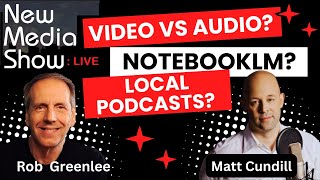
Rob Greenlee and Matt Kundel discuss how elections disrupt podcast downloads and how political guests like Donald Trump on Joe Rogan shape voter perception. Kundel's Trust Factor podcast evaluates political credibility, and he argues podcasts' one-on-one intimacy makes them more influential than traditional radio.
Chapters
Todd and Rob.
Todd and Rob in the afternoon.
Hey, afternoon delight with Todd and Rob. Oh yeah. Well, we're back with the New Media Show today, and I appreciate you being here with me, um, this afternoon. But, uh, as it said in the intro, uh, uh, Todd— this is a show that Todd Cochran and I do a show together, but Todd is out of the pocket today, and I have a terrific co-host with me who's stepping in. His name is Matt Kundel, and he does the, uh Was it the SoundOff podcast? Right. And, and he's been doing that for many years and he comes from the radio industry side, but has been a podcaster for many, many years. I'm sure most people watching this are very familiar with Matt. And so, Matt, welcome to the show. It's great. Thanks.
Thanks for having me.
Yeah, it's great. Well, I wanted to talk about some, some things that are going on in the industry today and that people are talking about in the podcasting space. But this also kind of maybe dovetails a little bit to the radio industry. To some degree, but we wanted to talk a little bit about podcasts with elections and then also the kind of constant struggle, and I know this is a sore subject on this show, is the battle between audio and video and how the industry sees itself, but yet how the audience sees this. And that's what we're gonna talk about today. And then the whole kind of vibe around the Notebook LM platform And last of all, local radio and local podcasts and how those maybe can intersect with each other. And but let's go ahead and just kind of jump into it, Matt, and talk a little bit about— I guess Donald Trump is going to be joining Joe Rogan on his podcast here, what, on Friday? But I know that the whole kind of election kind of cycle has impacted podcasting too. And I know that there's kind of two sides to this, right? More than ever. I don't know. Did you want to set this up a little bit? And I can give some stats a little bit on this path too.
Yeah, sure. I think the thing that's interesting is a lot of the surprise that politicians are showing up on podcasts. It sort of speaks a little bit to, I think, the self-esteem we've developed in podcasting about, you know, we're not mainstream, we're something a little bit different. But, you know, here we have politicians who are actively calling up podcasts and, you know, want to come on the show to reach certain audiences and especially younger audiences.
Yeah, I agree. And I think what they've identified over just evidence over the last year or so is the reach that podcasts have. I hate to say, but mainstream media has a competitor now, and it's in the name of its podcasting. So, you know, there's many podcasts out there. Joe Rogan is a classic experience or a classic example of reach that far surpasses anything with mainstream media. And it also dives into age groups and demographics that expand beyond mainstream media's reach. And so you have a very powerful combination of things going on here that over time here, we may see podcasts become mainstream media of sorts, right? I don't know what you think.
I think we're heading down that path, but I think we're already there when it comes to the demographics, right? Everything is demographics, right? So, I mean, you, you have a radio background as well. I have one. I was 25 years in radio and that was it. That was where you wanted to be all the time. And I remember somebody said, my first podcast conference in 2016 was actually Jessica Rhodes from Interview Connections. She says, do you need guests for your podcast? I'll get you guests. And I said, who can't get a guest for their podcast? And that was the radio smugness of who doesn't wanna come down to our radio station and talk about themselves? And a number of the articles that I'm seeing about people being very surprised about podcasting podcasts getting politicians to drop by and to say their piece come from people who are a little bit older and may not be used to it. But the mainstream is there. If you want 18 to 34, even if you want 18 to 44, and these are the people who need to be persuaded, they're young, impressionable. Podcasting is long-form content. It's a great place to go and pick up people who are either apathetic or maybe even change a few minds along the way. And so these campaigns are running the numbers and trying to figure out what the best podcast is, where they can guest, and what the talking points are going to be. So Kamala Harris has already done a few. And then Friday, there's a scheduled appearance with Donald Trump and Joe Rogan. But I thought what was interesting was Joe Rogan's audience and some of the research that Edison had done. Over what that audience is comprised of? Because I think a lot of people think Joe Rogan, they'll think it's going to be predominantly a right-wing or a Republican audience, and it's not necessarily that way at all.
Yeah, I don't think that Joe Rogan considers himself to be any party affiliation. You know, you know, he's a part of any party. I think he's trying to keep himself fairly neutral and just be talking about issues more from a you know, I guess his definition of what, what truth is that he's learning out there and using his own personal intuition. And, you know, if you think about what Joe has done over these many years is that he's had so many guests on, so many experts, that, you know, he's kind of rose and or risen to this mantle of, of being very knowledgeable about a lot of different areas. And so when somebody goes on his podcast Joe is kind of like able to challenge people about things that they say and, and really create an interesting environment because he's learned so much and has filtered information himself, uh, looking for what's right and what's wrong. And, and, and like all of us, we have our opinions on these things and, and this based on our own, you know, common sense, right? So that's what's going to be interesting about this conversation is how's Joe— because Joe Rogan and Donald Trump haven't always got along. Right?
No, not at all.
And so you have this, this kind of, uh, really built-up tension between those two. But you're exactly right, the, the demographics of the Joe Rogan Show tends to be, what, 80% male and, and 51% between the ages of 18 and 34. And, um, was it 32%, uh, are considered to be a Republican and only and 27% are considered to be Democrats. So he's— and about 35% are independent. So he's actually reaching at a higher percentage independent voters, ones that are maybe trying to decide between the two, right? You know, between the two options that we have.
Yeah. And I think the number of times in podcasting when you go to break up these numbers, I think people are surprised about how, how many independent people who will call themselves independent are listening to the podcast. So they'll self-identify as such anyway.
And I'm not really sure that I entirely believe the concept that there are any independent voters at all. I do tend to think that people are constantly leaning one way or the other on who they're gonna vote for. I don't know that there's a lot of independent voters that vote for either an independent candidate or they're just kind of like— everybody has a preference, right? Uh, it's just, is that preference confirmed enough to take them to the ballot box and make it— make a definitive solution choice, right? Um, so I think it's an interesting thing. So it'll be, you know, Joe Rogan gets as big of an audience as anybody, uh, in the podcasting space anywhere, or probably even in the entire media space today.
That's one thing about Joe Rogan is that I find I only will check it out if there's a guest that I wanna dig deeper into. So I don't consider myself to be a regular listener of the Joe Rogan Show, but oh, look who appeared on the show. I wanna spend some time listening to that particular guest. And I think that's just, so I won't self-identify as a Joe Rogan listener necessarily, the same way people do with parties, because I think, and I think the results of the midterm elections in the US reflected that, I'm neither really Republican or Democrat because I might vote for a Republican for president, but if I go down the ballot, there'll be a lot of Democratic initiatives perhaps that I will vote for. So at that point, I think people just think, ah, I'm something else.
Yeah, I know, I've already done early voting myself, so I'm already past the cycle of the election now. Now it's just, you know, I'm waiting for the results, right? So you have that. Thing. And a lot of people are, are starting to vote early, and these podcasts reach— this podcast is going to reach a lot of people, um, with, with Joe Rogan that are in that phase of doing early voting and trying to get out and get there before the, the November 5th date. And then I know you live up in Canada, so you're kind of an observer from the north. Um, What do you see as kind of the feeling about this election up in Canada right now?
Get your popcorn ready.
It's going to be entertaining, right?
It's great to be able to sit, to sit back and watch it. I think Canadians do sort of view it sort of the same way that a neighbor will peek out from behind the bush to see what's going on with that domestic across the way. And are they ever going to settle it or will the noise ever, ever calm down? I think the meme has gone around the internet enough about that. Canada is nothing more than an apartment above a meth lab.
Um, wow, I hadn't heard that one before.
Yeah, that one has circulated a little bit. Um, you know, Kamala Harris does have a Canadian connection, by the way. My hometown of Westmount, Quebec, she graduated high school from there, right? That's right. I understand that the mayor is trying to get the street nearby renamed in her name. Um, but, but aside from that, yeah, it's, it's, you know, whether it's left, right, blue, red, we have the same thing going on in Canada. And to that, I'll point out that Justin Trudeau did the podcast rounds, not that there was a campaign going on, but Justin Trudeau is the Prime Minister of Canada, and about 6 months ago, a number of phone calls, and I entertained a phone call as well. This is Justin Trudeau's office, we'd like to know if you'd be willing to have him on a podcast. And I was like, yep. So he did a few podcasts. He also did a number of American podcasts as well, because Canadians, of course, will listen to those quite often, actually. But he did the rounds and I thought it might— I think it was something sort of a testing ground to find out, is this going to change popularity? What will the reaction be? How will he perform in an election that we're going to be having in about a year from now? So I thought that was, that was an interesting testing ground to, to have happen. A few months ago.
Yeah. So, yeah, but yeah, before we keep moving along, I did want to bring up on the screen and talk a little bit about your podcast. So let's go ahead and pull that up, the Sound Off podcast. And I want you to tell us a little bit about that show and, and what you're trying to accomplish with that program.
Well, originally it was supposed to be a podcast about broadcast and still largely is. Started in 2016. I was let go from radio and sort of puttered around for about a year and a half as a broadcast consultant and started the podcast to, to forward, you know, talking about broadcasting. It was a way of sort of branded podcast for myself to promote my podcast consulting services and as well a voiceover business that I run. And from there, I just grew so fascinated with podcasts that, you know, we started to tell the story about podcasting as well. And I think what I was really looking for was the intersection between podcast and broadcast, when it would occur and when it would happen. What would be the synergies between the two? What do they have in common and how can broadcasters get the most out of podcasts and how can podcasters get the most out of broadcast? And through all that exploration, I mean, you'll see people on there from who've spent many years in broadcasting, some who spent a few. You'll see many of the leaders in podcasting come and make an appearance and and really a way to educate and share ideas between both mediums. And I say that because, you know, podcasting, I've sort of always looked as an on-demand form of audio, even though we're doing this live right now, but there will be an on-demand component to. And broadcast for many years has always been about, you know, live, local, and now. And they haven't really done a good job over the years to repurpose content. Often they just do it once and they throw it away and it never really gets revisited. So there's opportunities between both. And if it was one thing I could tell podcasters right now is that if there's an opportunity to work with a local radio station, one thing that radio does better than anyone else, and that's promote, promote, promote. And if Podcast Movement this year is any indication, I think there was a lot of focus spent on our promos and how we promote ourselves and cross-promos. And the sharing of promos in and amongst podcasting. How do we make a good one? What does a good one sound like? And I mean, this is second nature for radio people. They whip out 30-second promos and TV people as well. They'll get a 30-second promo on the air at the drop of a hat.
Yeah, I think more than ever, marketing around your podcast is the most important thing now. Now granted, creating the content originally and having it compelling is equally important, but But yeah, getting the word out about your program is, is a challenge and everybody, you know, struggles, I think, to figure out how to do that and do it in a cost-effective way and make it, make it actually work. And, and then the, the next conversation is about monetization. So, so yeah, so that's, that's great. And yeah, Matt, so how long have you been doing that, that podcast now?
We started that in 2016, and it sort of— it was at about the same time that I went to, um, the Conclave Radio Summit, which was a learning conference.
Yeah, I've been to that.
Yeah, well, we spoke— we spoke together at the one in 2017.
Yep.
Um, we were on stage at a podcast, um, portion of the show. And then the week after, I went to my first podcast movement in Chicago, and I just wanted to have a podcast so that I could go there and say, yes, I do indeed have a podcast, and you Yes, I'm currently working on one. And, you know, I think that very first podcast conference in Chicago, seeing everybody with a microphone, I saw all the sharing, I saw people helping one another, which is not something you see in corporate radio. They don't spend a lot of time doing things for the medium. But, you know, 2016, 2017 was an era in podcasting when there was a lot of people helping one another. And I found a lot of people who were willing to help me grow my podcast and always looking for a way. And I was absolutely fascinated with fascinated with how we did the counting. And I said, you know, I come with a lot of skills already from the broadcast world that can really, you know, maybe propel a podcast forward. And I started to do it with my own. And since then, in 2018, we started to bring on a few other podcasts. People were like, I just need some help with my podcast. And, you know, from there we grew it into a network. And here we are, 2024. And loving what we're doing every day.
Yeah, that's great. That's fantastic. Well, let's move on and talk a bit more about political podcasts. I guess Triton Signal Hill did some research showing that political podcasts have seen a 28% increase year over year with downloads and an incremental increase over the last 6 months. So I think we have seen you know, a growth in that. But what's really interesting is the kind of split between Democrats and Republicans around the popularity of the podcast. It says here that the Democrat-leaning podcasts still make up the majority of the political podcasts in the market. Their listenership, though, has declined from 58% to 56% year over year, while the Republicans podcasts rose from 23% to 28% of total downloads. So I think it's an interesting trend line, right? But it does speak to the dominance of the political side of being a Democrat as it relates to podcasting, but it has shown a growth of the Republican side picking up in popularity, right? So I guess that's a little indicative of what we're seeing in the in the polling and the political landscape of the presidential election here, too.
So, I mean, there's some stereotypes in here. I mean, stereotypes of Democrats who are trying to make a point and get a point across. And we're going to do a podcast and we're going to take the long route to get there. And then there's the Republican side, which is a little bit more fiery and, you know, the roots in AM radio. And here's the thing, and we have to change this right away. And there's always a sense of urgency with it. And I did see I did see a post on X. It was Daniel J. Lewis who pointed out that conservative podcasts are rather underrepresented in the podcast space. And then somebody— well, somebody came back and said, well, some of the most popular ones are conservative podcasts. And so I'm not going to— I don't mean to throw shade on this survey from Signal Hill, but I think we know that there's many ways to count. If we were to add up all the downloads of those that are considered to be left-leaning and right-leaning. I don't know what those numbers would come out because I don't think, again, anybody would identify in that particular way. So I think there's perception and reality here with this stuff. But definitely in an election year, I would expect to see these numbers look— that those numbers would check out for me. This is the kind of thing I would expect in an election year.
Yeah, I agree with you on that. But I do think if you think about it historically, conservative talk radio has really kind of dominated the broadcast side. There hasn't been a lot of successful, what I would consider to be kind of liberal Democrat radio programs that have been massively successful. So you see this, the more liberal side or the Democrats-themed podcasts being kind of where the younger generation has been.. And so we've seen that movement. And then the, as I think talk radio has declined to some degree, that we've seen this shift of the conservative talkers moving over to podcasting. And so we've seen them as kind of moving, moving up in the ranks. Right.
I think when it comes to AM radio, which has always been, you know, very conservative, the average age is just, you know, getting to be in the 60s, 70s or something. It's in its 70s now. It's actually, I think somebody said the average age of the, uh, AM radio listener was 78 or something way up there. But it's, you know, you're not going to be growing the audience, you know, on AM radio anymore. So you've got to look for some other ways to do it. And just to be fair, I don't want to say that if you're working under an AM radio station and you have a talk show that it's done over AM because I know smarts, you can— I access American radio FM too.
It doesn't have to be done over just AM.
Right. Yeah, I access, you know, my talk radio through a smart speaker and through phones now. But the target audience to that, you know, has sort of is lower. But the people who are actually listening, they are, they're getting up there.
And so, you know, I'm not surprised to see the same thing with public radio has got the same dilemma, too. You know, like the NPR audience tends to be, at least on the broadcast side, tends to be in that same age group. So I think what we're talking about is a demographic shift., of where people get their content from, right? We're seeing a shift from analog broadcast shifting. The younger generation is, you know, following along with Spotify or YouTube now. And that, that, that kind of leads into the next topic I wanted to kind of COVID on the show today. And that's this, this well-beaten path that I've, I've covered on this program with Todd Cochran that's created some heated episodes around this topic, but audio versus video, right? And Tom Webster put out in his newsletter as part of Sounds Profitable kind of a little bit of an overview of the behavioral segments of people that are consuming audio versus video and what their patterns are. And I tend to really agree with this because I can associate it with myself, my own consumption patterns. But then what I also hear from others where there's audio audio preference people out there that prefer audio, where they consume, you know, most of their content as audio. And then there is video preferring people out there that like to consume mostly of their video. But what we're seeing is a convergence of this where people are liking the opportunity to have the choice between these two., right? So they're still probably going to prefer to consume everything in their preferred method, which would be either audio or video, but there's going to be times when there's going to be crossover, right? So part of what he's driving here is that there's kind of discovery methodologies that people are increasingly using, and one of them is YouTube. And I know this is a huge topic too, but, you know, two-thirds of those people that prefer video are discovering podcasts via YouTube, right? So as a content creator, I don't think we want to ignore the pathways that our listeners are increasingly wanting to use to get to our content. So, you know, it gets back to this conflict, Matt, and give me your thoughts on this too, between the industry preferring itself to be an audio-only platform, I'm talking about the podcast industry itself and how they see itself versus how these bigger players like Spotify and YouTube are kind of driving this market change in perception.
So the answer when somebody says video versus audio, the answer is always yes.
Yeah, that's the big takeaway.
I agree with you. Yeah, but yes to what? It's like people go, oh, should I do video? It's like, yes. And what is that? And it's like, oh, I don't know. It really depends what's good for you. Because I think the pushback, and I was part of the pushback for about 10 minutes, is it's a pain.
It's a pain.
10 minutes, that's all? Yeah, it was about 10 minutes before a few people just said, just get on with it. You know what the right thing to do is. That's what happens. I always, I wind up pushing back on things. I push back on transcription. I push back. I've actually, I've pushed back on you and James Gridland at a, through Twitter when you guys were at Podcast Movement. I said, why do we need to do transcription? It's an extra cost. I don't need it. I've had one request for a transcription in 7 years. What is this about? And I think you guys said you of all people should be doing this. And the next week I was. So thanks for that. But again, video is so much extra work for a content creator, and it changes so much. And, you know, for somebody who makes a lot of podcasts, um, it's— it was a lot of extra work to get each podcaster up with a video strategy. And, you know, there's extra cost as well, extra bandwidth. Um, it's pretty easy to ship an audio file, a little bit harder to ship a video file, that sort of thing. Then don't even get me started on the editing. And it's, listen, it's great to have the tools today, whether it's StreamYard or Descript or Riverside, whatever tools you want to use to really help you do this stuff. But I think the biggest sort of flashpoint for me came at Podcast Movement last year. Steve Goldstein and Jay Nacholas were on stage giving their presentation about the new rules of podcasting. And by rules, it's not saying you have to do this, but it was suggested that you should probably take up some video and ingrain that into your show in some capacity. But the one slide that I said, okay, 75% of people who were ingesting the podcast on video also opted in to do so on audio. And so really video is a marketing tool. So don't look at it as sort of an extra thing to do. Make it part of the marketing pile. And I think if you look at creating the video as part of your marketing instead of like the whole audio experience, I think as a creator, you'll free up a little space in your head and you'll be able to accomplish that. And that's just have a video strategy that you're good with. Even if it's just a bouncy line and an audiogram that you use with Headliner, that's still about the search. YouTube is the world's number 2 search engine. Be a part of it in some capacity. And I know we're talking about Sounds Profitable, a study in Tom Webster. Tom said recently that when it comes to doing video, don't make it worse, was what he said. Don't make it worse. So don't make your video experience worse than the audio experience, and you should be okay.
Yeah, and this is an important kind of way of looking at it too, is even the audio preferring audiences out there, nearly half of those audio preferring audience have discovered a podcast or their favorite podcast on a visual platform like YouTube. So, you know, as we look to the trends, as we look to the future and the present too, is that I think if you're ignoring YouTube, no matter what you're doing over there, you could be creating Shorts, you could be creating just clips from your episodes, whatever that is. Your audience, was it half of your audience that is consuming your audio podcast can consume over there and is interested in consuming over on the visual side. So that's the takeaway that I was driving early on this program with Todd. And there was just so much, and you felt it too, I'm sure there was so much pushback because we don't, we don't, and part of it is kind of a let's be honest about it, it's, it's a concern about the open nature of the medium, right? If we shift attention over too much to these proprietary platforms, which podcasting has always had proprietary platforms. So it's not like it's a new phenomenon here, but I think there's a special fear about YouTube.
Well, absolutely. And it's, you know, it comes down to the programmatic ads. So we have clients on The Sound of Podcasts, right? And they're not a part of the YouTube experience. They're not getting their ads played. I'm not playing mid-rolls in there. So in the end, I'm not promoting my show as being on YouTube. I hope it's discovered on YouTube. And I do believe that somebody's going to take that and go, well, I can listen to it on Apple or Spotify or my Overcast or my app of choice., when I, when I get up and leave. And I think that's, that's going to be a good part of it. But I think the closed nature of YouTube, and it was, you know, it's very obvious they shut down Google Podcasts and made ways for us to create videos very quickly over on, on YouTube. But I'm not sure. I'm, I have not been terribly thrilled with that, but again, you have to create your, your strategy. It's a video strategy. It's also a little bit of a YouTube strategy and yes, absolutely be a part of it. And in the end, when somebody says, well, why should I do that? And I say, well, if you have the opportunity to erect a billboard going down, you know, I-75 towards Minneapolis or wherever, and it's going to promote your podcast, that's pretty much what a video is. It's going to pop up on somebody's screen at some point and somebody's going to see it. And I've actually just replayed episodes of the Sound Off podcast on X, for instance, just because I I bought the account and I figure I may as well use it and use StreamYard just to keep kicking out content. And people around the world will say, oh, I see you have more of a video presence, or I see you're a little bit more involved with video. And just that sort of reminder as they're scrolling by and seeing, that's, that's as valuable as a video on a, you know, as somebody just seeing it for 2 seconds and reminding, oh, there's a show going on, I must catch up with that show at some point.
Yeah.
So there's, I can't see too much downside to video other than it takes a little time and some organization to put it together.
Yeah, I still think today, just like the consuming side tends to lean one way or the other, right? So most content creators lean heavier towards one side or the other depending on how they're entering this. If they have experience with video or they prefer video, they enter this from a video perspective, but There's also content creators that enter this from an audio perspective and then they add video, or they enter it from a video perspective and they add the audio part, right? So you have this kind of two different entry points usually out there. What I'm increasingly thinking about is an entry point where you're coming into this with a dual strategy, right? You're coming at this to create audio and video, not video and then audio or audio and then video. You're creating it all at once. That can be used in both ways. And that's what we're doing here with this program is I think about this as creating both. I create the audio and the video at the same time with the same strategy, pretty much. I think where I've learned that there's a differentiation here is around how your podcast is presented, how you, you know, granted, this one is even at another level, which is it's live. So there are things that I have to do with this show that I wouldn't normally have to do with a prerecorded program. Yeah, um, in advance of doing the show, like the show notes, I have to put a description up in YouTube and put it out on all the socials before the show even happens. So it's not like I can take the transcript from this and create a summary of the episode, um, before the episode's actually done. So it puts you in a different kind of creation workflow to to do these things simultaneously. And then it also, you know, you have to think a little bit differently about your artwork too. I, I do episode-level artwork primarily for YouTube, but that is also shared across all the social platforms too. So it becomes the episode-level art. It's a different orientation. It's not square, it's rectangular. It's like 16:9 format. So it works good with big screen TVs and things like that, which is how I consume a lot of my YouTube content today. So, and I would say that YouTube is my preferred consumption platform right now. I still listen to audio like in my car and things like that on the audio podcasting side. But, you know, I have a balance in my life. I've got both going on. And I think increasingly that's what we're seeing happen is that people are doing both.
Yeah, and I think there was mention, Tom Webster did mention this in you know, what he told us. And I'm gonna have to try to remember that. I think people who— I think, I think it was younger or older people who were more ingrained in video. Actually, it was older people who were, who were quite ingrained in video a little bit more. And he found that to be a bit of a surprise. And then, so I was surprised as well. But then I sort of always stop and think about, well, why would that be? And it's younger people are more, more mobile. Younger people are going to be the ones who are going to be on the move, who are going to take their phone, who are going to go, I'm going to finish the show on my audio app. I'm going to take this into the car. I'm going to take this to work. I'm going to be moved. So, so younger people being more mobile is going to lead to more audio listening from them.
Yeah. And I think that does make sense. But yet those are the same people that probably grew up with YouTube too. So they're probably going to be, you know, you know, able to do both. And there are times when they're going to want to do Both. If they're just sitting around, they're going to watch the video. If they're, like you say, driving the car on the go, they can listen to the audio. It's giving people the choices to consume where they prefer to consume. Yeah.
One thing that I think one difference between the show that, that this show, the New Media Show, and the one that I do is I'm actually going to take the video. The video I'm just going to put up. I'll do some gentle editing to it, add a few things, and then that's that. But the audio, I'm going to create a separate audio experience. I'm going to edit it like crazy. I'm going to narrate around it. I'm going to make it a true audio experience. And because we started doing it that way, and I didn't think it was going to be good for the ears to change it and turn it into something that was a little bit more live. And I didn't want to get into doing some deep, crazy editing on the video side. So unapologetically, I create two different experiences. And I'm sure there's people out there go, hey, how come your video is like 50 minutes long with your conversation, but the audio is only, you know, 38 minutes?
And there's just— it's different. Yeah. And that could be accomplished through AI tools too. I know that the Descript tool has, you know, like silence removal algorithms as well as, you know, the filler words kind of stuff that can be removed that can change the length of the program. And that's kind of sometimes what I do with the content that I make too, is I will run it through those filters, pull out some of the dead space in there, but it does create a little bit of a jumpy video experience. But, but as long as it's not too heavy, and that's what I've been kind of trying to moderate, is how much I, I actually take out. It has over time has become less and less. So, you know, is, is the ultimate destination going to be where I don't use tools like that anymore and it just goes out the way it goes out, right? Which is like it's going out right now. There's no editing behind what's going out right now on this program right now. So why is it a problem to have it go out on demand that way?
So I'm watching a client and he's, he's over 60 and he says, well, I'm going to start a podcast. And he got Riverside and, well, I'm going to do some editing. And I figured after all those years in radio, he'd be editing the audio. But no, he went right to the video and he started editing the video and then sent me the audio. And, you know, with the progress that's being made, and a lot of people do it this way, I just say, okay, let's see how it goes. Let's see what happens.
Right.
And so with all these new things that, and the new ways people are doing things, I just love to watch and learn and see how this goes. I was one of the first persons to try Descript. Somebody tipped me off in September 2019. Hey, have you tried this thing? And I tried it and I said, okay, a lot of people are going to really benefit from this. Just It's not gonna be me. I need to see the waves. I need to, to cut. I need to see the breaths. I know what I need to take out. I've been producing, um, audio like this for years and I'm not about to change and, you know, move out and scrape out every, um, and, uh, and remove, remove the words. That was just not going to be me. I'm still a holdout to this day. Um, that doesn't mean Descript is a terrible product. I, I actually am a Descript user. Um, but just, it's just, it's just not for me, but it's made life just easier for so many people who just you know, had to learn to edit. I remember 2016. Hey, you got to edit your podcast. Well, what's that? Well, you need to get this thing called Audacity. That'll help you. It's free. And from there you'll have to learn. Well, you know, it was a huge learning curve for stuff like that. And here we are today. We can actually just edit the video and you can use some of the AI tools that even Riverside uses to change the way your lips move.
Okay. And your eyes. Eyes, right? Yeah. Your eyes too. I played around with that. That tool on, on the Descript platform a few times, and I found it, um, it can create a little bit of weird artifact type of experiences with the eyes. It just depends on how, like, if you're sitting back from it like this, it can— and, and you're small in the picture, it can really kind of mess with the, the blinking. Yeah. But if you're up close and your eyes are a little larger, it actually does, does a better job.
Okay. Yeah.
I hope not to use that feature. Yeah, right. Well, if you get your camera oriented right, then you won't have to, right? Yeah. Yeah. So it's all about creating the best original content, not, not having to do a bunch of processing on it. Yeah.
And I see a lot of people— I wasn't really sure what I would be using to edit video, but I have been using Descript for the video side of of podcasts and it's, it's like starting over. It really is. It's learning something new, but I'm beginning to learn it and understand it. And this is a scene and this is a layer and we'll put the graphic in here and yeah, it's fun.
And I've been using the Shorts capability with it too, where it will, it will automatically generate so I can tell it to generate 20 different shorts of a particular episode and it'll auto-generate these things. Then I can get in and, you know, add layers of text or graphics to the short and then have it published directly through Descript to YouTube and places like that.
And now's a good time, by the way, for me to go on a hot take about those shorts. Okay. Yeah, I see things like Opus Clips is one they promote. Look, I can get 10 clips, I can get 20 clips. I can get 15 clips. So as somebody who did morning radio and was program director for morning radio for many, many years where people would go in to create live content 5 days a week for 4 hours at a time where you wind up with 20 hours of content at the end of the week and we needed to put a promo on the air to promote for people to listen the next day. I'm here to tell you unequivocally that we would get 4 clips, 3 or 4 really solid clips that we could promote that were really, really good, that were effective. And your podcast is not worth 5 reels or shorts. So I'm here to encourage you, please, please, one clip, just find the one clip that really counts. And it's possible there are zero for your show. Yeah, but find the one, not two, not three. It's just internet litter. And I'm going to implore you, I'm going to tell you why not to do this, because every bad clip you put out tells people not to check out your show. That's it. I've played bad songs on the radio and ruined bands' careers by saying, yeah, sure, we'll play that. We should not have played that. They should not have released that record. You know, you should not put out a very mediocre clip because you're just telling people, hey, this is not for me. Every time you put out a bad clip, and if you're putting out 5, I can guarantee you 4 of them are no good. Just do the one great one and make it really good.
The question gets back to is what's, what's good.
So, well, that's for the, that's for the creator to find out, right? But if, if they believe they know their audience and you're, you're communicating with your audience, you will know what what the best clip is. And that comes down to getting to know your audience. You should be engaged with them in some capacity. This is why we hear about surveys being so important for your show. You should be surveying your audience whenever you can and finding ways to connect and feedback. And part of the social media aspect is to, is to, you know, find out what people like. You should be checking your metrics all the time to find out what shows worked and what didn't work. I'm sure you're going to find out shortly, Rob. You'll look at the downloads and go, we're not having that Kundle guy back on here again, you know, but that's, that's, that's part of it, right? Is so I think staying in touch in that way, you, you will land on the right stuff, and from that, your show will grow.
Yeah, yeah, yeah. I think also, and this is, this is what I've learned too, is putting out clips, um, can help you gauge what, what works and what doesn't work too. So, you know, it's almost like a trial balloon to your audience to say, well, what's going to connect too, and And then you just adjust your sales and do like the strategy that you took. I mean, because it is— I've come across many episodes where it just doesn't— there was just nothing in the content that you could clip out that was only 60 seconds long that was valid or worth doing a clip for. But then on the other hand, is that a bad sign? Yeah. That you're not creating content that's compelling enough in a 60-second clip. And it could impact your overall audience because you don't have very many of those.
Good news is I think Shorts is up to 3 minutes now. Yeah, it is, right?
Yeah, right. I think that was just a recent change, though. Yeah.
You know, and a little cynicism. I mean, if I put a clip out and the clip talks about Nickelback and it gets a lot of plays, that tells me about the relationship between Nickelback and YouTube. So I think you have— you should probably look a little bit. So we'll have that do on Instagram and how does it really do over here? But maybe Nickelback is not really the crux of what our audience is really coming to us for. So maybe not use the Nickelback clip necessarily. Maybe now you can create a second, a second clip that truly talks about what your show is. Yeah. Yeah.
So, you know, I think clips can be helpful. There's, there's people out there that are on the fence about shorts and whether or not they're, they're worth doing because they're difficult. They're more difficult to monetize. At least if we're talking specifically about the YouTube platform, it takes an awful lot of clips to equal any kind of revenue. So there's a view out there that, like you said, Matt, I think fewer Shorts being put out and more longer-form content will actually bring probably more longer-term results for you from a monetization perspective. Because really, really, the shorts are really just a promo for you. But, but if they're not working right, then yeah, they could be harmful, right?
So that actually makes sense. Yeah, I've seen a lot of people struggle. It's like, well, we do this all the time, how come we're not seeing the jump? And I think, I think traveling from TikTok all the way to your YouTube show or an Apple Podcast, you know, version of your show, that's a long trip for people to make. So again, I sort of get people to think a little bit about driving down the highway and seeing a billboard. Maybe you don't need Budweiser right now because you're driving a car, but when you get to your destination, maybe you'll want Budweiser, right?
Yeah.
You never know, right? I don't know why I mentioned that.
I just don't—
I don't care for that.
I don't care for that here. Which side of the political fence you're on now, right?
I just realized that. I just—
I realized how I walked into that. Yeah. So anyway, well, let's move on and talk about Notebook LM. It seems like everybody's all abuzz about this platform and I'm just, I guess to some degree I'm not really getting it. So I don't know, what's your kind of top level and we can go through and talk about it in more detail.
Well, I mean, it looks like a great way to gather up your notes and put it together and then repurpose it.
It's a notebook, right? It's a notebook. Yeah. So the name kind of implies what it does to some degree.
Yeah, and I guess what we're gonna talk about today, I guess, is this a dangerous thing if these get turned into podcasts? Because I think it was the conversational aspect from it. So I gave it a try and took a look and threw some stuff in there. So one of the things that they're pretty adamant about is that you can't, they're not gonna be scraping the content that you put up there to have their tools learn on the stuff that you're putting up. So I think that's the safety side of it. So if you do put stuff up there, and then you can say, well, can you turn this into a conversation with two people? And from that, you can get a pretty interesting conversation. And now you get pretty much the same thing what I was just talking about with the Shorts, but this is in a more nefarious, you know, way where you can litter the podcast, you know, portion of the world with podcasts about subject matter that is, you know, whatever you really want. And so I think that there are podcasts out there that have been put together using NotebookLM. And, you know, where, I guess, where did that stuff come from? You know, is somebody's work being uploaded into there and then used in that? I think that's some of the stuff that we're going to find out. But we're already seeing this in YouTube. I've seen some really bad videos be put together in AI form. And I got stuck on one the other day. Talking about, you know, the geographical locations in Spain that told me nothing, but it just regurgitated facts. I said, boy, I got trapped in the wrong video here. And people are going to do that. So again, we're talking about some podcast litter. We're talking copyright and again, some AI. So I'm not terribly alarmed by this. I think there's going to be litter. But, you know, I think the dangerous part on the advertising side is what if you put a few mid-rolls in on this garbage? And it actually, you know, some BetterHelp ads and some other key advertisers wind up having their ads put in this.
I think there's some trouble ahead. Yeah, I think there's this concept of faceless videos that people will create through, let's say, a notebook LM. They'll create this kind of conversational layer of text of sorts as a transcript and like a pre-transcript of what they could generate via like an ElevenLabs or someplace like that where you can clone a voice and be able to upload that and it will automatically create audio from that based on the voices that you selected. And then you take that, you know, so you could generate this transcript through NotebookLM, import it into ElevenLabs, generate the audio, and have this conversational podcast. And then upload it as your episode. And I think that's the pathway. And increasingly that may be possible on the video side. I've been increasingly thinking about, you know, people at some point will be able to create full episodes like what we're doing with our likeness, Matt and myself. And I just give it a transcript and it basically has the same visuals, has the same facial expressions, it has— but the sound that comes out of our voice on the podcast would actually be from a transcript that I gave it. So, you know, that is kind of a freaky world when we think about it. But I do think that we're going to get there.
So leave it to me to think of nefarious and silly things. There's a lot of those. Well, I mean, let's take— let's take Tom Webster's book, right? Yeah. And then let's take Steve Pratt's book. Both of them have released books. And then Valerie Gower, I know, is going to be coming out with a book in a few weeks about performance. And let's take all these books and upload it into Notebook and then create a conversation based on those 3 books. And now I've got a podcasting 101, marketing 101 type show that I could put out. I wouldn't— not me. I would not do this. But I mean, that's the sort of thing. Can it lead to that? Because it's— they've made it very easy to create like conversations and stuff. Yeah.
How many laws have I broken here? I don't know. That's a lot. I mean, if you take copyrighted content and you create derivative content from it via artificial intelligence, AI platforms like ChatGPT for Omni, you know, is it, is it considered original at that point because it's been rejiggered, reworded, re— recreated of sorts in a different form, or not. Well, it may be a different form, but it could just be rewritten in a different way.
Right. And I'm fascinated by your take on this because you're the guy who's talked for so much about trust in media. And, you know, podcasting scores right up there when it comes to trust. And it's one of the only mediums that has any kind of level of trust anymore. So from the trust aspect, I really worry about the medium when it comes to something like this and this tool, which I believe is always, all these tools are created for good until they're used against us in some particular way. But I do see a time and I think the time is coming and YouTube has already started this where you should be saying whether or not this piece of media was created with AI. But maybe it's going to be, hey, did you use Any voice enhancements with the script? Did you use NotebookLM for this? What did you use? Where you may have to start declaring your content before it goes, you know, up into the podcast world or on YouTube again, it's already happening. But it's going to be important to declare this stuff. I can see a time when, and it may not be too far off where we're going to have to declare this stuff in advance. And I believe the algorithm in YouTube's case is going to work against that. Do not show me any AI.
Do not show me any AI content. Yeah. YouTube does have a kind of a radio box question in their publishing tools right now that asks you the question, was any of this content artificially generated or created that you have to select. The question gets back to is, will Google be able to detect what's AI-generated and what's not on its own, right, without publisher input? Right now you're given a choice to select, well, was this created via artificial means? And I think where we're at right now is, was the whole thing created with AI. I think that's the level that we're at right now, is was all the content created with AI, or was— and it may be currently okay to have some portion of it be manipulated by AI, but not the whole content created in AI. And I think that's where we get into this faceless video stuff, is where it walks this fine line between is not all of it was probably AI-generated, but maybe it was AI-assembled and the audio was generated based on a transcript, but was that transcript created by AI? You know, so there's these lines of distinction that we may or may not want to impose, right? And that's gonna be the bigger question is because I think when you put a label like that on your content, I think it's going to be like almost like a thumbs down that this isn't trustworthy content, right? When maybe it is fairly trustworthy content. It may be unfair to the content that it's being labeled that way, but then again, you know, that's the line that we've got to figure out. And I don't know that anybody— I, I don't think that I've heard anybody really give me a clear definition of where that line is. I know Todd and I have argued about that on this show a lot, and, and I don't think he wants to have a clear line that says, well, if I edited one word in the script, right, that I have to label that versus was the whole piece of content generated by AI and there wasn't any human involvement, right? And, you know, it, it does kind of put you into this camp of, you know, like damned content, right? If you, if you put a label on it like that, I don't know what you think about it.
It has all the feels of crossing the border from Quebec into Vermont. You know, do you have anything to declare? Yes, I'd like to declare this AI content. You know, I mean, I thought about it one day when a client called me and said, and this is for a yoga podcast, and she called me and she said, I meant to say turn to the right and I said turn to the left. Is there anything you can do? And I said, absolutely. And in the file went into Descript, changed the left to right. It sounded awesome. And I said, well, I'm going to put that back up and I have to reload. I've got to create a new video for YouTube. But now do I have to declare that? You know, now do I have something to declare to YouTube and how will that affect things? So I totally understand where Todd's coming from on this. Yeah, yeah. But to your, you know, to this, it goes right back to the trust. And podcasting has got trust, and that's why all the politicians at this time of year really want to make appearances. Yeah, you know, there's, there's a lot of independent voters who trust their podcast host, who want to hear from candidates of any sort, who want to, you know, dig deeper on issues. And this is a bit of a heyday right now, and something like this could ruin it. I don't think Notebook is going to be the thing that, that undoes the trust at all. I, you know, If you're to ask me, is this something or nothing? I'm going to lean a little bit towards nothing on this. Closer to nothing than something. But perhaps one day there will be something that could really sort of destabilize the trust we have in podcasting.
Yeah. Well, let's, let's move on and talk a little bit about local podcasts. This has been a topic that Adam Curry brought up on a recent episode of the New Media Show, and it's been a topic I've been thinking about, and I'm sure you have for many years too, around, well, when is local podcasting going be an opportunity that could be explored and found successful. And I think my position has always been on this, that when podcasting reached the majority of media consumers in this country, then it is a viable option. The problem that we've had for many years is that the percentage of people that listen to podcasts in any given local station, like local city or whatever, was always the percentage of the people that were listening was too, too small, right? So, so, but as that grew, and I think we're getting close to, you know, what I would consider to be kind of market saturation for podcast consumption with individuals in our, in our society today, that, that opportunity is becoming more and more real, and that local radio stations probably need to increasingly start thinking about that. And I know that the local broadcast radio industry has been kind of slow to kind of embrace that because I don't think they saw the return on investment on it. But do you think that's changing, Matt, or are we just blowing smoke at something that's—
No, it's, it's, it's changing. And so when I listened to the episode you did with Adam Curry, No fewer than 3 times did he repeat that as the opportunity. And he, of course, has a very, very deep broadcast background. Yeah, he knows radio, he knows television. He's been involved with it. And he's right. This is it.
And it's now.
And it's— I think a lot of it has really happened because of the failure of— and that's not— I don't think that's the right word. Just the way that, that podcast advertising has evolved and the opportunities have evolved, that if you do have a podcast and it has 3,000 downloads per month, maybe it has 5,000, you know, how much money can, can you make from it? And the pressure's always been, well, you're going to need a lot of downloads. Well, you're going to need to get some advertisers. Well, you're going to need some programmatic advertising as well. And it's, it's just not there. And at the same time, we're seeing a lot of media in cities across North America disappear. Newspaper, especially in Canada, especially in Canada. They've tried to legislate it back to life. They in fact managed to kill it further. Thank you very much, current Liberal government, with your Bill C-11 and Bill C-18. Garbage, absolute garbage. Sorry, that's as political as I'm gonna get here today. And we talk elections, but it's, The newspapers, the journalism is disappearing. It's under attack. And, you know, there's opportunities to connect locally because people aren't listening to the radio as much because your local radio station is playing 10 in a row and it's voice tracked from another town, another city. So the local aspect is gone. So, yes, the opportunities are there. Now, people are hungry for that thing. They're hungry for local. And I'm, you know, all the things podcasting 2.0 that's out there, my two favorite ones are the two pieces that, that come from radio and that's live. And I'm not sure if I check the Fountain app right now, if it will indicate that this show is live, but I have in the past.
I don't think so. I think Todd, Todd has to trigger that and he's not in the pocket right now.
Got it. But I did, you know, I did enjoy that. I would, I would be driving around the city and I would be, oh, New Media Show's on. Let's see if I can use the Fountain app to listen to it live. And I love that. But, you know, what if I could also, you know, on my app, I want to listen to something that is live but local and in my area. And so that's the two things I'm most excited about for, for Podcasting 2.0 is live and local. If we can put those tags in there and people can, can access them and use them in that particular way, that that would go a long way.
Yeah. Yeah. And it's probably going to have to embrace audio and video if it's going to play into the, the trends that we're seeing. And I do know that there's cable television or cable companies that are putting out streams to support local markets. They tend to be kind of trying to narrow it down by city, but at the same time they come across as being kind of more statewide kind of streaming channels, whatever, on like Roku platforms and things like that. They try and associate themselves with local communities, but it's the same content that comes more from a state level, right, where they cover stories that are maybe related to a particular city in that state. And, and they kind of compile those into its own separate, like, feed of sorts, right? So as we're seeing this happen, the podcast side could be very similar to that, right? So there's, there's podcasts that are coming out for a particular smaller town where things are happening there, and maybe there's a correspondent that goes in and does some coverage in a day or so in a, in a given city, and then that gets recorded and then it goes up to this master feed that can get split up amongst various locales. One of the other things, Podcasting 2.0 Initiative has this location tag that they're trying to push out and get people to support, not unlike what TuneIn has had for many years where local radio stations can be identified by zip code in their platform. Or city, and you can have a list of all the radio stations that are in a given city and town and across the country, and that will pull up a list of those. So I think that the consumption platforms need to adapt and adopt this ideology as well for it to be widely accepted and supported.
Yeah. So a big opportunity if you have a local radio station and especially if it does news to really sort of invest in a daily podcast and to put that out there for people to talk about the issues a little bit more. I think radio is really hung up on the ad dollars. They love the 30-second ad. They get paid. They're just used to it. They're kind of hooked on it. And that's why you'll hear some really, really long ad breaks. But they should be able to move into the audio side and podcasting and put out a daily podcast. Yes, yes, yes. I know it's hard. Yes, I know it's going to cost money, but you should do it. Right. Time. Right. Yeah. Time, money, people. And it's a little bit harder, especially at a newspaper. I know there's a number of newspapers that are going, well, what do we do other than just sort of do our online and subscribe and $0.29 an article and, and all that stuff? Well, you know, audio is the way to go. So the problem I think inside many of those places that, you know, some of these news people are not, they're not audio people. They're great writers, but, you know, again, it's a, it's a whole different skill set. Same way I'm not a video person and I'm becoming one. It's, it's something that I think when, when you're in media, you sort of have to pick up and say, well, I'm going to pick up this tool now and start to do it. But the real important thing, radio station, cable company that has it, that has an access channel. I mean, if you've got a podcast, take it to your access channel. What a great— if it's a local podcast, take it to your local cable company. The video I've seen, I got a couple on my local cable TV, that two podcasts that are reproducing the, the video part and putting it on TV. And often I'll just be clicking by and I go, yeah, I think I'll check out the, uh, Manitoba Basketball Podcast and see what that's all about, what they're talking about this week. And another one here locally, Which Police Radio, it's a longstanding Manitoba podcast that is showing itself on local TV, on the local cable channel. If your radio station in town, if you have the opportunity, why not just, you know, there's contra opportunities and contra is a, you know, a radio word. Well, I'll trade you some advertising inside my podcast and you put a couple of ads on your radio station and let's trade and, and work together. Because I tell you, if you can get your podcast promoted on radio, that is a, that's a wonder. Radio is still very, very good when you get into people's ears and tell them about your podcast. Again, it's, it's actually way better than the billboard that you see on the side of the highway for a can of beer. Radio is still very effective in that way when delivering its messaging and certainly when it comes to promotion. And so, yeah, especially locally. And I think from the money side, and everybody wants to make money, it's a lot easier to sell in your area because you can go into the store, you can have the conversation, you can meet the people who are going to be giving you the money. You can arrange your deals much easier than sitting in your office and trying to negotiate over a computer in a faraway land with, through a third party. And you thought you were getting a $35 CPM, it's now $25, $10, $5, $8, $4. It's a $4 CPM by the time it gets to you. Yes, I'm exaggerating, and yes, I'm telling a tall tale here, but that's pretty much what happens when you make a deal. But if you go out and you say, listen, I've got this audience, they are all located in the city, everybody who listens is from the city, this is about the city, and your store in this particular city You shouldn't be charging a $35 CPM, or you should be charging like way more like advertising rates that, that, you know, for a radio station, like you can get 2 or 3,000 people in your local area to, to be listening to a mid-roll of the particular. But yeah, that's— don't— you're not doing a $35 CPM. You're looking at something way, way more.
So keep it competitive, you know, charge more. Do you think that any kind of content creator that wants to pursue this should get in some sort of a partnership with a local newspaper? Yes. Is it really trying to bring this stuff together and create workflows that are efficient in getting content out about what's happening in a, in a particular community? I know that there are some initiatives that have been, that are in process right now. One's called CityCast. That has been operating for many years now. I'm not sure where they're at right now. I haven't checked in on them in a while here to see how many cities that they're in, but it's an effort to— if you're curious about this, to go, go check out— I think they're at citycast.com, I think. Dot FM. Dot FM. Okay. Yeah. And, and that would be a good one to kind of follow and see what they're, they're, they're doing. And I know that they have correspondents that are scattered around the country that go in and do topic kind of conversations with local people about cutting-edge things that are happening in those communities. And then they're compiled up into various kind of podcasts that they have about a particular location. So it's an interesting project for someone to, to build, uh, build an enterprise. Should, should this really be done by the local radio stations is my question for you, Matt, because that's where the expertise probably lives.
Yeah. Or the local newspaper. Either one. Wherever the resources are. Yeah. Yeah. I mean, I still think that radio and newspaper still want to kill each other. I think it's a— it's still a long battle. I don't know if they would be able to get together and do it, but they probably should. One thing that radio is not good at, corporate radio, is collaboration. They are so hellbent on taking share from one another It's crazy. I can't— it's so— they don't get together to talk about the ways that they can promote the medium as a whole. The last time I think they did it was the 1980s when they would put ads on the radio to say, radio, red hot because it works, advertise on the radio. And they all ran the same ad. But to get radio people around the table today to really discuss what, you know, is really what they really need, it's not happening because many of the big companies like iHeart have already pivoted into other things. Odyssey again is pivoting a little bit into other things. And, you know, the local radio station is not top of mind, but the mom-and-pop shop, there's still opportunities, but there's not a lot of money to go out there and to really put out a daily podcast that— and I think, you know, where they get hung up on the money and they really should be looking at it as a marketing effort. This is marketing for our radio station. This is marketing for our people. This is marketing for the things that we do. And yet, I mean, you're going to take, you're going to take money and you're going to put it on a bus board. You're going to put it on TV. Maybe you'll take your advertising money, put it anywhere, but why not just do a podcast and that can be your marketing? You'll feel so much better if you're not trying to chase all the, uh, you know, dollars right away. And, you know, like any radio station, it takes 3 years to build a radio station. It takes, it took 3 years for me to build my podcast before it really had stable listenership. Yeah. And, you know, Valerie Geller talks about this all the time. When it— when you're building a morning show, it's 3 years to build an audience. And it's really, you know, the same thing for, for podcasting and, and anything else that we do. So if you can have the patience to do it locally. And I had a conversation today with former radio personalities in London, Ontario, where like we're 2 years in, we release consistently, we have downloads upwards of $4,000 a month. London, Ontario would be considered a medium-sized market overall.
The area—
I know in the States you work with DMAs, but it's got a solid, I think, $700,000, $800,000 in there. It might be even more, but lots of people to choose from. I go, you guys are doing great, you have so much opportunity to choose from. I go, well, do you have a website? It's like, well, we need a website. You definitely need a website because there's some inventory on there, right? You need a newsletter. So definitely get a newsletter because again, that might be something that you can use for trade to promote additional content. So yeah, I'm all about local. And you know, there was a time a couple years ago I said, well, you really need to come on my network right away and we really need to get you some dynamic audio and we really need to get you some programmatic ads and we really need to get you— nah, they don't need that. They really need is good old-fashioned on the ground and be in the community and double down on that. And they're aware of the downloads. Oh, because if you go somewhere, oh, we need 10,000, 25,000 downloads, well, they're never going to get that where they are. So take what you have, and they have a lot, and, and, you know, really hone in on that. And, you know, it's just like when I— and that's sort of the bulb that went off of me when I heard Adam Curry mention that. It's The opportunity is there because the old media has cleared out.
Yeah, that's true. Yeah. I mean, a lot of these, these communities around the country don't have any media to support them. Yeah. Right. So people are, are not very informed about what's going on around them. I know in the community I'm in, there's very limited media that's around here. There is a weekly newspaper, but that's, that's about it. It. Um, so you don't really know what's going on around you, and I think having a regular flow of information about your community, I think, is helpful to everyone. Um, yeah, so hopefully we'll see this start to, start to take off, especially as the amount of listeners to digital content accelerates and starts to reach total saturation. Uh, it's an opportunity to, uh, build a local marketing campaign and a local content media kind of property that then can be promoted to the community through what mediums exist and then just kind of build on top of that.
So I think the reason why you do it now is simply ad dollars.
The opportunity ahead of their path too. Yeah, right.
I mean, you will be able to pull your— I mean, right now most of those ad dollars are going to Facebook and Google. Google. Yeah. And so you'll, you'll pull some of that digital money, you know, into, into your world. You'll be able to charge more. And, um, you're always going to make the most money by, by charging yourself, right? Programmatic ads are going to buy you a few cups of coffee. And what's, uh, Todd Cochran— well, it might be a car payment, it might be a cup of coffee. I mean, it's got sort of various scales of—
right, it depends on how much you're spending on those things, right? Yeah, exactly. But, um, yeah, I wanted to mention too that I, I've been kind of expanding my wings a little bit on, uh, on the content side. I'm starting to get more involved in kind of live, uh, larger-scale live productions. And, and then also I'm, I'm starting to play around with, uh, multi-camera in-person, uh, recordings and live streaming. So I'm trying to push my knowledge and my understanding of trying to create these, um, these online events as well as in, in real life too. So, so I, I was the co-producer on an event last night called Heroes for Democracy. It was a live 2.5-hour stream, um, on, on StreamYard that we had about 80,000 people that, that joined us on that stream. Um, so it was, you know, I'm, I'm pushing my envelope of my, my work in creating content and taking advantage of the opportunities out there that people are looking increasingly for. And, and, um, you know, we'll see how that all turns out. But, but there's another episode of the Heroes for Democracy that are coming up, that's coming up in the evening, uh, next Tuesday too, with a whole lineup of guests or whatever. It's, it's a little bit of a political-oriented livestream. But, but also, let's, let's talk a little bit about— and I think there was one more topic that we wanted to talk about on the show—
was the Canadian Podcast Awards coming up. Yeah, I figure I'm from Canada, so I should probably mention this thing. But I know award shows are something that you guys talk about, you know, the AMBIEs.
I'm involved in a lot of them.
Yeah, a lot of them. Yeah. One of the things I'm surprised I was surprised about, and a lot of people don't know, is that it's free to enter. So, but you got to be— yeah, I know, exactly. So I thought that was great, uh, when I saw that. So because most of the time I, I, again, I go look at— I'm going to enter into the Ambies, um, and I'm like, well, I don't know, it costs like $200 some odd or something expensive. Yeah, yeah. So I mean, that's, that's a, that's a real commitment to do. And so I think one year I did, I did enter 3, and I justified it because I had the marketing budget to do it. I mean, inevitably, if you win, it's a marketing windfall. So I feel like I'm playing the lottery a little bit when I do this. Um, so, but, but CanPod Awards, uh, is, is where you want to go if you're, if you've got a Canadian podcast. Um, you, you know, they're taking entries right up until November 1st, and, uh, the process is quite simple. It's quite easy. To enter as well. They've got a handful of categories. And, you know, award shows are something I've never really paid attention to in the past. I've said, oh, maybe I'll do a couple, but this is one that I'm keen on again because it's free. And again, this is— I think it engages people, it engages the indie podcaster to aspire and participate. And that's something I'm really, really keen on, is to see them get involved. And, you know, I've got a number of Canadian podcasts. Well, should I enter? I said, of course you should enter. So, but it's quite, you know, at $200 an entry, it can be a little prohibitive. I know Todd does an award show and it's, his is very affordable. I think that's reasonable for the work he puts into it. So, yeah. So there you go. If you're a Canadian podcaster, jump in, please do.
Yeah. So what's the, what's, what's the domain name for that?
Do you happen to know offhand? Yeah, I do.
It's canpodawards.ca. Oh, okay. Yeah, I wanted to pull it up on the screen so people could see it. Um, let's see here. I think I had it as.com, but it's got the, the Canadian CanPod Awards. Pod Awards. Okay, I think I had it podcast. And let's see here. I figured I'd get it right at some point here. I kept trying all these different combinations of it. Um, yeah, so here, here it is. Here, is that it? Yep, that's it, that's it, that's it. Yeah, canpodawards.ca, and this is the site, and looks like the nominations were or from October 18th to November 1st. So you've got some time to enter what it looks like. And then the voting is from November 8th to November 15th. And I guess the awards ceremony is going to be in early December.
Yeah, there is a vetting process, so you should be Canadian. So don't think you can just not be Canadian. I don't think— I think there's some guidelines in there. You'll have to jump. I don't know if you have to put on a toque or drink Molson or what it is that's going to qualify you for this, but just be aware that these are Canadian Podcast Awards.
Got it. Got it.
That's who it's targeting.
Yes.
Um, Todd, I did want to mention one more thing about, about elections. Um, okay. Yeah. And because it's coming up and it happened in 2020, and, um, and that's going to be in the days after the election and what happens, because I spent a lot of time poring over data in, in 2020. And if If you go back and remember, there were a number of days where we didn't know who was gonna win. Georgia, Nevada, a few other places, I think they were still counting after. I had a number of podcasts, primarily female-targeted, that dropped for downloads, like significant drops in downloads throughout those days after the election. Dropping on the Apple charts, we will drop downloads, where'd all the listeners go? I was fielding a lot of phone calls. I said, you know, people are just on edge and they're just really trying to find out what's going to happen. So I think when we talk about downloads and disruptions, there's a number of them that have gone on in the last year, whether it was Apple with the iOS 17 update. This is going to be one. And so if you have a podcast that is not necessarily about politics, it's— hold on, just wait, okay? So I know there's a lot of people who pore over their downloads and count them every day religiously. And I think in— and November's gonna be a bit of a mess, right? Depending on how long it takes to count votes. If we're in a situation where we're waiting for a state to catch up and we have to wait declare a winner because it's going to be close. Looking at you, Pennsylvania, Georgia, Michigan, Wisconsin, and a few other ones. Yeah. So be kind to yourself on the downloads. Expect a little bit of a hit if you're not really— if people are going to be distracted from this, especially if you're, you know, a lifestyle type podcast or anything involving leisure. People are not going to feel very leisurely, but they will come back, right?
Hopefully before Thanksgiving. Well, hopefully they'll come back, right?
Yeah, never know. Right. But I, I do think back to that 2020 election and, and some of the disruptions that were going on and, uh, and some of the fluctuations in charts and downloads. And I noticed Podtrack took a significant hit that month.
Yeah, yeah, yeah. People are going to be, uh, distracted. They're, you know, who knows what is in store for us. Just prior and after the election. You know, this country, the US, is very divided, you know, so the reaction could, could be significant no matter who wins. So, right.
So we'll see. Yeah.
Get your popcorn ready. If you're up in Canada, the expression goes. Yeah, yeah, yeah, yeah. Well, a lot of other countries around the world too. So, and then on Friday, Donald Trump's going to be on the Joe Rogan. I think a lot of people are going to be looking for that episode in Spotify, I'm sure, on the video side. So you can check that out and watch that if you want to. And who knows if Kamala Harris will join Joe Rogan too at some point.
That'll be an interesting contrast. Is it going to move the needle for either of them?
I think that's— I don't know. I think most people have probably already decided by now.
Right. But I mean, afterwards, is there something that is going to really move it? And I think when we look back at— I think one of the things that everyone's going to look back at the election is we're going to look at the things that influenced whatever. Whether it was external money, whether it was podcast appearances. We already know that a debate earlier on has changed the trajectory of this early. So yeah, it'll be interesting to see, you know, how are we going to measure which podcast appearance is going to be the one that might have tipped the scale in any particular direction, if at all.
Right. And I want to encourage everybody out there, from a, from a bipartisan perspective to listen to those conversations and those interviews with an open mind as much as possible. I think that's how we make better decisions is when we pull our emotions out of this, this process and really think about policy and think about confidence that you have in these— each one of these people before you go into the ballot box and decide who you're going to vote for. Who, who is the candidate that represents the, the values and the direction that you want to take this country in the U.S.? And I think that's how we all need to look at it. You know, I think we get caught up in these divisive squabbles about who did what, when, and how, and who's this and who's that, and they're all very superficial emotional things, and they're not based on what we should really be evaluating these candidates for is based on what they're going to do when they get into office. Right. Yeah. And I think that's, that's what we need to be concerned about. Not so much that somebody said something about somebody else or there was something that you didn't like about how a person said something or whatever. Those are, those are kind of things that I would kind of push aside and just really listen to them. Really listen. Because I don't think either side listens to the other side very much. Yeah. So, and I think that's, that's why we're so divided, is that nobody's listening to each other. Right.
So one of the things that I've really enjoyed so far about listening to politicians making appearances on podcasts is that some of them are actually getting to finish their sentences.
Yeah.
And, you know, the lack of interrupting. Right. And the ability for me as a listener to listen and engage. And I'm not here to single, you know, single anybody out. But, you know, when you have somebody on Fox who interrupts Trump never, and Kamala Harris a number of times, you know, Fox has something in there too that makes me feel like, I don't think I'm going to get any information watching this particular exchange. So I do appreciate, you know, you know, being able to listen to a podcast because it is one-on-one with the listener, which is something that radio, it was always supposed to be that for radio, very intimate, very one-on-one, always talk to the listener. And funny how it evolved that radio became the place where you scream at the listener and podcasts evolved into the space where we are talking to the listener.
Yes, I think we have to keep in mind too that lies and deception exist on all sides of this. And somehow individuals— and this gets back to the podcast that I've been doing for a while now called Trust Factor— is is trying to cut through that to decide, you know, what can you trust about what these people are saying? Are they consistent? Does it sound credible? Does it sound like something that they'll follow through with? And if you agree with it or not, you know, but focusing on just the emotional aspects of it, I think takes us down the path of distrust. And I think that is what, you know, everybody focuses on. Right.
Name-calling and other things. Right. People know when they're being lied to.
Yeah.
People are smart, right? You get— people can hear it. And, you know, in radio— and this also pertains to podcasts as well— and this is why we don't have a lot of politicians who are willing to make a stop. I've seen politicians come on shows and we always expect, oh, the numbers are going to be huge. And they're not because people are like, well, it's a politician. I don't know that I'm going to get the truth and I don't know if I want to give give up too much of my day to listen to that. On the flip side, there's also the guest who will come in to do a book. They're here to promote their book. And we always found in radio, on the PPM numbers, they would drop whenever we would talk about the book, because the listener knows immediately they're not going to give me the best part of this story. They're really asking me to make a purchase and buy the book. I'm not going to be hearing the whole story. I'm not going to listen at all. So those are two lessons I think for inviting politicians on is can you get the truth? And if you don't, if you're not getting the truth, people will stop listening. So I'd love to see the consumption rates on those shows.
Yeah. Oh yeah. It's gonna be interesting.
Like you say, get the popcorn. Get your popcorn ready, which is a quote from Terrell Owens. Who, when he was playing for the Dallas Cowboys, I think they were playing the 49ers, which they're actually playing again against each other this Sunday. But that's— I think that's what he said at that point.
So it's awesome. Yeah. Well, Matt, I appreciate you being here. And why don't you share with us kind of where a person would go to get your podcast other than Apple and Spotify?
Yeah. So again, your website, as Todd Cochran always says, you got to have a website, you got to have a.com. One of the first things we went out and got was a.com. So we got soundoffpodcast.com. Shout out to Todd, who's— he passes out these blueberry pads every year at Podcast Movement. And I always grab a stack and I use them every day. They always sit to the left of me because I'm left-handed. So I've always got that there. And as well, we have a podcast network. So soundoff.network, if you're looking for some wonderful shows or if you're thinking about joining, we'd love to have you.
Yeah. So here's the, here's the domain name, soundoffpodcast.com, and that's, that'll get you there. So, so you have a network. So how many other shows are you building out in that network? 50. 50.
Wow.
50. Yeah. Congratulations.
Yeah. And we work with them on, you know, whether it's programmatic advertising or consulting, right down to full end-to-end editing.
Awesome. And production. All right. Well, that's, that's a fantastic service. And hopefully those clients of yours can learn from all of your efforts and streamline the process and, and become successful themselves.
So that's great. Thanks for having me on the show today.
I really appreciate it. Well, thank you and appreciate you being here. And we'll be back with another episode of The New Media Show next week. At some point it'll either be 8 PM Eastern, or it'll be at 3 o'clock Eastern depending on Todd Cochran's availability. So we shall see on all that. So thank you so much for being here with us today, and, and we'll see you again soon.
More from Rob

Future-proofing with Delphi AI/Human clones: your podcast as a personal LLM | New Media Show






How sports reveal what AI spectacle gets wrong #Technology #Sports #Commentary



