Podcasting Open Metrics Question #568 | New Media Show Live 12/13/23
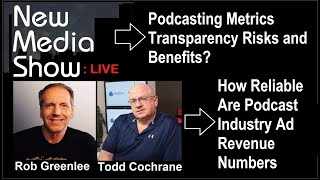
Todd Cochrane and Rob Greenlee question the $2 billion podcast ad market figure, noting that Spotify and YouTube hide advertiser data from creators. They explore the value-for-value model of direct listener payments as an alternative to opaque programmatic ads, and propose crowdsourcing real ad-spend data.
Chapters
Good to go. Oh, I played the wrong one. Not supposed to play that, that's a copyright violation. Neither that one there. What am I doing, Todd? Let's get it right. Todd and Rob in the afternoon.
Hey, afternoon delight with Todd and Rob Greenlee.
Oh yeah. Oh yeah. Here we are. After I hit 3 buttons wrong.
Well, that was an interesting introduction to the show. We went through a few intro songs, didn't we?
Yeah, we did. And I was actually— and it was my fault because I was like looking at things earlier today and I didn't scroll back. But by the way, your audio should be good.
That's good.
Yeah, because there— I've just made it now a checklist item. Yes, we have a checklist here because what I think happened last episode was the recording is great, but the channel coming out to the TriCaster, one channel was down, and that happened before. So you should be good, Rob. And we— yeah.
Yeah. And that raises a bigger question that I've been challenged on a little bit here over the last, I guess the last week or so is around, you know, the recording process that typically podcasters have gotten involved in, right? Is, is pretty complicated, right? I mean, you think about all the things and maybe we talked about this a little bit on last week's episode too, but, you know, Should we really have to continue struggling with things like this, with audio levels just in general? Yeah, with the technology that we have today, we should be able to just do it and it comes out perfect every time.
Well, you know, when you have a cable or a potentiometer that is sticky, yeah, then no amount of AI is going to fix that. You're still going to have If you've got a crispy pot or if you have a sticky, you know, you know, this, this gear's been running, this whole stack has been running for 19 years.
So I know, and that's, that's, that's a potential weakness. Um, I know I built a very elaborate studio when I first started doing audio content, and I was producing it for radio back then, but It was very complicated. You know, I had the, these different switchboards and so I could patch things to different, different systems and things like that. So, I mean, things have definitely gotten better. You know, you think about the technology that we have now is definitely better than it used to be, right? I mean, it was very expensive in the past. And what we've seen is things have gotten inexpensive and, and easier. But it does feel like we're still living in the mid-2000s when it comes to some degree with our— how we do this stuff. And but the technology out there is enabling us. You know, I've been working with a couple of companies, you know, like Numano and some of these that are doing things in a way that is, you know, taking advantage of newer technology and new ways of thinking about audio production and and spatial audio and these more advanced concepts. So anyway, that's just my point. I want to make a big deal about it, but it just seems like it'd be nice that we didn't have to have like 15 different settings in our systems around audio, right?
Well, in all reality, there's not any settings for me, you know, at this point, just, you know, I got it.
I mean, just this RODECaster, Todd, is, you know, I think we talked about this last time. You know, there is a an abundance of settings, so you can turn off everything, right, and not enable anything. But you've got— I've got a volume control on my RODECaster, then I have a volume control in my computer, and then oftentimes there's a volume control on the other end, right?
Yeah.
You know, through your system. And then you've got layers and layers and layers of levels that are—
if I had to do this all over again, I wouldn't do what I have now, you know?
Yeah. And I think that's my bigger point is that There is an easier way of doing this.
Because if you think about it, in order to have you on a monitor and bring you in on a screen with the current setup that I have, I bring you in on the Mac Mini on Zoom. So I've got the audio out of the Mac Mini going to the mixer with a mix minus so we can hear each other. Then it gets even more complicated. So I've got my own audio stream compressor, equalizer, big bottom, all the stuff that's in the current RØDE. But I will admit it doesn't do it as good as the, the $900 box that I have in my rack. But, you know, then there's an audio out that's going over to, you know, the machine that's doing the audio stream. There's an audio out that's going into the box that speeds the live stream so that there's an audio going in there. Then there's an audio out that's going into the recorder because I don't record on the RODECaster. I only record on a Denon recorder in my rack. Then I have an IP-based video going to the other room that records the video along with audio. Yeah, it's complicated, but you know, that's the only way we could do it. If I was going to do this again and I didn't have a TriCaster You know, the problem is it's— I'm invested in it. Just to make a switch now would be a downgrade in video quality for me. You talk to your StreamYard folks, tell them to get NDI adopted, and that would make it a lot easier to use. But it's just—
I mean, that's probably where it's going ultimately, that, that's part of this upgrade technology I'm talking about too. But, you know, a lot of people aren't using NDI yet.
Um, well, it's the, it's the standard for most broadcast stuff now.
It's, you know, for broadcast stuff, right?
Yeah. And it, and most cameras that are on the market today have NDI embedded. That's, you know, that's beyond a, you know, webcam, you know, you're just using a webcam then, of course. But, um, right.
I mean, I mean, the HDMI protocol is still pretty significant. I mean, that's what I'm using to do this is HDMI to USB. Yeah, I think that's far more common now for online creators.
Yeah.
And NDI.
So I've got, well, I don't know. There's a lot. NDI makes it very, very simple if you, you know, if you can afford the equipment to support NDI. That's, you know.
Yeah. And I think that's the question. I mean, so you look at like an ATEM or something like that, that's like a video switcher kind of interface. That's, I think that's more common with online creators these days.
Oh, they're using the little, you know, they, yeah, they, they're just using HDMI. That's all they're using.
So, you know, it's cheaper, smaller version of HDMI as well as the, yeah, as well as USB. You know, that's how they're, they're communicating this. But I agree, I mean, NDI would be a lot better. Uh, actually, you know what's funny about that is the former marketing director for Spreaker for many years when I was working there is now the head of marketing for NDI.
So, uh, NDI is— for NDI, there, that's a company. There's no, no organization. It's actually NDI.
So, well, it's a, it's a company that's focused on making NDI products.
Oh, okay, okay, okay.
Yeah, and it's actually in the name NDI, so I don't know. Yeah, how they got away with that.
It was originally a NewTek protocol, then NewTek got bought by, uh, Viacom or Vi— I don't know. It's— anyway, it's— my box has a different name now. It's not that technically a TriCaster by NewTek anymore. But anyway, it's, it's not here nor there. So I had a little, uh, I'm not caught up. I, you know, I basically, when I was out, I did really kind of tuned out of podcasts for 3 weeks. So I'm now catching up. And, uh, I, I saw something that came across in our Live and Lit that I was like, what is this? And it says, 100 sats from Sam Sethi. This is a test of YouTube video. 100 sats from Sam Sethi. This is a test of YouTube video.
Yeah, I heard. I saw that. And I was like, okay, so he's playing with getting, getting video, embedded video into that platform.
He already has. He's got— I know he has. But here's the thing. He's like, oh, you got an alternate closure tag. Well, that's only live when we're live. For the, for the Lit and Live, and there's no— I'm not linking to an HLS. So basically the discussion happened on the— and again, I gotta listen to it— that happened on the Podcasting 2.0 show. They said, well, since YouTube is going to give podcasters— I don't want to use that word— since YouTube is going to give creators free video, then why don't we tap it essentially steal it, use their bandwidth, and allow videos that are produced on YouTube and PeerTube to be listened to or watched in a podcast app. And I'm like, what the beep? And I'm, you know, I was just— I'm a little— I understand what they're doing, but I don't want to give ground. I think this is a mistake. You know, Blueberry and others have supported video and podcasting for years, and it's just like, okay, they're throwing up the flag and saying that podcast hosting companies can't support video for creators. So since the video is so hot right now, then we're going to backdoor and make a solution that makes it— makes a video on a podcasting app that comes from YouTube. We're going to embed that. We're going to allow people to stream that, that content. Well, you know, here's the thing that my argument is, and I know this is going to be debated. I can get on an airplane and I can watch a video podcast on Apple Podcasts because the media resides on my mobile device. I don't have to have an internet connection. Anytime someone starts talking about needing an internet connection to consume media, you've defeated the ultimate value of podcasting. And here I live in rural America. I drive 3 miles from this house. My cell signal goes to zero.
And I have— I watch, I watch video now on airplanes all the time.
Well, if you have the internet connectivity on the airplane, not all airlines allow you to stream video.
Well, United, all the, all the airlines that I fly on, they, they do.
Yeah, then you're lucky because United doesn't allow streaming video unless if you maybe you're paying for it. I don't pay for internet.
I flew on Delta and I flew on Alaska just in the last week or so, and I was able to watch movies and watch YouTube videos the whole time I was in flight.
And did you pay for that? Wi-Fi connection?
Uh, I have my account through T-Mobile, and T-Mobile gives you a deal with those airlines to provide—
well, on United they don't allow video streaming even on with the T-Mobile deal, but it's probably per airline. Yeah, yeah, different. So my whole point is, and, and Sam made the comment, oh, there's no podcast hosts that support Podcasting 2.0 and video, and I'm like Hello? Last time I checked, our live video that we're doing right now is Podcasting 2.0 compliant. And what I put up in my RSS feed has all the Podcasting 2.0 stuff in it as well. Hello? At least us is doing it. So, you know, there's a hack. That you can use to basically play back video in another app. Now I just wonder how long before, you know, YouTube starts seeing this. Will they put a kibosh to it? I don't know.
I think so. It's just an embedded experience, just like what they're enabling on a website.
So yeah, potentially. So, and then, you know, and again, I'm, I'm of the opinion that That's the last thing I want to do is start encouraging podcasters to go over and set up YouTube channels. You know, it's, uh, come on, let's, let's, uh, let's use the medium for what it is. And maybe I'm just, you know, being grumpy here, but, um, I just, I think it's a bad, it's a bad precedent. Then all of a sudden, podcasters are gonna say, oh, I'm gonna put my audio strictly on, I'm just gonna put my audio and video only on YouTube, I'm a podcaster., and then they get demonetized when they get deplatformed. You know, they don't realize what they're giving up.
Well, I think that's, that's the message that we have to communicate is, well, what's the advantages and disadvantages and, and what's— I mean, because people are going to do what they're going to do. I mean, you're, you have a particular view on it and you have a platform that supports that view. Um, but there's a lot of people out there that don't see it that way.
So, well, but okay, they may not see it that way, but guess what? Yeah, they ain't getting crap for views. I'm, I'm actively looking for shows that are quote unquote breaking out, and it's not. It's the 200 shows or so that, you know, they may even have an Apple Podcast listing, and there's no guarantee of success even on the podcast side. Well, it's a lot easier, let alone on the YouTube side.
So it's Definitely less competition on the podcasting side.
Oh my God, hell yeah.
Yeah, well, that also speaks to the popularity of the platform.
That's fine, you know, and granted it is what it is, but at the same time, you know, people— I don't want people to become disillusioned and thinking that, oh, I'm going to have major success over here. And the majority of people don't. Um, 10,000 stats from Adam Curry. OP3 is open code and stats. I put on most shows up there for advertising. It's a real path forward. 10,000 stats from Adam Curry again. Wow. IAB is initial charge over revenue. What a scam. OP3 for the win. I can't go to an advertiser and say that, um, I have certified statistics from OP3. I don't work. And OP3 is definitely anti-IEB, which it is what it is. But if I go to an advertiser and tell them that my stats are from OP3, they're going to give me more questions asked. So it just doesn't work from—
Yeah, but I'm not sure that's the position that's being taken out there is the advertising.
Well, he says— Adam says OP3 is all open code and stats. I put all my shows up there for advertising. It is a real path forward. From Adam himself. For advertising, it is not a path forward. If I have a podcaster that is only on OP3, I can't sell his shows.
Well, it feels like it's a question more about transparency or Non-transparency is really the question that we're being challenged.
Oh, the podcaster has a choice whether or not he wants his stats to be public or not.
Right. It's a transparency question.
It's not an advertising question. Why do I need to be transparent with my competition? I don't have to be. I only have to be transparent to those that are writing me a check. From a commercial standpoint, I don't have to be transparent to anyone. Show download numbers. Why would I be? Why would I have to be? Again, I take the old school route on this, is that my numbers are my business. And, you know, if you want to have your stats be transparent in public, great. OP3 is the way for you. No problem. But I bet you if you took a survey of 100 podcasters, 95 of them would say, I don't want my stats shown.
So what's the advantage of someone having public disclosure?
Well, I think, I think there's a huge— I think there's a huge risk. What's the risk? The risk is if you're doing advertising and you have two numbers and they're not the same, then what is the question that's going to be asked of you by your advertiser? Oh, we see over here that you got 20— reasonable concern. You got 22,000 downloads showing IAB, but you— I mean, an OP3, but you billed me 26,000. On IAB, and then your response is, well, they're not IAB certified. And the numbers could be opposite too. It could be flipped. I've done my own tests. I have some preliminary data which I won't go into. But again, it goes back to what—
So you have tested the IAB numbers against the OP3? Is that what you're saying?
I would just say I have— I would just say I have data. We'll leave it at that.
Well, I mean, I mean, it's either different or it's the same. Definitely different.
Okay. And I like what John's doing over there. Like, you know, John's a great guy. He's brilliant. Don't get me wrong. John Spurlock, he's a— but at the same time, um, there is, well, we consider the stuff we do with our stats to be proprietary, you know, our secret sauce. That's really, you know, and it's not that secret, but again, there's stuff that we do that others don't. And then was one of the reasons why we had no drop in Apple Podcast numbers.
So the Twitter stream on this topic from James Cridland, um, Included links to other shows like ours that are covering the podcast space, like Buzzsprout, Buzzcast, and the Pod News Weekly Review podcast and the Podcast 2.0. You know, you could click on those links in my, in my Twitter stream and, and be able to see all the stats from all those shows. And it's what's interesting to see in those stats is that the The audience level for pretty much all 3 of those shows is almost identical as far as weekly downloads. So it's around, I think, 1,500 to 1,700, I think, is the number.
Well, it means you got the same people listening to the same show.
Yeah, I mean, I, I, I just thought it was really interesting to see that. So like the Pod News Weekly review, it says downloads in the last 7 days is 1,463, right? And downloads in the last 30 days is 4,618. Um, and, and it has a bunch of stats on where people are listening, what countries, um, Europe, top browsers and referrers and stuff.
So, I mean, a lot of the same stuff, a lot of the same stuff.
So I guess the question is, is that, you know, I think for us to really make an evaluation on this is to compare the numbers and see if the IAB is comparable to this or not. I know that there are a lot of podcast hosts that are probably, you know, looking at their, their budgets, right? And maybe, maybe are more open now to considering not getting certified.
You know, Adam just, uh, just came in with a boost of $5,000. He says, a path, not an answer yet. IB is a trap and a ride to the bottom. Enjoy the ride. Well, here's the thing. Until 30 companies, or how many of the number is, right? Basically use, can consider using OP3 as a standard. It's a non-starter. You know, the battle we had, and this is what has to be understood, the battle we had was the huge discrepancy in numbers, most of it propagated by a couple of companies that were just counting by sixes.
Well, I mean, you've always said that you don't really care what the number is. As long as everyone agrees that it's right, it's based on a principle that will give you— that's right— a fairly verifiable number. I mean, there's always going to be some fluctuations in the numbers. Yeah, probably depends on the bots, depends on your profile of your distribution.
Sure, sure. Profile distribution has its— profile distribution has the biggest spread.
You know, what, what platforms are you getting your your downloads from or your plays from.
Yeah.
And I think that the industry has wanted to have— and this is also another little bit of an undertow around this too, is, is having numbers that are more transparent. Now, my, my blowback on that, I mean, I went through this a little bit with Spreaker when I was working at Spreaker, and maybe we talked about this a little bit last week, is that they were doing the same thing that YouTube was doing. They were displaying, right. What the play numbers were for all the podcasts that were hosted on Spreaker when I started working there. And then I also convinced Francesco over there to make it an option, right? Um, give the creator the option to turn off public stats or to leave it on. And it was their option to actually make that choice because some shows, I, you know, I think if you really think about it from a practical perspective, is that shows that are just getting started are probably less wanting to display the numbers than ones that are established or ones that have been around a while that the podcaster feels confident that sharing those numbers isn't going to embarrass them.
Yeah, right.
Or compromise their, their audience growth. Because, you know, I think we see this on YouTube too, is that this audience confirmation happens around being able see the numbers, right? So shows that get more numbers, uh, shown on the page typically get more viewers because there's more confidence that it's good content, right?
I, I think in the end, the, the thing I have to protect as a company owner is the reputation of the data.
So that— well, in the, the doing what the creator wants too. Because that's true. This is— this should be an optional thing. It shouldn't be required.
I can probably count on one hand the number of requests in the past 5 years we've had for podcasters to turn on their data publicly. And they have a way now they can do that through our— through our media kit. And our media kit updates their numbers every 24 hours, but we provide them a private link that that's not public, that they can share that with media buyers.
Yeah. And this, this op3.dev project is, is based on a prefix, right? Which means that it's— you have to embed a redirect is what I gather is how this will work. And I think you've proven through research in the past that redirects are not always—
oh, you're leaving 5 to 13% of downloads on the table.
So it just doesn't capture data because the transaction can either happen too fast or too slow.
Well, let me know. It's not that. It's about qualifier. It's about qualifying the download. And again, the only way you can qualify, really build a model. And again, it goes back to a model. I get a whole bunch of stuff. I see everything.
Server to server transfer of information is where it breaks down.
Yeah. No, I have a full collection. I know the IP. I know the user agent, I have all that data. And in an instant it passes through, but the challenge becomes when you need to qualify that to make sure that was valid or not. And then because of the nature of a redirect, there's no hosted log data, you know, it's basically a redirect, ping, ping, oh, that's a 1. Well, was it a 1? And what we had to do was take hosted data hosted log data along with the redirect data, marry those up and see where the, where the deltas were, where the deltas were at. And then from that delta, applied a model to the redirect to basically reduce, because if I counted every redirect, the numbers, um, would be way beyond what the download numbers were. So I had to apply a model based on hosted data logs, and that model has to— I validate that model every 30 days, and it has to be tweaked a little bit in order to make sure that technically we have to throw out a lot of stuff. That's why the stats will be 5 to 30, typically 5 to 13% less than a hosted log file will be. So I would encourage the folks over at— John over at OP3 to start grabbing and get some— get Adams and get PodNews and get all their raw log files and then do A/B comparisons on running those log files. And you'll see where the delta is. And there is a— there is— there will be a delta. Because you can never get enough qualifying information from the redirect. That's why you have to throw so much of the redirect stuff out. It's just the way it is. And again, I overqualify downloads too. So I go beyond the IAB spec and always have. And quite frankly, because we— when we went through that initial battle, and Rob, I don't know if you were in those meetings or not. I think you were.
I mean, some of them were in there.
Yeah. And you can, you know, some of that, you know, that what was tried to be shoved through. Oh my God. You know, Angelo at the time was about losing his damn mind. And, you know, he, you know, he wasn't one to cuss too much, but, you know, I heard a few tirades with him being upset because His essential, his essential premises was that they're trying to cheat because my, my—
there was a lot of that going on back then, right?
In my, in my, um, my instructions to him day one when we started building Rob Greenlee's Blueberry stats was I don't care what the number is as long as I would know what the number is. Get rid— log files are okay, so just telling you Log files are the ground truth. Adam just sent another 5,000 sats. He says log files are for beeps. So, but log files are ground truth to what has happened with delivery of that data. And especially if you've got your CDN set up to be able to see all the data. And that's another thing too, is depending on how your CDN reports the download and what's in the log file, we had extra flags turned on and still do to this day, extra stuff turned on so that we could see the chunks of data being served and everything else to be able to recreate the download. And then what's that really for? You know, that's really to get us into within a 2 or 3% range to be able to report to an advertiser. Now with a redirect, you're gonna have no problem. You're going to be 5 to 13% under no matter what. So you'll be, you'll be underreporting anyway if you're doing it for advertising. The key is if.
Yeah, I think that's an important point to make here that is, I think, being lost in the conversation. Um, and, and it's getting, you know, I hate to say, but, you know, some transparency within the industry of how, you know, what methodology is being used to generate even the LP3 numbers.
Um, and well, it's open source, so you can go look at it, right?
So, and so, I mean, if that's happening, then that's terrific.
Well, I'm not—
and I'm not saying the question is, is that are we on a redirect basis or on a prefix basis, are we ever going to be able to achieve the kind of reliable numbers that we have currently with the IAB?
Never. And the only reason my— and again, when we first did our first IV certification, the redirect wasn't certified on the first round. It was too hard. And then we spent a lot of time, spent 2 years trying to figure out, okay, how can I validate this to get it right? And that's where we came up with our model method. And I don't know what PodTrac did. I don't know what other chartable and others have done. I'm assuming they've had to do the same thing. Again, I don't know how they got their, how they got their redirect certified, because I was pretty shocked when PodTrack initially got their redirect certified because we didn't have ours certified. I'm like, how can you do that? Because they're just, you know, lack of data. There's just was too many holes. So we knew that the raw data was no, because I had hosted log and I had This is where the difference is. I had both. I had, and I still collect redirect data today, redirect data, and I have two sets of numbers. The hosted log files is what get processed for the hosting customers, and then those are just used as stats. We use the redirect logs, but again, then they're run through the model, and in the end, they get a number. And I have the, I can do an A/B switch within our admin. Like for my show, I still run the redirect, but I'm hosted so I can go and look at both sets of numbers. And every show is different. Again, it all depends on the makeup of how many Apple Podcasts, how many third-party apps, how many people are doing a web browser. There's this, there's this conglomeration of a formula. It really depends on, cause there's no one case fits all. Now, if your audience and my audience were exactly the same, with exactly the same makeup, the spread should be the same, right?
Yeah, between raw, logged. Okay, if you, if you back up and you look at this from, let's say, a 60,000-foot view, what do you see? And, and I'll speculate on this too, but I'm a little bit, um, unclear about what the goals are of doing this and why, why it's important to, to disclose numbers. I mean, oh, but it plays into the, to the justification that YouTube has had, right, around the goals, numbers being public.
Here's the, here's the goal of the OP3: double fingers to IEB. That's the, that's the goal.
And you had, you have folks that do not like Yeah, but is it really that, or is it just— I think it's part of it, this, this kind of mindless pursuit of transparency.
I think it's 50%. They don't— people don't like the IAB, and that's understandable. It's expensive to be—
to maintain it. They're never going to replace the IAB with this because no, they'll never— this is a prefix standard, right? This is a prefix methodology.
But you can get a prefix qualified under IAB.
Well, you can, right? But it's not the primary. It's, it's not like the OP-3 is going to be adopted by Blueberry or Lipson as their primary metric.
No, no, no.
I mean, is— that's the question. Is that the goal here, is to achieve that?
Well, I'm sure they want everyone to use OP-3, but they don't know what they're asking for from a, you know, you start doing 300 to 400 million downloads a month. And that, you know, like I say, my AWS bill, I have— there's no more credit card can handle that. It's a bank transfer.
But Todd, it feels like this OP3 project is something separate from that.
Oh, it is.
It's, you know, and again, it's not something— I mean, its reason for existence is, in my view, is more of like this ideology around transparency?
Well, I think that's probably 50% of it.
Okay, well then they're not telling us the other half.
Well, you know, it's, it's, to me it's implied because certain, certain parties— James doesn't like the IAB.
Well, then they should just come out and say that then, that what the goal of this organization is, is to create an open Well, they've said that.
Gas metrics.
They've said that. Standard. Actual, an actual standard, not guidelines which the IAB has put out there that—
But who sets the standard, John?
You know. Well, I think we're closer as an industry to coming up with a standard than we were back when the IAB guidelines was established.
But just remember that the IAB is not a standard. It's, it's a, it's a, it's a guideline, right?
Right. But should we be as an industry moving towards a standard, not a guideline?
You know, I think at this point, I think Adam's— Adam just sent us another boost. 20 years of podcasting and we're still arguing about downloads, B2B forever.
Well, you know, and okay, so, well, and we're under a threat right now because a lot A lot of people want to, want to get rid of the download metric entirely.
I mean, yeah, they want to get rid of it completely.
That was a topic on the Media Roundtable with, um, yeah, Stephen Goldstein and, and Dan Granger just last week. Yeah. Is it, is it time for us to move on and beyond the download? Right. Which takes us into the realm, well, how's this media being delivered? It's being delivered as a stream, right? And if that's a stream, then that plays into a different kind of media delivery.
So if that's— if we move to the stream God help us, then you completely— and maybe it's in 2023, maybe it's not an issue no more. Maybe enough people have connectivity, but they don't live where I live. And where there is no connectivity in places, shocking. And yes, that's probably 50 or 60% of the United States landmass, but probably 1% of the people that occupy it. Because, you know, everyone is centered around metropolitan areas and have great internet.
Well, Todd, if Elon Musk gets his way, well, Starlink is going to make internet access ubiquitous.
Well, it already has. It fixed my issue at home, right? But it doesn't fix the situation when I drive out of my driveway and for 7 miles there's no signal. Well, it could. Right. Well, they could. Yeah. If he connects it to— I think they could change it for sure.
I think Elon was quoted in saying that if he needs to make a mobile phone, he would.
Yeah, he could. But again, I don't think it's arguing about downloads. And again, only— here's the thing too, that's all, all things aside, I do an IV certification and probably spend upwards of $20,000 a year for my membership and my recertification. For about 3 or 4% of my user base because the rest of them don't give a crap. But it's that 3 or 4% that are my high-end users that need good reporting to go back to their advertisers and say, hey, you know, this month I got 82,000 downloads. So who am I? You know, I'm a realist here, you know.
Yeah, I think it's interesting that all three of these podcasts that they sent links to, and I've seen the numbers for even Lipson's podcast, the feed, and I don't think any of the podcast topic shows are much over—
So Lipson's actually using OP3?
No, no, no, no. I've seen their numbers in the past.
Um, our, our show at Blueberry, the Podcast Insider Show, is, yeah, maybe, maybe tops 2,000.
Yeah, that's, that's kind of what I was going to say. I haven't seen any of these shows that are bigger than, yeah, 2,000.
Um, yeah, the Company Show, I, I, you know, that week.
Yeah, now granted, they're weekly shows, right? Now the Pod News Daily show has had 11,000 in the last 7 days. That's, that's good numbers, but that's 5 days a week.
Yeah, but that's still, still good numbers.
Yeah, it is. I mean, if you split that number in, well, in half, right? Um, I mean, if it's a 7-day-a-week show, if you split that up over 7, or actually it's probably 5 episodes. So to be about $2,000 a day, right? Or $2,000 a week?
No. Yeah, per episode. But I also have a fiduciary duty to my company to make sure that we're serving our customers in what I feel is their best interest. We, right there, we've made it available so that any Blueberry customer using PowerPress or our dashboard can opt into OP3. They can use it, no problem. We haven't stopped anybody.
It's a prefix.
It's a prefix. It's just a prefix, right? They're free to use it, but it doesn't mean I have to endorse it. I have an OP3 section in our Podcast 2.0 introduction. It's not a negative in there. I explain what it is. And, but again, I want to make sure that because I've been so, you know, my perspective is just a little bit tainted in that I've been involved in audits, other companies' audits, right? And audited their numbers, which end up being very—
You've been the bearer of bad news.
Not only the bearer of bad news, but if I had— if they could have shot me dead, they would have filled me with 9mm holes in their office. Literally. I've had companies give their double finger to me saying, no, you cannot have our data for audit. And the advertiser says, yes, you will, or we will cut you off. Well, now, do you think that makes me the most popular person in the room? No. Especially when the, when the results of that audit requires that company to write a big smoking large check back to the media buyer. Right. And that was one of the— and why? Why? Because I had a trusted system. We took this attitude and we don't care what the number is, as long as we know what the number is. Never overhyped data. I don't have to report my download numbers to GoDaddy. My sponsorship. They've never asked me ever for a download report. All they care about is conversions. It's all they care about. And in the end, that's their metric for this show, for my show, my tech show. And they just— matter of fact, they just made some changes to my deals that are not necessarily— I feel was a good move. So I do have a concern about what's going to happen with them going forward. So I'm going to have to work double hard to make my numbers with, with them. But at the same time, you know, it's been a pretty long run since 2005, so I can't complain. So the value for value model, you know, is definitely one that— but I've also, I've had to split hairs because I've always had an advertiser, never been faced with not having an advertiser. So what happens if I— let's say they pull the plug, then what is— what am I left with? Me for me, you know, or go out and find another advertiser for the show, which should not be an issue. But again, do I want to make that transition at that point? Um, it would take a lot of work to replace that income with B4B. It would be a lot of work, but maybe the audience would support it, you know, because they know now there's not a sponsor, there's no, um, AKA, um, you know, they don't— they know I'm gonna make my, my budget every month. They know I'm gonna keep the lights on, keep the insurance paid, all that stuff. So, you know, I might have to downsize may not have to have this beautiful office I have anymore. Might have to work from home, but you know, yeah, that's life, right?
Yeah, it's, it's not such a bad outcome working from home.
No, you know, except again, Starlink is my only option, and streaming a show on Starlink is not necessarily proven to be the best choice, right? Yeah, yeah.
So it does have some occasional cutouts.
Uh, from what I'm— so maybe, maybe no more live. Maybe I have to go to just recording a show, you know, and putting it out. But you know, yeah, it's always a potential as well. 5150 sats from Matt, enjoying the show. I'm glad you are, Matt. By the way, yes, we are lit live with those great new beautiful apps from podcastapps.com. You can get in on the action and be part of this boosting too. I don't know why we can't hear the boost coming in. Do I have something Oh, I think I know what's going on. We should be able to hear the boost come from now on. So, but, you know, again, I can't talk enough authoritative on it, but this whole thing of incorporating YouTube videos in a podcasting app, I'm just— this makes my skin crawl a little bit.
I mean, I think it makes sense for some creators that want to, want to do it. I mean, I don't see any reason why they shouldn't be able to do it. I just, um, if that's what their chosen distribution method is for video, yeah, I mean, it would be— it, I think it would be best.
And they don't have to pay for that, those together. They don't have to pay for bandwidth. Uh, right.
But let's— that's the reason podcasts are over there already, uh, or or video shows are over there already is because it was too expensive to host video on a podcast platform.
Well, we have customers doing it and they don't— oh yeah, yeah, you know, it's— but again, you know, they— we always caution, you know, full disclosure, always caution shows they're starting to do video because I'm like, listen, you get real popular, you know, your, your per gigabyte cost can add up be quick.
Yeah. And you got to keep your, probably your video files fairly compressed if you want to keep the cost down.
Yeah. You know, you only can compress them so far.
Right before you start eroding quality.
Yeah. Yeah.
Right. Yeah. There's no question. Well, Todd, there's been, and I think maybe we covered it a little bit last week, but there's definitely some FUD. If you don't know what the term FUD means, it's fear, uncertainty, and doubt. About the podcasting space.
Did you see Twit?
What happened over there? I saw that whole thing with Twit. Yeah, man.
Yeah. Um, so what's interesting to me about this, and again, thank goodness my business is not solely driven by advertising revenue, it's, it's a component, it's a set and forget component for us, luckily. Mostly. Um, oh, and I do have some— maybe early next year we're gonna have something cool to announce in regards to programmatic and transcripts. That's all I'm going to say. I'll let you do it.
I also heard somebody say here online that they think that programmatic advertising is is dying or it's dead or something like that. I've heard that, that comment too.
It's up. CPMs are maintaining, so— but CPMs definitely is a longevity play because CPMs start out lower when you're new and then raise over time. It's kind of weird how it works. This is what we've seen as you prove yourself, right? Yeah, but there is definitely— there's, there's some people that are definitely concerned.
Yeah, I keep hearing, you know, even James Cridland says, um, you know, even with the news about Spotify and, and, you know, and now Twit, you know, are— is in trouble. Well, I don't know that it's safe to say that everybody is in trouble that's in the podcasting space. I, I think that there's just been a, you know, economic impact here. Well, it's been—
I think that's causing people to get laid off, but that's not the end of the— there's an economic impact to advertising, right?
And you built your whole business advertising.
Years. Yeah.
Really have an impact. That's right. Yep. And that's, that's what a lot of, uh, especially podcast hosting companies shifted over the last 2 years into really embracing advertising. And they invested a lot of money in it. They invested a lot of effort into the advertising side. And I always thought that, you know, that was going to be pretty vulnerable to economic conditions. Of course.
And, and it was the story problem with the story of Raw Voice Blueberry. When we started, we are 100% media company with a stats measurement system. Right. And thank God, you know, I was living and breathing this stuff 20 hours a day. Literally, I was— I wasn't sleeping for years. And I was on this, right? And we were small. We only had one employee that was actually full-time getting paid. We were subleasing an office. The cash flow was good, but I kept seeing all of a sudden, about the time Corolla came on the scene with his podcasts. I started watching the advertising dollars. My budgets were getting smaller and smaller on a quarterly basis, and his was getting bigger, and the bigger shows were getting the bigger, just bigger, the bigger spread of the money. And I basically said, oh, we are in trouble. We are a one-trick pony. We are going, we are, we are going to go the way of the dinosaur if we don't diversify. So, so that was the time we started the journey of monetizing stats, starting hosting. You know, this is why we were, you know, we are 6 years behind Libsyn. We were a long ways behind Libsyn, right? And you know, the question I got asked by some of the folks over there at that time, why are you becoming a hosting company? I said, because the advertising is going down.. And we didn't have— we were older. We weren't Hollywood. We weren't New York. You know, I remember the first time we went to New York to talk to ad buyers. And I went into an office, this gal brought me in, I did the whole— and matter of fact, I think Adam and his team had been there the week before and bought them something super nice because the gal told me, well, I had brought them macadamia chocolate nuts. And I guess the team, whoever was in there a week before, had brought them iPods. So Yeah, okay. You know, pay-to-play type of thing. You know, my chocolate macadamia nuts didn't go too far. And I had a— I think it was a Macy's suit. And, you know, it was a stretch. It was a stretch for us, for me to go to Hawaii, to New York and do the circuit, right? And I remember being walked out of the office and the— The gal that was in charge of the agency, she grabbed my suit jacket, pinched it right about my shoulder level. Yeah. And she says, don't ever come in here. And she called it a JCPenney suit. Don't ever come in here and present to my team again with a JCPenney suit. And I thought, I thought, oh man. So what did I do? You know, I spent the big bucks, went to Brooks Brothers, bought a nice suit. Still, still in my closet. And when I went to New York, Brooks Brothers, when I was on the West Coast, it was a polo shirt, you know, they didn't care. And to me, it was like, we're at that time, we're fighting the same stupid battle that seems to be going on today. Explain your numbers, explain your numbers. You know, they're not validated. They're not, you know, we don't have any, any, any you couldn't— they were used to having all this information even back then. They're used to having the client-side data, and of course we didn't have the client-side data. We still don't have the client-side data. So therein lies the, the, the issue.
What happened to you, Rob? Oh, I'm— I'm just popped up a, a tweet that Sam Sethi made and just wanted to kind of Oh, it's absolutely true.
The systemic problem with podcast advertising is not a measure of— this has been known since the beginning of time. This is nothing new. A download is not a listen unless you measure time listened. But here's the thing, Sam. There is a way. There is a formula that you can use to be able to determine if someone's actually listening to a podcast. Over time. But you need about 3 months worth of data, consistent data month to month, to be able to see what size of an audience is, whether or not the show is still continuing to be automatically downloaded. It's not perfect, but it's a system we've used for 18, 19 years, and I can get the numbers damn close.
And I don't go in— that's the bigger takeaway here is I I think making a statement that podcast advertising, it's not measurable or accountable, probably not, not, not entirely accurate. Right. The system has been all these— all the advertisers wouldn't have come in and, and, and supported podcasts. But guess what? It's really not. I mean, really, at the end of the day, it's not really about measurement or accountability to the advertiser. What's really important to the advertisers is ROI.
No, what— and here's the thing. This is where— well, this is why we built the retention graph. I can tell. Okay, see, this is— that statement to me is just like, sorry, Sam, you need to start talking to some companies and seeing how we're actually doing this. So let me give the example. We have the ability. Okay, so if someone is followed or subscribed to a podcast, and they are actively listening. That download happens immediately as soon as that RSS hits the street, right? It's going to happen. That's going to be 70, 75%. And now as years go on, it's less. So it gives my data even better data. 60%, 65% that's downloaded in that first 12, 18 hours, whatever it may be. Retention data if you have the right CDN and if you have the right constraint set, you can see on certain apps when they hit play and the data is chunked out. Some apps, when you hit play, just, it gives it to you all. So it looks like a download. But on some apps, you can see where they quit, where the thing rolls off. Right. And again, it's a small portion, of the active plays that I get to see that data. And we're talking 7, maybe 8% of, of the total, like the Apple, right, um, podcast stuff, right? Well, and again, depends on the app, and I'm not going to talk about that. Do your own research. And the— and I can see where people, how long they're listening where they drop off, and then taking into account, okay, let's say they have Apple Podcasts, which the majority of shows do, at least 50%, and we follow the rules as published by Apple Podcasts to know that after 3, 5, whatever the number of episodes is, they'll quit automatically downloading the show. Mm-hmm. Now, if you have intelligence brought into your stats where you can see all of a sudden, oh, We just had 10 downloads of catch-up. Does that mean that all 10 of those episodes are going to be listened to? Probably not. But we can tell when someone has hit the button again and said, hey, give me all these downloads that I missed. Do they go back and listen? No. But again, if you watch over a long enough period, if you, if you average the amount of downloads plays retention data over a long enough period. And Mike, I mean, you still have the screen up, just in case you forgot.
Well, no, I was gonna talk about the next thing. Okay. Um, on here where Lou talks about, um, how, how programmatic advertising is dead and why there is a flight to quality content.
Not true.
It's absolutely not true. Well, Well, what's your definition of quality content? You know, that's always kind of a red herring to me. Yeah, you're, you're assuming your view of what quality content is, right? You're not really taking into account what audiences think is quality content. It may be different than your view.
If you look at a long enough period of a show, and I built into our campaign advertising management system, CAMS, I can look at a show, I can take how many ever episodes I set the— let's say I set the 4 months and I just do a simple math equation. Take all the downloads, add them up, divide by the number of episodes, and I get a pretty close average. Mm-hmm. Let's say that show's doing 5,000 downloads, plays per episode. When I do it, when I do an advertising campaign, I put that show down for $5,000 per episode for that campaign. If they deliver $4,800, I bill for $4,800. If they bill for $5,200, I bill for $5,200. But what happens is, is because we've looked at a long and big enough spread of time for a show, we have a pretty good feeling of where it's going to land. And of course, the media buyer is going to come back. And if performance isn't where it needs to be, I'm not so concerned about going look, looking at the listens and plays, I go look at the content. How is the content? How is the run done? Does audience actually match? That's why we have all of our podcasters do a listener survey. So I have stats, I have listener demographic data, and tied it all together. I have this trifecta of information that gives me a pretty good idea what a show is capable of doing. Is it perfect? Nope, don't claim it to be perfect. But as long as we meet performance, that's all that matters. It's all that matters. If the advertisers come back, says you hit my CPA, I'm gonna pay you CPM, but as long as you hit my CPA, we're happy. Or they come back and say, hey, we're underperforming. Give me a make-good. I've never, ever, ever, ever in 19 years given a make-good. I deny them. I say no. They just didn't resonate. It's not my fault. We did all— so when someone says what he says, it's technically true. But those of us been in space long enough, we know the history of shows. We look at the data and we're able to make educated decisions on, okay, does that show really appear to have 5,000 listeners listening every episode? And if the numbers are all over the place, well, that average is going to be lower anyway. Right. Right. And that's all I guarantee.
And I do think that we, uh, as an industry, um, have been progressively moving towards this model like what's been in radio for many years. And that's radio thought of themselves— really, their customers were their advertisers, right? And so they were going to do everything that the advertisers told them to do because then they felt like that was going to unlock more budget for them.
Right.
So there was a monetary connection between catering to everything that the advertiser wants, uh, versus catering to everything that the audience or the content creator wants or is willing to do. So you have this kind of negotiation that's been going on, and this is a, this was a little bit of a thread that happened between, uh, myself and Heather Osgood, because she made this comment about transparency in the podcasting advertising market, right? And my comment to her was, as well, the advertisers want the podcasters to have ultimate transparency on everything, right? But they're not willing to have any transparency back around performance.
Well, I'm going to be honest with you. They— I can count on one hand the number of times that the advertisers come back and told me the exact performance, what is working and what isn't working.
So they're— for the advertising industry to hold, to force the, the podcasting industry to make all these accommodations, they have to be willing to make some accommodations on their side. They don't want to because that's going to put them in a position where they're—
they could be asked for higher CPMs. And another thing too is, oh man, man, oh man, this opens up some history.
Oh, well, it opens a Pandora's box that many people that look at one side of this issue.
Yeah.
Of transparency on the content creator side and not hold the advertisers accountable.
And that's one of the challenges. 9 out of 10 times I'll ask an advertiser, what is your— let's say you spend $50,000. What do you consider success on this campaign? And you spent $50,000. And again, again, a lot of this has been direct response. And then we see now more lift campaigns, of course, but let's just talk about direct response. We'll leave the lift campaigns out. What is your measurement of success? And you know, 90% of the time they would never tell me. They would never tell me, if we get, if we get 200 activations, we're happy on a $50,000 spend. They would never tell me that. Citrix GoToMeeting made the mistake of telling me one time what our performance was and how we were beating. Man, I took that to the bank. So Right. This goes way back. It— before— oh, someone's gonna have to go back. And if these numbers are off by $50, $60, then, you know, don't sue me. But it's— I published it somewhere in my archive somewhere. But at the time, print was getting them— they were— they would have to spend like $230 or something like that to get a Citrix GoToMeeting customer via a print ad, print, television, radio. I was delivering customers at $27. Right. So if they spent $1,000, which they weren't, they were spending $500,000 to $1 million a quarter. I was delivering them customers at $27. And, you know, they got pretty greedy with that to the point where the performance was so high, the media buyer was getting such huge bonuses, they had to reengage with another media buyer because Citrix had a performance clause that they had to pay the media buyers out this massive— they were making more money than we were, I'm sure. And they changed media buyers, they changed the tactics so that they really killed— I mean, we were— it was, Rob, it was a money printing machine. It was amazing. I mean, it was freaking amazing. And that's the only time that I was actually told, this is what you're delivering me customers for compared to X. I would love, I would love to hear from anybody else that's actually gotten a real number from a marketer on what the response is. So we were delivering 9, 10 times better performance than print and radio, man, we went to town with that, right? That was right in our deck.
And it got us— that's not what they, they want. They want to take advantage of this medium, get as much ROI as they can, and not have to be accountable for massive windfalls.
That's right. From— right. So, you know, in my opinion, you don't get companies spending $1 million, $2 million, $3 million a quarter and they're not seeing massive success. These folks aren't stupid, right? And but yet Who ends up getting screwed?
The creator. The content creator always gets screwed. Always. It's just like the farmer growing produce always gets screwed by the grocery store. Always gets screwed. Right? Right. It's the same thing. It's the one with the money is the one that usually has the power.
So let's flip this now. All right. And I know Adam and the rest are like, stop.
Well, there's two sides of this argument.
And so, yeah, so now, all right, everyone's heard what we've said. This is— we've talked about this on the show before. This is no new— this is no new territory for us. For years, actually. What, what the new territory is, all right, let's say you're a small show and you're getting— let's say, let's say you're making $250 a month. On advertising. These 10,000 downloads, you're making $250. Or let's say you have 1,000 listeners and you would only make $25 on CPM. Going to value for value route and doing it correctly and asking for a donation for, again, time, talent, or treasure, giving back— and I know everybody hates the word donation— giving value back for value given. If you focus on that, small shows will do much better over the long term than they'll ever make from advertising dollars, ever, if they really focus on that. Now, a show that's got 100,000 Well, they could probably convert it, but it's hard to take yourself away from the nipple, you know, because if you're getting $25,000 a month for a single advertising deal, it's pretty hard to pull yourself away from, from the boobie because, right, it's not hard. But if advertising dollars are going away, There is a way. Yeah, there's an alternative, right? Okay, all Podcasting 2.0 people, raise your fists. Come on, I just gave you the thing.
So, well, and Todd, there's a reason why the podcast industry somewhat to some degree has capped out at $2 billion, right?
Exactly. Is it, um, I know exactly why.
Is it Is it because of our transparency? Is it because the download is not a good metric? Is it— I mean, what is the rationale? This is all catering to what the advertisers want, which is right, which is a gatekeeper to their control over, um, um, the CPMs that also controls their ROI.
Why haven't we gone beyond $2 billion? I'm gonna say 3 words. I know it's media buyers. Maybe it's 4 words. Media buyers are lazy. They don't— they're not willing to take risks to monetize the 40% of the podcasters at the top that want to be monetized. They would rather run 10 ads and some top-level program and cause everyone to go 30 seconds advanced on their phone to skip the ads or use the new app that's going to bypass the ads. They would rather do that than work and say, okay, Todd, put 500 shows on an ad buy or 1,000.
They won't. They won't. And there really isn't any reason why they shouldn't.
They're lazy. It's just— it's also ego. All right. So can you imagine like someone, some 22-year-old that's in charge of account goes into his boss and said, here's the 500 shows we're going to run on a campaign. And the boss looks at the list and he says, oh, I know the first 3.
Right.
Who the hell heard of the other ones? Who the hell are these folks?
Take them off. Right. And transparency of numbers through this OP3 is not going to magically solve it.
Won't fix that at all. Right.
You know, they're so, you know, it could contribute to advertisers getting access to data, but most of these advertisers are buying off of buying platforms that have access to the data.
So, so it's, you know, the reason we're never going to get beyond $2 billion and probably going down is because right now it is, I'm sure, right, is because media buyers don't want to dig in the pool. So I— this is why any podcaster that's listening to this podcast, if you have 10,000 or fewer listeners, you better be all in on value for value. Yeah. Unless you have your own deal where you're promoting your own product or service. And again, we understand that 50% of you could care less to make any money to begin with, which is fine too, right?
And oftentimes people that complain about this, um, on, on the advertising stuff don't really understand how the advertising stuff works anyway. Um, so, and what's, what's driving these these decisions on the part of the podcaster and the ad agency and then the actual brand, what the dynamic is between all those and how really unfair to the content creator it typically is. And we're not focused on that because we're always focused on trying to cater to, you know, placating these, these ad buyers that are—
that are playing us. It goes back to what I said more than a year ago.
Right.
All right. If you want to— if podcasters really want to control their destiny and be able to potentially evoke some dollars out of someone, get a coalition together and leave Spotify. Leave. Take 100,000 shows off Spotify tomorrow. All of you disconnect. That may not do anything, but it definitely would be newsworthy.
Creators always get screwed, right? And I know people keep raising this issue around Spotify. It's like, well, do we want podcasters to get treated like the music artists?
No, they don't. They don't even want to get— I know they don't even want to give Go ahead, Todd. They don't even— okay, so on the Podcasting 2.0 show, Adam and Dave were talking about an artist that disclosed their royalty check from Spotify is like $78 for the year, right? And the show was in Adam's Boostagram ball. And the number of boosts that they got in one episode was like 4 times the amount of money they made in a single year from Spotify. Spotify does not care about creators, and this is what podcasters and anyone that creates content needs to wake the hell up. YouTube doesn't care about you either. They are going to run ads against your content for people that aren't paying. They're going to run ads that you'll never know what was run. And you may have a disagreement with the ad that was run against your content. You'll never know. You will never know. And they don't care about you. They care about controlling your content and keeping eyeballs on their platform. That's all they care about. Yeah.
And until people wake up and understand this— I think most content creators understand that's the relationship that they have. It's just, it's hard to translate that into some sort of proactive action that would be more beneficial to them given the power that these platforms have over creators. Everybody wants to be popular and make a million bucks on YouTube. And that's what drives us. It's the same thing that's been going on in podcasting for a long time. It's the appeal of popularity, right? It's the appeal of stardom. It's the appeal of, it's like, you know, you shouldn't, you know, you don't need to get paid by the platform because what the platform is giving to you is Peanuts, fame, and, and maybe—
oh yeah, a very few fortune. Yeah, right. And not everyone can be a— what is his name? Mr. Bean or whatever his name is. I don't, I don't know. MrBeast. MrBeast. Yeah, no one— very few people. And MrBeast has about 80 people working for him, so, you know, he's got his own headaches.
So, but if you watch, there is a documentary on YouTube about how MrBeast got started, and it's very interesting. Because it talks about a kind of like a very grassroots beginning for him. I mean, he started out as like a 14-year-old creating stupid videos on YouTube, right? And grew into this power creator that was basically build his whole platform on this concept of giving back to others, right? Whether it be money, whether it be food, whether it be anything, and helping other people. So he would actually just throw money at people on his show, uh, or give them food, or he would, he would basically— he did a whole episode about going in and buying all of the food in a grocery store and cleaning all the shelves out of this grocery store and taking it to a food bank. No way. That's, that's how he built his popularity, was based on that kind of stuff.
Yeah, we'll work, we'll work for food here, we'll take, uh, Ruth's Chris gift certificates.
And his first video that turned viral was him walking out to a homeless man that had a sign up, right, begging for, for $2, whatever. And MrBeast gave this this homeless person an envelope full of $10,000. And this homeless guy just like loved all over him, and, and MrBeast had a big smile on his face. And, and so that's what— that's really where— which is really fascinating if you think about it. It's, it's getting back to, you know, this very human connection.
Adam just makes a great comment. 5,000 sats and another Boostagram. I would love for someone, anyone, to show me the 2 billion in podcasting. I can't get past 500 million. You know what?
Mm-hmm. You know that. Well, that's actually a very good point, Adam. It is. I don't know that there is any— I mean, if you really think about it, most of these numbers are estimates.
Well, there's no consolidation of reporting. Well, someone has that number. I'll tell you who has it. Really? Anyone that's an IAB member has to submit their advertising sales report.
Oh, IAB would have it, right?
But not everybody is a member of IAB though. Well, the majority of hosting companies are, maybe not production companies. So we'd have to look at that. Spotify is not, I don't think, as a member. But there would be a consolidated report.
But I mean, it would give you a ballpark, but—
and that's probably likely. And that's— and if they don't lie, because the more money you've made, the higher your renewal fee is, right? They're actually probably going to underestimate it, probably, right? You know, that's why they're switching. Next year you have to actually report revenue. That's part your revenue as far as your membership.
So, well, that— I mean, how is that verifiable anyway?
Uh, you know, send in tax returns or something? I don't know. Our tax returns usually are like 6 months late because we never get them in on time. Um, yeah, I— you know, it— you, you have something there, you know, because I've often—
there was some times I did some I did some spreadsheet work and I mean, because oftentimes these numbers that we hear about the advertising market are survey data.
FM, right? You know what FM is?
Beeping magic.
Yeah.
Beep magic. Magic. Right. I think there's another word, but I'm not going to use it.
Right, right. So, you know, $500 million?
I'd probably between 5 and 1, you know. Right. And why is there such a big discrepancy between radio and podcasting on that?
Because the radio is local. All radio advertising here is local. Very rarely do I, you know, when I rarely turn into commercial radio, it's about the car dealership down the street. Of these little radio stations are making enough money to keep their staff employed. So, you know, they're, they're probably running a million, 2 million per, per station, little tiny stations.
And there's, there's less metrics on radio than there is about podcasts. No metrics. So it's, you know, it's like this— it's always been this funny thing about— yeah, the contrast, or it helped a higher standard, right? It's like we're thought of as like a like a sponsored link ad on Google versus radio, which kind of gives this wide berth of, of survey data. I mean, I've— I think I've mentioned on the show before, but I, I did one of those diaries for Nielsen.
Yeah, me too.
Got your $3. Yeah, I think it was $2.
I think, yeah, it was inflationary, right? So tell you what, tell you what we're gonna do. It's time. We'll use the New Media Show email address. I know, I know a lot of you are listening that are out there in podcast earning money's land. You'll never admit it, but we, we see, uh, where, you know, people from New York and in California are two of our, you know, biggest, uh, biggest listening regions. Uh, get yourself a fake Gmail account. Now, someone— you're going to risk a little something here, um, but todd@newmediashow.com, and get yourself a fake Gmail account or even a Proton account, something where, you know, where we can't track you, and send this anonymous email with, uh, with a company name and a number. And, uh, I won't— we won't announce the the companies by name, we'll add everything up and come up with a number. Now don't lie to boost the numbers because one of you knuckleheads will send me a billion dollars for a certain company and you'll have lied and we'll exclude that. Don't lie. Tell us what your real annual advertising numbers are. And, uh, or Rob, you can send, you know, you maybe better go to Rob and Rob can anonymize the data. That way you're not sending this to me, and, and Rob can anonymize the data and, uh, and give us, give us, uh, give us a total. I think that would be fun to do, uh, but, you know, I think, you know, it's a certain amount of trust here.
Yeah, send them to Rob because, you know, Rob doesn't work for nobody right now.
Send them to me, right? Right, send them to you, you know. Right. But, uh, I know it's— people are gonna be too scared to do that. Yeah. Yeah, we wouldn't reveal it though, but we do like our secret sources.
We don't, we don't have too many. The numbers would be—
I think they're quite a bit lower than 2 billion. I believe so too.
I think they're much lower. There's a reason why it's, it's never gotten much over 2 billion in like the 4 years that they've made proclamations that it was going to.
Right. But if you listen to certain shows though, you know, they're definitely putting 7 to 10 ads in these episodes and I'm sure they're just amazingly effective.
Well, that's the other end of the spectrum, right? Is that the big shows are just getting either completely bought out or they have too many ads in there. Yeah, too many. That's what's driving this, this also this metric in the research that's showing that there's increasing sensitivity on the part of listeners to add load.
But at the same time, it's going to drive— and matter of fact, I didn't get a chance. I had hardcore meetings all day. Did anybody listen to Sounds Profitable's thing today?
They were doing it at the same time that we're doing this.
Oh, okay. Well, we'll have to go back and that'll be a good one for next week. Right. There's probably some— there'll probably be some slides out on the internet at this point. But yeah, $2 billion. I, again, most of my business is service business. I'm, thank God, I'm not reliant on advertising. I wish, you know, I wish my advertising was a little higher. Just like anything else when you're trying to drive more revenue, but I'm pretty happy with our programmatic where it's at now. And contrary to what everyone's saying, I have not seen a race to the bottom yet. So because this programmatic stuff is running in content that would basically, you'll never hear on as a host endorsed. It just never is going to make it into host endorsed.
And I think that the commenting about advertising and podcasting is, I think we should all kind of back up and get a, get a view on this that's realistic because we've been playing this advertising game in podcasting for, I don't know how many years now, Todd. 19. You know, and if it, if it's constantly stalling out and it's not progressing, all this kind of stuff, maybe it's just not really meant to be as big as everybody would like it to be.
There we go.
Value for value, baby. Right. So there needs to be an alternative. And I've had this, this thought myself for many years is that there needs to be something else.
Right.
You can't, it just doesn't, it's not a natural fit advertising with podcasting. There's not a lot of options. It's kind of like oil and water trying to blend them together.
It's, its ideology is completely contrary to each other. Yeah, it's, you know, it's all about now. It's, you know, I run a PayPal on my website since, since I started the show, so, you know, it brings in some dollars, but it doesn't, you know, it doesn't pay the bills, you know.
So I think this, this value-for-value kind of model You know, it, it could be the model, the, the foundation and the early kind of foundation for something new in podcasting that could be different.
Rob, uh, come on now, you, you haven't obviously been listening to No Agenda recently or any of those.
Well, that's not my, my, my point here. My point is, is that that is an emerging model. Yeah. That could replace advertising in this medium and/or augmented or be in addition, and it will continue. I don't think it's widespread yet.
I think it's still early days for value for value. I think what it is is making, you know, the education piece on this is— Yeah, it's daunting. Yeah, it's daunting.
Um, I think the— I, I—
and that's what's holding it back. Don't get me wrong, you know, I love the boosts that come in, but at the same time, you know, I think that the majority of people, even though the processing fees suck, you know, are used to doing fiat donations with PayPal or credit card or something like that. And I think, you know, it's, it's a dual head model. If you have both capabilities to get fiat funds, and fiat again is dollars or pesos or yen or, you know, some national currency, conventional currency. Yeah, um, a combination of that and a combination of value for value in strictly in regards to Satoshis. You know, Dave Hamilton and I had a discussion a couple of, maybe it's been 2 months ago, and we talked about this quite a bit in a call. And Dave and I, you know, I love the value for value program with boosts and stuff like that. The engagement is, is fantastic. You look what we've happened here in the show today. You know, Adam's been giving us feedback, Matt's been giving us feedback, we got feedback from the last show. Um, that makes it engaging and that the engagement's worth more than the value of the sats that have come in. I haven't run the numbers at Blueberry recently. I need to do so and go back and see how much people have earned up to date from, from, from, from basically from Boost and streaming stats. But if we convert enough of the listening audience to a modern podcast app and we get them to start, I can, as I've said to my tech audience at Geekness Central, If every one of them gave me just $2 a month, just 2, well, 50% of them gave me $2 a month. Rob, holy shit, I would, I would be, I'd be able to hire 5 people. Yeah, just 2 bucks.
Yeah, doesn't take much. But again, on a per listener basis, and add up to a lot if you have a decent-sized audience.
And again, it's about And Adam just hit us again, another 5,000 sats. The V4V only works if you create content of value. That's not a big group compared to spray and pray programmatic advertising. That's true. Programmatic advertising is definitely spray and pray. We know that. Yeah, but if I can— if podcasters are making more from spray and pray than they are convincing their audience to give back in value. But the thing is, we have to train a generation of podcasters that don't be afraid to ask for this value back—
time, talent, treasure. Well, and, and I don't know if you've noticed, Todd, but the Bitcoin value has been going up.
Oh yeah, my— I was actually looking at my, uh, I've doubled, I think, in my, my sat holdings right now, or about, about double.
Which is going to make it interesting for this tax year. Well, you don't have to pay on unrealized gains quite yet, so—
no, you still have to report it. And then because Bitcoin prices like this every day, then you have to export-import. And you know, it's— it— I heard someone talk— I think I heard Adam and Dave talking about last year, but I'm definitely going to have to report it this year. There's no way I'm not gonna get on the wrong side of Uncle Sugar. I've been there, done that.
I'm not doing that again. Well, I know that there's an effort on the part of the Biden administration to actually push forth this wealth tax, which includes an unrealized gains tax.
Yeah, they're always trying to dip their hands in our pockets.
Well, it's like, you know, if you have $200,000 of equity in your home, you would have to pay capital gains tax on, on that equity whether or not you have the money or not.
And I think that doesn't matter if you— that's not even talking about, uh, inheriting something. We're talking about, you know, they need to, they need to quash that stuff.
Everyone's just a way— it's just a way for the government to just get more revenue into their And then they think that they're accomplishing, you know, some equality kind of—
well, there's only two things guaranteed in life: death and taxes. Those are only two things that are guaranteed in life. Look at, uh, you know, I wish I had half a million dollars to spend on hookers and blow like someone did, um, you know, but he, he failed. It's okay to spend that money on them, but if you don't pay taxes on it, then that's a problem. There you go. There's your answer. Right. Um, being a little bit of a dick there, but sorry. Yeah. But you know, it's true if they're just going to take money. Yeah. But I think again, going back to the value for value thing, you have to give value back. And I think part— and I talked about this with podcasters I talk to all the time, you know, especially when they're like, oh, I've only got 1,000 listeners. And I'll bring up a Google image of 1,000 people and I say, that's the audience that you're talking to. And, you know, I, I say print that out and put that somewhere where you can see it when you're doing a show. And then you, when you realize how many people you're actually reaching, you may have a little bit different approach to prepping for your show and the quality of content that you put out. Because 100, 1,000, 10,000— if you don't visualize 10,000 listeners and can see what that looks like, you know, think, think about, Rob, if you and I were to walk on a stage in front of 15,000 people. I guarantee you and I will have spent a couple hours being prepared at a minimum before we went out and talked to 15,000 people. What do we do during this show? We just strap the mic on and go. So hope for the best, you know, spray and pray, right? So I think that is the— that's the thing podcasters have to really understand too, is in order to make value for value work, you have to— you have to make a great show. And probably if you make a great show, your audience is probably going to grow. Yeah, and opportunities will open up. I don't— I think a lot of times people think this is just going to be magic and it's just going to happen.
Yeah.
It's hard work. Yeah, I would agree. And some of us are gluttonous enough to do the hard work.
You know what?
We're already over, dude.
I know we are.
Holy cow. Where'd the time go? It went. Well, what have you got to say about this show? Are you asking me? No, I'm asking the audience. Oh, okay. And if you haven't been here, all this stuff is in the archive that we've talked about today. This is not something we haven't talked about 25 times at least. Mm-hmm. Oh, by the way, Mike Dell sent me— let's see if I can find it.
There's a company called ElevenLabs.
Yeah, I'm familiar with them. Yeah. I don't know if you'll hear this. Let's see if we can hear this. Scooter Piper, pick up. Oh, wait a minute. Let me turn the volume down so you can hear. It's a voice cloning platform. Yeah, you want to hear my voice that's been cloned? Mike did a little sample. Let's see if I— Can you hear this? Peter Piper picked a peck of pickled peppers. Do you hear that? That sounds pretty close. Sounds pretty close. Now listen to the other one he created. Let me turn the volume up a little bit. I think we need to give Mike $100,000. Sounds pretty close to my voice, doesn't it? It does.
Peter Piper picked a peck of pickled peppers.
The audio quality doesn't seem to be that good though. No. The peck of pickled peppers.
But Peter Piper picked a peck of pickled peppers. It's almost like you're talking into a condenser microphone that you're too close on.
Yeah, but I think we need to give Mike $100,000. That is better than what I would have expected, and he only gave it a small sample to train from.
Yeah, they're, they're training these off of, uh, I think it's like 15 seconds to 30 seconds of audio, right?
Yeah. All right.
geeknews@gmail.com, geeknews@gmail.com, @geeknews on X, @geeknews at geeknews.chat on Mastodon. Okay. I'm on Twitter, X, @robgreenlee, and you can reach me via email, robgreenlee@gmail.com is a great way. And you can go to my website, robgreenlee.com, and That's like a launching off point for articles and all the other podcasts that I'm involved in, in doing every week.
I'm doing about 3 live shows a week right now. So someone must've sent out the bat signal because we've had quite a few people come on to the company that shall be not named livestream. Uh, we had quite a boost. They must've said that Todd and Rob were trying to talk something about the industry. So. Someone set off the bat signal. But if you've been watching on one of those new modern podcast apps, we appreciate, appreciate it. If you've been streaming SATs, we definitely appreciate it. And, uh, it's been our pleasure. We'll be back here next Wednesday for another edition of the New Media Show. Everyone take care, be safe out there, and we'll see you next week. Uh, comments are open. Our secret lifeline is open to report earnings on, uh, Advertising. Let's see if we can figure out how much money is really coming into the podcasting space. Um, if we get any emails, I'll be shocked. So yeah, all right everyone, see you next time.
Take care. Thanks for being here.
More from Rob

Future-proofing with Delphi AI/Human clones: your podcast as a personal LLM | New Media Show






How sports reveal what AI spectacle gets wrong #Technology #Sports #Commentary



