Podcasting Reset In Full Swing #567 | New Media Show Live 12/8/23
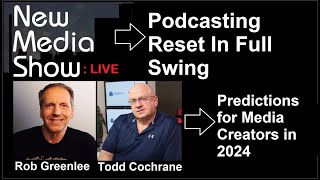
Todd Cochrane and Rob Greenlee discuss a $6.7 million overbilling case tied to inflated podcast download metrics and a 15% overcount affecting advertisers. They argue that abandoning RSS feeds for proprietary platforms like Spotify would hand control to large companies and threaten creator revenue and content freedom.
Chapters
Right. I forgot to update the title, so that screwed up, but that's okay. I'll fix that later.
It looks like we're streaming on YouTube.
Yep.
So, yep. Hi everybody, we're almost ready to start.
Yep. Todd and Rob in the afternoon. Hey, afternoon delight with Todd and Rob. Oh yeah, oh yeah, here we are back in the studio. Of course, you never left your studio, Rob, so—
I know, that's true.
Happy—
well, I did for, for a little bit. I went back to Seattle for, for 4 days, uh, last week to spend time with my father. So, so I did, uh, get out of the studio a little bit anyway. But yeah, not as much traveling as I used to do in the earlier days of podcasting.
Yeah, so happy Friday to you.
Thank you.
And we are doing this on a Friday because yours truly was all kinds of traveling, and, uh, we wanted to get a show out this week, so here we are. And we do have a few things, I think, a few things to talk about, but most importantly, I had to, uh, I left my headphones in my bag at the house, and I didn't want to wear big earmuffins today, so I ran over to— I don't even want to say that the store's name— and bought the most cheapest in-ear earphones I possibly could get, and it sounds like I'm talking in a tin can.
So yeah, I think it's, it's kind of remarkable that I, I watch a lot of, you know, YouTube/podcasts on a regular basis.
Don't say that word in one word.
I know. I'm surprised at how many people are wearing those big, big headphones still when there's so many of these behind-the-ear, in-the-ear kind of things that you can wear. So, well, look, look a lot better on video if you're going to do video. At least look the part, right?
Yeah, well, you know, that's, that's their, that's their in, that's their, uh, that's their issue, you know.
Oh, it is. But it's, I think a lot of people just either they really value the quality of the audio that you can get out of those headphones, which I appreciate. Um, and there's certainly a value to that. I think a lot of people have told people over the years that, you know, for you to really hear all of the finer details of your audio quality, that you have to have these really fancy headphones.
Well, I'm going to tell you, the $6 and 88-cent ones that I bought were— well, they don't. They're horrible.
Well, yeah, but you can hear what I'm saying at least.
Yeah, yeah, yeah, right.
And you know, and then there's always these.
Well, that's true. Those aren't too bad actually.
Oh, no, actually I use these for most of my calls.
And what Rob was holding up was a wired— wired, uh, the old— the old school.
It's the Apple wired.
Yeah, the wired ones in here kind of things, right? But it was hard finding a wired earbud. I, I, everything was wireless and I, you know, I don't, I, I have a wired connection here. So anyway, uh, here we are. Welcome back everyone. Hope everyone's doing well. Lots of news and of course, you know, uh, another 1,500 people have been laid off at, uh, at Spotify.
You want to start off there? Yeah, I wanted to start off and I put it in the title art for, for this that I think we're going through a little bit of a podcasting reset right now. I mean If you look at all of the various pieces of what's happening and what's been happening for a while now, it feels very reminiscent of what happened back in 2008, 2009 timeframe where we just saw this kind of upheaval in the industry and a reset and kind of, you know, the deck chairs are being rearranged. And in this case, it's like personnel, right? There's a lot of people being displaced from some significant players in the podcasting space. Uh, and, um, and it's going to cause— there's, there's consequences for that, right? There's going to be— generally they're positive consequences because that, that talent gets spread around the industry. And over time that turns into, you know, long-term newer opportunities.
Well, I, I think what it is is I think the economy's in the crapper. And, uh, it's not, not going on. No. And I think that, uh, you know, I, I don't know if you heard about Twitch. We can talk about that in a minute. Not Twitch, but Twit. Um, so 150,000— excuse me, 1,500 laid off at Spotify. And I don't know how— of course, there's no idea how many of those folks were On the podcast or on the podcasting side, but it goes back to my, it goes back to my analogy that free is not a business model. And even though Spotify has a paid tier, they have a lot more people using that service for free than they do that pays for it. And you have, you know, a huge number of podcasters that are over there for free costing them money. So, you know, we'll see, we'll see how this, uh, over time, how this, how this pans out. Um, you know what happens when Spotify all of a sudden says to their podcasters, you got to pay $20 a month or $30 a month, uh, to be hosted over there? All of a sudden it doesn't become such a great deal And, uh, and it will happen if they continue to lose money in the way that they will have to tighten their belt and they will have to either cut services, otherwise they go out of business.
Well, 17% of their staff is a— that's a, that's a couple notches on the belt.
That's— and you know, they said that their upcoming severance costs alone will cause them to go into the red again, uh, between $100 and $116 million, where if they hadn't flushed $9 billion down the toilet already in their piss-poor strategy in their podcast strategy, um, I think their only win over there has been Rogan.
Yeah, and I think part of what's happened is that is that I think, you know, a lot of the companies are moving away from these guaranteed deals with talent.
Well, that's given.
They were never a very smart thing to do. I mean, I know I faced a lot of situations with that, too, and I just shook my head and go, I know you guys want me to do these kind of deals, but it's like they don't actually make any sense to do. Especially when it's on new shows that you have no proven track record on. Right. And, but that, that's what I mean. It was only like a year ago when people were. And so now we're hearing this rhetoric around dumb money and smart money. So that's the phase that we're coming out of is dumb money. And now we're moving into people that manage their money a little bit better and more.
And of course, Spotify CFO quit too. $12.6 million, you know, he's in stock options he had.
Yeah, he kind of dipped just before the bad news, right?
Well, you know, the stock actually went up then when they announced that, so maybe— and they said it was automated trains, the stuff that was already scheduled, so— but you know, that's—
you probably knew it was coming, right? I mean, is he going to get in trouble for insider trading to some degree? But I don't know. I mean, who knows if the stock went up just prior to him selling, then maybe that gets him off.
Yeah. But, um, you know, and it goes back to this post I saw on Twit. Twit LLC is laying off people. Previously this week, Leo said that he is $1.1 million in the minus for 2024. So the needs to get more subscribers at $7 per month or people will be fired or Twit LLC will be closed. That is a shocker.
So you're talking about, um, um, Leo Laporte. Leo Laporte, right?
Okay, on Twit.
I get sometimes confused with Twitch and Twit.
We're talking about Twit.
Yeah, yeah, I saw he let, uh, Jason Howell go.
Yeah, I saw that. And it's all because there's so much in the red, probably couldn't afford a salary no more.
And, uh, I mean, all those people out there that were saying that there's not a serious event happening in the podcast advertising industry have been kind of blown right up, right? People's whatever, you know, and this has been going on for quite a while. It's just that the industry has been like, no, no, no, it's not a problem. It's not a problem. But guess what? These things wouldn't be happening if it wasn't a problem.
And I saw some comments in a variety of threads that Windows Weekly and Security Now are probably the only two shows over there that are that profitable. And again, I haven't listened to either one of those in years, but I also read some other commentary. Um, and again, I have nothing to know. I don't listen to any of Leo's shows at this point, and I haven't for a number of years. But someone's—
that exactly. It's an interesting— because the same thing has happened to me. I used to listen to Windows Weekly every, every week.
Yeah. Now, what was, what was really interesting was that several people in this thread that I'm reading made the comment, and I don't know, again, those of you that listen to it, maybe you can tell me or tell us if this is true, but they went pretty woke over there. And I didn't realize that. And if they did, again, I don't know.
Well, they are just out of San Francisco, so—
well, it's a tech— how can you— shouldn't be woke if you're tech. You should be politically neutral.
Well, Todd, some of the biggest woke companies in the world are in Silicon Valley.
Well, no, but I'm talking about the content shouldn't be— if you're doing tech content, it should be non-political. Yeah, I do a tech show. It's non-political. Yeah, I'm an equal opportunity basher. You know, I, I just tell people what I think, and but I don't try to put a political spin on it.
Yeah, but is everything turned political now? Talking about any topic, um, somebody out there could spin it as a political—
well, maybe, maybe true. But you know, the problem, the announcement out of Disney recently where they basically said that their, I guess, internal stuff where they've lost a lot of money on movies was not matching what the American public wanted. So I, again, I don't know. I, I don't listen to, to Twitch.
So I saw a, or Twitter meme on Disney that was talking about how people are claiming that Disney's made more bomb movies than Lockheed Martin.
Yeah. Yeah. And at the same time, you know, now the word is on the street. And of course, we, Mike, I, and Mackenzie recorded our 2024 predictions show. We do one of these every year. And let's do that a little bit on this episode too. Okay. Talk about what's coming too. Yeah. So I won't say what Mike predicted for his predictions, but it revolved around Google and YouTube and it wasn't necessarily positive. So, you know, I think that we'll have to see what transpires in 2024, but I really, you know, I've said, already said what I think is going to happen. I think real simple, AI is going to continue to advance and companies are going to be using it a lot more and they'll be offering tools. Matter of fact, I started testing our tool this morning. And then there's going to be, as I've said already in the show, real voices are going to be winning and people are going to be seeking out voices like you and I and other podcast content. And we need— we should not lose sight of the fact that podcasting as a medium is very special and very unique, unlike many others, in that We are truly in our listener's head, literally. And it's the most intimate form of content done. I was listening to— I rode the train from Chicago, and I haven't— this first time I've done Amtrak since I was a kid. And I rode Amtrak from Chicago to Battle Creek, which is about a 2-hour, 45-minute run. And I listened to a couple of podcasts and a couple of times the audio got so real. I had to take an earbud out and make sure that it wasn't coming from my computer speaker. It sounded like the person was right in front of me talking to me. And I don't know if I'd experienced that in a while. And it just kind of was kind of weirded me out just a little. But it just, it brought me back to the realization that we really are right there, as close as we possibly can be. People are riding along with us right now.
And I think as the technology gets better too, we're pushing into kind of newer experiences around audio too, more spatial audio and things like that that can can really enhance that listening experience, some of the depth and perception.
Yeah, some of the TikTok stuff that's coming out right now, it's got some incredible spatial audio. But I think it's just going to get better. So maybe my prediction is maybe in 2024 more of that will be employed. I don't know.
I think audio quality is continuing. Yeah, it's going to continue to get better. I mean, because I know that there are a lot of companies out there working on trying to make recording audio in all sorts of different environments. I mean, you know that I've been working in that area and trying to enable people to record anywhere and have good audio quality. And I think that's a powerful move in that direction.
So, you know, I think from that perspective, that's kind of where my heart is. It's where I think it's going to happen, you know. It's, uh, we're watching.
Companies aren't going to be around either. Um, I mean, just look what's happening to Castro. I know that there's a lot of fans of that app out there. Uh, it's been active for a long time, but like we've said on this show for many years, it's difficult for podcast apps to, um, remain economically viable because there's not a lot of sources of revenue for them unless they sell subscriptions.
Right. Well, this is where the, the model, um, and we are lit in live today, by the way. Um, this is, this is where the model of giving value back to the apps as well as the podcasters through the value for value live streaming Satoshis is, is key. Um, so I don't know, we'll see. We'll see what happens with the with layoffs and company survival. We're definitely— go ahead.
Oh, I was just going to mention too, I know that there was some talk about some concern that the IAB was maybe not being supported on renewals on podcast metric standards.
I'll just say this, there is a those companies that are not currently on the current standard know they're on the clock, and they know that next year they're going to have to, because what are they gonna— so they weren't required to maintain certification. There wasn't basically— they're between versions Uh, it wasn't completely clear, and I don't want to get into politics of it, but I don't think there's going to be any doubt that those companies are on that list will renew when— because there's a new version, there's another, another version of the spec coming, and I— there will be a public comment period at some point here soon, I believe.
Okay.
And once that's released, then what I think you'll see is those companies jump in and, and get recertified.
So I can see it just from a cost-cutting standpoint that they built this technology. It seems like it's working for everyone. Unless there's a significant benefit to upgrading to that next version or, or certification, you know, the cost involved in adhering to that officially is pretty high, right?
The cost is— the cost for The cost is going to be annual going forward. You'll have to renew annually moving forward. And the cost play into just the big platforms that can afford it. It— they have lowered the cost.
Oh, they have? Yeah, I didn't realize that.
And I don't know if I'm at liberty to say what the cost is or not.
Yeah, I don't think you have to, but it's— I think it's good that it's not onerous because that was driving a rebellion.
Well, the first—
on the side of smaller platforms, the first certification cost us $35,000. Yeah, yeah, I remember that.
And the renewal was not that much. Um, and then because we did the renewal, now we'll do the renewal again. And, um, they gave everyone time to budget so that they would be— have it in budget for follow-on follow-on years. So, but the problem also is the IEB membership cost is going up.
Oh, oh, the membership cost?
Yeah, they've changed— they're changing how they calculate membership, membership cost.
That's what a lot of people, a lot of the smaller platforms were objecting to, was, you know, just the onerous cost.
Well, the, the membership cost is still a minimum as of like 11 grand a year. Is the minimum, I think. And then it goes up based upon your revenue. Um, but if there— but if there does start to be fallout, if all of a sudden companies are not starting to renew, which we'll see— again, I'm assuming all of them will based on kind of the feel I had from— but originally there was only supposed to be a renewal done on major revisions, not decimals of revision.
Right.
And then they basically, they've come back and said, hey, you're going to have to renew every year. But it is an onerous process no matter what. It's, you know, it's probably 40 to 60. Yes, staff time is huge.
And then resources within the company beyond just the cash payment.
Yeah.
Um, and then I saw this post in PodNews about the, the OP3 project, the Open Podcast Analytics project. I know that that's, that's, that's, that's a little different than this, but I do know that they started out being a potential option.
Um, but there's no certification with that and they're not going to be IAB certified.
Yeah, right. It, and it's a little bit, it's the Open Podcast Prefix Project. Yeah, it is now. That's not how they started.
It's been open. Yeah, they started as an open project. Now it's just because it's getting more expensive, more people are using it. They need— I'm assuming it's a prefix project. Yeah, it's a prefix project. It's always been prefixed.
Oh, I didn't think— I didn't think it was always. I thought it was a potential replacement to the IAB.
Well, they want— some people want it to be because— and here's why it will never be. It's open. The stats are completely open. You can see everybody's stats that is using it. Nothing is private. That's why it's open. So anyone that's using— well, if you don't, if you don't want your stats seen, it's a problem. Well, so when you say your stats seen, um, it's all that stats really mean, means it's public. You know, anyone that's using OP3, I can go and look at their, their stats.
Stats of what?
Their podcast.
Of all their podcasters?
I can look— anyone that's using OP3, I can look at their stats, episode stats, program stats. It's open. Nothing is hidden.
Okay. Okay.
So if you use, if you use the OP3, your stats are open. Your stats are public. For everyone to see.
The code is open, but the stats are open. Hmm, okay. Why would open to public say everybody? Okay, but is there an interface to be able to go see what—
I don't, I don't use it, so I don't, I don't know. Hmm, but it's open. Yeah, it's open. It's, it's a, it's everyone's stats are publicly. That's what they— it's all about transparency.
Yeah, it's not about transparency of the, of the algorithm being used.
Well, maybe, maybe that's so the content creators. It's an— Rob, go look it up yourself. I don't— I can't talk to it. Yeah, but I believe the— I believe the code's open and I believe the stats are open.
It could be open to sharing with other platforms.
No, it's—
I don't know that consumers can get access.
I believe so. I believe it's all, all available. Hmm.
Well, that's, that's, that's interesting. So, okay. Um, yeah. All right. So what you're saying is that the industry doesn't have any any place else to go other than IAB for a certification.
That's the only recognized— it's, it's going to be the only thing that's going to be right, you know. OP3 is not going to be recognized by advertisers, and most of the people that use OP3 are not worried about advertisers.
Yeah, I saw that, uh, was it Transistor was on board with it?
Transistor, Podium, RePhonic, Flightpath, and Pod News. Yeah, they basically have supported it. They basically are, are contributing of some, of some sort.
Yeah, I also saw that, um, Tesla is now going to have the Apple Podcasts app by default in its App Store. On the car.
Well, that's good.
Is it? Prior, it had only had a Spotify app in it. Hmm. So, and it said, it mentioned there that the Tesla cars were going to, going to support CarPlay. I was, I was a little surprised at that, but it's going to be interesting to see what that looks like. It's coming out in the holiday update. For all Tesla car owners.
And if I'm wrong on stats being publicly available, someone correct me, but I'm 99% sure that's the case. Okay, so someone will weigh in here if I'm wrong, uh, later. Yeah, but that was my understanding, is that the everything is, is basically publicly— you can see other shows' stats.
Oh, okay. Well, I guess there is precedent for that kind of, kind of stuff. I mean, I mean, there's, there's always been a certain amount of, um, content platforms that display, you know, the number of views or downloads or something like that. I know it was something that Spreaker used to do. Um, they used to display publicly all of the stats of every episode. Publicly on their, on their website. Yeah, actually I had them make it optional, um, back when I was working for them.
It's, uh, also curious. Podtrack releases Ranker. Total global downloads for top 20 publishers down 15% month on month. And I'm gonna, I'm just gonna be real blunt, we didn't see a drop at Blueberry.
Oh, with the update to 17? Yeah, iOS. Yeah.
And I said it before on a previous show, but everyone's whining, whining about their drop, and I'm like, not a complaint over here. And it just tells you that maybe some of these stat systems need to, uh, uh, analyze a little deeper. Maybe they need to start, uh, you know, qualifying.
Let's, let's call it what it is. The IAB metrics standard is not really a standard.
It's a standard. It's the minimum. It's a—
well, it's a recommendation, and not everybody adheres.
Well, if you're certified, you have followed the guide, the general guidelines. But well, there's some, there's in there, there's some, there's some pretty strict rules in there.
Yeah, but there's slack, right?
But it's the minimum, minimum requirement.
There's the 2-hour rule and there's the 24-hour rule.
Yeah, no, no, the 24-hour rule is the standard. There is no 2-hour standard. The 24-hour rule is the standard.
Okay, I thought that there was some variability there. No, in the standard, because not everybody would agree to a hard and fast strict If you're not 24 hours, that's why Libsyn has two selections.
They have the IAB standard 24-hour, and then they have the other selection that is not the IAB standard.
I was, I was very much against that, that decision when I was at Libsyn, um, of giving that toggle, that toggle, because when you flip it the other way, the numbers go up. Yeah.
And yeah.
You know, what's the point? I mean, the whole point of the IAB metric standard was to get everybody on the same page, right?
And if you are an IAB— if you do present IAB-certified standards, you're on the 24-hour plan, right? And, but that's the minimum qualification.
Again, there are others that are going beyond 20.
That's what— well, there is a higher level of qualification of a download. You can look deeper.
Well, there's also the, the blacklists and the whitelists. That is actually probably the biggest variable.
Yeah, it's mostly the, the, the list that makes the most impact is the deny list, right?
That's the blacklist. Yeah, that's the Or, or, or in this, the proper way to say it probably is the block list.
Yeah, what's— whatever, whatever the proper word is. I think there was another word that was used too that was deemed inappropriate, but yeah, the block list.
It's basically a list. Look, let's be frank about it. It's basically a list of bots and platforms that have IPs or whatever that are that are not actually listeners.
I pay $12,000 a year to be updated every 24 hours of lists of servers, bots.
$12,000 a year.
$12,000 a year for that list. But that's, that's in it. That's the base. That's the base. And then we have more.
Oh, that's a lot to pay for that.
Yeah, it is a lot to pay for that. But it's otherwise, it's, it's, uh, you'll spend every day whack-a-mole.
Yeah. So, well, that maybe explains— well, that probably doesn't explain the Apple difference. No, no, no, the Apple difference more to do with how the Apple—
it was how they were—
how it works with automated downloads.
Yes. And the counting of those, right?
Does, does your platform or some of the other platforms have a, like, a way of managing that that's different than what Apple is doing? Like a more—
No, we, we see, we see those extra, we saw those extra downloads before, but we didn't qualify them and count them. That's why we didn't see a drop, because we already knew they were duplicates. We already knew it was the same IP, same user agent. We knew. It's not rocket science. It's really not.
Yeah.
So, yeah, I was—
Yeah, I was a little bit surprised to see that a couple of really major podcasts, like The Heavyweight Show, which was part of the New York Times Best Podcasts of 2023, um, you just—
you have to ask Spotify. It was being what, canceled?
Cancelled by Spotify.
Oh well.
And, and another show, a Pulitzer Prize-winning podcast called Stolen, Is also getting—
does it mean it's being monetized?
Well, I think what, what this is really doing is their cancellation, but each of these shows are able to move to another platform if they can get a deal with some other platform. I think this is kind of being miscommunicated. I think this is really exclusive deals that are getting cut off., right? Yeah. So, so these shows are going back to the, to kind of, kind of competing at the, what, where they probably should have been all along, which is kind of, you know, freely available and not locked down to one platform.
And what I found interesting was Red Circle has a new launch, new vetting feature allowing advertisers and podcasters on the platform a questionnaire, discover which show is the right fit. That shows me that they've been— ability and, I mean, no, makes me think that they've been a little bit too loosey-goosey and they weren't matching real well to begin with. So that's, that's what I read into that. I might be wrong.
Yeah, but that's also kind of the same thought process that the brand suitability and brand safety.
Well, well, what is the question? The questionnaire could be, what do you think of our product?
Have you used it? Yeah, is this talking about advertisers?
Yeah, advertisers are going to send podcasters a questionnaire so they can— apparently the advertisers can make up their own questionnaire and then the podcasters respond to it, and based upon those responses, they determine which show is the best fit. May not be anything to do with brand suitability. It may be Do you like our product?
Behind it though, right?
Yeah. You know, fit, right? It's fit. Yeah.
Yeah.
Content.
Yeah. So, so it, it may be a way that Red Circle is basically able to avoid doing the brand suitable.
Maybe not. I think they're doing it. I think what it is is basically, yeah, I think basically what it is is they advertise it because, you know, what we've always did is when an advertiser comes in You know, I always have a list of shows. I'm like, if you have any reservations about this advertiser, do not accept this deal. If you cannot endorse, if you cannot get behind, if you cannot be enthusiastic, don't take the deal.
If this has always been the case, well, I— casters have been able to turn down ad deals.
Well, I don't know if that's the case over at Red Circle.
Well, Programmatic has basically, you know, not allowed, right?
Right. Well, again, we're not talking about— we're talking about host red, right? Yeah, I'm sure.
So yeah, I just wonder, I mean, how's your programmatic business going?
It's growing fantastic. Okay. Yep, each month it's growing. Okay. And, uh, I've, uh, I might hit my KPI by the end of the month. I was— I had a KPI by the end of 2023. It's close. And I was pretty aggressive. So it— I might hit the KPI. It might be a few hundred dollars under the KPI amount. I'll call that a win if I, you know, if I'm within a couple hundred bucks.
Yeah.
So it's not going to be— I'm not going to be under $1,000 and I'm not going to be over $1,000. I'm going to be right in the— right, really close. But it's growing every month. So Matter of fact, I was kind of shocked the other day when I looked at the numbers how it's done.
So yeah, that's great. I saw that Rode acquired Mackie, which I thought was an interesting acquisition.
Wow, that's a— Rode acquired Mackie. I thought that had been the other way around.
You would have thought. Wow. The truth of the matter is, is Rode uh, RØDE is being a lot more innovative. Yeah, with their technology. Then Mackie— Mackie's a little old school.
Yeah, it is.
They're actually, actually based up in the Seattle area.
Wow, that, that's a— that's, that's big. I missed that one.
Mm-hmm. Huh. Yeah, so, so I'm not sure what that means for Mackie, if that just becomes a derivative brand under RØDE or How that acquisition really helps RØDE, I'm not really clear on. Or is it just taking out a competitor?
I don't know. I don't know. You know, I've got Mackie gear here at the house.
Yeah, or taking the RØDE technology and integrating it into the Mackie mixers. Yeah. That would be a strategic move that would make a lot of sense. I just wonder though, Todd, as we think about the future of this, You know, as I've been kind of thinking about and working with these more advanced AI-driven audio optimization platforms, that we're going to see that technology get integrated into all these mixers and in recording platforms natively versus the current, like with Rode has like their compressor software and that kind of stuff. That's that are fancy.
Yeah, I mean, you have to get in. Not unless the device— not unless the device is connected to the internet, you're gonna have to— and they're gonna have to become much more powerful processor-wise.
I think what, what you could do though is it could be updated over, uh, over-the-air update.
Well, again, when you're talking AI You're not really talking AI. What you're talking about is some programming that does certain stuff. AI is a— there's two different processes there. Let's not get them confused. There's a lot of stuff that happens today that is like an AI-type process, but it's, it's just some code that's been written to do a certain thing. Right.
I don't know. Live, but live optimization of audio. Yeah. Let's see. Reduction. It's. It's not entirely here yet, Todd, but it's coming. We'll see. I'm talking to companies right now that are actually working on it.
But it's web-based. It's not going to be in a RØDE. There's no way it can be in a RØDE, not until the RØDE gets processor-wise much more advanced.
Right. Well, I mean, you look at a RØDE Duo and those, I mean, that is becoming very intense on the software side.
Yeah, but I bet it's only running off of something maybe equivalent to a Raspberry Pi or something like that. It's probably not that big of a processor. You might be surprised because again, it's code.
That could be what it is today, Todd. Yeah, yeah, yeah. What I'm saying is that this technology will increasingly get integrated because what that'll do is that'll simplify the use of these tools, right? I mean, you and I both have set up RODECaster Pros And they are not easy to set up. I mean, they are, they are a challenge to set up properly. Um, because there's so many tweaks and adjustments and ups and downs and scroller bars and turning off and on and all this kind of stuff.
But Rob, I've had a whole rack of stuff here that I've had to twist knobs and set stuff for years. So it's, to me, that's nothing new.
Where it's going, Todd, is what I'm talking about. Oh yeah. Yeah. Um, is simplicity. AI is going to take over a lot of this stuff.
It's not.
Yeah, we'll see. I think the days of us scrolling up and down on a mixer are numbered.
And yeah, we'll see. That's, that's, that is why would it not? But again, that's not necessarily AI.
That is just, well, okay. I mean, AI could have a component to it.
Um, but nonetheless, the technology is progressing to, they already have, they already have mixers that will ride. If you get into expensive mixers today that ride the levels by themselves, you don't even have to touch the faders. The faders move by themselves, right?
So if you spend, you know, $200,000 on a, on that kind of mix, right?
Yeah, but most people don't have access, and that's usually tied to some MIDI device and some computer and—
right. Yeah. But most everyday podcasters don't have access to that. No, not at all.
Currently.
But time will tell. I'm just trying to think out where this is going. Right. And, and, you know, even the, the Rode Duo is, is an example of what I'm saying is that they're getting smaller, more compact, and much more powerful, but they're also unfortunately getting a little bit harder to configure because of the complexity of them.
In the end, if you just set the microphone and you set the level and don't set any of the other features, you're still good to go.
You know, that's what's— what's the point of buying a tool like that if you're not utilizing it?
Well, I bet you a lot of— I would bet you 90% of the people that own a RODECaster set the mic, set the fader, and don't do anything else. You and I like to tweak. I guarantee you most people don't touch any of those other features. They'll look at them and get scared of them.
To tweak it to get decent audio quality out of it. Well, I would say that the first 2 months that I had this thing, I didn't feel like I had it set right because what, what, what I was hearing through my headphones wasn't what was going out. No, that's a problem. And that's— and it's difficult to configure something if you, if you're not hearing what it's doing.
It should give you whatever's processed is what you should hear. You would think.
Yeah, that's— and that's probably most of the time, right? But there were times when I was doing this show and the configurations were all great, but what was going out sounded like crap.
I think too is what happens, and this is something that just because I've been around for such a long time, I record right on the device, and then I listen to that recording. I go back and—
yeah, but if you're doing stuff live, Todd, it's—
it's— but, but still, if you— if in order to get the settings right, to get the settings right in your initial testing, you should be— what I'll be is like, okay, I'm now touching the fader, moving it up to 3, and now I'm, uh, touching the compressor. I've moved it to 25%. Well, how does it sound? I've moved it I keep talking and make the changes actively and I listen to that and I go back. I'm like, okay, 25% was better than 10. Let me go to 25. And, you know, I'll spend a couple hours. I bet you the average podcaster doesn't spend a couple of hours setting up their mixer.
No. And that's kind of— I mean, you just stated what my point is. But the thing is, this is what the software is smart enough to, but to set those.
But the problem is it can't because every voice is different.
You, but the, but the software, see, that, that's what's changing about AI technology is I don't, I don't think it'll ever—
intelligent. Okay, you know, well, I don't know. I don't think so because, because it's your voice and my voice are different. I guarantee you that your mixer settings are different than my mixer set.
Yeah, because there's so many settings in here, there's no way they'd be the same.
No, but you've tweaked it over time to get it to sound the way you want it to sound.
Yeah, but that may not be the best setting.
Here's the funny part. I haven't— I don't run on a road in the show. I've run on— I haven't had to touch my— except for the scratchy fader, I haven't had to touch my rack settings since 2019. There's no kids in here touching the knobs. The environment's the same. I've set this my rack, and it hasn't changed in, in 3 years.
You also run a compressor too.
I do run a compressor.
So that has to be adjusted.
Not any— not because I doesn't— I haven't touched it in 3 years because I set it once, got it right. The studio now is soundproof.
You've had to do it with, with my audio.
Well, I've had to turn your audio up, and then at times I've had to turn it down here, right?
I was booming out to you.
And part of that is, is because of the Mac. I think the weaknesses is the when it comes in on the Mac.
Well, Todd, I also think that we are geeks here and we're okay with playing with this stuff. I think a lot of the newer people, the younger people coming into the space, they don't have that interest in tweaking with technology for hours and days.
I think, I think mostly, I think most of the younger people are more technical than you and me and should probably, they should probably understand this better than you and I did. I can't imagine them not. Yeah. I don't know. I might be wrong.
I think you like to be a contrarian.
No, I, you know, my kid, someone showed me something the other day on my phone that I did not know existed. On the Android I have, I didn't know you could do this. Yeah. And make it take a picture. Hadn't the area clue. I was trying to take a selfie and someone said, just use your hand. I'm like, what? Yeah, do like that. And I'm like, I did that. It took a picture. I'm like, oh my God.
Well, all of us have limited attention spans, right? So there's no way we can pick up every little option and every little device that we have unless we're constantly monitoring.
Well, it's one of those things where now I got subscribed to an Android show to learn about all these tricks I don't know.
Yeah, well, that's, that's, that's the blessing and the curse.
So Rob, why don't you start a RODECaster show and talk about how to set up the RODECaster?
There you go. I don't have an interest in doing that. There's a specific—
there's a whole bunch of stuff on YouTube. Don't worry, some other, some other geek has done it.
Yeah, plenty actually. Yeah, and people probably call them podcasts too.
No, probably. Yeah. You gotta stop that. You need to— do you need— we need to have a jar here, and you need a jar on your side, and I need a jar on my side. At any time you associate the word podcast with YouTube, you need to put $20 in it, and at the end of the year, we'll trade jars and see who has the most money.
Well, Todd, I think we have to be practical about it too. There is a podcast section in YouTube.
Well, quit calling it that. But reminding people, well, okay, so I think next week on the 13th when Tom Webster and team have their video thing review, I think there's going to be some good information that comes out of that, right?
And they're going to confirm what I'm saying.
I think they're going to confirm that top shows, the top shows, get views. And that's it. Hmm.
I don't know. It's a pretty generalization.
Well, I can guarantee scale and perspective, right? It's about— no, it's what, what, what do podcasters care about? What's—
they care about definition of a big show.
A big show would be at least, at least If you're going to be on YouTube to be a big show— oh, okay, I'll be simple. More than 1,000 views per episode, that would be a big show on YouTube. Big podcast on YouTube.
Yeah, I do episodes on YouTube all the time.
They get 1,000 views. You're rare. I don't know, this show never gets 1,000 on mine. I get a lot more, uh, 60, 70 on this, on this channel.
That's it. Yeah, I mean, this show tends to struggle a little bit on YouTube.
Yeah, because it's 90 minutes. Quite sure why. It's not formatted for YouTube. Well, it's not. It doesn't have a YouTube format. We're not, and we're also old. We're old. We're not young and hip.
Well, one thing that would be more, more compatible with YouTube is if we didn't do this side-by-side video thing. Um, I think, I think the shows that I see that are big and successful, they flip back and forth between who's talking.
Well, I can do that too. I can. I did that for years. You didn't like it.
What do you mean I didn't like it?
You didn't like it when I flipped back and forth. I did that for years where we flipped from you to me. I can do that right now. So hang on. I'm going to put me up front, or I am here, and then I'm going to put you over here. All right. So ready to go. Ready, rock and roll. We can flip back and forth.
No sweat. Well, okay. So that doesn't happen automatically in the platform. I mean, you have to actually click a button.
Yeah. I got to click a button. So do they. Okay, when they're running their show, they have someone that's running a switch.
Well, there's nothing to keep the platforms from enabling who's ever talking to flip it, because I know Zoom does that, right?
Um, well, we're not using Zoom.
I know we're— well, actually, we are using Zoom.
Yeah, but you're on Zoom on a single channel, and I'm—
I know, but you're not using Zoom.
No, you're using Tricaster, right?
So we can— is— yeah, that's actually a good, good topic. I was curious, is Tricaster still updating? Um, their, their tools, are you getting patch updates for your—
yeah, all the time. Yeah.
If people that are watching this don't know what a Tricaster is, it's, it's basically like a studio in a box, right? So it'd be like a StreamYard that you have on a little computer on your desk of sorts, right?
And I stopped putting up lower thirds. I can put up lower thirds. I can put up a little piffer in the side if I want. All I gotta do is make the change here. Let me go over and grab the right graphic. All right, we get that. We'll put that up there.
I've always wondered, Todd, because you have like a— I mean, I think when you bought that, it was like a $50,000.
Uh, no, because I see this is the problem. Now I have to remember to switch. Um, I, uh, I, I started out with a used unit, and then they had this incredible upgrade path where you went from one model to the next. So I went from, uh, their base model to, uh, 865 or what is— so I basically paid about half of what a retail unit cost, and I got a trade-in value. So I've done 2 or 3 trade-ins. So the last trade-in was, yeah, it was expensive, but I'll never do it again. When this thing dies, then I'll switch to something else. I'm done buying their hardware.
So when you say that you're going to switch to something else, would it be a platform that would be more kind of software-based, cloud-based?
Probably, but the challenges is I'm— I have to have something that supports NDI throughout because I'm in— I have an NDI studio. I don't know if StreamYard supports NDI or not, but Wirecast does, and some of the other software-based stuff does support NDI. So when you're seeing me right now, that's not coming over— that, that image is being sent via a LAN cable, not an SDI cable or, uh, or an HDMI, or HDMI, right? It's, it's over a LAN cable.
Right.
Yeah.
Yeah. So what I'm doing here is HDMI. So I go from my Sony camcorder to, to a, like a translator that basically takes that signal and converts it into a digital signal. Um, right. And, and then I can plug it into a computer.
It's all— and, and the thing that you—
my two USB is what it is.
And the thing you don't see here, and I probably don't have this camera white balance, is I can actually do a different view.
So I can— because you have like 2 or 3 different—
yeah, I have 2, and they're not all balanced right now, so you can see they're off. So my red shirt changes colors on camera 3.
So do you ever really use all those cameras?
I do from time to time, and you know, when I do, then I have to go in and, you know, white balance the cameras and make sure the color matches so that when I go from camera 3 and I'm showing that to this, it doesn't, you know, it doesn't hit you in the face.
So so much. Yeah, are they all different brands of cameras?
No, two of them are the same brand, the third one is not. So that's part of the problem, that this is the third brand camera. So, okay, this is the— these two are pretty close.
You ever do, um, shows in your other studio that you have right now?
Yeah, yeah, I do. I do, uh, demos. I do Blueberry stuff. Uh, don't do too much stuff in the green room though. I've used the green screen a couple of times, so that's probably the most underutilized Yeah, that's your third studio, right? Yeah, the demo studio. I can actually use, um, an iPad to switch the camera. So I just set the iPad aside and I get the same functions here, and I could actually bring in— let's see here— like, I can bring in— I've got Pod News loaded up, an email. I could bring that up or whatever screen I wanted to bring up. So, but again, if you're in a same room and you're doing multi— I'm probably making people dizzy here switching back and forth. Um, if I'm doing— if they're in the same room and they're in a table, then they've got someone that is sitting there mashing the button, switching between people. Right. Yeah, that's what happens on, on Twitch. They have someone manually— sometimes Leo does this with me.
Yeah, and I see even on, on YouTube, people are setting up multi-camera shoots and they have like two couches or something like that, and there's a camera that captures both of them together, right, kind of facing each other, and then there's a camera facing one person and a camera facing— so there's actually a lot of the shows are doing 3-camera.
Well, you even with the TriCaster, and I just don't use it, is I can use— if it's— if I have enough focal depth, I can take this camera and focus it over here. So it only takes a block. So I can use the same camera to do 3 shots or actually up to 6 shots per camera. Depending on how much, you know, how far back the camera is from the, from the object.
Right. But that's how it's, you know, some of these, uh, YouTube creators are creating more like a television experience is that they're using multi-camera shoots. Well, they're using a guy that's, that's, that's sitting there with one or two cameras and they're flipping back and forth.
Well, they're actually— most of them are using one camera with the ability to focus, to switch. Yeah, to focus on the— and they all they do is crop. So it's just a crop part of the original image. And we do that when we go to see—
yeah, yeah. And I've been able to do that with my 360-degree, um, camera that I have too, where I can just set it between us and it'll capture. It's got two camera lenses, one on each side of the—
oh, and one on each side.
Yeah, and then I can, I can, in the software, I can flip back and forth between the speakers.
Yeah, there's no, there, if I had the camera could sit back further, there would be no reason to have 3 cameras in here. And actually, when I, when I, I was, I got constrained. What really happened to me, here, see, again, I didn't flip it. I got constrained because there's a wall that is literally from where my finger is pointed right there about 3.5 feet away. So there was only so far I could go back with the cameras. Um, and if, you know, it was basically because the way this— I, you know, I basically moved into an old dentist office, so I really couldn't pop, knock that wall out, um, and move the cameras back further. Oh, so I see what you're saying. Yeah. Because that's part of it too. More depth.
More depth. Yeah.
Yeah.
Because I see some of the creators have a view of their, their desk, right? Well, as their hands. Yeah. They can be much more kind of gesturing as well. I mean, my setup here, I, I just have a gigantic screen that's in front of me that my— I've got a teleprompter that's sitting on top of the screen. It's because my screen's so big that it kind of elevates the camera up and I kind of have to sit up with my chair pretty high to get up in the air.
Yeah. So what happens here is I've got the smallest monitor I could directly in front of me. So here's the camera lens, right there's the monitor top. So, and that's another issue too, is I move the camera back, then all you see is the back of the monitor. So the So the goal would be is if you're going to do this differently, and because of the way my shows are and I need to be able to see the articles from my show. Yeah. Is— That's the challenge. Is then I would have to have the camera back further. Then I would have to have a bigger screen back further. So I would know what I'm talking about. And in this case, it's not, it's a little bit obvious that I'm looking down, but it's not super obvious. So what I do with the browser is I minimize it. So it's as close to the top of the screen as possible. And then I purposely, roll the article up so that my eyes don't go all the way to the bottom of the screen and it looks like I'm looking down. Yeah. And again, you can kind of see it a little bit. Like right now, can you tell I'm looking at the top of the screen? Is there— so I'm looking here at the top of the screen. Here I'm looking at the camera. So just you can see there's a little bit of eye shift.
I have the same thing too. I look down just a little bit below my camera to see you. Oh, but I can also— I haven't properly configured my teleprompter yet, so to kind of go up so my eyes would be up.
Well, I have a big monitor behind the camera, so I look at you. You are directly above the lens, or if I'm in this view, you're a little bit sideways. Yeah. It used to be I'd have to look at you like this. That's how I had to used to look at you before. Yeah. And for those of you listening, we're like, okay, Dad, stop.
Well, so I think that the topic here is interesting because I think, um, as we think about shows that want to be successful on YouTube and as an audio podcast, I, I think that's where the evolution that I see moving. So this kind of side-by-side thing And I'm doing it too. So it's, you know, with my other show that I'm doing and, and things like that too, but that whole flipping back and forth full screen, it presents a better experience on the television.
Oh yeah, for sure.
For sure. Um, because the, the image is more full screen and that's kind of what, you know, the major media companies do with this stuff too. And I see a lot of the The bigger shows are flipping back and forth.
So in a perfect world, what I would do, and again, I would take— see, we can see you right now, right? I moved you back right now. What I would do is this.
Yeah, it's kind of dark, isn't it, back up on that screen?
I would hide you and I can still see you. So I would show this even though I've got you stashed. I can still see you on your screen.
Got it. Yeah, there's all sorts of ways to do this kind of stuff. So did you see this, uh, this article about, um, There's a copyright enforcement company is sending demand for money to podcast directories for reproducing thumbnail images from RSS feeds.
Did you hear about that? Yeah, I saw that. And you know, that was just some, you know, a little weird. Well, what it is is someone trying to extort some money.
And yeah, it's like that patent troll back in the back 5 or 6, 7 years ago.
And, you know, James did the right thing by having the lawyer send the message, and of course they went away. Yeah. And, um, if someone sends us that, we'll do the same thing, you know. But we've got a lawyer on staff, so we're a little different. But this is where, this is where a podcaster needs to be careful on their album art. They need to make sure that their album art is not infringing any copyright, right?
That's original. Can't be using logos from, from brands. No, right? And that's the— that's really the, the risk area. So if you put a logo, let's say you, you know, you're creating a podcast about Tesla or whatever, or some other company, Ford, or Microsoft, whatever, and you use the Microsoft logo on your cover art, you are at risk of violating trademark and copyright and things like that.
So, and that's where you got to be careful too with the AI stuff to make sure you're not—
AI will completely not do anything with a brand logo.
Well, it'll come close.
It'll, yeah. So some brands just have text, right? Yeah. So like if you look at even a Microsoft, it's just the words in font, right? And it could come pretty close to that. So I, you know, I think brands, um, yeah. Um, I mean, Microsoft has a logo, but it's more of an icon.
Um, and that's where you got to be careful and using Fiverr and some of those other folks, because, you know, they They don't go to Google and grab images, right? Yeah, be careful. Yeah, right. And it's not that hard to create album art today, so, you know, just Canva. Yeah, they do a great job.
Yeah, it takes a little creativity to go in and use Canva, but I know that they're increasingly—
well, they have capabilities in there. Well, they have, uh, templates, and you just Correct. You know, that makes it real easy. And, you know, maybe pay for a couple months of Canva. And of course, all the graphic artists, a lot of the graphic artists out there are like, oh, pay me $600. Well, that ship has sailed, I think.
I'm not exactly happy with the Canva user interface, but that's Not the best in the world, I would think.
None of them are perfect. Yeah. But I don't know, I guess, I guess we'll see. But yeah, I'm— someone coming trolling, you know, I legitimately got hit on a— well, what it was is I had paid for royalty-free— I paid for an image off of a site. Um, had the license for the image. And where I got screwed was there was image within the image, and the image within the image was a Getty image. Basically, it was just— it was a picture, and in the picture had a, um, uh, picture album, and inside the picture album was a Getty picture. And I end up That cost me $300 because that Getty image, the image within the image was not licensed. And even though I had licensed the whole image, someone hit, so I got screwed. I just, I had to pay the bill. You get one from Getty, you just have to pay. You can't fight them. That was years and years and years and years ago. And I put the, I put the law down hard on my writers. I just like say, hey, this is the, this is where we're going to get images from here on out. You know, here's the account, they all have a login password, they're royalty-free, and go over and get them there. Don't be using any art from any other location, you know. It was, it was expensive for me. I couldn't afford it at the time.
Yeah, I saw that the, the Podtrack, uh, Ranker came out with some numbers a few days ago and yeah, I listed the top 20 publishers are down 15%. I know we mentioned this a little bit earlier in the show, 15% month on month, stating due largely to modified download behavior on iOS 17.
So yeah, so that's a big drop. Yeah, that's, it's, uh, that's, that's a 15% drop in revenue.
Yeah, I'm sure that the The podcast publishers are feeling—
well, here's the thing. Let's just be honest about this. Performance should be up. The advertisers should be thrilled.
Oh, as far as ROI metrics?
Yeah, right. Yeah, right. 15% could be the difference between a renewal and non-renewal of an ad campaign. So when you're off—
so the question is, here's the question: the brands and the advertisers being transparent with the publishers that they, they got a greater ROI on the campaigns that they did buy?
Well, let's put it this way: is anybody going to give 15% back for the entire time that these downloads were being overrepresented?
Well, that's—
you're right, Todd, that's at the other end of the spectrum, right, is because I remember, I remember, I remember doing an audit for a very significant company that had to write $6.7 million back to their advertisers for overcharging them. Yeah, many years ago, right? So If you've been overbilling 15%, I know no one wants to hear this. So would that not give an advertiser pause that they've been paying for too many downloads? That's, that's a big number. You think about a campaign, it's, let's say a campaign's doing 100,000 downloads. And 60% of the downloads come from Apple Podcasts at 60,000. And then if we, if we do the quick math here, uh, 15% of 60,000, what is that? 3, uh, 3, no, more than that. Uh, 3,000? No, no, no, no, my brain isn't working here. I've got a little bit of, uh, I've had brain fog today. So 15% of that is 0.15, is 45, no, 9,000. That's 9,000 downloads that they gotta rebuild on. On 100, you know, so 9,000 at, you know, $25 CPM, you know, that's maybe not that much, $225, but You know, for every episode.
Yeah.
Hmm. Hmm. Yeah. Or, you know, or 15% less than performance on those 60,000.
So. Yeah, there's always two ends of the spectrum.
There's two ends. So now they're paying less and getting better performance. Wasn't that the goal of the IAB? The IAB was to make sure we were all on, had the same number coming out so that everyone was operating fairly and that we would, could be, could be compared on performance only from network to network. Mm-hmm. Yeah. So everyone would have a level playing field. I remember that was the goal.
Right. But I also saw on the Media Roundtable, you know, Dan Granger from Oxford Road, I guess, had Stephen Goldstein on his podcast, the Media Roundtable, which that podcast is actually hosted at PodcastOne. So I don't know if you knew that or not. Um, I guess Stephen was on that program talking about, is it time to move past RSS?
Oh my God, really?
That was— yeah, that was one of the topics.
What, what is— what is their time? Okay, what are we moving to?
I know.
I agree. Time to move beyond RSS. Okay.
Then what?
Yeah. What then? How are you? It sounds to me like he's not a gatekeeper type of guy, is he?
Well, I don't know if I would put him in that kind of mindset, but I think I mean, he spent most of his career in commercial radio. So you think about just the fact that, you know, Dan Granger would have him on that topic, given Dan's passion for podcasting. So did you listen to it? Podcasting, all this kind of stuff. And I think this maybe is a response to, you know, you know, Steve is doing a course at the NYU in New York here on the business of podcasting. And I think what he's seeing is the same thing somewhat that I've been saying too, is the influence of, of YouTube.
Oh, stop! But put another $20 in the can, please.
I know. And, and You know, that way of thinking plays into proprietary platforms, right?
On— they— then, then what they're saying is to all the thousands and tens of thousands of indie podcasters, they have no desire to do video. They're telling them to fuck off.
Yeah, but I mean, because if you host your show just on Spotify or you host your show just on YouTube, or you host your show just on these platforms, then, then the place for RSS starts to dissipate. Right. And I do agree with that.
Um, you, you agree it starts to dissipate, but you agree that it's a bad idea.
Well, it's a bad idea for podcasting. Yeah. I agree with that. I mean, I mean, I think it's hard to make a case to get rid of RSS. It's impossible to get rid of RSS today, right? Um, and how it's been for a long time. I don't think that RSS is broken as a, as a method of distribution of content.
Rob, you've been drinking the YouTube Kool-Aid too much.
No, no. Well, no, I don't think it's broken. And I think that we do need to move to Podcasting 2.0 kind of. Yeah. Enhancements to it, but the industry needs to embrace that too. And, and I'm not sure that, that, that they have as much as probably what we need going forward. It's, you know, part of, part of what they talked about here is, well, also around dumb money and podcasting, but how, you know, what is it, if anything, advertisers should do with AM and FM radio? So they're also talking about the other end of the spectrum, which is what's going to happen to broadcast radio. They're screwed.
Right.
So if you think about getting rid of RSS and you think about radio not being a place to engage anymore, then what are we left with? We're left with everything moving to large proprietary platforms., on kind of exclusives.
Well, guess what? That's when, that's when the podcasters will be treated the same way as musicians, and they will get nothing. They'll have to rely on live events, concerts, merchandise. They will get nothing. So anyone that buys into this that's a creator They, they need to be shook violently and say, think about what you're doing.
Yeah. Cause in the metadata here, they are claiming that we're, we're going beyond the RSS feeds. They're, they're making the assertion that they see in the market that we're already moving beyond RSS. Then what they're, what they're being triggered by, what they've seen at YouTube.
Well, guess what? They're then part of the podcast industrial complex that is only worried about themselves and not worried about creators. And the second we stop worrying about creators and start overarching the importance of big, big media companies that are already screwing creators, people— we have to, we have to be on the warpath on this type of conversation?
Well, it brings back the issue of gatekeepers. Yeah. And it brings back the issue of more control over the content, content moderation. So the bigger platforms are going to be fully embracing content moderation. So you think about these brand safety and suitability tools that are rolling out too.
Thank God for Open RSS.
Right. And you look at what's happening at YouTube around content um, filtering and censorship and things like that. Um, you can kind of see how that plays into kind of this, this view. And it's actually going back to an earlier era, uh, around content. And, and unfortunately we're seeing a tough time, right? People are, you know, you know, you continue to see there's fewer shows updating weekly their episodes. Um, and I just wonder, Todd, I mean, how do we get this moving in the other direction again? Or are we going to see a shift towards just, you know, a relatively small pool of huge shows and that becomes the medium, which is exactly like we had back in the '90s with, um, I don't, I don't think it's big network.
I don't agree with that because There's always—
are we seeing a—
I mean, there's a danger of that. Yeah, there's, there's always been a pool of big shows, and there's always been an audience for every show, or smaller shows. Yeah, so, you know, in that, every show is going to be a big show.
Not every show is going to be on the topic and the genre.
No, they're not, right? And not every podcaster cares they're, they're a big show. I, I, I, I, I don't— I refuse to be dragged down into the thought that we are going to move into an era of what it was before, where you have to sign a contract to be on a platform and you have to be controlled by a program director and you can't say X, Y, and Z because it's going to piss off an advertiser. You know, this is— we have to realize that that's the direction it's going. Well, guess what? Not everybody cares about money. And if this is what it's all about, people are— this is a conversation completely about money. If money wasn't involved, no one would care. There would be no discussion about YouTube or anything. This is about money, about whose pockets are going to get filled. And in the end, you go to a closed system, podcasters are not going to get paid. You remain in an open system, you still have the viability if you want of the potential of earning money. But you go to a closed system, the rich will get richer, the creators will get screwed. They don't care. Look what YouTube does now. YouTube only rewards the top shows. The rest of the shows get nothing. Nothing. Nothing. What happens on Spotify? Only the top shows get money. Everyone else gets nothing. So it's up to their own devices to monetize their podcast, right? No. And podcasters got to realize this. And I think you don't hear podcasters saying, let's kill RSS. You only hear that from money people. You don't hear a podcaster saying we need to abandon RSS. That only comes from people that are part of— I'm part of the podcast industrial complex, but I'm also a podcaster. Right. And, you know, I just— I'm at a point now where I guess, you know, we just have to continue to educate. Is there anyone in this audience that thinks it's a good idea to get rid of our And if there's anybody in this audience that thinks it's a good idea to get rid of RSS, please stop listening today. Yeah, you're part of the problem. People need to start speaking up, you know. I'll go over there and comment on that one.
Yeah, I'm also on, on his website too, and there's an article in here talking about the same topic. And there's a quote from his article said there, there is still a debate about what a podcast is. Well, you know, and whether it must have an RSS feed.
I think that ship has sailed.
Say because we have to move beyond that.
No, the listener— but the thing is, we're not moving beyond that. The listeners choose where they want to listen to podcasts. If they want to listen on YouTube, great. If they want to listen in their podcast app, great. But I don't want to deny them the ability to listen on a podcast app, right?
Yeah, I mean, his argument here is, as TV as an example, sees its business model crushed by viewer choice. It now delivers content wherever there is an audience to be found. Yeah, of course. Podcasters thinking about how to grow and retain audience should have my students in mind, is what he's saying, younger people in mind and how they discover content.
Of course. We've always said we don't care where they listen, as long as they listen. But stop talking about getting rid of RSS. It's— podcasts should be consumed wherever people— wherever we've always— I've said that from day one, since 2004.
I don't care. I'm not sure, you know, it's probably being portrayed exactly, um, the way it should. I mean, our RSS should remain the way it is, right? It's not like We have to promote or advocate for getting rid of RSS, right?
That's what we need to move beyond. That, that would be the death of the industry.
Move beyond the concept that it only has to be RSS.
Tell Libsyn, tell Buzzsprout, tell RSS.com, tell all the, all the companies that you're not needed anymore.
No, no, but that's not what's being said here, Todd. It's It's like, uh, I think what the industry has been is very insular to say podcasting is only about RSS. I think you and I had been— what he's saying here is that, is that we, we have to open our mind to think about how audiences are consuming the content that may be seen as an RSS, as a podcast.
Yeah, that's fine.
Again, we're, we're on YouTube. That's, yeah. Instead of focusing on just You know, and I think he's using this—
what he should say is podcasts have moved beyond RSS, are being consumed everywhere, but they've been that way for the last 10 years.
Yeah, it's, it's, it's perception of what a podcast is, is expanded in the mind of the, of the viewer, the listener, right? And it's our fault, but the medium of RSS has a place in the ecosystem.
It's our fault as podcasters for letting this happen. No, I don't think so. Yeah, it is because we— yeah, it is because we haven't educated our audiences on the value.
Well, Todd, there is a piece of this that we don't have control over, and that's, that's what a platform like a YouTube does, right? We don't— platform like a Spotify does. We don't have, as podcasters out here, but in the real world, we don't have control over those.
You're missing the point. As a podcaster. No, we don't have control of what YouTube does or what Spotify does, but we as podcasters can very well extol the value of being on Open RSS that guarantees that this show and any show that's in podcasting will stay online regardless of the commercial interest of YouTube and Spotify, if they decide that this show should not be surfaced, should not be, should be shadow banned, should be buried, we don't have to worry. We still are in control of our destiny. We're in control of our brand. We're in control of our dot-coms. And we can put the double middle finger at any of these platforms. That they call themselves a podcast platform but yet are not being ingested by RSS, because this show and all podcasts that are on RSS will remain online regardless of what those big behemoths do.
I do think that there's an example of that, and that's Alex Jones.
But, you know, there's lots of examples of that. Spotify kills shows on a daily basis. Off their platform. I get the emails, podcasters, why have I been removed from Spotify? Why? We don't know why they've been removed, right? All the time, removed episodes, removed. This episode was removed because of X.
But I have this, this conversation with folks that are not what I consider to be part of the podcast industry or part of the the bubble of podcasting and they, they kind of just— but look at me if I say, you know, people in the industry are very focused on RSS and it's like, if it, if a show doesn't have RSS feeds, it's not a podcast. And they just look at me puzzled.
It's like those people do— those are— but those are listeners and we, we don't care how listeners consume.
The industry— Okay, but we're splicing hairs.
Okay, no, no, we're talking right now. This show's talking to podcasters. No, I get that. Okay, so podcasters need to talk to their audiences and they understand. Don't care where you listen, but remember, if I disappear off YouTube, you can still find me over here.
Or if I disappear— Todd, what I see happening in the industry is people are objecting to anyone calling a video version of a podcast or a show that looks like a podcast on YouTube as you're like making a huge mistake by calling that a podcast. And, and but that's not taking into account what the viewer sees. And it, it comes across as that we're being kind of a little retro here.
I don't, I don't call out. I only, I only happen I personally send comments in YouTube channels. I don't say anything to anyone publicly. If they say that they're there, they have a podcast on YouTube, I don't re-rate them. I just leave a comment. So I can't find your podcast on Apple Podcasts. Yeah. Where is it? Right.
Yeah.
You know, it's a reasonable question because all they do then is because oftentimes they don't know.
They don't know, or they don't want the extra effort and the extra expense.
90% of it is they don't know. They're in a YouTube ecosystem. They think, oh, this is YouTube. This is where I'm putting my podcast. They don't know. They just don't know.
They haven't been educated. And not all shows on YouTube will make good audio podcasts. No. You know, that's also a truth as well, you know, especially if they're very visual and things like that and they don't talk about the visual experience in their program, right?
So what you need to do is anytime anyone asks about this show, make sure you send them to the video version on Apple Podcasts.
Right. Well, that actually blows people's minds sometimes. It's like, what? You can get video in Apple Podcasts.
Yeah.
So just do that. Apple is not, not really promoting that anymore.
And just do that going forward.
So, and I do, and I do, and people look at me shocked.
Okay. So has some tweets, I mean, some, some, uh, boosts come in and we're out of time here. 17:01 from Mike Dell. RSS is the only way for free and open podcasting. 17:01 from Mike again. Welcome back. I got 2 of those. Thanks for the double boost. We got 111 sats from some quack and he says podcasting 2.0 episode 153. And so basically, oh, oh, that was from a different show I was on. Sorry. Yeah. 12 sats. Oh, that was from podcasting 2.0. 1701 stats from Mike Dell a week ago. Overcast Podcast Guru and Castamatic does OPML import. Um, 500 stats from RSS Ben. Great to hear you guys from 2 weeks ago. Um, let's see what else. This was, uh, yeah, I've already read these. So those are the boosts that come in. We've had a lot of streaming stats though. A lot of people are listening to the show on podcastapps.com, a show, an app from podcastapps.com, and streaming our, um, Castamatic, um, what else, Fountain, what else is, who else is listening? Let me look here, Podcast Guru. So anyway, those are some of the apps that are streaming SATs to us, um, 809 sats a minute, 28 sats a minute, 100 sats a minute, 1,000 sats a minute. So yeah, thanks for everyone that is streaming the show live. So open RSS, you have to pry it from my dead cold hands. And you owe that, you owe the you owe the tip jar $40 or $60 or $100 or whatever it is for many times you said the P word associated with the Y word.
Podcast and something tube. Not that.
We can't do that. Yeah. All right, everybody. I'm—
Go ahead. I was just going to mention that I just popped over to the podcast. Index catalog of content, and it's showing 4,294,000 shows. Yeah, how many in the last 10 days? 241,102.
Let's publish an episode.
How about 30?
338,689. Man, we gotta get that number up.
In the last 60 days, 413,000. Yeah, almost 414. In 90 days, 463.
That number's down. Okay, 3 days is only 107,000. I am Todd at blueberry.com, @geeknews on Twitter, @geeknews at geeknews.chat on Mastodon.
Please, uh, let us know what you think about the format of the show and what you think about this show and how, you know, what we need to do, you know, better with the show to meet your needs or what you're looking for. Hopefully we're, we're doing a good job, Todd. I mean, um, numbers are steady. Oh, well, that's, that's always good. I'm always happy to see that. Um, but you can find me, um, on Twitter @RobGreenlee, and I have a website, robgreenlee.com. I do a show on the StreamYard channel every Thursday night at 7 PM Eastern. It's live. I had Jim Lauterbach on yesterday talking about the history of video podcasting. Oh, so that was the episode, which was very interesting because we talked about all those early shows that were popular back in the early era of, of podcasting, when, when video was a really, a really very viable media type in the podcasting space. Whole startup companies were started and Jim was in the middle of it back in those days. And now he just came out of being the CEO of VidCon. So he's very much plugged in. But yeah, so if you want to send me an email, um, robgreenlee@gmail.com, that would be, uh, it'd be great to hear from you.
And, uh, so anyway, we'll be back on our normal scheduled time next Monday. Everyone take care, and we'll, we'll see you back here, uh, back here live and lit. And, uh, thanks for being with us today. Everyone take care. See you next time. Yeah, bye everybody.
More from Rob

Future-proofing with Delphi AI/Human clones: your podcast as a personal LLM | New Media Show






How sports reveal what AI spectacle gets wrong #Technology #Sports #Commentary



