Podfest Expo’s New Strategic Partnership Details
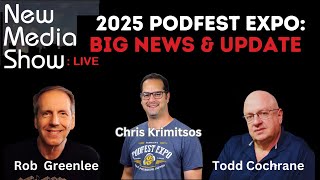
In the second half of this New Media Show episode, hosts Rob Greenlee and Todd Cochrane shift focus to product and event updates. Todd showcases the Audio Sigma Pod Mobile, a portable DSP‑enabled audio interface that supports up to ten participants via Ethernet daisy‑chaining, offers built‑in equalizer, denoiser, phantom power, and integrates with StreamYard as a DSP. He notes its price points ($199–$359), the lack of onboard recording, and announces a giveaway of two units at Podcast Movement’s Blueberry booth. The conversation also covers technical streaming challenges, including Starlink’s susceptibility to heavy rain and cloud cover, and the importance of reliable internet for live shows. The hosts then discuss the Podfest People’s Choice Awards voting process, explaining how they weight votes to prevent any show from gaining an advantage, the scale of participation (over 3 million votes, 900 shows), and the upcoming final slate voting. They mention the upcoming Podcast Movement conference (August 19‑22, Washington, D.C.) and brief industry news such as Auphonic’s new transcription tool and the AMBI awards opening for entries. Throughout, the hosts maintain a conversational tone, offering personal endorsements (without sponsorship) and practical advice for podcasters.
Chapters
No stream here yet. There it goes. I'm good.
Okay. All right, well, back with the New Media Show. It's great to have you back with us watching. Todd's here as well, and he's back in, in the US, in Michigan. So he's, he's joining us from his, his studio build. So how's it going today, Todd?
It's not the studio. Right behind me is not the studio build. I posted a picture on Facebook that showed the partial studio build. So yeah, yeah, maybe, maybe next week, maybe next week we'll be ready. So we'll see. But, uh, yeah, I went— I've been making multiple runs to the storage unit and dragging stuff back here. So, uh, the, uh, the, uh, I could not have anybody here right now because it is an ultra— well, let's just put it this way, I cleaned up behind me. And for Chris, if you didn't know, I, I lost my other studio. I I didn't get evicted, I got my lease terminated. So, uh, I, uh, had to vacate the, uh, location I was at. So I'm rebuilding. Yeah, it just sucked, but you know, it's life. But yeah, hopefully this new setup will work, and if, you know, bandwidth willing, we'll be— we'll be okay. But matter of fact, I was talking with an alternate party yesterday about some additional bandwidth, so we'll We'll see. I asked the company how much to bribe you guys to bring fiber down my road a mile and a half, and the guy says, you know how much it costs a mile to bring fiber? And I said no. I said— he said $70,000. I'm like, you know, if he said $10, I'd say I'll write you the check, baby. $70,000? Oh, we're gonna have to go on a Kickstarter to get that done.
Yeah, right. Yeah. And that would probably just to you, right? Is that the— is there any other customers that could get on that?
Yeah, yeah, just to me. But there's not enough customers from their point, you know, like 6 houses or something. So, you know, and no one's going to, going to, you know, say, oh yeah, I'll give you $10,000 to have fiber.
Yeah, no, that's true.
But anyway, well, here we are.
So, yeah, so we're lucky to have Chris Kromitzos with us, the founder of Podfest Expo that goes on every year down in Orlando. And Chris, thanks for joining us. I appreciate it.
Oh, thanks for having me. Last time I saw Todd, we were hanging out in the Philippines, in Manila, so that was awesome.
Yeah, that was. And I was able to hang out with Aya in Cebu here recently myself as well. So you guys got the royal treatment. Her and I just went from business to business to business. I think we, we visited 5 different companies in like 8 hours. So, um, yeah, so a little different visit with her, but, uh, yeah, it was good.
Well, thanks to both of you because, um, your support really helped us, uh, get Podfest Asia off the ground. Um, it was a shoestring, but we did it and it was awesome.
Yeah, and it's a little bit of a, of a sign of the direction that you're going too.
And that was a nice event and definitely 2 different, uh, perspectives, I guess. And it's always every—
yeah, I think you're lagging on us a little bit, Todd. So yeah, so I was wanting to have Chris here to talk about, you know, his big announcement that he had a few weeks ago now. Yeah, a, a new kind of partnership and folks in, in his company actually Cutting Edge Events, I guess, is the, is the new company.
Well, Cutting Edge—
is it a new company or—
no, no, Cutting Edge Events is the holding company for Podfest.
And I got it.
And the different things that Podfest does. And we added two, uh, managing directors, so two investors that are going to be working in the company to help us expand. Nick Pavlidis, who is, uh, he's been podcasting for quite some time. He started with 5 Minutes with Dad. He also owns part of Morgan James Publishing Group. And then Dr. Glen Vo, who is a big influencer in the medical space. So that's gonna allow me to do one thing, which is focus on building community, going out to different places. We just announced that we're going to Bogotá, Colombia at the end of the, in early September. So we're looking at really growing the international network not only the US, North America, but really growing tentacles into other parts of the world.
Yeah, that's awesome.
So, so are you actually going to have an event, event in Colombia? Is that the plan?
Yeah, yeah, I'll be, I'll be sending out some information shortly. So, um, that one's going to be a little bit different than, uh, Podfest Asia, which was a Podfest-specific event. This is— Podfest is going to a festival that's being held with creators in Colombia, in Bogotá. And we'll— I have a translator, Neil Gilarte, is coming down with me from Wild Style Media. And then we're also going to invite them to Podfest. So think of that almost like a foreign exchange program, like, hey, you guys come. So they're going to have a room at Podfest, we're going to have a space at their event. Isa is the head of the— that conference that we're part of. She's really big in the voiceover space. So We're excited. Um, Podfest is all about the independence, um, and helping the creators, but also now we're finding this really big source of editors, um, that also we want to bring to the fold. So you'll see a lot of stuff that we're going to do for the technicians behind the scenes. We've always been very supportive, but we're going to be doing a lot more moving forward.
So I also saw that you guys made a change to the hotel venue as well as the dates of the event. So yeah, I have it up on the screen so everybody can—
so yeah, I could, uh, I could tell you guys a great story, but basically we had a hotel confirmed. They knew they were going to close down, but they didn't tell us that. A month later, they shut the hotel down. I can't say much more other than we have lawyers right now dealing with that. Luckily for us and our relationships, we got a better hotel. They felt bad for us. They really found something for us. So we found a home and it's at the Renaissance, which is an amazing property. They gave us a really great deal for our community. But yeah, the hotel literally, I don't even know if it exists anymore.
Oh wow. Yeah.
So sorry, I want to be very clear. The one we were going to have it at, we have a great hotel now for next year. Everything worked out. But you could imagine it's stressful enough with these kind of businesses. Having your hotel just shut down on you just adds a whole different element of stress.
Well, and also when you—
if you have to change the dates too, it's a big cost too if you think about it. All the materials, all the things. So there's all kinds of stuff that goes into it. Luckily, um, we're working on it and we have really great members in our community that are, um, helping take on that case.
Yeah, that's great. Go ahead, Todd.
I— there must be some serious lag going on here because I said we're stepping all over each other, so I apologize. Um, So that's that, you know, losing venue like that. Did— I guess maybe you can't even say, but they still have your money, or it—
like I said, there's attorneys involved now. Um, unfortunately, a lot of these bigger companies, when they see smaller events, they'll say, hey, go get representation if you— we're not— we're good. They try and say it's force majeure. I don't get in the weeds. That basically means it's an act of God, which it was not. Um, so anyways, we got a really strong case and, uh, we're gonna be fine. But, uh, in the moment, this all happened, Todd, while I was heading out to Asia, by the way. Like, while I'm flying out to Asia, this is what I'm dealing with on top of trying to get my flights there. So, uh, it was great. So it all got settled. That's why I was so happy when I got to Asia, even though I hadn't slept for 2 days. And then all these amazing people were there, and Todd could attest, they were so grateful. And that's what I really loved about Podfest Asia in Manila. Thanks to Ron, um, who was amazing, that helped us, uh, with Pod Machine. Aya, uh, who's amazing, who has Architect My Business. We had some really great local leaders that helped us put it, put it on. But, um, for those that don't know, I almost didn't make it, uh, because of just flights getting delayed all the way through, and then the language barrier in Japan. I didn't understand exactly what I was being told, but I wind up getting on the right plane, and I got there with an hour to spare. So it was so much fun.
Yeah, you— when you come dragging your suitcase in, I'm like, oh yeah, you had just got off the flight. But, uh, you know, that's one thing, you, you hadn't slept in a couple of days and you did real well. You weren't too punchy. I could see you near the end of the day.
Yeah, but I was— I loved it, Todd. It was so good. And seeing you, like, there was a bunch of us, uh, you know, from the US, once we saw each other, we were making sure that everybody in the Philippines was welcome. And then they would— I mean, people come up to Todd, say, can I get a selfie? It was really nice just seeing how grateful everybody was there. It was great. And for Todd to share that with us, and thanks to Todd, we had lunch provided, uh, because of Blueberry. So people were really, um— that was one of my favorite events we've ever done, Todd, just, uh, from the gratitude perspective of the audience. It was really amazing.
Yeah, it was. And, you know, I think what it really shows me— and of course, you know, the big event in Florida in the, in the, I guess, and I guess it was, we termed this in the winter, it's not even the spring, right? I just kind of, it sets a different perspective for me, um, because I'm sure some of the folks that were in Manila may come to Florida and, um And I think it just— this would be a good extension. We'll see if you guys are able to do this next year. But I think that just the, just the seeing what's going on in the international market— and I talked to Rob Greenlee about this quite a bit when I got back. I didn't know what to expect from the panels. I just really kind of sat back and listened. And the folks that are running networks out there, it would have been the education that they were providing was equal to, if not greater than, maybe a session I'd set in at a regular event here in the United States. So it, it would— the level of content, the level of information being shared was, was really right there at a level 10. Um, it wasn't like we were year one into an event and the content and the, you know, the speakers and stuff weren't up to speed. No, no, no. The The education level of the content was really, really up there. And then the nuances of the, um, of the community. And one thing that I always just thought that was interesting is no one was talking about CPMs or anything. I was like, okay, is this a big secret? And I think just culturally wise, they don't necessarily go too deep talking publicly about money because I got 2 or 3 of them cornered and said, hey, you know, you, you beat around the bush a little bit, but what are you guys actually seeing for advertising? And they told me, it's like, oh, it's same as the United States. Awesome, you know. And to me, that kind of solidified the whole conversations that they were sharing with the folks that were there. Now, obviously, there was a lot of VAs, a lot of creators, a lot of editors— not a lot, as many creators, a lot of editors. Um, so Hopefully round 2 of that event will have more of the actual creators come as well.
I, I was shocked at how many amazing editors that we had, um, and what really cued me in, because I know I'm putting on the event, but kind of like Todd, I was discovering the same thing he's saying. We were discovering in real time, and that's why you have to do these events, because that's how you discover this stuff. Um, when we had Jack Baldini, our attorney, go up there And they were not asking the same questions that U.S. people would ask. They were asking very detailed trademark copyright infringement stories. And I think a lot of them have dealt with so many different creators, and in Asia they rip off things a lot more quicker. Like, things get ripped off left and right, I guess. So it was very eye-opening to how astute they were in that field, whereas like in the U.S., someone will ask a question, what is a copyright, what is a trademark? That's not what they were asking. They're asking, what happens if I'm working on something and this guy stole it, but I'm the editor and now they want to sue me? So it was interesting to hear these kind of questions, and it was eye-opening, kind of like what you're saying, Todd, how, um, how in-depth this audience was, the people we were pulling from. Um, it was really, really eye-opening for me.
So, Chris, on this new strategic partnership that you've got with these two new gentlemen coming in, and, uh, you And I know this is— you've been a one-man band along with the support team, of course. Yeah, right. Yeah. But, you know, I'm excited about this from just because you stretch pretty thin, my friend.
Correct.
And so, you know, I find that to myself all the time. I'm thinking, oh man, I'm a little bit too stretched too thin. So it's good to see you've got these other folks coming in and helping you out. And, you know, how's that changing And what's it been so far for the business and for the event? You know, how, how do you feel today? Here we're August and we're what, we're 4 or 5 months away, whatever the date is. Rob Greenlee, put that back up there. But how are you feeling today as far as an organization standpoint as compared to where you would be normally without this extra help?
I probably feel overwhelmed. I don't feel overwhelmed. I actually— you'll appreciate this— I feel like I'm not doing enough. And that's the whole point, if that makes sense. So because I'm used to doing a lot of the things, now I have teammates that could hand off different things. So we have already had record sales this far out, uh, people purchasing tickets way in advance than we normally would have. Um, and Nick published these as part of Podfest, so we had other people that were interested, but they just weren't part of the community. And you guys know this community is very special, and I've kept it that way. So finding a cultural fit was priority number one. So Nick Pavly has been a great partner to work with, so has Dr. Glenn Voh. They also have a lot of connections on there and that they're going to be bringing in, you know, just different sponsors, different access points that they have that will help the conference grow. But one thing that they have told me and I've told them, they go, the community comes first, and that's the key to Podfest. That's what makes it so special. So Um, that's where we're focused. And I mean, I start the pod tour next week. I'll be in Georgia for the pod tour, uh, and then I'll be at Creator Fest, which is not our event, some other event, but we'll have a booth there. And then we'll be going to at least 20 to 25 cities on the low side across North America, making sure that we reach podcasters where they're at and just keep growing, um, growing, growing Podfest.
Do you see a lot of the changes, Chris, being really on your, your outreach, marketing, local events, just trying to drive more, more attendance to your events and also on, on the international side? Or is it more diving into what actually goes on at the events, or is it just a combination of both?
So a happy number for us for a podcast would be for Podfest US, uh, somewhere around 3,000 attendees overall would be great. And then, uh, focusing internationally, and that's kind of where my focus— I'll be doing a lot of the US, but that extra time, kind of what Todd just said, that frees me up, uh, building those relationships, just trying to figure out where we're going to be in Asia. Because I could just tell you my gut feeling, and part of this is gut and also numbers, is we could attract about 500 people next year in Asia. Well, that takes some research and work to figure out where we want to be at while the operations are running. So we're excited about the expansion inside the US as much as outside, but we think we could tie this in. So one of the great case studies is a bunch of people did hire people out of Asia to work with them side by side at a premium, but the US podcasters obviously still get a good a good deal, but they're also paying a little extra because they want people that are well-versed in our community. So I know we have one YouTuber that hired a full-time person to work for themselves, uh, out of Podfest Asia. I know a few other relationships got made. So, uh, we want to keep creating those extensions of people working together cross-culturally. We are in a global world anyway, so, uh, Podfest is getting internationalized and it's going to happen very fast.
Do you see a lot of growth potential for the event outside of the US too? I mean, are you thinking about Europe or are you thinking primarily about Asia right now?
We, we like Latin America and Southeast Asia, if I were to be honest with you, for our growth, uh, for a couple reasons. Europe is slightly mature, but we also like, like, the scrappy independent. So that's kind of our MO, and we find that, like, Colombia Philippines, Indonesia, possibly maybe down the road we do Singapore. But like, those are areas that we think lend really well to our brand. And I wouldn't be surprised if one day in the near future there's a Podfest that's getting 10,000 people. Might not be the US, but, but it'll be somewhere in the globe showing up. Obviously we'd have to figure out if we can even do that, but, uh, don't be surprised if there's a huge event outside the US that's pulling thousands of people that are coming forward. Our, our community is special. I mean, Todd was there. I mean, people loved hanging out with them. They loved hanging out with us. I literally could—
I—
people didn't stop coming up to me thanking me for us coming out there. I'm sure they were thanking Todd. They were just coming up to us, thank you for being here, thank you for acknowledging us. Um, we see those individuals part of our community.
Yeah, they've had no had no events. They've been on their own. So, you know, they either do something virtual. There may— you know, there was another event that happened just here recently in either Singapore, I can't remember, some event. I, I— and we didn't hear too much news. Yeah, Malaysia. We didn't hear too much news out of that event. Um, but, you know, it's just like when I went to Saudi, it was the same thing. Was just a huge eye-opening to me. And, you know, there is definitely, like, you know, takeaways that I brought back to the team You know, that's why I went to Cebu here recently, is, uh, well known. I spent 2 months in the Philippines, um, some of it's personal, the other piece of it was a little bit of business. And, uh, to be honest with you, the quality of people, um, that the workforce in the Philippines has largely been known for many, many years to be— they work a lot of jobs overseas. Matter of fact, when I was coming back The guy that was sitting next to me was on his way to an oil rig in Louisiana, south of Louisiana, you know, out in the Gulf, um, working for a big multinational. And I was talking with him and he goes out there and does 10 weeks in, uh, on the oil rig. And then he goes back to the Philippines for 6 weeks and, you know, back and forth. He's flying more frequent flyer miles than I am. So it just shows you the level of workers that are basically almost going everywhere in the world. But at the same time, there's this burgeoning industry, um, largely started by call centers. But now you look at like, uh, she has 57 highly educated top engineers in the country doing engineering work, uh, outsourcing for companies here in the United States. She's a facilitator of it. And I went to another business and it's, I believe it's called a BPO. And there was 600 people that were doing everything from bank finance to I mean, the full, the full monty of skills. So what the advantage really is, at least in the Philippines, is everyone speaks English. So that gives, you know, less, less misunderstandings, that kind of stuff. So I can see why we had so many editors. And I actually visited a couple of businesses where podcast editing companies where All the, all the gentlemen do, or ladies and gentlemen do in that company all day long is edit, edit podcasts. And, uh, I was pretty blown away. Just that was just external of the event from Podfest. So it just made me realize there was opportunities there to hire some really, really good people.
We also had the senator, remember, Pia Gaetano, stopped by.
Yeah.
Um, so I— one of Aya's best friends is like the top senator in the Philippines. Like, when we say top, they wanted her to run for president. She declined. So she came by to hang out. And, um, Aya just told me she— I think she started a podcast because she was so inspired by all the podcasters there. Um, they also, uh, Todd, I don't know if you picked this up, but they, um, they love audio dramas in the Philippines. And I did ask why. When they were kids, they would have audio dramas. You know, if you think about what people could afford, if they couldn't afford a TV they had a radio, and the radio would play audio dramas, and they would paint the pictures. So they have a deep love for, uh, audio in that country. So, you know, I had no idea, um, these, these different things you discover. We brought Wally Green, who's a, you know, a former pro ping pong player, and we knew that would be a hit because we did our research. Asians love any kind of like ping pong or table, table sports, and I think Pia, the senator, actually has a private indoor tennis— paddle tennis is a new thing now— and she stole them for a couple hours and had them play at her place. So it's, you know, these things don't happen unless you're, you're in-house for it to happen. So it was just a lot of fun. Uh, it was hot, just like Florida, I would say. Um, but, you know, nothing out of the norm for me out here. We just got whacked with the tropical storm last week, so half my yard is still underwater.
One thing that kind of surprised me too, and I haven't told this story yet, I, I visited, um, a newspaper, uh, SunStar. I went out, seen SunStar's operations, uh, in Cebu, and, um, they basically have seen the handwriting on the wall. Now, here in the United States, we know that physical newspapers, you know, people are not buying USA Today or the New York Times in paper format. That's just a declining, just, you know, completely declining market. While at the same time, the digital piece is, you know, obviously ramping up and everyone's using, going to these traditional websites online. But, you know, they're basically saying, how do I survive this changing market? And they've essentially used all their editors, all their writers, all their people that do visual media, and they basically become a media company. And so they still doing the, the business of newspapers while that still continues, but at the same time they have this new pivot on a digital marketing. I thought it was brilliant. You've got all these qualified writers. You got all these people. This is what they do. They've done media for, you know, their lifetime. And now we're just going to switch to do digital and you're going to be like a regular agency. And I thought it was an incredible pivot for them. So I think, wow, how come some companies or some, you know, these media companies in the United States haven't made that pivot? I think they recognized it and really saw the handwriting on the wall and decided, okay, things are changing. We need to change. If we don't change, we're going to be extinct. And so for me, I thought it was a brilliant pivot. And of course, they're serving local businesses and companies there., in the Philippines overall. But I come back to myself and say, why isn't the, you know, why isn't newspapers that are dying here not doing that? And there's some writers and all the creators. So what are all those creators doing now? They're doing podcasts and YouTube channels and stuff like that.
Amazing. Yeah, so I wanted to ask, um, kind of, do you see, Chris, um, by doing these events outside of the US and Asia and other places, that, that it could bring more of a potential, uh, base of attendees for your Florida conference? Because that will probably still be your primary event, um, but doing this outreach all around the world, is that going to help grow your your Orlando event every year?
Uh, almost certainly, for sure. It's going to grow Orlando, and it's— we're really growing a very solid foundation. We had, um, the one thing that surprised me, because I, I don't— that was my first time in Southeast Asia. Uh, Todd's probably more expert because he's traveled a lot. Um, we had people from Vietnam, we had people from Singapore, you know, people came in and I would talk to them and they're like, hey, I'll see you at Podfest. And what was interesting, they were putting flight trackers to when they got a good price on a flight to come out that far out. So, um, yeah, we're going to see a lot of cross-cultural exchange. But I would love to also vice versa, right? Instead of half a dozen of us from the US next time, let's get 20, 30 people that want to come out there and hang out with 400 or 500 people in Southeast Asia. So I think you're going to see it. That's the whole point is to see it all across. Obviously, our US is right now our HQ, but the other branches should grow quite rapidly.
Yes. So we got a question from the audience from David Menendez de Silva, who asked the question, what can an indie podcaster expect to bring home as kind of like a benefit or a windfall from actually getting involved in a big podcasting event. So Chris, I don't know if you want to address it. I'm sure you think about that a lot.
Yeah, so like, um, one, you meet a lot of technical, uh, individuals. So there's a lot of really experienced, uh, editors that you meet. A lot of times people are looking for different people to work with. Uh, the tips, the, the education is incredible, uh, that people are sharing on how to grow. On what you want to do. And then the collaborations, you know, at Podfest we do have an influencer meet and greet. There's also the Hall of Fame, which we love. But the collaborations to learn from how the whole ecosystem was built is there. I always tell people, like, if Todd and Rob are in the room, go say hello. And they always, they chuckle a little bit. I'm like, no, they're the reason why the rest of us are here, you know. Todd's got a story giving Steve Jobs feedback directly. Uh, that's not a common thing. So like, they those are the people you at least want to talk to. I know when Todd teaches, it's always action-packed. He's always updating his stats. So people always say to me, hey, that's the 4th time I've seen him speak, but man, that's good to know what's going on because Todd updates his stuff. He's not telling you what happened 3 years ago. He's telling you what he sees today. So I think that's really important. For me, it's the community really, because let's say you're successful, you're doing well, You want to see your friends and see how they're doing, and the collaborations are, are ginormous to see your friends and compare notes and see how they're doing. But Podfest does— I, I'm obviously very biased, but I do believe we have some of the best, if not the best, education for independent podcasters because the education is given by them. Majority of the educators are applying. We go through literally 500 submissions and we make sure— we, we don't ask the question The question we ask is, how will this serve the community and is something that they're looking for? And that creates superior education on the stage.
Yeah, I think that's the thing that, you know, a lot of newer podcasters need to have as a takeaway is that all of us, you know, Todd and I included, we started off earlier in our podcasting career going to conferences and being involved. And sure, I was working for companies at the time that they that gave me that capability. But, but it's also, you know, building your connections inside of the industry and learning from others. And I think that the industry really has been built historically off of sharing and helping each other. And I'm, I'm hoping that that will continue. I think I have seen a little bit of a decline in that as people have gotten competitive in this medium and not, not sharing and helping others as much as they probably could. And that's a big thing that happens at these conferences is people are sharing and giving hopefully good information to, to others. It's not always good information, but it's also, you know, something that you have to, as a content creator, as a human, you know, kind of, kind of decipher for yourself what's good information for you. It's not always a perfect fit, but, but these things are all about building community and building relationships. I know, Chris, that's the big thing that you've been really doing with your Podfest conferences is building those connections to independent creators and not so much entirely focused on kind of the business side of podcasting per se. But I— there's a component to that that's coming to your event as well, I'm sure.
Yeah, there's networks that show up, there's connecting, there's networking, um, it's all there. But, um, yeah, at the end of the day, we want to make sure that your time is well spent with great people having a good time and comparing notes through the camaraderie. Like Todd mentioned, Aya— I met Aya through Jim Cirillo and David Allen Moss in the Cleveland pot tour stop last year. I have to mention that we love to get out to the Philippines. I've always had a great— kind of like, um, when I was a kid, I had a really great experience with the Filipino family that I was on a class project, and it was me, another Greek kid, a Filipino kid, and Michael Chang. To all of us, our parents were from other countries. And we all grouped up and we had to go do a class project. Anyways, one of the kids, we went to the house after school. And the parents didn't feed us because culture, I guess they don't feed the kids till later. Well, me and the other Greek kid, we like to eat. So we were starving. The next day, we went over to my buddy, Asinjo's house, and his family's from the Philippines. But this time, we told our mom, so they gave us like an extra thing to eat in case there was no food after. But they roasted a whole pig, and I said, what's, uh, what's, what's, what's this pig? And paella? Who's this for? And they go, for you guys. I'm like, we're like 14-year-old kids, like, what are you talking about? And I just— the hospitality— both parents were nurses, um, great people, because they still had the, the scrubs. They had just come off of work, and they literally made— like, when I tell you they put out a spread, I never forgot that. And that's one of the reasons I was like, I want to get back out to the Philippines, because I just still remember the warmth of that family. And I, uh, Ron, all these amazing people, they laid out the red carpet for us out there. So it was an incredible journey.
And I think the thing people have to remember too, because if you haven't traveled much overseas, you know, I've really seen a lot of the world. I've been fortunate to. And there's some places that, you know, are rife with poverty and it's very, very sad. But what I think we— what I was exposed to was incredible working spaces, more modern than even maybe what you would have oftentimes here in the United States. Um, on, uh, nurse on staff, uh, child care on staff, all these things that you kind of hear about big companies like Google and other folks being able to provide their employees. They're doing this within these BPOs for these folks that are working for American companies, and it comes as part of the package. So I was just astonished, to be honest with you, about this, um, about the work, but basically where they were working. Number 2, the policies around working where no one's being abused, people are being paid at probably higher wages than they would be able to earn in a local company. So I, you know, I was pretty astonished just from that aspect as well. You know, again, that wasn't even related to the conference.
We're just—
we're at this beautiful facility. And again, like Chris said, happy to have us there and glad we're here. And thank you. And Yeah, the whole nine yards. So there's something to be said. I think if you are working in a big city like New York City or something like that, you're used to these types of big working facilities. But not everyone lives in a big city and has this type of exposure. I was, I was pretty blown away. But again, oftentimes you've had this perception. Part of my challenge of hiring offshore was I was worried about, um, I didn't want to be that company that ended up in the news for not providing the right type of facility, the right salary, the right benefits, all those types of things that often you hear about companies, people hiring people, that they have got that locked down. Hey, you don't have to worry about, uh, a situation where someone's going to be taken advantage of. And I think that was a— that was separate from the event, but it just goes to show you where at least the Philippines is in regards to that type of, you know, if you're hiring VAs, I recommend that you hire a VPA through a BPO. That person will be absolutely unequivocally taken care of. They won't have to work from home. They can come and work with other people You're going to pay a little bit more for that, but I think that's ethically the way to go, especially for folks that are thinking about hiring VAs. And again, there's companies in— like Ron's company, um, that is doing this ethically, and the people you're hiring is getting paid a fair wage. Um, and to me, that's more important than— you know, it's important to take care of the people. So that's why I had hesitated in going offshore. I just I just didn't want to have an— I guess the better word is an icky feeling. Is that the right word to say?
Some of those buildings are, are world-class. I mean, they're— for people don't know, they're like energy efficient at the highest level.
Yeah.
Um, and the owners of the buildings, the weird part of it is they're like 33 years old. Like, you'll meet people in the US, usually it's like you have to work your way up. They're growing so fast, it could be a 33-year-old that owns a skyscraper. It's the craziest thing when you see it. And they're just so grateful that you're there. They're welcoming you. And they always got ping pong tables on top for what I'm saying, for break rooms. That's awesome. You'll take breaks because I said when we brought Wally over there, and obviously Wally plays ping pong, they're all excited to challenge him. And they grouped up around him. And anytime someone got a point on Wally, they all started yelling. They were so excited. And I said to Aya, thank you for bringing in the ping pong table. She goes, what are you talking about? So this ping pong table is here all the time. That's what we do during breakout. Just a really cool thing to see the employees taken care of better than, than some US circumstances, honestly.
So like personally, in, in the audit, the one company I was talking to in Cebu, ongoing education is just default. You have no choice if you're going to— even if you— let's say there's 20 companies that have people within this BPO. Everyone is getting continuing education. Everyone. Doesn't matter which company you're working with. It's just part of the package. So I don't know, I'm kind of like Chris, I was pretty much blown away. And it changed my perspective quite a bit. And we will, we will at Blueberry be hiring some people out of the Philippines, for sure.
And BPO stands for business process outsourcing. Yeah, it's a third-party company that helps support, uh, basically guarantees your results. If something doesn't work, they got someone else that could do the work.
And the main thing about it too is, is you're guaranteed that you are not going to end up on some list because you've taken advantage of someone because you paid them less than you should be paying them. So, um, that, that is not going to happen. And a lot of the employees that are in those have been with companies for many, many years. They state because you're, you're very fair in compensation.
So yeah, I think those are over, Todd. I think the, you know, when people would get people and brag about them paying someone a dollar an hour or whatever, now you got these middle companies that have, uh— Rob, one thing that I noticed, I don't know if you noticed this, Todd, and I did ask Aya about it, I said, hey, a lot of the girls have braces. And she goes, what do you mean? I go, I just noticed, like, a lot of the girls in their late 20s, early 30s have braces. I go, is it cheaper here or something? She goes, no, it's pretty expensive. And I go, why do they have braces? She goes, because they're making good money now and they invest in themselves. So, like, you know, here when you're a kid in the US, usually your parents get you braces. They're, they're now over the last decade, kind of like what Todd's saying, they're making good money, so now they, they will put it aside to get braces and things like that because you notice it. When you see all the young girls at a certain age have braces on, and it's because they're doing well and they're investing back in themselves. I, I thought that was pretty cool to see.
Now, wages for local companies that hired, like in grocery stores and other businesses, I'll be frank, the, the pay rate's pretty atrocious. Um, it is not, it is not what I would— it's not equitable. So, but it's what the market demands, and where folks are coming in, they've spent money on education. You have people with bachelor's degrees that are working at McDonald's. Um, that gives you an idea how it changes. You're not going to be a teenager going into McDonald's in the Philippines and getting a job. And I don't know what McDonald's pays in the Philippines, but I know the BPOs are paying a hell of a lot more. And, uh, and the quality people you're getting educated— you're, you know, you're getting bachelor's degrees, master's degrees, PhDs, depending on what you want. Your job spec, that, that, uh, those, those folks are available. Just like here in the United States, don't get me wrong, we've been big proponents of hiring the United States. But I just, I guess for the podcasters listening, if you're hiring a VA, please, please, please be cognizant of what you're paying them.
So what does that mean, Todd, to be cognizant? Is it to pay them more?
Is that what you're trying to say, or I'm just curious if you're, if you're paying a VA, and a lot of the VAs are working for more than one people. If you've got someone for 40 hours a month, uh, you should be paying them a month's living wage. That is, you know, not as, not as Chris said, uh, at this, at this minuscule rate. Um, And I don't really want to quote the pricing, but you should not be— let's put it this way. If you've got a VA for $300 a month and you're using them on a partial basis, let's say you're only using them for 10 hours a week and they can have 3 other clients. Well, maybe that's fair for $300 a month. But if you're using that person for 20 hours and you're paying $300 a month, you are underpaying. Significantly. And people say, oh my God, Todd, that sounds low. Well, the average wage, like I said, people that are on the working in a local community, um, it's very, very low, and, um, they don't make nowhere near that. So again, be cognizant of what you're paying your VAs outside of the United States.
Yeah, if someone's making $500 a month— not, I don't know about podcasting, like stick to what Todd said, but $500 a month is a good salary there. So if you can make $6,000 a year, that's good. If you're making anything like $750 or $1,000 a month, you're doing really well. And then I did ask Aya to take me to the, um, like where the poorest of the poor are there because I wanted to see it. So to give you a frame of reference for what Todd is saying, so we just told you what I would say the upper middle class are doing. When you go to the poorest people, they're buying drinks for two— I forgot what their denomination is, but like Yeah, peso. So you could buy like a drink for a penny in the, in the markets like you see on TV when they go to the poorest places, dogs roaming around. And then they don't— they can't afford to buy, uh, cigarettes by the pack, so they buy them by the stick. So I was asking, I said, why did he just pick up 3? Uh, he didn't get the whole pack. They can't afford it. So it's like a peso for a stick, a cigarette stick. So that's what you're talking about. So think about that. If they're buying a drink for a penny and 3 sticks for 3 cents or whatever. And that's a lot of money because they're at the, the bodega, so to speak, the corner bodega there. So when you're doing 500 a month or more, you're doing really well because those people— what Todd is saying— they're taking care of their family too. They're not just using that money for themselves. The older generation might not have the education or speak English as well, so there, that money is like fueling the entire ecosystem.
Yeah, I think, you know, from like the cigarette by the stick is like 12 pesos, so, that would be like 20 cents, that they would pay by the stick if they're buying it like that. Um, 58 pesos to the dollar is the exchange rate currently, 57.5 right now, I think. But I also, at the same point, um, if you get someone that has a bachelor's degree and has experience, um, 600 is actually too low. Per month to pay.
Uh, what do you think about $1,000?
I think if you have someone that has experience with a bachelor's degree, it's probably gonna be around $1,000. Now, if you get someone that has an MBA, you're probably talking $1,200 or $1,300 a month with an MBA with experience. Um, that is paying way beyond, uh, way beyond national average. Um, whereas a doctor in the Philippines, believe it or not, may not make $2,000 to $3,000 a month. So that gives you some perspective. If they are a city doctor, if they're a country doctor, you know, they might be making $1,200 a month. So it just kind of gives you the deltas. But this is why you have such enthusiasm for folks that are working for foreign companies. And doing a fantastic job.
It's life-changing. Yeah. So let's, let's change topics a little bit and kind of, kind of wrap up with Chris here a little bit and talk about what's, what's coming up and how maybe our, our viewers here or listeners can get involved with Podfest right away. I know you've got the pod tour coming up here, Chris.
So yeah, if you're Atlanta, I know Dave Jackson's flying in from, uh, Ohio to be a part of Atlanta next week. So feel free to come out August 14th. I'll be at Creator Fest after. That's a private event, but in case anyone wants, let us know. We could get— we got some codes there. Uh, Bogotá right around the corner, early September. And then we'll be posting Eventbrite links within about a week, uh, Most of these events are free. You could just register on podfestexpo.com, hit Pod Tour, and join us in the different cities that we'll be at. And then if you'd like to get our newsletter, which we release once a week— we just released one this issue— podfestmessenger.com. Larry Roberts is our editor. He does a great job putting everything together. Feel free to subscribe to that. But hopefully we'll see many of your viewers and listeners over at Podfest. It'll be our 11th year in person. Um, we— the way the luck worked out, we never missed an in-person year, so it'll be 11th consecutive year at Podfest.
Yeah, so you've got a lot of events coming up that people around the country can— can—
we're going to post a lot more, so that's just the opening. Oh yeah, yeah, this is just the open. By the end of August, you're going to see because we work with local leaders, so we're also working with their schedules. And then I might be at a bunch of them, but other team members will be at other ones. So we're excited. We had a huge audience in Toronto last year, so we're excited to— within Canada, there's so many people hungry that want to get together and they just haven't had the opportunity.
So what usually goes on at a Pod Tour event? What's the What's the program look like?
So this year the theme is video podcasting. We just think video is a big thing. We saw that out in Asia. Um, so the theme will be just a couple tips on how to look good on video, uh, how to produce really good video. Um, so that's this year's theme. So we just go through 10 different steps, but that's about 20 minutes of the presentation. The rest is if we have some veterans of Podfest, we might bring them up to do some Q&A. Like very informal, and then we all hang out and chill. Uh, give everybody a code on site to join us at Podfest. Um, you see there, Cutting Edge Events, which is the company that runs Podfest— scroll down a little bit, um, you'll see it right underneath— we have over 31,000 people that, um, have attended our events. So like on Eventbrite, that's like almost unheard of. So we've hosted— I don't even— I lose track, so I don't even want to say the number because it doesn't sound real. We've hosted a lot of events supporting podcasters all over the world now. So, um, I'm really grateful to that because when we post an event on Eventbrite, I think we're over 60 RSVPs, and it's a week out. We'll have well over 120 RSVPs for Atlanta. Um, how many show on a free event? About 50%. So 60 people show up, we'll have a great time, and then, um, we give them an opportunity to join us at Podfest. So Atlanta is a great city for us. We'll probably go there again before the year's up. But we just love it up there.
So it goes from 7 to 9 PM Eastern on Wednesday, August.
Yeah, so format 7 to 7:30, light networking, everybody's saying, hey, how you doing? Where you been? You know, welcome new people. 20-30 minutes of presentation, we keep it very simple. If I have a PowerPoint, I have images that correlate with a handout, literally, because that way, if if we don't have PowerPoint, we don't want to stress out. Here's the material. And then, and then after that, we just connect, we just hang out, and then off to the next step.
Okay, yeah. And then back to Orlando, and then Clearwater. So there's—
and then, yeah, we're gonna do a lot more in Florida, Colombia, Bogotá. I've never been, so I'm excited. It'll be my first time in Colombia.
Yeah, it's awesome. One thing about Colombia is brush up on your Spanish because they're not as much— there's not as many English-speaking people in Colombia as there is in other Latin America countries. So that's a real heavy Spanish. So, uh, uh, yeah, brush up on your español.
I will do it. We'll do it. I got Neil Gillarte who will help on that one. But, you know, the fact that you say that in the Philippines, very easy to get around. When I was in Japan, not everybody speaks English like they do in the Philippines.. And the people of Japan are so respectful, they give you exact directions. So little things like they don't tell you like, hey, that's the last bus, if you miss that you're not getting another bus. They just tell you here's where the bus stop is. So you learn a lot about cultural differences in communicating. But I had a good time in Japan too. We spent— since I was over in Asia, kind of like what Todd— I think what I learned out of this is don't be so Uh, for me it's always been like, oh my God, the plane ride's so far. But then you get there, you're like, why haven't I done this? You're like, over that dumb little logic. So I'm excited to expose my family to those countries in Asia. I was just so impressed with the people and everything.
You know, it's— you know, people say, oh, it's, uh, like fly out of Chicago to get to Narita is, you know, 13, 13 and a half hours, but you're gonna sleep part of it. And you're going to arrive like at 5 o'clock in the afternoon and, you know, be able to get your— easily get around and get your hotel and sleep the night and then be ready to rock and roll the next morning. So Japan is a great destination. Um, all of Asia is not that hard, but it is a, you know, typically depending on how many connections you have will be a 24-hour day. But once you're there, then if you've got 7 or 10 days to spend there, then you're good. Um, but you know, one thing I tip for you for Japan, Chris, is Google Maps will get you around the subway in a big— it's, it's fantastic. Um, it's unlike any other place. I'll be using it next time for sure. Yeah, because you have to get— tells you even what level to go on for the train sometimes. Yeah, and it'll say, okay, go to this exit, turn left. And, um, but yeah, so the trains are the way to go in, in Tokyo. And anyway, it's, you know, most countries have better train station— train situations than the United States. You know, I'm riding Amtrak and it's like, you know, my chair is dirty, you know. So I'm like, you're not going to find that in, uh—
oh, Japan was the, the, the trucks. You could see your reflection in the trucks. I've never seen that before. Like, they— like trucks that work, trucks like oil tankers. You could see it was, you know, it would be in front of us and I could see my reflection. And you know, they use it every day and yet they clean it meticulously. So it was incredible. It just, I don't know, uh, I went to one of the, uh, Moss Brothers, which is like a fast food in Japan, and the lady looked at me and repeated my order back, looked at my eyes, asked if I agreed to the order, then she pointed to the pictures. I mean, the level of detail, even at like a fast food place, was incredible.
Well, you, you may have got that in Japan. You may not get that in the Philippines.
No, no, it was— that was in Japan.
Philippines, more you can have a good time, but you're not going to get that. Sometimes you get to get your order read back to you, then you get your order and you're like, this isn't what I ordered. But you know, it's, it's just culturally different every place, you know, and I was able to go over to Thailand for the first time in 30 years for 7 days, and nothing has changed there but the food. You know, I thought, my God, I could, I could become a vegetarian in Thailand because the food was just, I mean, um, off the chart and inexpensive. So it's just those types of things that, uh, you know, those little things that are cool to do when you're in specific countries, not not less doing the tourist thing. And I know you got to do a little bit of tourist stuff while you're over there, which was good because awful, awful long way to come just to do business.
Yeah. And I've, I've never been to Asia, so this whole conversation is kind of new to me. So it's great to hear. Definitely. And, and Chris, thank you so much for, for joining us today.
Thank you both. And thank you for all that you guys have done for the podcasting ecosystem. I don't think people I know your audience probably realizes, but I try and tell the podcast audience like, hey, there's people that help build the steps that we're all stepping on. And thank you for laying the foundation many, many years ago and still being on top of it today, which is—
that's hard to do. Chris, we got to give credit though. There's a lot of new people doing a lot of great things too. So, oh yeah, we're, we're learning from them as well. I go to events, you know, I like— I try to— it's hard for me I try to listen more than I talk. And, uh, it's amazing the ideas and what people are doing in the space right now. So we may pave the way, but I tell you what, there's a lot of folks now, they're doing some incredible work out there. And, and I think we've started to see some of that, those folks, you know, you see them at your event, we see them at other events, uh, putting out great information. So, uh, you know, it's one of those situations where you can treat an old dog tricks and then I think that's what both Rob and I try to do is try to stay up on, stay up on stuff. And we're not perfect. We're still a little bit of old curmudgeoned in certain ways.
But when you go so much for so many years, it's hard for us not to be a little skeptical of some things.
And yeah, so, and when you do your video focus, remind folks that there is video podcast in Apple Podcasts, even though they make it a second-class citizen.
Hopefully that'll change in the new year, maybe. So who knows, right? So yeah, so if you have an interest in going to Podfest at a new hotel, I guess that, that new hotel, I get a sense, is literally a newer hotel.
So it'll be a world-class experience. Yeah, yeah, very nice. Thank you guys for having me on.
I really appreciate it. Yeah, well, thank you.
Bye, Rob. Bye. All right, so yeah, that was, that was good. Kind of a little bit a different topic than normal. We do hear a little bit of more inside baseball, I guess. I don't know. I switched to a different internet connection, so it seems to be doing better.
It's more stable.
Are you not on Starlink? Yeah, I'm not on Starlink right now. I'm on my point-to-point right now, so it seems to be working better. So Lesson learned there. I think I'll be using that here on out until it fails. Hey, by the way, um, there was an article in PodNews today talking about how Spotify is now trying to poach podcasters. Uh, basically they're advertising, uh, their services against us directly to podcasters on Spotify. So, you know, and, you know, I, I'm— we're doing fine. And because Spotify hasn't killed us yet, right? You know, free isn't always everything. You know, I just want to remind people, and I think it's really, really critical. You know, that those of you that are listening that are podcasters, I think it's, I think we need to remember what you give up, what you're giving up when your podcast is on Spotify and when you're hosting at Spotify. And I think it's really, I think it's really critical to remember that Audience privacy is non-existent. You, you basically have sellout your audience. Your audience is being marketed to and you, the podcaster, are earning zero. They're being remarketed to outside of Spotify. Remember that Spotify is paying almost nothing to music artists. They— the only reason they're paying them is they have to. And Spotify's not a friend of RSS. On top of that, they own Chartable and they own the former PodSights, which I now is, I think, rolled into Megaphone, or maybe it's actually part of Spotify. They can take all your IP data from those two services and target your listeners again and again and again and again, and you get nothing. Now, if that doesn't matter to you If any of those points don't matter, you don't care about your audience privacy, you don't care about your audience being resold to, then just remember this is what is happening. Um, you know, for years people got tired of hearing it. They'd say, Todd, what are you doing with stats data? We don't do nothing with it. We don't resell it. I've had people try to buy it. Had people try to buy insights. And we've had people offer very, very big checks for us to give up information, probably into the tune of several million dollars over the life of the company that we have said no. You know, so I think just remember that. And, and, you know, when you have this urge to save some money, which is, you know, your choice. Just remember that you are the product and your audience is the product.
Well, and also I think, you know, Todd, think— thinking about the broader industry too, if, if everybody, um, shifts over and does what Spotify would like everybody to do, it's also potentially could be a, a cause of the other little piece of news that came out today, which is I guess there's rumors of a fairly significant podcast hosting company has lost its CEO and has sold part of its business. So sometimes what triggers those kinds of things are when too many customers leave a platform and they're not viable anymore. And I think we've seen this happen many times over the years, so this isn't kind of a new thing, but I think in this climate right now, it's, you know, we may see it happen more, um, where there's, you know, some of the smaller hosting companies struggle because of efforts like what Spotify is doing to siphon off paying customers off of other platforms into a free platform that, you know, may not be good for the overall industry of podcasting.
You know, if I was a betting man and knowing the structure, you know, I have stock in Blueberry, we have stock, it's privately held stock. I have to give, well, I have a, we have some rules around stock sales. So, you know, it's not like I can just go and say, here's my stock, you want to buy it? It's not as simple as that. But some people are holding a different kind of stock that they very well could sell. If I was I, I have a feeling I know who this is, um, and it's not going to bode well for them, uh, long term based upon everything that's been going on. Uh, I will just— I'm going to hold judgment until it's announced, if it's—
if we see something come out. Um, yeah, I don't know. I don't know who it is either, but this type of scenario typically happens inside of of a larger company.
And he said major. He used the word major. So who's a major podcast host? Uh, we're a podcast host. I don't know if we would be considered a major. We're not in the top 3 or 4, right?
So, you know, well, I mean, major— I could envision this happening inside of, you know, I'm just speculating right now, um,, you know, inside of like Amazon or inside of like an iHeart or somebody like that that wants to look, you know, kind of pass on, you know, some—
okay, the CEO doesn't have stock. The heads of those at Amazon and stuff, that, that no way it's from them. It's got to be one of the top regular 5 traditional companies from a structure standpoint.
I know which CEOs have gotten stock. Um, okay, it doesn't say anything about stock.
It doesn't say anything about stock. Yeah, I think it said something about stock.
It said, uh, it said sold part of its business to someone else.
That mean— that mean— well, if you sell part of your business, that is stock usually. Well, it could be a technology or a platform that you're selling to someone else. In Pod News, he said—
let me go find it.
Well, I have it right in front of me.
Yeah, they said— has lost its CEO and has sold part of its business to someone else.
Okay, so if you hold stock and you sell your stock, you have sold part of your business.
Well, sure, sure. But it doesn't say stock specifically. So, yeah, okay. You know, yeah, I mean, stock is usually associated with a whole company, not a part of a company.
Well, it depends on how much, you know, I hold a percentage of Blueberry through my stock, you know, and okay, if you took it to mean that, Todd, that means that they're selling a part of a bigger company, right? So to me, I don't know, we'll find out if there's any truth to it. Yeah, we'll, we'll see. Um, again, it's like the, uh, speculation journal at this point, right? Right.
Yeah, I mean, I mean, it could be completely incorrect too.
So yeah, because it could be just a rumor of nothing.
Yeah, because actually this has happened in the past too. I think James had something that came out a couple months ago that was about some company selling or something like that, that there was going to be some big announcement that happened with that and it never happened.
So, well, I know some insider baseball on that and I can't say anything without—
So it was a sale of something that didn't— I know.
Okay, so, so how was that different? Uh, well, let's just put it this way. There's always people, there's always people that are sending me emails saying, hey, we'd love to talk about buying your company. And, you know, let's say you go into a due diligence, uh, round, and then you get close to a term sheet, and then you get the term sheet and it's not so, so, uh, great terms, and you say, uh, you know, pack sand. Yeah, you know, so, you know, right, I've shredded a few, uh, term sheets in the past. Um, you know, one in particular that, uh, can't get sued anymore by him.
So what you're saying is it may have been pitched but it didn't happen.
So yeah, I got pitched, and yeah, when the cell phone was next to the shredder and it was, you know, that was, uh, you know, the end of the conversation. But you know, so there can be deals are getting close and then the deal doesn't go through.
And I think that's probably more common than the deals that go through.
Yeah, I'm sure. Right. So, so then, you know, someone is, and if you're a public company, technically none, you can't really, you have to, I'm a private company. I can probably say whatever I want now. I might get fired for saying it, but if you're a public company, there's definitely rules. On what you can say because it could make the stock do this and you get in trouble with the SEC. So we'll see, we'll see what— see if there's any— again, I, I have my Ouija board out and we'll see how it goes.
Yeah, I also saw that, uh, Brand Safety is back in the news big time.
That's good.
I'm glad, I'm glad Elon's suing them.
Was it, uh, Elon as well as Rumble? Well, X actually— X is some— essentially Elon is suing Garm. So, uh, I, I personally think it's well deserved.
I was, I was a little bit surprised by the, the video that was put out by the CEO of, uh, of X, um, uh, Linda Yucker Arrow, um, you know, that she made some of the comments that she made in there. I thought it was really kind of interesting that they had, they had discovered significant evidence of, um, kind of collusion amongst advertisers to specifically target, um, those two platforms and, or individuals. And we've— Yeah, yeah, right. And it's interesting, you know, we've talked about brand safety and suitability and those platforms and Garmin and things like that. And Garmin is definitely in the crosshairs right now of a rating system that is proving to be giving people a tool to kind of moderate content. It's not so much as innocent as as I think many would like to kind of project it as being. But, you know, I think if you're on the advertising side of this space, increasingly those GARM criteria through brand safety are getting integrated. And I know that there was some news that came out the last week or so about the benefits of having brand safety tools built into podcast hosting companies. And increasingly I think we're starting to see that start to develop now. So that would cause a situation where those brand safety tools were made available to content before it was published, which has been kind of like the, the opening that has kind of held those platforms back, is that it was only applicable to past content. It wasn't being used to prevent the publishing of current content. And so if that can be— if that technology can be integrated in with podcast hosting platforms, that means that when you publish and when you upload an episode, it automatically goes into the brand safety tools and gets rated before it even is actually made available on a public—
well, I think those companies have integrated that should be called out. Well, I don't know who all is integrated. I have a pretty good idea of at least two.
Yeah, no, I know of a couple too, and they're, they're out there, you know, proactively about it and promoting it as it's the next great thing to slice bread. And I just wonder if they're— they, they may regret that, um, here in the next few months that they've been out there so much getting in front of it, right?
I think, I think every company that's a hosting company that's doing that, it should should have to disclose, and their podcasters should know that their content, you know, might be being subjected to some downward pressure. And that's all I'm going to say at this point. Hey, I want to share today, um, sure, today I'm using— well, I have two of these. This is called the Audio Sigma Pod Mobile. This is Gen 1. Um, the unit that I'm using today is a much more advanced, uh, unit. But, um, what I'm doing with this today is powering my SMB7. I have, uh, the ability to send a monitor out. So we're, we're live and lit. I believe we are, unless I've touched something. Well, I don't see it working right now, but I know that we've been live and lit most of the day. How come I don't see nothing on the monitor anyway? But anyway, The only thing this thing doesn't do is record. It's got the ability to have an equalizer, denoise. It's got some functions, basically phantom power and the like. So why isn't that working? Oh, I got a cable that is goofy. My apology here. Um, anyway, so we've been live and lit, but you might not have heard anything. Anyway, anyway, this is from Audio Sigma, and, uh, I've been using this here as the studio is being built. Um, when I did my tech show on Monday, I used this with, uh, on, on-screen recording. I went old school. I recorded with Adobe Audition, um, not using any third-party tools, so This is a great, great tool for anyone that is looking to have a rig that will go on the go. And the amplifiers in this thing is— they're off the chart. Uh, beautiful sound come out of this. Audio Sigma Pod Mobile.
And if you're a podcast movement—
oh, it's Audio Sigma. It's called Audio Sigma, S-I-G-M-A. And, uh, it's currently being sold purely through a partnership with the BSW, but they will have— we're going to give 2 of these away at Podcast Movement. So if you're going to Podcast Movement, we'll have 2 of these Podmobiles to, to utilize. Again, very, very small, comes in a nice carrying case. In fact, I didn't have a carrying case for my original, and I saw the carrying case that he delivered the new one on, and I went on Amazon and tracked it down and ordered another, uh, a second case, um, so that I have both these now in a, in a, in a hard case when I, when I need to travel and so forth. But, uh, it's a great— if you'll be doing a solo show, and this integrates with time— we're using StreamYard right now, so it, it's seen, you know, by your computer as a DSP.
Mm-hmm. Yeah, I see it's got a— it's got an Ethernet port jack on the back of it here.
Yeah, that's for daisy chaining them. So this doesn't— this doesn't connect to the internet, it just daisy chains. So if you want to, it comes with a USB-C as you see in the bottom. Yeah, right. Yeah, right here. That connects to your computer and then the mini jack on the bottom left. One is an aux in, one is an audio out, and then headphones at the top. On the back side of this are selectors too for denoising. I don't know if they show it, the back side of it, or not. Yeah, I don't know, I can't see it. Yeah, but on the back there is selections again for equalizer, and it's preset levels. You can set 4 different levels or 3 different levels. Denoiser as well. Um, you have a mix feature here where you can basically left-right people. Um, yeah, so it's, it's a great unit. I'm— I love the work that the originator— I, when I first saw this a couple years ago, I bought one on the spot right out of his bag. And, uh, he— I got the second one here just, uh, a week or so ago, and Um, but anyway, if you're looking for a real nice portable kit, this is it. Do these, um, have a good kind of gain boost in it for an SM7B? The amplifier in this is off the chart. Nothing— there's no— I— that I know of at this price range, uh, you know, this is the— this is what you see. There's no lift booster on my SMB7. This is the— this is pure purely, and I only got the gain cranked maybe a quarter. Um, so yeah, it'll, it'll handle an SMB7 no problem whatsoever.
Okay, so here is the domain name if you want to go, yeah, read, read more about it.
So, uh, stop by the Blueberry booth and we're going to be giving a couple of these away. There are some criteria to win, but, uh, you know, maybe we'll have it hooked up to a computer. You can try it. He's going to be at Podcast Movement, um, at the— I believe the BSW booth. He'll be there with these units if you're going to Podcast Movement. You definitely want to go. Once you hear this thing, there's no— there's no shh in my ear, Rob. None. Zero.
There is no—
very, very quiet preamp is what it sounds like. It's fantastic. I don't hear any background noise whatsoever. It's as clean as anything I've ever used. It's— this is the sound out of this is cleaner than the RODECaster.
Uh, yeah, so what's the— okay, so the price is typically $359.
$359, yep. And they have a single unit. Yeah, for two, basically it can handle two people, or again, like we're doing here, we're tied into StreamYard. So this— okay, so this will tell you something. This is an Adam Curry approved device. Adam tried building one of these on his own and spent a lot of money and couldn't do it. Um, this is the same, you know, I turned it on. It's a pretty high-end unit. Oh, it's, it's a high-end unit, but it's—
yeah, I'm going to tell you, $289 for for just the single, uh, you know, track input, right? Worth every penny. And then $199, it looks like, for, for another single.
It's called the Mic Hero. Yeah, so you have to look up the difference on these, and some of those are older models, um, I believe.
$199, I think. But yeah, that's what, that's what this one is here, is $199.
But the new one's got all this DSP processing on it, makes it completely— it's, you know, the difference between the unit I've had for a couple of years and the unit that I've just got, it's— it's even though the unit before was fantastic, this takes it to a whole, whole new level. It's 100% better than the first unit that came out. And I thought the first unit was pretty doggone good.
So when it says it can accommodate up to 10 participants, does that mean if you get like 5 of these things you can daisy chain them? Yep, yep, sure can.
Through the Ethernet port, is that what—
yep, is that— yep, how you would do it? Okay, yep. So you could have as many as 10, 10 people all on one, right, one channel or one, you know, show, I guess.
Yeah, if you had that many guests on the table. Yeah, yeah, you know, and if you're gonna— if you think about a RODECaster, you can have 4 people. All right, so you think about the price of a RODECaster, but 4 is it. So if you're going to be doing some sort of roundtable thing where you have 6 or 7, there's not a lot of devices out there unless you hump a mixer to be able to— true, but that mixer is going to be pretty big, and it's going to be big. These are just—
throw these in a suitcase. Yeah, yeah. I mean, just, just 2 of them would get you 4 people, which is right, right. It really is most, you know, that you're ever really going to need.
I think, you know, if like we go to CES, I could see having a third one. But, you know, the only disadvantage of this is it doesn't have onboard recording, so you have to record a third party. So either you record— because I was running StreamYard and Adobe Audition here on my iMac, and it handled it just fine. Adobe Audition was recording the iMac, uh, StreamYard was doing its thing too. So I really had a double backup because StreamYard recorded locally and, um, the, uh, the, the device I use addition. So maybe your MacBook would only be able to handle just doing StreamYard, but, um, yeah, I'm, I'm pretty stoked about this product. I fully, fully endorse it. I don't get paid to say that.
Yeah, well, it's not an—
there's no endorsement deal going on on this one, right? No, no, no. It's just my recommendation. I will say he did send me a free one.
So he sent me this. Yeah.
Maybe there should be though. But so, but you know, I, it's, what's interesting was, is when I introduced him to Adam, Adam gave him a whole bunch of feedback. I wish I had this, this, and this. And when he built the next gen, he basically, him and Adam, my understanding is they collaborated together. And that's why this now has a denoiser. That's why it has an equalizer. It's got an ability to do split. And I don't fully understand that. There's a record mode. So maybe it sends back a single channel or splits. It says split stage and normal. So I'll have to look at what that means. Maybe it means it sends two 2 individual tracks back for those of you that like to edit. It's got a loopback function I'm not using. It's got phantom power, and you can even plug it into external power supply, but I'm running it right off USB. It's working just fine.
So yeah, anyway, that's what we have. That's the audiosigma.com/podmobile. So if you're listening to this in the audio version, anyone you want to go check it out, it's audiosigma.com/podmobile. And so, Todd, let's, let's quickly talk, uh, about in the last couple minutes about your People's Choice Awards.
Yeah, Slate was announced, right? Yeah, Slate was announced on Monday, and, uh, we've got about 20,000 listeners casting the final ballot. So you can go through the list of folks that were that were nominated. So we've, uh, you know, we've made it to this next stage. So what we look at next is the way we came up with the list of people that are voting is we know because they have a login who voted for what. So when we extract our— we had, uh, this year a little over 3 million people participated, 900 shows, around 3 million people, down from last year. 3 million people participated in voting, and then we have an option in the— when they signed up to vote for the nomination, they can opt in to be part of the final slate voting. And then what we do is we know who voted for what, so we do a weighting on the list. So that, as an example, and I'm not going to say a show name, let's say Show 1. Let's say Show 1 had 1,000 people nominated, and show 2 had, um, 700, uh, nominated. So in the end, if we would have just took 20,000, and we probably would have ended up with more people for show number 1 in the, in the final voting pool. So what we do is we adjust it. It's weighted so that no show has an advantage over another show when it comes to final voting, and that's pretty tricky. It takes my, uh, team over at One Technology— it takes them about 24 hours to get that list together. Um, so that's where we're at. We're in final voting now. Some of the categories were a little short, uh, this year. We didn't have as many Spanish entries. Um, there's not as many Asian shows either.
Hmm. That's interesting. Yeah. Yeah, it's awesome that it's coming up here. The awards are going to be given out at the end of September, right? September 30th. Yep. As part of International Podcast Day. Yeah. So that's awesome. So trying to think, is there anything else that we might want to talk about, Todd? Anything top of mind with you? I know I guess there's always stuff going on in the news.
Yeah, I don't have anything pressing right now.
Trying to think here if there's anything that jumps out. But, you know, there's always new things that are coming out on the technology side of podcasting. I guess Auphonic has launched a transcription tool, I guess. Which I guess is new. Looking at anything else, I guess the AMBIs are now open for entry too. But I think that's— we could probably call it a day, Todd, if you want to.
All right. And apologize earlier for my weirdness in the streaming connection. That's okay. That's going to be the challenge here. That's the thing I've got— I'm worried about the most is, you know, and it's raining. If it's raining hard, I'm done. I won't be able to do anything. Spot—
the Starlink goes down. My—
oh, it's the cloud cover. It's the cloud cover. Cloud— well, cloud cover. The Starlink is more affected by rain, but the point-to-point still is too. It's affected by heavy rain. So interesting. I'm pointed— I'm pointed in an antenna 13 miles away. So that's what this stream is right now.
So anything gets in between that heavy rain, that signal doesn't, doesn't do as well.
It can slow it down, right? Yeah. And Starlink just does not survive heavy rainstorms at all.
It's bad. Really bad. Yeah. And just to let everybody know too, Podcast Movement's coming up in a couple weeks too, down in Washington, D.C. on August 19th through the 22nd. So if you haven't booked yourself for that, that would be a good event to attend if you're inclined. Absolutely. So, well, anyway, Todd, we should probably sign off. Why don't you tell people how to, how to find you?
@geeknews on X, geeknews@gmail.com on the email. Of course, you can reach me at on Mastodon at @geeknews, @geeknews.chat on if you're on a Mastodon account. So those are the 3 primary ways.
Yeah, and I can be found, uh, at X as well, @RobGreenlee, and on LinkedIn and, and YouTube and all of the platforms like that as well. And definitely come back and check out the show next, next Wednesday. I'm assuming that we're doing a show next Wednesday.
There's no conflicts that you have. Okay.
I don't have any conflicts. So I think next week we'll just come back and just do a regular show with you and I, Todd. And okay. And because I know we've been on a, a guesting spree lately, so I think it's time for us to kind of get back to our core, and that's talk about the issues in the medium. So, so absolutely. Yeah, sounds good to me. So Well, thank you everybody for being here, uh, for the show today. And this is our website, uh, newmediashow.com. That's where we post all of the podcast episodes that you could keep up with and check out. And then obviously on all of the, the main podcast listening platforms, uh, we have an audio and video feed, so you can consume this show in its video form if you would like on Apple Podcasts, like we keep saying. And then and then also on, on a couple of different YouTube channels too, off of my YouTube channel as well as Todd's. And so, so we're trying to embrace all the new stuff, aren't we, Todd, that we've been doing for 12 years?
Yeah, well, we're not embracing nothing new.
It's just abnormal here, right? Exactly. So.
All right. Take care, everybody. Thank you so much. Yeah.
More from Rob

Future-proofing with Delphi AI/Human clones: your podcast as a personal LLM | New Media Show






How sports reveal what AI spectacle gets wrong #Technology #Sports #Commentary



