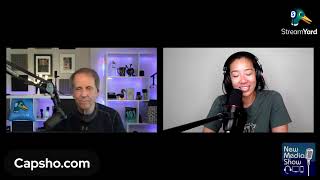
Rob Greenlee and Deidre Chin of CapShow discuss Podcast Movement 2023, where AI dominated the conversation. They cover how AI handles post-production and marketing assets, the rise of AI-generated voices, and whether podcasts can stay authentic as the technology advances.
Chapters
Well, welcome to The New Media Show. It's great to be back again. Todd Cochran, my co-host, has decided that he's going to head off for a little bit of a vacation. I guess the podcast movement wore him out or something like that. But my name is Rob Greenlee. If you haven't watched The New Media Show before, I, I occasionally will, uh, be the lead host on stuff when Todd's gone. Now, now that I have an account with StreamYard, I can jump in and say, okay, Todd, go off and have your vacation, I'm going to continue the show. So, so, but I'm really lucky to have Deidre Chin with me from CapShow, and she was at Podcast Movement, right? And welcome to the show. Diedra?
Thank you. I feel like I'm the poor stand-in for Todd. I've got big, big shoes to fill, for sure.
Yeah, it's, it's, it's kind of interesting if I think about kind of the, the life of this program, this, this New Media Show we've been doing for like 12 years or whatever. And, and what we noticed in the data, and, you know, if you're a longtime listener to this, you've probably heard us say this before, but we typically It's really interesting how the numbers fluctuate based on if we have, you know, like a third person on the show, um, how, how that affects the overall numbers. This is like, people like to tune into the show just to hear us, Todd and I, kind of argue about stuff. So, oh, okay.
So do you find that the most listeners when it is just the two of you versus when you—
well, well, what's interesting is that the numbers that I've gotten when I've done this show with like, like a person like yourself that comes in and is a co-host have been very strong too. So I think it may just have to be, have something to do with having 3 people on versus 2 people.
Oh, that's interesting. Okay, well, there's a nugget, uh, for anyone listening.
Yeah, yeah, it's like it's a fly on the wall kind of, kind of situation, right?
Yeah, that is too interesting. But I think the key thing too is, um, it's really important to keep experimenting with the show and see what actually works, works too. So that's super cool that you found, you found that.
Yeah. And if you do a show long enough, you can kind of see these, these trending patterns. And it's also helped me kind of view podcasting a little differently when it comes to guests and kind of co-host type of situations. And here, here recently on Twitter, there was a whole thread of discussion about this concept of co-hosts. Um, versus guests, right? Um, or interview format, right? And how, how if you build your show around a co-host, what you're doing is you're, you're building kind of a chemistry between the guest and— or not the guest, but between the two co-hosts. And that creates a different kind of dynamic than an interview program.
Yeah.
So, and a lot of audiences like that because You know, any given listener may not like me, but they may like Todd, or they, you know, vice versa. But both of us are usually always there. But anyway, I didn't want to bring you on to talk about that kind of stuff necessarily, but, but it's an interesting, you know, kind of juxtaposition of how people perceive podcasting. And it's, um, you know, we've learned a lot about it over the years doing this show because we've tried a lot of stuff.
Yeah, and I was just gonna say, because, you know, it sort of has a very radio feel to it, right? When it's just two co-hosts talking and having conversation, which has— it does seem like it's— podcasting has taken on a different lens of, yeah, it's either a solo or a guest interview style show. So it's really cool to see that, you know, even the radio style co-host stuff is actually still really popular.
Yeah, no, I think it is, and it probably will continue to be. And then now, as you can visually see, you know, doing, doing video and doing it live is, is something that this show has been doing for 12 years as well. So, you know, we've been doing a live show, and it's— this program is not— there's no outline, there's no script. There's, you know, I did tell Deidre kind of the, the main things that I wanted to talk about today, but which is really, you know, at the end of the day, what your reaction to Podcast Movement was. It's always kind of like one of those watershed moments every year for the podcasting industry. And just what your reaction and, you know, did you have a good time? Did you learn anything new? And what were your kind of overall takeaways from Podcast Movement?
And did you lose your voice, Rob, as a result?
No, it's just phlegm. It's just phlegm from the coffee drink I had. Got it.
Well, I definitely felt like I I was losing my voice for sure.
Oh, I was. Yeah.
Yeah. But I find Podcast Movement one of those really rare events where you feel like you're, you're having this reunion with friends and family for like, you know, either annually for people who don't go to Podcast Movement Evolutions, or every twice, twice a year with PME as well in the mix. So I always have a ton of fun. So this is Okay, so this is my, my view generally on events. I am an introvert, so I dread the prospect of going to these events. I'm like all the way up and I'm getting on the plane and I'm like, oh gosh, okay, I have to like gear myself up. But once I get there and I'm like seeing all these familiar faces and getting to hug everyone— I think Rob Greenlee had a good big hug, um, when we saw each other, uh, it's just, it's so magical. Like, I love— that's why I love these events, and especially Podcast Movement, because of this very thing. Like, people come back to it, yeah, like every year, and that's the magic. You just get to see these people who are your friends and family again. It's so cool.
Yeah, and I think that's the— that's kind of the magic of podcasting, is it's a people medium. And when you go to Podcast Movement, you, you're surrounded by very outgoing and They can be, you know, they can be some introverts that are out there podcasting. Actually not a very uncommon situation for podcasters to be introverts and not really like crowds or whatever. But it's also typically a community of very genuine people that like to help others and share. And I think a lot of— I heard that comment from a lot of folks that were new this year at the event saying that they really, really enjoyed the community. That's around podcasting. And that's always been kind of what's kept me energized about the podcasting industry just generally is how much community focus that the industry has and supportive of each other. Now granted, it's become over the years become a very competitive medium as well. People are wanting to succeed and people start working for companies and people, you know, agendas start coming into play to some degree. But so that competitive instinct has definitely been growing over the years in the medium. But at the end of the day, I mean, all of us kind of have a common passion and we all come together at Podcast Movement every year. And it's like you said, it's like a, like a reunion. There's a lot of people that I, I knew 10, 12 years ago that don't, don't go to these events anymore. So there's been a changeover of new people that come to these events. So you're always meeting new people all the time when you come to these events. And that's what also makes it interesting too.
Yeah. And I'd love to get your views on that transition. Like, what, why do you, why do you think that has happened? And what do you almost see as the few with, with the new blood, I guess, coming to podcasting? You're like, where, where are you seeing this going?
Well, I think that it's gonna, gonna continue to be like this. I think that there's a changeover in the industry right now. I think that the Gen Z community is going to have a huge impact on the direction and the kind of the population of the podcast industry. I, I think that younger generation is coming in and it's inspiring a very rapid growth in the listening consumption side because of the type of content that's being produced in the medium. So we're seeing, you know, almost like a generational shift that's happening in the industry. And really what really I think makes that obvious is the conversation around video at the event this year that has created, quite frankly, some consternation with some of the longtime podcast people in the industry that, that are like, well, no, the video belongs over in YouTube and YouTube's not podcasting. And so podcasting is only something that's consumed off of an RSS feed. And that's, that's the perception. And I get kind of flack from that from the industry too, because I'm a little bit more kind of like opening my eyes to what the reality of the perception of the consumption side. Yeah, this is more than just RSS feed now. I mean, I think that the listeners and the viewers, and I'm increasingly saying it that way, are seeing podcasting as much more than just content that's delivered off of an RSS feed, though that's still primary, but it's definitely growing. And YouTube is, and Spotify and these other platforms are definitely adding to that shift.
Yeah, and it's so, it's so interesting because it, it is 100% a generational thing. Uh, because if you ask me, I, it didn't even enter my mind when this whole thing started, this debate started, um, around the video podcasting, you know, types of things, because I was just like, well, does it really matter? It's just a different way to consume the same content. Uh, but that's very much, you know, millennial view right there, uh, which is probably very different to the Gen Xs and, uh, sorry, the Gen Zs. Oh, Gen— which one's the one before me? Gen X?
The Gen Z? Yeah, is the younger gen, right?
Yeah, yeah, yeah. So the ones before— before the generations before me, um, have a very, very different and almost definitive view of what podcasting is, which didn't even enter my mind when it all came about. So it's super interesting to see, even like from a generation generational perspective, what— how people view even certain types of medium as not just general consumption, but like the way that it gets delivered or how it gets delivered.
Yeah, I mean, it shouldn't matter as much, uh, really in the bigger picture of things, you know. And I've, I've been told this many times from those that are doing the research on this and that are presenting this, this trend line, is, is that really we should be thinking about this medium more from the viewer and listener side. And but yet I keep coming back to this thing, well, the podcaster needs to understand the distinctions here. So it's really an understanding that there is RSS and there is other forms of distribution. We can view them as podcasting or we, we don't. That's a, that's a choice. But when we say that video on these platforms is not podcasting, it's conflicting with the message that is being received by increasing numbers of consumers of this content. So we're not really— we're talking to not the complete industry, we're talking to just a segment of the industry, and I'm not sure that that's the right long-term path to go. Thank you, Eileen, for the comment. I appreciate that. You know, she's happy to meet you, Dieter.
Yeah, nice to meet you too. Super cool. Yeah, what I— and so just to go back to the Podcast Movement question, like what I really appreciate about what Dan and Jared do, and obviously the whole Podcast Movement team, is the innovation that they bring into each event. So, you know, for example, there was the concept of Brain Dates, which I was fortunate Jared reached out to me and he was like, I want you to be one of the first to use this. And when I first kind of went into it, I was like, I don't know what I'm doing here. But, you know, again, I'm a millennial, so I just push buttons until things, something happens. It kind of works. And so that happened. And I just got a ton of my friends onto it as well. I was like, oh my gosh, this is going to be amazing. And it was, it was so much fun to not only host, but to even attend some of these Brain Dates, which are the small, you know, much smaller discussions around specific topics. So I thought that was a really, really cool addition. What did you manage to get?
Yeah, I did a Brain Date too. I did a, yeah, I did a Brain Date about the convergence of audio and video together now and had a, had a table full of folks to talk about that. And it was an interesting conversation. Actually, I recorded it.
Oh, so that's a great episode.
Yeah, I'll be putting it out. Yeah, I did like 12 interviews and 12 recordings at Podcast Movement with the, uh, new, uh, Neumann, um, sound capsule device that I have.
I remember, yes, I was using that. That's very cool.
Yeah, I had a fun time going around and just clipping on these little lapel mics on, onto people and clicking the record button and, and kind of forcing them to do an interview.
No, well, I wouldn't say you forced. There was a little bit of—
I kind of pushed it on them. I said, I'm going to record this if you don't mind. I just need to clip this on to you, and, you know, if you want to be careful what you say, that's okay. But that's kind of the opportunity of a device like that, is that it's so simple and so easy to actually get recordings and, and things like that. So, so I had a fun time at Podcast Movement this time. Probably, you know, I was there representing StreamYard too, so I, you know, the whole spectrum. So you think about me focusing on an audio device, audio-only device, and then talking about audio and video, that's kind of, kind of where my head is. And that's, that's, that's not just because I have these relationships, it's more to do with You know, I've been doing like this show for a long time. So this convergence has been part of my world for years. And I love live. I mean, live has the energy that keeps connections, individual connections with listeners out there. And if I can do more live, I'm gonna do it and I'm gonna do more live. So it's not, you know, this is a self-fulfilling prophecy that I have that's gonna hopefully make me very busy. So.
Yeah, and on that too, you know, we talk and Harold, hello Harold. He's asking what the hottest 3 topics of this year's podcast movement was, and definitely up there was AI, as we can probably imagine. I know, Rob, you wanted us to talk about AI, but the reason why I'm kind of bringing it up now is because I'm actually in the middle of this 5-day challenge that we're doing in conjunction with Molly Mahoney, who does live streams all the time. This is essentially a live stream repurposing challenge using AI. It was really cool. One of the things that she said about going live is that increasingly what we're going to find in not just the podcasting industry, but really everywhere, is that AI is going to become a bigger and bigger way that content is created, but content is also amplified. And if we want to continue creating that connection with our audience, if you— if we want to actually be seen as the authentic human that we actually are live, And livestreaming is actually going to be the future of how we do that. Because, you know, AI can't be here as me, as Deidre, talking to Rob, right? It has to be me going live. So yeah, it's actually a really, really cool intersection, you know, what you're doing, like bringing the video in, the podcasting, and increasingly the AI part to it. It's a really cool Venn diagram that starts to happen.
Yeah, though I would say that the obvious next question is that It probably technically might be possible for an AI to host a live show. We shall see.
Probably, probably. But for now it's not. So I'm like, go live.
We're all hoping that that's the case, right? That we have a pathway for humans to have a place in the future and not be totally replaced by AI, artificial intelligence, robots that show up in our podcast for us. On our behalf, right? It can look like us, but it may not be us, right? Yeah.
And I'd love to know, actually, Rob, I know that we're going off a little bit topic, but a little off topic. But when we caught up at PME, I believe, yes, it was, yes, it was at PME in March. I want to say it was in March. We had a full-on discussion about AI and the future of AI and our respective dystopian views on where AI is going.
I'd love to talk about Twitter too, right?
Yes, yes. And so it's what, like 6 months or so, maybe not even 6 months, um, since then. I'd love to get your thoughts now on, you know, what, what your views are. Are they still the same? Have they shifted slightly? Have they deepened? I'd love to know what, how you think, where you think the future of AI is going to take us.
Yeah, I think that the interesting— I mean, just to kind of say what we talked about back then, it was more about, um, what I felt that Elon Musk had in plan had in store for his acquisition of Twitter and why he wanted to acquire Twitter, I think gets back to where he wants to take that massive amounts of human data that has been gathered by Twitter over the years. And I, you know, if you think about what he's working on, he's working on Neuralink, he's working on— I don't know if you just saw his announcement that he He did a live video in a Tesla vehicle demonstrating Full Self-Driving 12.0. And what that car— what that means is that his Full Self-Driving software with the 12.0 upgrade will be— the car will be driving itself based on AI technology. And it's based on what's called a neural a neural net, not code. So just to give you an example of what that means is that there's no code in there that tells the car to stop at a red light.
It's all done through all of the other cars that stop at red lights.
It's a— it's all done through video training. So the, the AI has been developed to really replicate the human brain. And, and, you know, think about how we gather information from the world and what causes our ability to navigate the world. It's through our vision and through our kind of instincts that are built into visual training that we've had over our entire lives. And that's exactly what Elon Musk has replicated here, is the ability for the AI to learn visually and to interpret that information into actions on the part of driving the vehicle. And he, he quoted in there when he was doing this demonstration how smooth the car was and how it drove just like a human, because it had been trained by videos that were coming out of actual human drivers of the Tesla vehicles. I mean, each of those cars has up to 8 video cameras in it. And so it's gathering lots of data around lots of driving situations. I think it's like 4 million cars that are gathering data. So you start thinking about just the vast quantities of visual data that it has for that, that machine learning model to pump into the AI engine. And, you know, there's no code that says stop at a stoplight. So it's like You know, I think we're at a— that was a huge inflection point. I'm not sure that everybody really fully grasped, uh, what that means. I don't know what you think about that, hearing that. I, I'm assuming you heard about that now for the first time, but yeah, I—
well, yeah, because I guess I don't really follow, you know, the goings-on of Tesla, but I do high-level somewhat follow the goings-on of Elon Musk. And, um, you know, he's one of those figures that is like brilliant and you can, you know, and I am like in awe of the brilliance, but also I'm incredibly pretty terrified of what is coming and the power that he holds because, and I think this was at the heart of our discussion even previously, Rob, which is imagine the amount of data, human data that he has access to, you know, between, you know, owning the roads with Tesla and the human discourse conversations in Twitter now, now X, even like the satellite satellites, um, that he's, you know, funding over, you know, third world countries and stuff with, you know, um, SpaceX, you know, like there is, there is so much data that this one person has access to. And when you think about what, you know, one misguided decision or one, it's kind of scary, right? What could be happening.
Yeah, well, I mean, if you think about the big picture of what he's doing, I think when we were talking about Twitter, it was like, you know, that's the real data, is the most valuable thing now. And having ways to gather data from humans, especially when you think about what he's building, you know, he's got the XAI project that he's building, and that's gonna aggregate all this data into, I believe he's determined to build AGI. Which is the artificial general intelligence, which is kind of like the next level. I mean, most of the LLMs that we see out there now, and ChatGPT would be a good example of that, are fairly limited in their scope, right, of what they can do and what they're capable of doing. But AGI is like human intelligence, right? We can do anything based on what we're trained on.
Skynet. It's the Skynet.
It is. And he's literally going to have all the Starlink satellites that are going to be able to connect the world to this, this AI. So as you think about, you know, maybe a billion of the Optimus Tesla robots out there all connected to Starlink, you can kind of— yeah, this might work. What was also remarkable about his demonstration was that he also said that the, the new FS the 12.0 doesn't rely on an internet connection. So, well, think about it. We don't— I mean, I guess to some degree we rely on an internet. Yeah, I was about to say our phones, right?
Yes.
But the AI that he's built to drive these cars isn't dependent on an internet connection. So, you know, just like we are Um, if we're not looking at a phone or looking at a nav system on our car, we're not dependent on the internet either to be able to drive. So you can really see the, the mapping of human intelligence to what he's building there. And it's— and then you think about Neuralink, and that's the ability to tap into the brain to be able to connect to this artificial intelligent existence. And you can kind of see, you know, that future is a little scary, um, yeah, about what is possible, right? We don't know what's possible right now. All we know is these connections are being made that sound a little ominous. I don't know what you think about all that.
Oh, I am on the same page. As soon as, you know, I, I keep reading, and that's why I keep a high-level overview on, on what he's doing, um, especially him, because really, like, even when you think about who's next biggest, like the likes of Google or Meta or whatever, like they are not building— well, to my understanding, they're not building the kind of connections, and they haven't probably quite connected all the dots that I think he has. Like, he has a much bigger vision from what we can see him actually doing than the others have. The others are definitely in it for, you know, like commercial purposes, of which he is too, but you can almost see that the the moves, the chess moves that he's kind of doing in a way for this bigger picture that the others just aren't.
Yeah, yeah. And I've got firsthand experience. I've got a Tesla Model 3 myself, so I'm actually using the, the, some of the software. I don't know if that's a good thing or not, but, uh, I'm definitely— and I'm also a shareholder in Tesla too, so I, uh—
so you want Skynet to, to take over?
No, I don't want Skynet. I just want the stock price to go up. That's all I want. So however that happens, I'm probably okay with that, but still just in the spirit of full disclosure here. So, so anyway, uh, Harold, uh, Gilchrist just posted a comment. Were there a lot of vendors showing new creative podcasting products at Podcast Movement? And I would have to say, yeah, there was a few of that. I would put the Deidre in there too, uh, with CapShow. But AI, there was AI on display at Podcast Movement, and there were new, you know, recording platforms, and there were new things, and which is always the case at Podcast Movement. I think new companies that are coming up that want to reach the podcast market will get a booth, and that's what, that's what did. So, you know, StreamYard was there for the first time, and Numano was there, and that's, that's that a recording device that uses AI as well. And increasingly even StreamYard is using AI technology. So, you know, I think that there is a convergence happening. And as you think about what happened between Squadcast and Descript just a couple weeks ago, it's another example of kind of this convergence of these AI publishing and post-production type of publishing platforms that we're seeing, and of which CapShow is, is one of those, of trying to connect up the recording and, and making of content with what you do with it after you make it.
Yeah, I mean, I would love to get your thoughts on what you thought because you're pretty— I mean, you've been in the industry for a while, Rob, if I can say so.
2004, right?
Yep. And so you, you've been, you've, you've been there through all the changes. So I would even love to know what you thought were kind of, you know, to Harold's point, some— what are some of the most creative podcasting products that you've seen come up in the last, you know, 12-ish months? And name names if you want. Um, and thank you for mentioning CapShow. Um, but, uh, yeah, I'd actually love to know what you— yeah, what you think are actually some of the most innovative.
Yeah, I think right now I, I think it's just the post-production publishing AI products right now are the, are the most interesting. And I think what we're going to see is increasing integrations into the content creation platforms. And as AI contributes to even some of that, it's going to be interesting to see how far that goes, right? Are we going to see a platform that does the creation, the post-production, and the publishing and the distribution all in one platform, um, which we haven't seen yet. Um, but I do think that it's probably likely coming. Um, yes, that's— somebody's gonna connect up all the dots. I know I had this thought about that many, many months ago that that was coming. Yeah, I actually— I think I talked to you about it.
We did, we had a chat. Yeah, and even at the time I was like I think it's gonna, it's gonna happen through most likely acquisition. And we can see that, right? Again, you mentioned Descript and Squadcast. And because even being a tech founder, like, I know how difficult it can be to be really good at even just one thing, let alone many things. And that is part of the reason why Descript actually did acquire Squadcast, because they tried before, right? They tried to create their own recording platform, and it just was not that great and people were not using it. And so because their zone of genius, what they do really well is the video editing part of it, or the editing before was audio, now video. And when they can just double down and focus on that, which is just make that the best that they can be, it just makes total sense that they just acquire now other companies and start to build that workflow out. So I think you're right, that is what is coming on the horizon. It's just going to be interesting to see who can actually start to dominate that game.
Yeah, I mean, I don't know that there's a lot— I think you're one of the exceptions. I'm not sure that there's a lot of expertise in AI technology within the podcast industry per se. I think a lot of the expertise is still somewhat on the outside of it, um, and have— are, are slowly but surely trying to integrate with the industry increasingly. But, you know, yourself and your platform as an example of someone that understands AI and how it can be utilized and is building a tool that, that really helps podcasters kind of streamline their, their post-production side of what they're doing with their program to help them with the publishing side. So, you know, I think that those are the, the layers. So I guess what I'm saying is that you're probably an acquisition target at some point. Oh, thank you. That may be the goal that you have too.
So if anyone wants to throw money at me, I Right, exactly.
So, so, and I think, you know, your piece will connect up to another piece, right? And they will be— and that's what we're going to see initially is, um, you know, some, some kind of partnership, you know, some integrations that will happen with, uh, let's say the hosting platforms. Um, what, what probably you need to get connected up with more is the creation platforms, and then you can be kind of like part of that funnel into the the hosting and distribution side.
Yeah.
So is how I think that makes it come together.
Yeah. And that makes total sense because even though— and thank you for your kind words. Yes, we are heavily in the podcasting space and that's kind of where CapShow starts and is very much where that's where we're investing our time. But, and but we are very intentional to say like we are more of a marketing platform, if that makes sense. As in, like, because yeah, you're right, it is all about post-production. But we help podcasters create their marketing assets because one of the things definitely when I started my first podcast, you know, not like 2 decades ago like you, but, you know, 3 years ago, that was the one thing that I struggled with, which was how much it kind of sucks to have to actually create more marketing assets to grow my podcast. Because I just, you just don't think about those things when you start a podcast. It sounds like a lot of fun. It's like, yes, I can record and the editing for some people might be a bit of fun. But then it's like, I have to actually market this thing for it to grow. I actually have to get it in front of people. That's like, that is tiring. It takes up a lot of time. And so that's why I say it, it really sucked. And so that's where it came from. And because we're marketers, my co-founders and I, we've really, really built Kapsho off the back of our marketing expertise. For podcasters. And so, yeah, so thank you. Thank you for saying that.
Yeah. So how important is kind of the feedback? I mean, I know you built kind of like an ambassador community and you've— you're kind of— you're gathering, I'm sure, feedback from many people in the industry around features and function and things like that. And so where are you at in that process? Are you feeling like, you know, you guys are really clued into the, the workflow process that typical podcasters go through, and you're trying to like chip away at their, their time, um, that they have to devote to doing this stuff?
Yeah, it's one of those catch-22 situations. Um, okay, so let's talk about time first, because we do get some, some feedback to be like, I don't understand, this isn't saving me time. Um, and that's because Well, that's, that's the thing. That's the thing. It's like, you know, what does time actually mean to people? Is it really, really— I think that's what's becoming, has become really apparent for me. Because time for me was just like, yeah, it's gonna— time equals either how much you can create in a certain amount, you know, that is either more or better quality. Or it's just if you just want to focus on one thing, it does actually massively shrink, you know, that. But people don't view time the same way. From one person to the next. That's just the really, really fascinating thing about how we— because you leverage AI to be able to save time. Now, what does that mean? For me, it means you can actually create more at a better level, which is like, why wouldn't you? Why wouldn't you leverage these tools at your disposal in order to do that? But I think what happens is we get so desensitized to what it is that where our expectations are. So it's like, oh, saving time actually means I want 100% perfection for even more, even if I wasn't doing them before. But now it's like, I'm gonna do more of these things and it's gonna be 100% perfect. And it's just push button, you know, to your point, like from the workflow perspective, push button from wherever, from a publisher or like a hosting platform or an editing platform. All the way through to it's on a social media platform or it's on, it's published somewhere. And yeah, that's just not how AI works right now.
Yeah, it's, it's not quite there. It's not to say that it can't be there at some point. I guess, you know, all of us have to decide how much dependency we want to have on AI and in what we do with our podcasts. And that's, you know, I think it's still a little bit early to be entirely dependent on it, but Obviously, even today, it's— I don't even think it's technically possible to do what I'm talking about here. So it's— that is somewhere down the line. And hopefully, you know, platforms like yourself and, and other hosting platforms will, will understand how this workflow can work, because it will be a revolution of sorts in how we— how the workflow of creating a podcast is. But I'm I think that the big question mark is, is still how will AI affect the content that's actually created, right? Not the, not the post-production metadata stuff. I think we've, I think we have a clear understanding of what that looks like. I'm just curious about, you know, even if you look at what Descript is doing with the post-production, with the editing and things like that, and the ability to remove, you know, the 47 or 43 filler words, and just by clicking a button, right? And it does it for the audio and the video, which is extremely powerful. I mean, I, I think, you know, it causes a content creator to think differently about, um, how they, how they produce their show too. So maybe, you know, for shows that are using Descript, maybe you don't want to move as much when you're doing your podcast.
Yes.
On the, the visual side also, you're going to be doing this and jumping around a lot because it's clipping, right? It's clipping out those hesitations or those, those filler words. But I think increasingly people are expecting that because it does dramatically reduce the amount of time that that piece of content takes up to consume. So, you know, I think we all have filler words, but I think each one of us has to develop some level of Well, what do we believe in when it comes to— should it remove every little 1-second pause, or should it remove all the 2-second pauses, or should, you know, what words do you want it to— ums or the ahs, or— I mean, because you, you can go through and check those boxes, right, and say, I want every um to be removed but not every ah or every and or that, that kind of stuff. So you can get that granular with it. But it's, yeah, that's the power. But it can also backfire on you too.
And it's, and it still takes time, right? Like, to your point, you can, we have these tools now that can help, but still, at the end of the day, you as the human, you still have to make the decision, um, which is actually the really, really interesting interplay between how we as humans and creators actually do work or leverage AI. And that's to my point, it's like we can think that, you know, saving time is we just click the Select All, remove all the ums and ahs. And that saves time in an absolute term, we would think. But then, but then what you're saying, or what I think you're alluding to, which is like, is that actually the quality that you want to be producing? Right? Because sometimes the ums and ahs—
it's OK to have the ums and ahs, right?
It makes us human. And that's how we actually continue to create connection. And so that's a really, really interesting dynamic I think we're going to see playing out is everyone will have a view. You know, I'm very staunchly, every time I get asked about AI and especially in the workflow, I'm like, I really would recommend continuing to lean into the humanness where it makes sense, which is in the content creation part of it and in the wherever you're trying to connect. So even this, we talked about going live at the beginning of this, and it was because going live is actually such a great way to create that connection with people. And hey, let's just keep bringing the humanness to this and then leverage AI where the humanness, where it can actually make the human process more efficient, if that makes sense. So yeah, that's, it's going to be interesting to see where people land on either side.
Yeah, I mean, it's You know, you can really— I mean, I use that clip feature for a lot of the stuff I'm doing now, and I, I find that the content's a little bit better because it feels like it's more concise. It has less, you know, because I, I tend to— when I talk, sometimes I kind of contemplate a little bit, and that can be okay. I mean, if you talk about like a live radio program or something like that, especially is that sometimes it's okay to have kind of like a moment of contemplation, especially if you say, well, you know, if you're— if it's a dramatic moment, you just kind of say, well, this is the way it is. Are you sure that's what you want? And it causes your audience to think, right? Because you've driven a message to them. But if you use these tools to remove that pause, maybe that it doesn't have the same emotional impact on your audience, right?
For sure. Yeah.
So Harold is back with another question. I'm curious if there were any vendors showing AI tools to help podcast listeners save time. That's an interesting perspective. Parsing through podcasts. I haven't seen that yet. That's an interesting question, Harold.
Well, and is that— is that— and Harold, I don't— hopefully you're still live with us. But do you— is that in terms of helping you find the next recommendation of podcast? I'm assuming that's what we're talking about.
I think that's what is asking about.
Yeah, so I do know that there are definitely new players in the market that I know of. I don't think they were at Podcast Movement, I want to say. Well, I know. Okay, so for example, Podoplo are creating an app, a podcast player that is designed to bring intelligence for podcast listeners. So things like recommendations, even You know, you mentioned clipping and not clipping by way of video, but from an audio perspective, it's like, hey, you know, these might be certain things that you might be interested in. I know there's another relatively new business. The name escapes me. They're doing more. They're doing it more from an educational perspective around going almost, you can, you know, creators like, like us can input our episodes, our shows or whatever into this platform. And based on what the listeners have said, they're interested in from an education perspective, they'll actually surface, you know, even just like very relevant bits. So it's almost this algorithmic, like the search thing, but only for podcasts, you know. So this is some really interesting ways that people are looking at this. I wouldn't say that there's any one big player that's really got this down, though. I don't know about you, Rob.
Yeah, I don't know of that much effort that's being put in yet. With AI technology. But, you know, one analogy that I can draw here that hopefully will, you know, help, I think, with that is that how we've seen content discovery occur on YouTube, uh, with algorithms, things like that, um, is something that has been mostly missing from the podcast listening side, I believe. I'm not sure that there's as much intelligence behind the association engines and the recommendation engines that we've seen develop in YouTube come to podcasting yet, but I do think that AI will have a role in that at some point. And I do think, you know, as we look at the big picture of kind of AI just in general, is that it's going to learn about all of us and about our behavior with consuming content over time. And it will be able to make better recommendations to us. But there, you know, there's downsides to that too. So it just depends on, you know, as we've seen with YouTube, that these recommendation engines can have certain bias. They can have moderation capability as well. You know, but it's all keyed really. And I think, I think even YouTube is tapping into this. And I think a lot of the, the big listening platforms like Apple and Spotify or whatever are tapping into transcripts increasingly. And I think about, you know, CapShow, and I think about Descript and these other platforms. This whole infrastructure that we're talking about is all keyed on accurate transcripts and, and being able to, to edit via the transcript to be able to generate metadata based on what's in the transcript, I think is, you know, that's foundational. And I've been feeling that movement for like 3 or 4 years now that the transcripts— because I was hearing all these big companies like Apple and Google and Spotify talking about how they're going to start pulling transcripts and storing them internally, and then maybe eventually making them available publicly to to listeners off of their platform. And I think we're starting to see that crack starting to happen now. But, but I, I've been counting on these platforms using those transcripts to create better discovery algorithms. But it also opens the Pandora's box to moderation too, because once they have that deep content metadata, they can analyze it and do various things that we may or may not like.
So yeah, which is where it's really interesting, the whole concept of, you know, podcasting, you know, the power podcasting being the, um, the, I guess, the independence of for the creator and, you know, based on RSS feed, etc. And when we are like increasingly, because it still has to be distribution, and, um, you know, we, we know that there are big players, i.e., iTunes, Spotify, that are the biggest distribution platforms. And so how do you keep your independence when there are still— it's still, it's still a distribution play, right? Like, it's, it's so fascinating.
Yeah, I used to work, um, I worked for 7 years for, for Microsoft on the Zune podcast listening platform back in the early days of the medium. And so I've been on that kind of listening platform side for many years, and it's, uh, you know, It's a challenging place to be. I have a lot of, I have a lot of respect for the folks at Apple and the folks at Spotify that are trying to play in on the listening side. It's not an easy place to be because you're always trying to, you know, you're being evaluated based on the consumption and the usage and things like that. It does tend to drive you into different situations. And I do think that there is a a model there, um, that YouTube has established that could help podcasting. But I, you know, like I just said, there's, there's a, um, there's baggage that comes along with that, that, yeah, that, um, we may not all like. And I think a lot of people will criticize what I just said because of that risk. So, but I also think that if you think about it, if you start putting yourself in the position of the listener, or in increasing numbers, viewers, um, you know, I think it makes, makes a lot of sense long term. I just wish there weren't the content moderation interests that are out there, um, because I'm a big proponent of kind of free speech and, and having people be able to, you know, share, which has always been the culture of podcasting. It's always been, you know, nobody's Unless there's kind of like, you know, hate speech or whatever, it's, it's all keyed on terms of service that a lot of these platforms have. And I've been involved in some situations where content had to be taken down, but it's, it's still relatively rare in the podcasting space to have content taken down for content. There's a lot of shows that are taken down because they have copyrighted music or things like that, but per content takedown based on topics or subjects or whatever, it's, it's not widely done yet.
Yeah, yeah, yeah. Which is, I mean, this is a whole nother, like, you know, can of worms that we could be opening around, you know, free speech moderation, things like that. Because honestly, I'm like, you can probably tell from my accent that I'm not from here. I live here now, but I'm not from here. And so we just don't have the same kind of, I don't know how we call it, like, um, deep ingrained feeling of right to this concept of free speech, if that makes sense. Like, it's such an American thing. I feel that, um, I just— yeah, I, it's— and I look at it and I'm like, I get it, but I also think that Americans are a little bit crazy.
Well, that's the full spectrum of the situation, right? And that's why It has become a controversial topic, as is, you know, some people, you know, I think increasingly the digital mediums that we have today make pretty much any content possible. And there's, you know, there's interests out there that would like us to not have that kind of freedom. So I think that's the, that's, that's the trade-off, um, on, on this. And And I do think it's just a matter of time before, you know, things kind of, you know, that openness that we're all used to here in the U.S. kind of gets a little bit suppressed because, you know, it's free speech in the historical nature in the United States has been very kind of localized because there wasn't digital mediums like the internet. So now that, you know, any given person can have a megaphone to go to the world. Yeah, it wasn't just to the local people that they were around, uh, where they could be individually criticized for their thoughts. Now it's like on a global stage, and that does make the authorities a little bit more concerned about it, right?
And that's exactly right. And you know, when you think about free speech, it's like, I don't know, I'm interested to know, do we, do we think that it's always historically been free speech, or is it free speech for the people who have more money, you know, and therefore can create the bigger audience. And, you know, you know what I mean? Like, it's, it's a, it becomes a very—
yeah, I mean, I think if you, if you have heard what Elon Musk has said about this, and also Linda, the, the new CEO of Twitter, is that, uh, we believe in free speech, but we don't believe in, uh, free access to that speech. So, you know, you can say whatever you want to say, but if you say certain things, it's not going to reach as much people. So, you know, and there's a lot of people that push back on that and say, well, if I say something, it should go to all my followers. Well, you know, that's the, that's the gate that we're seeing increasingly be deployed against free speech is, is that Sure, you're free to say it, but you're also not free to have anybody hear it.
Yes. Yeah, exactly. And that's why, that's why it comes back to almost what I was saying before, which is the distribution platforms actually, you know, they are, and they know it, they know how powerful they are. And that's why, you know, we see even in the podcasting space, to bring it back to podcasting, we, we see a lot of new players enter the whole, you know, I want to become a podcast player. App, for example, because they know the power of being able to build that distribution, because there's a lot of power in that. Just the problem is it's very, very hard to do, uh, and that's why it does take a lot of money, it does take a lot of time, uh, and a lot of new businesses just don't have either that money or time to do it. So it becomes really, really interesting, a really interesting conversation to be like, what does free speech actually mean? Because I just don't We could be very purist about it or not. Either way, I just don't think that it's really working in the way that— yeah, either way, either as a purist or not.
I mean, because when the U.S. Constitution was made, you know, there's an amendment in the Constitution that does preserve free speech in this country, but that was written in a, in a pre-internet technology timeframe. Too. So, you know, I think, you know, it's going to be interesting to see how that plays out. Johnny, thank you for the comment. Hello from Santa Cruz. I appreciate you joining us. Um, so thank you for, for, for joining the show. I appreciate it. And, uh, but yeah, so we'll see, you know. I think, yeah, over the next 2 years, I think a lot of these issues are going to be fully deployed might be the right way of saying it.
Interesting. Okay, well, you, you've, you put a stake, um, stake in the ground, so we'll have to circle back in maybe another 6 months and see.
Yeah, and just see what's, what, what's happening on that, that front. I know that there's some new legislation that's being proposed to, in, especially in the EU, um, that will— I think it's already been passed— that, uh, that the government has the right to shut down kind of speech, um, based on it's being deemed as harmful, hate speech, all this kind of stuff. And it's— they've left that kind of fairly open-ended, um, on what all those things are. So it hasn't been clearly defined. So I think that's, that's where a lot of people get a little nervous because it's like, well, You know, what— how far is that going to go, right? Is it, is it going to eventually include all speech that's maybe contrary or a different, a different opinion? And then at some point we just can't express ourselves differently to each other. And that's— I'm not sure that's as healthy either. So, you know, I think, yeah.
So, well, we won't have any difference of thoughts because Don't you know, Rob, AI is going to take over the world?
And so, right, is AI going to have free speech? That's the question, you know. Is AI going to have free speech but humans aren't? You know, you know, what's going to happen on that front, right?
Yeah. So, yeah, and, you know, even, even when you say that, it's kind of like, what, what's fascinating is you kind of go, is there a reason why they, for example, are keeping it really open? You know, when you think about, you know, because again, they pull Probably also, no offense to all the Americans here, because I love you guys, but you know, you're pretty crazy, especially about the Constitution, etc. But that thing was written a long time ago, and when we put so much stock in something that was written that isn't kind of— hasn't really moved with the times, it was written very definitively but not kept up with the times. I wonder if that learning from that is kind of what is driving this open-endedness, because yes, things will change and things that maybe are appropriate now won't be appropriate, whatever. I don't know, we don't know what's going to happen, right? But I guess maybe that's where that openness comes in, right?
I think that the danger areas is that the, the speech that doesn't follow a certain government narrative is what people are concerned about, right? And so is there— there's been examples of the government putting out information that has proven a year later to be incorrect. So, and, and at that time that there were people that were, you know, giving the correct information, but they were getting labeled as propagating misinformation, right, when it was proven later to be accurate. So that's the danger, right, of, of clamping down too much on this, because, you know, if you think about journalism, I mean, what's the purpose of journalism? Journalism was preserved based on the concept of free speech. And, and, you know, the ability to challenge authorities with the truth that were discovered or malfeasance that's going on that needs to be exposed because that's what's right. Where if we can, you know, if we get put in a situation where we're hiding behind truth because the government has weaponized anyone doing journalism and challenging them with disclosures, whether it's whistleblowers or whatever, you know, that has consequences too. That means that the government can do whatever they want to do and, and not face any accountability. So that's— yeah, that's the dangerous side of suppressing free speech. Now granted, a lot of countries, like you said, around the world don't have even any kind of infrastructure like that. Um, so, and, you know, I guess it's up to all of us to decide whether or not that's good or bad.
So, yeah, exactly. And at the end of the day, that's what we— even in this construct of, you know, having free speech, we still have to decide what it is that we're going to believe, um, because it's not free correct speech, right? Like, everyone believes that they're correct, even if, you know, they're proven not, or whatever. Everyone still believes that they're correct in some way, but that's not what we are.
Yeah.
Already out there, right?
Yeah, exactly.
So I think— sorry, go.
Yeah, so I think we kind of, kind of went down the rabbit hole on the free speech.
We really did.
I don't want to plant my flag in the ground too much on that, um, but, but, you know, I've been around long enough to have seen the evolution of this. I mean, I did a radio show for many years back in the early 2000s about the internet and the web. And, um, back then I thought, you know, it was a utopian type of situation with the internet, is that everybody was going to be able to freely communicate with each other, and we were going to have this kumbaya moment that everybody was going to align on everything, and everything was going to be much better because everyone could communicate with each other. But, you know, I guess I didn't take into account at the time that human nature is human nature, right? And there are people out there that will, will use that freedom to harm others. And of course, I don't think any of us want that. Um, so, you know, this internet thing that we've allowed to come into our lives is, has two sides. You know, there's a good side and there's a, there's an evil side to it too.
As with everything, like, we are 100% going to see that even with AI or any other new technology. There's always going to be— because, and it's not that the technology itself is the bad thing, it's just always going to be bad people, right, you know, utilizing it in, in certain ways. So it was actually an interesting debate that again came up with when I was having a chat to Molly this morning, and around, you know, is AI— because I think she mentioned— oh, that's right, she was talking about ElevenLabs. If no— if people don't know about it, you can basically use it to clone your voice and/or other people's voices. And basically you could even record a whole podcast episode with it.
Don't say that, to record other people's voices, right?
And you know, the, um, the good thing— the good thing is like, yeah, it save you time, and it can be a lot of fun when you're using it for the, the right reasons. But we also know that there are people who use it who are going to use it for really bad reasons. There's going to be an uptick in scam calls and things like, of people just using these clone voices to scam people. Like, that's just going to happen and all that kind of stuff. Exactly.
There's a whole company out there. I don't know if many of you saw the fellow that was, um, kind of impersonating Tom Cruise, um, that was— that has been out in Instagram and these platforms. He actually has his own AI company that is, uh, promoting this concept of creating deepfakes.
So that is crazy.
Yeah, it's got the whole, you know, like, you can— this technology will actually replace the— just the face part, uh, in the head part of any video. So you can actually You know, you or I could go out and create some video out there and then just put some celebrity's head on it. Yes.
Yeah, which is exactly where the actor strike is stemming from, right?
Like, it's so—
yeah, it's so crazy.
Yeah, so it does kind of make you wonder if we all need to create our own, um, clones at some point just to, just to compete with this, right? Um, But I do, you know, it does raise this question. I do another show called Trust Factor. It's a show on YouTube, and I think I'm gonna do an episode on deepfakes at some point and just talk about just our increasing— and this applies to podcasting, it applies to YouTube and whatever— is, you know, there's going to come a time when we're going to have to either have some sort of a notification, and whether it's YouTube or in wherever we're consuming it, that this video was created by AI. Uh, there's gonna have to be some sort of an identification. Also, there's going to be situations where somebody will create a video that was done by, you know, some president or something like that that is saying things that they never said. Um, and then people get all spun up about it and it becomes viral and it becomes a had a news story, but it was all based on someone that was trying to play a political trick. Yes. Uh, I think those days are coming, if, if they haven't already come.
I think they—
yeah, yeah. So we're gonna have to be skeptical of everything we see, um, online, I think, as we go forward because of this technology. And, and, um, I don't know if it's always going to be possible to be able to tell that it's fake.
It's good. It's getting increasingly harder for sure.
Yeah. So that's the dark side. The, the, the, the lighter side is that all of us could possibly create versions of ourselves and create podcasts and actually not have to actually do them.
So I feel, Rob, like every time that we get into a discussion, it always does descend into the most dystopian view.
Right, right. That, and also the— wow, I could, uh, I could do podcasts, uh, all day long, you know. Yeah, exactly. All I have to do is give it what information, um, to, to talk about, and it could just do it for me. So I can just lay on my lounge chair and have a menta. So that's the, that's the I don't know if that's a good outcome or not, but that's, that's going to be an outcome. Yes, right, for sure it is an outcome, right? I'm going to be this— that's my master plan with my efforts with, uh, with YouTube. I'm going to create all of these different shows, and but you won't be able to tell if it's really me or not.
Oh, that's a great game to play, spot the fake Rob.
Right, right. Can you tell? Can you look at his facial gestures and his whatever? Is that real or not? Yeah. Yeah, because I'm already doing this with, uh, you know, I, I'm already seeing on Instagram, uh, these, these new videos that are being posted in there that you can tell that they're, they're image generated, um, because they're kind of— their mannerisms don't seem entirely human. It seemed a little jerky and seemed a little bit artificial, and the voice coming out of them doesn't always match the Not that that is a big factor, but, um, doesn't always match. But I'm increasingly seeing more and more of that. Yeah, so I'm not gonna be surprised to see podcasts start to head that direction. I guess they did create a, a whole Joe Rogan episode with AI. I guess this was like 4 or 5 months ago. Yeah. So anyway, so is there anything else that you saw at Podcast Movement that blew your mind?
I don't think it was anything that blew my mind, to be honest. I think, you know, there's a lot that's still happening in the editing space around people leveraging AI, etc. I, you know, we're obviously in the post-production space on the AI side, and I know that when we launched 13 months ago, it was incredibly innovative. We were the first in podcasting to do what it is that we do. So I can't say that it doesn't feel innovative now because And maybe that's just me because I've been in it for, for a little bit longer. But I think that there's still definitely a lot of, I guess, education around, you know, which is what we're kind of doing, having these discussions around how it is that podcasters can be leveraging all these new emerging technologies for them, for themselves. I think, you know, we're talking about there are already businesses out there that's helping you clone your voice that are, that have AI actors. These are things that, you know, there are image generation tools like, you know, like Midjourney, etc. So it doesn't, it doesn't feel anymore like there's going to be something that's going to blow our minds. I think we're seeing a lot of the things wash out right now around the possibilities. Things are just going to get smarter. They're just going to get a lot deeper in each of those aspects. That's kind of how I see this evolving for sure.
Yeah, so while I have you, let's talk a little about CapShow too, and kind of, I can, I can pull it up too on the screen here and we can kind of, you can kind of run through with us a little bit about it.
Yeah, I can, I can share my screen if that's helpful, Rob.
Oh, here I can do it here. I can pull it up here.
Okay. So while Rob's doing that, yeah, I'd love to talk about Kapshow. So essentially Kapshow is the fastest way to repurpose and market your expert content and your expert content being, you know, a podcast, livestream like we're doing right now. It could be video content. So anything audio or video you can essentially put into Kapshow and we create all of the marketing assets for you. So what that means, it looks like is your title and description, your social media captions across all the different platforms. 2 types of emails, so promotional email and an engagement email for your newsletter list, a YouTube description, 4 types of blog posts, a LinkedIn article. And we, a few weeks ago, launched our creative studio, which is really helping creators use, turn that long-form content into even smaller pieces of short-form content. So we don't do, for example, the the clipping yet. What we do is the smart identification of soundbites, the smart identification of quotes. Because again, we don't, you know, we stand behind like what it is that we do and why we do it and how we do it. We don't really want to be contributing to what I call the content vomit. So I don't really believe in the go from A to Z completely automatically, you know, clips are created for you. I know that you use some of that, Rob. So apologies if I'm kind of going counter to what it is that you believe in. But from our perspective, we're like, if we can just smartly identify— so we take the time out of you identifying those clips, but you use a Descript, for example, or any other video editing tool to actually make it your own— that is going to become the power of how we leverage, you know, AI and keep our human— like, the human— our humanness, our creativeness, um, rather than everything have everything look the same as everyone else's out there.
Sure. Well, I pulled up on the screen kind of your, your My Shows page on the— in the tool itself. Is there anything in here you wanted to show us, or—
uh, well, yeah, because I think that you're— when you last used it, you probably don't have access to Creative Studio yet, Rob. I know that we're getting you— we're getting that fixed for you. Um, so I can— I mean, I can show.
Okay, okay, why don't you do that?
Why don't I do that? Okay, cool.
I will shut that down and you can show me the latest and greatest.
Yes, let's do that. Okay, so the, the MyShow screen looks very much the same, um, but the difference is going to be inside each of these. So, you know, I was rattling these, you know, assets off, but essentially, you know, we look at all the different platforms that we can create content for. Um, our Twitter is like by threads,. So you can actually, um, yeah, use Captcha to help you create your, your, your Twitter threads essentially, or X we should really call it now, um, you know, your emails, your YouTube description, LinkedIn article, um, you know, it's like a long-form content and then the 4 different types of blog posts. And, uh, this is what I was talking about, Creative Studio, which is where we do this smart identification. So based on the action you want your audience to take, so are you looking to raise awareness, are you looking to get Are you looking to get engagement? Basically, we will identify these 30 to 60-second clips. We can also generate an intro and outro script for you to, you know, because again, a lot of times these will come from our guests if we have guests. And, you know, your followers on social media aren't there for them, they're there for you. So, you know, you want to be able to pre-frame them and get them to watch your short-form content. So that's why it's a really good idea to actually introduce the thing that, you know, you've clipped, um, and then also create that call to action. And so we identify it for you because, can you imagine spending the time to actually find this? But the beauty is, once we've identified it for you, it becomes really, really easy and simple to then just edit, um, edit that out using a Descript or, you know, as I said, any other video editing tool, right? Um, and putting all that together. So, you know, that's what we do on soundbites. Segments is like YouTube segments, which is a 3 to 5 minute, very specific. So it actually will identify the chunks in your whole episode that goes to, that goes to answering a specific question that you answered in your podcast. Because even like we did, Rob, we talked about a gazillion different topics in this last hour. And so what we've done here is just gone, you know, we know that on YouTube, you know, content that gets surfaced are increasingly going to be those how-to tutorials, you know, what people are searching in very, very direct and targeted. And so that's what we're helping here by identifying these soundbites and these chunks and putting them together for people. You know, we identify these one-line quotes as well. And it's based on different, you know, are you looking for a promotional style quote, a story style quote? That's what we'll will surface for you. And we also have a short-form script generator where depending on the questions, again, that was answered in your podcast and the type of audience action, it will actually generate a script that you can just record. You know, again, use a teleprompter or Descript has one of those, you know, one of the new features that they announced was the eye, like they can, you can basically read this and then use Descript and the eyes will look like it's looking at the camera.
It's crazy. Yeah, it can take a little while to process that if you have like an hour-long video or something like that. It can—
yeah, yeah, yeah.
But these are like looking at the camera already, right?
Yeah, but these are, you know, designed to be just short-form, um, video content. So you can imagine like using something like Captcha based on one podcast episode that you've recorded, the amount of content that you technically can create and put out there is insane. It's insane. So yeah, so that's, that's what we do.
All right. All right. Yeah, I think that's awesome. So, you know, and I, I'm sure you're always thinking about some new aspect of what you can, you can do. Is there, you know, is there a roadmap of new things that are coming to the CAP show that you're always—
always Right.
Yeah.
Yeah.
I'm actually like— Software SaaS product, it's that way.
It's like— Yeah. We're in this really frustrating place right now in terms of software where we have to somewhat down tools and stabilize the platform. But it's frustrating because it's like there is so much more that we want to be doing. And so it's, yeah, it's one of those things where we need to, we know that we just need to stabilize the platform, but there's so much, Rob, that's coming. It's going to be be pretty awesome.
Yeah, well, that's, that's fantastic. So, Deidre, it was great to have you on the show. I think we're gonna wrap it up here and kind of let everybody move on with their lives. Um, so it was great to have you on.
Um, thank you.
Thanks for having me on. Talk about CapShow, and then also to just talk about all these, uh, controversial topics coming out of Podcast Movement, um, that are happening and that are, that are really important to the future of what we're seeing with this medium. And, and I think it's important for all of us to kind of, um, understand these changes and, and see where the opportunities are and for all of us to adapt. And because I, I know that's what, that's what I've been all about for the last 6 months is really trying to adapt to the changes in the medium to learn about, um, because when I was working at one company exclusively, you kind of get a little siloed. So, you know, I started in this industry working on the content side, so that's kind of where my, my passions are, and it's always been. And that's why I, I really appeal to working with podcasters and creators, is because I can, I can associate with them Yes, and I can, I can feel their pain and I can feel their, their process. And I, you know, these tools are all really— my career has really been about helping create tools that help streamline this. And that's why, you know, it's so exciting to talk to you because you're at the kind of at the cutting edge of where that evolution is, is happening, as well as, you know, the creation side with platforms like like Numano and StreamYard or whatever, that they're really pushing the envelope of what's possible in podcasting and trying to reach more listeners in an interactive way and a fun way. And so I'm excited to see the evolution of your platform and what happens to your company over the next couple of years, and we'll be following it very closely. So Deidre, thank you for joining me here. And you're certainly, if you're watching this, you're certainly welcome to reach out to me. I'm at rob.greenlee@gmail.com. I can also be found on X at Rob Greenlee with two Es on the end, and we'd be really happy to hear from you. And, and, you know, definitely come back and watch next Wednesday's episode of The New Media Show, and I'm sure Todd Cochran will be back and we can, we can argue and fight again about what's happening in the podcast. No, I'm I'm just kidding. We're Kumbaya. We've been doing this show, I think we're up close to 600 episodes now or more. So, but Deidre, how can a listener contact you and interact with you? I know you have your own show and your own podcast.
So why don't you tell us all about that? Yeah, so I have a podcast for podcasters. It's called Grow My Podcast Show. And essentially, I talk to experts about what it is that they've done, what strategies they've leaned on to grow their shows. And we do the things ourselves. And sort of report back on results. It's, it's kind of a pretty hands-on, like you learn a lot and then you see how it is that we're doing it. So that's kind of what the podcast is about. And obviously, capshow.com to find out more about CapShow and what it is that we do. And we'd love to see you in our community as our newest CapShovian.
Yeah, I'm excited too. I actually joined your community just, I think it was yesterday. Friday.
So, so I'm excited. Rob's in there, so everyone else has to come in.
This is— that's right, it's a, it's, it's a total requirement now. Sorry, you don't have a choice anymore. So yeah, um, but yeah, well, well, thank you, Deidre. Thank you for, for joining me and watching the, the New Media Show again. And, and, uh, I hope you have a wonderful day, and thanks for spending time with us today. Day. So I appreciate it. Thanks.
Bye, everybody. Bye.
More from Rob

Future-proofing with Delphi AI/Human clones: your podcast as a personal LLM | New Media Show






How sports reveal what AI spectacle gets wrong #Technology #Sports #Commentary



