Should We Trust AI? The Answer Might Scare You | Ep 7
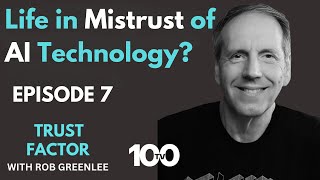
Rob Greenlee argues that AI systems lack the transparency and accountability we need to trust them safely. He points to algorithmic bias, black-box decision-making, and massive data collection without consent as major risks, and calls for an AI constitution and stronger privacy laws to keep these systems aligned with human values.
Chapters
Trust Factor with Rob Greenlee focuses on all aspects to building human trust in online communications. How to live our life in mistrust of technology? And should we put our trust in captured data about us all? Rob Greenlee here again in episode 7. Thank you so much for joining me. The trust factor in your life is essential and profoundly impacts your happiness, security, and safety. So that's what we cover on this show. Trust is the number one factor in our lives right now. So that's why I felt it's important to do this show every week to give you some things to think about trust. So we are also available now as an audio podcast, and then you can like and subscribe on YouTube to this show as well. Just go to 100 TV channel. And if you want to find the audio podcast, just do a search for Trust Factor in your favorite podcast app. So thank you so much. So let's get going. The question in this episode are some of the most important, or questions are some of the most important and pressing and consequential topics in our increasingly data-driven world that we live in that is becoming so technology dependent. And I think we all know what I'm talking about here. Technology is creeping into every aspect of human life. So the issues of trust, privacy, and algorithmic bias, and the implications of AI on decision-making processes is very important. And great power, great potential power over human freedom is at stake, especially when you think about the potential corrupt use or the use of this technology that can have a lot of power and control and enablement of the potential of unlawful uses are definitely possible with this technology. And I think we're just seeing the early days of how it can be used. And as we look at other parts of the world, you're starting to see that start to rear its head, like a country like China. Likely, unless we build into the AI limits to its actions and create what I like to call an AI constitution of sorts that basically will put limits on how it enforces laws and/or will create its own laws. So that's the risk. We need to figure out a way to put guides in here, just like we have in America with the US Constitution, which basically sets a basic framework for the structure of society and how the rule of law will fall into play and what we have rights to do. Now, if we don't have an AI constitution, then laws could be just made up by the AI as it grows in its intelligence. And if we do have laws that we all agree to in the constitution, then that AI only is limited to enforcing those rules up to some set point of enforcement. So Remember that technology in of itself is neither good nor bad. So as we think about technology, it's how we use it is what really matters. And it really determines its value or level of trust, right? So as we think about technology just more broadly, how far do we trust it? And what is the value that comes from that trust? Those are things that we need to think about. And can we ever just default to trusting technology? But it does require us to have an understanding and, and be clear, clear on what its limits are and the also the potential risks that are in there to provide some safeguards and how we use this technology and how we recognize what the risks can be for, like I was mentioning in the prior part here, that technology in and of itself is not good or bad, but it can be used in a bad way, or it can be used to really benefit people. And one example that I want to give on this is our growing trust in car navigation systems. So this is just an example of how technology has been integrated, and to some degree, this is a form of artificial intelligence of sorts, though it's rather limited compared to what I believe is coming in the future. But the internet-connected car in their navigation systems, how much trust we as drivers have actually put into those systems when we drive our cars around. So we just trust when we type in an address that it's gonna go to the destination and it's gonna take us there safely. In the most efficient pathway, and also to do it in a way that is safe for us too. And as we think about the growing technology of autonomous vehicles, I think you can see where we might over time type in the address of which the destination is that we're going to, and the car will actually physically drive us there based on what that map is. And there is a potential risk there long-term as we turn over more and more control over to the AI that could put us in a situation where there could be potential risk, right? If the car's driving itself based on its own source of information about the destination, but maybe there's another motivation. Maybe it takes a different route or it takes us into a dangerous situation that maybe puts us at risk. This example that I'm giving is just a clear example of what the dangers are and what's possible. Granted, I'm not saying that the navigation systems today are doing anything nefarious or trying to be harmful to us, but I have seen in the past where it's made mistakes. And so AI technology is not going to be void of errors. And this gets into the next area, which is, is the data that's captured or given to us accurate? Because not all data collected or processed by AI systems are completely accurate or absent of bias as well. So as we think about this, AI is an imperfect tool as far as we know today. I think AI systems really getting into controlling a lot of human behavior and human activity is still an undiscovered area right now, and it can either be good or bad. The quality of AI outputs is heavily dependent on the quality of the data that it uses or it collects, right? So if it collects incorrect information through either a glitch or a misinterpretation of data that's captured, there is a potential of an error. Is the inputted data any biased at all? Is it flawed? Is the output skewed? Could the output be skewed in an incorrect way? So that's why it's very important that there's no absolute trust in AI or cloud technologies for decision-making. Can, you know, if we do have this trust, it can lead to errors. In corrections or mistakes or all sorts of calamity. It could be used for very dark things. So we just don't know yet. I think we're in relatively uncharted territory at this point, but, or it could reinforce biases. Maybe there's biases in the data that, and you can start thinking about all the potential uses of AI, whether it be in employment, whether it's professional assessments, whether it's just the spectrum of the potential impacts of errors as we turn over more control over to AI technology is rather mind-boggling and really makes you wonder, can we really get our heads around this? And also the next factor of this is privacy of your personal data, right? So as we think about AI getting increasing access to, let's say, our biometric data or our behavioral data or communications, you can just kind of roll up all of the data that's being inputted into our mobile phones, into our computers, into our televisions, into our, increasingly into our autonomous driving or internet connected vehicles. You think about all of the video cameras that were the Ring cameras and all of the in-home internet connected devices that we have. That there could be a real issue around privacy of your own personal data. Technology advancements have resulted already in severe privacy concerns. So as we see AI getting more significant out there, that there is a chance that this could become a much larger issue. As massive amounts of personal data are stored and processed in the cloud, Oftentimes without the user or the user where the data is collected from do not have explicit knowledge or consent to capture that data or to store it, or let alone use it in combination with other data. This could lead to misuse and unauthorized access that could be used against us or can be used for good as well. I think it's very important that as we look to the future and AI is increasingly important, that increasingly you as the source of the data need to be in more control of your data. And this has been a debated issue for many years in the technology sector about users owning their own data. And I know that like Facebook and other platforms have given access to data through either a download of a large packet file that gives you access to all of your data that you put into Facebook and things like that. But I think what we're really talking about here is understanding what is being collected about you and what that really means. And I'm not sure that we all have a clear idea of that and who's accountable to this. Who is the judge as we look to the future of artificial intelligence? Is there a, is that going to be the government? Is it going to be a higher level AI that's more of like an assessment of values or rules or whatever that, that governs other AI technologies? So we start thinking about almost like a government regulation governing various artificial intelligence entities out there. As we see robots and we see this artificial intelligence utilized in a lot of other places, one of the critical challenges with AI is what's called the black box problem, meaning it's often difficult to understand how exactly these systems are going to arrive at choices and decisions. They will likely lack in transparency. And can result in unfair outcomes with little recourse for the person that's— that the outcome is inflicted upon, right? Who is accountable for incorrect decisions or maybe corrupt or improper decisions? Or as artificial intelligence develops, it starts to develop its own judgment for things. And what recourse do we have and who is that through, I think is a big problem. Who has the final ruling of wrong actions by AI? I think it's a valid question to start thinking about. And so really the bottom line here is, should we trust captured data about us that are feeding the algorithms in AI? You know, that, that's a bigger question. You would think that we could trust the data being captured accurate, but maybe it's not. I don't know that we have the answer to that. And this data also goes up to the cloud, is being put there supposedly under the guise of helping us make better decisions in our lives. And this gets back to the rationale behind this is that I think there's a recognition or this perception that the AI will be able to know us better than we know ourselves. And that it will be able to make better decisions about aspects of our lives and the choices that would mean whether it's a medical diagnosis or if it's a decision about a career or how to handle a particular situation. I think that there's this thought that because of the superintelligence and the access to more complete data, that the AI will be better than our own built-in judgment and our own built-in algorithm of sorts that can make those choices, that, that has been making those choices in all of our lives. And is the AI going to replace us somehow in these decisions just based on the available access to information about us that maybe the AI is more capable of processing to come up with an outcome? We can probably shoot towards utilizing these AI algorithms to help us make better decisions. But I think we need to take that process with caution and skepticism. I know I've mentioned this in past episodes about caution and skepticism around AI, but we need to figure out ways to mitigate these risks that the algorithm will make the incorrect judgment for us. And then somehow have the ability to inflict that on us. And we need to have some process that can foster a healthy relationship with that technology through this process. And I do think that we can try and work towards promoting transparency in the AI realm and openness. Now, granted, I'm, I don't know that's realistic. So as we think about AI algorithms, Should they be transparent? Should we understand how those algorithms work? And the question that I have for that is, is it really possible for us to understand how those algorithms actually work? And it just may be too complex for us to comprehend, and I'm not sure how we get access to that data and whether or not proprietary platforms, which I am sure these will be built on, will not want to publicly share their magic formula. This could allow us though, if we were possible, if it was possible to do this, to allow us to understand how decisions— it does help us to know what the rules are. So as we come up with like maybe an AI constitution or AI rules, hopefully we're going to have AI rules because if we don't have AI rules, or an AI constitution, then anything is possible. Anything, any outcome is possible, potentially. If the AI gets enough information about us and there's a nefarious interest behind AI that wants to create a specific outcome that we don't necessarily want, it may have the power to make that happen, whether we want it to or not. And that's what the danger is, because AI with this type of power will be able to implement enforcement against us. So what we need to have is strong privacy laws and some level of security around these algorithms with some regulation. I know that there's been a large group of AI scientists that have expressed this concern that we need to put a pause on AI development to to develop, you know, a framework of rules and regulations for protecting user data and ensuring its responsible use. And so I think these are very important things. And one of the big things is educating users, educating us. I want to know public awareness and education on data privacy and AI and cloud technologies. Would be great. But can that be really accomplished for all humans? Are all humans capable of comprehending the complexity of this? I think we have to trust humans in their ability to guide AI and to oversee AI. And we need to have escape pathways to disarm AI when they've gone rogue or they've gone passed their guidelines. And it's great that these AI tools could empower us to make better decisions. And technology certainly has enhanced all of our lives. So I think that there is some level of trust that's being built, but is that trust based on true trust or is it based on dependency? And I think that's where I think the danger is that the convenience of technology has proven, like with the mobile phone and with the navigation system, It's the convenience that builds the trust, but is that trust well-founded? And I certainly would love to have technology analyze my, like my CT scans or look at those type of things that there is proven evidence that it has a better ability to diagnose disease or problems than a human doctor does. That maybe is prone to more mistakes or not being as educated as an AI tool might be. It's very essential to consider AI's limitations. And like I've said, its potential risks. But we also need to look at what's the opportunity of this technology to improve our lives. And if that's the goal of AI, is to improve our lives, and to make us healthier and to make our system much stronger and have a real responsible AI that is definitely helping us in our pathway through, through life. I think that there's an advantage there, but it does seem that there's a highly likely scenario that increasingly AI tech is likely unaligned with humans. And I know that term unaligned is a fairly well-known term to describe the current state of AI technology. And it's developing. AI technology is developing at its own rate and its own purposes that is not necessarily aligned with, let's say, an AI constitution, and it's getting out of alignment, or maybe it's never been in alignment with humans and what are important to humans. Now, granted, most of AI's technology is based on human learnings. And so AI is going to know us. This is true over time. AI is going to know us better than we know ourselves. And that's the real danger and opportunity of AI technology. And that's where this mistrust comes into play. We need to be skeptical of AI technology because we're going to need to live in an era of mistrust until the AI can prove to us through us being diligent that AI can be trusted in all situations. I just don't know that this is an AI that was built by humans. And humans are known to have dark sides or evil sides or corrupt sides, as well as good sides. Depends on who you're talking about. And it, and that's gonna vary with AI technology too. There's gonna be some AIs that are, let's say, maybe used in the military that that, you know, are taught how to do certain things that may be violent. And then there's other AIs that are going to be built that are more social AIs and that are much more about surveillance, control, and enforcement of laws. And so I think there's going to be this spectrum that we have to deal with that is going to be coming in the future that needs to be thought about. And we really need to dig into it. And that's part of why I'm doing this show is I want to be able to communicate, dig into these topics. And I am going to be diving into a lot more AI topics in the future and even another show that's being contemplated right now that will be focused on AI technology. But that's a separate opportunity or a separate show from this. But this show will ride along with that too, because I do believe over the next few years, this AI topic will be one of the, if not the top issues around trust in our world today. And increasingly, to take this back to the human level, I believe humans need to focus on finding ways to trust each other more and building trust as well, separate from technology. And, but that is increasingly becoming more difficult. So that's the main topics of the show this week. And I appreciate you being here and listening, but I did want to cover really quick a couple of comments and show feedback from episode 6. Melanie Flabby wrote, all our data is at the mercy of our many corporations. So it's hard to find the balance between using technology and trusting that our data will not be misused. Yeah, I think that cuts to the heart of this whole issue around our data privacy and these AI tools getting access to it and then being used or misused or in benefit used. So I think we have to look at this in a balanced way. And I agree with you, Melanie. I think that is the question of the time and Ross Brand wrote so much trust in our experts and institutions has been lost. So this is another great point, Ross. And I appreciate you raising this is that one of the reasons that I am doing this show, this Trust Factor show, is because I felt that too. I felt like over the last 2 years, there has been so much loss of trust in every institution and in many relationships, corporations, just organizations across the board that have proven to be or exposed to be either corrupt or have done things wrong or harmed people. And there's other humans out there that are out there causing havoc and increasing crime, makes people distrust each other. And that's the big thing that's going on right now. I wanted to mention also, and I appreciate Melanie and Ross for the feedback, and I certainly look for as much feedback as I can, and I will definitely talk about it on the show. Just give me feedback in the comment fields on YouTube or in the podcast apps, or actually I think you can do it in Facebook and some of these other platforms where we post links to episodes, and then you can go in and make a comment about what you've heard in this show. And because I do want to create a feeling of community here with the show and get your ideas and your concerns and talk about them on the show as well. So I'm also on Twitter too, so you can post comments over there and let me know your thoughts and what other topics that you might be interested in hearing about. I'm also on LinkedIn too, and on Facebook as well, but my Twitter address is @RobGreenlee.. And then, like I said, you can join me back here, hopefully, in the next episode. And thank you for joining me in this one on episode 7. I'll be back with another episode that will dive even deeper into this topic. And maybe I can find a couple other topics that would be of interest, not just about technology, but about other aspects of, of life and what we're all experiencing, because I'm trying to make this show about how I'm feeling to some degree and how I think that is being felt by so many others. And I just feel like there needs to be a place to talk about these things and get the word out. I'm not trying to be politically a flamethrower on anything. I'm a technologist mainly. I'm a marketing person. I think a lot about our societal impacts of technology because I've been involved in it for so long. And like I said, thank you so much for joining me here again. And look for me on YouTube and also on Spreaker as an audio podcast. So you can get this show as an audio podcast as well. And this show airs on YouTube every Monday. Thank you so much. And I look forward to having you back with me next week, or you can send me an email too. If you want to send me an email with feedback, just rob.greenlee@gmail.com. Robgreenlee@gmail.com, which is a terrific way to reach out to me too and give me feedback. And I'll talk about your comments on the show. So thank you so much. I appreciate your time. Thanks.
More from Rob

Future-proofing with Delphi AI/Human clones: your podcast as a personal LLM | New Media Show






How sports reveal what AI spectacle gets wrong #Technology #Sports #Commentary



