Stream Leaders Break Down Their Exact Results
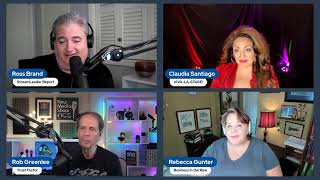
Ross Brand, Claudia Santiago, Rob Greenlee, and Rebecca Gunter discuss Canada's Bill C-11, which requires streaming platforms earning over $10 million to register with the government. They also cover how to spot deepfakes and AI images, and why independent creators now influence what people buy more than traditional influencers.
Chapters
All right, hey gang, we got a great show today. I'm so glad to be here with Claudia Santiago, Rob Greenlee, and Rebecca Gunter. Our topics today: will Justin Trudeau's new mandate mean that Canada loses access to Spotify? How do you tell if a photo is a fake? And what's the impact of podcasting on purchasing decisions. We'll talk about it next right here on the Stream Leader Report Live Panel. Let's do a show.
It's the Stream Leader Report Live Panel. Creators talking to creators.
Raw, real, and unscripted.
And sometimes they say the quiet part out loud. Here are your hosts, Claudia Santiago, Rebecca Gunter, Rob Greenlee, and Ross Brand.
Hey gang, welcome to the Stream Leader Report live panel. It's episode 22. I'm Ross Brand along with Claudia Santiago from Viva La Stage, Rebecca Gunter from Business in the Raw, and Hall of Fame podcaster Rob Greenlee from The Trust Factor, and we've got a bunch of hot stories today. Um, I, I guess the first one we'll start with is the one that was on the COVID of the thumbnail, so why not? Let's go right into it. It's a, it's a interesting, uh, situation. And as I mentioned to Claudia last night when we were chatting, we're almost like becoming the Canada News Network or the Canada news station here. Um, it's another story story from Canada. And this time, uh, Prime Minister Justin Trudeau and his government have put forth a mandate in which streamers who are making $10 million or more in Canada must register with the government. And the question is, will they? And specifically, will Spotify? And if Spotify doesn't, that would mean that people in Canada have no access to Joe Rogan. So here's the story. It's from the Free Press. Justin Trudeau is coming for Joe Rogan. I don't know if that's a little bit of hyperbole or if that is something that's actually motivating this. And I'm not sure that it's actually being motivated by going after Joe Rogan, but Uh, for no specific reason, I'm gonna start again with Claudia.
Well, I decided to wear red today because, oh Canada, my red and white. Um, because Canada just seems to be servicing all the time.
Um, Happy Thanksgiving, girl!
Happy Thanksgiving!
Oh, is that— is that today?
It was Monday, I think.
Monday.
It was Monday.
I knew that, I was just checking.
And you know, my, my husband and I have had the privilege of also living in, in the USA, and we've got lots of friends there like family, so we kind of double dip on Thanksgiving. We do.
I would too, girl, I would too.
Yeah, yeah, yeah, very nice.
So coming back to this, yeah, um, okay, so the— initially when I saw all this I thought, what, that means I can't livestream, right?
Right.
So because you're making over $10 million—
because I mean, initially, just in Canada, initially what was circulating out there, they weren't even saying that. So there goes like just another example of fact-checking and really digging into what's really happening here now. Something new I found out last night, actually, as I was digging in a little deeper, was while I may not be censored because I'm not making over $10 million, there are companies that are, okay? And what I did not know was Canada, then with those companies, they get a list of those watching those broadcasts or listening they get a list of that. Now I need to dig in more into that, but that startled me. I mean, it shouldn't, but it did, which means if I'm hanging out on wherever, YouTube or Facebook or Spotify, if I'm listening to certain broadcasts, all of that gets sent to the Canadian government, which is interesting.
So they're not only tracking the companies, they're tracking the listeners as well.
The average Joe. Yes. So while it's not affecting me as like a content producer, live streamer, whatever— yet, yet it's my audience, right? And, uh, I get a little bit on those big platforms, right? Yeah, I get a little mama bear about my audience. You don't know me well. I do. You know, there's certain things that I do on social.
So everything going on on those platforms, I'm just, just to clarify and understand, is going to be tracked then? Not just whether you listen to Joe Rogan, but if you listen to Claudia Santiago?
Yeah.
Uh, Viva La Stage, Business in the Raw, Trust Factor, you're also going to be tracked if you're doing that in Canada? Apparently, because if it's on Spotify right, or one of the major—
yes. And you're— so, so if I'm content producing on there, I'll be tracked. If my audience is showing up, anybody, all that audience is tracked. So all that data goes to the Canadian government. Now, once again, I need to deeper fact-check because that was like 11:30 last night when I realized we were doing a deeper talk into this topic.
So It's a developing story.
Yeah, it's a developing story. And so yeah, I am going to be digging deeper into that one. So yeah, that's just my thing. Rogan, why he got— why he got picked, um, maybe he makes over $10 million, but he's also blatantly said a lot of stuff about Justin Trudeau, which a lot of people have. Now this is the thing, this is where we get into the whole censorship thing. What's really going on behind the scenes? What's really been going on now? I, I've got, I've got my thoughts on a few things, but I'm not going to take up all our time here, so I'll just pass, pass the ball back to your court.
All right, so, um, Rebecca, nothing could be bad about putting all everybody on a list and tracking who they listen to for how long and what they search for and what they're doing in, in a social platform or streaming media platform, could there be? Could that be used for any sort of nefarious purpose?
Generalize— putting people on a list isn't a good— isn't a good sign. Red flag, red flag, right? Right, for sure. But I would also suspect that more, um, people know— the folks who make these lists know more than we even can imagine.
We're being tracked anyway. The platforms have all the data and everything. The question is, Rob, sharing it with the government. Why does the government need it if the government stands for free expression? Which I don't know whether our governments in North America or anywhere else still do. Um, in essence, why would it— why would it matter that whether they have a list or track who's doing what and how much they're making, other than whether you're paying your taxes or not? If there are taxable income on any sort of product or service.
Yeah, I think really, I think, uh, what I was wanting to do here is kind of back up probably to a higher level and look at what's happening here. I mean, this article that we're referring to is— was written really in a way to be kind of clickbait, um, to some degree, because this law applies to all the major platforms, not just Spotify and not just Joe Rogan. Right. This law applies to Apple, it applies to, uh, probably YouTube and Google, um, and those could have easily been pulled out of this mix too, but they're specifically targeting, uh, or in this article they're referring to Spotify because Spotify has a licensing contract with Joe Rogan, and Joe Rogan has had a reputation for being very outspoken against what's happening in Canada, right? So So there's, there's that connection that is, you know, very attractive from a, a so-called journalist here that's writing this article, even though I think it's the media has turned into— I mean, they're a profit-making organization, so they're going to use information that they have to create articles that will get people's attention. I mean, we're talking about it here, and we're, you know, Joe Rogan is probably the biggest, what I would consider to be independent, um, voice media creator in the world right now. So he's, he's a great target for this article to be written to. But let's not mistake what's really going on here. This is, this is the Canadian government, um, doing somewhat what the U.S. government has been doing in the U.S. for many years now. It's just we didn't know about it. Um, and that also refers to Twitter and refers to Facebook. It does refer to, to, um, really all the major online media platforms, is that the governments have been gathering information about what all of us have been talking about, who's talking about it. I think I saw a couple of articles that come out about this controversy even in the U.S. So what's going on in Canada is just being surfaced in a little bit of a different way, and this is no less concerning. This is a pattern that's starting to develop all around the world, um, right now around this concern about, you know, hate speech. And, and, and, you know, like I raised in our comments before the show, was, was our, you know, it's playing with our perception of reality too. Um, you know, this doesn't really go after any small creators, but it does go after small creators that happen to be distributing on large platforms, and which is really targeting all of us.
Right, exactly, because that's where we all are told put your, put your podcast on the major platforms, right? And get the exposure, right?
So that's—
oh, go ahead. I'm sorry.
That's all right. That's what I'm really concerned about here is, um, this is a, a developing trend that we're seeing kind of sweep the world around, um, governments, um, getting more involved in in kind of silencing people, um, about their, their comments about things that they're seeing wrong in the world. But it's also being driven based on this warped, um, perception that we're all seeing around what is true and what is reality. And, and, um, that is what's driving this, is that the governments are saying, well, we're the only arbiter of truth.
So yeah, the, the Free Press is published by Barry Weiss, who's a former New York Times columnist, and I would say a fairly responsible journalist, fairly centrist, level-headed. Um, but that doesn't mean that the business model doesn't encourage clickbait. However, here's a thought. Is this a way of Trudeau getting back? Is this really— could this really be largely about Rogan knowing that Rogan would put pressure on Spotify because he's kind of— he's this free speech absolutist and might be like, we're not going on any list, and he's their biggest star, and so there's a desire to accommodate him. That's one thought that has no basis in anything other than my speculation. And the other thought is that Canada sort of has a history of favoring its own media and entertainers and so forth, although the great ones break through whether they pick winners and losers or not. Does this have something to do with the fact that, let's face it, American media is so dominant on a lot of these platforms that perhaps It's to, uh, you know, create more space for Canadian artists— artists, easy for me to say— podcasters and voices and so forth. And for no reason, I'll ask Claudia what she thinks.
Yeah, well, I was just gonna say, I mean, um, at this point, I wouldn't— I wouldn't, uh, I wouldn't be surprised at a whole lot. Especially since way not that long ago, anyone that supported the truckers got their bank accounts seized. This is Canada. This is right here in North America. So things like that where this is the kind of stuff we saw, or I saw firsthand in, in Chile, you know, when the regime took over. So There's, there's some crazy moves Canada has made, and, uh, I, I agree with what Rob's saying, that a lot of this has been going on behind the scenes for quite some time without us really knowing. I mean, once upon a time I was an executive assistant for a large firm out in, in Vancouver, um, that, um They were hired and specialized for data collecting. And way back then, way back then, huge dollars were paid to get these reports that help people with marketing and that. But that was way back then. And the kind of data that would come through was astounding. So data collection is nothing new under the sun. But The crazy thing is now there seems to be way more control. Like, when a government can overnight seize bank accounts, that's, uh, dangerous territory for sure.
Yeah, well, I don't know if all of you remember back many years ago, uh, when the scandal around the Cambridge— I think it's the Cambridge Analytical, uh, company out of the UK. Was linked up with, you know, data gathering off of Facebook and other places like that, and then collating reports that were given to kind of political campaigns, right, around voters. So, so this is exactly what could happen. If you think about the implications of what this is, and what's astonishing to me is that this is out in the media. Um, and, and why is it being publicly discussed right now? Um, it's, it's almost like there's a concerted effort here. It's like it's okay that it's all in the open now, um, where in the U.S. it's always been kind of done behind the scenes that people didn't know about. So that's the big change that I'm seeing, is that they're being— it's almost like they're proud of it now, um, that they're able to do this.
Or it's a test case to see, well, their resistance here. If there's not, it'll be nothing to get, you know, uh, the next industry to register and the next industry's data to track.
Um, that's a good point, Ross, because, um, that may be kind of, you know, that was the first stage is to do it behind the scenes. Next stage is to do it out in the open.. And, and I believe that there are a couple of countries around the world that are pushing the envelope on changes like this that may be being used as test cases for the rest of the world. So, you know, that's kind of a little bit of a conspiracy theory, but I do think that there are certain pockets around the world right now that we're seeing that are pushing the envelope on, you know, a new way of looking at things and being kind of upfront and out out there about them. Um, Canada has— it's been shocking to me to see what's been going on up in Canada, um, at this point, because they aren't being talked about in this way in the US.
Yeah, yeah. I was just, uh, watching earlier, uh, um, a video with Rogan and Zuckerberg, and it was, it was quite interesting to see because they— he was actually asking him all about censoring and, and how they work. And, and, um, you know, one of the things I didn't know was, uh, the FBI actually got a hold of Facebook. And so outside of a large company, there's also the regulatory stuff coming from government. And then whereas Where is that coming from?
Right, right.
Well, it's been confirmed in many news reports that I've seen that increasingly government actors have been getting hired by these platforms. So you're starting to see this infiltration of the security state into these media platforms. And so there's this tight relationship that's been going on for many years now. Uh, it just happens now maybe they feel confident that this time to go public, which I don't quite understand, but maybe it's good that we all know what they are doing.
So, right, right. And we didn't know, at least not to the extent of it, until we saw the, the Twitter Files. Um, but the security state, right?
Yeah.
Um, has been doing this with the mainstream media, with newspapers and television news for probably going back to the '60s or early '70s. I forget what the operation was called, but they had a code name for it. But basically it was embedding people in newsrooms and, um, to plant stories when needed. They might function as journalists, uh, on a day-to-day basis, but they're there when a story needs to be planted or story needs to be blocked or a different angle needs to be put forth, if you have those people in key positions, they can influence— you make sure that the narrative doesn't get away from you.
Right. I think they call it spycraft, Ross, right?
Yeah.
Rebecca? I'm for piecraft.
Right, right.
Yeah. Yeah, I mean, it's, it's kind of scary stuff the more you think about it and the more you see what's happening here. Um, and how much do you believe? And I mean, if it's a law, then it's hard not to believe it, right?
I guess they call it a mandate, meaning I guess it comes from the bureaucracy through the approval of, you know, from the, from the head of state or prime minister on down through the bureaucracy as a as a mandate, not necessarily voted in as a law, but I'm not positive on that.
It does say in the article that there was a Bill C-11, which, which I think was passed by the, um, it was, yeah, the Canadian government very recently.
Yeah, it was passed.
Yeah, so this is a topic to watch. I don't know that you know, for the smaller podcaster, doesn't make that much of a difference right now. It's more of the slippery slope and what it means if the bigger players or the bigger platforms take a stand. And if like Spotify takes a stand, then maybe your podcast doesn't get distributed in Canada. We saw when we brought up— when I brought up the article earlier, there was a Twitter profile on there and it said The feed not available in Canada. So in Canada, I guess if you're following that online news magazine, you're not seeing the story that we were, we were just discussing, which is a little, a little concerning. And we'll see where that all, that all goes. Um, I think an issue that's very close to this one is dealing with how do we know And we're heading into a time where there's conflict on several continents in several areas of the world, and war is often where the most egregious fakes come out. And there's so much fight now for the media narrative. How do we know what's real and what's not? And I know, Rob, you covered this to some extent on the trust factor, but let's let's come together on this a little bit and see, see what we can, uh, what we can discern. Kind of where are we all at on, on how do we figure out what's real and what's, what's fake online?
Yeah, I think it's a very difficult question for all of us to grapple with, um, and, and not get— I mean, there's a tendency to get caught up in something that you hear about or you see and, and with really innocent intent of having an emotional reaction to something that you hear or see that's in a headline of an article or you see in a video. But increasingly, people are challenging some of the videos and some of the headlines as clickbait, right? Or fakes, or videos or pictures that we're taking in taken in other conflicts around the world in prior years, not even, not even there, and being, um, changed to represent them as something that happened in Israel or something that happened in, in Palestine or whatever. And, and, you know, it's— I don't think there's any question that atrocities happened, and it's just, you know, what do we as consumers of online content How do we react to what we see, um, when it's so extreme and so wildly unsure about, you know, what we should believe and what we shouldn't believe? And should we be skeptical of everything? And it's forcing all of us to kind of adjust our sails around, you know, do we trust everything or do we question everything? And if we question everything, that puts us in a different, completely different mental mindset. To everything, and it doesn't play into the taking sides agenda that's oftentimes behind these extreme examples of things that have happened. And I think that's the challenge that we all have. We all want to align ourselves behind what's right, what's righteous, what's good, what's not evil, but we may be accidentally aligning ourselves with evil without even realizing it. So that's the danger of what I see happening right now in the world, and especially with the upscale and the conflict that's happening overseas in a variety of conflicts, not just one or the other.
So yeah, I mean, if you look at the conflict in Ukraine and Russia, um, depending on what news source I look at, either Ukraine's been completely decimated and has no chance or Russia's on the run and it won't be long now until, you know, they recover their territory and, and so forth. I mean, it's so shockingly different that I— where, where does the truth exist? It, it almost depends on which side you're following. Is there any objective truth? And none of us know well enough in that conflict in particular um, what's, what, what's really going on on the ground.
Yeah, and a lot of journalists are restricted from going in and covering the, the Ukraine war too, right? My son actually lives in Russia, so I hear from him what's going on on his side, what he's hearing on his side, and it's almost exactly the opposite of what we're hearing. So on this side, so, um, it's, it's very, you know, it puts you in a situation of questioning what's real and what's fake, um, in, in all this. And, and I know all of us need to make daily choices around what we believe and how we will live our lives and how we think and what our anxiety levels are. What should we be concerned about? What should be worried about? And it's, it challenges all of us now more than ever. And I don't think it's gonna get any better either. I think with AI and deepfakes and the ability to automatically generate things that can easily be seen as real is a very scary coming reality of the unreality. Go ahead.
Well, I would just want to pipe in here with the fact that we are human. Yeah, we need to remember that. And with everything that's going on, I think our humanness— we have choices. We have the choices on what our values are, who we are, who our community is. I think now more than ever, it's really important not to be solo birding out there, that we are sharing community because, you know, two brains are better than one. And you, when you can have open dialogue and discussion like this too, and based on what your values are too, I think that's so important. And in a coming generation, I'm always looking for how do I come alongside this younger generation also is helping them to figure out their values. Because at the end of the day, you know, I have one mentor who says to me, Claudia, you're a knower. And she points to her stomach. She says, you're a knower. Something inside of you, your intuition, is going to feel and know also where some things are a little off. So, and then with my background coming from a war-torn country, since I was a little girl, you were faced with propaganda. I mean, I knew what that was when I was 4 years old. So I can kind of smell that a mile away. So I think as humans also, we can train ourselves up and we can train up that next generation to go, hey, you know what, maybe dig into that a little more. Or, you know, does that sit right with you? Go back to your values. What is, what is your intuition telling you? What, what is your community also saying about this? You know, and that's why I think it's really important too to align ourselves also with like-minded people that, um, you know, aren't, aren't out there trying to kill a bunch of— you know what I'm saying?
Right, right, right.
You know, so that when we do come into a community, we're kind of going, hey, I don't really I don't know about this. What do you think? And, and there's a sense of trust factor there because there's been a longstanding journey with them, you know, or you've built that rapport where you're able to be open and all that. So anyways, those are my two cents on that.
Go ahead, Rebecca.
Yeah, I'm really glad, Claudia, you brought up the next generation, uh, and community because my contribution here, while This absolutely scares the pants off me. Um, however, I also don't really believe that there is a neutral source of news anywhere. We all— everybody has an agenda, and you've got to really look at that. I'm hopeful because the two people in my life who I interact with on a regular basis who are Gen Z, a 15, almost 16-year-old, and an 18-year-old, both really kind of have almost a dismissive attitude towards like AI-generated images and writing. Both of them said, I can see it a mile away. I already know that that's fake. So they had a very strong discussion with an 18-year-old. Could the piece we're looking at right now have been written by AI? We're looking at original piece of writing. And he was like, I, I've just worked with it enough to now I know that I can see the patterns of word choice, and I can see when people are using it on LinkedIn, and I can see when their emails are using it, and I can see it a mile away. To your point, Claudia, I can see propaganda a mile away. So I'm kind of hopeful that while for us we're like, oh my God, it shakes us to the core of what is real and what isn't, the Gen Zers I know are like, I already know it's fake. So maybe Well, that's hopeful. Human evolution. Yeah, maybe human evolution has a, has an ice cream cone for us at the end of that.
Yeah, I mean, I find that when I look at some photos that I realize after a minute or two are AI generated, I don't know, it doesn't always occur to my brain right away because you look at like sort of glamour photos and different things and they're so Photoshopped and touched up and everything else that they have almost an unreal look to them. And that's, that's even kind of a style that people have gone for in the last, um, probably decade or whatever, and how they present themselves and backgrounds they use and things like that. So then you look at an AI-generated image and, oh, but you know, your brain sort of subconsciously is going Yeah, a lot of Photoshop, but nothing, at least for me, it doesn't always jump out. And then I look closer and I go, oh yeah, yeah, yeah, that's an AI image. But at first, my mind hasn't been trained yet to think that first.
When I was growing up, and this is, you know, years ago when you'd see the Cosmopolitan magazine or whatever, and you'd see these models and they were flawless and, curves all in the right places. And as a young girl, and even my girlfriends that, you know, in junior high and stuff, they were like, oh, you know, how do you even look like that? Well, no one had told us that those are all photoshopped. But this is way back, way back. It's not a new thing today. This has been going on for a long time. But the freedom in it was in the education. Where, uh, you know, people in the industry or people, you know, teachers and that would say to you, well, actually, this is how they do it, and they show you a before and after. And I'll tell you, you know, it brought a lot of freedom to us girls that were thinking we had to measure up to that and getting all depressed because, you know, we weren't that. So I, I think too the freedom comes in education. I think the freedom comes in mentoring and training and teaching, equipping, um, those around us if we've got some insight. And I love that about this show, and I love what each one of you bring to the table because it's all different areas of expertise. And, and I think, uh, for myself even, I'm learning a lot.
Well, the, the internet certainly exposed some things that we wouldn't have seen before. Like, I remember probably as far back as almost 20 years ago there were sites that would show like celebrities without makeup, or, you know, they would show a politician who was short standing on a chair to give a talk or something like that so that he would look taller than the people who are standing there. And you go, oh, that's how they do it. Okay, okay. Like, you look at the person without makeup on and it's sort of like, some of them you go, I don't even know why they need makeup. And others you go, that doesn't look anything like that actor in the, you know, you know, playing a hero, you know, jumping off of buildings or whatever. And, you know, he looks 20 years older without makeup or without, you know, going through that body-changing exercise routine that, you know, they do for, for, uh, you know, 12 weeks before the, the film shoot. And then You see, like, you know, the magazines, and I mean, this got to be terrible pressure for women. They show these celebrities like gave birth last week and now is, you know, thin as a stick or whatever. And it's like, well, you know, how do we know when the picture was taken, number one? But number two, if you make $20 million a movie, you can have a full workout team and nannies and the whole thing. Like, it's, it's setting unrealistic expectations for the average person to, to try and live up to.
Well, that gives me hope, actually, Ross. When I— I think I've mentioned this before on the Streamliner Report live panel show every Thursday, 1:30 Eastern Standard Time, here on LinkedIn and YouTube. Very nice. Thank you. That advertising steals a woman's sense of self and sells it back to her. So Claudia's story of where the illusion is broken makes me be like, aha, take that advertising, take that one, because now you know, now you know.
It's true. And even, you know, sometimes there's a movement out there of, of, um, being authentic, and their target market actually marketing is they want the stay-at-home mom, the one that has like 3 kids and doesn't have time to do her makeup, and she just feels like she's, you know, like all these things that they're targeting that. So, you know, there was, there was a, a celebrity type that her show, she does this on purpose. She's trained to fumble around in her camera doing her live stream. She like, like visually looks like super messed up, like she just rolled out of bed. But you know what, her audience connects with her because that's her target market. Now I had a client going, oh, she's so authentic. And I'm looking at this and I'm going, all that's staged, honey. She's an actor. It's staged. It's done for a specific agenda and purpose for her target market. So, you know, it goes both ways. Things are used a different way where you're all prim, proper, perfect, or you're quote unquote authentic. It's like, just be yourself. That'll be authentic.
Yeah, I once talked to a YouTuber who's got a very big following, and I said, you know, you're using StreamYard like we are. Why don't you do some more, uh, you know, your own overlays or switch shots more or whatever? Um, and he said, you know, it's a fine line. If he gets too high tech with things it becomes that he's less relatable. The audience feels he and his co-hosts are less relatable. Um, the more bare-bones kind of like we put the people up on the screen and we leave it alone kind of thing. It's not perfect. It's not, you know, we're not using, you know, some fancy software with changing shots and all this stuff and transitions. And it's like, yeah, it, it, it seems more to the audience. He felt that like, I'm just talking to you and you know, yeah, we're the ones on the show, but we're, we're all a community and we're connected and we're in this together. If it gets too fancy, it's like, well, maybe the audience wonders, why do I need to support this person or send them a Super Chat or, you know, attend their event or whatever? They've obviously got everything all together. I, I'm not sure what the reason exactly is beyond the, the little outline that he gave me why he does it, but I thought there was a lot of sense to that, that if you, if you, if you become too perfect or, or you elevate it so much, then yeah, there's, there's people looking up to you. But if you're trying to build community in which maybe you're the lead, a leader of the community, but you're still one of the community, how much the special effects and all these things take you away from being relatable and having a conversation the same way you would have if you were on a Zoom chat with one of the members of your community or, or what have you.
Yeah, I think that there's a reason why we're seeing mainstream media in a state of decline right now, and more and more people are paying attention to independent creators, ones that are not associated with these big media brands. And I think you tapped right into it there. I think I think the realness, the authenticity, the building of trust and holding on to trust is something that's key to this. But I do think a lot about how all of us need to think differently as we travel through this evolving landscape of the priority around independent creators having a major influence on the world now., in a way that has maybe our government and corporations and global leaders, uh, worried and concerned and needing to do things like this, um, to be able to get a handle on it, um, as we look to the future. Um, because what happens if the major media goes bankrupt? Then who's going to be the one that's going to be delivering news and, and updates and what's happening in our world? And And I think as this escalates, it's also going to drive a lot of the younger people to just kind of, you know, not pay attention anymore. And eventually, do we have this— do we go back to a different kind of society where people just don't pay attention to media, just like it was like maybe 50 or 60 years ago when media wasn't a big presence in most people's lives?
Yeah.
And what did we do? Hey, we hung out with each other.
Yep, cool idea.
It could be where we're heading back to, face to face, sitting in the same living room together reading. Bruce brought that up the other day. He said, you know, in that movie Sense and Sensibility, where— which I love, by the way, I love Jane Eyre— anyway, uh, and, uh, they sat around the fireplace and they were reading poetry and playing the pianoforte and they hung out with each other.
Hello.
Yeah, well, let's think about how our birth rate would probably stop declining.
I'm curious.
There you are, there you are. He's trying to sneak in the Tinder.
Here we go. Yeah, right. I'm curious how, how the Gen Z generation is reacting to what's happening in our world today. Yeah, I don't know that I have a clear picture on what they— what the— as a collective, how they are reacting to the changes in the world, and, and are they pulling away from media? Are they pulling away from the internet? Um, that may be a sign of the trend in the future.
Where does Gen Z go up to? Like, what is the oldest Gen Z?
I think it's in the early 20s, I think.
And that's the generation just below millennial, right? Correct. So the Gen Zs are probably, if they're getting their media from sort of younger sources, they're probably getting it from people who are, are millennials, right?
That's probably their— or other Gen Zers.
Um, yeah, there's, there's, there's some grumblings of like punching up at the generation before you already. The millennials. Millennials are so cringy.
That's what I hear, right?
They're so cringy. I'm like, my God, used to be the it generation, but they're so different.
The, the millennials and the Gen Zs are different people.
Yeah, I, I've been, I've been reading that the Gen Zs that are most well-adjusted and successful are absurdist. To your point, Rob, of like, do they tap into media or do they not? Just to realize the whole thing is absurd. That's like the healthiest mindset you can have right now.
Isn't that sort of like a continuing slope in a way from where Gen X was to where like to where—
yeah, it's a slide.
All right, the Millennials, and then to where Gen Z— Gen Z is— the only difference is the Millennials drank the Kool-Aid a lot more, I think.
They were the first ones, I think, to really start pushing back about workplace culture, like, you know, figuring out how to not work 12-hour days just because that's the only way you could pretend you're in a meritocracy. Like, there was a lot of pushback, I think, and so— and starting to break generational curses.
Millennials, I believe.
Yeah. And then also there's the Gen X too, which is one that doesn't get talked about that much.
Not nearly enough, Rob Greenlee.
That's the Twitter generation, I guess.
No, I love young people and I make an intentional effort to include Gen Z, Gen X, and like, Gen— like the any younger generation. Like, to me, I'm like, I want to get around them. I want to get around them. I want to learn from them and then just be there for them. You know, I don't have kids of my own. Um, that's a whole other story. But, you know, it just— for me, I just, uh, I think I'm really— personally, I'm missing it if I don't come around them and, and, and, and walk with them, have them walk with me and teach me stuff too, right?
I agree wholeheartedly. The Gen X and the, the Millennials are kind of in this a little bit in the same time frame, but, um, to some degree there's some overlap between those two, those two particular generations.
But I think there's one of the big differences is, um Some of, at least some of Gen X, we remember working before there was an internet. Like, you know, our first few jobs were before there was an internet out there that like, you know, dominated everything. It was like, I mean, I remember like, and I was a very late adopter, um, I, I probably, but I, I just remember like having to learn Windows and stuff like that and having to get my own computer so I could go online. Like, I was such a late adopter of all that. I was such a late adopter of social media. Um, but then shortly after that, live streaming came along, and that was a different— and that was it. It was like, okay. But it's, it's like, um, I think that's a big divide in that we're not digital— Gen X are not digital natives, as they call it. I don't know if, if a lot of millennials like, when did they get the phone? When did they get the, uh, you know, they certainly probably don't know a working world without the internet and email and being connected 24/7 and all that.
Um, but they've spent more of their lives in that world than, right, let's say the baby boomers, um, which is myself. I mean, I spent most of my life without the internet, so it's just, that's, that's the difference here.
Well, one thing none of the generations, um, had to do back in the day was, um, look to podcasters and other independent creators for guidance on what products to buy. And I believe Rebecca shared this, this story. Um, can you just slide it down a little bit so you can see the— there we go. Influencer marketing is out, creator marketing is in. Build trust with creators to amplify your brand. And I think the most interesting thing that I saw, and I think we all kind of saw it, is that podcasters are now seen as perhaps the most credible of all, you know, online creators in terms of who people look to before they make a decision on buying a product.
Rebecca. Yeah, I love this story. Um, first of all, I just, I don't have a visual of all the things that my boyfriend has bought just because he's heard about them on podcasts, but it is really long beyond these Casper Factor. Like brands are really turning to podcasters to, um, become the voice of reason way beyond, you know, a commercial you would see kind of stuffed into your Instagram feed or whatever. I think that right now this article is so interesting because it's right now discussing the transition from influencer marketing to creator marketing. And by influencer marketing, y'all might remember of the Instagram model who's got her Hydro Flask in Belize and, you know, her perfect bikini, and she's spending just oodles and oodles amount of time kind of almost like a full-time job trying to influence other people to her lifestyle or his lifestyle as a body, but whatever. I mean, fill in your gender here for an influencer. But now creators are taking the reins as being the most influential, um, kind of buying decisions that there are. And I brought two media samples that are an absolute delight to watch. One in which a creator just does his shtick. Like it's a, I got a little TikTok of a creator who just does his shtick, his normal thing. It's really funny and fun to watch. And then I have one of him doing a marketing, like doing creator marketing. What is doing creator marketing look like? And I think this example is a very powerful way to just understand what's the difference between influencer marketing and creator marketing, but also to see how, how is this so different from a commercial that we might be used to? So I'd like to, without further ado, share that media. Go ahead, if I may. You may, absolutely. That is delightful. So this guy is one of my favorite, um, content creators on TikTok. I love his style so much. It's just so zeitgeisty and angsty and, um, referential and fun. So his name is Tom Fell, and we're first going to just see a normal TikTok that he would normally do.
I'm tired of having goals. I'm sick of improving personally and professionally. Accomplishing anything is massively overrated. I'm exhausted of being held to any standard whatsoever. I'm at peace with never reaching full optimization. I'm ready to retire after accomplishing almost nothing and saving very little. I don't want to hit metrics or milestones. I don't want to look back at how far I've come. I don't want to overcome adversity and emerge as a better person. The journey of a thousand miles begins with a single step, and I don't want to take it. I want to aimlessly meander until I wander off a cliff. I want to lay down in the forest and be slowly consumed by vines. I want to murder my calendar and live leap into a sinkhole. Learning and growing sucks. This is who I am. Any improvement is purely accidental. I'm being pulverized by the crushing weight of daily structure. Life is chaos and so many things are outside of my control. No thing brings me happiness. It only comes from within. We're here on Earth to fart around. Don't let anybody tell you different.
I'm tired of having goals. One So it's interesting to watch this guy, and we'll get into the other one in a second. But if on face value, if I told you that this was one of the most powerful voices in advertising, you would laugh me off the planet because of his just like, you know, negative, negative, uh, messaging, right? Like, it's not worth it, who cares, I don't want to do any of it. So now we'll take a look at paid advertising using him as an as, as the vehicle. Okay, I'm sick of improving. Sorry everybody, that's the first one.
Beauty of livestream. You're rocking it, girl.
Wireless companies, and to remind you, at Metro they have no contracts, no credit checks, and no surprises, AKA nada yada yada. That's it. That's all they wanted me to say. Now watch me have an existential crisis about doing an ad. I've monetized my passion, but at what cost? Is this why I got into comedy? Am I happy with the person that I've become? Should I start filming an apology video right now? Will my friends and peers still respect me? At least my parents will love this. This is me taking a good hard look at myself in the mirror. I can't believe they prove this. Thanks for watching. I hope that means they'll think this is successful.
Can you replay the beginning again?
I'm sorry, Rob, because I was in the wrong— I was in the wrong thing.
Sure, absolutely. Just hit the replay thing at the bottom. Yeah, there you go.
You're right there. Do it again. Where's— there we go. There we go.
Sorry, Rob. It looks like your sound is off too. Oh, don't worry about it. I'm sorry, I didn't mean to make things technically complicated. No, you know how— but he—
all—
sorry everybody, that's TikTok's fault, not yours. Oh no, it's my fault. Blame TikTok. See, it's got to be canceled. It's got to be shut down. Um, no, it's— I, I think what's interesting though is how talented he is. Like, I can see from the way that— I mean, the first one you're like, ah, he's just a funny guy and he's being kind of sloppy and, you know, whatever. Is he serious? Is he joking? I can't really tell. Um, but then when you see how professionally voiced that, that, uh commercial is and his delivery and everything. Like, this isn't like just your average Joe getting a— this guy has got skills. This guy's got serious talent.
Now you can see why.
And maybe he's been trained even, but he's certainly got serious talent.
Yeah, yeah. But I think this is such a great example of what is influencer marketing. And I really am sympathetic to him that if, you know, a product came to me and was like, now we need you to make a you know, uh, Business on the Raw episode that's, that's clear, like so meta, a commercial like this one is. What on earth would I write?
Like, what a challenge. Yeah, I mean, it's, it's pretty cool how he's leveraged that persona that he's created, or that is him, I don't know. It's hard to tell because everything seems so tongue-in-cheek and— yeah, you know, um, but how he's You know, that his ability to sell is in that he seems like he doesn't care and give a damn about anything. So why would he be telling you about this phone if he didn't care? You know, you know what I mean? Like, hey, this is kind of cool, so let me just share this with you. If he was just like, life is great, buy something every day, whatever, you wouldn't, you wouldn't even look at the product that he was suggesting.
Which is influencer. So that's dead and this is alive and well. I mean, can you imagine that the marketing team coming to like David Ogilvy's office and being like, this is the new hottest thing? They'd be like, what the hell?
Right?
Yeah, they would sell it like, hey, listen, this is the new thing. We got a guy who fakes being humble and uninterested in life so that he can sell products to other people who want to take a dismissive look at corporations and companies. Companies and stuff. Boom! Who is the perfect spokesperson for that? Like, it's genius. Um, it may be authentic, it may not be, but either way, it's like, that's marketable now. Like, yeah, exactly.
The real—
don't get it— the cynical— like, it used to be always every commercial was happy and like, yay! And you know, you see stock photos that are on websites and like The team's together and they're all jumping because that's what we all do at work. We all dress the same and then we jump. It's a family. We put our hands in like we're breaking the huddle in a football game, you know. Oh, I usually have stock photos on everybody's website, but in reality, um, that isn't most people's life day to day. So it's like, this is more relatable because we all have thoughts like, what is this worth? Why am I doing this? Why am I going to this job?
Why? And that's exactly where entertainment— they've partnered with an entertainer. He's an actor, he's an entertainer. So what people are looking at is it's a, it's a, it's a, it's a laughing break in their day. He gains following because people want to laugh. They want to go, yeah, this guy's hilarious. Then he slips in the, hey, by the way, you know what, check this out, right?
Yeah, this interesting quote in copy, Claudia, that is— and I don't remember who to attribute it to, and I'm probably paraphrasing, but people read good, like, good things. Sometimes it's advertising. So in this case, people watch good content and sometimes it's advertising.
Exactly. And when you can get a laugh out of advertising, or you can catch people's attention and the product is still recognized— like, how many times do we watch an ad that's crazy and for the first 18 times you watch it, you don't really even know what the product is? You just know, the jingle or the, the funny person who interrupts, you know, that pattern interrupt where they jump on the screen and say something silly or whatever. This, you clearly know what the product is, but you're having such a good time with this guy. Yeah, that, that was awesome. Thank you for bringing some videos and, uh, making us laugh here.
Um, if you want to revisit that front one, Ross, it's in the member chat.
Okay, all right, I'll, I'll take another look at it. This has been the Stream Leader Report. Thank you to Rebecca Gunter from Business in the Raw, Rob Greenlee, Trust Factor, and Claudia Santiago, Viva La Stage. I'm Ross Brandt from the Stream Leader Report. Every Thursday we do the Stream Leader Report live panel, 1:30 PM Eastern, with Claudia, Rob, Rebecca, and I. So thanks again for joining us. Thanks for keeping things going in the chat. We will see you next week, Thursday, 1:30 PM Eastern. Take care, everybody.
More from Rob

Future-proofing with Delphi AI/Human clones: your podcast as a personal LLM | New Media Show






How sports reveal what AI spectacle gets wrong #Technology #Sports #Commentary



