StreamLeaders Report Panel Show - 12-14-2023
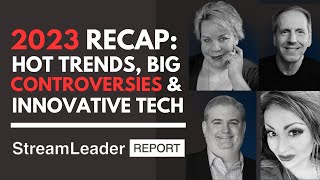
Ross Brandt, Claudia Santiago, Rebecca Gunter, and Rob Greenlee recap 2023's biggest digital trends: community-first podcasting, AI's expanding role, and video's comeback. They discuss how creators build audiences through live interaction, the rise of AI security threats, and the ongoing debate over what counts as a podcast.
Chapters
All right, what's your favorite tech of 2023? What's your biggest industry controversy of 2023? And what's the hottest digital trend of 2023? We're going to do a 2023 recap and also, of course, go over some of the biggest stories of the week and of the last month of 2023. It's our final 2023 show. It's the 2023 recap. A lot of fun, a lot of opinions, A lot to talk about. Let's do a show.
It's the Stream Leader Report Live panel, creators talking to creators, raw, real, and unscripted. And sometimes they say the quiet part out loud.
Here are your hosts, Claudia Santiago, Rebecca Gunter, Rob Greenlee, and Ross Brandt. All right, hey gang, Ross Brandt here for the Stream Leader Report. It's our weekly Thursday Stream Leader Report Live panel every Thursday 1:30 PM Eastern, except the next 2 weeks because we're going to be off for the holidays. But this is our big end of the year wrap-up show or recap, uh, and it's going to be a lot of fun. We have the great Rebecca Gunther, Business in the Raw, Hall of Fame podcaster Rob Greenlee from Podcasting Tips with Rob Greenlee, and Claudia Santiago, the great singer, musician, entertainer Claudiosantiago.com. So let's get right into it. We'll recap 2023, and I'm gonna put the questions out there. There's no right or wrong answers, they used to say in school, until you gave an answer that had nothing to do with the book you were supposed to read and you found out there is a wrong answer. Um, let's get right into it. Um, what is your top digital trend of 2023? Rebecca Gunther.
Oh dang, digital trend. I think my top digital trend for 2023 is the Stream Leader Report weekly live show every Thursday, 1:30 Eastern Standard Time here on YouTube and also co-streaming on LinkedIn. This is my trend. This is it. I'm serious. Using this platform to bring voices together and to uplevel the industry. This is my new favorite trend. And I— fight me, fight me, internet family.
I'm loving doing this show. So what can I say? I can't argue with that. Rob, your top digital trend of 2023?
I would say the development of artificial intelligence in all of our lives, as well as I think a kind of a renewed focus on video online too. It seems like those were the two biggest things that kind of hit me between the eyes this year.
So, all right, can't argue with that. Claudia, your top digital trend?
Well, I love that we have and we're not entering, we have entered a massive tech revolution. And I just, I count it an honor actually to be part of history like this. And, you know, I am excited, but also going in with eyes wide open and checking everything out and seeing what's gonna be best to implement for me, but also my clients and yeah. It's just, I don't know, just living the history part of this, it's, uh, really, really exciting.
All right, well, now I get to do McLaughlin Group style where I tell you what the correct answer—
I thought you said there were no wrong answers.
Of course there's no wrong answers. Um, all right, I'm gonna say community is the top digital trend of this year. You look at the The podcasts, the live streams that are successful, um, they're not only producing in general a pretty large volume of content, but they're building community from, from the beginning. Pretty much, uh, the reverse of how people used to do it, which is they would live stream or podcast for several years, grow an audience, and then decide to start a Facebook group or a paid group and move people, uh, into that. And now I think you're seeing people, as soon as they start, if they're on top of things, they're, they're, they're getting that first listener and that first viewer right into a, a community to continue the conversation and, uh, you know, chat with them offline and let them know when the next thing's coming up, not relying on on social media, uh, for notifications and, and keeping in touch with people. So I, I would say, uh, community is a big one for, for this year.
Well, Ross, if you've shown us anything, the community happens here in these comments. The comments are hot. You have regular people who show up all the time. Shout out to Beauty Bubble. You have engaged conversations. You're able to bring them in. So I think the community you're building here is absolutely in the comments. So I I stand for your prediction.
Thank you, thank you.
I love that we're always watching, we're always watching those comments and see some people there.
And huge, huge shout out to Beauty Bubble for being here since our first episode. I believe this is episode 30, but I lost track of the count. I've had to look it up, but I do believe that this is the Stream Leader Reports 30th episode. Okay, let's talk about controversies. Everybody loves a good controversy. What is your big industry controversy of 2023? Claudia Santiago.
Oh my.
Okay. Well, do you want me to just dive right into our topic here? Is that what you're asking?
No, don't. It doesn't have to be the topic of the day. It's just whatever you think is the big controversy of 2023. And then we can get into that in a deeper— when we have more time later on.
So I, I, I think that the biggest one is, are we as humans going to be replaced by AI robots? What are we going to do? What is the security of all this? How do we— yeah, just people, some people are loving it, some people are really skeptical. Um, yeah, and where are we heading? Where are we heading with all this new tech? The implants, the, uh, camera on the tip of your tongue. Hello, just saying.
You're gonna put the chip right inside you. Rob Greenlee, I know in your world there have been some controversies going on.
Yeah, it's like where to begin on that one. But, but if I think of, uh, what's happening right now, I think it's, it's around the, the kind of flurry of concerns around a cyber attack on our country, and I think that is really kind of indicative of what we've been going through for the last few years. It's like we're bouncing from crisis to crisis to crisis, and it's like AI and the big blowup around OpenAI, and it's still not really clear exactly why that happened, and there's some concern that AI may be, um, you know, moving along faster than most people realize. And I think that that is kind of a concern for, for many. But then you combine that with cyber attacks, and maybe we're moving into an era of, of warfare is becoming much more clear that it's beyond, you know, like ground battles, you know, like what we're seeing in Gaza and those things like that, that really the battlefield of the future is going to be around digital technology and attacks coming that way. And that's kind of scary. I think that's the biggest controversy. And I think as we think about our big tech companies being targeted and somehow maybe there's, you know, there's things that are going the other way too from our side., that are attacking other countries too. So there's, there's definitely some concerns on, on those key areas in my mind.
Well, we can always be assured that all of our top tech companies are doing everything they can to protect their users first and foremost, right? I'm sure that's before even thinking about their own businesses or their own interests. It's all about protecting the user, um, Rebecca Gunther. Your big controversy in the industry for 2023?
I'm really piggybacking off of kind of your last glib remark, Ross, about, let's call it, the trust factor, if I may borrow that phrase from my esteemed colleague. Who do you trust? Controversy is, you know, kind of this versus that almost, and this ain't that's been the theme for 2023. Do the tech companies have the user's interest at heart first and foremost, as you glibly suggested, question mark? Who is the source of media? Why is it someone's getting canceled? I think it's a great pulling back of the curtain to see the all-powerful Oz. And I actually am for it, 'cause I kind of like to see some more transparency in the decision-making that we move forward. So I think the big controversy is the trust factor. Actor, question mark. Yay or nah?
All right. Um, I'm gonna say, uh, although I could say something about, uh, social media, X and Threads, but we're going to talk about Threads and what they're up to in a little bit. So I will say the big discussion, and Rob's been involved in it much more than I have, but the big discussion about what is a podcast, is YouTube a video, podcasting platform, or is it only if your video goes delivered through an RSS feed? What is the public calling a podcast versus what do some of the OG and industry people want to stick to the definition of a podcast? So there's a lot of probably needless fighting about that, I think, at this point. You know, the thing is the medium, and it's really a great time for people who are doing podcasts with video right now. And those that, you know, as I said earlier, if they're building community along with it and they're, you know, consistently putting out content, some shows and some channels and some podcasts are really blowing up. And I think the podcast and the video podcast and the podcast and video that may or may not be RSS feed delivered is all going to have a big, big role to play in the 2024 election. In fact, I think a lot of people now, if they want to hear what a candidate really has to say or learn about who they are, they're just as likely to go to a podcast as they are the evening news where they get maybe a sound bite or two, or, you know, a quick interview, either a softball or a hardball interview depending on whether they go on friendly or unfriendly media.
Yeah, to kind of riff off of that, Ross, a little bit, I think if we see more crackdown on the part of, let's say, YouTube on content moderation and censorship and things like that, that could push people over to doing more RSS-based video podcasting. And I, um, I regularly have conversations with people out there that are very confused about this convergence between video podcasting and YouTube. And, and clearly understanding, a lot of people don't even understand that you can embed a video file in an RSS feed like you can an audio file because people don't, you know, Apple hasn't been promoting that they're a video consumption platform. They've been really focused on promoting that they're an audio consumption platform, which is not true. So, you know, we may see in the new year kind of a renewed focus around being in control of your video distribution versus turning it over to YouTube.
Is there any chance that storage and bandwidth or whatever it is that you're paying for can get cheaper? Because right now it's just out of the reach of the hobbyist podcaster, and even some pros don't want to be spending over $100 a month on, on storage, right?
Yeah, I think you have to spend probably at least anywhere from $50 to $100 a month to get involved in video podcasting. So, so there needs to be enough value that I know Podbean has a plan for, I think it is $50 a month, uh, to do a video podcast because it is a lot more bandwidth to deliver video depending on how much it is and what the encoding bitrate is. You know, it's just so much cheaper just to upload it directly to YouTube and it's, you know, it's on Google's dime, right?
So, right, right.
So that's kind of why things have happened the way that they've happened, but it may get back to that these big mega distribution platforms want so much control over the type of content that passes over their network because of advertiser pressure, primarily is where it's coming from, and political pressure, that people start gravitating towards being in more control of their video and audio distribution. Now granted, there are some efforts to content moderate even RSS-based consumption of, of content too. And that's something that we kind of— I think we have to push back against. So there needs to be a relief valve to get away from moderation and censorship, right?
I was surprised to see a notification come across my Substack today that somebody was live in Substack. And I've seen that you can host a podcast there. I was like, wow, that's really interesting that, you know, live streaming is starting to reach these very specifically content, you know, like written, the written word type of platform, uh, LinkedIn Live, etc. So it's almost like the, the variety of muffins in the bakery counter is expanding.
Yeah, where are you going to build your, where are you going to build your community in, in 2024 is going to be a big question, I think. And those Substacks and places like that are, are definitely set up to be an option and to be monetizable at the same time.
Yeah, I do wonder about live too. So if you think about what we're doing here, we could choose at the, at the moment to talk about something that is, you know, um, kind of not as, you know, popular, or we could say something because it's live, right? It's in the post playback, replay playback, that platforms have the ability to censor and control what we talk about here. So live may be an outlet for more freer speech, even on these big platforms.
Now they do control monetization. If you say the wrong word early on, you notice you're not, you're not being monetized while you're live. I think you can still, you can still get super chats and all that. Yeah. And by the way, we are taking Super Chats, right? I mean, I've never mentioned that on one of our shows.
Oh my God, I don't even know what a Super Chat is.
We're open for Super Chats. What's a Super Chat? People donate. People— yeah, you, you basically, you, uh, you give a tip to us for, uh, the great work that we're providing for everybody, and your comment will stay at the top of the comments for a certain amount of time.
Oh my God, it's like buying a library wing at the university.
Yes, exactly. Your content, it's just as permanent as the library wing. You get a couple, 2 minutes for a couple dollars.
Where I see—
we'll take what we can get. Ross needs a new, new long sleeve t-shirt.
What I see is exciting too is where, um, distribution, content distributors. So if we're going live and we're using a distribution system that can take us to different platforms, if one of the platforms says, uh, don't like what you're saying, we're gonna pull that down, or you can't monetize— well, the cool thing is, is if with, with content distributors, if we're going to different channels, there's some channels that will go, yay, we like you, So I think it'll be kind of interesting to see where we all go with, and also the content distribution companies adding the different channels.
Yeah.
I mean, Beauty Bubble saying here, community content, because it's driven by the needs of others, is massive for 2024. And I think, you know, with so much focus on the content creator, a lot of content creators maybe aren't thinking enough about. Who they're actually trying to reach, who they're communicating to, and what their audience wants. And you could see that in, for instance, Rob and I were at a meetup the other night, and we may have had certain ideas about how it was going to go or whatever, but if you want to have a great meetup, sometimes you just have to let the, the people there— what are they interested in talking about? What do they want to do? Do you want to create some content, or do you want to share some, some ideas about how to get good at doing something? Do you want to ask questions? Do you want to break into small groups? You know, sometimes you just gotta see what the audience wants, and you can't go wrong by delivering that to them, uh, much of the time. Yeah. All right, let's get to the last of our 3 questions in our recap of 2023. What is your favorite tech innovation of 2023? Rob Greenlee.
I would say at this point, if you consider it to be a car or a truck to be something of a tech innovation, I would say the Cybertruck is one. And then also the announcement just yesterday of the next generation Tesla bought Optimus Generation 2 that came out. I think those are the two things from Tesla that we've seen that are glimpses of what the future is going to look like, and it's going to look quite different. And a lot of the things that I'm learning about the, the way that that Cybertruck is being manufactured is revolutionary and may usher in an era of very inexpensive cars, and also very efficient cars and very tough vehicles too. Like, there was a couple of videos that were put out about the Cybertruck where guys were kicking it and stuff like that, and they— all three of these guys walked away bruised from trying to damage this Cybertruck. It's like they were limping away because they kept bashing it with their feet, trying to dent it, and they couldn't. And it was hurting them more than it was hurting the truck.
So yeah. So what makes it a Cybertruck? What is the control of it that makes it a Cybertruck?
Well, it's— it really is reflective of a new way of thinking about kind of how a vehicle is assembled, manufactured, and how it actually operates. It has like a drive-by-wire capability in it, which means that it's built on a 48-volt architecture, which most of cars in the past were built on 12 volts. So as we think about our cars that had a 12-volt battery in them, right, this car is built on a 48-volt battery system. So that means that it has fewer wires, it has fewer connections. Things can, can travel through the vehicle and power other types of things off of a master circuit. So it's, it's basically just a revolutionary way, and they're going to drive so much cost out of making these things. It's going to be stamped out in like one huge mold, and then there's going to be outer skin put on this car that's going to be— I mean, I mean, you can shoot a machine gun at this thing and it won't even go through the doors. That's how difficult— even, even Joe Rogan tried to fire a high-speed kind of arrow at it, you know, and it bent the arrow and it bounced off. So it's, you know, it's, it's just, you know, I think we're coming into an era where, where vehicles don't have built-in obsolescence and frailties and lots of things that will break and possibly get damaged. And you have to spend a lot of money to get them repaired and all the stuff that is just built solid so you don't have to deal with a bunch of maintenance on your vehicle in the future.
All right, before we move forward, any word on the price?
Yeah, it's actually the base unit right now. It's not available till next year, is about $60,000, um, which is, you know, it's not inexpensive. But if you think about the rebate that's out there, it's about $7,500. Um, I don't know if that's going to last into 2025 or in that time frame, but the high end of this thing is more in the $100,000+ range. So, so it's actually, you know, there's a lot of people that are talking about this car is that it's, it's dangerous for pedestrians because it's so tough, right? You can't. And it's like NBC breaking news is that pedestrians would die if they got run over by a Cybertruck. Okay, well, if you got run over by any vehicle, you're probably going to die. So, yeah, I mean, Cybertruck is somehow unique here.
A diesel truck will kill you.
Right, I mean, it's big, but it's not that big. I mean, I think an F-250 is a lot bigger than a Cybertruck, I'll just put it to you that way.
And if you have to live in your car for any amount of reason, you've got kind of a built-in protection hub. So if we go total Mad Max Beyond Thunderdome, I'm taking my Cybertruck to the RV park and hunkering down.
Yeah, I think all it needs now is some bulletproof glass, and I think we're, uh, good to go.
Oh my God.
All right, Rebecca, what is your favorite tech innovation of 2023?
My favorite tech innovation of 2023 is TikTok. And I know it's not a brand new innovation, and I know I'm late to the party, but damn, this beautiful piece of interconnected software allows us to hear and tell stories and interconnect and have conversations and create kind of like these global, nationwide to local movements of thought leadership, ideas, best practices, conversations, art, creativity, absurdity. I'm like, I stand for TikTok so hard in 2023. I think this is changed the game for humans to be able to talk to each other from any walk of life, from anywhere in the globe, and to be able to piggyback on each other for creative endeavors and to advance the human species.
Issues.
So, um, we all know TikTok is bae for me, so, um, that's my answer.
That's my final answer, Ross Brand. Claudia, what's your favorite tech innovation of 2023?
Robots, robots, robots, robots. Um, what I'm loving is the, uh, the medical aspect of any helping humankind with some of these innovations. Just to see the medical advancements. I had no idea what had been in the works and what has already been implemented. And we've, we've delved into a little bit of that in this show. And that's been absolutely wonderful to realize how many people are being helped. Now, on the other hand, while it is one of my favorite things, it's also pretty damn scary. There's so much about it that could go sideways. It could go wrong. So while it is my favorite, there's also some big red flags as to why exactly are they doing this.
I'm still waiting for Rob Greenlee's AI-empowered robot staffing agency to download their skill sets and come do my dishes.
Yes, that's right. I mean, they're pretty athletic from watching some of that film. I mean, they're starting to get very skilled and like they're— I don't know what you'd call, you know, their motor skills and how they can manipulate things. And all of a sudden they're going to be— no, we're going to be no match for them soon enough if we are already a match for them, right? They don't get tired, they don't get hurt.
There you go.
All hail the algorithm! All hail the algorithm!
That's right. Oh, go, go, doing backflips on stage and, you know, it's like I don't have to worry about insurance.
Oh, you, we— you cast that story in a different light. Yeah, where's that band for the rim shot?
It's the Congo behind, um, that's my Congo, right?
Yeah.
I'll say for my favorite tech innovation of 2023, it's all the different ways people are using ChatGPT to create their own product. Like every product that comes out now, it's gotta be like this, and there's this generative AI section of our software or of our what, like everything's got like an AI chatbot ability built in. And while it's, you know, I haven't dove the most deeply into it, I, I will say that like it's so cool some of the things that you can find out. And sometimes I just have a conversation with ChatGPT about some topic that I'm interested in learning about, or if I want to challenge my own opinions on something I'll just get into a conversation with ChatGPT, and it's really almost like talking to a person after a while. It's, it's really a little bit different than anything we've, we've kind of dealt with before.
My kid's been practicing dating simulation with it. Yeah, I'm serious, like to have like texty conversations with somebody you're interested in. Using ChatGPT or AI-enabled bot to practice flirting.
There you go. You know, and this is like exciting because it'll help us with our Tinder business. You know, remember we've got the AI Ross brand.
That's right. That's right. Often duplicated.
Hey, as we speak, as we speak, I'm being cloned.
So just so you know, wow, you're saying Santa clone is coming to town?
It's a virtual digital clone, but a clone is being made, um, through Podfest. Um, there's a, I guess, a sponsor or a company involved, a startup, and, um, they're offering to create a clone for, uh, speakers at Podfest. And then you have like a few weeks to use it before you have to pay. So, um, gathering all my info to train the clone, and we're gonna see what it's like. But, uh, apparently, like, if you decide to go with the service or whatever, you can set— have your clone have appointments with people. Like, if somebody wants to pick your brain, instead you set them up with the clone and you can charge them for a consulting session. 'Cause the clone sounds like you, talks like you, understands you, I think. Amazing. We're gonna see what it's like, but— Ross. Something for a little show and tell maybe in 2024.
Ross, I have bad news for you. Your clone is making Facebook pages. Yeah.
It might be. It might be.
You better check your clone, brah. He's out there, rogue.
Oh man, that's who made the Facebook page.
You know, to be honest, when I saw that, I thought, hmm, could this— could this be one of those things that's rolling out? Hey, so sorry you got hit with that, Ross.
I mean, whoever did it— thank you— I mean, whoever did it, like, for that day was sharing people's profiles and then putting some way that they could make money or whatever. But, but then they stopped doing it that day. And I know a bunch of people have notified Facebook, including me, twice of it. And it just continues to sit there. So if you search for, for me, that comes up in the list of pages, just like, you know, crazy.
So anyway, you can't get in there and say it's unofficial? You can't do—
no, I go through and I click the thing, imposter, who are they? You know, this was my clone, this was my clone, it wasn't me.
Yeah, crazy.
Well, I'm far more popular than the clone because the clone is zero followers right there.
Yeah.
We know the truth.
You ain't gonna replace me so quick.
Often replicated, never duplicated, Ross Brandt.
All right, I promise you though, if we get our— if we get our Tinder dating site up for you, um, you'll have good traction, uh, Ross.
You'll have a good track. So, um, are you— are you working on the profile, or what is your role gonna be?
Brand ambassador.
I just show up, right? The clone actually does all the back and forth. I just show up, right, for the date.
That's right.
You can set up your own GPT.
You want to show the reverse of what my teenager's doing? A short 16-second video of the Tesla bot that was announced today?
Yeah, yeah, absolutely, absolutely. Let's watch that. The Tesla bot.
Yes, it was.
There we go.
Yep, that's it.
Wow.
Wow. I'm not sure why it's tough, but yeah, I guess that's all it is.
That promo for your staffing agency is excellent.
Sorry, Rob. I, I always make the mistake of like, how do I get this off? Oh, I'll just kick the— you should, because you're kicking the screen share, but somehow I always kick the person with the screen share.
This isn't The Gong Show.
Uh, hopefully Rob doesn't think I really meant to kick him out, and he shall be back, uh, shortly, I do hope.
That is something else, like how those things move. Like, honestly, it looks like a man in a suit because of the movements. And but it's not, it's a robot, and it's just crazy.
I feel like honestly, this is— when I see that video, I think that maybe there's some sort of an answer to the impending elder care crisis. That's just even just with basic housework, for how long people might stay in place more often, like longer than in an instant in an institute, you know, assisted living, etc.
And just for things that get harder to do when people like, you know, open that heavy refrigerator.
Oh my God, tie my shoes. Right, right. If you've had a stroke, you can't like extend and grasp. Like, there's just so many ways.
Sorry, Rob, I don't know what happened.
I, I, I meant to, uh, kick the I had the, uh, screen share out and I kicked you out with it. So sorry about that.
Throw the baby out with the bathwater, right?
Yeah. What a cool perspective, Rebecca, on that. I just think, wow, you're, you're so right. It could change how our elderly or disabled— like, the care and how long they actually can stay at home independently.
I just, I just— when is Rob's temp agency opening up? 'Cause I got to retire into playing.
Right.
Right.
Wow.
Incredible. All right, Rebecca, I want to talk about this crazy story that you've got because fans are creating their own unions or there's talk about it or it's a joke. Tell us what's going on with that.
Well, it's tongue-in-cheek to kind of start with that, that some creative folks have— let me find the graphic here, which is adorable— the Taylor Swift Fan Union. What would happen if fandom— Claudia, girl, we gotta get you your fan union. Um, which really speaks, I think, one, to, in my opinion, 2023 was definitely the year of the worker union. And the ability to, you know, have folks who have big economic impact have also then the ability to control some aspect of their future through labor. And the argument, or the kind of food for thought, that this op-ed piece, uh, from Fast Company is really about— what is the economic power of your fandom? I'll kind of just switch over here and talk about this piece from The Washington Post about how Taylor Swift became her own economy. The amount of voting power, buying power, their sheer mobability makes them almost the economic force that would contend with a small country. So if brands become such a force in which, I don't know, it's just an interesting, like, could capitalism kind of turn in this direction in which, like, your job is not just to consume a brand but also to work towards, I don't know, more consumption of it, more influence of it. Uh, it's a glib little piece that really caught my eye, but I think in the year of the union, thinking about the power of the consumer and what would happen if they unionized is extremely— an extremely interesting topic. I was joking before we kind of came on camera about that old— that scene in Blazing Saddles where the cowboys and the, and the, um, waltzing dancers kind of meet together on a Hollywood studio set, they get in a fight, and, you know, big clock, screw you, I work for Mel Brooks.
Like, what if—
what if— what if fans unionized and were like, I work for Mel Brooks, I work for Taylor Swift? It's just a fascinating economic, um, fantasy to think about if we unionized as a fan union.
Let's talk about what that really means in a practical sense. I mean, damn it, you know, a union has a certain amount of baggage to it, right? That, that word. And is it a union against Taylor Swift?
No, it is a union as the fans are unionizing.
Okay, for what purpose is the question?
Uh, well, I would think for activism. Social and political. I would think for kind of driving consumer spending. I would think for just the economic vehicle of something in like the Eros tour, the movie that went along with it, the merchandising, the record players, all the things.
So the word union doesn't have a historical meaning that implies like a labor union or something like that?
Well, I think that that's kind of the fantasy exploration, Rob, is like, what are fans doing the work? Are they doing the work?
Well, then that would mean that they're kind of oppositional to their, their leader, right? Which would be in this case Taylor Swift, right? So does that mean that they're going to not show up to her event unless she does something?
Are they going to strike if she doesn't do it?
Right, exactly.
Are they just not going to show up to her concerts if if she takes a particular position on something, or she says something they don't like, or does something like some business deal or something like that, votes a kind of way, wears, you know, has a public opinion about a kind of thing.
I think that to your point of like, okay, well, the deepest meaning of the word union— you're being glib, but what does it all mean for us? What Do our fans compelled to organize? Well, it's our groups of people compelled to, or compelled to organize. And how does that relate to the consumerism of the brand itself?
Yeah, I think it's an interesting thing to think about from the standpoint of, uh, you know, nation states too, like all of the citizens in a nation coming together, but Typically unions are oppositional to something, right? Not, you know, embracing something, right?
I'm gonna throw this out there. Taylor got really royally, uh, injusticed by her own label, by the label, and, you know, wanting to withhold from her the rights to her songs. And so perhaps with some of this the— they can unionize or to protect her, to, to say, hey, I'm not supporting what the— that label is doing, I'm going to support this. So, and then the other thing is some of these fans may be bought fans, like not, not robot, but bought as in paid fans, because that is done also in the industry. Uh, there is, there is a huge budget for marketing. And some of these fan communities are not necessarily— I'm just giving you industry insight— they're not necessarily ones that go, oh my gosh, Taylor! It's more like, oh, I'm on the list and I'm getting paid as an influencer, as a fan.
Or, or maybe, you know, things are slowing down after— we might want to start a fan club or a fan union or whatever and and, you know, this will keep her in the news for, for quite a while. I mean, she doesn't need any publicity at all, but just in theory, that can happen with artists. You know, there's been talk of this— not— I, I mean, I don't know if the union word was used, but there was talk— there's been talk about this in the sports industry for fans when leagues go on strike. Um, You know, what about the fans when leagues charge, um, I forget what it's called, the NFL football charges like these personal seat licenses? Like you not only have to buy a seat or a season ticket, but you have to actually invest in licensing that seat on top of it, which can be thousands of dollars. Um, and what But I think basically the sports industry realizes you're never going to get fans to act together because no matter how mad they are about a strike, when you come back and play, there may be a time that attendance is down. But once my team has a chance to go to the World Series or the Super Bowl or whatever, I'm not missing that, right?
Yeah, that's interesting.
The other thing is, I guess, for sports is that the in-person tickets, I imagine, are not the big, the big moneymaker. The, the big moneymaker is the TV contracts. So, I mean, unless people stop watching on TV altogether, um, they can play like during COVID to an empty house and still be doing business.
Yeah, so I was thinking about this. I was looking at the article too, and it, it does have an image on here. It says the Taylor Swift Fan Union's effort to join the United Musicians and Allied Workers. So it does have a strong kind of traditional kind of association just based on the name of it here. But I'm, I'm really starting to think Maybe this is, um, something of a way of solidifying a community per se. And then also, I know that this term has been out there for a while, and I think they're— it's called, uh, Swifters or, or Swifties or something like that, right? Yeah, right. So that, that terminology could be linked up with this too, and that's just like a, a fan community that's organizing itself somehow to for some purpose, which we don't really know yet, um, what that purpose might be. But it's, it's an interesting trend, right?
It could, it could be the new form of religion. It could be the Swifties.
Yeah, I don't think I had an idea, really any idea of how famous and popular she was until she started dating a football player, and the entire either Sunday night or Monday night broadcast was like, it was more about her than it was about the football game because of the number of people tuning in just to see her cheering in the stands for her boyfriend.
You know, even that, some, some are saying that that's actually a strategic marketing thing, the whole thing with her. And so they're, they're coming together, bringing brands together, and it's a whole different way of entertainment.
That's so interesting. The two of them were the topic of conversation in a business meeting I had yesterday, and I was shocked that my, that, that my client was like, really just kept saying, I've learned so much from her. I've learned so many marketing lessons. Like, the, the enthusiasm for who she is as an entrepreneur has almost as much of a hold on people as the enthusiasm like a teenager has for, you know, her love songs. It's very interesting. She's a very interesting case study, I think.
And a little inside scoop just on behind the scenes with Taylor is, uh, from day one, her and her family have positioned her in such a way that, um, they make a lot of the decisions in her career. And, and this has been outside of their normal model out of Nashville. And so, uh, yeah, I know people that work with her directly and, and, uh, develop certain things, but she is brilliant, uh, but also very, very business savvy.
Well, I'm for organizing the Claudia Santiago fan club. Make me the president.
Make me the president. All right, it's yours, Rebecca.
Claudia, what do you have, uh, for this week?
Oh boy, um, this one I'm gonna need a lot of your input, guys, because I'm still learning so much about this. In fact, I gotta pull up my notes. Um, but, uh, okay, so Zuckerberg has Facebook, he's got Instagram, he's got WhatsApp, and then he's created Threads. And, uh, I know I jumped on board right away. I actually got on their waiting list before it went live. You know, I was waiting till midnight, you know, went live and I had my account. So the crazy thing is with Threads, when you look at it, honestly, I don't know about you, but it seems so useless. Um, did I just say that? But this is the thing is I knew that behind the scenes Zuckerberg is a— he's smart and he's got a plan., and there's something about Threads that is different, and it's called, uh, decentralized social media. And as I've been looking into this more, and I'm going to ask you guys a lot of questions because I'm just learning, it's part of Mastodon, right, Rob? This is a different framework, and, uh, and what we're currently on is, is different. So the way it communicates with other platforms and like where are we heading with this decentralized social media? And obviously with Threads, it's still, some things are in development, but that is one of the main thrusts of Threads.
Yeah, I think it's the linkages between all these platforms I think is really where it's gonna be seen is that, you know, there's all these different, platforms like Threads and Instagram and Facebook and all whatever. And I think this open— it's more about open connections between these two, and it's a way to, you know, to create more of a seamless kind of pathway between all the platforms because people are members of various platforms and, and trying to make connections between them. Is also a common thread even in podcasting. I know that the Podcasting 2.0 Initiative has a project and an integration that's proposed in the RSS feed to be able to link up all of the comments from all of the listening apps and funnel them all through a central platform that can be shared across all the other listening apps. So It's kind of like what you see here with StreamYard. And I mean, you contribute in a comment on Facebook or on LinkedIn or whatever, and it goes into a common pool that's then shared across everything. But that could happen across listening apps too. So, and then also live capability is being built into RSS 2.0 as well. So, you know, linking to like this program that would be right next to your on-demand audio program. So you could have a live version of the show. So there's, there's a So there's an effort I think that's happening in the technology sector is to try and connect all these different and disconnected platforms and try and connect them up again to create community.
When I've heard about decentralized, a lot of times the centralized social media, the centralized internet goes along with the blockchain. It goes along with protecting privacy. Yeah, your data, your own data, right? Yeah. And I, I mean, I think, um, obviously Facebook already has all of our data, uh, through every one of these apps. And I think when people talk about going to a Mastodon or some of these, uh, I know there's a whole sort of distributed, I think they call it, or, uh, decentralized social media networks and platforms where it's like you don't even know where the server is, that you're like, there's all these different servers, or you pick a server so that it's— nobody really controls the data of everybody. Um, well, so, or, or everybody does, depending on— everybody does, but I don't— I So I guess I don't understand the decentralized part with Meta unless it's, hey, how do we get the data from Mastodon too? Or how do we get the data from all these other sort of more protected servers?
Well, and that's why a lot of people have been very skeptical of of Meta wanting to make this connection with all of these other platforms is that it's a way for them to potentially extract all that metadata out of those platforms too. And just, it's just a bigger pool of data for them because that's what Facebook is, is a gatherer of information about users. That's what they market and that's what they sell.
It's a data company. Right, they're selling data.
They're selling data. Yeah, correct me if I'm wrong, but from my understanding with decentralized social is also like currently with a lot of platforms, they are doing this whole verification thing and you've got to verify through Google platform, through some other thing, real person, which is really kind of wild. So that's one thing I'm understanding. The other thing that I don't quite get And it makes me kind of wonder because it says that there's not one person that makes a decision on content and things like that. So it's going to allow for more open conversation and thoughts. And I'm thinking, well, if not one person's controlling that, why is Zuckerberg integrating that into Threads when he's like king of control? Right. Just saying, like, what are you doing? And then the third thing I read also, which I found very intriguing, is that through this also people will be able to create their own platforms, uh, with this technology. Uh, I don't know exactly, like, I just barely started digging into that, but I don't know, some of you may know more about that. So not only will everybody have their own podcast and YouTube channel, now everybody will have their own version of Facebook or LinkedIn, which, which can have like really, really amazing pluses because as we talk about building community and if there's platforms that are not letting us say certain things, well, you know, we can have our own version of the Swifties, uh, with our own community, uh, where we have free speech or bring forth whatever. But then there's a whole other gamut of criminal minds tapping into that. And so I don't know, this whole decentralized social media thing was very intriguing to me. And I'm in the classroom still, obviously, right?
Right. Yeah, I mean, I'm not a huge fan of Threads since I've been over there. I, I, I mean, and I know that like people don't like X or they don't like Elon Musk or whatever, but it, it just seems like the people who left X because of hatred or it was too political or, you know, uh, it was too biased or whatever, they're going over to, to, uh, to Threads And same people are now ranting on Threads and hating people with different opinions and whatever. So I mean, at least between the two places, X, we have a history on it, on Twitter, on X, and there's a, there's a huge diversity of content on there where I don't know, I find Threads is kind of boring and, and, you know, I get hit with these rants immediately. Like, it's like 2 promo posts from, you know, friends or whatever. One, hey, look at, I'm on vacation and bing, you know, now I'm hit with something about politics or whatever. And I don't mind doing that on X where there's, where I feel there's a very balanced discussion. Not that I'm necessarily engaging in it, but it, it, and even X, I wonder like, why am I getting so much? Stuff in my feeds about politics and stuff when clearly I've never tweeted about that on my account? Like, is it because I have other accounts that I may use for reading the news and following things and they're merging together because one of my accounts follows that and my 5 other accounts are about live streaming? Like, why, why are those live streaming accounts I don't want to see that stuff in my feed when I'm on, like, I'm on those other accounts for work and I don't want to be distracted by, you know, somebody's rant about whatever the issue of the day is.
I wonder, I wonder if TikTok runs on, on decentralized social, uh, type platform.
What do you think?
That's a mastodon thing.
The CCP is about as centralized as it gets. I mean, to what extent they influence it, I don't know. But, you know, they have an owner.
And can someone explain Mastodon to me?
We could do a— we should do another segment on this next year because when we come back in 2024, let's do a segment on decentralized internet and alternative social media platforms and talk about some of that stuff, um, because there's so much to it. And like, like you said, I mean, we're all just kind of learning about it. Um, I have some friends who, who use those platforms, and it's like, it's like a whole nother— it's learning to speak a whole nother language.
Yeah, developing our own platform.
Maybe we should. Maybe we should. Do we get to make the algorithm?
Oh my God. Get ready for the stream leader retort.
Retort. Yeah, look, live streaming posts get 5 times the views.
I love Rebecca's hair, by the way.
Thank you. Do you want to end on a holiday spirit note here to some degree?
Absolutely, absolutely. Uh, let's bring this up.
To the stage. So Ross and I were just in New York a couple days ago here for his, uh, New York City video content creator and podcaster kind of combo meetup. And I took some pictures of some of the Christmas trees around Times Square. And so this is, this is one of them. And I'll show you another one that was in Times Square as we, you know, fast approach Christmas is coming up, or the holidays for Some people, not everybody celebrates Christmas, I understand. And then this is the one that's by Rockefeller Center, a little bit closer. So you can see this huge crowd around that, this gigantic tree. So I just wanted to share that. And this is Grand Central Station, their decoration. And as we come into the the holiday season.
So very nice.
What a beautiful segue.
That was awesome. Claudia's going to be dancing in the holidays. Yes, she's got her under the disco ball.
I have my disco ball. Actually, actually, these are all over my tree, by the way. Very nice. Ah, beautiful pictures of New York. I've always wanted to go to New York.
Christmas. Yeah, you gotta come for one of our meetups. Yes, guest speaker.
Oh yes.
Yeah, so yeah, I think we should do a Christmas meetup for livestream. Universe, I think we should.
Maybe you've got room for us all in your apartment, Ross. I'm bringing my sleeping bag.
All right.
Come on.
All right. All right, everybody. Thank you so much, everybody, for joining us throughout what has been over half a year, I think, now we've been doing this panel, 30 episodes. Thank you so much. This is our last one of 2023, but we'll be back the first week of the new year, uh, every third, and from there on it's every Thursday as well, just like it was most of this year, 1:30 PM Eastern, uh, for Rob Greenlee, who's later today hosting Podcasting Tips with Rob Greenlee on StreamYard's channels, and Claudia Santiago, whose music and entertainment you can find at claudiasantiago.com. And of course, the great Rebecca Gunter, who does her live streaming, her writing. Everything is business in the Raw. It's a great show. And also, where can we find you with Stone Fruit?
StoneFruit.com and on YouTube at Stone Fruit. That's S-T-O-N-E-D-F-R-U-I-T. Come check out— I've got a lot of Raws on my channel, baby. All right, you're craving extra Raws, come come on over.
And that's some happy fruit there, boy, I'll tell you. It must be, uh, feeling, feeling pretty warm.
All right, this has been, this has been the Stream Leader Report. It's our live panel edition. You can find out all our episodes on YouTube on the Livestream Universe channel. You can also find them on some of our other creators' channels as well. And with that, we'll send you out by saying Happy holidays. Merry Christmas. Happy Hanukkah. Happy New Year. And we'll see you in 2024. Take care, everybody. Bye.
More from Rob

Future-proofing with Delphi AI/Human clones: your podcast as a personal LLM | New Media Show






How sports reveal what AI spectacle gets wrong #Technology #Sports #Commentary



