Tesla's Aggressive Driving Mode Just Got Dangerous
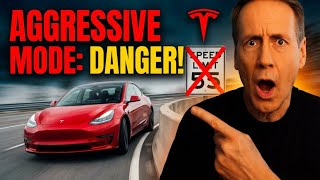
Rob Greenlee tests Tesla FSD 12.6.4's three driving profiles on his Model 3 and finds that even the Chill setting can be configured to drive 20-30 mph over the speed limit. He raises questions about legal liability when the car exceeds posted limits, and documents a random FSD disengagement that forces manual takeover. Greenlee calls for Tesla to be transparent about how these settings affect speed and following distance.
Chapters
Well, welcome back to another episode of Behind the Wheel. My name is Rob Greenlee, and I'm happy to be back with you, and thank you for watching another video on my channel. I appreciate it very much, but I wanted to come back and talk about a subject as I'm driving down the freeway in hurry mode in my Tesla Model 3 2022 Long Range. So I have about 27,000 miles on this car, and I've been a subscriber to FSD 12.6.4 for many months now and have been actively using it for most of the drives that I'm going on today. And so, you know, I've, I've been experiencing some challenges with the 12.6.4 here recently. Around its— I don't know if the right word is a little bit of unreliability. I think I talked about in the last video that I made about how it will disconnect from Full Self-Driving just randomly while I'm driving down the road. But what I wanted to really talk about today, and maybe it'll do that while I'm driving here so you can actually see it. And if it happens later,, then I'll just cut it and splice it in here so you can kind of see what that looks like on the screen and how disruptive that is. But what I wanted to talk about is the Full Self-Driving supervised, profile classifications. Now if you have Full Self-Driving, you probably have noticed this. If you haven't, then it's something maybe you should take a look at. In your car. I, yeah, if you go into your settings area like I have on the screen here, you can see what I'm talking about. It's under the, the category Autopilot and it's Full Self-Driving Supervised profile and it has 3 different settings. It has Chill, Standard, and Hurry. And so right below that here, you can see it here. But right below that is a maximum speed offset. So this car does give you the ability to adjust, let's call a spade a spade, the car's willingness or ability or acceptance of what I would call kind of speeding, going faster than the speed limit. So If you set this setting to hurry, it'll tend to drive actually potentially quite a bit faster than the speed limit, right? So you can see up here in the speed limit classification, it shows a 55 mile an hour speed limit, right? But yet when you go in and you look at the hurry classification, in the settings, it's currently capable of going a maximum speed of 78 miles an hour. So I think it's an interesting dynamic. And I think if I go into standard mode, so if you look at this as the car changes lanes here, but what's the maximum speed for even standard is 78 miles an hour. Now I can go in here and set that number right up here, currently says 76 if you can't see it on the screen. But it is possible to set, you know, even Chill, right? But even Chill has the ability to set the car to drive faster than the speed limit, quite a bit faster, right? I mean, that's 11 miles an hour, or actually 21 miles an hour faster than the speed limit. Which could potentially get you, get you a ticket, right? So, but if you go in here and you set your maximum speed offset to, let's say, 30%. So what does that do to your ability to set your maximum speed? So if I go in here, it doesn't really change it. So I'm kind of It's interesting to me, and I know as we move into this next phase of technology integration into all of our lives, and, and I'm increasingly hearing that at least here in the state of Connecticut, there is an expanded movement towards more photo surveillance on the freeway and tracking, putting up kind of monitors along the freeway that monitor the speed of traffic. And will do like photos of the license plates of cars that are going over the speed limit. So I kind of wonder kind of where we're going with this from the standpoint of, of will these cars eventually disable this ability to set a maximum speed offset of, you know, like 40% or 30% that we may see that kind of go away As it, this car may put you in a position where you're relying on the car to drive you down the freeway and the car gets you a speeding ticket, right? So what do we do as we look to the future of this? I think all of us, and I see this on the freeway in Connecticut today, is a lot of people like to drive you know, 20+ miles an hour over the speed limit, and it's almost like it's the normal speed limit. But I do wonder, as we look to the future, as technology enables more enforcement of laws and rules, because it can, right, that is there going to be pressure put on Tesla to remove this kind of capability where where the car is actually able to decide itself how fast you can drive, right? And it disregards the stated speed limit for the roadway. So, and it raises a very big question, you know, who's responsible for that, right? Is it the driver or is it the full self-driving software? That has empowered the vehicle to drive 20, 20+ miles an hour over the speed limit. So I just think there's going to be a big reckoning moment at some point. Now, granted, the percentage of Tesla vehicles or full self-driving vehicles is still very small out there in the world. I mean, even Tesla owners today, I've, I've I've heard numbers that only 10% of Tesla owners even have the full self-driving capabilities in their car that they actively use. You know, especially in the, the Hardware 3, AI 3, older Teslas, right? It's probably more enabled in the newer Teslas that are Hardware 4 that have a little bit more advanced capability around full self-driving. But this issue of having these various settings of hurry, standard, and chill is really more about driver assertiveness is what I would call it. So it's an interesting kind of tension point that we have in these autonomous vehicles as we look to the future is that how are they going to be aligned with The rules of the road and the, the laws that are increasingly going to be enforced by technology, right? As we get more, as we see more roadway monitors that are utilizing technology and, and our photo speed traps, really, in a lot of ways, we're starting to see this go into a lot of the major cities. And I do kind of wonder, you know, are we living on borrowed time here that we're going to be able to exceed the speed limit by enabling our full self-driving software to actually break the speed limits, right? So I think it's something that I wanted to raise that I've been thinking about a lot with full self-driving for a while. Since we've had these different settings, you know, it does say right below here in the setting between Chill, Standard, and Hurry, drives faster with more frequent lane changes. So, so that's what this setting is really trying to do, is it is basically allowing you to drive, you know, if it's in the Hurry mode, it's allowing you to drive a little bit more like a maniac, right? Or more urgent in getting somewhere. But if you set it to standard mode, it's going to be a little bit more of a relaxed type of a drive. And if you set it to chill, it's going to be— it's going to tend to stay in one lane, and it's going to, um, probably adhere to, to the, um, the speed limit a little bit more depending on what you set your maximum speed offset to be. If you set it to +0 or you set it to +20 or 30%, that gives you that range of what the car is capable of doing. But it does get back to the question, who's responsible for that, right? I guess I could be linked as responsible because I told the car to to exceed the speed limit. I think this other setting down here, um, click this button to expand full self-driving visualization, which I think is, is an interesting thing. It widens the Autopilot visualization area when full self-driving is active. So I have the, the ability to make, I guess, the cameras be able to see a wider view of the environment that's around the, the car. So I don't know if that has anything to do with resolution or it just gives it more like a wide-angle view that maybe makes it a little bit more complete in its, its view. So I wanted to hop in here and I was kind of hoping that the car would error out and able to show you But you never know, I might add that at the end of this, this video because I'm going to continue recording here and see if I can capture that experience of when it actually cuts out, it completely cuts out the Full Self-Driving software and I have to manually drive. And there's really no reason for it. It's not like it's a disruption based on my lack of paying attention or any kind of a penalty. It literally is a software error that occurs that causes the car to not be able to use the full self-driving software. And I believe it's a bug in the system. It's a bug in the platform or it's a bug or an error somehow in the software. There's some sort of a conflict that happens. That triggers that. So around use cases. Okay. Okay. It actually just took over in an error in Full Self-Driving. You could see how disruptive that was. I had to capture control of the vehicle. And now, because I've been through it before, that the car has to be driven by me and there's no other option for that, right? I would actually have to pull over and actually get out of the car and I'll actually do that for you so you can actually see that. And I just don't know why there's an error happening in full self-driving. You know, it's very disruptive. It happened on the freeway. It caused the car to, you know, because I have to take over very rapidly and it causes a disruption to the flow of the vehicle driving down, going towards its destination. So I think it's very worrisome that the car is doing this. I'm contemplating taking taking the car to the service center and having them do an evaluation on the car to find out why it's, it's just randomly. And it says on the screen, parking brake functions disabled, automatic vehicle hold is disabled, cruise control is disabled. So I've lost a lot of the, the functions that the car has around its basic functions. Now I'm still able to drive the car manually, and that's, that's, that's what I'm doing now, but it, it just doesn't build confidence. And that's what I was trying to communicate in the last couple of, of videos here, is that this thing, you know, it's turned out to be not— Full Self-Driving has turned out to be not as reliable as I expect it to be, right? I mean, I don't really feel good about it just randomly while I'm driving down the freeway, say, sorry, you know, full self-driving, the capability of that is, has errored out. I think that there's a bug in the application this car should continue to do what it's designed to do. I just don't understand why it's, why it's not. So, and I also have noticed that the car will actually follow behind another vehicle just like we just saw here, very closely. Here lately I can see it, and this may be part of the supervised profile. If I were to set this to maybe standard, maybe it would create a little bit of a further distance on the following distance. I can kind of see after I made that setting change, it kind of backed up a little bit more. And if I set it to chill, does it actually slow down more and create more distance between my car and the car in front of me? So There's aspects of this that I think Tesla needs to share a little bit about what exactly these different settings, the Chill, Standard, and Hurry, really bring to the driving experience so we can make sure that we've dialed this in appropriately. Or if we, you know, let's say I go in here in this maximum speed offset, I set it to 50%, right? Does that mean that if I'm going, if I'm driving in a 55 mile an hour zone, does that mean the car is capable of going, um, you know, almost 90 miles an hour? Now granted, this car is capped out on full self-driving at, I believe, 85 miles an hour. So it says it's recommended 40%. So if I go back to 40%, then that's, that's what Tesla recommends, but who is actually responsible for that? If Tesla recommends 40% over the speed limit and opportunities where it can, then there's opportunities for me to get a speeding ticket. So, well, that's all I wanted to share today, and I appreciate you being here, and, and thank you so much for watching. And definitely subscribe to my channel, and that'll keep you updated on my latest videos of the Behind the Wheel series and a bunch of the other content that I'm doing on this, this channel. So thank you so much for watching, and I appreciate you being here. Bye-bye.
More from Rob

Future-proofing with Delphi AI/Human clones: your podcast as a personal LLM | New Media Show






How sports reveal what AI spectacle gets wrong #Technology #Sports #Commentary



