Tesla's Latest FSD Update Tested on Highway - Here's What Happened
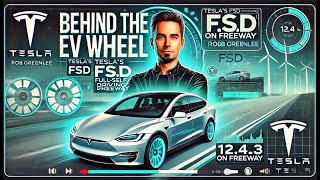
Rob Greenlee tests Tesla's FSD 12.4.3 on a 30-mile drive in Connecticut, finding improvements in highway merging and lane-centering but noting regressions like aggressive lane cuts and a misread left-turn that sent the car straight. The system still demands constant attention, especially in rain.
Chapters
All right, this is Rob Greenlee again, back with Behind the Wheel. And we're back on the road with Tesla Full Self-Driving Supervised 12.4.3, and I am back on the road heading towards a freeway trip here this morning. This is July 12th, and this is the second day of having the most recent update to the Full Self-Driving stack. I am a subscriber to the Full Self-Driving software on my Tesla Model 3 Long Range, 2022 model. I've got about 19,000 miles on this car, and I am about to get on the freeway, and I, I want to see how the drive is different this time on the freeway since I have not driven the car since the most recent update to the software. And, um, I'm going to try and adjust this so you maybe can see me a little bit in the, the mirror. I don't know if that actually— you can actually see me very well, but. But anyway, let's see how the car navigates some, you know, some intersections and then the freeway access as we come up. Actually, just in the next mile or so, that'll hop us on the freeway. So I am in a little bit of a unique situation where there's new stoplights and stop signs and things like that being installed in the area, and it does seem to be doing a good job of picking up those, those new things, and it seems to be operating pretty well. So it should be getting in the left lane here and take a left turn. And so it seems to be doing okay. When I first started and I left my driveway, it, it had more kind of hesitations. It took a very long time to get out of my neighborhood. It was like driving very cautiously through the kind of residential streets. It was really having a hard time really kind of figuring out how to get out of the neighborhood. It kept really kind of hugging the curb on the side. I thought it was a little bit odd. This software appears to have some challenges at at times. So we'll see if it goes smooth today, and I'm hoping that the car will continue to learn and get and improve and, and get better. I'm not, you know, really on the inside with Tesla to understand how the, the neural network on this vehicle works, whether or not it learns in each vehicle, and that the software gets gets better, or the neural network isn't really like code. So it's at a stop sign here and it seems to be navigating that. And we should be able to hop on the freeway here in a second and start getting that experience here in a second. It usually kind of hesitates a little bit through this part. Um, it didn't do that this time, so that's, that's good. So I'm hoping to make this entire trip. It's actually about a 30-mile trip, um, to Norwalk, Connecticut, and I'm off to seeing, uh, take a chiropractor appointment. I'm a very tall guy. I'm about 6'8", so as it's getting on the freeway I have to ramp up the speed of the car to get it up to, you know, just over the speed limit to be able to travel with the flow of traffic. And so I do think that the software needs to have a better feel for the speed of the flow of traffic around the vehicle. And I do think it does a pretty good job of that. But there are times, and I know that there's a lot of crazy drivers on the roads these days, so it actually tried to change lanes very, very close to a vehicle behind it just now, but then it stopped, so, which was good. I'm not quite sure why it tried to get over so close to a a vehicle that was coming up to the left of the car. Okay, now it's getting over and it's kind of doing it right in front of a car that's right behind me. Um, so in some ways it wasn't, um, all that kind of cautious. It seems to be straying off to the left side of the road quite a bit. Not quite understanding that. So I'm going to up the speed to 70 miles an hour since that's kind of the flow of traffic right now. So that was a little bit kind of a regression of experience. So now it's changing lanes again to kind of get out of the fast lane since a lot of the cars behind me are actually wanting to go even faster than 70 miles an hour. This is a, this is a 55-mile-an-hour zone. But I do think that that's a very common situation on the freeways these days where there's huge differences in how fast people drive on the freeway. Um, there are some people that want to drive like 80 miles an hour, even maybe close to 90 miles an hour, and there's other people on the road that, you know, maybe want to go 50 or 55 or 60. And it creates this huge disparity, you know, difference between the rate of speed of vehicles on the freeway. So it's an interesting kind of conundrum for FSD software to be able to fully manage these speed preferences safely. So, okay, it's getting over again and it's cutting off another vehicle coming up behind it that was coming up at a rapid rate of speed. It didn't appear— it probably should have waited for that vehicle to pass, but it kind of cut them off. So I think that there is some updates that need to happen to the full self-driving stack to make it a little bit safer and not feel this need to cut off upcoming vehicles like on the left or on the right when it's changing lanes. But, you know, it seems to be doing a good job now. So I see a car merging to the left in front of me, and it kind of backed off on the accelerator a little bit on this. And, but I really do like the fact that I don't have to be constantly touching the steering all, all the time on a regular basis, um, and in adjusting the, the speed. So I've had cars piled up behind me again as I'm going, um, you know, 15 miles an hour over the speed limit. So if I go up to, let's say, 73 miles an hour, there's like 10 cars piled up behind me, and I'm showing 73 miles an hour. Just because people, you know, I don't know that people now really, I guess, follow very closely the speed limits on the freeways now. I think that there's this— and I've wanted to talk about this a lot, um, because I do spend a lot of time driving on the freeway, and I do wonder about that. Okay, so we just had the car just decelerate very rapidly down to 64 miles an hour. From being at around 70 or 72. A car in front of me merged in front of me, but there was plenty of space there. But, but the car in front of me is actually going quite a bit slower, so it's going to cause traffic to kind of pile up behind me. So we're coming up into a kind of an S-curve type of an area, and let's see how the car Does the car drift to the left or does it stay centered in the lane? That's been one of the things that I've noticed with the Tesla over, over the many months that I've been kind of doing the, the kind of self-driving, the Autosteer functionality, is the car drifts a lot inside the lane. It doesn't appear to be doing that as much now like it used to. The car in front of me is certainly drifting all over the place, but I don't think he has full self-driving. But it does seem to be doing a good job of staying in the middle of the lane. And okay, this car is merging to the right in front of me, and the car is accelerating back up to what my set speed is of 73 miles an hour. So I kind of feel a little weird about feeling like I have to drive so fast and so much above the speed limit just to go with the flow of traffic. And but, you know, I've mixed feelings about it. I do feel like cars now, this car very, very specifically, is a lot safer of a vehicle, right, that could manage higher rates of speed, especially as we move into a timeframe where we have the car actually driving itself, right? So we may come into a time where speed limits are not as important. It does make me wonder about that, about what the future looks like for speed limits with technology like full self-driving and what that means for the future of how fast cars drive. I think it can go one of two ways. It can actually go where there is no real speed limit and the vehicles manage that based on the safety of the roadway itself and the capabilities of the vehicle. Since the vehicle is going to be taking responsibility for the safety of the vehicle and the safety of others and the safety of the passengers, it does make me wonder what direction that's going to go. Is it going to go towards being very strict to a certain speed limit, which I'm not seeing that being the case in Tesla software where the speed limit is strictly enforced to be at the speed limit that's specified on the signs on the road. So I do kind of wonder about that and where the software is going. I did notice that, uh, there was an announcement. I did see a lot of coverage of this, that the, the Robotaxi event that was set for, I guess, August 8th has been pushed back to October. So I guess Tesla made, I guess, an announcement or said that they weren't quite ready, to roll out the Robotaxi, the CyberCab, concept on August 8th. So they're giving themselves a few more months to get this rolled out. Um, and I would say that that would also be smart, I think, for the, for the software too, just based on what I've seen so far with their latest public release. I'm sure there's versions that they're working on that are much better than, than the public or release version, um, that maybe they are thinking for the RoboTaxi that won't have a steering wheel or won't have any pedals or anything like that, which I'm sure is what they're working on. So it'll be interesting to see how that rolls out. Um, so I'm probably going to cut this, this video a little bit as I get into kind of, you know, another aspect of the freeway trip. This is a long drive, so I don't want to— it's kind of boring a little bit. It's not actually doing a lot, um, right now. I certainly appreciate you watching this and seeing how, how the car does and being with me here. So I'm probably going to stop the video at this point and I will resume it at a different point here. So I'm going to turn it off now. So I'm back here and we're a little further on my trip to Norwalk, Connecticut, and it's going to navigate an area here that it's going to need to merge to the right and get on an exit. And it cut in front of another vehicle. Uh, I think what we're going to see is it to merge over a little bit more into another lane. So we're about to get on the Merritt Parkway, which is a, a parallel freeway to 95, which is the, the roadway to New York City. And so it's, it's got to get off here, um, a little exit here, and we're going to join 15, which is the Merritt Parkway, roadway going south towards New York City, but I'm actually going towards Norwalk, Connecticut, and that's my destination, which is probably another 15 miles from here. So I just wanted to capture that exit merging process, and it seemed to navigate it fairly well. And so now we're merging over to a new freeway here. And it looks like it, it actually merged over a little earlier than it normally does. It usually follows those little dot-dot lines and it gets over that, but it got over a little earlier this time, which is just definitely an improvement. It's driving a little bit more like I would as a, as a human. So We seem to be moving along at a good clip. I'm going to turn the, the speed up a little bit more. So we are coming up on an exit on my trip to my chiropractor appointment, and we're coming up into some heavy traffic. So the car is going to have to merge to the right in a very congested kind of backup experience here. And I've also noticed over the last 10 minutes or so that the car has been very, very diligent about enforcing its attention, um, with the the camera, the cap camera, uh, if I look down or I look other than straight ahead, it will throw up a warning. Um, I mean, I'm, I'm a little hesitant to know how many times it will warn me about that before it will, it'll shut down the, the full self-driving capability on the drive. So I'm not quite sure what the, what the penalty penalties are for not paying attention as much. But I'm definitely finding that I need to pay attention. I'm about to get off and the car just did some merging. So it's going to choose to get in the right lane here in a second and get off the freeway. And it seems to be navigating that pretty smoothly. I see on the left up here, We have a Model X. It's in the same color as my Model 3. So we're going around this exit. This is going to be getting back onto residential streets again. So we're getting close to being in Westport, Connecticut, which is right next to Norwalk. So it looks like it's Trying to take a free right here on a, on a red light. Okay, it navigated it. It's got to get back in the actual lane. It kind of got out of the lane to some degree. Let me turn up the speed up to 35. So let's see how it manages these, these particular intersections as we come into a residential area. There's usually quite a bit of traffic through here, so it creates an interesting challenge for the software, a bunch of merging lanes and things like that. Seems to be getting through it pretty smooth. So you can see there's lots of traffic and cars, and it seems to be hesitating a little bit, so I'm going to turn up the speed a little bit up to 35, so hopefully it'll give us a better indication of its travel speed here. We're coming up onto a stoplight here. But it's really been enforcing my eye tracking pretty aggressively here. Even if I look down at the screen, which I think in some ways is probably something you should do when you're driving the car to monitor what the car is doing on the screen as well and what's coming up. If you look too much at the screen, it'll, it'll throw up a warning to you. Or if you look to the side, look out the window, or look in the back, or look through the— look down at the screen, really, it'll, it'll throw up a warning at you. It's very, very aggressive on that. Not quite sure. I guess Tesla is trying to figure out kind of a balance. On monitoring eye tracking between what's really aggressively trying to control the driver's forward vision and the driver's ability to monitor other inputs that Tesla is putting in front of us when we're driving the car, like this large screen monitor that's right in front of us that has a lot of information on it around destination and whether or not, you know, what the duration of the trip is, what time we're going to arrive, those kind of things. And if you look at it too long, it will penalize you, or not necessarily penalize you, but it will throw up a warning. So it looks like we're merging into another intersection. Kind of got over a little bit late. So it says no turn on red, and I wonder if it's going to respect that or not. We'll see if it sees that sign that's hanging from the stoplight up there. So far it seems to be respecting it. Okay, green light, and We're getting into the lane pretty smoothly here, so, so far so good on that. And so we're continuing here, and we're going about 36 miles an hour in a 30 zone and coming up on another stoplight. —and turned green, so we're proceeding through smoothly. I still haven't had to touch the, the steering wheel, so that's good. As long as I continue looking forward, it's very— well, okay, this is going to be interesting because it's not actually managing this correctly because the lane to the right actually is the go forward lane, it didn't pick up the, the signage saying what it needed to do. So now it's turning left, which I don't think it's— I think it's going to have a hard time with this intersection figuring out what to do because it's in the left turn lane here, but I believe the car is going to go straight. So I may have to interject here because the car didn't pick up the correct markings on the lanes to navigate the situation. Okay, it's going straight when it really should have turned left. So that was a mistake. By the Full Self-Driving software. It managed to navigate it because it got ahead of the car next to me, but that wasn't the correct choice for the vehicle in that particular situation. I probably should have interjected, but I wanted to see how the car was going to navigate that. But that was definitely an error on the part of the software reading the the signage and the markings on the road itself. Didn't make the right choice there. It should have actually turned left in that lane. It was clearly marked as that. So there's always these edge cases. Okay, so we're coming up on a speed hump. Let's see what it does if it picks up the— okay, it does pick up the speed hump. This is a fairly substantial one, and it did slow down and it did navigate that. Here's another speed hump. Looks like it's picking it up in the cameras. Okay, and then we're coming up on a stoplight— or not stoplight, but stop sign— and it seemed to navigate that very well. Here's another speed hump. It's picking up that. So I think what happened in my earlier video that I did was that the speed hump that we— I came upon that it did not manage, didn't slow down for, was about half the size of these that we just went through. So I just got a warning saying full self-driving may be degraded. Due to poor weather, since it did start to, to rain, uh, here, which is interesting. Interesting. It says maybe degraded. Now the windshield wipers are working properly, so I'm not quite sure why it's degrading the Full Self-Driving capability. It's just warning that it might I guess is what we're experiencing here. So let's see how it manages the green light here. Um, I would think if it needs to clear the, the forward-facing camera, it would just wipe the wipers a little faster, and that should keep the visibility clear. But it is very, very sensitive to poor weather conditions whether or not it's going to operate full self-driving, which is an interesting little twist here. So, okay, let's see how it manages all this. We're almost to my appointment. So we're about 2 minutes away. So it's going to try and go around this car. Geez. Okay, it seemed to navigate that, and it's going to have to get over in the left lane again. It, it made me a little bit nervous, but it seems to be— seems to manage— be managing it well. So, well, I'm going to cut off this, this episode of Behind the Wheel., with a Tesla Model 3 Long Range, uh, model year 2022. My name is Rob Greenlee. Thank you for watching this. I appreciate you joining me again for this, uh, other episode of Full Self-Driving with Tesla. And subscribe to my channel at Rob Greenlee. And, uh, thank you so much for being here with me.
More from Rob

Future-proofing with Delphi AI/Human clones: your podcast as a personal LLM | New Media Show






How sports reveal what AI spectacle gets wrong #Technology #Sports #Commentary



