The End of Year Wrap Up of 2023 | New Media Show Live 12/27/23
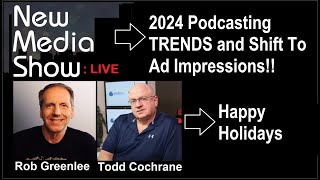
Rob Greenlee and Todd Cochrane review 2023 in podcasting. Heather Osgood pushed to replace downloads with "impressions," but the IAB has no definition for it. Podimo raised $48 million and AdvertiseCast was acquired, while podcasters face scams from FinCEN and economic headwinds into 2024.
Chapters
Todd and Rob in the afternoon.
Hey, afternoon, with Todd and Rob. Oh yeah, oh yeah, here we are post-Christmas, so I guess Happy New Year is in order. Right.
Happy New Year is on the way. Right. 2024.
Wow.
That's going to be an interesting year for everyone. I'm sure.
Yep. And we are, we're late today. Rob and I both had things going on. And also the website is like in, it's fine. If they basically started a migration before Christmas and they finished it up yesterday. And of course this morning I knew that the SSL certificates were the last thing that we're going to have to put on. Right, remapped all the A records. And yeah, um, the, uh, the sites are updated but the SSL certificates are not in yet. Oh, so things are coming up non-secure on the website. So we're live but we're not lit because for some reason I can't log into New Media Show The way I've got it set up, so we've got to wait for the SSL certificate to be put in place. They're saying 8 o'clock tonight. Of course, the piece that they said, oh, this will happen within 2 hours. And they said, I emailed back 2 hours and hey, the SSL certificates are not on the site yet. And they said, oh, we're having a problem. We'll try again tonight at 8. And I'm like, oh, you, you, you turkeys. I guess I could have turned the A record back, but about the time I turned the A record back to the old box, they would say, hey, we can't assign the SSL certificates because it's pointing at the wrong IP or whatever has to be done. And anyway, here we are.
And so is it a good, good time of the year to make infrastructure, infrastructure changes like this, Todd, or is it?
Yeah, I think it actually is because it's low traffic time. Yeah, yeah.
I'm, I'm sure most people don't even know that we're going live right now just because we— I did put it out that we were supposed to start the show at 4, but we didn't really do that. So, but that's okay. It's a holiday week. So, you know, the New Year's is coming, but it's kind of interesting, the, the, the kind of quirky things that come out during the holidays because there's— it's, it's really kind of a slow time of the year, right, for the industry. So, yeah, you know, these weird stories, that come out about all sorts of things that are going on. Like, like I heard, um, Heather Osgood coming out talking about her, her pronunciation or her, her projection that she's going to be only selling impressions into podcasts in the new year. So I guess that means that downloads are kind of becoming passé with, you know, only selling parts of the industry, only selling impressions.
Well, so they didn't want to call them downloads, they didn't want to call them plays, now they're going to call them impressions.
So, well, well, that's how all the other advertising that's done is all based on—
and that's working out well for display advertising that gets impressions, right? I think this is a very bad decision on? I think that's a horrible decision.
Well, her explanation of it is that it's, it's simplifying the selling process, Todd.
Okay, so it's— so what? So, so if you got 1,000 downloads and had 1,000 plays, do we now have 1,000 impressions?
I— some metric associated with that, but I would say that's generally what the, what the conversation is.
So how's that conversation going to come back and they say, well, what is that equal— how is it— oh, I don't even want to get into this. How is even equivalent to the IEB. There's no definition of an impression in the IEB spec.
Well, it also gets back to— and we've said this for many years, Todd— it's be careful what you wish for here.
Oh man, it just, you know, it sounds like desperation to me.
Well, it's this desire to make it easier for brands to buy the medium. That was Heather's explanation for this, was that it's too complicated talking about all the different kinds of delivery technologies and how it's tracked and the attributions.
I don't have to deal with any of that.
So, right. And, and it's like, you know, just say, well, you know, buy 120,000 impressions. Just, you know, I guess at the end of the day, when advertising is getting hard to sell, there's an impression, no pun intended here, that, uh, So what's shifting?
So that is going to be a race to the bottom because they're going to say, oh, an impression, just like a web page impression. Great. I'll give you $2. I'll give you $2.
You're selling it just like programmatic advertising.
I'll give you— no, I just know it's an impression. I get like a page load. What do web page loads get you now? $2, maybe $1.75, $1.50, maybe if you're lucky. So yeah, go ahead. I think that's a very, very, very bad thing to do. So what's hard? It's supposed to be hard. Right.
Well, Todd, welcome to the complexity of the new year. It's the effort to simplify everything is actually going to make it more complicated.
And meanwhile, people aren't paying up. You saw this deal with Laura Ingraham. Oh.
Yeah, with Laura Ingram, right?
Oh, $919,660.
I'm sure there's a big lawsuit around that, right?
Daily repeat. The Daily Beast reports that Quake Media failed to make payments to Ingram. Quake Media was a $2.99 a month podcast subscription platform. It stopped posting on Twitter more than a year ago, and its website appears to stop working over the last few months. Huh. I wonder who owned that.
I don't know. I'm not actually familiar with that company, so I don't, I haven't heard of them before.
So Quake Media owned what service? That's the question. Right.
So, and, and you probably saw Rob Walsh made a comment on the feed about iOS 17 changes and Apple Podcasts could reduce your downloads by 30%. For shows that have over 300 episodes.
And again, and again, Blueberry not affected by this because we didn't count those to begin with. Those—
that's, that's an interesting kind of twist on this conversation about the IAB though, Todd, because it means that that isn't really a standard.
Well, it's because it, you know, all you had to have is a minute worth of media. Yeah, to count it. And if the, if the download started and it did not complete, it sat there and spun and failed. You know, there is a, there's a reason why you can look at the progressive part of the download. You can look at how much of the chunks were delivered., and if only one chunk got delivered— let's see, this is not rocket science. If only one chunk or two chunks got delivered, that's it. Yeah.
Well, Rob's contention here is that your audience size didn't change.
No.
It's just that the amount of times that those episodes were downloaded changed.
No, many times they were attempted to be downloaded, right? Well, that's kind of the same thing, right? No, no, there's a difference. When it was downloaded, it's downloaded.
When it was attempted to be downloaded and didn't download, well, your numbers were inflated based on that criteria is what I'm trying to say.
Yeah, because, because there was underqualification of the download, right?
So do we— I mean, this begs the question, Todd, is that the whole goal of the IAB was to get everybody kind of on the same page here? With doing metrics, but it doesn't appear that we actually accomplished— we didn't accomplish that.
Well, what we did was it was either there was those that wanted to look at a 20— well, okay, the 1-minute thing. And I don't remember, again, I don't remember the entire discussion point, but the 1-minute was the minimum that you should measure. I had always— and even, you know, publicly I've said that the 1-minute minimum was way too low.
Well, that and plus, how do you actually calculate 1 minute?
It's easy because I know how many bytes of the file was delivered.
Yeah, but doesn't that vary based on the file file encoding?
Of course. Of course.
Yeah. So it's always an approximation, right?
No, you know how much of the file you're going to get. Okay. So again, I don't know the science behind it, but you are able to tell on that initial with the raw log data, that initial query, you know how much of that media file has to be delivered to get the whole file. So if you just— again, I'm not the tech guy, so—
I mean, if you click the play button and it downloads a minute's worth of audio, but you actually only listen to 30 seconds of it, does that still qualify?
The thing is, on most players, when you click play, they just— oh yeah, well, you know, it depends on the speed of your connection, right? And Again, it goes by player by player, device by device, app by app, and the functionality of how much it'll chunk out initially. So, you know, this is why most of the time when someone clicks or when that— when someone is subscribed to a show or follows a show, that media hits, it gets full download. And about, you know, 90% of the time it delivers that you know, full download immediately. Yeah. And you get that whole completion record. Whereas when someone comes in and, and sometimes they come in on a certain app and they hit play, it does the same thing. It downloads it as fast as it can and it's, it's all there. Right. So there's only a percentage of shows that are, um, so we're talking about real life activity here. We're talking about active playing. But when an app comes in and says, okay, I've resumed watching the show, give me all, give me the last 15 episodes that I missed. Um, usually what was happening in prior to iOS 17 was all of those were being queried at once and trying to be downloaded at once. And if you're on a mobile device, that obviously It's good. You've seen it. You know, it, it stuff downloads at different rates of speed if you've hit 2 or 3 downloads in your mobile phone. But imagine trying to get 10 episodes at once. Well, maybe 7 of those fail because the phone can only do so much. And, um, from the concurrent connections, and it doesn't— and it just basically kind of times out. So it gets a little bit of it But then it comes back the next day and tries to get it again because it didn't get it because it didn't complete it. And it depends on the app activity whether or not it— but we can see that the log file, how much of that media file, you know, maybe it was just a query and it got the header, which includes all the metadata and any album art that's in there, if there is album art in it, because that's all loaded up front. That is supposed to be calculated in and removed out and not included in your 1-minute calculation. You're supposed to throw that and made it. So if there was a 512K image in the header file of the MP3, you're supposed to toss that and then count a minute before you deliver it. So if so, so long as you're doing that, um, then if immediate minute of the media file was downloaded, you technically at the minimum standard can qualify that as a download. But again, and then what they also changed on iOS 17 was basically some function how it acts, but the majority of this bad behavior was happening from it trying to download backlog, a whole back catalog. Yeah. Right. Right. And there's been some other changes that may affect people's numbers a little bit, but again, it depends on the makeup of the audience. If the— if you have a high majority of your audience that is subscribed and actively listening, there'll be no change. But if you have an audience that's not subscribed and they come in and hit play, maybe you're going to see a little bit difference in, in numbers, probably, right? Um, and probably more accurate numbers, to be honest with you, because not everyone listens to a No one listens to— not everyone listens to every episode that they're subscribed to.
So, right. I mean, that episode could have been delivered to your device, but you, you never actually took an action to listen to it.
But this holiday, I've been binge listening, catching up on all my back catalog, listen to 4 or 5 episodes in a row of shows that I haven't listened to in a couple of months. Yeah, so it's not to say that people don't come back and listen to this stuff later, but probably the majority of folks probably don't. But again, you know, again, it's, it's also if you're just using a raw download number as your predictability of your audience size, and that's, that's dumb because again, you got to look at a longer, you know, from a, from if you're selling media, again, this only matters truly if you're doing advertising. You got to look at a— you got to go look back 3 months or, you know, 12 episodes or whatever it may be. You need to look back at a period of time and say, okay, what have I done as an average here per episode? And if I'm maintaining, you know, if I have a show that's coming in at 800 and one that's coming in at 2,500 and one that's coming in at 2,000, next one's coming in at 1,300, which some shows do like that, then you have to use an average. If you're coming in every, every episode and you're 12,300, 12,500, 13,000, 12,500, episode, episode, episode, episode, then you can probably pretty safely say that this audience is probably, you know, 12,000 or so active listeners. But if it's like this, up and down, up and down, up and down, up and down, shows me that people are not subscribed, shows me that they're actively playing. So you have no choice then but to look at a longer time period and get an average. And still, sometimes you're going to be under and sometimes you're going to be up, but you hope then that you have at least have enough deliveries on an average to fill all the inventory. So, so when people come— this is what bothers me about, um, advertisers that buy a one-episode trial.
Oh, it fluctuates.
Well, if you get on an episode that is A low point, right?
You're not going to hit your targets.
Or if anything is, it depends on what you've told them, right?
You know, you can't always predict.
Oh, my, my average is, uh, 10,000 per episode.
Well, what if you have one that say it does 8, right?
Does 8, 7, and it— or 7, and it underperforms, right? Then the advertiser, well, that was a bad— that was horrible. So I think you have to be very, very clear. And this is why I refuse. I, you know, if you want to do a one-episode buy, go somewhere else because this is not how the medium works to begin with. Todd, it's a test.
It's a test.
We're trying to—
yeah, a test. This is going to work out well.
And I'll tell them, well, this test is going to fail. This is what I tell them, that the test is going to fail. Oh, we still only buy one episode, or only we buy one episode a month. Right. It's a horrible strategy.
So, Todd, I'm hearing others in the medium talk about, you know, some of the top social media podcast marketing tips or trends, right, for 2024. And the number one I keep hearing about is Instagram is poised to become a potent platform for podcast promotion, reels, feed posts, stories. All play crucial roles in Instagram. I don't see Instagram being a podcast consumption platform. Depends on your audience. I suppose that's true.
I'm not sure. If it was my daughter doing a podcast, she would rock and roll on Instagram. If it's me, no, I don't. I haven't been on Instagram in 3 months.
Yeah, I mean, what is the demographic of Instagram right now?
Each show is different.
Is it mainly female, you think?
I think there's a wide variety of people on Instagram, but I think it all depends on your audience. You have to—
so, no, but do you think it's predominantly dominated by women?
Oh, I, I would— I know that I'm just gonna make— I'm just gonna make an assumption and say yes. Yeah, but you know, Instagram is now used by a lot of people as a dating app. And let me follow your Insta. You know, give me your Insta. It's not give me your Square, give me your Insta, you know.
Right. And also it's, it's possible, it's increasingly possible to livestream a show to Instagram too. So you can see where these guys are really trying to compete with the other big, you know, YouTube and, and TikTok and those folks on, on the media consumption side.
Right. Yeah.
So, and then short-form video. Is being said is really increasingly going to be a significant, you know, play.
Well, reels and shorts are probably, you know, look at TikTok and Facebook Shorts.
Well, I think the Tom Webster research came back showing that there is an increasing match between short-form videos mapping to people moving over and listening to the long-form side. So I think that there's increasing movement like that.
I don't know. I do know this: people that start loading their YouTube channel up with shorts, I skip all the shorts and go to their long-form content. I don't watch their shorts. Well, but again, if you're just trying to figure someone out, yeah, maybe. But again, that's for a YouTuber, not for a podcaster.
Yeah. Is that your Your consumption behavior though, Tom, is biased toward the long form, right?
Yeah. Yeah. So again, I don't think any of these strategies are bad. It's just wherever you want to, where, you know, where's your tribe hanging out?
Yeah, I think it, I definitely agree with you. I think it does increasingly require one to have an understanding of the demographics of the user. Base of any, any particular social platform. Absolutely. But that's hard to do sometimes. I mean, I guess you have to do some searching online to determine that.
Well, no, you should know where your people are hanging out.
No, but what's the, what's the predominant user profile for Instagram or for Reels or for these platforms? I think it's helpful for you from a content creator perspective to understand who the typical— it's like we, we've always said the Spotify listeners are typically in the younger demo, right? So if I'm doing a show like this, this show, it's probably not going to cater to the younger demo, right? Yeah. So we're never going to do well on Spotify. Oh no, right? We can try, but—
So here's another one that bites the dust on Christmas. Vocalize. Never even heard of them. I didn't hear of them either. Basically gave its users 10 days over holiday period to move its analytics. Oh, really? Wow. Prefix. So if you're running Vocalize and it's— and you're listening to this show on January 1st, your podcast is no longer delivering. No. So this, this is a huge thing.
Think about, you know, We've seen this happen.
So I know, but right over the years, but imagine any of the prefix providers. Here's the thing a lot of podcasters don't really think about. We've talked about it on this show a lot, is I pay more attention to my prefix uptime than I do my hosting uptime. They're both equally important. But if the prefix goes down, oh, oh, it just gives me, gives me shivers. Um, and that's why we, we basically have 2 servers. They're just sitting at idle in different data centers. And if the prefix goes down, I think it's 7, 3 to 7 seconds, it's bam, it flips., and, uh, it runs until we tell it to switch back. And then if that second one goes down, it goes to the, to the third data center. And if three are down, well, then there's something else bigger going on in the world. There is, there is something much, much bigger happening that it's not healthy. Yeah.
Yeah, I thought it was interesting, the article in PodNews about, um, in Europe they're still investing in podcasts.
Someone dropped a big bunch of money.
Yeah, that was a big check. $48 million in funding to Podimo, right?
What do you need that much money for? If someone gave me $48 million, I don't even know what I would do with it.
Yeah, well, I think this company is the company that, uh, is investing in other companies, right? They're actually acquiring or investing in other, other companies.
Yeah, maybe. I guess if I had $48 million, I, I know, yeah, I would. The thing is, this is the challenge Lipson got into, and I think they're still suffering from, is they went on that drunken spending spree and trying to sort all that chaos out, you know, I— making more than one acquisition a year to me sounds pretty, uh, pretty scary.
Yeah, I do kind of wonder about some of those acquisitions, but I do say that I do think that the AdvertiseCast was probably a pretty smart move. I think Probably so. Yeah. I think on, on whole, I think that was probably a good, good move for the country or for the company itself. From a revenue perspective, it definitely kind of shored the decline in revenue that I think was happening on the hosting side.
Well, I think that Everyone's predicting 2024 to be pretty ugly. Most economists are saying, you know, you thought it was bad in 2023, strap in for 2024.
And I hear others say the opposite. So it's, it's one of those things, you know, it's like, well, what's the Fed going to do? Is the Fed going to lower interest rates and is that going to be a catalyst for new growth again? That I'm hearing both sides of it and I'm not quite sure what to believe, but I do think that the overprinting of money will continue to have an impact on our economy. Yeah, so we'll see. But there's so many other factors going on right now.
It's like, yeah, well, I hate to almost open that box because there's so many things. The conversation around the Christmas tree was things are— people are They're hurting. Hurting. Yeah.
Yep.
And everyone laid off people. I think a segment of the population is hurting. You can't tell by travel, by people spending money for Christmas. You can't tell. There is a segment of people that are hurting really bad.
I would say there's a lot of people running up big credit card debt too.
I would— I I think the— if you look at— if you're— I'm going to go on a limb here, have nothing to back this up, but just, you know, conversation. If you, if you're on the lower 40% of the earning income United States, it's, it's pretty horrible for you right now.
Even if you're at that kind of that, you know, if you want to buy a home.
Oh, forget it. You can't even, you know, the conversation was around cars and, um, well, that's even hard. Well, it's not hard. There's the, the car dealers are full. We're talking about pickup trucks. Well, and yeah, it's the interest rates what's killing people and the vehicles are up $30,000. You know, you can't get a pickup, hard to get a pickup truck now for less than $50,000 and a new one. And that's a plain Jane, you know, no frills. And if you want something with, you know, you want a heater in it or air conditioning, it's, you know, then you're talking $80,000, you know, or windows that roll down.
So, but we can always get out and go and get a Cybertruck, Todd, for $60,000. No, no, thank you.
Next year, that's— go ahead and get one. No, where am I going to charge it? It's true. There's 2 chargers in my town.
We just, just put one in your own garage, or—
Yep, and I'll, I'll wait 24 months to get a permit approval to do it.
So I have to—
shouldn't have to have a permit to put in a charger, to put in 120-volt charger.
Uh, no, you don't. Well, yeah, it's, it's usually a 30-amp, uh, yeah, charger.
So if you wanted to— so you maybe switch between, uh, doing laundry and charging a vehicle.
Um, which you could do that. You could. Yeah, yeah, you just unplug the dryer and plug the car in.
Yeah, great. That's something I want to do every time is crawl behind the— well, yeah, I know what you're saying. Depends on how convenient the plug is, right? But, and most people are just doing bypasses, but that does take the electrician to come in and do that. But the— yeah, so I don't know, we'll Again, I wouldn't have an electric vehicle in cold Michigan based upon the way these batteries are not holding up. I guess you must keep yours in a garage or something, don't you, during the winter to keep it warm?
Well, I do keep it in the garage, but the Tesla has kind of battery temperature control functionality too. So it keeps the battery warm? Well, it does if it needs to be, right? Yeah. So if you're, you know, if you're charging it, it's going to warm the battery so it charges fully. But if you're not driving it or whatever, it doesn't.
Right. But, but if you haven't, if you haven't truly in a garage, you're probably not affected.
But, you know, yeah. I mean, I think that that's the ideal use case type of, type of situation. Right. I mean, I've got my own 220-volt charger.
I just have too much. Mileage anxiety, you know, based on my experiments out in Phoenix and being worried at 40 miles whether or not I was going to have enough charge to last me 2 more days just driving around town.
And I have about 350 miles on a charge, so that—
I put 40 miles away. I was at 40— as I put 40 miles on it, I was at like 40% left or something.
It was ridiculous.
So it depends on how you drive too. Driving— when you're letting up, when you, when you're worried about the power, then you drive very carefully. Oh, you do?
Okay.
Yeah.
So, but it's awfully tempting in those cars to push the accelerator.
Yeah. You don't drive very fast in Phoenix traffic.
So it's all flat though, Todd.
That's the thing. Yeah. Well, then it's— then it even failed even worse. So, right, right. Um, I, I don't know. I guess I just, I just think the economy's tight, so I think people are going to be cautious.
Yeah, I do wonder about that part, right? Are, are we going to see a recession hit just because people—
we're not in a recession?
Well, I guess some people are and some people aren't would be the answer, I think, at this point.
Um, so maybe we're not in a recession, but we sure as the— sure as heck I have our—
having our wallets gouged. Yeah. Oh yeah. Clearly everything is more expensive nowadays. Right. Yeah. It's definitely challenging. And I know coming up here and at the end of the month, we're back down at Podfest again. So the podcast conference schedule continues every 6 months or so.
Right.
Right now is kind of how it works out to be.
So you mentioned something, I think, before we started. So what is this thing that Dave Jackson announced, announced his Podcast of the Year. Who was his Podcast of the Year?
I think you have to listen to his audio in order to find out, I think is what it was. I wasn't sure because it wasn't clear on PodNews. Here, let me read what it says here. It says Dave Jackson announces his Podcast of the Year. I guess he announced some podcasts.
And why? You know, the show you get notified in your app and immediately stop listening to whatever show and immediately go to theirs? I don't do that.
I don't really ever do that too. So I'm not sure which one he's talking about because it— here, let me see if I can figure it out here.
Um, I'm gonna have to go look at his show notes probably.
That's what I'm looking at. But I, you know, I think he's doing a good job of teasing us to listen to his audio, I think is what he's doing.
My podcast of the year is definitely the Podcasting 2.0 show. That's for sure. And then the MakeCon show. Those are my top two for the whole year.
Oh, let's see here. I'm not sure. It says a special shout out to Matt Rafferty from the Author Inside You. See, he pod inbox. I'm not sure that has to do with his pick. Yeah. I think you have to go listen to his episode. I got you. Yeah, Dave's all about the audio. Yeah, so he's, he's gonna do a little promotion to get people into listening to his audio.
So anyway, so, um, this was something— it's interesting that there's an article about it here in Pod News, but also we got a message from our, uh Legal counsel says, happy holidays from the U.S. government, who has blessed us all with the new Corporate Transparency Act. If you run a corporation, LLC, or another qualifying legal entity, you've just got over a year to tell Uncle Sam who owns your company or pay the hefty penalty. Well, there is a, um, be careful, people are sending out scams. In regards to this.
Um, let's see here. Probably trying to get, uh, proprietary information.
Yeah, so basically, um, FinCEN, whoever that is, recently issued a warning. Now that's a fraud. The fraudulent correspondence may be titled important compliance notice and ask the recipient to click on a URL or scan a QR code Those emails or letters are fraudulent. FinCEN does not send unsolicited requests. Please do not respond to these fraudulent messages or click any link or scan a QR code with them. Be on the guard against such fraud and stay abreast of key developments involving this law by visiting— okay, I'm not going to tell this. Our legal firm sent this to us, so I'm not going to say who the legal company is, uh, our corporate lawyer.
So, so what the law says is that starting in 2024, if you run a corporation, LLC, or other qualifying legal entity, that'd be like a, like a partnership or something like that. You've just got over a year to tell Uncle Sam who owns your company. So I think this is really targeted towards LLCs and organizations that have kind of anonymous owners, right? I think that the government wants to know actually who owns these.
I didn't think— I think Michigan is— when I formed my LLC, I think I had to put who— I thought so too. I, I had to put who the— yeah, I had to put the percentage of the company I even owned.
I had to put— yeah, yeah. I don't quite understand this unless people are, are doing these layers of— yeah, they're doing layers. Where these corporations are being seen as people. So they're basically making corporations be the owners of these LLCs, which isn't directly related to a person.
Right.
So this is, this is just a way to ferret out who's owning what. So if they need to go after somebody, they don't have to get in this quagmire of complexity of all these interlaced corporations.
Right. Because I know like someone will form an LLC and then have 5 LLCs below that that maybe will own 5 different businesses or something to that effect. Happens a lot in rental properties. Real estate, right?
Happens a lot in real estate. I think that's who they're really going after here is people with those, you know, like each house that you own is a separate LLC. Well, it's in the name of your parent LLC.
You want to laugh, but the folks that bought the building that my sister sold this building I'm in. So I have a new landlord, and I know who the landlord is, but the, the corporation is, uh, basically the address of this building. Oh, it's actually like 123 Street. 123 Street LLC is the actual name of the LLC.
Yeah, well, that's, that's who they're targeting here, right? I think it's people that are doing that kind of stuff.
Yep. So, so, but again, in Michigan, I had to put— for my LLC here, I had to put my name in.
So yeah, so I'm sure this is— that's the most common thing that people do with their LLCs. They, they have a partner or percentage distribution between two individuals or You know, actually, if you're just a sole owner, there's no real reason to have an LLC. So, well, there is, um, for some legal protection, what it really is.
And, you know, there's, and there's different levels of LLCs too. There's a sole proprietorship LLC, and then there's a couple other letters, and then it really, then it goes into There's two different types of corporation, an S and C corp, you know, and the S corp is— don't quote me on this, but S corp, that's why I had my company when I was in Hawaii, because it was just me. It was just— and I really probably didn't need a full corp all those years. So the difference between an S corp and a C corp was the S corp, the taxes pass through to my Social Security number. Whereas the C corp is its own entity.
It's its own entity. And you can, you can write off like your health insurance and—
Right. Well, there's most of the write-offs are still legal with the S corp.
But again, any profit loss path and how you take money out of an S corp is different than how you take out of a C corp.
Yeah. And even an LLC. Yeah, you can do a— what's it called? I don't remember, but yeah, you don't have to write yourself a paycheck as an LLC, but you do have to show the money that you pulled.
Yeah, right. And then some things, you know, just being a sole proprietor is perfectly fine too. You can still write off your expenses and things, but And, but there's some, some legal advantages of limited liability, and that's kind of what they are talking about here.
So, and like all my insurance and everything is in the—
yeah. Yeah. And I think podcasters, you know, in some ways have to think about this too, because they may be doing a podcast in combination with another business that they're trying to start up, especially if they're doing a side hustle or something like that. And, you know, talking to a tax professional or a lawyer or something like that to help you walk through that decision-making process is important.
So I love this comment from Transistors, Justin Jackson. Oh, Justin. Thanks, Justin, for backing me up here, brother. He says, don't start a video podcast and go audio first. In the beginning, a new podcaster needs to find their voice, practice, and learn what makes an episode compelling. I agree.
Yeah. So I think from a reasonable perspective, I think that makes sense. You know, adding video does add a level of complexity to your production. So, you know, you may not be ready for that.
So who knows? 1701 sats from Mike Dell. Better late than never. I could think of a few things to do with 45 mil. 100. Oh, these came from, uh, these were Geek News Central plugs. Uh, Dave Jones last week, 5,150. Great discussion, guys. YouTube infatuation is coming from the advertising sector, which has no loyalty to any medium. So I don't think there was any other new media show. We did get a bunch of streaming stats. The streaming stats have been on fire, so I want to thank all of you that have been, uh, streaming stats to us, uh, by the minute. 50, 100, there's 1,000. Um, a lot of 50s. Um, 2,162 per minute. That's a big one. That was Dave Jackson. Uh, 1,000 sats a minute from Adam Curry. 50 sats a minute from Pod Bun. Went back, I'm looking here, who else? There's some more stats from Dave Jackson. By the way, did Dave volunteer to do our chapters?
No, but he joined me on my podcast tip show last Thursday.
Shorts, 2 sats a minute from Chad. Uh, what else? 246 sats a minute. Oh, that was someone ran out. Um, we got, uh, 200 sats from Alby. Anyway, so yes, the streaming sats have been really, really good as of late, so definitely appreciate it. I had to transfer 500,000 sats out of my GetAlby account to make sure it was under a million. Sats. So really, why is that? A million sats is the limit you can keep in a GetAlby account. And I don't know why, but that's their upper limit is they don't want you having more than a million sats. I think a million sats is about $400. Hmm.
Is there some governmental issue there?
Yeah. I don't know what it is, but You know, they, um, if you have over a million, I think they're going to put you on a pro level.
So, um, if you get over, you might, might have to pay a subscription or something like that.
Yeah. And I don't know, be honest with you, I don't know the reason. Uh, hope— I think they're gonna— some folks are gonna talk to them recently in the near future. But yeah, it seems— I understand— I don't understand what carrying a big balance is about, uh, to be honest with you, but Um, yeah, but yeah, I had it. I actually had to transfer out about, about a million and a half sats because I was close to 2 million sats in my account. So I did it 3 stages.
I think I'm getting close to like 400,000 now, so I've got a ways to go.
Yeah, but anyway, thanks for the boost in the— and everything that's come in, everyone. Thanks so much. Yeah, again, no bat signal today because New Media Show is, uh Let me refresh it here. In transition. And it's still not secure. It's saying your connection is not private. It's unsafe to go there. Yeah, so hopefully in a couple hours that'll be fixed.
Todd, I wanted to talk to you about another topic that I saw pop up on social media. Actually, it was on X, but this whole topic of should any of us really share personal information online anymore? They've already got it all. No, but I mean actively writing posts or doing podcasts or whatever that are telling a story about ourselves that isn't in, you know, kind of a positive light, right?
Overdisclosure, right? Oh, I think oversharing's always been an issue. I've been always very careful not to overshare.
No, I, yeah, I know that you and I both have. I just see a lot of people posting, putting up content that doesn't always paint them in a very, um, good light, I guess.
So is it, is it, is it where they're self-reflecting and disclosing and trying to improve Well, I think that that's the intention that they're going about it.
And I think it does build a level of trust, but I think it kind of raises the question of, well, why are they doing that in that forum? Right? Are they wanting sympathy? Are they wanting people to help them in a challenging situation and thinking that a place to do that is social media? Or, and even in a place like LinkedIn, right, where people are looking for careers and looking for jobs and positions, should you be disclosing too much stuff about life's challenges?
For $200, I think that's what we pay, I can have a— give a name, a little bit of information, and I can get a full report Unlike your last 10 years of social media posts, any negative, any, you know, basically builds. And it's still up to me to interpret that report and determine whether or not someone's going to be a good employee or not. But I think most companies are running those reports today to do background checks on folks. I've always told my kids, be careful what you share out there because once it's published, You might delete it, but it's, you know, someone's retweeted it or whatever. It's, it's still that information, you know. Once it's out there, it's out there. So yeah, um, you know, you know, my— both of my daughters share quite a bit of social media stuff about my grandchildren. Um, I'm not one to tell them they shouldn't. Uh, of course, they're, they're little kids. It's not thinking it's going to affect them, but You know, there's other security concerns I get concerned about. You know, there's lots of weird people out there.
So yeah, I know that when I read or, or hear things like that, I kind of question what the motivation is of sharing that.
Yesterday I was here in the office. I wasn't really working, but I was kind of doing some cleanup and stuff. And I went, did a TikTok live for about 30 minutes. And really it was just the camera was facing me while I was typing on my computer and I just watched them. People were asking me some AI questions and some stuff like that. And someone got on there and said, oh, Merry Christmas, was Santa Claus good to you? And I saw I had a good Christmas and I didn't elaborate on who, what or where. And You know, then someone that I did not know asked me, so what did you get your grandkids for Christmas? And I'm like, I'm not going to divulge what I got my grandkids for Christmas. You know, what's, what's the point? Who, why, why do you need to know? What's, what business is it yours, right, um, for me to divulge? Yeah, what I got my grandkids for, for Christmas. And actually, somebody even asked me what my budget was for each grandchild. And I'm like, I'm not gonna share that, you know. And, you know, I tell my— because I think what triggered it is I made a comment. I had just told my kids to send me their Amazon wishlist, right, for each kid, because they know what they need more than I do. And yeah, then I could pick from that. And I think that's what drove the question. So maybe I overshared in that regard, but it was You know, then they were asking like these super personal questions.
So you just wonder who— I'm a firm believer in gift cards and stuff like Amazon gift cards and stuff because it puts— they— that other person can get exactly what they want.
Exactly what they want. Right. Yeah. Right.
Or need. Yeah.
Frankly, it goes both ends. Yeah. So, you know, my son in Hawaii, he had something specific he was having challenges with. I said, now just let me, you know, let me send you some Apple Pay. You know, you can, you can use it against that, you know, and So that kind of thing, you know. Yeah. And it was kind of funny too, because the exact amount he needed, I was 37 cents short on the Apple Pay. And I said, well, I got, I got it up to 37 cents. Am I good for the, can you cover the other 37 cents? Right.
Yeah.
Because that's what was in the account. Right. So I didn't want to have to, didn't want to have to tap it for, you know, to a debit card. It was stuff I had earned through Apple purchases and stuff, you know.
So, um, it was kind of funny, but Yeah, because I think I've changed my view on this over the years too. I mean, back when Facebook first came out, I was sharing a lot of personal pictures and a lot of, you know, details about the things, the hobbies and the things that I was doing and things like that on Facebook. You can still see some. I haven't— it's not like I've taken it all down, but I have kind of rolled back kind of those efforts. And it's become, you know, a little bit more podcast-centric, a little bit more business-centric, more trying to inspire people to, you know, take, take positive actions in their lives and, and share examples of that and just, you know, around content and things like that. And it definitely maps more towards my career, I guess, and my, my work in the medium and trying to, um, you know, accomplish things on that front, uh, versus trying to use social media as like a, you know, like a, like a personal social outreach kind of thing. And it's not really, I think, what it's good at.
Well, I'm just looking at, uh, I hadn't even read the news, to be honest with you. I my email stacked up pretty heavy.
Um, but there was a big decline in, um, new episodes published last week. I saw it was between 12 and 16%.
Well, that's, uh, you know, that's probably not unusual, but you know, people, people haven't learned that this is that— like I, like I said, I spend a lot of the Christmas holiday catching up. Yeah., you know, and catching up on just about everything that I, that I read or listen to.
I mean, yeah, it says the total podcasts updated in the last week is 164,331, down 16.3%. Well, not surprised. Yeah, yeah. It says total podcasts updated in the last 30 days, 330,500, down 4.5%.
%. That actually sounds bigger than it
is. Oh yeah, well, it's double the amount of shows. Yeah, but which means that that 4.5% is a big chunk. Yeah, but, um, but yeah, it's interesting, you know, in some ways it's not surprising because it's the holidays, people taking time
off. I had some things— matter of fact, I've got some stuff that's just finishing up. Matter of fact, over the next 12 hours, I've got a batch of media that I'm delivering, and then I'll be done for a project that you and I are aware of. But, um, yeah, that's a big project. Oh my gosh. Yeah, 2,000, 2,000+ files, right? The, um, yeah, I don't know. I, I just, you know, this time of year is one of those things where I, I did, you know, I do actually a little house cleaning. I kind of get stuff kind of because I'm always at my desk. I never hardly leave my desk, and I walk in and leave, and the office gets a little, uh, a little cluttered. So I kind of move the stacks around a little bit. I don't know if I actually clean anything out, but, uh, I'm gonna have to. I decided though, I am going to start putting some stuff on Marketplace. I have a whole bunch of stuff that probably no one around here will buy, so who knows,
maybe. Oh, like old, old audio
equipment? Yeah, microphones and Yeah, I've got a bunch. I'm never going to get rid of microphones. Those, those don't get sold. You know, there's always a use for a microphone or gifting someone a microphone. So, all right. But other stuff, you know, stuff that is like, okay, I haven't touched that in 3 years. Do I really need it? So yeah. But I tell you, podcasts will be like you said earlier, podcast is going to be on us pretty
quick. Yeah. Well, right after your CES adventures, and which you haven't told us too much about, about what you're doing down
there. Yeah, you know, same old thing. I, I show up and just be talent this year, so I leave next Friday. Okay. And, uh, a week from Friday, and, uh, I believe the show starts on Tuesday, but I get down there, have a little Vegas fun on Saturday. Sunday is starting the media stuff, so do media stuff Sunday and Monday, then the, the actual live show will be Tuesday, Wednesday, Tuesday, Wednesday, Thursday, Friday this year. And, um, so yeah, hot and heavy, uh, beyond 2 or 3 hours every day throughout that week, uh, interviewing people. So, you know, luckily I don't have to— I just, I come in, kind of help. Well, I stand around and look important, be like the foreman, you know, that just pointing It's not my cables to hook up, so I just, you know, give, you know, consulting where I think it, you know, where it should be. So who's actually kind of, kind of leading the charge? Uh, it's, it's Scott Ertz from, uh, F5 Live. Oh, okay. Yeah, he takes care of all that. Then Kirk, my, uh, executive producer of Geekness Central, he will be there, um, In fact, I'm really— Kirk, he has worked for Verizon for many years in their collections department, and his dream for many, many years was to be full-time in the media space. And let's see here. Hang on a second. He has retired, and much to his mental health, where's he went to work? He is, he is being a producer for 1210 WPHT in Philly, a talk radio station out there. So he's picked up a producer job. He's from Jersey. But yeah, so after 25 years and not having— you know, talking to disgruntled customers about their bills and billing collection, which— can you imagine doing that for 25 years? Rob is talking to people about their credit, you know, their, their, their, their mobile bills, outgoing bills, right? Yeah. So, you know, he has— he's, he's told me for years he wanted to get out of that job. And, uh, so yeah, so he's got himself a job as a producer, all from everything he's done in the podcasting space with me and his own show. So he actually picked up a job in, uh, traditional radio. Oh, so he'll be out there. Kirk will be out there, and, uh, he's more behind the scenes. Maybe we'll be able to get it. He likes doing the in-the-weed stuff. He doesn't necessarily like being on the mic that much, but, um, Don Bain, the gadget professor, will be there. And then of course, Scott and his team. So yeah, we'll, we'll, you know, between the 3 of us or 4 of us, we'll cover the 10 hours each day and have a new guest every 10
minutes. So I'm not as— what are you in? Yeah. So what are you anticipating at that show to be kind of? Oh, it's going to be
AI. Everything. A lot of AI stuff. Yeah, I'm sure. Sure. It's going to be huge. You know, and everything, everyone will have added AI to something. So, and to be honest with you, I'm kind of— Kind of burned out on AI? Well, not on AI, but I'm just— this will be year— oh man, Andy and I went the first time in 2005. So this will be my 18th consecutive year to CES. And, you know, I would have been planning since Thanksgiving. For that show and putting in a massive amount of hours. And now it's like, okay, I'll throw a bag together 2 days before I leave. And, you know, I don't even— I, I don't even take a big camera anymore. I take a GoPro and a monostick and a wireless system, and that's it, um, to do interviews. I don't carry a big camera no more. There's really no use, right, in doing that and humping, you know, humping all that gear and the big mics and boom mics and wireless pack. We used to do 82 pounds of batteries, and you know, it was because the product turns out just about the same. Yeah. So yeah, and I do— I don't take— I don't have anybody to assist me, so I just go solo, and I'll just hold the camera out and put— clip the other wireless onto the other person and rock and roll, you know. You're good to go. Good to go. Don't have to stress it too much. So I upgraded to, um, I'm actually don't use GoPro anymore. I'm using a DJI, uh, camera and wireless
system. It's fantastic. Oh, is that that, that new DJI camera that they
have? Yeah, the
Osmo. Osmo, right? Yep. So that's— I've heard that's really, really
good. It's got It's got landscape as well as portrait, right? Yeah. So anyway, that's what's planned for CES. Yeah. So, and it's hard to break the habit of calling it what it used to be. You can't, you're not supposed to use the acronyms and it really makes no sense to me
why. What, the Consumer Electronics
Show? They don't call it that
anymore? No, it is the CES
show. for. For a while. So that's thing that seems to be, you know, that seems to be the thing. Todd. I've been using the Apple Podcast app and my, my Tesla Model 3, and actually it's pretty, pretty convenient integration, I have to say. It was easy to set up and so shame on you. You should be using the Fountain app. for a while. So that's the thing that seems to be, you know, that seems to be the thing. Todd, I've been using the Apple Podcasts app in my Tesla Model 3 and actually is pretty convenient
integration. I have to say it was easy to set up and so easy to use. Shame on
you. You should be using the Fountain app. It'll show up. Well, it'll show up in Apple CarPlay. I, the car doesn't have Apple CarPlay. Sorry. Oh, how then, then how are you using your phone in
here? They loaded the Apple, Apple Podcasts app directly into the app, um, kind of built-in marketplace in the
car. Oh, it's just, well, it's, it's Apple Music and So you can't plug your iPhone into
your— It doesn't use the CarPlay
software. Only uses the separate
apps. Oh, that sucks, donkey. Wow. Well, I mean, why should Tesla do that? They have their own operating system, their own
interface. They have everything. Well, and it's the reason why GM has decided to get away from using Android or Apple, because guess what? All that data that we're— all those buttons we're pushing is all valuable stuff that they can sell to someone else, right? So, you know, they're not taking you— when you sign the terms of service to use those things, you're basically signing up to be spied upon at another level, just like shopping. Well, all these platforms are doing that. Oh, I know, but I think it's really dumb for GM to go proprietary
again. Well, the question for them is, can they actually build any kind of decent software? They don't have a track record of being able to, well, create software that will be the software that Ford provides me
naturally. It's a decent navigation, AM/FM radio, Bluetooth. That's— but I can switch to Android or Apple
CarPlay. I can use either just by plugging your device into
it. No, just the Wi-Fi. As soon as the Wi-Fi connects it. Oh, or Bluetooth. Is it Bluetooth? Bluetooth or Wi-Fi? Yeah, but the— well, the Wi-Fi has to be on to do Apple CarPlay, so I don't know. Right. Yeah.
Right. It's a good question. I don't
know.
Yeah. Yeah. So anyway, it's, it's been nice to have that experience in
there. I mean, it'd be great if Fountain was in there. Yeah. It's too
bad. It's that they're not.
Yeah. But it's not there yet. Because they, they're not. Well, that should be, you know, send that up the, you know, you're a stockholder of Tesla. That's something you should request. Say, hey, I want Apple
CarPlay. Here's my vote as a stockholder. I don't know that I would trust that over the interface that the car has because it's so integrated into how the car
operates. But to be honest with you, I wasn't that impressed with their
interface. So, well, I mean, if you're not using it every
day. Yeah, to me it feels like going
backwards. Well, it's custom built for the vehicle. So if they were to replace it with CarPlay, it wouldn't have any interface to manage the
car. So yeah, that's one thing you couldn't figure out when the car is— you stop, park the car, is the car really off? No, you have to actually go into some menu to actually turn the car off. And that was what I really didn't understand about. Well, that was a dumb thing about
Tesla. No, you don't ever turn the car off. There's no off button on the Tesla, so you don't ever turn it
off. Well, that's the Hertz guy showed me how to turn the car off or whatever it was. Well, you can put it in park. Well, I put it in park, but then said make sure before you— if you don't do this, you run the battery
down. Took me through some menu to shut the car
off. I think he's giving you a bad Bad advice. So you just put it in park and walk away from
it? Get out of the car and leave. The car takes care of everything
itself. Well, that's not what the Hertz guy told
me. He said make
sure— He doesn't know what he's talking about. Well, then I guess they need to be trained. He just goes to some menu thing I had to go
through. He says— Most electric cars has a button on the dash that you push on and off,
right?
Yeah. Actually, Nissan does that. Uh, I think all the, all the GM cars have it too., um, that are electric cars. I, I believe Tesla is the only one that you just get out of the car and the car shuts up, locks
itself. And using that little fob was a pain. It seems like it would never really truly
work. Have to rub it around to get it to— I don't even have
that. It, it does everything with my mobile phone. You walk up to it, you just walk up to the car with my mobile phone and the car opens up and, well, First, you get in a rental, you get a throb,
right? Of course, right? So that's going to be a little bit different experience renting one of these cars versus actually owning it and getting integrated into the car itself. So it knows who you are when you get in. So it adjusts the seats and does everything for you when you get
in. So I'm still not buying one, especially some of the reports that have come out recently about them being a little shady in some of the repair work that they've had to
do. So they're probably gonna get sued again. Just to give you an old— my own personal experience is that yesterday I took the car in to get my tires rotated. Um, the only other thing I've had to do to that car in 2 years was add wiper
fluid. You took it to Tesla to have the tires rotated? No, just do a shutdown. Oh, okay, okay. Yeah, consider yourself lucky, I guess. Listen to my last Geekness Central podcast, you'll hear all the
drama. Oh, okay, I'll have to go, have to go listen to your, your
drama. But I haven't had any drama, so it's all right. Knock on wood. I tell you, one service that I've actually found love with, it's now become completely transparent. I haven't— probably I'll go say this, I'll go home tonight and have to reboot it, but I have not had to reboot my Starlink in about 6 months. Oh, well, that's good. Yeah, just keeps on ticking. I did— yeah, I rebooted it in June. I came back from vacation and it wasn't working. I had to reboot it. So, all right, well, we are— whenever— I guess we started a little late. We only do an hour, but we got anything else to go
into? Um, I mean, I think that the Hall of Fame's coming
up. Oh
yeah. When's that going to get
announced? Uh, probably in the first week in
January. Oh, that, that's going to be fun to watch. Yeah, it's going to be, you know, Podcast versus Podcast
Movement. So yeah, so who's— well, I guess we haven't— you can't say. I've kind of heard who might be the,
the— what you would call it— the
MC. Yeah. Yeah, I'm the one that got this person. So, oh, so did that person that you and I were talking about come through? Ah, that's a big one. So we'll leave it at
that. We'll let you guys do your own
speculation. Well, it'll be coming out soon, probably next
week. Yeah, after the new year,
right? And we'll let everybody know who's being inducted and what's going to happen at the
event. So get your tickets. It's going to be live streamed, it's going to be live streamed online, so everybody will be able to attend, right, if they choose
to. Oh good. And remember, those of you that have been inducted, a tuxedo is the standard that Rob and I set. You dress— I don't know anybody else is going to do it. If you
under— if you, if you don't dress in a tuxedo, then you have, um Uh, you're
slacking. That's a very old school term. I
know. Well, you know, come on, it's a Hall of Fame. I know. I, I mean, I got the little, little bow
tie. Yeah, of course. Yeah, got it. You got
it. You gotta, you gotta dress to
impress. Yeah, I guess
so. Yeah, yeah, no blue jeans. Or t-shirts. We'll probably see— actually, probably a lot of the inductees are going to be sending in videos, so, uh, it'll all be done just like this. So, but there's going to be some people there in person, so it's going to be a mixture of the
two. Okay, well, the last, uh, the last Hall of Fame ceremony, the The stories that were shared— oh yeah, were compelling. And I'm, you know, that, that's a, you know, it was a big change to how it was presented. And I think that, um, yep, I was a little bit jealous, um, you know, when they went that to that format. So hopefully this year the, the, the, the stories, uh, will be
similar. Compelling and very motivational even for some of the— I hope so. It's hard to say, you know, each group of inductees kind of has their own kind of philosophy towards things, right? And some will share more than others, but we are giving each inductee, I think, up to 5 minutes, I think, to
share. That's actually shorter than what they had before, isn't
it? I think it was, I think between 5 and 8, I think is what we had when you and I were
inducted. Yeah, but what was the last, the last inductees at Podcast
Movement? How much time did they
get? I think it was up to 8 minutes, I
think. Up to 8 minutes, and then that person's introducing them gets a few minutes too, right? It's a couple of minutes,
right?
Yeah. Yeah, so now it's a little closer. The person doing the introduction, I mean, obviously you can do as long or as, I mean, well, as short as you want, so, so you don't have to take up the whole time, right? Yeah, to introduce someone properly though, it'd take a couple minutes at least. Yeah, right. And yeah, so I hope that, that the inductees, um, will share, you know, kind of, kind of how, how they view the
medium. Are you— have you given
them— are they being given input? Um, I wouldn't say that that's happened quite yet. I think the big challenge has been getting people to commit and getting people to, you know, do what needs to be done to get just the basics done. Now I think the follow-up should be is kind of sharing, you know, what that acceptance speech should be
really. Maybe share some of the 2 or 3 of the other
ones. Yeah, I think if you go watch the 2022 version of it, which is available on YouTube to watch the full, full-length version of it, I think you'll see what Todd and I are talking
about. Yeah, it's the same thing that you and I both did when we did our induction. I don't think ours were— I don't think I had— because we, you know, I went the first year, I had no idea what to, to talk about, to be
honest. That's true. That's
true. So that's just knowing you, I'm sure. Yeah, the acceptance speeches though have I was impressed the last, the last one. I really, really was. I was
mad. That's pretty blown away. Yeah. So was your— is your year still available to be watched,
Todd? I don't know. I have no clue. I
didn't— I don't even know where to go find it. Well, I would look on YouTube. So yeah, I was going to do that and create a whole YouTube channel just for the Hall of Fame. Yeah, smart. Is the next big thing I was going to work on. And then hopefully we can get all of them on there, even the ones that were done by Podcast Movement, which were all the other ones, to try and get those videos onto that channel. So we have all those induction ceremonies
available. I don't know if we've lost them or with some of the years or not. I'm not sure. And there was, you know, a couple of years skipped there. So you have to figure that out. So, you know, for those of you that are not aware, the Hall of Fame was re— I guess for a better word, relinquished or turned over to the Hall of Fame inductees. Right. And the heavy lifting has been obviously Rob Walsh and both you, Rob, have done a lot of heavy lifting. On this go-round. And then the goal really ultimately is to make the Hall of Fame
self-sufficient. And I think in the new year here, I think as we think about 2024, I think to kind of move the Hall of Fame forward in a positive direction, I think we need to take it kind of a little bit more out of the hands of Lipson to some degree and kind of create our own little organization that manages a lot of it. And then, and then that puts us in a better situation to bring in, you know, a deeper bench of sponsors and supporters of it. And it, and it makes it less associated with one
company. Right. So, right. But there is no formal company or LLC or anything
yet. So it's all It's all volunteers, you know, Chris Kermitsos and, and, and Wendy at, uh, at Podfest, you know, she's the organizer of the conference and stuff like that. She's a big part of this as well. And then the Libsyn team, you know, supports quite a bit of the process too. And Rob Greenlee, they wrote a check, they wrote a check to make this happen. So
yeah.
Yep. And The expenses of it are going up. So we have to, you know, to keep doing what we're doing and to do it at a higher level is going to require more support from the industry to keep this thing going and, and to have it be representative of the broader industry is because it's a
challenge. It's, you know, by time, just, you know, the trophy cost alone is a couple of thousand, just the
trophy. Right,
totally. And, uh, that's just 8 trophies, right? Just 8. And then, um, and then you think about all the other expenses, maybe paying the MC honorarium and all
that. And then, you know, all of a sudden travel expenses and all this kind of stuff too can factor into this. And then also just paying the production team, right, that is being hired by Podfest to to produce the, the whole show and to stream it live online and to do all the PR to support it and all the things that really a lot of the same things that I did when I was working for the Podcast Academy and, and also coming into play and potential celebrities coming and that kind of stuff and any additional security and all that stuff that goes along with
it. Mm-hmm. Never say celebrities in the podcasting
space. What do you mean, celebrities? Well, increasingly, and over the next few years, I think celebrity is very much a term to describe what we're dealing with here. And it comes with a lot of potential attention and a lot of maybe controversy because we live in a very divisive world today. And podcasters are living on both sides of these issues. So, but as a Hall of Fame, We need to be embracing the medium,
right? Not partisan sides, right? Yeah, no politics
allowed. Yeah, you can be political. Yeah, but well, I'm not trying to tell people what they have to do or what they can say or what they can represent, but yeah, it's more to do of the impact on the medium and how a person and contributed to growing this medium and making it a success and being, being successful with whatever audience that they've been able to gather for
themselves. Right. So we'll leave it at that because I'm sure there's gonna be some discussions once everything's announced. Oh, there's definitely going to be discussions. Yeah, I'm going to be in CES that week, so great week to miss a show. Oh, what? Well, I won't be available the— well, I will be available up until— well,
maybe. When's the announcement going to
happen? Oh, it's probably going to be like, uh, the 3rd or 4th or something like that. Okay, so we do a show on the 3rd, which I'll be here for, but I won't be here. That's right, won't be here for the 10th. So it's announced on the 3rd, we'll be able to talk about
it.
Yeah.
Yep. And The actual ceremony is going to be on January 26th down at
Podfest. So
January— is that the first night of the
show? It's the first full day of the show. First full
day. Oh, okay. Prime time. Yep. And it'll be like 7 PM
Eastern. Awesome. Yep. Okay. So, all right. We all been informed a little
bit. You just don't know
who. Yeah, there's a lot more details to come. All right, everybody, we'll get off in here. I'm Todd at blueberry.com, at Geek News on Twitter, at Geek News, at geeknews.chat on Mastodon.
Okay. And I'm on X, Twitter, at Rob Greenlee as usual, and have my own YouTube channel at Rob Greenlee. You can send me an email if you want. RobGreenlee@gmail.com is a great place to reach out to me and love to hear from you and hear any feedback that you have from the podcasting space. It's always great to see all the comments on Twitter, X, on the topics we do with the show and, and get feedback from
you. So we have stuff that we can banter about, about. And the episode will come up if you're listening to this on Thursday and hopefully everything's up And the website's all— but we are on new infrastructure, and, uh, I've been dabbling in that a few hours today, uh, playing around with the cache settings and all that stuff. So that is, uh, it's always fun to be on new hardware. Yeah, and, uh, it is quite a powerful platform, so I'm excited to do PageSpeed tests to see if it's faster than the box that I was on before. So bringing in the new year with a bang here. Yeah, yeah. And hopefully everything stays online. But yes, if you're trying to go to the website right now, uh, at this very moment, uh, it is going to say, uh, warning until we get the SSL certificates. We're in progress. So, all right, everyone, thanks for being here. We'll see you next Wednesday back at our regular time, I hope. I hope so too. All right, everybody,
More from Rob

Future-proofing with Delphi AI/Human clones: your podcast as a personal LLM | New Media Show






How sports reveal what AI spectacle gets wrong #Technology #Sports #Commentary



