The Format Question Every Creator Gets Wrong
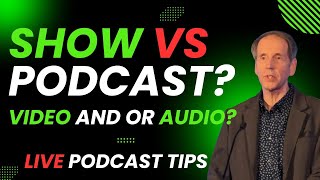
Rob Greenlee argues creators should call their work a "show" instead of "podcast" as content spreads across audio, video, and live streams. Google Trends data shows "show" searches vastly outpace "podcast," and platforms like YouTube and Spotify are reshaping how audiences discover content.
Chapters
Well, welcome. I appreciate you joining me tonight. Um, on this episode of Podcast Tips, I'm going to be discussing, um, The answer to a very burning question that's been in the podcast medium for many, many years that I think we're starting to face a situation where we need to grapple with this issue. And so just wanted to— let me see, I have to do something here. It looks like LinkedIn wasn't working for me. So those that were tuning in on LinkedIn, it looks like that connection was not made. I'm so sorry, but it's, it's available everywhere else. So let's see, it's asking me to delete on LinkedIn, but I haven't done that yet. So, well, there's an error over on LinkedIn, sorry to say. I was hoping things were going to go smoothly, but, um, so to get back to the show, sorry for that distraction, but, um, this question, and you probably saw it in the thumbnail artwork for this program, but it's this question between key distinctions and similarities between the concept of doing a show versus doing a podcast. Now, the history of podcasting has been these terms have been kind of used together in most cases. But I think as we kind of move into this new era where we're creating a lot of content for a bunch of different platforms, a different bunch of different formats, we're going live, we're doing things in short-form content, we're doing things in long-form, we're doing things in maybe segmented content, that this distinction that we need to think about as content creators is getting a little bit more important for us to get clear in our heads, right? And that's what I wanted to talk about today. And then also this bigger question of whether or not a show should be audio or whether it should be video or it should be a little bit of both, right? So I think that really cuts to the chase of a lot of the struggles that we have in the medium today just around being— and I want to up-level this to the whole concept of just being a content creator. And I think being a creator, being a video and audio maker, publisher, whatever, does at the end of the day, it kind of bubbles up to the concept of a show, right? But there are some really issues that go along with that, that I think if you wanna be known as a podcast, but also you wanna be known as a show, I mean, some people are just combining those and that's what I'm gonna go through today. And it's really important that you think about this yourself. If you're a content creator or you're considering creating a show or a podcast, Why it's important to kind of draw those distinctions in your mind, because it might have an impact on how you think about your content and how you distribute your content and kind of how you communicate what you're doing to your audience. And it may make sense increasingly to call yourself a show, but yet if you're doing primarily like maybe audio-only content, it may make sense to just say that you're a podcast. Because at the end of the day, I believe, and it's being shown in the research, that audiences, whether it be audio or video, are increasingly seeing any kind of online media content as podcasts, right? And then there's a whole element of text too you gotta throw into the mix. Not to confuse it anymore, but you think about X and you think about articles and you think about content that goes along with this, whether it be transcripts or just other types of derivative content that come from this, that's not so much an issue for that, whether or not you call it a podcast or a show, but it just speaks to the complexity of the content creation market that we're in today. And it's okay to be confused about this because I've been confused about this, just like the whole topic of you know, a download versus a stream, right? Which is another battle that this industry has had for many years. I'm not going to go down that confusing path. I think to some degree I have in past episodes of this show. But anyway, to get back to this concept of a show or a podcast, what do you want to call what you're doing? Many people have been suggesting for a few years now that you don't call your show a podcast in its name, right? So if you have a show, now granted, I'm in a tough situation because the word podcast is in the title of my show or in, you know, in the name of my show. So, but what I'm talking about is adding it, right? So if you're doing a show about, you know, underwater basket weaving or something like that, that you don't call it the Underwater Basket Weaving Podcast. And that takes us back to the confusing question around what is a show and what is a podcast and what do you want to be to the audience? And I think that's really the most important question that we can ask ourselves is how we're communicating to this externally and also how we think about our show too. It's kind of like what's been happening in the in the radio industry to some degree, how they've been transitioning from being seen as radio, as primarily radio type platform, to maybe an online media company or an online, yeah, I mean, a media company like National Public Radio did a rebranding on a different division of their company called National Public Media. 'Cause what they're doing is they're trying to prepare themselves for a transition that will likely happen at some point in the future away from the term radio. And so that's not unlike what we're seeing happen here. And I do wonder if this is a good analogy for that, because as we think about, like, if I talk about this show, like I titled this in my logo up in the left corner, in the corner of the screen here, I said Podcast Tips Show, right? I don't really need to add the word podcast. It's not like I'm gonna put in there Podcast Tips Podcast, right? That doesn't make any sense. But I'm a unique example on this spectrum here of this topic. But I think the thing is, you know, to take away from this is that You just have to think about your show in the appropriate way for what the show is. And in this conflict between show and podcast, you know, I've wondered about it too in the long run as we move down this video path and how everyone seems to be so conflicted with the idea of calling a video show a podcast. I mean, I think there's even another term. So if you think about even like YouTube, oftentimes we want to refer to that, that YouTube video as a just a YouTube video or YouTube channel, but yet YouTube has decided that they're going to throw their hand into the ring of this discussion around what a podcast is and They have seen themselves for many years. I've actually worked off and on with the YouTube folks for many years in podcasting, and, and they have always had a podcast team at YouTube. It's just how prominent and how integrated that kind of name and that experience has been in the interface, right? They have until just recently decided that they're going to be seen as a as a podcast distribution platform because they're seeing like what many of us are seeing is that the research is coming back saying that YouTube is one of the top 2 places that people go to discover new podcasts. Now, many in the podcast industry will really push back on that and say, well, most of the podcasts from an original orientation came from Apple or came from Spotify, something like that. And you're also seeing Spotify move into this too. And to not complicate this even more, but you kind of have this issue going on around, you know, all these platforms like a Spotify wanting to jump into the space and also wanting to have direct upload relationships with content creators. And this is something that I've been seeing develop over time. So that's where this conflict comes in around, well, what do we call it? Do we call it a show or do we call it a podcast? So if we look long-term, I kind of wonder, you know, which one's gonna win because increasingly I see people seeing a show as being a podcast and I see other people wanting to talk about a podcast as a show. So, you know, maybe it's the combination of the two is the long run, and neither one of them are going to win. Maybe both of them are going to occupy this space forever. But I did do a little lookup in Google Trends, and let me pull this up for you so you can see a little bit of the, the, maybe the weighted average here of what is going on. So you have this term, right? This is a Google Trends term kind of chart, right? And if you look at the top, there's keywords that I put in here to search for. And those terms are podcasts, podcasting, online show, right? Which is kind of what we're doing. And just the word show. And obviously the word show encapsulates a much bigger spectrum of content out there. It'd be a radio show, a TV show, those kind of things. But I thought it was an interesting comparison, right, to what Google is seeing out there around the interests and the search queries for this. That green line that you see at the very top is actually to the term show, right? So it's an elevated kind of recognition of this type of content that we do in podcasting. And it makes me wonder, and the term podcast, podcasting is like this little tiny line at the very bottom of the chart, right? It's these lines down, down here, right? So you can see that in comparison, the, the term show is like astronomically more significant in the minds of people at least doing Google searches, right? And that's not always a terrific kind of way of, of showing that there's something that we can tap into here that may be more significant, but I think it is a little bit of a clue that maybe there's there's something going on here that may play into a larger kind of strategy, right? And that maybe thinking about the shows that we do as shows is a good thing to have as well, right? Because I do like the term podcast because it is a term that is kind of unique, right? It came up in the early days back in 2004, 2003. It's a hotly debated topic of when the term podcast started being used. I was doing a radio show back then, and I started doing a podcast back on, it was like September 15th or thereabouts of 2004. And so what that means is I've got a t-shirt here that says 20 years. So I'm fast approaching in the next 2 weeks my 20th anniversary of being a podcaster of sorts, right? I was doing a radio show back then, so in some ways it wasn't the same thing, but that, that was the date that I started putting an enclosure tag into my RSS feed. And so, you know, it wasn't a big deal, it just was something that I was jumping on a, on a hot kind of movement in the, in the industry back there. I was already doing download distribution of my radio show to via an MP3 file off my website and off of other platforms back in, back in those days prior to podcasting started. So, so there were many precursors. And if you do some searches in the Wikipedia platform, you can find kind of like precursor platforms to podcasting. A lot of people haven't looked that up, but also the, the Wayback Machine with the Internet Archive is another place to go to look at kind of the, the origins of this, this medium, right, and where it came from. And some of the links in the Wikipedia will link back to the Internet Archive, um, that will help you draw some context to this and, and see where it's going. But yeah, I'm excited to say, you know, I have a 20-year anniversary. I think, you know, I think last year I was saying it's a 19-year, but, but it's It's a milestone, and I do see that this medium is not a new media necessarily anymore. It's an established media, and there's nothing wrong with that. But I do, I think we've kind of covered that a little bit, and if you have any questions on this this, this debate between calling your show a show and calling it a podcast. Go, go ahead and give me your thoughts. I see your arena says about the 20-year anniversary, and looks like Mark, um, ironic is in here. And, and also we have Johnny Bean here. Thanks guys for, for joining, and thanks Reena for, for jumping on board here. And, and Reena also says OG. Yeah, I suppose sometimes I don't like to think about that, that aspect of it, but, um, but yeah, ultimately, um, I'm not sure who's gonna win on this. I think time will tell. I think it depends on how much mainstream media fades. I do think that there's an element of that that's involved here too, and why we're seeing it be a hotly talked about issue. And to many in the industry, it's kind of a settled thing, right? We're podcasting. But I think as you throw in more mainstream media talent and you see these big media companies, even radio networks, becoming podcasters, big podcasters, and they see this as their future, I think they're gonna start using the term podcast maybe a little less and start calling their shows just shows. And I see this as kind of like a bigger trend going forward. So in some ways, it doesn't really matter which one wins. I tend to think that it, It's both that are probably going to be used because I could see the term podcast show, right, as a good reference to this because then it taps into the longstanding many-decade kind of understanding of what a piece of content is. But yet, you know, throw in that podcast term makes it all kind of more easy to understand. I don't know that we have that challenge right now because the the awareness of the term podcast has really kind of reached a very high point now. I think we're well over 70%, or about 70% of the population understands or has actually listened to a podcast at some point. So that's pretty high penetration of this, this medium in that area. Um, so, so that's, that's the, the core of my, my questioning of that. What you do as a content creator is, is maybe use this discussion to help you strategize around what, what kind of show you want to be, right? What's your distribution strategy? Is, is your show really a, a show that does a lot of different kinds of derivative media? Like, are you doing video, audio, live streams? Are you doing social media shorts and Reels and those kind of things. And I think if you are, then you start moving into the, the realm of more being just a show or an online content show, right? Versus a podcast, which is— if you talk to a lot of people in the podcast industry, they think of that as an RSS-based distribution of audio primarily and increasingly. And this is what I'm encouraging the industry is to move into thinking more about video when it comes to RSS distribution, because that's the history of this medium is doing that. So I'm a big fan of that, that origin and us moving into that increasingly. So we, we have a hold on what the future looks like for RSS because I think as the younger generation comes through, right, and gets older and moves through, that favorability of video is going to pass through. And I think the aspects of the bandwidth being a lot less expensive than it was in the early days of podcasting will make video a much more viable business model for many podcast hosting platforms. Now granted, there's only 3 video podcast hosting platforms that exist in podcasting. And ironically, those exist because those 3 companies were around in the very early days of podcasting when video podcasting was, was very large. Um, that was just before, just as YouTube launched and, and got off the ground. A lot of those early video podcasters decided that they were going to go over and host their content over on YouTube. And the big reason for that was that it was, uh, it cost them less money. It was free hosting. They were having to pay for their bandwidth on the other hosting platforms, whether it be Libsyn or Podbean or Blueberry, or they were doing their own hosting, which, which back in those days, uh, a lot of the big networks and those that were building, um, their video podcast distribution actually built their own RSS technology and then hosted on their own internal servers that they were already doing for live streaming and for other types of things. So they were— it was a little bit of a different environment back then, but there was about 30%, 30% content even. And most people would be surprised at this— Apple Podcasts has video podcast playing capability inside of it. It's always had it in there. So this is a topic that's bubbling up now because people are thinking more about video. And so this gets back to this whole thing around what's your focus as a podcaster or a content creator? What's your distribution strategy? Is it which way to go on this? Gonna maximize your reach and maximize your audience? How's that going to play into your overall distribution strategy? If you're seen as a podcast, you might be pigeonholing yourself into, as it was said on stage by a very big video creator, Stephen Bartlett from the Diary of a CEO. He was up on stage and And he made this very, very kind of stark statement about podcasting is that he felt that podcasting was small, right? So that meant to me that he has this perception that podcasts are primarily just audio, right? And he's primarily doing video. So if he thinks the term podcast is small, it's because it's not being seen by these content creators as part of a holistic content strategy. It's being seen as a very narrow kind of niche, which is taking your audio from a highly produced video, which is Stephen Bartlett, like, gets, you know, hundreds of thousands or millions of views to his his very highly produced videos that he does and puts them out as an audio only or just an audio version in an RSS feed. And I'm hearing more YouTubers saying that they're about to launch an audio podcast of their shows. And so, you know, it's going both ways. And then there's the audio podcasters out there that are thinking about creating a video version of their show, or they're trying to do live, kind of like what I'm doing here with this program. And so you kind of are seeing this convergence, and I think at some point here we're going to see maybe a platform or a couple platforms really start to rise in prominence that are maybe, you know, I'm talking about podcasting hosting platforms, start thinking about video first because these big content creators over on YouTube are are maybe thinking about video podcasts as well, but they don't have any tools to use to distribute like podcasting has today for audio, right? So maybe there's an opportunity here to have a better kind of platform that really makes video first, maybe also does audio, Right. So, and, and we're seeing like a, like Blueberry, um, is doing this kind of tool that they have where you can take your, your channel URL off of YouTube, give it to them, and then they'll make audio files out of all your videos. So, and that's, that will put it into an RSS feed, and then pow, you're a podcaster, right? You're doing an audio podcast. So, so this is probably what I'm talking about here is part of a bigger kind of trend that we probably are going to see, um, as we look to, to the future, right, of, of podcasting and online media creation. As there's always pressure on all of the tech platforms, these SaaS platforms, to try and optimize and then make the distribution of content easier and easier and easier. And then that also gives an opportunity for monetization to come in here. Now, granted, you know, Spotify and, and YouTube and whoever other platform may come into the space, even, even like an X or something like that could be another destination for a video podcast syndication strategy, or LinkedIn, or those platforms right now that you have to direct upload or stream live to, like we're doing now. Um, there may be an opportunity to build a one-tool kind of creation to, to distribute audio and video better, right? Because right now, uh, Lipson, Podbean, and Blueberry really don't do a very good job of getting video out to lots of different platforms. And it doesn't have to go out to all those platforms from a technological perspective via RSS. Now, it would be great if it did, but I'm not sure that it has to. It can go to all those platforms via like an API relationship with those platforms. So let's say Spotify doesn't wanna work with RSS with video. Maybe they just wanna do a direct kind of upload sharing relationship with a hosting platform. Now granted, that hosting platform may or may not actually host the media file, That has to be negotiated. So that is the type of relationship that I see potentially coming in the future. And that would give the, really, I think the content market, the flexibility to say, well, I want to be primarily a video creator, but I want to have an audio version, right? So this is the platform to go that will give me that primary treatment around video. Right. Cause I'm not sure there's that many content creators that are, that are doing audio and video kind of equally, right. Where they go into it saying, well, I'm, I'm going to do this show as an audio show, but maybe do video too. You know, I think most content creators will come into creating a piece of content and say, well, I want to primarily do a video because That takes, takes a different kind of approach. I kind of approach this from the standpoint that I was a long-term audio creator, and then a couple of years ago I decided to invest in like, like studio lights and a better camera and, and a, and a better kind of home studio type of setup that moved me more towards video. And I've seen myself gravitate towards creating shows that were primarily really primarily video. And, but I also have strived to keep those video shows available as audio podcasts. So that's just my embrace of the medium. But I have felt this tug of war, right, of being one or the other. But it's challenging to do both. And I think that the reason it's challenging is because it's a mental positioning that you have around, you know, what's important to you. What do you think you're good at? What do you have as your setup to create content? Is it really professional enough to be seen as a pro content creator, right? Is it on the video side, or are you primarily just an audio podcaster? So, and I, I don't really have a, a position on this. I, I love audio creators, primarily audio creators, that, that maybe is a different skill set than what a video creator is. And I think that's a lot of the struggle that a lot of current content creators have, is it, you know, it's like, I feel so much pressure to do video now, but yet I don't really want to do video, but I feel pressure to do video, and I'm not ready or willing to invest in the cameras and the studio lights and the background and all those kinds of things that you kind of need to do now. The, the production expectations have elevated. I mean, I sometimes feel even what I'm doing here with this show doesn't have really high production values. Because I'm not— I'm trying to do it live, and it's difficult to have— it takes a lot of effort to do a live show identical to what you might be able to do in a pre-recorded show, because then you can just record. I've done that as well, and that's part of what I've been doing over the last year is playing around with content, right, and trying to learn myself so I can be an expert in video, I can be an expert in audio, and I can be an expert in the distribution side. But But to, to really understand how to do this in a recorded format gives you all sorts of ways that you can add elements to it. Zoom in, zoom out, transitions, adding other visual elements that are contextual to what you're talking about. But all those things are added in post-production, right? So you don't have the ability. I mean, I could do it here to some degree, but it would a little it wouldn't be as snappy. It wouldn't be as quick of a transition. I'd have to load a screen and stuff. So, so when I load a screen, it's usually something for a really high-impact purpose, right? And then I talk about it and then I move on, right? It's not like this visual impression. And that's, that's what a lot of the pre-recorded video creators are, are doing now with a lot of overlays and a lot of explosions behind them, or if you can think of it, uh, it's being done on YouTube, right? They're doing all sorts of stuff. And even like, uh, MrBeast or Stephen Bartlett, you know, I saw a recent video that Stephen Bartlett did where he was adding these graphic elements to his productions that he normally doesn't do, but, but he, he does because he's just trying to make it I kind of call it— it's like eye candy is what it really is. So, so that's, that's kind of what I wanted to talk about on the show today. I mean, it, it wasn't a very complex topic, um, but it's one that I think we need to all think about more and think about the, the direction of this medium and where it's going. And how we fit into it and what's going to be the narrative as we look to the next year and what's going to be where the growth is and the opportunity. And this really gets back to the audience that you're trying to reach too. And so many podcast consultants talk about this. Around knowing your audience and knowing as best as you can. Now, this is really hard to do when you're just getting started, is to know who your audience is, because you may not have an audience yet. So, you know, you have to start somewhere. So you have to start with your concept of what you're trying to do and then try and associate this and try and get it in front of unbiased people, right, as you're as you're doing it, it'll help you refine this because maybe a concept that you have maybe will lend itself more to video, but that's something that you can get to later, right? And that's okay if you want to potentially transition to video, you can do that, but you don't have to start there, right? You can start just doing audio and then kind of move into doing video when you're ready, or maybe do audio and then do some Shorts, right? Just use your iPhone or your Android phone and create some vertical videos that you can cover some, some topics. You know, I know that there are gurus out there like Gary Vaynerchuk that talk about, well, you gotta post like 30 times a day, you got to put content out 30 times a day, and it's It's— those concepts make sense to me too. I've also thought about doing a show like this live every day, but maybe a different content. I don't know that I would want to talk about podcasting every day for, for a half hour or something like that. So it would be a different topic, right? It would be more probably timely, it'd be more up-to-date type of perspective type of videos, but It really gets back at the end of the day of what you want to do, who you're trying to reach, and what is the resources that you have to do it right. Because I think the game has elevated. I saw this very clearly at Podcast Movement when I was there just last week is that we are clearly in the professionalization age of podcasting. It didn't It hasn't always been here. The days of, of anyone being able to create a show with all sorts of formats and production qualities, finding a fairly large audience relatively quickly, was probably more possible in the past. Like, I'm talking like maybe 10 years ago, because there was just fewer shows. The expectations of the audience weren't as high as they are now. And I think a lot of this gets back to media celebrities getting involved in podcasting and working with big budgets and big teams like that Stephen Bartlett fellow that I told you that does a lot of stuff on YouTube. You know, he's got a team of 65 people on his team. You know, so think about that. In context to even, even myself. I mean, I'm an only content creator. I mean, I'm, I'm managing everything with this show and, and bringing in content into this that is kind of mostly off the cuff here. I'm not— I did create an outline, but I'm not really following it that much because I'm really talking from my experience and what I see out there and where things are going. And I've been doing this type of perspectives on the New Media Show for like 13 or 14 years. So I, I have the perspective of seeing the path of time, right? And seeing these little clues about directional change and then talking to key leaders, talking to content creators, talking to media companies, just the wide spectrum of things that I see, what's in the news, what's in pod news, and kind of trying to piece apart what's going on and hearing about companies, who's going outta business, who's merging with who, kind of as a clue, right? And these are the clues that I've been following for many years, oftentimes from the inside, because I used to work for Libsyn, Spreaker, Podbean, Microsoft, PodcastOne, A lot of these names, I mean, Microsoft hasn't really had a long-standing name in podcasting, but I, I did work on podcasting at Microsoft for 7 years and launched a competitive platform to the iPod. Actually, I have it right here. I don't know if I've showed it on the show before, but it's called the Zune. This is it right here. It was a portable media player that was competing against the iPod back in— I started working on that in 2008. Or so. So it was— it's got a pretty good size screen. On the back of it is kind of funny because it, it's got a tombstone. I don't know if you can see that very well in the video, but it's, um, this was the, the last batch of the Zune media player that came out in about 2010. And by, by the end of 2010 the executives at Microsoft, after investing a billion dollars, decided that they were gonna shut it down. So I have a little case here with the Zoom logo on it. You can see that right there. And what's funny about this, this little, little device, it's a, it's a fun story, is that if you were to do a search in Google under the term Zoom, you will find that there is very active communities out there that are still following that platform, and, and because I loved it so much, and it was really sad to see it go away. And it's very indicative of Microsoft where they create something that's very new and really kind of at the cutting edge. I think this, this device was actually better than an iPod. Uh, it's much smaller, it's thinner. This thing holds, uh, 64 gigabytes of storage, so it's not huge, but. But back in that time, 2010, that was a lot of storage, right? So, you know, you could see there's all sorts of media in there. There was a browser in there. It had apps. It had audio and video podcasts in it that you could get. It had TV shows, movies, all sorts of stuff that you could get on the platform. And it had Wi-Fi built into it. HD Radio and all this stuff. So I mean, they're really pushing the envelope on this. And that's— I spent 7 years working on this, and I helped them move it over to Windows Phone and then built the video podcast experience over on Windows Media Center for the television back in the early days because there was just that much good video content on there. So I'm hoping that comes back again, and I'm hoping that the medium can, can embrace all this stuff in a way that helps the consumer. And I know that one thing came up at Podcast Movement too that I wanted to talk about, and it came up on the New Media Show too, but was this concept— Tom Webster was up on stage. He's, he's one of the principals of Sounds Profitable, which Tom actually spent years working at the Edison research folks, if you didn't know, and he proposed that the industry needs to go back to its roots and focus probably more on promoting the audio experience of listening to a podcast. And so he had this suggestion, well, we need a Got Milk campaign in podcasting again. I don't know that I entirely agree with him because I'm not sure that we're ready for that. I think we've got to get some sort of consensus on what our identity is, what we want to be, and to be able to really communicate that effectively to new potential listeners to podcasting. And the other aspect is, I'm not sure that— I mean, I guess we can certainly increase on the weekly consumption of podcasting because I think that the monthly consumption of podcasts is actually pretty high. Already. So there's probably not a lot of growth in monthly consumption. Now, that would be users that are consuming at least once a month a podcast episode, right? So if we can grow weekly consumption or daily consumption, then we will really kind of grow this. So if there's any kind of a got milk campaign that we might want to do I would focus on that, but the question we have to ask ourselves is what do we want to include in that? Do we just want to be siloed into doing a national campaign promoting audio, or do we want to be seen more inclusive to, like, say, the younger generation that is really so focused on video? And to bring those two worlds together more, and I think maybe the industry isn't quite ready for that yet. So, and the reason for that is a lot of the infrastructure in podcasting has been built to support audio over the last probably 10 years or so. That's been really the focus of the industry, really since Serial came out. And that was back in about 2014, in that timeframe. So it's been about 10 years that we've been really, really, really focused on on audio. And most of the companies in the space besides those 3 I mentioned have really been focused on audio. Like Buzzsprout, one of the top couple of podcast hosting platforms, I think they're pretty much vehemently against video, having video on their platform. And I think a lot of the reason is, is because they're concerned about costs. And but, but I'm not sure that that's a good excuse anymore. I think if we need— if we want to move this medium forward, we got to think about, you know, the full spectrum. You know, the older folks listening to podcasts are thinking this is just an audio-only medium, but the younger folks in this medium are wanting to embrace more than that. They may not know what's possible, right? And that's what I'm trying to do, is I'm trying to bridge that divide between perception of what the industry needs to to become over the next 2 to 5 years. So, so how does this boil down to what you should do as a content creator? And I think that the, the best way to approach this is really embrace RSS. I think the other part of this too is that there are pathways that exist in the Podcasting 2.0 initiative. These are the the new name tags that are being proposed. If you were to go to podcasting2.org, I believe, they have like an outline of all these new tags that could be added to RSS. And some of those tags are like links to live streaming streams, right? Either audio or video in an alternative enclosure tag. Now I'm getting a little geeky here on you, but RSS is at the foundation of audio podcasting right now, and if you want to support video, you can do that. But these new tags would extend that item to potentially have two links, not just to an MP3 file or an MP4 file, but they could have two separate links. One could be a downloadable video file and one could be a downloadable audio file, or one of them could be a direct link to, let's say, your, your YouTube show that you're doing live. And it would notify the podcast app that there is a— your, your favorite podcast is now live. Tune in. So these are the extensions that I'm wanting to see embraced by the industry. The big question is, unless we really push on this from an industry perspective, we— I don't know if Spotify and Apple are going to embrace them. Now, Apple has some work to do because they do have video podcast support. In the current, and a lot of people don't know this, so tell your friends, tell everyone that there are video podcasts in Apple Podcasts right now. This show is actually one of them. So you can actually watch this entire show in that app, right? I mean, all the 37 episodes that I have in that app right today. So I did that on purpose, partnered with Todd Cochran from Blueberry to get that done. So that is kind of my approach to this. And I, I would like to see us kind of work on that part of it, right? Let's, let's add the innovation to RSS. Now, granted, it's hard for each one of us to have a big impact on that, right? But I think as we talk about it, right, and we encourage the hosting platforms, we encourage the listening platforms to embrace these new tags, right, we can build this, and that will put pressure on Apple, it'll put pressure on Spotify to embrace these tags. And hopefully at some point we can have it be pass-through, but likely it's going to be, well, it'll just be a delivery method to YouTube. So it'll be like, well, they'll grab one copy of that and then it will go into your YouTube channel and it'll be associated with your podcast that's also in there as audio, right? Or it could ultimately replace your audio in YouTube. So, you know, that's another controversial topic on this too, is it— is it what does having a link to an audio file and a video file do to your listeners? Does it— does it lower your overall numbers? I think that's a question that's hard to answer right now. We don't really know If a user says, goes to a particular listening app and they see a podcast episode, click here to get the video version or click this other link to get the audio version, what is that going to do to your overall numbers? Are there fewer people that want to consume the video so they don't watch? Or do they head down the path of audio, and if they do, maybe it's easier for them to consume it because there's more places that they can consume the audio version. So I think there's an education process that needs to happen too, where the listener needs to understand that maybe if they're going to watch a video, a video podcast, they need to have a certain experience that they're involved in at that moment to be able to watch it., right? Where on the audio side, maybe they can click audio and they can still go out and mow the lawn or go for a walk, right? Because you're not going to watch a video podcast while you're out for a walk. So, so these are the, the issues. So I, I think in the short term, from a content creator perspective, I think potentially referring to your show, not necessarily in the title of the show, but by saying that I do a a podcast show, uh, is probably a good compromise for now. Um, but just not using the term podcast in your show title, because then you pigeonhole yourself into being seen as a podcast, right? Versus a show. So, which I don't think that you want to do. And you might want to use the term show depending on if you're, uh, primarily a video creator. I think it's okay if you're primarily a video creator to call yourself a show. I think that's, that's acceptable. But, um, but also talk about your show as also being a podcast too. So, so I hope that was helpful. And I know I've got a lot of questions and comments that, um, that have come in, a lot of them from Reena, um, Freeman Watts. And I, I can certainly go through some of those in the last couple minutes. So, I mean I won't go, you know, hour and a half on this show because I think I've covered the topic fairly well. And, and also, um, let me see what comments, um, looks like, uh, Rena calls her show— I call my podcast a show. Okay, so you're, you're kind of doing the same thing that I'm, I'm suggesting, and I, I think it's appropriate for, for your show as well, Rena. I appreciate it. And, and she also comments in here, um, thoughts on quality over quantity. Um, yeah, I think that's a— I think the ideal one there is, um, quantity of quality might be a better way to reverse that. I've oftentimes observed that doing more than one episode a week has proven to be a faster way to grow. Now granted, a lot of content creators don't have time to do that, so it's really up to you to decide what works for you. But quantity can be helpful because then you're in front of people more, kind of like what Gary Vaynerchuk says, that you got to post, you know, 20 or 30 posts a day, right, if you really want to grow fast and be in front of people. But you also have to think about, well, what's that message that you're putting out 20 or 30 times a day. It takes quite a bit of effort. And are you creating media to get that? Um, and that's why he has a team around him, is that whatever he does, wherever he goes— and this is a good way to think about it— is, is if he does an interview on another podcast, or if he goes to a conference or an event, or he has a meetup or something like that, he's got a a content creation crew with him the whole time that's recording him constantly. And so he takes all that interaction that he has in his own life and how he does with speeches and on-stage presentations and podcasts and stuff and creates derivative content from that, right? His conversation with individuals, right, that come up to him and want to talk to him, they'll record that, get get permission to put that out. And so he constantly has this content creation engine going, and it's very organic. It's very kind of natural to Gary, but it is a good example. But it does take— I think it's hard for an individual content creator to do a replication of what Gary does. So I think he's really talking to kind of people that have been able to build a team around themselves. Um, let's see here. Yeah, so Irina asked here, or, or is it a numbers game, the number of shows you put out? So that's kind of follow-up to what I was just talking about, that, that there, to some degree, I think we are in an era of numbers, right, of frequency. And getting in front of people because people are— I just think it's a way to stand out from the crowd and, and do something that others aren't doing. Um, and then, uh, Reena also asks, um, I'm not seeing the benefits of paying for hosting. Yeah, that's an interesting question. You know, I think Anchor and Spotify have been really pushing on this for many years, that, that, you know, if you host over on Spotify for Podcasters, you don't have to pay for hosting. And it is true, bandwidth is quite inexpensive now. So really, the, the pressure is on the hosting companies to deliver more than just hosting. And that's why you're seeing some of the changes happen at Lipson. You're seeing some of the changes happen even at Blueberry, and to some degree, you know, Podbean and some of these other platforms, that they're adding like AI capabilities, they're adding all sorts of additional capabilities to their platform because what they're seeing is that the podcast hosting part of it is actually being kind of commoditized, right? It's, it's not as unique of a selling proposition to just host, right, in metrics is kind of standardized now. There's a lot of pushback on trying to get better metrics, and there's a lot of jealousy in the podcast medium around the kind of metrics that YouTube offers content creators, right? And that takes us back towards more of a proprietary distribution approach, which would be more like a Spotify or uploading directly to Apple. And that's where you, you know, Apple becomes the podcast host at that point. And increase, you know, they do have the ability to do that right now around paid content. So if you wanna put up a subscription piece of content that people have to pay for, Apple will give you all the metrics on that, not unlike what a podcast host does. So these are little signs, same thing that Spotify is doing, even with video, even with audio through Spotify for Podcasters, right? You can go in there and upload directly to Spotify and to some degree RSS is optional. So, so these are kind of bigger, bigger trends that I'm seeing in the podcast medium that a lot of people aren't talking about. And, and the reason I can talk about them to some degree is because I'm not associated with any particular hosting company right now. I don't work for one. And so I'm, I'm like Rena says here, um, to be totally honest about what's going on in the space. Um, so Reen also says, I see YouTube as a good idea. I need to be more consistent there. Right, that gets back to the challenge, right, of being a content creator. Can you do everything, one person or even two people? Can you be there and do this and do that and, and be able to grow your show? You know, that's where these big teams, like I was talking about Stephen Bartlett, he's got 65 people working for him. Right, and he's built a big show, but he's also very analytical about what he does. It means he analyzes every aspect of the production, the marketing, the promotions, and the content creation experience, even down to having a CO2 monitor in his recording studio to monitor the level of CO2 so he gets the best performance out of his guests. So, you know, that's, that's the That's where we're going, where I'm talking about podcasting is professionalizing, right? Especially as mainstream media kind of goes out of business, because in some ways they're heading that direction. And, and, um, I, you know, how long they're going to be able to hang in there, they're going to have to transition pretty much all over to, to, uh, YouTube and the digital side of things. And that's just what they're gonna have to do. It's the same thing with the radio folks as well. So Rick, uh, Savoia says, um, let me see here, I wasn't pressured, I wanted to do video early on, I just didn't have the funds to invest in it in the beginning, right? And that gets back to what I was talking about earlier, is, is that not all of us are willing or have the, the time to invest in what it takes to do good quality video. And, and, and Rick, I think you do a terrific job with video. So you did do it and learn from it and get better at it, and that's, that's, that's fantastic. And that's what I'm hoping to do with this show too, is I, I want to do this stuff and, and learn from it. So, and then, uh, Rick Savoy also says They do all the graphics to stand out from everyone else. Yeah, I think what you're talking about is, um, Stephen, Stephen Bartlett again. He also set up on stage at Podcast Movement that he, he produces about 40 different versions of his thumbnails for his YouTube channel for each episode, and he does tests on it. I know YouTube has this built-in ability right now to, to test multiple thumbnails. To see which one works. And if you upload multiple ones in there, what they will do is they'll actually run it against your content. This is my understanding. I don't know if it exactly works this way, but they'll run it against your content and that'll help them. They will actually pick the best cover art for you and that will continue to run in your, in your episode, right? Based on the one that's triggering more watches. Right, or clicks on the button, or create more watch time, which is another big element in the, the YouTube platform as well. And then also got a question from Live Podcast Media. So it says, quantity is important today for algorithms since quality has different levels and content creators always want to improve it. There's no certain measurement on, on quality. Yeah, and I've— I agree with this, um, that, that that's the case, uh, Sonia, that, that, you know, it's very subjective. And I've done a whole episode on this, um, feed on this topic of, um, quality. What is quality? What is content quality? And it's a very subjective view. One person's quality is another person's trash. So, you know, it's— that's the hardest part about this, and that's kind of where that testing comes in, right? That's where that, you know, trying to satisfy the most amount of people, right, not the least amount of people, and using yourself primarily as a gauge on quality may miss the mark. So, you know, there's a good, good chance that that could happen. So, you know, and that's, that's, that's the risks that we all take. And that's why for a lot of small content creators, it's a— it can be a long journey of learning and trying new things, seeing what works. And it's the same thing, as you probably have noticed, I've been playing around with the thumbnails on this, this particular show to see, you know, trying around with different ideas and different concepts and trying to come up with a different approach that will, that will make this channel reach some more people. And I'm going to learn from it. That's the big thing, is I just want to learn from the process and understand what works and what doesn't work and what's malarkey and what's not malarkey. I, I do get feedback from, from people out there that give me feedback on this stuff, and, and I always appreciate it, um, you know, and So Sonya also asked, well, what do you consider to be mainstream media? Well, that's an interesting question because increasingly, um, the online side is being considered the alternate mainstream media. So, so we're becoming a little bit hybrid. So when I talk about mainstream media, I'm talking about the large cable networks, uh, or, or or the big, big content networks like ABC, NBC, CBS, PBS, and, and just a boatload of other content creators that are considered to be kind of part of the, the establishment media enterprise in the, in the U.S. And that can include also like a BBC or an ABC down in Australia or a CBC in Canada. I I consider those to be kind of mainstream media, right? And, and so if you're doing things exclusively online in YouTube or as podcasts and stuff like that, I consider that to be alternative, becoming increasingly alternative mainstream media as those, those traditional mainstream media outlets kind of fade because their audiences are dropping. There's no question about it. Those that are watching on the cable channels, on those paid cable connections that people have through their cable connections in their home, right? That's kind of dying off. So, so it'll be interesting to, to see how that plays out over time. Uh, yeah, so I wanted to thank everybody for tuning in and watching this episode of Podcast Tips with Rob Greenlee, and this is episode 38. And like I said, I've got a, um, I have a place that one could go to get all the past episodes off of a website. It's actually off of Todd's domain. It's podcasttips.bluberry, and that's B-L-U-B-E-R-R-Y dot net. And that'll give you kind of a complete rundown of all the episodes, links to the video and audio files. Not unlike what I'm proposing that would appear in, let's say, an alternative enclosure scenario in a, in a future kind of podcast consumption app. So this is kind of what you would get replicated. So, so if you go there, you can get the RSS feeds, you can, or go to Apple Podcasts and just do a search for Podcast Tips with Rob Greenlee, and you can get access to all of those those shows too if you want to consume them on your iPhone. And it's also in Spotify too. It's not yet a, a video, um, on Spotify yet, but I do intend on doing that at some point. And then I do have a YouTube channel, so some of you may be watching this off of my, my own YouTube channel, which I have all the episodes of Podcast Tips on. So I just appreciate you being here and And let me link to my information, my other social media too. If you want to send me an email, I'm at rob.greenlee@gmail.com, or you can just send me a direct message on any of the social platforms too. Um, you know, on X, I'm at Rob Greenlee as well. And I just started this week to work on the upcoming Podcast Hall of Fame, so that's going to be down in Orlando coming up, uh, in toward the end of January of 2025. So it's another episode or another ceremony to induct another 8 people into the Podcast Hall of Fame. So that's coming up soon, so look for that, and I'll be making announcements on that off of my social channels, and you'll see that through Podfest as well. So, so that's, uh, that's all, all that I have for me. Um, tonight. So thank you so much for joining me and, and being here with me on the show. I certainly appreciate you being here. Thank you so much. And, uh, let's, uh, let's start the music and take us out of here. And I, like I said, I appreciate you being here. Um, we'll be back again next— I think we'll be back again next week for another episode of this show. So let me look at the calendar. I believe so. So let me look here. Um, yeah, I think I'll be back next week, next Thursday for another episode of Podcast Tips. So thank you so much and have a wonderful evening. Bye.
More from Rob

Future-proofing with Delphi AI/Human clones: your podcast as a personal LLM | New Media Show






How sports reveal what AI spectacle gets wrong #Technology #Sports #Commentary



