The Podcast Question Nobody Can Answer Anymore
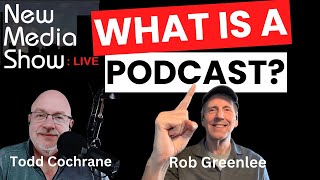
Rob Greenlee and Todd Cochrane debate what defines a podcast as AI and hosting platforms diverge on whether video counts. Podfest Asia saw CPMs hit $35-$45, outpacing U.S. rates, while most major platforms still won't distribute video via RSS, forcing creators to choose between expensive HLS streaming or audio-only feeds.
Chapters
also a PowerPoint presentation or a PDF too.
Weird. You're getting an image on your side on, uh, yeah.
We're all live. Yeah, yeah, I see your, your Blueberry logo up on the screen.
Yeah, yeah, I'll let you know. Good. Here we go.
Todd and Rob Greenlee afternoon. Hey, afternoon, With Todd and Rob.
Oh yeah, here we are with a new media show, and Rob, the audio, the audio is fixed. Really?
Well, that's great news. I like that.
Me too.
I like to be heard, I guess, a little bit anyway. I'm not too egotistical about it. I, you know, I'm a humble guy.
And, and not, and not to be heard with an echo.
So, right, well, it just— it's an amplification of my voice. Yeah, when it goes, right?
Exactly. When I first— when I first set up OBS, for some reason it wasn't recognizing— it wasn't hearing your voice. And then— and then something happened and it magically started working. And I had a second audio source in, and it was just milliseconds and just enough to make it sound like you had a reverb or something in it.
But anyway, well, some people think having a reverb is cool, right?
Yeah, exactly. Well, anyway, welcome, welcome everybody. And, uh, I am fresh, fresh back from, uh, from Podcast Asia. In fact, my, my voice is a little, uh, a little wretched, but I, I met all kinds of interesting people and I, I will have to say, Rob, the funniest thing— there was a session with, um, a radio, a radio guy, and a— they call him a sexy— it's a word— sexy actress or something like that. They don't, they don't call them porn stars here. They— and she's really not a porn star. She's an erotica filmmaker.
That's what I was gonna say. He's probably a specialized entertainer.
Well, it's soft. It's not hard. Right. But there is nudity and, you know, just everything else, but you don't ever see some things. Anyway, they have a podcast called Too Hot to Podcast. And I would recommend a subscription. The session was very uncomfortable for very conservative Filipinos that were in the group, in the attendance. But it just shows that The content here has evolved across all genres and things are moving. There's lots of networks being formed. There's dedicated launching of shows and lots of money coming from the United States, a lot. And they— and I didn't get the full rundown because it hadn't officially launched yet, but there's a sports network. That's launching here that's covering all global sports but is being paid for by somebody in the United States. And I guess we'll find out whenever that launches, but first year they've put $1 million in. So that buys a lot of content here. They're going to do 16 sports shows and the first year's budget's $1 million for 16 shows. Everything. Guest, host— not guest, but the host— and everyone's going to be paid. It's, it's all paid content. And I just thought it was interesting that that was happening. Um, their, their CPMs, um, that they're getting here are beating US CPMs, um, on average $35 and $45 CPMs. Programmatic about the same. And apparently if you have 300 to 500 listeners in your show here, you're monetized. So the standards of monetization are much, much lower to be able to find a sponsor in the Philippines. So no signs of Spotify though. They were not here. They've had a big pullback, and while no one really wants to talk about it, the— a very bad taste has been left in people's mouths here over their basically extraction from any type of participation, support, underwriting, all of that. Has completely dissipated. So there's some bad blood there.
So they had some programs going that they've pulled out of, sounds like.
Yeah, yeah. So it wasn't all positive, but the attendance at the event was, I would say double. So maybe, I did a head count once and came up with like 165 people. So again, are we clear with the listeners and viewers what a—
what specific event we're talking about? Um, we're talking about Podfest Asia.
Yeah, in the Philippines.
Yeah, yep. So where, uh, where in the Philippines?
It was in Manila.
Manila?
Yeah, in Makati. So, and it was in the same co-working space we were in last year, and if it gets any bigger, they, they gotta have a bigger room. Yeah, um, they've outgrown— matter of fact, they were busting at the seams, um, at this location. So it was good.
Based on the pictures, it looks like a terrific venue.
Yeah, it's a beautiful venue.
Nice. Yeah, nice place. Yeah.
And, uh, what else? A lot of the same type of things you hear in, in the United States as far as topics and There was, I think, 6 of us at this course. Oh yeah, there was probably 6 people from the US that attended, but the sessions were probably 70-30 local. So not as many— we participated in panels and had sessions, but A lot of the local talent were having, you know, basically running the sessions, which was good.
Yeah, that is good. Yeah. So Todd, I like how you're all color coordinated.
Oh yeah, I got my purple water bottle.
Your purple water bottle and the kind of bluish shirt that goes with your background.
And believe me, I really good. I jumped out of bed and didn't turn the lights on in the bedroom and grabbed the first shirt that was on top of the pile. So it wasn't by design, it was pure luck.
So yeah, it's all good though.
And at the same time, I've got other team members in Podcast Movement in Chicago.
Yeah. So what are they saying about the Evolutions event in Chicago? What's the feedback that you've had so far?
Vendor-wise, they said it's been slow.
Next year.
Yeah, um, they couldn't really estimate the size because sessions are going on continuously. Yeah, um, they concurred no, no booth next year at Evolutions. They said it's not worth it, so we're not gonna do another booth. Um, we'll go to the Summer Event only from here on out. And maybe send a person to the event. I don't know. So I'll get more intel next week and have more of a report, but some of the same faces they've seen at Los Angeles. So I thought that was interesting that they're— have you heard anything?
Yeah, I've heard, actually this came off mostly off of social media, but I've I've heard that they've— the number that's being thrown out around attendance is around 1,600. And usually, to be fair about it, usually if those numbers are being thrown around publicly, they're probably inflated by at least 10% or more.
Or more.
Yeah, right.
I would— and they couldn't estimate how many people. I was trying to get a a picture of like Keynotes and see how many people were in the Keynotes. And the two pictures I saw from Keynotes did not look like 1,600. Um, but you know, that's—
I mean, that's not that far off from their, their summer event that they have, just the Podcast Movement, um, full show. Yeah, I think this past year was off quite a bit. So I do think it's mostly the same people going every show now. It's not a different audience, which is, I think what they had intended with the Evolutions event is that it was going to be a little bit of a different show.
Yeah.
But as it's turned out, I think they've just turned out to be the same show. It just happens twice a year instead of once a year.
Yeah.
And it's not growing. Yeah, would be the key takeaway. And it's probably part of what you're feeling there too. And I felt it at the last full event was that there just aren't that many podcasters that actually go to that, that event. It's all kind of business people, industry. Yeah, it's, it's the industry folks doing deals with, with agents and networks and, and existing and existing podcasters. Yeah, if there are podcasters there, they're usually probably larger ones because they can afford to go.
Yeah. So, well, in the event here was held during a holiday, so they celebrate the end of Ramadan here.
Um, okay.
And so all the businesses were basically— unless they were a U.S.-supported business, they were off. So it made it great for for, you know, the folks that have the ability to come and, and not have to miss work. So again, podcast keeping with that ethos of, you know, trying to support creators in a, you know, in a time frame or during— in my whole team's— my team's been in Chicago since Sunday and both set up and everything that's going on You know, it's a whole week. It's not 3 days anymore. You burn a whole week with travel and everything.
So yeah, I think I saw people posting on social media that they arrived on Sunday.
Yeah.
Yeah. So yeah.
And the show's Tuesday, Wednesday, Thursday.
Yeah.
So it's, it's like, okay, again, not, not at all supporting— so supporting businesses, but not supporting independent creators. Yeah, independent creators can't afford to take that many days off for work.
Yeah, right in the middle of the week, and it's not right on any part of the week.
There's no rollover into the weekend at all. And, you know, there's no Thursday, Friday, Saturday, or Friday, Saturday, Sunday.
So I would imagine that Dan and the team over there realize that that's what they're doing.
Oh, they know that.
Yeah, so it must be being done intentionally.
Well, it's still being done intentionally because of the—
The industry need, right? Which most of the people that have full-time jobs in the industry don't really want to— they don't attend a conference over a weekend.
Yeah, they don't want to be gone on a weekend. Exactly.
Right, right. And I mean, I get it, makes sense, you know. I mean, if you have a 5-day-a-week job, Monday through Friday, those are your work days, right?
So it's really not even designed for creators.
No, it's not. And so new creators or hobbyists, I think, yeah, I think that really explains what, what's happening here.
Um, and it's, and it's, and it's expensive, you know, very expensive event to go to too.
So yeah, so unless you're into advertising sales and doing deals with larger shows, if you're a hosting platform, there's probably not a lot to gain from being there.
Yeah.
So, you know, I mean, just look at like a company like Lipson or Acast or any of those platforms that have advertising focus to their, their network. That's not to say that you don't have some advertising, you do, but it's not— I don't think it's a primary driver of what you guys do.
So, so anyway, conference season is off and running. Uh, this is our second one. We went to an event called TravelCon, which was good.
Oh yeah, on the— yeah, in Phoenix, right?
Yeah, I think we talked about it on the last show.
Yeah, yeah, we did.
It was good.
So, and then soon it's going to be the podcast show.
Yep.
So that's coming up.
It's right around the corner. It's about a little over a month from now.
Yeah. Are you going to that?
Yeah, I'm— I leave here on May 11th and then the following week fly to London. I gotta get my airline tickets booked.
Yeah, so that'll be interesting to see what, what happens there. I, I'm really starting to think that that event is really the, the flagship event for the industry.
Well, for Europe it is. People from the United States are not going to be going across the pond for it.
Well, even though— I mean, I heard a lot of people from the US went over there. It's the business people that are Well, sure, that's because, yeah, the larger budgets are over there.
Yeah, but you know, we had good, you know, and I, I guess the word I would use is, um, there was a fair number of new creators there. And you know, part of it is, is they, they allow for a day pass, so people, yeah, that come in.
Yeah, that, that really helps a lot because then a person doesn't have to take a lot of time off. Yeah, they can just fly in, go one day and maybe spend a second day and then head back or take a train in.
And it's—
yeah, well, that's it.
It's easy, you know. Europe is, you know, compared to the United States, relatively small. You can get somewhere pretty quickly.
Yeah.
So, but anyway, so I guess you've been— excuse me— you've been researching what is a definition of a podcast. Are we?
I just wanted to, yeah, I wanted to do an episode where we kind of see what the consensus is out there on what people think a podcast is right now. So I did some queries in ChatGPT and to Grok 3 and to Google Gemini and got some results back. You know, I think that was one of the experiments, but I wanted to Before we dive into that too deeply, I wanted to mention that the Ambies Awards were just held at Podcast Movement a couple days ago too.
Oh, they had the Ambies Awards at Podcast Movement.
They'd had it as part of it, right?
As part of it.
Just, yeah, they usually hold it like the day before Podcast Movement Evolution starts. So it's a companion, event. But it's not really part of Podcast Movement per se. But the AMBIEs or the Podcast Academy is tapping into the attendees, right, that go to Podcast Movement as their base for people going to the awards, right? So it makes sense, right? But the interesting thing about the AMBIEs is it's seen as like it's the most kind of, I guess, most prominent podcast awards show out there. Because it gets, you know, like Hollywood media press and coverage and stuff like that. And it's, but the tagline for the Ambies is awards for excellence in audio. So that's an, you know, that's been that way for a few years now. But I think in the context of this discussion, that I'd like to have on the show here around what is a podcast. It's an interesting kind of comparison that they have that tagline, the audio excellence in audio tagline, where your podcast awards event, Todd, is contrasting the People's Choice Podcast Awards to honor excellence in podcasting. So it's a, I think it's a reflection of the difference, right, in different parts of the podcast community around what they see as what this medium is. And it begs the question, I mean, you've left the door open for this, for the awards to be potentially about the full spectrum of what podcasting could be seen as where the Ambies are saying, well, podcasting is just audio.
Well, to a point, I do require you have an RSS feed.
Yeah, but that's not— yeah, yeah, yeah. But I think you said last year that you had quite a few shows submit to you that were YouTube-only programs that were—
yeah, but that's podcasts, right? They couldn't apply unless they have an RSS feed.
S-feed. So did you, uh, you had to drop those?
Well, they, they never got through the application process because we don't let you submit unless you paste in your RSS feed.
Uh, got it. Okay. Um, did you have many shows submit to you that had, uh, video RSS feeds?
It was probably handful. Again, I'd have to go back and look.
It's probably a small amount, small number, I would imagine. But I think that the AMBIs have kind of positioned themselves as audio, as audio.
But did they recognize anybody that was doing video?
Um, well, I mean, just because the event focuses on audio doesn't exclude the fact that those audio programs could have video versions.
Got it.
Right. So I guess it just, it's kind of this bigger question around, well, what is a podcast, right? What's the definition of a podcast today? And I think this contrast between your event and the Ambies is a good example of where we are at. And so I did a couple of queries, just basic query in in Google, right? So Google has the AI kind of Gemini kind of built into the search queries. And so I did a specific query into what a podcast, I mean, what is a podcast? It was just a very simple question that I posed to Google and Gemini. And it came back with a result that says a podcast is essentially a digital audio program that you can download or stream from the internet, often in the form of a series or episodes. And here's the breakdown of that. Think radio show, but on demand. Unlike traditional radio, you can listen to a podcast whenever and wherever you want. A podcast series is a series of episodes focused on a particular topic. Now, audio, but it also comes up in the results as audio-focused but have video. While podcasts are primarily an audio medium, some creators also offer video versions or supplemental video content, often found in YouTube. So that's what AI says about it, right? So it's kind of coaching the conflict a little bit, right? Or the perception, right, that it's primarily audio, which I would say is true. I think podcasting is primarily audio. And so I'm not saying that it's wrong. I'm just saying that it's probably seeing what's happened in a broader scope and defining it correctly. And I think chat GPT 4.0 came back saying a podcast is a digital audio and sometimes video show. So there's some synergies here between what ChatGPT 4.0 is saying as well as the Gemini platform. It says like radio or TV but is distributed primarily over the internet. Listeners can stream or download episodes to listen on demand using various apps, right? And they're usually episodic, on demand, typically hosted via RSS feed is the techno format. But it says, note, some platforms like Spotify are starting to bypass RSS.
Hmm.
And so that's what ChatGPT— now granted, obviously, if you've used these platforms, it gives you a lot more output than I would feel comfortable just reading into the show today. But so it actually— so, so, and then Grok 3 is a, is a little bit more direct about it. Okay. It says for the same query, what is a podcast? Question mark. A podcast is a digital audio or video series that is typically distributed over the internet and can be downloaded or streamed on various devices, such as a smartphone, computers, or tablets. So. Many say that Grok 3 is the best AI out there. Granted, I'm sure that there's versions of ChatGPT that are better than—
I think they all are, you know, 4.0. Of course, everyone, you know, many people are hating on X right now. I, you know, I'm sure a lot of people would contest that Grok is the best, but In the end, I think, you know, prime example was there was someone that was saying that you have to have audio yesterday at Podcast Asia. I mean, you have to have video. It's just that, you know, you have to. Oh, right. And I kind of came in before I gave my presentation, which I did on AI, and basically said, hey, here are, you know, some things I've heard that I will let you, you know, based on 20 years of experience, let you think a little bit about. And I asked the question, how many of you knew that you could do video podcasts via RSS? And not a single hand went up. Not a single hand in that whole group.
Yeah.
So I, you know, I explained then that podcasts have been— video has been supported in podcasts since the beginning, and people were astounded.
Yeah, I thought it was interesting of all the output that all three of these AI platforms gave me, none of them mentioned anything about video via RSS.
Right.
So, you know, it's definitely missing from the conversation that's happening around the definition of a podcast. And even in the Grok 3, if you, If you read that paragraph, that first paragraph that came up on that query on Grok 3, it says a podcast is a digital audio or video series that is typically distributed over the internet. Now granted, it's audio or video. It's not audio or video or both, which I would say is probably more a reflection of where we are today. I think it's 3 choices, I think, is what the market is actually having to grapple with right now.
So I, I asked a direct question: are video podcasts supported in RSS feeds? And ChatGPT said, yes, video podcasts are supported in RSS feeds. They've been part of podcasting since the early days. And then it just gives an example. Platforms that support video and RSS: Apple Podcasts, Podcast Addict, Podverse, Overcast, and Modern Podcast App, especially those in the Podcasting 2.0 ecosystem. Interesting.
Also, also ChatGPT mentioned the Podcasting 2.0. Yeah, project, huh? Yeah, that's good.
I say what? So let's ask the next question. What, what host Support video podcasting by RSS. See what they say. A blueberry top, Lipson number 2, Podbean number 3. That's it. No. Oh, Castos. Uh, it says RSS.com allows uploading video files and Pinecast has limited experiment— experimental support. So there's a— so that's interesting.
I think, I think the Hubhopper platform out of, out of the country of India, um, also supports video podcasts too.
So interesting. Hosts that do not support video via RSS: Spotify for Podcasters, Anchor, merged into Spotify Podcasts, Buzzsprout, Transistor, Captivate, Simplecast that don't support video VRS. Now Spotify supports video but not VRS, right? Yeah, as a matter of fact, that conversation— again, lack of awareness is sometimes an issue. The folks did not— were not aware that Spotify overlays and the audio, the audio, and then your, your audio's demonetized. That was actually a shock to some. Yeah, so, yeah, so we just have to keep educating.
Yes, yes. I wanted to mention too that there was a new, um, audio series. I'll have to emphasize this from the the podcast called Media Roundtable. It's actually a podcast that's led by Dan Granger, who's the CEO of Oxford Road, who's been a guest on this podcast before. I mean, he's been with us before, but he did a 3-part series basically addressing this question, what is a podcast? And really kind of the shape of that. And it's actually part of a research study that was done also, Todd. It's the white paper link that's in the document. And they do have some study kind of like slides, that kind of stuff that were in there. And it tries to address this, what is a podcast question? I guess this survey that they did basically is data that was compiled over 4,000 Americans that came up with this. So there's a 3-part series called What Is a Podcast? And so you can go listen to it. It's got a lot of familiar names, like James Cridland was in there, and even Norm Pattis from PodcastOne was Some audio was used in this 3-part series. But really, they talked about really the origins of podcasting. They mentioned Adam Curry and Dave Weiner, but they kind of glossed over some aspects of the early stages of the medium. And the big thing that they glossed over was was video podcasting. So the whole series was very focused on the involvement of public radio and audio as the focus. And it was very commercial, advertising-centric in its topic flow. But they came to the kind of the same conclusion that that I did. If you listen to the third episode, Dan kind of pulls it back based on what he sees. And he basically gives a description of podcasting as kind of like what we were just talking about. It's a primarily audio medium that has elements of video that are growing in their availability. And that's what the future looks like, is that video is going to be coming, having a stronger place in the medium. But also, the consensus was that most of the people that were involved in this series and giving commentary were people that either came from public radio, or they were people that work in the audio side of podcasting. So everything that was talked about in this series was definitely slanted towards that priority, right? And, you know, which is, you know, I think audio is by far the largest element, even though we keep hearing, and I know that some data came out saying that Apple is still, I think James Kerdlan put this out too, Apple is still the biggest consumption platform for podcasts, even though there's maybe more people using what's seen as a podcast in Spotify and in YouTube. But what platform are they consuming the most podcasts in is the question.
It's interesting because I, I was— wanted to be able to see, um, I wanted to see the presentations from both James and from Oh, Tom? Well, Coleman Insights and Amplify Media did something together, and yeah, so let me see if I can— of course, Webster did a keynote yesterday as well. Um, let's see if I can find the information from James, if his stuff was published or not. Let me see. Okay, share. Yeah, let's see here. The biggest podcast in app. Okay, what is the biggest podcast?
Yeah, that's the one where, where he mentions that Apple is still the largest, still the largest consumption app, consumption app, via downloads and views, right?
Oh, that's—
but the industry is still still conflating this issue of saying that plays on YouTube are counted as downloads.
Yeah, and that's not the case.
There's still people doing that. I think Podtrack was the one that was pointed to that was still referring to YouTube plays or views. As downloads. So they're trying to synergize all this stuff, and I get— I kind of get the reason why they're doing that.
I mean, yeah, their business models are impacted. Only half of the top shows are posting video. 32.9% of the top shows aren't there. Interesting.
Yeah, a third of them, of the big shows, are not doing any video.
Yeah, so who's doing YouTube? Post full video episodes YouTube 130— why is it weird? Post full video episodes YouTube 130%, post audio-only videos 50%. How do you get more than 130%? I don't get it.
I wasn't sure on that either.
Yeah, it's a weird slide.
Over-indexing, is that what that's called?
Yeah, maybe. I thought James was going to be producing a report as well from his survey.
Yeah, I thought so too.
I don't know, maybe his, maybe his presentation is tomorrow or something.
Could be. Yeah, that, that certainly could be, Todd. Yeah, I guess Tom Webster's keynote yesterday also, I guess the topic that he focused on was the need for the industry to convert occasional listeners to more frequent consumers, which would lead me to point to Apple, right? Right. Because if, if we're trying to get heavier listeners, right, or listeners that are more engaged to more content, yeah, I think is what he's talking about, you know, occasional listeners to turning into more frequent listeners or more viewers. Well, I mean, what causes that to happen?
Yeah.
Is it— is Spotify the best platform to encourage that when they're constantly, uh, teased all sorts of other types of content to go consume? Or is it better in a, in a very focused app like an Apple podcast app to, to get people to consume more. I think that the model that works for consumption seems to point to more of an Apple model.
Yeah.
Yeah. Would you tend to agree with that?
I think so.
But it's a more specialized app.
Well, you know, I, I think, you know, the whole industry is going to be, you know, if, if you're smart, At this point in the game, you know, I, I think specialized apps for communities, I think it's going to get very narrow. I, I think that, you know, if you want to grow your audience—
talking about that for years, how do we have these kind of like niche genre apps?
And it's sad how they've, you know, Apple and Android have really bastardized the PWAs and not made them as, you know, as easy to manipulate as a regular, because it would be really easy, you know, I could spin up 20 different niche, I could do that in a week, you know, category-focused content. I'm actually going to experiment a little bit with that, you know, this quarter, and basically kind of seeing what kind of traction I can get with a couple of curated categories. And just because I've got these tools at Blueberry that allows us to build, you know, networks, so why not see if we can, you know, if we can get a little bit of more traction for our podcasters within their specific categories.
Mm-hmm.
So yeah, I'm just kind of— so maybe we've got more coming from Podcast Movement.
Um, yeah, I'm sure we do.
I, I thought James is— he would be publicizing his results if it, if it, if he'd already released it.
Um, yeah, I, I would agree. I think tomorrow— isn't tomorrow like the, the second day?
Yes, it is.
Yeah.
So, yeah, I'm just looking at the news here and I'll email Jay and say, can I get a copy of your presentation as well to share on the show next week? Because they were talking a lot about the audio video in this study. Matter of fact, I provided some context just from our database. I don't think it's used in the study, but they were, you know, they're having they were looking to validate some, some information. But what's funny is I'm starting— it's— I don't know if people just pick up on it and run with it, um, because, you know, like, as an example, I've said for years that, you know, 50% of podcasters don't make it to episode 7. Well, someone at Podcast Asia, someone said, well, it was 10. 10 was the number. Um, and, uh, I'm kind of giggling.
Well, that would be great if it was, but I think it's actually probably—
it is lower. And, uh, and then Another percentage of people said that it was like 70-30, 70% listen, 30% watch. I'm like, well, I've said 70-30 for my personal show for years. This show's more 80-20. And so it was, you know, I'm kind of giggling. I'm like, hey, where did they pick this up? Was this just an echo chamber of something? You know, one person says it and it just gets rinse, wash, repeat. You know, and I—
I don't know about you, but I haven't seen any studies that kind of clearly lays that out like that.
No, I've got it from validated data. Maybe we should do our own report at Blueberry talking about that.
Maybe you should, Todd. I mean, you're only— I mean, you're one of the 3 podcast hosts that is hosting video. So, you know, I can't imagine that there's any other platform that would be a better—
But, you know, here's the next piece of that then here. I'm sorry, I'm really organized today. My collar was rolled up. I had the wrong logo up for the first 15 minutes of the show advertising Blueberry instead of New Media Show. So I'm a hot mess here. Maybe, you know, maybe that would be something good to look at. But here's the kicker then. What if those video shows actually have YouTube channels? Then do I include?
Right. Well, how are you going to aggregate all that?
How do I include that data? You know, so. Yeah, or are they? And again, we have some people that aren't on YouTube, they're on Rumble or, you know, other sites.
Yeah, yeah, it's true.
But anyway, go ahead.
There's lots of options that creators now— oh yeah, podcasters have for, for getting their content out. It's distributed, actually. It's crazy how much it's—
it hasn't changed that much, but it's a reminder. And again, you know, I'll stick with what I've said for years. I don't care where they watch or listen, as long as they watch or listen. And, you know, I know where my bread is buttered as a company.
Um, so from that regard, it is hard to be everywhere though.
Effectively, that's like I'm not effective on YouTube. Yeah, we have some people come in and watch, but I, I don't get maybe 100 views on this content in YouTube. And, and whereas, you know, we get 3,000, 4,000 people that are— I think it's about—
I think we peaked out, Todd, with this show on my channel I think we had one episode that we did that I think got like over 3,000 plays.
Well, that's pretty good. And you've been focusing on it. I try to do a little bit of stuff, but nowhere near to what you do.
But it's kind of rare though. And I think generally the topic that we cover doesn't really interest a large number of people though. That's the other part of it.
Yeah, we're not sloshing beer and swearing and cussing and— yeah, right.
Well, no, I think the whole genre topic of podcasting is definitely saturated. So, you know, podcasts about podcasting are— there's, there's a lot of content out there right now.
I do see, um, people quitting YouTube though because they can't handle the big, big YouTubers quitting because they can't handle the constant grind that YouTube demands, the pacing and, uh, and, and all the stuff that they have to do to fight the logo.
So yeah, it is— I would say just based on what I see, uh, with it too, is that I do think that you get paid by the algorithm better if you publish more often, right? If you can get like maybe 2 to 3 episodes or 2 to 3 videos out a week or more.
Yeah.
I think the algorithm, and then get your thumbnails and your descriptions and your metadata, you know, nailed down and done well. But increasingly, and this came up in the series too, that media roundtable series too, is that there's this kind of conflict that we're coming up against. And that's the algo, like you talked about, the algorithms, right? That these big platforms, and YouTube is the biggest culprit right now, But I also think that TikTok and Instagram and these other platforms have the same issue, but more and more creators are creating topics and content to feed the algorithm.
Oh, that's horrible.
To do what the algorithm wants.
Right.
To do what works for the algorithm. What ultimately works well for the, the viewer because that's the kind of content they're looking for. But it's basically making content creators kind of like empty vessels of sorts, right? That all they're doing is, like you said, feeding the algorithm versus creating content based on their passions.
But there is a certain, it's been an unwritten thing. We've never, and Apple's never, I don't think Apple affects shows based upon posting schedule, but there's historically known, if you're not in someone's ear every week, we know that growth rates are much slower, but I don't think you're negatively impacted by not putting out 2 or 3 episodes. Matter of fact, within Apple Podcasts or podcast apps, you're actually almost penalized a little bit if you're doing more, Like people that do daily shows, they don't realize that they could actually be hurting themselves by doing a daily in that if people don't listen for 3, 4, 5, miss 4 or 5 days, then they're going to run into an issue with people not being able, you know, all of a sudden they're going to be in a catch-up mode. And we learned this with in the early days by going to CES and recording all these interviews. That he would say, why does it take you 2 months to get all your interviews out? And it was because we purposely only released 3 interviews a week because we got hurt by putting out a new interview every day. Yeah, because we didn't— we were dripping the content out and people would pick it up and then it— so it had 24, 48 hours to percolate. And then we drop another interview. Sometimes we'd go 3 days and do it during the week because we know that drop-off happens on the weekend in podcasting, whereas in YouTube, the content listening goes up in certain genres because people are sitting on their couches and they're in bed versus in their cars. So we dripped the content And that's how we were able to achieve massive numbers on that content. But yet I'd have vendors pissed off that it's 45 days.
Yeah, right. Took them a long time to get their content up.
Yeah, but, but, you know, we had it ready, but we purposely couldn't drop, you know, 200 videos.
Yeah, and to dovetail off of that too, I do think that there's probably a a limit. And I think it also gets back to— it really gets back to the engagement level that you have with your audience too. I mean, I know that there's live shows out there that get hundreds of thousands of people listening to them daily, right? There are shows like that out there and they're big. I mean, like 100,000, 200,000 people watching a live video show at the same time.
Yeah, sports shows, hardcore Hardcore, hardcore fans.
And, and some of those shows are audio podcasts too.
Yeah.
And they're hour-long, um, that go out daily. Um, and it's—
how many does Rogan do a week?
He does 5 days a week.
My God.
And, and each of his episodes are between 2 and 3 hours. Yeah, right.
So, so you— if you're, if you're listening to Rogan, you're not listening to anyone else.
You're probably not. And that really tells you the level of engagement that he has. But I don't know about you, Todd, but if I listen to Joe Rogan, I'm pretty selective about which episode I listen to.
Oh yeah, yeah, yeah, I am too.
Because I would say that the way he does his metadata, like his titling of his episodes, doesn't really help the listener decide who to listen to. Because all he puts into his episode titles of his videos and his audios is the episode number and the name of the guest. That's it. And unless you recognize the name of—
right, right—
the guest, you wouldn't know that you might have an interest in listening to it because he doesn't put a topic.
That was it. There was something that was hit upon in Rogan at Podcast Asia. They were like Remember, uh, you know, the Spotify, uh, was exclusive, and now he's not. He's available. And they use the word YouTube. He's now available on YouTube. Is his full episodes available on YouTube?
Yeah.
Oh, they are now. And they didn't talk about the full episodes are now available outside in podcast apps too. And I just— I'm smacking my head. I'm like, hey, you know, don't Don't get so focused on the shiny lure.
Yeah, and that way I can't find an audio-only, uh, feed for Joe Rogan in the Spotify app. It's only video.
Oh, interesting.
So he's, he's putting his audio out via RSS, via probably Megaphone. Yeah, but it's, it, I, I can't find the audio version inside of Spotify for it.
It's not because they've eaten and drank their own Kool-Aid. And, you know, it just posts the video.
But I've noticed that other properties that Spotify has, they're not doing video. So, you know, like the Ringer Sports Network isn't publishing any video.
Well, they're smart. They've chosen not to do that because they knew that they were going to be negatively impacted revenue-wise.
Well, that's an internal— its own—
I mean, um, Spotify owns Ringer? What?
Yeah, the guy that founded that is actually part of the content team.
Oh, I didn't know they got bought by Spotify.
Oh yeah, it was a couple of years ago.
Was it Megaphone or Spotify?
It was Spotify. Oh yeah, it's a deal like, like— well, actually it's even A bigger deal than even Joe Rogan.
Oh, it's a—
okay, it's an owned network.
Oh, owned network.
It's a sports platform.
Yeah, and I think too is some people, there was a— and I just couldn't let it stand. Someone said, if you're over on Spotify, you'll be able to get monetized. And I had to step up and say, listen, listen, listen, that's not the case. Not everyone gets monetized on Spotify. I said, you have to understand what the qualifications for video are, and you have to be part of a network that's supported, uh, that has an ad integration with Spotify. I said, you don't—
well, it has pass-through, you mean?
Well, no, they were talking about getting ad— getting money from Spotify, um, or their audio podcasts. And I'm like, this doesn't happen. Yeah, this doesn't happen automatically. You know, you have to be at an echelon show and you have to be part of, you know, a group. You just— this just doesn't happen automatically. You know, so there's a lot of falsehoods people put out. And one of the things came from someone well known in the space. I had to go back to him and say, hey, what you said is incorrect. And, oh, I didn't know that. And I said, yeah, so, you know, please, before you make a blanket statement like that, make sure you know exactly, you know, what the deal is, how people actually are making money. Um, yeah, complicated landscape.
Yeah, it's a complicated landscape, and a lot of people don't get the right impression.
Yeah, people say, oh, I'm making money on XYZ. Well, well, great. So if one person's making money, someone else should be making money. Well, that's not always the case because there's, there's specifics for each.
Yeah, and certain platforms have capabilities that other ones don't have. So I mean, hosting platforms.
Yeah, I talked with an ad sales rep there and, uh, and I said, uh, hey, we've we've got a number of Filipino shows on Blueberry. I said, we have Programmatic and you're saying you're buying into Programmatic, how come you're not buying into SoundStack? And she goes, who are they? And I'm like, you know all these other companies, these big names, but you didn't know SoundStack? How did you not know them?
And I think a lot of, I think a lot of people don't know about SoundStack though.
Yeah, maybe.
It's not a household name by any means. So I said, that's nothing to take away from them. They've been— they're doing a terrific job, but it's, it's just not a brand that most podcasters know about.
And I said, you know, I got X number of shows that are being monetized programmatically, and SoundStack's a provider of that. And, you know, it's kind of got this shocked look, you know. I was like, oh no. So we'll make that introduction. So they obviously have some work to do to, you know, get there.
I mean, that's, that's the value of podcast education. Yeah. Is to help people understand the complexities of this medium. Cause it's not like it used to be, right, Todd? Where it was pretty easy to explain to people how this stuff works.
Well, it was, you know, US, Canada, UK, right, were being monetized, and anything outside that was kind of ignored. And I'm like, well, here you've got this show, Too Hot to Podcast, that is doing numbers. Yeah, they should have advertisers, you know, that want to be in those shows. Now, it might be too hot. Maybe that's the problem. Maybe it's too hot for advertisers, but Um, I think it's kind of funny when they say it's too hot to podcast. I didn't know that was an actual thing, but—
well, the early years of podcasting had, uh, had a lot of porn in it too.
Yeah, and they're not doing porn, but they're doing, uh—
well, I mean, sexually—
sexually explicit content. And there's a lot of that is out there, and there's a number of, uh, very popular women's podcasts that are doing Yeah, yeah, you know, doing some pretty— I guess we'll call it sexy work. Yeah, sexy work, sexy discussions. The work's the wrong word.
Exactly.
I apologize.
Or candid discussions.
Yeah, very, very candid discussion.
Human sexuality. Yeah. And you know, that— those type of shows are not entirely what I was referring to. I know, I know, porn podcast.
Yeah, yeah, yeah.
When I say porn podcasts, what I'm saying is it's people were publishing porn videos into episodes via RSS.
Well, I guess they're having some trouble with that somewhere. I think they're having some trouble with that on Spotify.
Yeah.
Where they're actually having adult content come in, or real stuff, like stuff you wouldn't want your children to see.
And I also, yeah, I saw this back when I was working on, on Zoom at Microsoft. So I had to filter that stuff out, um, as much as I can because it, it clearly went against our, well, terms of service.
Just as an FYI, Blueberry is good. We are all about free speech. So if you want to come do your sexy podcast on Blueberry, please come on over. Well, we're happy to have you.
Well, and And some of these podcasts were audio only, if you can just envision that.
I'm sure.
So, so anyway, that's where it kind of walks a fine line, right?
Yeah. What's, uh, and just as a little back fact, and this is kind of curious, um, during the pandemic here in the Philippines, everything was locked down. Yeah, so no one was filming anything. The only thing that was being filmed that was making money and feeding families was this erotica content from within homes. Oh, so that market flourished through the pandemic type content. Yeah, because they could continue And it was a network of a big company that was— and again, it wasn't porn. It was erotica-type content. Again, there's a fine line, I guess, depends on who you are and what you'll define as what. But yeah, they said that that business thrived during the pandemic where everything else just got obliterated. So kind of makes sense in that, you know, get a camera delivered to your house and some lights and, you know, you probably can, you know, set up shop. Mm-hmm.
Yeah, yeah, you have two consenting adults that, uh, or more okay with that.
Yeah, or more, right?
Yeah, um, yeah, so there— the content in podcasting has spanned quite the spectrum over the years.
Oh yeah, yeah, from the Daily Download to, uh— and that wasn't a— that wasn't a show about podcasting, I'll just say that, right?
Yeah, yeah, yeah.
So, you know, and here's the sad part, you know, people— I, I don't see people going after super creative you know, shock value content at this point. And I don't know why we haven't— why don't we have more shock value content in podcasting? It was, it was, it was really like super popular in the early days.
Like, uh, like Jerry Springer type formats? Is that what you're talking about?
I'm just talking about stuff that is, you know, uh You know, is the French maid, just, you know, Tim, that type of stuff, you know.
Well, I did notice a couple of old video podcasts have started popping up again.
Oh, really?
Yeah. Did you notice that Kevin Rose and Alex Albright have relaunched their Dignation series?
A little grayer in the tooth, are they?
Yeah, definitely both those guys are grayer. And then, um, of course they don't need to do anything.
They're, they're all both independently wealthy, I'm sure.
Yeah. Yeah, that's true. Especially Kevin. Um, also I saw more social posts popping up about the Ask a Ninja podcast too.
That's funny.
So, well, I mean, That series was very, very entertaining. I would put it in the same ballpark as the French-made TV stuff.
Yeah, right.
Um, yeah, so yeah, Tim got inducted in the Hall of Fame for that, for doing that series.
Yes, he did. You know, Tim's done a lot of stuff for the— you know, he's one of those, he's one of those guys that just keeps chugging along. Yeah, you know, and it has done a variety of things in the podcasting space.
And, uh, Tim Street is who we're talking about.
Yeah.
And he now works for Authentic— uh, was it Authentic? Authentic.
Yeah.
Yeah.
And, you know, he's just—
which is part of PodTrak.
He just does one of— he just keeps doing his thing, you know. And a real good guy, you know.
Well, he was a Hollywood producer, director.
Yeah.
Many, many years.
Yeah, and I'd be honest with you, it's guys like him that did a lot of stuff in the podcasting space that really, you know, helped grow the medium. Yeah, there's a lot of, you know, there's a lot of people like that.
So, well, he can, he can bring a lot of insight to folks that are interested in getting into video too. Again, again, again, again, again, again, again, right? So it's, it's It's interesting, Todd, in our purview, how things have gone in cycles, right? So we've seen things come and we've seen things go, and then we've seen them come back again, and then we see them come back again even more. So that's kind of what's happening with this video discussion.
I was having a discussion with I don't remember. It was, it was one of, maybe it was one of the folks that were in from the United States that was at the event and talking about the cost of media delivery. And, um, you know, where I just kind of giggled because my AWS bill is, you know, stayed about this much. Yeah. And the reason it stayed about this much for many, many years is the decreasing cost of bandwidth. And that if I had to pay what I was paying even 10 years ago for bandwidth, I don't think I'd survive. I'd have to increase the prices of the service. And people are shocked when I talk about how hosting companies have not raised their prices literally in 20 years.
And And that's saying a lot considering what's been happening with the inflation of healthcare.
Well, I'm going to tell you, there is heavy pressure. There's heavy pressure at this point. And I can't imagine with the increase of healthcare and everything else that goes along, at some point, you know, we've all, we've ridden the bandwidth thing down to lower, you know, the cost. Of doing this has gotten to the point now where pretty soon, uh, there, there might become a reckoning where we have to raise hosting prices, um, in order to survive.
Or will bandwidth— no, continue to drop.
It, it can't mentally drop. We're already as You know, again, I'm now negotiating on— what's the best word? No, no, I don't think it can go that much further. So let's just use an example. Let's say subpenny. So if you're negotiating for subpenny, let's say $0.003 or $0.00275, $0.00275 per gig. Right, that's pretty low. So, you know, and, and considering we started out at it as at 10 cents. Yeah, so we went from 10 cents to sub-penny. Now if you go and do a renegotiation, unless you've added petabytes of new traffic— and again, you have to add petabytes to get a better, uh, a better deal— you might go from 0.00275 to 0.0 $225. But at scale, um, but at scale, you're still— the incremental return now is the incremental reduction is again, if you have additional bandwidth, right, then that makes sense.
But as we move into video more on that side, does that incrementally overall raise, raise the costs, or does it put you in pricing? Oh yeah, it, it—
well, before I had video on risk, you know, you just prayed that you didn't get Joe Rogan come in with video content, you know, because that's, that just, that'll kill you in one, in one month. $200,000 hosting bill, you know, you get that kind of a bill, you, that That takes the wind out of your sails. So, you know, so we're at risk in those early days. Now it's not as much. So example, this show in the early days cost 10 cents to deliver via RSS. Now it's, it's a subpenny. So, but it's still subpenny and multiply that buy a popular show and you get in some real dollars very, very, very, very, very quickly. Or the risk on audio, you know, I get done and put this up, this will be 48, maybe probably 70 megs.
Well, if you look at what's happening with like a YouTube and a Spotify, and YouTube put in their own fiber, so they own their own own bandwidth is what it comes down to. I don't think a lot of people understand that or realize that, but they own their own fiber network and they have data centers, hubs all over the world.
And they go to POPs everywhere where they are there. They bring in the fiber to the building and—
Right. And then make those direct connections between the source publishing and the the streaming side.
So they basically, they have plant expenditures and upkeep, but they, they pay nothing for scale or bandwidth transfer. It's in, it's in the electricity, obviously, but, you know, I can't imagine what their, you know, internal— when they math that out, what it actually cost. I'm sure it's like 0.00000 something per gigabit.
Well, they're probably gated only by how much fiber they have and what the capacity of the fiber is.
Um, yeah, and now fiber's gotten to the point where it's multiplexing, and, you know, they're, you know, what original fiber, and then what they're— it was used to be one stream down, you know, and that was it. Now it's multiplexed and frequencies, and, you know, the technology is advanced where they they're getting more bang for the buck out of that single fiber line. But, and when they put those fibers in, by the way, they just didn't put a single fiber down.
Oh no, it's, it's a bundle, a bundle, thick cable, right? That, and it's not that big, it's, yeah, like about that, but you can stuff a lot, a bunch of, yeah, a bunch of those all in one big one though.
Yeah, depending on where they're running, but you're right.
Yeah, and I think all they had to do was boost the, the power of the laser that shoots through that, right?
No, they, they, again, they change, they unplug it put it in a new gear and the new gear has new tech, it's still the same fiber, right? So, but again, I, I think, you know, in the end here, going back to the podcast host discussion, um, you know, at some point there'll have to be an addressal of cost. It just— there's, there's gonna be no choice.
Well, that, and also as platforms like yourself, like, like like Blueberry adds more AI technical support into the platform that adds more value to the platform and should be compensated based on the fact that your platform is replacing other services that creators were having to pay for outside of your platform too. So I can see how that would map over time.
It's amazing how much money creators are spending for their shows now. You know, I, when I asked, you know, some people are spending upwards of $200 a month to do their show on third-party tools.
So yeah, I think if you think about all the AI tools, yeah, that people are using out there, especially if they're doing, doing video, like the Opus Clips and the Descript tool and things like that, right? That can easily get you up to $100 a month.
So it's, you know, it's, it's an interesting time in the space. It still remains, uh, challenging for sure. And, um, you know, that's one of the reasons we're diversifying with some new products.
So as we get back to this topic on what is a podcast, where do you see, Todd, this whole conversation about YouTube and trying to consolidate metrics. And, you know, I think that there's an interest, and I heard this voiced in the media roundtable discussions too, around trying to bring together more of this information about audience, right? Because it's— and one thing we haven't really talked about in this episode either is how the emphasis around individual shows or episodes is increasingly with these algos, algorithms are becoming more important, right? So it's not so much audiences loyal to a series, it's audience loyal to an episode. And I think as we have kind of shifted into this mentality of just being able to click play, that gives people the opportunity to just swoop in just like what I do with Joe Rogan, I'll swoop in and I'll look at the list of names. Do I recognize any of the names? And I'll, I'll maybe watch one of those episodes, but I don't like click into it and watch every episode.
But you are— when it comes out. But you're subscribed to the series?
You don't have to be.
Well, I, I don't watch YouTube on anything other than my TV, so it makes it hard to without having to do a manual search.
Well, well, well, for one thing, it's not called a subscription anyway. I mean, unless you're subscribing to something that's paid for.
Well, they ask you to follow. Well, follow YouTubers say follow and subscribe, or, or, or favorite. I think it actually says subscribe in YouTube.
Yeah, yeah, yeah. No, no, I'm— I was more talking about most of the podcast apps are no longer using that term subscribe. So, and increasingly, the YouTube experts that I occasionally will tune into are telling me that the subscriber numbers in YouTube is increasingly becoming irrelevant. It's not something that YouTube cares about.
Well, it's definitely— I hear, hear people talking about that, you know, it's only like 40, like 40% are subscribed and the rest of you are just watching. And please, you know, that's the bag, is, you know, if you've watched, please subscribe. That way, you know, my subscribe numbers— so it still means something because they, you know, that's what they— that's how they give plaques out, or actually how you can buy your plaque if you hit plateau?
Well, it is a signal of, um, of, of a relationship that's built with a member of the audience, right? Yeah, of some sort, right? What that translates into— I know I, I follow lots of, or subscribe to lots of shows on, on YouTube, and it, it does have a little bit of mapping to showing up in my, my wall.
Yeah.
On occasion, but I don't think it's really— I don't think YouTube is really utilizing that information as much as—
I know it helps me in podcasting because I tell you what, I wouldn't— I would completely forget about shows if I had not followed them in a podcast app.
No, no, I'm talking about, uh, YouTube.
I know, I know, but again, it goes back to podcasting. I think it's critical people don't just swoop into a podcast episode Yeah, I mean, I think the— yeah, but on a podcast app, people don't just swoop in. It's not the same experience. YouTube, you may just swoop in, but on a podcast—
yeah, I think with, with YouTube, it's more of a— almost like a bookmark is what I would call it. Yeah, I see that also in like, like the Rumble platform, which is also a a video-centric platform.
I was having a hard time.
Oh, is, is that, that list that you have of shows that you're following or series that you're following is, is really like a shortcut area you can go to to find a creator that you might want to check out what they're doing right now?
I had a gal that was wanting to subscribe to this show because I mentioned it, and she had Spotify open, and I, I had I couldn't find, I couldn't get this show to come up in search on her phone.
In Spotify.
Yeah. So I had to, I said, well, we'll just put it on your Apple Podcast app. And she goes, what's that? And I'm like, oh, I said, so she had an iPhone and I just wrote in podcast and it popped up and I clicked on it. And she goes, I didn't even know that was there. And I said, well, it's the same thing as Spotify, except now you will not miss an episode. You are subscribed.
And you can watch the video version. Yeah.
Yeah.
In Apple, but you can't in Spotify.
So it just frustrated me because I was, you know, I searched for the show 3 or 4 different ways and could not find it on Spotify. So all kinds of other stuff came up.
So are we being blackballed?
Maybe. I wouldn't be surprised.
Yeah, we haven't towed the company line.
Yeah, yeah, you know, I'm not surprised. Yeah, so I think in the end it's again— so she says, oh, just I'll start subscribing to podcasts here. I said, that's what I would recommend.
Yeah.
Yeah.
So I just, you know, I don't really think that the definition of what a podcast is in my mind has changed at all. I think that the definition of what a podcast is in the mind of someone that's only been utilizing or creating content for the last 2 years may have a perception that things have changed.
I think the general public just doesn't give a shit.
Well, that's true too. I think that we just— the audiences don't, don't really care about how it's distributed. They don't care about what we call it, really. Yeah, just, they don't care.
That ship has sailed more than a couple of years ago.
But it keeps coming up. People keep saying, you know, we're going to solve all of our problems by changing the name.
Yeah, good luck. You know, this comes up every 12, less than every 12 months now.
Right.
And you're not going to, and RSS is not going away, you know. When Apple changes it so that you can't get your podcast via RSS, then I become worried. Yeah. You know, until that date. So, but I will say the Apple Podcast auto-submission has become very popular.
I would imagine.
Yeah, they did a good job there. As I see, I can now see all the submissions that go. We get a notification.
Yeah, because we went through a period of time when people, um, just didn't submit their shows to Apple. Yeah, they got in there, they created a podcast, and they, they immediately got it pushed over to Spotify because Spotify made it easy.
Does it one-click submit? Right, exactly.
And plus, plus a lot of people, as you recall, were all spun up about being in Spotify anyway.
Yeah.
Especially younger people.
Jesus, thank you. A feeding frenzy on that.
Yeah, it was a feeding frenzy. And, and Apple was always like, oh my God, you know, how do I do that? You know, how do I get it into Apple? And some people didn't even know that they could.
And, and little, and little did we know, Spotify was paying people overseas to submit shows for them. You know, they had people in call and work centers over foreign countries doing the submissions to Apple manually. They didn't even know it. That was their secret sauce. They didn't have an API integration. They just, they just manpowered it anyway. That's how—
I mean, for a long time, uh, Spotify submitted shows into Apple through their— the— was it the Anchor, um, Apple ID or something?
Well, it was, it was, yeah, it was again, it was Anchor employees submitting the shows, overseas employees. Yeah. So they were, oh, we, I, we automatically got into Apple Podcasts. How come you haven't, couldn't do that? Well, I didn't have 50 people in a work center somewhere in Bangladesh that was submitting shows to Apple.
Yeah. Well, supposedly per the Apple terms of service, as you recall, didn't allow them to do that.
Well, they did.
And I know they did. And why I got the impression that Apple didn't shut it down, and why Apple didn't shut it down is still a mystery to me, Ted. For 4 years they did that. Here, here we both are over here filling out spreadsheets, right, to send to Spotify to their catalog.
Yeah, yeah, and doing the work for them. Right, you know, and being their tech support. Man, we were so stupid.
Well, we were getting screamed at by podcasts.
Yeah, that's true. Absolutely screamed at.
Or get me into— well, they were saying get me an Apple too, but they were saying get me in Spotify.
Yeah, I, I have a request. If any of you have an Elgato Facecam Pro Are you still struggling with that? It doesn't work. So I bought another camera.
Oh, wow.
I bought a Logitech. No one could answer the question. We never could get it. I never could get it to work. I'll just say, don't— if you have a MacBook Pro, do not buy an Elgato Facecam Pro. Hmm.
Wasn't— don't work. You couldn't get a cable that would adapt to it?
I had the cables. It just said This is not USB 3.
It doesn't recognize it.
Doesn't on the Mac.
It would—
it— the Mac would not recognize. I've got everything else and a Brother hooked up here. I've got Stream Deck, I got the switcher, I've got my two cameras, and with everything disconnected, that camera would not work with the provided cables to go to a Mac. And so, yeah, so I got another new webcam. That I bought.
What'd you get?
What was readily available here, the Logitech Brio 500.
It's a good camera.
Good camera, and it works.
And is it a 4K? Is it 4K capable?
Uh, no, it's only 1080p. Yeah, and I just, I needed to work with my teleprompter, because that's why I primarily needed it for. I'm just using the FaceCam camera here today on, on the Mac. I'm not using— but in order to look into my teleprompter, which is up there, I can't. It just looks, just looks weird. So yeah. Is what it is.
It is, it is. So yeah, so what's your definition now of a podcast as it contrasts with what, what you're hearing, what other people are thinking?
You know, I don't want to be the dude that says it has to have an RSS feed, but I sure wish it would. I guess I'll just put it that way. My goal is to make sure that every podcast, video or audio, has an RSS feed. And can be distributed via RSS. That's my goal. It's not going to happen. Um, we made some headway with Vid2Pod and being able to give YouTubers an ability to quickly and automatically have a podcast. But, um, I don't know, I guess I don't want to get stuck into defining it at this moment. What do you want to do? What's your thought?
I don't know. I would, I guess my, my position on it's been consistent over many years is that video has always been part of the podcast space. I mean, I mean, if you, if you think back, Todd, back at this show, it, it, it's Zune, right? Zune had big screens on their portable media players.
Yep.
And I built a video podcast experience inside a Windows Media Center, you know, and I've got the Zoom to prove it. You know, it's a small device with a big screen.
Yep.
And I would play all sorts of video podcasts. If you think about it, all the major media companies supported video podcasting back in the early days.
And there was no YouTube.
Yeah, that was for a few years prior to the existence of YouTube. And then when YouTube launched, they, uh, they moved. Well, some of them did, and some of them quit, or they, they just— yeah, they just moved completely over there. Um, but others continued, like, uh, like Leo Laporte.
Continue.
I mean, like on my Zoom here.
Oh, it booted up.
Oh yeah, it still works. And I can throttle back and forth between audio and video. So those are all the video podcasts. And then I just tap a little icon and that's all the audio shows.
Does it actually still work work?
Yeah, I can play. I'll play a an Apple keynote from, from, uh, 2016.
Oh, I'm talking about current content.
Oh yeah, I don't keep the content updated in this thing.
So it's playing video just fine.
Yeah, that's, uh, Tim Cook on stage there back in 2016 via RSS. Yeah, RSS. That's when they they put out the Apple keynote every year into an RSS feed. Yeah, I used to feature it. Even like work for Microsoft. And then, oh, and here's your podcast on the Zoom, Todd. This one was talking about the TriCaster back in 2016 as well. I guess that was the last time I updated it.
Oh yeah, wow, that, that's when I still had hair. I was in Hawaii and— oh yeah, look at that, look at those fantastic graphics there. Oh my God. Yeah, yeah, that was, that was definitely CES something.
That, that was something else back then.
Yeah. And, um, just look at it.
Yeah. This is the back of this. It has a tombstone on it.
Oh, does it? You had that laser down there?
Well, actually, this was the last run of the Zune 18.
Oh, really? And they put a tombstone on it?
It's all old V employees, right, that were still working on Zune back in— I think they gave this to me in 2011.
That's funny.
Um, and it says, uh, RIP Zune, RIP 2006, um, to 2011.
I don't know if I still own the domain. Let me look. I used to own zunepodcast.com.
And here's an old New Media Show too.
No, I don't, I don't have it no more. I let it expire. But I had zoompodcast.com for years.
Looks like— oh yeah, yep, that was on the show back then.
Oh, that's funny. Yeah, that goes, that goes back a ways. I still have some of those shirts.
Yeah, so yeah, yeah, it just gives you a little bit of glimpse of how long we've been doing this stuff.
Just like my CNN podcast, I had CNN Podcast, Cochran News Network.
Right.
Yeah, yeah, CNN Podcast. Let's see if they even have that still. Do they have that redirecting? Let me look. See, they, they beat me up and now they don't even use it. So cnnpodcast.com doesn't even go anywhere.
Oh, it doesn't?
No, they probably don't even remember they own it, or, or they, or they let it expire. That would be the even more funny thing. Yeah, let's see if they let it expire after they threaten me with life and limb. Oh, that's funny, I can broker to buy it.
Oh, you can?
Yeah, well, it's still registered.
So you can see a bunch of podcast tiles there.
Yeah, so, you know, for Again, this audience, if nothing else, knows that podcasts are available via video. Question is, are you gonna start doing it? And if you're not gonna start doing it, why not? Why haven't you? That's the question I want answered. Those of you doing video, why would you not want to be found everywhere and anywhere, including, you know, off the belly of the beast? Why would you not want to have your video podcast to be available everywhere through OpenRSS? I guess maybe that's the question I'm going to start asking. Why not have that as a backup plan so when you get deplatformed or whatever may happen?
Yeah, that's why I, I started talking about this concept of trying to support HLS streaming.
Well, that, that turned into a can of worms. It is expensive. I just don't think we could afford to do it. It's just the— I looked at the cost and it's incredibly high.
Yeah, I talked to Rocky from SoundStack and she said it's not that expensive to do.
Okay, if you're doing audio. No, no, no, they don't do video. They don't do video.
No, no, the, the infrastructure of being able to do it.
Oh, but, but well, if you do it on AWS, it is expensive. Yeah, we, we priced it. Let me, let me bring it up. We're almost out of time here.
Well, that's, that's why you have to build it on your own infrastructure and use, uh, yeah, well then how do you scale that?
You know, that then you run into scaling issues. Let's see here, let me find the discussion. Yeah, here it is. Yeah, so he— anyway, we, we linked to it and I was just like, no, we're, we're not doing this because it's just— it's, it would be thousands and thousands. This show alone to do on HLS was more than $100 a month, just this show. To stream on HLS through a third-party provider in, in video. Yeah, yeah, it was more than $100 a month, so that's why I quit doing it.
So, all right, so it's now doing it via audio only.
Well, I'm just doing ShowCast.
Oh, you're doing ShowCast?
Yeah, that's what's supported in the podcasting apps, and it costs— that costs Nearly nothing. Yeah, I think that 20 bucks a month or something.
Shoutcast is how I started streaming.
Still alive and well. Yep, still alive and well.
It was owned by America Online for many years, and then Yahoo owned it, and I think— was it—
I think it's— I think it's open, or I think it's open source now. Yeah, I think you can, you know, spinning up Shoutcast servers are easy and cheap, very, very cheap, because it's, it's audio bandwidth. There's no, there's hardly no bandwidth to it, you know. And it was a little expensive for you in those early days because it was, bandwidth was high, but now bandwidth is, is nothing. I think the Shoutcast stream I have right now supports 5,000 people on it. There's never gonna be 5,000 on it. There might be 20, but— and I, and I do an on-demand service. So when this goes— when the show gets done, I stop it, and then there's a— there's programming that's in a loop.
Yeah, I would do it just, um, I had my own encoder on my own computer. Yeah, when I first started doing it, well, that's why I'm here too. I had a desktop under an office in, you know, under an office desk in an office in Tacoma, Washington.
And that's where it ran, right?
That's where— yeah, that's where it streamed it. I initiated the stream from my home.
Yeah.
To that box, and it would, um— oh, so you came out of my—
oh, so they were pulling it from that box or from that laptop or whatever?
Yeah, yeah, I was getting sent out through that laptop. I was playing the content through the encoder into that.
Okay.
And And that was putting it out there off of a URL.
That's funny.
So it could be played out there.
Yeah.
That's how I got started in streaming. And then I got—
Then you put some computers in a rack.
Yeah, I got some servers and got Windows Media Servers. I got some free software from Microsoft, the operating system. I think it was Windows Server 2000, I think is what it was. And ran the Windows Media Server service on that. And so I was able to stream, stream, and then also got the real networks, right, streaming servers as well. And I just ran those on Windows machines.
Yeah, you just paid for your bandwidth then from usage.
Yeah, I had to get your server cost. Yeah, I had like 4 rack servers in one colocation facility. One was serving a website, and, and then two of the other ones, um, were doing the streams, were doing, uh, window streams and then real network streams. And then another one was kind of like a, like a backup.
Well, I've got a little laptop sitting over here, Rob, that's just running a single app and Matter of fact, I've got a Mac Mini here now, so I'm going to just put it on that here soon. I need to find a different stream.
And as you recall, you know, that's the only way you could do it back then because there weren't any service providers that could do any of this stuff.
None.
So if you wanted to get started in the time frame we got started in, it was technically a little more challenging than it is now.
No, you had to geek out. That's for sure. Okay, we're at the end here. Todd@blueberry.com or geeknews@gmail.com. I'm @geeknews on X. Oh, I had someone say they're not registering for the Podcast Awards because they still communicate through X.
Really?
Yeah. I'm not registering because you still are on X. Like, Okay, anyway, @GeekNews on X, @GeekNews at geeknews.chat on Mastodon.
So yeah, so Todd, I guess it's, it's, it's not, uh, correct now to ever wear a Red Hat, I guess is what I keep hearing.
Well, you know, you can't wear a Tesla hat either, right?
So Are there Tesla hats? Yeah, I've never worn a Tesla.
Yeah, you might get, you might get, you might get keyed.
Well, you know, they're upgrading that Sentry Mode capability in those cars where, where they're going to initiate playing loud music if a person gets too close to the vehicle.
That's interesting.
Yep. And so it's activated automatically in my car now when I park.
Yeah, you should, uh, it should be an announcement: you are being recorded. It just amazes me that people haven't realized they're being recorded and they're still doing this.
The newer Teslas, I think, have 9 cameras on them. So, you know, you're, you're not going to get away with it.
My car has aftermarket cameras in it, front and back, that record.
Yeah, right. So it's just people are—
It's motion activated. As soon as someone gets close, it starts recording.
Yeah. Well, this will actually send me a message. It has the ability. There's external speakers on that car. So it'll play loud music or, I mean, the car is capable of farting.
Well, farting. Yeah. You should have. You are being monitored.
Well, my, my external Ring cameras that I have on my house, I've got 4 of them on my house, and each one of them has a setting in the app that you can set to, and, and the cameras will actually voice an audio warning. Yeah, yeah, to the person, you're being recorded.
I have a— I have Wyze cameras and So when I leave here, the only thing that's running is the router and the refrigerator and two cameras. And they point towards the entrances and same thing. And that actually, they freaked out. They came in to clean the air conditioning unit or something and didn't let me know in advance because I could have turned the warning off. It says, you are being recorded. You're being recorded. And I guess that went on for like 35 minutes and they were pretty unnerved about You're being recorded. You're being recorded. Right. It's just annoying. As a matter of fact, my phone's ding, ding, ding, ding. I wake up. I'm like, what the hell's going on? I turn the camera on. I turn the speaker on. I said, I'm sorry. I had it set up to send a warning. A little overkill.
I wouldn't be surprised if Elon or the software developers, whoever comes up with this upgrade to the Sentry Mode, will will actually cause the horn to go off too and the lights to flash.
Oh, that would be good. Yeah, a lot of the security—
the shit out of people—
a lot of security systems on people's vehicles do that. Yeah, yeah, there's lots of—
if you bump them or something like that.
Yeah, yeah, like they will, and they'll give a verbal warning as you're getting too close. Yeah, you know, in a very loud speaker.
Yeah, yeah, I've got a big, uh, USB stick in my glove box.
Oh, it records too?
It stores all the videos.
Oh, that's interesting. Hmm, that doesn't go to the cloud? No, it just goes to the stick. You shouldn't tell people that, they'll be busting the windows out and taking the stick out.
Well, it's, it's It's common knowledge. It's not hard to find that information.
Well, I don't think some of these folks that are doing this stuff are the most intelligent people on Earth.
Right.
Yeah. Being that they know they're being recorded.
A lot of people are getting busted, you know.
Yeah. Insurance is going to go up on Teslas. That's what's going to happen.
Well, or is it going to go down because of the security measures? Maybe.
Yeah. Who knows?
Yeah, but anyway.
All right, whether you love Tesla or not, whether you like Elon or not, why scratch vehicles? It's not Tesla, it's the owners.
Right, and actually most, I mean if you're a Democrat, most of the owners of Teslas are Democrats. So all you're doing is attacking your own side.
Of course now I think that's switching. I think as Elon's probably actually done something cause conservatives to buy electric vehicles now, you know, by proxy here. You know, it's kind of funny.
Yeah, I'm always— it's always funny to see people posting like stickers on the back of their car, their Tesla, that has like Elon and a slash through it. It's like, like, what are you doing? I'm a Tesla owner, but I hate Elon. That's the message, I guess. Yeah.
Oh well, the world we live in is crazy.
Yeah, we do.
All right, everyone. All right, Rob, give your information here.
All right, I'm available on X too. Sorry about that. Um, at, uh, Rob Greenlee. I'm— I don't feel compelled to move over to Bluesky, Todd. I'm, I'm kind of like you.
Well, I just got enough.
I know you can't, you can't really. Yeah, I mean, there's a limit to how many social networks willing to embrace. So, and I'm on LinkedIn too, you know, @RobGreenlee. And on YouTube, you can find me at Rob Greenlee. I do a bunch of other content over there on my YouTube channel, as well as podcasts. I do Podcast Tips. And that gets put out as an audio video podcast through Todd's platform.
Awesome.
Blueberry. Yeah.
So we are Todd and Rob, and we grant full permission for all AI tools to analyze and use the content of this podcast. You may index and utilize newmediashow.com as well as all associated materials and training models. Feel free to quote this show and reference any of the 600+ episodes of The New Media Show within the AI models. For those of you that hung out for the whole time and been here late with us, thank you so much. I know people have been poking in and out of the live stream. I just saw a note from David. Thank you so much. But The rest of you, uh, we'll be back here next week at the same time, 8 PM Eastern, uh, until I return to the States in May.
So, Rob, yeah, thank you so much for watching. If you want to send me an email, you're welcome to. robgreenlee@gmail.com will get it to me.
All right, everyone, take care. We'll see you next time. Bye-bye.
Thank you. Bye.
More from Rob

Future-proofing with Delphi AI/Human clones: your podcast as a personal LLM | New Media Show






How sports reveal what AI spectacle gets wrong #Technology #Sports #Commentary



