The Truth About Podcasting Right Now | Market Audit Live
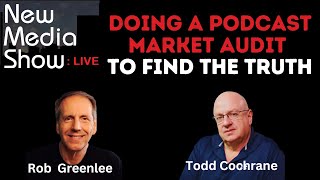
Todd Cochrane and Rob Greenlee examine the podcast industry's current state, warning creators against over-relying on Spotify after its funding pullback. They discuss listener habits like 1.5× speed playback, evaluate new analytics tools, and flag turmoil at Libsyn with staff departures and potential acquisition fallout. They also raise concerns about undisclosed AI-generated podcasts.
Chapters
Todd and Rob in the afternoon.
Hey, afternoon delight with Todd and Rob.
Oh yeah, well Rob, here we are. I, I am back in the re- Built Studio. How are you?
I'm doing all right, Todd. How are you?
I'm, I'm good in my, uh, well, those that cannot see behind or in front of me, my, my— I spent literally— I, I got everything done, kind of wired up Friday, and then I literally spent all day Saturday, all day and part of Sunday cleaning up, taking stuff I didn't need back to the storage units, sorting the assortment of— I've got big yellow tubs. Does anyone need a LAN cable?
You've got a bunch of extra stuff. I do too, so I get it.
I, I mean, I have big yellow tubs, LAN cables, SDI cables, uh, power cables. I mean, I probably get enough power cables to power half the country and just, you know, the little plugs that go into stuff. So yeah, we're, we're back. Studio's dialed in, I think 90% dialed in. Still has some dark spots, but I, I don't know, it looks exactly the same for those that have—
yeah, that's what I was going to comment on. Yeah, it doesn't look like you moved.
It doesn't look like I went anywhere, right?
So yeah.
So yeah, so it's— it is— there we go. The, you know, it doesn't look like a move. The only thing is the background's a little bit different, and the complaint I've had so far is it should have been uniform. But I'm like, no, that was the way it was designed, was to be, you know, polka-dotted.
Now it's like me, me, I've got black and gray panels. Yeah. Behind me on the wall, and it's, it's more for looks than it is anything else.
Yeah, originally this was the panel that was directly in front of me. So when I had a wall— and there's no wall here anymore— when I had a wall, it was, um, that was what was in front of me. Of course, then I've got a TV here, so the only thing that really is different is all the furniture is the same. A few different camera angles. Stuff is a little bit positioned, plus I'm about a foot further from the back, so there's about 12 more inches. So when I go to this view, that's much wider, you know, much, much wider, uh, of a view. And of course I turn the camera this way for this show, then I turn it back pointing towards the other monitors, but Yeah, so, um, be honest with you, uh, I was afraid that I was gonna have an issue with, uh, you know, hand reflex and everything else. But the first night I did the stream, there was only one channel up. The left channel was working, and I was scratching my head the whole show, and it just was a pan setting on the TriCaster. Your audio Sounds pretty good coming in. When we first connected, you said I'm blasting you, so you had to turn, turn me down. Um, so from that— but the only other, the only other risk is the bandwidth. And for those of you that want to know how that's being structured, we're streaming on Starlink. So the outbound is going on Starlink, and I watched the weather. The weather today looked good. So if the weather's bad, I'll flip it so that we stream on my point-to-point. You are coming in on the point-to-point. So I kept the stream separate. And so everything in the house is wired at a gig. Uh, of course, you know, I have nowhere near that connectivity, but speed test done before the show. But the only problem is going to be is when it's bad weather, then all bets are off. Yeah, yeah, it could go sideways.
So when you say point to point, how exactly does that work? Because I'm sure there's people that are— well, they have no idea what that is.
So there is a tower, uh, 30 feet outside this wall. The wall is about 15 feet from me. I'm in two— I'm in a 2,000-square-foot lot, and the, and the tower is 30 or 35 feet high. And at the top of that is an antenna that's pointing to another antenna 14 miles away. Oh, and that, um, that antenna plugs right into a modem. So it plugs right into my, uh, Ubiquiti device and it says, okay, I get an IP, blah, blah, blah. So, um, it's a PoE device. So it's power over Ethernet, powers the antenna, um, and then that basically touches another tower and that's how the communication goes, is wirelessly. Now in the summer, which we're in the middle of full greenery here, the connection will be worse because I'm shooting a little bit at some point probably through treetops. Oh, because it isn't exact, I can't see it. And if I took— if I stood on top of the tower and did my binoculars, and there's not a— but in the winter, the signal gets better because the greenery goes away, right?
Yeah, there's no leaves.
Yeah, there's not much leaves for— so right now, my speed— actually, my speed on that point-to-point connection through a company called DMCI is— was, when we tested today, was about 35 megs. Now, that's down. About 5 up, and it varies. And I'm sharing with all the neighbors that's on this. And then of course Starlink is, is usually good if there's no weather, but you know, there's no wired connection here. We're all using, you know, I'm on the edge of this. So, so we'll see how it goes. So those of you that tune in live, if you're watching live today And, uh, we're up lit and live. We're up on podcasting apps, uh, we are up on YouTube, Facebook, and everywhere else that we normally are. So if you're watching live and the stream gets weird, not my fault. Done the best I can. We will have a master recording unless Rob goes, you know, and freezes.
Well, It can certainly happen on my end too.
But you have a—
go ahead.
But you're wired. You have a much, much higher probability of staying online than I do.
But I have noticed— I'm on Xfinity cable connection, and I've noticed it's been a little not as reliable as what you would expect.
Now I have one trick left up my sleeve. So the Starlink can fall over to the connection you're on. So Starlink goes down, the way the thing is wired, it will fall over to the point-to-point.
The point-to-point—
if the point-to-point fails, there's no fall over yet. Now this is a long shot. My sister, she's got the same setup as I do. She has Starlink and she has point-to-point. Now she— the point-to-point I cannot be on. She's, um she's a county clerk, so she's only allowed to have one machine connected to that wired. She does election stuff, so that is— that network is off limits to me. I can't use that as a potential backup because that antenna is actually pointing to another tower. And I said, shit, if you would have— if you would have— if that was not restricted I would make that the fallback to the fallback, um, because I can do that the way I'm wired here now. But she has Starlink as well, so I said, well, if my Starlink goes down, your Starlink's going to go down because it's going to be the same, the same situation. So all told, $240 a month, uh, to maintain this connectivity. Now I was at the local fair and the company was there. I told the guy, I said, who do I have to bribe to bring fiber down my road? He said $70,000 a mile to bring fiber to my house. Now, do we have any benefactors to the New Media Show? Yeah, it's— if it gets to that point, we'll just quit anyway.
Yeah, I think that's a glimpse of the challenges of what's been termed for many years the rural broadband. Yeah, right. Is just the cost of doing it is astronomical. I know that the US government has created a multi-billion dollar budget to bring internet connectivity.
I know all about that.
I don't know that they've really ever done it.
So the government paid Frontier. Oh, did we, did we freeze? I can hear you, Rob. I can hear you. Yeah, I, I could hear you talking, but you weren't moving. Yeah, Frontier, Frontier was— I think— go ahead.
Yeah, I think it's safe to say that the dream of ubiquitous internet access, fast internet access, is not really—
no.
Come to fruition for whatever reason. It's usually money.
Yeah, so Frontier was given a big massive pot of money and they were told to expand. They have spent none of that in this area. Zero. None of that money the government allocated to expand rural broadband was spent by Frontier. Billions— I mean hundreds of millions of dollars, and they they've not spent a penny of it because it costs $70,000 a mile to bring fiber down.
So yet cost that much, it shouldn't cost that much.
Well, by the time you get permits and crossing roads and digging under trenches, I agree it shouldn't cost that much, but right-of-ways, I, you know, it is it. And here's the, here's the challenge is We spend all these billions of dollars sending money overseas, and yet I'm a mile and a half from a Spectrum connector. The last, the last plug is a mile and a half from me.
Yeah.
And I offered to pay to have that line brought down the road. At the time was only $12,000, which I thought it was a great deal. And they told me I have to get 50% of the people on the road to sign up for Spectrum for a commitment of 2 years before we would bring it down, even though I paid for the cable. I was like, you got to be kidding me. So anyway, welcome to the New Media Show, everyone. We're talking rural broadband, right?
It's an issue for still a lot of people out there that want to get access to online media. You know, I think we're in an era where, you know, the broadcast television and all that stuff is in decline and getting access to the internet is kind of your pathway to information and work and all sorts of— it's a critical component now, good or bad, depending on your opinion about it. But yeah, it's— and these kind of things impact podcasting too.
Yeah.
I mean, It's— people can't get online, they can't get to your content.
So again, those that have connections, you know, it's just kind of a given. You know, you get pissed off when your, your service goes out for a couple of hours. But 2 years ago, we couldn't have done this. This is why I had this— that's why I had the office in the other town, because when I first moved here, 15 megs up, 3 megs— no, 3 megs up, 15 down. That was it. It's all we had here. It's gonna work. Yeah, for 4 years. And then Starlink came. I got Starlink. And then just recently, as, as I was being evicted— I'm not really evicted, that's the wrong word— having my lease terminated, same thing, um, they upped the point-to-point speed. And it's just like, I better hang on, I better keep both these services. But as you just saw, you, you, you You know, so anyway, that could be on my side too. Yeah, who knows? And we're on Zoom. Yeah, it's hard to say. I would suspect it's the connection. Um, we'll see how we do over the whole show here. But hey, how about, uh, Patreon? Uh, how about Patreon telling, uh, all their, uh, creators, sorry, um, 30% Uh, you're gonna, you're gonna get, uh, all the money you're getting via someone that signed up for a Patreon via iOS is going to get 30— Apple's going to get 30% of your rev.
Yeah, I guess that's not an incentive to sign up through the iOS app.
So, you know, here, if, if Patreon had a set and had some fortitude and was strong, they would say, fine, cancel the app, and we will only do business via PWA and the web.
That's what people are going to wind up doing anyway now.
Well, you know, it's very, very hard, Rob, to tell someone that is doing stuff on their phone.
That's true.
If you have someone that is consuming all their content on their phone to go and say, you can't— we don't want you to do anything on the Patreon app, we don't want you to consume content on the Patreon app, we want you to come in and use a PWA, which most people, their eyes glaze over. It's— this is, you know, it is— this is— so think of you if you were a podcaster today and you have now— you're now taking a a 30% haircut.
Well, Todd, let's get really clear on what they're doing here because it, it kind of says two things here. It says, um, Apple will take 30% of all creator payments— creator, creator payments, right— on the iOS app. Apple is already taking 30% of all the creator payments, which is the payments made by the listener or the viewer, right? Through the app, right? So what this is, is Apple's gonna take 30% of all creator payments. So if you set up an account on Patreon through the iOS app, that, that payment that you make to Patreon is going to have a, have a deduction made before the money makes it to Patreon. So what's Patreon going to do? They're probably going to pass that cost on.
Well, what they're going to have to do is come to the website, cancel anything that you're doing through the app.
Yeah, but again Yeah, but if you're already signed up through the app, yeah, if you're already signed up through the app, then that means that Patreon's, yeah, costs just went up.
And it was a little bit of a gray area Patreon was working on. So Apple's getting its cake and eating it too, and double whammy.
Yeah, I'm surprised that Apple wasn't taking 30%. Well, that's why that's creator payments up to this point.
That's why it was operating in this gray area, right? Yeah. So, you know, build your— as I have learned firsthand, here we are, you know, here we are in the new— we're in the, you know, we're in my new space. Do not build your castle on rented land.
Yeah, the same, well, it's not the same topic, but there was some discussion on social media over the last couple days about, you know, the desire of many in the industry to get rid of the download again.
Again.
Right. And it's all It always revolves around primarily the same issue, and it's access to listener/user data, right?
Yeah.
It's the same thing that, that RAD tried to do through NPR is getting access to player data of sorts.
Right.
And somehow the, the industry would like to shift to this concept of, of monetization that's, um, engaged based on the attention that is obtained by the podcast, right? And what the engagement is of the audience as a metric, right? Versus using a download, which it seems like a lot of people are against really anything in regards to the download. Because they think it's, it's basically an empty box of data. There's just not enough data for what the expectations are. And my pushback to this whole discussion is to some degree is be careful what you wish for because this plays into the narrative of the large proprietary platforms.
That's right.
And there was some pushback on that too, saying, well, that's not necessarily the case because all the big platforms currently support RSS. But what we have seen over the years is a gradual erosion and growth of perception, whether it be at all the proprietary platforms of direct upload models starting to be deployed.
Yeah.
Right. And so, you know, if you have fewer listening platforms, right, then it's a more viable option for each of these platforms to enable direct upload strategies, especially these big platforms that have basically acquired or purchased podcast host platforms, right? That's part of a strategy to have a direct upload relationship with content providers.
So, right.
There's a danger here. And I was just calling it out and people were, you know, getting all spun up about this whole concept that, that, well, we need better data in order to, to get better CPMs and demand.
You know, it's, that's been the story for everything.
You know, it has been. This is not a new conversation.
Brand safety. Brand safety is going to help get higher CPMs. IB certification is going to help get better CPMs. Garm is— and we gotta, we gotta talk about Garm.
Oh yeah, well, I'm going to here.
I, you know, some stuff I want to pull up about it because there is a house of cards around Garm.
Well, it's already fallen.
Well, I know, but the whole— the fallen with two people. You know that.
And I'm sorry to say, but the damage has already been done with Garmin. So, you know, just because they— the World Federation of Advertisers decided to close up shop because the water was getting a little too hot on that topic doesn't mean that all the platforms that adopted Garmin are doing what they're doing.
That's right. Yeah. So let's go back to— okay, so we've kind of covered 2 or 3 things here. We've talked about Patreon. And the idiocy that's going on there. Yeah. And then this next topic, you know, it's just— I know, you know, someone— I can't say, I have to be careful. Back to Todd being careful. I made a comment in a Slack group and someone was asking, oh, Garmin's gone. And I said, I said, good effing riddance.
Yeah.
What? And you know, there's a reason why it was very easy for them to shut them down, right? And, and, and I said, riddance of the two people and the shell game that was being played. Hahaha. And then someone came back and said, oh, that's not going to change how we're going to do business. We're still not going to advertise on certain shows. And my response was, you should divulge that. You should say you, you, you, if you're using this, I said to the company, you should disclose if which shows and which episodes you have said are brand risk or whatever reason. You should disclose this to the community, to the podcaster, and, and let's, let's just lay the cards where they lay. Oh, that didn't go over. That went over like a fart in church.
Well, Todd, there's a much deeper story to this.
Oh, I know.
The whole Garmin thing was really kind of a face for the real platform that's behind this, and it's called It's called NewsGuard.
Yeah.
And so I— oh, I— you're gone, Todd.
I know, I put you for— I put you front screen.
Oh, you did?
Yeah.
So this is the, the actual company that's behind what, uh, Garmin was all about. This is the actual, actual company here. It's at newsguardtech.com. And as you can see on the front, it's all about tracking election misinformation and detecting misinformation. And so, you know, and then creating a reality ratings for news outlets, right? So this is essentially the same thing as what GARM was being being accused of, right?
Yeah.
Um, but this is the, this is the master platform for this whole initiative. That's why it was so easy for them to shut down GaRM, was because this is all, this is still going.
Yeah, well, you know, then Elon needs to sue them, or whoever the masterminds, you know, the group behind this. They, they, they should, you should go after them. Yeah, I just— it's this, the simple— I saw something on CNBC and it was on a YouTube channel and it was basically, um, you know, you either love or hate Elon Musk at this point, but he was basically asked by CNBC, you say some stuff on your channel that makes people not want to own Teslas anymore. And he, um, and, you know, and it makes people nervous about advertising. And he paused. I mean, he paused for like an uncomfortable 30 seconds and kind of looked away. He was doing a, a recall enough. And, and again, I, I, I don't know what—
that's, that's typical Elon though, you know.
And, and, and he basically come back and referenced a movie, and it was like, um, gosh, I wish I could quote it. It was so classic. Um, and then basically he was just basically saying, 'Paxan'— and I'm being nice, I'm using nice words. Um, I'm gonna say what I want to say because it's my right to say what I say. And stuff that's been deemed misinformation today has turned out to be real 3 months later, and he referenced the laptop, the Hunter laptop. We won't get into politics here, but that was one example, right? We have many, many more because of COVID and everything else. So you have all these people that think they know best. They think they are God. They think they're smarter than everyone, and they think that we as consumers of content at large don't know our ass from a hole in the ground and should be basically treated as children. So I, I'm at a point, yeah, that if you're working with— if you're a podcaster and you're working with a company and monetization is the name of your game and you say anything controversial, just like I did just a second ago, which would probably make this show brand unsafe. You need to consider who you're working with. Yeah, I don't do any third-party tracking. None. None. Zero. My partner that does host read ads doesn't either. Yeah. And guess what? It is the way it is. Um, I, I, at what point, at what point do everyone just, you know, I guess those that are eating from the, the advertising, you know, trough have to accept that, you know, these executives think they know best about your content and, uh, what brands would You know, I'd rather have content, some content be a little bit on the edge, a little spicy. And if an advertiser comes in there and advertises with that, that tells me that that brand really stands for something. And what does they stand for? Freedom of speech. And to me, that's pretty important, but I'm just Todd.
Yeah, Todd, I would say that there's not a lot of data or evidence that an advertiser advertising on a show that's considered to be brand unsafe has any significant reduction in ROI. So there isn't a lot of solid data behind this practice of using these tools. And if you go to the NewsGuard website, they do have an area on the website that specifically refers to podcasting. So So here, I'll— hey, Rob, bring that up.
Before you go there, I want to go back. We got an email. I got a text here on YouTube from Eileen. She says, hi Rob and Todd, this is a quote from the email I got from Patreon. And I knew this was the case, so we did— we failed to mention it. We want to really care about one thing. This will not impact your existing membership at all. Apple's App Store fee only applies to new membership purchased in iOS App Store beginning in November 2024.
Okay, well, that's good to hear.
So that's— it is good. But so this gives you from August 14th until November 1st to change your strategy on who you are talking to for new Patreons, uh, and people that renew that maybe their credit card went dead. But anyway, go ahead, Rob, on this podcast quote-unquote reliability ratings.
Yeah, so this is on that same website that I just pulled up a minute ago, and it just points out what I was just saying is that the whole Garmin discontinuation is just kind of like a front for this whole thing.
Yeah.
So this is actually the foundation of it. And I've, I discovered this on their website, you know, probably 6 or 8 months ago. And I wrote an article about this whole thing on my, my robgreenlee.com. Blog just to let people know about what's happening here. It's really— podcasters need to understand what's really going on here. It's being portrayed in the industry as this opportunity for people to, you know, get more advertising in their show because they've been evaluated and they're considered safe. But there is kind of a darker use side to this. And And I do think that there is a risk, and we may be seeing it happen and we just don't know it yet, but this same technology could be applied to the listening platforms as well. So not just to the advertising side of things.
Rob, hey, you should see the emails I get from the big S. You should see the emails I get. And we get the email says that this episode has been removed because of blah blah blah. And we go listen to the episode. Yeah. And I am astounded, right, by the number of episodes that get removed over there. And I'm like, this is not safe for your platform. And we, when we inform the podcast and say, hey, they, they have taken this episode down, or they have suppressed it in search, we tell them what they've told us. And nary a podcaster that is— and we get these weekly— nary a podcaster that we inform ever does anything. Why? Why don't they call them out? Why don't they scream? I'd scream bloody murder if our show showed up on a list. Now, I had our writers over at, uh, Podcaster News, um, I, I asked them to write an article on podcasting and RSS and the importance of RSS feeds. And the reason, the reason I ask this is because more and more we're getting people on the phone that are migrating to Blueberry from other hosting platforms, and we ask them, what is your RSS feed? And they go, what is that? I don't understand. I don't know what you're talking about. Or consultants that don't know what the RSS feed of a, of a podcast is. And this article says, in the evolving landscape of podcasting, one technology remains a constant linchpin: RSS. Despite its pivotal role, a growing number of podcasters and their teams lack a fundamental understanding of RSS and its significance. The knowledge gap presents risks that could impact the openness and accessibility of podcasting itself. Going back to what you said here a little while ago about these platforms wanting to go to streaming, want to abolish the download, that it's this ongoing suppression of information What? How, how can it be a podcaster that is creating content does not know, does not know his RSS feed does what it does today? It is, it is, this is, this is an existential threat to podcasting and is coming from people from Spotify. And a few other platforms that it's been going on for years now.
It's just been this kind of undercurrent in the industry. Yeah, that, that it just happens a little bit at a time and a little bit at a time, and, and people raise, you know, red flags like us, and it's like then people kind of crash on top of us and say, oh, that, that's, that's, that's old curmudgeon talk.
Well, they're not talking to podcasters every day like we are, right? This, this is not, this is not Todd just, oh, doom and gloom. This is, this is me looking in the rant channel on Blueberry's Slack channel and the team going, I got another one, doesn't know what, what their feed is.
And all these topics are somewhat related to each other.
Yeah.
Part, part of a larger move in the industry towards the domination by proprietary platforms.
That's right.
And that's what the fundamental struggle is of Podcasting 2.0 is fighting back against that.
Absolutely.
And giving this concept of innovation into the open standard.
And I'm just gonna call a spade a spade. Rob and Elsie over at The Feed and Rob Walsh's complete lack of even wanting to consider RSS to podcasting 2.0 and the benefits of that and poo-pooing it. It, you know, that is— it's— Lipson has made their bed and obviously they lost their CEO. He left. So there's absolute chaos over there. So this, this idea, this, this concept of we're not going to do any of that stuff because it's, it's, it's just for 5%. Well, you know, in the end, getting in bed with the devil, being a couple of these companies that are doing what they're doing, it could be, it could be the end of the industry.
Well, I guess, you know, and it's, it's not so much that they're, they're, they're the devil in some way.
I'm not saying that. Okay, I'm not referring to Libsyn, I'm referring to third parties.
No, no, but I, you know, I know that, uh, Libsyn has been very vocal over the years around its, its privacy positions. It's, it's—
well, not lately.
Well, I think those values still exist.
I mean, they do.
I've, I've talked to them and they do feel pretty strongly about it. But I do think that there is this tension in the industry that is coming in around these new concepts and it's being driven through the advertising side.
Yeah, yeah, yeah.
And, you know, but what a lot of people don't realize when they look at the big picture of these topics is that the advertising side is like 10% of the market, right? So as far as total numbers of podcasters, right?
Yeah.
And so you, you're kind of shaping the industry based on a small set of content creators that are trying to do whatever they can to cater to the advertiser. Yeah, right. And this is a little bit— this is the same kind of ideology that came out of broadcast radio. So, so in some ways, you know, like I used to work at PodcastOne, I admit it, for a year. And that was a company that had its roots in broadcast commercial syndicated radio. Right. And just about everything that we did at that company was focused on the advertiser, what the advertiser wanted. Right. At the end of the day, that company really caters to advertisers. That's who their customer is. The listener is the product, right? Not the customer.
Well, and that's the way it is at Spotify. The listener is the product.
And that's the ideology that's coming into podcasting increasingly. And if we see that fully develop like it did in broadcast radio, then podcasting is going to be just like broadcast radio, right?
Yeah.
Do we want that? Do we want over-commercialization? Do we want high ad loads. I don't think the industry really wants that. And I do think that there's a recognition that ad loads at 16 minutes an hour is just not a sustainable model for the podcast side of things. But I do think that these larger media companies would like to get back there again because it means that they've been able to recover their revenue that came out of the commercial radio side.
So this year, um, for the Podcast Awards, record number of shows didn't enter the RSS feed, uh, when they registered.
Yeah, so we're starting to see a shift away from RSS, and those out there that kind of shoot me down on that, yep, are, are kind of not really looking at the, uh, the kind of arc of this over the last 10 years.
Of the 300 entries, how many do you think didn't put their RSS feed when they registered that I had to go back and say, give me your RSS feed. And I forced them to get— I, I could have looked it up, but I forced them to send me an email with their RSS feed. How many do you think? There was over 100 that made the slate that didn't enter the RSS feed. And then I had some that said, I don't have an RSS feed.
And I'm like, well, they probably don't even know where to get it.
And, and then I went on, I went on, I said, well, you're on Apple Podcasts, so you have to have an RSS feed to be on Apple Podcasts. And I looked it up and I sent it over to him. Guess where everyone, everyone that didn't know they had an RSS feed, what platform do you think they were on?
Spotify.
Megaphone.
Oh well, that is Spotify.
Spotify.
Yeah.
So I'm not, I just see, I'm just seeing stuff.
I'm just And it is true also on, on a lot of the, the larger podcast hosting platforms, it's not easy to find your RSS feed URL in the interface.
And it doesn't help that some podcasting companies give you 10 RSS feeds, one for each destination, but we'll leave it at that. There's another juicy one over on Podcaster News: why podcasters should think twice before trusting Spotify. So it's a very enlightening read. I think people should go over there and read that. Um, take your time and go through that, make a comment on it, please.
Mm-hmm.
So, you know, all we can do here is fight fire with fire at this point. And, um, like Mike says in the chat, without RSS, free and open podcasting is dead.
Well, it becomes a a market of proprietary platforms, right?
Gatekeepers, right?
Like, uh, like, like YouTube.
Yeah, gatekeeper. Yeah.
And, and, but the, but the issue that was being discussed in this thread online was, um, having an aggregation of player data back to, let's say, a, a Blueberry or Epson or whatever. And, and I guess YouTube has been the only large proprietary platform that has enabled like an API shareback, but not everybody's adopted it or not everyone has got access.
Be careful what you wish for on that data.
Right. Well, I mean, it's not based on the same, you know, IAB v2.2 compliant data. It's based on YouTube's criteria. I'm not sure if they're compliant with the IAB. On the audio side. They may be, but I don't know offhand. I did see that PodScribe is now 2.2 compliant, which is— is it PodScribe? Is that owned by Spotify too?
I don't know. Yeah, we're going through our recertification right now.
Yeah. And on a kind of not a direct related topic, but I do know that we've talked about in prior episodes we've talked about revenue growth on the advertising side in podcasting and how, you know, we're constantly making projections about, yeah, you know, we're going to be at $4 billion and next year and all this stuff. And it's been 5 years that they've been saying that. Yeah, I do— I, I did see that iHeart, uh, put out their financial report, uh, Q2 2024, showing that podcast revenue— so This is a positive thing, I suppose, if you want to look at it that way. It was up 8.1% year over year, but its growth is slowing. So, this is another thing like we were talking about is that the projections and what has happened in the past, the growth is slowing. And so, but Bob Pittman said that, you know, and this is what every, every CEO says is that, well, next quarter we're going to be up double digits. Right. And that's exactly what these, these forecast reports are saying too, is 12% growth. Right. But it's actually coming in at 8%, which I guess given the market and the economy, 8% growth is, I guess, could be considered good news.
Well, Rob, I must apologize to those that have been living live and lit today. Um, on the audio stream, only you can hear me. For some reason, you can't hear Rob. It must be another pot turned down. Um, I can probably fix it, but I'm not going to jump up at this point and do it. So, okay, it's no wonder we're not getting any boost because they can't hear you.
Ah, yeah, okay, there you go.
I missed, I missed one, one setting. Damn it.
Well, I guess, uh, I guess you need to go watch this on one of the big large proprietary platforms like YouTube.
We'll go to newmediashow.com and, you know, you can do that too. Get, you know, we'll have audio and video again back on the, you know, on the show too. So, but, you know, I don't know, it's I don't want to be this doom and gloom guy.
I don't either. But these are the facts. These are what is actually happening. I mean, we can all put roses on the table and make it look good or whatever, or we can really be honest about this and really see what's happening. As an industry, we do have power to do things if we want to change here. So it's just, it's like a lot of things that are happening in our world right now. We have big choices ahead of us around the direction that we want to go with our country, our nation, our planet, our Earth, all sorts of stuff. And not everyone agrees on what that path forward is, but I think the big thing is, is that we all need to be able to share ideas and talk about this stuff. So we do make the right decisions here and not, you know, not get maybe bamboozled into something that we don't really want.
Well, we did get 1,776 asks from Martin. He says, hey Todd, I hear you, but not Rob, but maybe you haven't started yet. Liberty Booster 1776, Martin Leniskog. You know, if I'd have read this earlier, I'd have known that. So Martin, it's Todd's problem. He screwed it up. 1701 sats from Mike Dell. Welcome back to the studio. Garm, death is good. So anyway, um, yeah, that was kind of my— that was my big shoot the shot thing, this thinking about this past week. Um, What else is on your, your list, Rob? I know you have some other things.
Well, I think those were the big things. Um, oh yeah, yeah, I did want to talk about this audio audit that I saw pop up in the PodNews newsletter. Um, thank you, James Cridland, which I will be seeing him and you at Podcast Movement next week. So I'm excited to go back. So I don't— I continue my streak of being at every main podcast movement event since the very first.
Don't eat me, James Cridland.
Right, right. Exactly. But anyway, to kind of move forward with this audio audit company, it's basically— I don't know how new the company is, but it gives your podcast a score for audio quality. And shows how you can improve. Now, I guess it has a tool that, you know, it talks about all sorts of, um, of little aspects of your podcast. And I can actually pull it up.
And what's interesting is, um, we have— we are using Auphonic to, uh, master our media. So Curious here that they said that we were too loud considering we are using the podcast spec, -16 LUFS. Oh, okay.
Yeah, I was going to pull this up here, trying to see if—
let's see if you can find it.
Yeah, hang on here. Oh yeah, here it is. Okay, so I submitted the New Media Show to the platform and it's really easy to do that. All you do is just type in the name of the show on the screen of the website. It's called audioaudit.io. And so it'll basically pull in your most recent episode. I think on the free plan, I'm not on a paid plan, but this is what comes back. With your episode, and it basically has the sound in front of you that you can play, and there's little bars, vertical bars that mark various places in the audio that they've identified as possible issues. So this last episode with Chris Kramitzos got a 9 out of 17 for a 52% evaluation. And so who are they?
How do they know audio?
I don't know.
That's exactly the issue, right?
So they came back with these, uh, these warnings or pass. So it basically goes through a whole list of no one's factors.
No one's putting metadata in. No one's putting cover images again. Chapters, those are externally supported now. They don't know what the hell they're doing.
Yeah. And then I guess Todd, our bitrate passed.
Of course it did.
The number of channels, which I'm not exactly sure what that means. Is that mono versus stereo?
We're doing mono.
Right. And then sample rate passed, sample width passed. So that must be like a normalization score. That's what that might be. And then, uh, Loudness passed. Peak volume, there's a warning. And it looks like noise floor passed. Quiet channel passed. I'm not sure what quiet channel is. Silence at the beginning, warning.
Yeah, because there's none.
Yeah.
Right.
And silence at the end, we passed. So silence in the middle, we passed. Restarted sentences. I'm not sure if that's like a word, kind of saying a word over and over again or a sentence over. I'm not quite sure what that means. And then this was a big flag to me is profanity and swearing. So it has a content safety mechanism in here. And I guess we passed on it.
I guess we're not going to pass on this one.
Unwanted noises. There was a warning.
Well, here's the thing, and I just brought you back from full screen. Okay, the simple fact that they're saying you need metadata, you need chapters, you need images, means they don't have a clue on what's happening in modern podcast apps. Mm-hmm. Nary a clue. The image isn't picked up by anybody. That was something that left over from 2004. Putting metadata— the only thing that's in metadata in most audio files now is add insertion markers. No one's putting metadata in audio files no more with, uh, you know, episode number, title, and none of that stuff. The simple fact that they have those first 3 in there means that they don't know what they're— what, what they're doing. Yeah, they're using some old spec. And the other rest of the stuff, I don't know, but I, and I'm going to pay for this. Yeah, whatever. I can build one of these.
Yeah. And it doesn't, um, yeah, it does offer a breakdown description for each one of these things. If you click on it, I didn't actually click on it. Um, and it, it does appear to be incorrect because it is claiming that, that there is no cover image.
Yeah, there isn't. We don't have a cover image in our— no, we don't.
Well, but we do have episode cover art, but that's separate.
That's not put in the metadata of the audio file. That's in the RSS feed, right?
Okay, so they're, they're evaluating. It's not clear on this.
Yeah, they're— they want—
it does say, was it included in the audio file?
Yeah, that's stupid.
And there's no reason to do that.
No, not anymore.
So they're, they're, they're basing their whole service on incorrect—
yeah, absolutely. And they don't know podcasting.
Yeah, out of date tech.
You know, those first 3 things are out of date. And of course you can have Apple chapters in metadata if you so choose to do that.
Oh, it's saying that, uh, it's, it's wrong if your audio file is not in stereo, which I would say is incorrect.
Incorrect, right?
There's no reason why an audio podcast like this has to be in stereo.
No, we're not doing some soundscape or anything like that.
Yeah, I mean, it's not even stereo when it's recorded, so why would you put it out as stereo? It's just a waste of bandwidth.
Yeah, it is. I record in stereo, but I publish in, uh, publish in mono.
Yeah, it's, it's going to be mostly the same audio on both tracks.
Yeah, same thing. You're just wasting file size, right?
Totally. And it says here, okay, so 44.1 was detected. So, and then sample width is that— oh, okay, 16-bit. 16-bit. So I guess we passed on that. Loudness. Okay. So peak volume. So it came up here, said it detected a 0.57 dB at some point in the content. So, okay. Yeah. Okay. Noise floor pass. Okay. Silence at the beginning. Let's see what it says. 'Not enough silence was found at the beginning, at the start of the track, less than 0.5 seconds.' Oh great, people, we saved everyone 0.5 seconds of listening time. So whose judgment is this?
Whoever these guys— whoever's— what does it say about who's doing this? And they expect people to pay for this? Come on.
Yeah, yeah. I don't know that you have to be so— have a certain amount of silence at the beginning. I tend to put a little bit of silence at the beginning or a fade up at the beginning, but I don't think you have to have a lot of that.
Chop chop, I'm done, right?
Restarted sentences. We think we detected a section of speech that may have been restarted. So they're not sure. They suspect.
Suspect.
We think we detected.
Being that we didn't edit the audio, there's no overlap, right? It is what it is.
Unwanted noises. Okay, let's see what this is. It says it detected 6 unwanted noises in the audio.
Maybe it was Chris was outside, maybe the crickets or something that we were hearing.
Yeah, it lists an animal, two birds, and a throat clearing.
Probably.
And a zip. And some sort of a zip. So I don't know if we zipped up our shirt or something like that during the production.
Oh, well, that's funny.
Yeah. So, and then it also creates a transcript, which looks like is incorrect. So anyway.
Yeah. Okay.
It's a, it's a company in progress, I guess.
I'm sure they'll be at Podcast Movement and coming around and selling their wares. You know, you know, I have gotten— AI is going to be the thing at Podcast Movement. I've probably gotten 10 emails, and I'm, and I'm sending responses like, we're building our own AI, we're not doing any integrations, happy to talk to you about what you're doing. You want to come show me a demo? Great. Um, that's not going over well.
Yeah, I would imagine.
Yeah. How did you build your own AI? Um, not that complicated.
Okay, so I'm on their website.
Oh, don't— we're gonna give them more credit, Rob?
No, I'm just trying to see how, you know, who these folks are.
Oh, okay.
I guess they're based out of the UK. All right, well, I hate to dog on you folks, but yeah, well, there might be a benefit here if they can kind of get it more up to date with the standards in podcasting, right?
Yeah, I don't know where they got— I don't know where they got some of their information, that's for sure.
Yeah, so anyways, anything new going on with, uh, Blueberry?
You know, it, um, we're just busy, you know, busy, busy, busy, busy. Um, I, I'm in a stage of— I'm calling it nitpicking stuff. So going through and see something and not quite liking it and how it functions or what it does and just that kind of stuff. We're we're going through. Um, the team is, uh, busy building. We have a very major project that is underway. A recertification is underway. We're having to build some things to make sure we meet all the, the ballywickets that, uh, they want for recertification and just, you know, some normal stuff. And, uh So, you know, we're giving away our Thrive package this month so anyone that's a hosting customer with us can try all of our Thrive features. So the big challenge, you know, here's the thing: when you have a big customer base, they're just off doing their own thing. And even though you have an email that you send in a newsletter and everything else, people call us and say, how come you don't have this? And we're like, we do. And they're like, really? And you're like, yeah, well, just, you know, get on the screen share. And they're like, Oh, so, you know, it can be hard to, um, you know, it just— so we're working on educating the customers within the platform itself, a little pop-ups and notifications. And, and it's just when you got such a big thing, it's not surprising that people don't fully know what's going on within the platform. Mm-hmm. So what about you? You got anything going on? What's new with you?
Uh, just, just trying to, um, you know, get myself all pulled together and get myself ready to go to Podcast Movement. So yeah, so it's— I've been playing around with the, with the app. I don't know if you've been playing around with it much.
And which app?
The Podcast Movement.
Oh yeah, I've been getting, yeah, lots of requests. I wish I could talk to someone without accepting something. It's, it's hard to chat with people without accepting— excuse me, wanting to do a meeting or something. So that's the only thing that really is annoying with the app.
Todd, I also noticed Um, I don't know if this is not new, but it's— I guess it's new to me because I tried to do it, but I did notice that the Apple Podcast Connect website, uh, no longer works with Windows.
Huh. Oh, you must have— are you using Safari on Windows? Oh, um, I have no problem. It's just I use Chrome to get in.
That's, that's what I just did, and it comes back saying, um, this requires a device with iOS 17.
Huh.
Yeah, here, I can actually—
you need to send that to Ted.
I've been talking to Ted about a different topic, but, um, here, let me show it to you.
So you can't log into Podcast Connect?
Not off of a Windows 11 machine with Chrome. So it says right down here—
something weird.
So it says right down here, I can scroll in.
I see it. Wow, that's weird.
That's not good. Down here.
Yeah.
It says requires a device with iOS 17.
I've got a Windows machine sitting over here. I'm going to try it as soon as we get done. That's odd. Hey, Mike, if you're listening, we need to test that. That's weird. Of course, a lot of my team members are on Macs. Yeah, yeah, that's, that's, that's, that's a problem if it's saying that.
I had to access it. Yeah, I was trying to make a change to one of my podcasts that I have in Apple, and, and I, I was forced to go use my iPhone. Yeah, so if you're on Windows and using Android. I don't think you can work with Apple Podcast Connect anymore.
Mike says you can't log in with Mac and Chrome, so you have to use Safari.
On, on Windows?
Uh, no, on a Mac. You can't log in with Mac, having a Mac and using Chrome. That's this— that's bad news.
So they're basically making it a requirement that if you're a podcaster and you want to get your podcast into Apple Podcasts, this is— this is to be on—
this is unacceptable. That's unacceptable on an Apple device. Yeah. And the majority of the non-modern world is on a Windows machine.
Yeah. So I don't know if this is— this is just a mistake or That, that's bad.
That's really bad.
Yeah, so I'll ask Ted about it.
Yeah. Hmm. Randy's asking, what do you think the Rode— R-O-D-E— micro— I mean, uh, we're still seeing the screen, Rob. Um, what do you think that Rode will do with Mackie? Um, for the long haul. What do you think that Rode will do with Mackie? Did Rode buy Mackie?
Yeah.
Oh, I missed that.
It's been a while now. Um, my guess is they'll turn it into a— like it is a more professional line of mixers.
Uh, Mike said, correction, it just did work for me again, Chrome Mac. So he was able to log in with Chrome and Mac.
Um, you know, Windows is the question.
Yeah, the Windows is the question. So we need to try a Windows machine. Um, you know, I didn't know that Rode had bought Mackie. That's interesting because, you know, I've got a Mackie mixer over here with stuff that this thing can't do. It's got channel inserts. And the reason I have a— yeah, I have a Mackie mixer too that I probably should sell, but it's just, you know, in order to do this show with the way we're doing it, I'm using a channel insert and you're hearing me from a channel insert. On it. Now the RØDE, we were doing stuff with the RØDE too, being able to do the show this way as well. So just the way I'm wired here, um, is different. So I, I— there's always going to be a need for big mixers.
Um, yeah, I agree.
Big professional for studios and stuff like that. Yeah, definitely going to be a need.
That's what Mackie really excels at, is like the 12-channel, right? But, you know, wide, wide mixers. Yeah, most, most podcasters don't need that.
No, when I was taking— doing like going to CES and stuff like that, I, you know, we would have 8, 9, 10 channels wired in, uh, with 10 different inputs and lots of spaghetti mix out. And, you know, for a podcaster, you don't need that. The RODECaster is fine. Why do I have mine wired here the way it is? Because I have this equipment. I don't have to buy anything new. You know, that's the key here. Um, it's the, um— welcome, Beauty Bubble, for taking your seat and joining the show. Another angle is to follow is to be reminding the Friedman Group is parent company of RØDE. So I don't know much about the Friedman Group. Um, I'm assuming they're out of Australia. RØDE is out of Australia. Um, unless— I don't know if the Friedman Group is. So I, I don't— you know, Mackie's a major brand name. I wonder how much they spent to buy Mackie.
Well, they're, they're based up in Seattle.
That's where their Friedman is.
No, no, Mackie is.
Oh, Mackie. And Rhodes in Australia, I'm 99% sure.
Correct.
So, oh, that's interesting. So I, you know, I missed that bit of— it's been a while then, huh? So I bet I missed that part of the news, news cycle that that happened.
My guess is that they're going to take the RØDE technology and integrate it into more Mackie professional mixers, would be my guess.
So there was— I laughed on an article over at PodNews. It said, run your podcast ad too often and it won't work as well. That's according to the latest PodScribe Performance Benchmark Q2 2024.
Are you, are you surprised, Todd? I'm not.
Um, my tech show Geek New Central has been brought, uh, to you by GoDaddy for 1,700 episodes in a row for 19 years.
How many, um, ads for GoDaddy do you have in your podcast? That's the question.
One.
Okay, that's the answer.
That's not what they say here.
It's not?
Let me go back and find this here. I think I rolled off it. Run your podcast ad too often. What do they mean by too often?
Too frequently.
I mean, does that mean multiple? Is it about in the same episode or multiple episodes in a row?
Correct. Oh, in the same episode.
Of course it's not going to work well, right?
That's why I say it's not a revolutionary thought.
If you're running— if I run my GoDaddy ad twice, I would have a revolt. There would be— there might— my audience would fall off a cliff. They would, they would say Screw you, Todd. I don't want to hear— you already told us once. I didn't read that. I thought they were— this was an assumption on my part that it was.
Yeah.
Okay.
And also, here's the Mackie website. And I think what you'll see is a lot of similarities to—
Oh, yeah.
So I think if you look at the actual hardware devices that are catering to the live streaming market, like in podcasting market, they look a lot like a RODECaster Pro.
That's interesting.
Yeah.
By the way, Do you know what the ugly baby talk is, Rob?
Well, it's a common term to refer to starting out ugly, right?
Well, you know, anytime I get an email from a podcaster that says, uh, I'm, I'm a number— I'm a 5% rated Listen Notes podcast.
Oh, there you go.
And I'm like, oh, you gotta have the— gotta have the baby discussion, you know. Um, okay, let me do this. Don't eat me, James Cridland. Why are you reporting, James, on Listen Notes, saying that July saw the lowest number of new podcasts this year? You know, they're their data. I tell people, disregard anything that that company says about your show because everyone's a 5% show. Uh, he says technically the number of new— remember, refers to new feeds.
Many new podcasts been launched on defunct feeds for shows, especially if you're, uh If you happen to be putting out 2 episodes a week, you're probably in the 5% range, right?
Right. So, um, anyway, Pocket Cast is going to add the ability to rate podcasts to the next— on the next version. So, uh, there is— there's that. Oh my Gosh.
Yeah.
Um, it's just some of the stuff that's— it, it— you can tell there's not a lot of news because there's been a lot of digging for stuff.
Um, there's always—
there was a little tongue-in-cheek. Did you, did you review this Hollywood Reporter, the most powerful people in podcasting in 2024?
I saw this. Yeah, I saw this. Yeah, yeah, power, power, power.
The most powerful people.
And always these, these lists that come out. I think, um, the Inside Radio folks that's owned by iHeart actually puts out—
yeah, they put out one too, right?
Top 40 list or something.
I think, Rob, I think you and I should put out the most powerful— the New Media Show most powerful people in podcasting list.
Well, isn't that kind of, kind of what the Hall of Fame is, Todd? Yeah.
Yeah. Hey, by the way, um, this again, and I think it was really under— this should have been your headline, uh, uh, James, for this particular newsletter that came out.
Which one are you talking about?
I'm talking about the one that was released 2 days ago on August 12th. With how Spotify started and killed Latin America podcast boom.
Oh, I did see this.
Yeah, how they killed Latin America. Well, I think they should talk to RSS.com. I think RSS.com is doing very well in, in Mexico. And his last time, I— isn't that part of— is that Latin America or not? Uh, Rob froze.
Or is—
are you still here, Rob? Oh no, okay. Oh, you're just— you're looking very still. Is, is Mexico considered part of Latin America? I, I have to ask the Book of Knowledge.
I think so. I certainly could be wrong.
Yes, Mexico is considered part of Latin America. Latin America is a region, includes South America, Central America, Mexico, and the Caribbean Islands, where people speak Spanish or Portuguese. Mexico's the third largest country in Latin America. Okay, so I just want to make sure I wasn't being stupid here. So, um, RSS.com is doing very, very well in Mexico. Yeah, they have a conference down there, they've got a team down there. They're doing well. So Spotify has not killed podcasting in Latin America.
I don't even know what that means. I mean, killed it? Well, I don't have a podcast catalog in Latin America.
Is that what it said? The podcast boom came to Latin America when Spotify began commissioning hundreds of shows in 2019. Commissioning shows?
Oh, that— got it.
That wasn't a boom. Podcasting was in existence before 2019. The high-volume strategy had its critics but helped build an industry, and Spotify won as much as 90% of the market. Not true. Now that Spotify has frozen funding for new shows, podcast producers struggling to figure out what comes next. Get an—
do, do this to some degree in the US market too.
Well, they have done this in Asia too.
Yeah, so it's budget cutbacks, right? So it is.
Yeah, yeah, you know, I— it's everyone. Okay, I want to just be a sailor for a second. I, I really do. Podcasters need to wake the beep up and understand that Spotify is not the beating saver of beeping podcasting, right?
Right.
This is the— this is again going back to what we talked about, Rob, earlier. Yeah, they have nary a clue that there is an ecosystem, rich and vibrant, that is outside of beeping Spotify.
Right. Well, they, they do live in their own bubble, Todd. That is, that is a true statement. And a lot of companies do.
Over the last 2 years, Spotify's backed away from investing in podcasts. The company wound down contracts across Spanish-speaking Latin America. More than a year after its release, the award-winning Mesures Valentines is still looking for funding to make a second season. If your show is successful, you don't need funding. Go out and get an advertiser and have listener support like the rest of the world.
Right. Yeah.
Global fallout from Spotify's haphazard rush. And just like quit giving them so much credit.
Yeah. Yeah. Todd, did you see this other derivative topic that fell out of the most powerful people in podcasting in the Hollywood Reporter article?
Yeah, go ahead.
Where people named in that list, right, were polled about listening to podcasts at over 1.5 speed, right? So that's where you listen to a podcast at faster than normal playback speed, which would be 1, right? I guess Julia Louis-Dreyfus from Seinfeld fame and I guess a big podcaster now, doesn't know what 1.5x is.
Because she doesn't listen to podcasts. Right.
And Bill Simmons, who is a big, big sports podcaster for, I believe, in a deal with Spotify, says it's for sociopaths. It says, although 1.5x speed is too slow according to Ben Shapiro from The Daily Wire, who is definitely not a sociopath.
So you have Julia Louis-Dreyfus saying, I don't know what 1.5 is. Bill Simmons says it's for sociopaths. And Ben Shapiro, who obviously listens at 1.5 or more, is too slow. It's too slow. Now the way he speaks, I'm not surprised.
I know. Yeah, exactly. No machine gun. But I on the microphone.
But I will say this, you go— if you're listening at 1.5, you're hurting yourself. You, you are hurting your brain.
You're also a fan of, uh, Minnie Mouse.
You are making— now there is something, there is something to this.
Yeah, there is.
You, what you might— okay, this is Todd's opinion.
So I might save time in your life.
Well, I might fall along in the Bill Simmons category. If you listen too fast, you might have psychopathic challenges, right?
Or is listening too fast going to cause those psychopaths?
Well, no, we're not going to say you can cause sociopath.
I know it's, it's psychopath, which is a whole nother—
oh yeah, that's a whole different thing. But psychopath, I, I encourage you, if you feel stress or anxiety or anything like that in your life and you're listening to podcasts at 1.5, stop and go to 1. You're missing the pauses, you're missing the nuances of speech, you're missing the— and with some of these podcasters now editing so tight that they don't leave even a millisecond of air in their podcast because they're using AI tools to remove every millisecond of error, you're going to go insane.
So, right, in Todd's opinion, and jokingly, of course, I don't think that you could actually understand what Ben Shapiro says at 1.5.
I don't think so either, because, because it—
that's equivalent to probably going 3 times.
So, okay, so Calm. Listen to the show at speed. Enjoy life. I, right, I, I have you ask me, am I listening to a show at 1.5? I start feeling manic. I can't do it.
I would imagine your comprehension, for most people, would go down.
But that's my brain. Doesn't— maybe I'm just old. My brain doesn't operate good at high speed. I gotta think. Matter of fact, I listen to podcasts and sometimes I hit stop and I think, and then I go, I go backwards 90 seconds.
Yeah.
And I listen again. Now I do that— where do I stop and listen twice on more than two shows? The Marketing AI Show, I listen, sometimes I have to stop and beep beep beep back. And also the Podcasting 2.0 Show. Because maybe I'm driving and I didn't— I don't know, did I miss some nuance there? And beep beep beep back. So because there's stuff, there's stuff that we miss, um, that we have to think about.
So yeah, did you see this, this announcement that came out, uh, just a couple days ago on Pod News? As well. Um, the launch of the Bumper dashboard.
Yeah, so I guess this is another analytical tool, um, that say, you know, and the question is where are they getting their data?
I think they have a partnership with Spotify.
Well, okay.
Oh no, no, no.
No, Spotify combines data from a different source, allows Bumper clients to see numbers of verified listeners, total listen time. We have that at Blueberry already. We have your total listen time. Clients are listening for, for a segment of shows, not everything. They can't get all this.
Yeah, isn't this platform— wasn't it started by—
I don't know, I don't know who it started by. People think it all looks pretty, but I— how are they getting listener time without log data? They're not tied into getting, you know—
well, that, that goes back to the earlier, yeah, concerns, yeah, uh, around the, the whole getting player data, right? So there is no aggregator like we've talked about many years there's no like middleman aggregator of listener data, right, that these big platforms are willing to share.
Blueberry doesn't share. Well, how we do it is if, if you as a podcaster want your Blueberry stats somewhere else, we have an API that you have to authenticate your account username password with that third party to be able to pull data out of Blueberry to go to a third-party service. So we do have an API. We have a huge number of— and I think close to 300, uh, different companies and services that are connected to our API. But every account has to be authenticated to pull data out of Blueberry Stats, and they can't get everything. We do have an advanced API that is available for premium that gets them everything, but We don't let them have the whole enchilada for free.
Mm-hmm.
Let's go ahead.
New app, this new, um, the bumper dashboard, it does look like it's getting access to, to Apple, Spotify, and YouTube data.
And it— they must be scraping it then.
It's looking at, um, things like our retention. So this would be like audience.
Yeah, attention. If they're getting that through scraping Apple, you guys, maybe this is the reason why there's issues logging in. Maybe they're trying to stop these scrapers from scraping. Well, because that's the only way they're getting it is to scrape it. There's no API at Apple. To pull this data out unless there's something I don't know about.
Yeah, it looks like it's interesting that James did an analysis on his podcast based on the old OP3 version of his show, I guess, or something. I'm not quite exactly sure all the details here, but it does compare, uh, Apple, Spotify, and YouTube. And it does show that the path of retention for an audio podcast on YouTube basically falls off like a cliff. Yeah. Right at, right at the beginning. And it remains extremely low where the Apple and Spotify versions of the show maintain good audio listener retention.
According to Spotify.
Well, according to this chart.
Yeah. Who knows? But they're scraping. They have to be scraping from the web.
Well, if you think about it with YouTube, if this data is correct and this is tracking audio consumption, YouTube is a video platform.
Right. Right. Right.
So I think it would be simple to assume that if you're primarily consuming audio on YouTube, you're not going to have a lot of retention.
I wouldn't think so. Hey, so let's talk a little bit about this situation with Libson and Gibson leaving— or Gibbons leaving.
Oh yeah, John. Yeah, John Gibbons leaving.
Yeah, so they've been pretty crickets over there, and it's been a lot of, a lot of changes as of late over there.
The team is, from what I hear, is dramatically smaller than it was What I, I had—
again, I have no information to confirm this. I have not talked to Dave, didn't say anything when we talked to Dave. So, you know, I'm just, you know, scuttlebutt. For those of you don't know what scuttlebutt means is rumors. Rumors is they downsized a bunch of people because there was potentially an acquisition happening and they were trying to get cost down on labor to make the numbers look better, and the acquisition failed. That was a rumor that was in the spring.
Well, they did sell, uh, Pair Network.
So yeah, they sold Pair. And so if, if I remember correctly, John holds a lot of Libsyn stock.
I don't know that that's how much truth there is to that.
I don't know. I don't know. Of course, the stock— the stock right now is worth toilet paper.
Um, well, Brad, the former CEO, had a lot of stock.
Oh, maybe it's Brad. So, you know, it's interesting that he pulled the, the plug Um, well, also a lot of the two founders of AdvertiseCast have left the company now, so, so, um, you know, and so we know now, is this going to allow Lori to come back? Um, you know, uh, because my understanding, she didn't go voluntarily, so, well, yeah.
I don't know that we know that for sure. But I do know that there is significant restructuring going on over there. And I do know that a lot of the team that was aligned with Dave Hanley and Trevor, who were the two co-founders of AdvertiseCast, a lot of the team that they brought into the company with them with AdvertiseCast at Acquisition. A lot of those guys have left, so to start up their own advertising sales company, which I'm sure is going to be a big drain on the advertisers that are currently—
so Libsyn ads, with the chaos Libsyn's had with getting Libsyn 5 out and getting the pairing of features Yeah, feature parity. Feature parity. Um, yeah, what are they— they gonna put Rob in charge? Rob's going to be the new CEO?
Well, I don't know about that.
So, oh, it's an interesting— Rob has stock.
I would say right at this moment, Rob is probably the most senior person at the company. That says, says anything. I don't know. I mean, more, more specifically, I don't think—
I think Rob is on the other side of life. I don't think he's— I don't think he'd want to come in there and there would be— well, stranger things have happened.
Yeah, I did talk to Rob just in the last week.
Oh, okay.
But, you know, he's He's hunkering down. He's got a lot of work on his plate. I do know that. So, yeah, but I understand he's, he's fully, fully on board and moving forward with the company.
I'm sure, you know, he's, he, he has a reason to make, you know, we, I know Rob holds stock, so Rob has a vested interest in making sure the company succeeds, you know.
So yeah, I used to I have stock too, but I sold, I sold, I sold out.
You sold it before it went to, before it went to pink sheets?
Yeah. Well, I don't know about, I think it's always been somewhat in pink sheets, but yeah, I do think that the company is restructuring right now. And I do think that they're, they're maybe heading back to a structure that's more like what it was before the big activist takeover.
Well, I'm going to tell you, it actually— it's been—
put Brad into power.
It's been 10 years of craziness. If you think about the Chinese reverse acquisition, all that— well, that's insanity.
Completely.
I know, that's completely behind that. I know, but it's just one series of chaos.
Oh, I know.
It's surprising the company's been able to operate as it has. And, and I don't know how, if they're bleeding customers, you know, again, I don't know. I know what we see come over. What we see come over is mostly because of Podcasting 2.0.
Um, I'm not surprised.
That's the main reason people come back, come to us. But I'm sure they're losing to Megaphone and all these other entities. Either there's a, some, there's a chart somewhere that shows the, in the, the migration path of people. So that's publicly, and there's a link to that somewhere on James's site. So yeah, right. Um, you know, it's not like that's a secret, but yeah, the truth is those numbers are generally pretty small. Uh, yeah, they're small. They're not— it's not like we get 100. I wish, you know, onesies, twosies. Yeah, but it—
but the last time I saw that chart, I'm not sure where it is right now to click on, but yeah, I don't know either. I can probably look on the website.
We're already 90 minutes here, Rob. So we are. Yeah, we made it.
Um, so, but that chart does a good job of kind of showing where people are moving to, and it does look like there's a lot of traffic moving over to Spotify for Podcasters.
Yeah. Well, one thing for sure, ladies and gentlemen, we're going to podcast. Podcast Movement next week, and, uh, I am sure there's going to be a few beers at the bar, and I am sure there will be some off-the-record conversations that Rob and I will not be able to share when we come back. Um, but if you want to be a fly on the wall and you're going to be at Podcast Movement, the best place to hear the scuttlebutt of what's going on is at the bar or outside of session rooms or one-on-ones with people. So, uh, you want to learn the rumors, the— what, you know, what is the magazine that is a National Enquirer? If you want to know the National Enquirer news of podcasting, um, my camera's a little off focus. I can see it across— I mean, not completely square. I can see it across the top of my head. Yeah, look sideways. Another thing I gotta fix. Okay, okay, um, all right, well, we're back, back here in the studio, back, back to normal on Zoom.
So we're not doing it on StreamYard.
Yeah, and I do have some lower thirds, but I am going to improve those so that we all have lower thirds So I'll get those mocked up. Um, but yeah, I don't have to— I have— it's amazing. I'm not putting any miles on my car, Rob. It just sits in the garage. I have my food delivered. I have no reason to leave the compound here.
So I mean, unless you want to go to the grocery store or— yeah, do something.
But I am—
I suppose you can order that, have it delivered if you want.
Yeah, I can. But I am getting ready to have construction done. We're going to put up, uh I'm adding security. Um, let's put this way, uh, uh, we got to be able to make sure that the loft and the studio is just one level more higher in security here. So, you know, I had pretty heavy security at the last place, and I need— I want the same level of security. There's security here with a big German Shepherd that will bite you. Um, and, um, let's put this way, this is the country in America, so It's not a good idea to open anyone's door, um, because you might be met by a shotgun if you do.
Um, okay, boom.
Well, you know, that's, that's— you can do that in the country because, you know, people— the only time people open the door is either the fire department come to put a fire out or the police responding to a shooting or A burglar.
Oh, quick, quick, Todd. I saw that there was a podcast that was listed in, in Pod News called Sleepy that, uh, is, is a podcast that's entirely generated by AI.
Plenty of those out there. I know 4 or 5.
Oh, you do?
Yeah. Not— and, and they're voice spoken in the voice of the podcaster.
Yeah.
And they are completely AI, and, uh, people don't know, and it's not disclosed. I think it's wrong. I think it should be— I think it should be disclosed completely. Okay, I'm Todd at blueberry.com, geeknews@gmail.com, @geeknews on X, @geeknews at geeknews.chat on Mastodon. Of course, don't forget about the New Media Show, newmediashow.com. Come over to there and follow via your favorite podcasting app. We'll get the live audio fix for next week. I'm sure it's just one knob that needs to be turned on a channel output. Uh, we'll get that going so you guys can hear Rob on the live audio stream. Rob?
Yeah, I can be found on X as well, um, x.com/robgreenlee. And you can send me an email if you want, robgreenlee@gmail.com will come to me as well. And I can be found on all of the social media platforms as well under my name. And if you want to go to my YouTube channel, that's at Rob Greenlee as well. So if you're going to Podcast Movement, I would be interested in meeting up with you or maybe catching up somewhere or something like that. I'm not gonna be affiliated with any particular booth, so I'm gonna be an entire free agent for the first time at Podcast Movement.
Rob might need a job, so anybody's hiring, hook him up there at Podcast Movement. All right. Let's see, which podcast hosting company haven't you worked for? Buzzsprout, you haven't worked for them yet. So I haven't worked for Buzzsprout.
No, I haven't, or any, any Spotify-related hosting platform or SiriusXM.
Rob, if you go to work for Megaphone, we're— this show's done.
Okay, fair enough.
Yeah, don't, don't go work for the enemy, right?
Okay.
And really, you know, that's unfair to the Megaphone folks, but you know You're all owned by Spotify, so, you know, you just get included because of such.
But Todd, they're the number one podcast. Yeah, whatever.
Yeah, yeah, whatever.
Former honor that was—
that's supposed to be YouTube now, Rob.
Well, well, and it's formerly known as iHeart, right?
You know, I, I think I said YouTube for the first time the whole show. We made it almost to the end. Okay, um, everyone, thanks for being here. And we will not see us next week, uh, so the following week we'll be back here.
Um, and we're not doing it on, on stage live, uh, media show at Podcast Movement either.
No, we don't. We, we've been, we've been, uh, uh, how should we say, we're not there. We didn't even ask any. We didn't even ask.
I, I don't think there's any, uh, live performances of podcasts at Podcast Movement this year.
I don't think so either. Okay, we'll see everybody in 2 weeks. Take care.
Thanks.
All right.
More from Rob

Future-proofing with Delphi AI/Human clones: your podcast as a personal LLM | New Media Show






How sports reveal what AI spectacle gets wrong #Technology #Sports #Commentary



