The Untold Journey of Modern Podcasting Legends
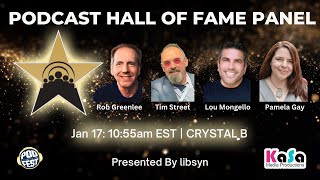
In this 2025 panel, moderator Rob Greenlee convenes three Podcast Hall of Fame inductees—Pamela Gay (Astronomy Cast), Tim Street (Authentic/PodTrak), and Lou Mongiello (WDW Disney podcast)—to recount their personal journeys and reflect on two decades of podcasting. The conversation begins with each guest describing how they first discovered the medium, from an airplane‑flight idea that sparked Slacker Astronomy to early video‑podcast experiments and a lawyer‑turned‑podcaster’s Disney‑focused show. They discuss technical hurdles such as the high cost of video bandwidth, the transition from audio‑only to live video streams, and the evolution of monetization models from one‑off sponsor deals to sustainable revenue streams. The panel explores how live audio, live video, and community interaction reshaped the creator‑listener relationship, and how AI tools (large language models, synthetic voice generators, automated editing) are now both an opportunity and a threat to creative authenticity. Each panelist shares how podcasting transformed their careers and personal lives, culminating in reflections on their recent Hall of Fame inductions as validation of their impact on the broader podcasting community. The discussion closes with forward‑looking predictions: a resurgence of long‑form, intimate content, the continued relevance of audio amid video growth, and the need to balance AI assistance with human connection.
Chapters
Hey, anya?
Well, I'm Seattle before all else. The podcast Hall of Fame and the journey of making it all right. So moderating the panel today is going to be Rob Greenlee, the chairperson for the High Camp Hall of Fame, alongside some inductees. We have Lou Mangella and the other, uh, the other lady, and we have Tana Streit. Trust me, you're not going to learn from the better topic people. All the details, the real reality of what goes into making something like this happen. Podcasting has evolved, what they've learned, and what Rob Greenlee is here to do. What are we making? Head edit? Inventing the sentence? Up in the air? I'm gonna be interested to hear what everyone wants to say. So can we welcome our guest, Rob Greenlee, to the Lotteries and Sable conversation?
Well, thank you for being here. I appreciate it. Are the mics turned on and we're all good? Thank you for being here. I appreciate it. And the, the, the reason for this panel is to, is to get some Hall of Famers to, to talk about their journey a little bit in their podcasting adventures. I mean, everybody on the stage here is, has been involved in podcasting in the origins from the very early years, going back, I guess for, for some of us, 20 years and others, you know, shorter than that, but. Not significantly shorter than that. So, so what we wanted to talk about today was the evolution of podcasting and the perspectives from people that have traveled that, that long journey. Like, like myself, I started podcasting 20 years ago myself and, and it's been an exciting journey. And also, you know, the medium has evolved a lot. It's changed.. But in some ways, and I think some of the folks on the stage will probably agree with me, that the fundamentals really haven't changed that much. But, but I wanted to just, just, you know, reintroduce. So Pamela Gay here is a longtime podcaster. She's the host of the Astronomy Cast podcast. So she's a scientist and she brings a lot of expertise about science, faith, and she's a 2018 Hall of Fame inductee. And then Tim Street is a VP at a company called Authentic, or it's a Podtrack company and it's been involved in podcasting since the very early days and was the creator of an inspirational, fun kind of series, French Made TV, back in the era when video podcasting was a really big thing. And I know we're all talking about video today and what's happening with that. But most people don't realize that when the very, the very beginning of podcasting had a significant span of a few years when video podcasting was a thing. Now, granted, YouTube is using that term podcast, but when we talk about video podcasting, we're typically talking about video that's distributed like you currently make available your audio content. So it's in an RSS feed and it's an attachment to that. And that's what Tim did in the early years of VideoPockets. So I hope that he can share a little bit of insight on that. And then Lou Mongiello is the host of the Disney podcast, WDW.
WDW.
And he is getting inducted to the Hall of Fame tonight. So guys, welcome to the previously Debs Talk. So let's, let's go ahead and get, get started here and just talk about if each of you can kind of, kind of reflect on the, the early days of podcasting and what really kind of, kind of inspired you to get started as a podcaster.
All right. So I, I've been nominated. I, I started podcasting back in 2005, and I love that here that is not one of the oldest. Yeah. There are other people who predate me, and I love it. And it all came about from an airplane trip. There was a whole group of us traveling from Boston out to California for an American Astronomical Society meeting. And one of my colleagues had picked up Parade magazine. And he comes up to me when we all get from our separate flights to the conference, and he's like, okay, so on the flight, I read about this guy, Father So-and-so, and he's using this new thing called podcasting to talk about Christianity, and we need to use it to talk science. I was like, okay, whatever, I'm game. And we launched like 3 weeks later. It was he and I and one of our friends who had an undergraduate degree in radio, film, and television that he had never used and was very happy to use. And that was Slacker Astronomy. And we reached out to Adam Curry and we're like, there's no science or technology category. Can you help us out? And not only did he create the category, but he listened to our show and then geeked out about it. And that completely changed the trajectory of my life. I, I was like random academic running teaching labs at a Boston university, not Boston University, a university in Boston. And I was just the person who ran the telescopes and kept the things going. And suddenly I'm on the internet and people want to know me and they want to learn from me. And I'm like, wait, people actually want to learn science? I can science you. I shall science you. Come, we shall science. Science. And a year later, we all got better jobs that were like, no, no, no, Slacker Astronomy is a little too blue for your new job. Please do something different. And this is where we started doing Astronomy Cast, Fraser Cain and I. And we've been doing this since Labor Day weekend, 2006. A new show every week talking about the latest ideas and how we learn them about this universe we share. As long as we keep building new telescopes and new creative minds keep coming out, there's going to be more information. And it's— podcasting has accidentally defined my life in ways I'm super grateful for and now seek out through opportunities like this. So science with me, please.
The first podcast that I ever came across was a podcast called Tiki Bar TV. It was a video, video podcast, early days of podcasting. And I was like, wow, I want to partner with these guys. I can get them sponsors. This is going to be great. It didn't work out. The creator, Jeff McPherson, super talented guy. We, we couldn't come to a deal. But what happened, I, I did what any normal frustrated person would do when you're having trouble is I, I went to a podcast convention. In Ontario, California. Shout out to the Berkman Brothers. And there I heard a guy named Leo Laporte talk about this company called PodTrak and how they brought him his first sponsor in podcasting. And lo and behold, I started a podcast and PodTrak brought me my first sponsor, which was GoDaddy. And the podcast that I had was kind of a silly Benny Hill, Austin Powers kind of podcast, PG-13. Where women dressed as French maids would do how-tos. And for GoDaddy, we did how to register a domain. So it was very silly, over-the-top, kind of fun stuff. And eventually that led me down the path of working with PodTrak and being head of production and development for Authentic, which is a PodTrak company.
So, you know, as a Disney guy, I don't know if I should say that I did watch French Maid TV because I loved him or say that I didn't watch French Maid TV 'Cause I'm the Disney guy, but I did. And, you know, I knew about Tim before I actually met him, became friends with Tim. Yeah, in 2005, I was a lawyer in New Jersey, heard about this podcast thing that was just starting to come out, literally just a few weeks earlier. And I was always a tech guy, and a buddy of mine started a podcast, which had the worst name ever. We called it MouseTunes, which makes no sense, but it was iTunes back then. And we didn't know what we're doing. I still don't know what I'm doing, but at least I fake it. It's a lot of smoke and mirrors. Eventually I went off and started my own show and they called it WW Radio. And it was so early on that I had to put the word radio in the title so that people understood what it was that I was doing, because it took years before we had to stop answering the— we still don't have to end the question. Like what I think actually now we are asking ourselves, what is a podcast? Because YouTube videos are now podcasts, which is incredibly confusing, but I just always believed that the spoken word was so much more powerful than anything I can write. The ability to convey emotion. They hear you when you're happy. They hear you when you're sad, crying. It's podcast gold. Plus, I was a horrible typist, so it all worked out.
Yeah, I had the name Radio in my first podcast too, just because I was on the radio. But it also was a way to reach people in the early days of trying to translate what a podcast was, right? And we were always trying to say, well, you know, people would ask us, well, what's a podcast? And we'd say, well, it's kind of like an online radio show, right? That was always what we had to do to try and translate that. Now, now we don't really have to do that anymore. I think everybody knows the difference now, but, but it's interesting that we all went through that, that phase. And that conference that Tim just talked about was back in 2005. And so that was like right after podcasting started. But, but so as you guys kind of, you know, thought about your, your journeys of getting your show started, and hopefully this will be helpful to others, but what were some of the biggest challenges that you had to overcome as part of that process? Not so much in the early days, but just as it, whether it was mentally or if it was kind of understanding what you were doing with your podcast, what, what were the biggest challenges?
This is gonna sound so stupid. But as someone who, who plays with technology, who does new media, who does social media, I would be talking to other academics and they'd be like, oh, all of that technology stuff, that's for all you kids. And I'm like, dude, I am significantly older than you are. I just know how to dye my hair. And, and so there was this level of credibility that somehow as soon as people, they're like, oh, you're just playing on the internet. And I'm like, all right, so, so you are doing public outreach that you're super proud of reaching maybe 20 people at the local pub, which is awesome.
Kudos.
I love beer too, but I don't have to leave my house and I reach 20,000 people on a bad week. Let's talk. And trying to convince people that this thing on the internet was, was actually capable of doing real education, building real connections, building real community. And you don't have to interact face to face to have meaning. And no, you don't have to be a baby to play on the internet. Old people do it too. Proud of being Gen X. It's just been weird, the cultural dynamics of who is supposed to be on the internet and who we actually are and explaining that. It's stupid, but that's my struggle.
Yeah. Yeah. I think for me, the challenge that I had early on was figuring out a business model that was sustainable. I mean, I had a show that was getting 7 million downloads an episode and couldn't figure out how to monetize it. This was before YouTube was doing any kind of revenue share. And so, you know, we, what, what I would do is I would do an episode for a specific sponsor. And once they did that episode, they would pay a lot of money for it, but then they'd go away and they'd never come back. So the business model wasn't right. And I didn't realize at the time that if I could just figure out a way to make the show consistently on a regular basis, that eventually there would be a revenue stream that would show up and support the show. And in the meantime, I wound up getting a job helping other people monetize their shows. So it was kind of like, well, this is, this is fun too, is, you know, it's fun to be the guy who's, who's handing out the advertising deals as opposed to the guy begging for the advertising deals. So that kind of changed things for me. But podcasting definitely changed my life. I mean, I didn't give up my law license, but it did change— it changed me from being a TV producer into being a development executive.
I think actually all of us, I think we were very fortunate for getting in on the ground level because it was this brand new, this novel thing. And for me, it was creating content around Disney. Again, the words social and media had not been put together yet. And I had a discussion with— I had a V Bulletin discussion forum, shout out to the Bulletin, which is where I sort of came to the realization that I was not the only Disney nerd sitting in his basement thinking about Disney that was somewhat adult-ish, as it were. I realized over time that the challenge was going to be, and still continues to be, the realization that not everybody consumes content in the audio format. It's just not the way that they— so I always was like, well, in addition to this, I need to create content in the way that people are most comfortable consuming it. But the podcast is— the podcast and the community has always continued to be the heart and soul of what I do.
Yeah. So I think that kind of leads into another kind of thought path here that we can go down here. And that's how has podcasting evolved and changed? And Lou, I think you alluded to, and Tim, you're a representation of this too, is the evolution of the format of the medium. As well as incorporating video and how we went through this phase of audio-only emphasis. And when all along YouTube and video were like a shadow companion to this medium for the entire span, the 20 years of this medium, it was just that most creators started to really focus on audio. And so why don't you share that kind of perspective from the early years as we kind of have moved through to present and contrast that a little bit.
So, so I, when I started this, I had a cartoon avatar and I was like, my photo shall be associated with nothing. I was a cartoon avatar. It was my voice. And, and that was where I felt safe. And occasionally things like, I was, Harvard was the university in Boston where I was at. And I was there when Zuckerberg started Facebook. So I have like a 4-digit Facebook ID. And so I made the mistake many of us made of all of my fans can be my friends on Facebook.
Don't do that.
And so it was like, okay, so those people are allowed to know what I look like. But I still want to have some privacy. And then one day my co-host, I love him dearly, says, let's start doing video. And that was scary. And so this evolution of voice is podcasting to, well, now we have a social media component through MySpace and Facebook and then Twitter to now we have There was that weird augmented podcast thing that I'm so glad that didn't catch on where you could put picture bookmarks in and it took way longer to do that than it ever took to do audio only or video only. I'm so glad that didn't work. Then we went to, let's do Google Hangouts and Google Hangouts changed. It was the next big evolution for us. I'm just gonna keep using that word. Where we went from just the two of us talking on Slack, not Slack, on Skype, getting no feedback from the audience, putting things out and getting emails, to now the audience is in the room with us and they're asking questions. And when you do a science show, you don't always know if you're answering the questions people have or just talking about stuff that interests you and no one else cares about. When they're in the room, they can be like, wait, did you just say, can you, can you expand on that? And so now we have this, we're recording live. Now we're on Twitch and YouTube Live, which was Google Hangouts. And, and so seeing this record live, produce edited content, put out edited content, and realizing there are people who want sausage. There are people who only want perfectly polished. And being able to seamlessly produce both has really been amazing. The one thing I want is lighting that works out of the box. If that can come, that, that's all I ask for now. Yeah.
I think, you know, the early days, bandwidth for video costs a lot of money. We would've gotten a bill about $4,000 a month for the video. But a guy named Tim Napoleon at Akamai gave us bandwidth for free. And then we also had a sponsor, M-Dialog. Greg Philpott said we were doing 7 terabytes per episode of video downloads, and we all thought Apple was going to be the place that, that video podcasting was going to take off. And for a while it was. But that bandwidth charge really killed it. And when YouTube came out, all the video people went to YouTube, and us included. And so that was a big change. And, you know, one of those challenges that we had early on.
Yeah, so my journey to video, much like yours, was a little bit different and circuitous, right? So I was podcasting for a couple of years. I hear about and learn about this new technology. And I literally remember like the night that I tried it, I finished dinner, I told my wife, I said, listen, my office was downstairs in the basement. I said, I'm gonna go downstairs, I wanna try this other, try something out. I'll be up in like 10 minutes. 4 hours later, she comes downstairs. She goes, what the hell are you doing? So I'm like, who are you talking to? Like, I could hear you through the air conditioning ducts. Who's down here with you? I'm like, I don't know. Like, I'm doing this thing and I'm talking into the box and there's people there. She's like, what are you talking about? Like, I have no idea. Like, let's talk about that. Wait, the conversation stopped being about Disney very quickly and just talking like with the community because we as podcasters, content creators, we put out content and then what happens? We sit there and we wait. Sometimes you pray, like, is anybody listening? Like, is anybody out there? Because if you don't get that feedback and you don't get that response, you don't know. And I was instantly drawn to live video. Like, I love it still to this day. I still haven't done a live video, you know, every year, every week since then. There's this incredible energy that it brings because I get that immediate feedback, that one-on-one connection, the conversation that you get to have with your audience. Plus I love live video because I don't have to edit. I don't have to do retakes. And I think like podcasting, which I think is the most personal, the most intimate medium because you are so closely connected to somebody. I think live video authenticity has become a marketing buzzword like many other things. I think it's most like true, authentic way for your audience to see you and you see them. And I think it's a perfect complement to podcasting.
Yeah, I started on live radio and, and I still have passion for live and I've been doing a lot more live video now. So that was live audio, but that has been a transition for me too. And, and I do— I, I worked in podcasting all the way back to the time, you know, prior to video taking off. But, but it was really a phenomenal time in the early years of podcasting. There were whole media companies being built around video podcasting, and a lot— many of those were purchased by, surprisingly enough, cable networks that, that wanted to incorporate kind of this new way of producing content and kind of a a younger kind of way of doing this. And so it's been an interesting journey to see it kind of fade away and then kind of come back when YouTube finally decided that they were going to wake up and, and join the podcasting space and change the landscape. And I think that they, they have, to the chagrin of lots of people in the podcasting space that have built their models mostly around audio. And I think audio is, is still really key in podcasting. I mean, if you look at the overall consumption of audio, it's still huge, it's still growing. So our conversation about video isn't to take away from audio. I think what I'm increasingly moving towards is seeing the reemergence of video into the podcasting space. But yeah, let's, let's kind of just, you know, If each one of you can identify kind of like the most significant thing from your, your journey and the impact on your life. And I think this isn't talked about a lot, but the transformation that happens in each one of you in this journey.
So, so for me, and here having listened to the storytelling segment before this one, to, to tell part of my personal story. Back in 2008, I, I had been at a small university for a couple of years. It wasn't going great. I was the only woman in the department. One of the tenured faculty liked to say, oh, we don't give tenure to tits. In those words, it was great. And I was sitting at my desk one day basically doing the what am I even doing with my life? And I got a phone call from Doug Isbell, who is one of the leaders in astronomy public communications. He's a press officer now at JPL. And he's like, we're looking to do an International Year of Astronomy in 2009, and we need someone to create a new media presence for the world. I was like, what? Okay. And I got asked to chair the International Task Force for a UN-designated International Year to celebrate astronomy. And I got to come up with a committee. I got to come up with what we were going to do. I got to reach out to people across new media and travel the entire planet, all of it. Except for Antarctica, haven't been there yet. And it was all because of podcasting. And, and up until right before the pandemic, this, this momentum kept going where it was, how do we find each other? How do we link together all these voices across the planet? We started a show back in 2009 called 365 Days of Astronomy, which exists to bring together, aggregate the voices of astronomy. So a whole lot of The Astronomy Podcast started as part of 365 and then spun off to do amazing things outside of what they started with us. And we're still going with that show. And we're still helping new voices in podcasting from around the planet get going. And so while I'm super proud of what we do with Astronomy Cast week after week, it's all the voices that now exist communicating science in all these nations. There's, there's Cosmic Savannah, which is a South African group talking about the up-and-coming nation that is building the biggest telescopes in the world that no one knows about right now. And they're giving voice to that. And so that one phone call while I was undergoing existential crisis and facing grading kept me in astronomy, kept me doing what I was doing, and opened the world to me. And I don't have the 7 million downloads an episode, but I have the universe, and I get to share that. And it's it's been amazing. One phone call can change your life.
Yeah. The interesting thing about podcasting is that the door is still open, you know, to borrow from a friend of mine, Chris Hanson, who does Investing from the Beach podcast. Gay, straight, Black, white, male, female, it doesn't matter. There's nobody stopping you from starting a podcast. There's nobody stopping you from monetizing that podcast. The door is still open. You can go do the thing you always wanted to do. You can build that audience. You can go engage people. There are folks out there, there's folks sitting in this room right now that build businesses and sell them. Megan Powers is here. She does marketing in podcasting. Sonny Gault sold a podcasting network. There's just amazing things that you're allowed to do and nobody can tell you, nobody can stop you. You just have to be smart about. You know, early days of podcasting, there was a podcast called Wall Street about stock market that sold for $5 million to CBS. Those kinds of deals have gotten much bigger, but there's still opportunity and there's still time for you to get out there and go do that thing and make it happen while the door's still open.
In lieu of talking for the next 3 hours about how podcasting has changed my life, because it has in incredibly wild, unforeseen ways when we first started way back when. I choose instead to focus on, because we all have it, the ability, I think responsibility, to impact the lives of others. I say this all the time, we never know who's listening on the other side, and that's not the warning. It is more of a, it's a privilege to do what we do. And people are giving you the most valuable commodity, which is their time. And whether you talk about, as some of my, when I first started, my friends were like, at the time, they're like, wait a minute, you mean to tell me you're going to sit in your room for an hour or so by yourself and talk about Mickey Mouse and hope that people finally listen? I'm like, yeah, man, isn't that awesome? They're like, they give you 6 months. I'm not friends with those morons anymore, but Um, there are people who are giving you the most valuable commodity, which is their time. And you never know how what you do is going to positively impact them. So for me, it's not about what is podcasting been able to do for me. The gift is getting to hear what your show, what your voice, what your, you know, what you're putting out there is able to do and how you might be able to positively impact others.
Yeah, that's great. Yeah, so let's talk a little bit about what we maybe can see about the future of this medium. You know, all of us have lived through the past, and I know, you know, spending time in the past is helpful to a degree, but I think it's more helpful, I guess, for new creators and people that are involved in podcasting today to kind of have a better perspective on where things are going. So if each one of you could kind of share what you kind of envision based on the evolution, and I think that's a key word here, is that this medium has evolved over time. Some things haven't changed much, but other things have dramatically changed. So what, you know, go ahead and start here, Pam.
So I think there have been a number of inflection points over the years. There was that moment when Apple introduced their podcasting directory and everyone went from iRiver to iPod. There was the inflection point when it suddenly became affordable to livestream. There just continues to be these moments when the technology changes and it changes what we are able to do. And we're at a new inflection point that I think is weirdly different, and it's due to artificial intelligence coming in. And artificial intelligence is a phrase that is getting used to consume a lot of different ideas. So there's the generative ideas, there's large language models that are out there using NotebookLM to create podcasts that are killer. Like you can feed them a research paper and say, give me a 10-minute podcast, 2 voices, and it will go and it will give you one and it doesn't suck. And that's terrifying. And, and at the same time, you have what Adobe's doing that makes our editing so much easier. And I think that trying to figure out how to keep our creativity, keep our voices, keep our uniqueness in what we do, and figure out how to get found when Google wants to give people half a page of AI results and no links to anybody. Figuring out how to survive past the AI and leverage it to be our own true selves, we— this is the now, and we're living it.
Yeah, AI is a tool, and a lot of people have called me a tool, but I'm using it to make a Disney astronomy podcast.
No, stupid French can't do that.
Well, I think you're a stupid French.
Well played.
That's very true.
It's gonna be awesome.
It's gonna be awesome.
There's linkage. He said you have to call it When You Wish Upon a Star. I've been playing around with AI and I'm super excited about it, whether it's using audio like ElevenLabs to play with voices or to modify your own voice or to use your voice to give a dramatic performance to an AI voice. It's incredible. I played with NotebookLM. It's amazing. It's super fun. It's a great party trick. If you want to impress somebody, ask, do like an improv, ask people, so where'd you grow up? Okay. What do you do for a living? And what's a specialty that your parents used to do? And then you tell NotebookLM to make a podcast about those 3 things and it will. It's pretty cool. And it'll do it in about 9 minutes. It'll, it'll, Well, no, it'll do it in a couple of, couple of seconds and you'll get a 9-minute podcast. So that's where we're headed. It's a tool. People use tools all the time. And you know, the early days of word processors, writers were like, no, I only type. I'm not going to use a word processor. And the early days of the Avid editing machine, filmmakers were like, no, I cut film. I'm not using a stupid toy computer. You're always going to have that.
So I agree, and we've all watched this sine wave of pod— and I think history is a great predictor of the future. We've seen the birth of podcasting, then came the death of podcasting, then it was the resurrection of the podcasting, then it was the podcasting apocalypse, then it was the podcasting re— and it's been this wild, it's like being on Space Mountain, like it's this wild ride completely off and you don't know what's coming next. But I still believe at its core, not to sort of get tangential into the The definition of what is a podcast has been changed. I don't think by the podcasting industry, it's been changed by the consumer and by the corporations who are like, we're going to decide that YouTube is now a podcast platform. I say nay nay. I think I'm still about, you know, I'm about to not to be like the old man in the room, which clearly I am, but it's fine. I believe in the purity of the medium, right? Because there's something special about podcasting because one, there is no algorithm. It is the only thing you subscribe to a podcast, you get a podcast. Like it's wild how that still works. It's one of the things I love about it. I love the intimacy. I love the relative ease of being able to let anybody become a creator and a producer and let your voice get heard and not pray that some algorithm or a pay-to-play platform is that going to allow your content to be not seen, but heard. By somebody else. And I think as time goes on, if we're looking at the future, right now we are in this current doom-scrolling, 15-second, very low intimacy, I think, relationship that consumers have with the creators. I actually think in the next 12 months, I think you're gonna see this return to long-form content, to wanting that deeper connection between the host and the consumer, the friend and not a fan, which is always, I felt, and I think that's, I think that's what I'm hoping because I do a long-form podcast. I think that's where we're heading next.
Yeah, I agree that there's probably going to be a kind of a pushback at some point. I think as we head down this AI path, you know, I think that the technology is powerful and it's, if you look out just a couple of years, that technology is gonna be able to probably mostly reproduce all of us in our podcast.
I'm not even really here.
This is good. That's right. I mean, at some point it'll just be a robot up here talking like me, but it's, it's just the opportunity of it is mixed, right? And I think that's how we all have to look at it and look at it through the lens of if you're a podcaster, why are you doing what you're doing here? I mean, it's the human connection. It's all those things that are so powerful. And NVIDIA is just a, in some ways it has a different level of connection, but it also has a different level of commitment on the part of the consumption side, the audience. They have to be looking at a screen where a podcast can be listened to anywhere, right? If you're waiting in line to get your driver's license renewed or something, you can be listening to a podcast. Can't really, I mean, I suppose you could do that with your, with your phone, with, with a video podcast. You know, you're sitting there and you can watch it, but you're not really able to pay attention to the world around you. So there's just more opportunities for people to listen to audio. And I believe that's why it's still strong and will continue to be strong.
And I think we become part of people's routine, right? You're part of the morning drive. You're part of walking the dog. You're part of going to, what do they call that? The gym. And I think that's part of the Griffin's gene.
So to kind of wrap it up and then get to some questions really quick, I wanted each one of you to kind of tell us a little bit about how being inducted into the Hall of Fame means. I mean, what does that mean to each one of you? And I mean, how does that make you feel as a person? Go ahead, Ben.
And of course, this time I have absolutely no words. I, it's, it's this validation of we've been showing up, we've been helping lift up those around us. And this combination of giving of, of what's in our heads and our hearts, and then helping others do the same thing got acknowledged. And I'm sure all of us would've kept doing what we were doing anyways, but to have people acknowledge that that actually has meaning and it makes you part of the DNA of this profession, which is what this is, it's a profession. It meant a lot. And I'm going to stop babbling incoherently and using science words for no reason.
You know, when, when I heard I was selected for this, when Rob reached out to me, I was kind of dumbfounded because I feel like I've done the least amount of work out of any podcaster out there and gotten the greatest reward for it. And so it's, it's very humbling to me to be on this stage and, and be next to somebody like Lou that's in, you know, it's, it's just crazy to think about the amount of work that they've put in. As opposed to the little amount of work that, that I did when it comes to creating my own podcast. Now, I've helped other people throughout the years, but it's, it's pretty humbling and, and feels really good.
Tim, that's, that's exactly why you're in the Hall of Fame is because you've helped so many other people, including me.
Yeah, I wouldn't know. I wouldn't be here if it wasn't for Tim. So I told him, podcast, podcast, well, it's even better on stage. It's incredibly humbling and it is an honor and it clearly impacted me when Rob reached out as well too, and to be included among these legends in this industry. But I feel that this award is not about me. This is not for me. I am accepting this on behalf of the community, of the family that was built, because I wouldn't be here without that. None of us would be here without the one person that's listening on the other side, that's giving you their time, that's giving you their support, and allowed us giving us this gift of allowing us to do this thing that clearly I think we all love, you know, 2 decades later. So I accept it on behalf of them and it's, it's, it's a privilege.
Well, thank you for all of you for your, your significant contributions to this medium.
More from Rob

Future-proofing with Delphi AI/Human clones: your podcast as a personal LLM | New Media Show






How sports reveal what AI spectacle gets wrong #Technology #Sports #Commentary



