Why Every Podcaster Should Be Worried Right Now
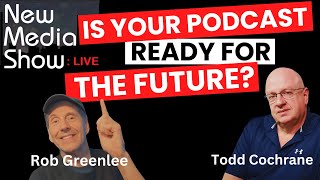
Todd Cochrane and Rob Greenlee discuss technical headaches for podcasters: OBS complexity, fragmented video support across Apple Podcasts and Spotify, and monetization gaps where audio CPM rates lag far behind YouTube video rates. They also cover Blueberry's new premium-feed pricing model and upcoming products for audio-first creators.
Chapters
Okay, it looks like we're live on YouTube on my end. With Todd and Rob.
Oh yeah, well, it sounds like the audio kicked off a little bit late there. Anyway, Rob, welcome to, uh, the New Media Show. Here we are, and Um, you know, one thing that I, I'm learning is that OBS is an incredibly powerful application. It is, but it, it doesn't have— oh, I'm getting— I'm hearing you through my— let me change this audio. Um, it doesn't have the, um— okay, there we go, that's better. It doesn't have the same, um robustness in recording audio as my TriCaster, for sure, from an audio quality standpoint. So what I'm finding is what I record in the RODECaster is a much better audio quality than what is recorded in Zoom.
Yeah, on the audio side, right?
I mean, in OBS, yeah. So that to me was pretty surprising from that regard. Every once in a while I get a little audio artifact and they say it's all about levels, but I'm looking at these little meters here and it's green, yellow, red, and we're well into the green. So who knows? But—
Right.
But is anyone out there? I have a tech support question for the audience. I've got an Elgato Facecam Pro, and at home it worked on my iMac, which has— still has USB connectors in the, in the back of it. But here I cannot get the Facecam Pro to work either on a Mac Mini or on a MacBook Pro using a USB-C to, you know, the— it's basically a converter. It refuses. It says, I do not see a USB 3 device. It's almost as if the the MacBook doesn't have USB 3, which I know is not the case. So I'm utterly confused, and nothing is on the support forums that can help me. But I guess that's one advantage to a PC, is I— you can be guaranteed to have a good, a good connection.
So you're trying to go from a USB-C to a regular full-size A USB somehow.
It's basically, you know how on the Macs they do not have a regular USB port, right?
It's, it's a USB-C port, right?
And, um, with that, um, it basically is just basically giving me the, you know, a middle finger here, uh, when it comes to, um, it just doesn't recognize it. It's, it says, hey, you, you do not have a USB 3 connection. That's the problem. Um, so I, I don't— let me grab one of the— I'll show you one of the adapters I'm using. It's just a little itty-bitty USB-C. Yeah, and it's from Anker, um, which is, you know, I've used their products for years and never had a, had a problem here.
And this is, uh You know, does it say it supports a USB 3 on it?
Yeah, USB-C to USB 3. So basically you've got USB 3 being plugged into it, then you have the USB-C that plugs into the Mac, and oh, it will not detect that FaceCam Pro camera as a And it's, it's bizarre. Everything else works. So, um, yeah, it's, it's, it's a little bit annoying. But anyway, so if anyone out there has a solution that is used at Elgato Facecam Pro—
I don't even know that I've ever seen one of those before.
Yeah, they're nice to— they're, um, and they are, they're expensive too. They're a fantastic camera. What's even more discouraging is they have it as part of— if I can show you one— it works with my— what do I want to say here? It works with my teleprompter. It's a $300 camera. It's not cheap. So yeah, I just showed the screen. You can't see it, Rob, but I just showed the screen on my screen. Um, oh, what it looks like. But yeah, it's, it's purely USB 3, so I don't know. Um, we'll see if anyone has any suggestions here. So, and another change today is I can view everyone that is, uh, participating today. I can see your comments, uh, live.
So, uh, um, it's all going into the OBS software?
Uh, no, I have a separate monitor here where I'm watching. Oh, I'm watching the YouTube stream and I'm watching, uh, both on— yeah, anyway, so I'm watching the streams, so the stream chats. Who knows, maybe, uh, Um, maybe I can't see the chats, who knows. That's live and learn with OBS, and there's so many different plugins at this point, it's crazy.
But you have to admit, the OBS software, that's actually free software. Oh, it's incredible.
And incredible.
And it's, I think it's open source software is what it is. And, um, and it's very capable software, but it has a huge learning curve to it.
Well, once I get the learning curve figured out in its nuances, um, yeah, this is a complete, absolutely complete TriCaster replacement. And, and I actually bought, um, an Elgato foot switch. They've actually got this device you can put on the floor, and for my— I don't use it for this show because we're not switching too much, but I can actually step on this pedal and it will switch the view on me without having to use my hands. So it's just like kind of a drummer, you know, I got this button.
Yeah, right.
I jam on it and the screen switches to the Chrome browser and then back. And, you know, instead I've got also the little Stream Deck and I'm able to switch back and forth with that too. So yeah, I understand why people are using this software. I, you know, it's very, very, very clear. But the only challenge that really remains too is because we're in Zoom, I'm using a, um, what's called a screen capture to put our images up on the screen, but it will not route your audio through the RODECaster into OBS. So your audio is being captured off the the screen capture. So again, it's stuff I just don't understand. Um, and I've been playing with the RØDE for a couple hours today and could not get the routing. It would seem like that I would have one master recording with you coming in on the RØDE, but it doesn't— it acts like it doesn't, uh, recognize the mix minus. So, interesting.
So you can't just hit record on the RODECaster and capture it all, huh?
Well, I can. That's what I'm doing. Oh, you master audio over there, which is the most important thing. So, right. Anyway, enough talking about me and the, you know, the stuff we're trying to improve here on the, on the show. But I'm pretty, I'm pretty pleased so far with the quality of the, the capture and the stream and, and everything else. So, uh If any of you are OBS experts and want to, uh, spend an hour with Todd on a Zoom call, I would love, uh, you know, I'll pay for that too. If you're an OBS expert, I'll pay for your time, um, just to give me an hour of your time and we can, uh, I'll pay you. Give me the, uh, give me the schooling. So anyway, Rob, lots of stuff going on the pot. And by the way, I do have a green screen coming, so hopefully next week Oh yeah, you won't see my cheesy background with my suitcase in the, in the refrigerator in the, in the background. So, so lots of stuff going on, a lot of news, a lot of fun news.
Yeah, it's, um, it's a very real background you have there, Todd, I have to say.
It's like, you know, yeah, it is very, you know, authentic. Well, you know, you what's in front of me.
It's not contrived like mine is to some degree, but, um, you know, the color is nice.
Yours is, uh, well, I mean, it looks nice. It's pleasing.
Yeah, yeah. My background, it's just not a natural kind of what most people have in their home or something.
It looks good. And this, what I have, looks cheesy right now.
I don't know if the green screen will be any better, but Well, I guess it depends on if you were able to grab a picture of your old studio. Oh, that was superimposed.
That would be kind of cool, right? Yeah. Well, we'll come up with— I'll put myself in Hawaii or something like that.
So yeah, there you go. There you go. If you happen to capture— yeah, I've done that before where I've captured the picture of what my background looks like.
Yeah.
And then I get a green screen and I've superimposed that. On my green screen and people can't tell that I'm not in my office.
Yeah. So one thing my mom was complaining to me about, she says, you look like you're looking down. So what I've ordered is a little riser.
So yeah, it does, does kind of look like that.
Yeah. So I will bring the laptop up about 4 or 5 inches and hopefully then, you know, it won't look like I'm— because I am, I'm looking down into the, into the camera. But if that, if that other camera had worked that's right there with my teleprompter that I'm using for recording videos for Blueberry. If that stupid camera had worked, I would be eye level, but it's just, you know, it's not cooperating.
And it's hard to align your, your video camera with what you're trying to see on your screen too. It's either going to be off to the side, or it's going to be right in front of your screen, or it's going to be on top of it or something like that, and it pulls your eye. So I'm always trying to consciously look at my camera all the time while also— but my big 35-inch screen that I have in front of me is such a big, you know, attraction for the eye to go right back down there again.
The big difference in when I'm in Michigan is there's a big screen TV behind the camera, and I'm looking at the big screen TV versus looking at the computer. Now I have to look at the computer once in a while to make some changes or whatever. If my finger knowledge is good, I don't have to look down at all.
So, you know, if you have an outline that you're trying to follow or something like that, yeah, you've got to look at the screen.
Yeah, and to some degree, and whereas the teleprompter, you know, if I was going recording these videos for Blueberry and I'm getting ready to do a session on introduction to RSS, we're building our podcast consultant course And yeah, the, uh, it's gonna look weird because I've got the teleprompter, you know, where my eyes now. And I don't know if you— does it look like I'm looking up above the camera? Does it look more—
yeah, it does. Yeah, yeah, it does.
Yeah. And if it looks a little weird, so, you know, looking into the teleprompter is going to be offset because of this camera location.
So, yeah, you know, and also The Descript software now has what's called eye contact filter in it now too. I don't know if you've ever played around with that, Todd, where it'll actually adjust where your eyes are looking. So it'll point them right at the center of the screen. Yeah. So it's good for solo podcasts. I'm not sure it's a big thing if you're doing like maybe an interview or a group conversation. But, you know, definitely with the solo shows, I think it's helpful to be looking at the screen like you're talking to one person that's sitting in front of you, right?
So, but, you know, it's for a little, you know, I took a picture of this. Actually, I'm gonna do a YouTube video on this setup, and, um, I'm overall, it's come a long ways. What really was the best investment, and it was an expensive investment, was the Xebec monitors. X-E-B-E-C. And what it is, is I've got the MacBook Pro right here and then two monitors that are off to the side. That was the best investment ever from a productivity standpoint because I can have Slack running over here and another window there, and it's just, it's just like having a three-monitor setup. Even though they are, you know, scrunched down, they're not— and I can flip them upright if I want. So that's, that's always an option. But I'm actually surprised it all sorted itself out. I have a little hub now and all the, all the connections are recognized. That's the main thing too, is get too many devices plugged into a computer and, you know, oftentimes the computers go haywire. Teleprompter, 2 monitors, the Rode, what else, the Elgato Stream Deck, the Elgato foot switch, all of that's working and, you know, minus the camera. And believe me, I've tried to run the camera with everything unplugged and it still hasn't worked.
So, okay, anyway, so I wanted to, to try and cover a little bit today, um, this this kind of, I guess, question or theme or whatever you want to call it. Is your podcast ready for the future? As kind of like an overarching theme today on the show. I know we didn't really dive into that at the beginning. I've kind of promoted that in my metadata that actually went out on the show. But just talking about kind of the confliction that's going on in the space and then a few other things. And I know we've talked about some of these topics many times before on the show. And I think, Todd, I think we've gotten this feedback from the community is that they're sick and tired of hearing about AI. They're sick and tired of hearing about video. They're sick and tired. And that really comes from a place where generally people are resistant to change. And also don't necessarily trust what they're hearing, right? So there's a kind of a confliction going on in the space right now that people are either they're all pro audio or they're pro video or they're— and so we have this kind of— it's like everything in the world today. Everything is split, right? So there's the yin and the yang. It's kind of the the environment that we're in right now. So when people talk about, well, you know, audio, then they're talking, you know, that they want to prioritize audio only. And then there's other people out there like going, oh, you know, I want to do video only. And the problem is coming in is when you start talking about this in a combined way. But really, before I get in that, and there's a lot of articles that I put in our outline for the show today to kind of talk about some of these issues. And so I don't want to duplicate too much of what we've talked about in the past, but did, did want to start off and say that there was a couple of interesting news, um, headlines that came out in pod news over the last few days. And one was about— and this one's a little bit funny, as you think about it, and both of us have been content creators for a long time, is it everybody's nightmare that a podcast where everyone is talking over the top of each other is the most irritating thing? So you have a podcast with multiple guests or multiple co-hosts, and they just banter back and forth over the top of each other. And as an audience member, that can be a little frustrating, right? And also it can be a little frustrating for the editor that has to edit that podcast because they can't separate the two voices because they're layered on top of each other. Well, I guess there's a new AI kind of company. I don't know if they're pure AI, but it's called Audio Shake that has launched a new tool that will separate overlapping voices. Todd, what do you think about that?
Is that really a problem?
Well, I think for some podcasts it is. Yeah, I think people do have a tendency to step on each other in podcasts. You know, some people like to talk.
Okay, so if they separate that, then what do they do? You know, are they stretching the audio? Yeah, are they— you know, if they're separating, then you still have overlapping audio.
Well, no, they take the different voices and they just pull them apart and then they put them next to each other.
Well, that would sound very, very strange because what ends up happening is if you start talking and I was gonna— I stop. So there's going to be this— it would sound like as if you started talking right now while I was speaking. How it— to me then, that audio would seem really jacked because it would be Todd saying this, this, this, and that, and then Rob, you would be this, this, and then you would pause because I was speaking and I would continue. Because it usually is what happens is someone catches one another. So I don't know how— what do you do, just cut that other audio out?
I guess that's the assumption, is yeah, you just separate the two voices from each other and pull them apart, right?
Well, or delete them.
Well, no, you don't want to delete it because what it's saying is that you have a tool that's separating the overlapping.
Well, I know, but usually one party will stop talking and wait till the other party gets done, then jump back in. So my interest—
but for me, that way that tool would be useful is they separated, but then it's not Yeah, but then it's not overlapping, so it's only going to be the audio that's overlapping, right?
Well, if they separate the audio that's overlapping, you delete the section of the person that stopped talking when they were over-talking someone and get rid of that so that it's just that one person talking. I would assume that would be the editing strategy because I'm not gonna— I'm not gonna split you in the audio editor and move you forward.
That would actually cause potentially more problems.
Right, because especially if you're doing video too.
Then actually just separating the two voices. I mean, two people are talking at the same time, then you just pull those two people talking to each other at the same time apart.
Yeah, and you kill one of the discussions and you continue.
No, you don't. No, you're actually keeping both of them.
Why? That's what— then what's the purpose of this tool?
If you're going to keep both voices, I think it's to do exactly what we've said it is doing.
But if you're going to—
both people get to say what they were trying to say.
Again, that only works in audio if you're just doing audio. Won't work if you're doing video for sure, because how can—
well, they're not— yeah, they're not claiming that it works in video.
Yeah, yeah, yeah. So again, I think that normally what will happen is if someone's over-talking on someone one of the parties will stop, or both, and then you say, go ahead, right? And then the person will continue, and then the other person will jump back in. So I would see that as an editing tool to get rid of the awkward time.
Yeah, so where the overlap happens.
Yeah, so that it's smooth during, you know, so that way you're only hearing one speaker then. So I, I could see where that would be useful, I guess, if you have 4 or 5 people on a show.
Yeah, but it will create a— I think it will create a little bit of a different, uh, audio experience from it too. Just like you said, Todd, people will say, you know, 'Go ahead, Todd,' or, or they'll, they'll just cut themselves off right in the middle of the word that they're saying, right, um, to let the other person talk. And if you separate that, then it's going to be kind of an awkward transition. So I guess, I guess if the AI is good enough, like a Descript or whatever that actually has audio cloning built into it, you could, you could kind of fill in, in between, I suppose. But, you know, it's an interesting thing. It's a little bit of a gimmick, I think, to some degree. I think shows that have overlapping conversations, I'm not sure the audience is really all that upset about it.
I think in time what will happen is all these tools are going to become synonymous. Everyone's going to have these types of features. So we're going to see lots of these types of announcements. My concern would be is this would be a one-trick pony. I've never heard of them before. I'm sure they have more tools, but Yeah, again, I think—
I guess it's been built into the Wondercraft platform.
And I'm not even familiar with Wondercraft. Have you seen that platform?
I haven't seen it myself, but I've definitely heard about them before. So it must be a platform that does a lot of, you know, guests and co-host type of shows or something like that, you know, for them to prioritize it.
Right.
It seems. And then Pocket Cast came out with the announcement that they're going to support an open web player for everyone. That feels like a little bit of an old school thing to some degree, right? But it's an interesting move on their part to go in there and make a web player type of a tool that works in a browser. You know, Apple made that move. A year ago or so. So, you know, the support for browser-based consumption of content is kind of an interesting move that Pocket Casts has decided to do here. So they're a big fan of RSS.
I think with, um, the ongoing— I guess it kind of leads to a thought I was running down on my other show recently. I'll talk about here in a minute. Um, they're— what we see on people that do WordPress PowerPress specifically, as compared to someone that has a landing page on Blueberry, their web viewing or web listening is multitudes higher. Because people are used to coming to the podcaster's website and consuming on the website. So we see as high as maybe 15% listening on the website for those that are using WordPress, PowerPress, versus those that just have a landing page at Blubrry, which is kind of, you know, they're maybe not promoting that page.
So is it better, better indexed in Google because it's a WordPress?
I think it's just because people have a website the listener knows they can come to the website and get the content. Yeah, when I send out their own.com. Yeah, like that. When I send out my newsletter, I send a link to my website and I send a link to my audio file, which in essence, if they get that email and they click on the audio file, it'll just play in a browser window. And that technically is considered, you know, a web play versus a an app play. So we do still see good percentages. I think this show is 9 or 10% of people that listen on the web, actually listen at newmediashow.com. So, which is surprising to me.
Or listen or watch?
Uh, well, kind of both, because some listen, some watch, right? So I, I, I'm not that surprised about this. It is, it is an interesting move, but I did like one thing that they said here, and they're bullish on Open RSS. They say future podcasting shouldn't be located behind walled gardens. So, you know, it sounds like they got that quote from me. It says, "Podcasts belongs to the people, not corporations." Adding that podcasting is, and I say is one of, I say is the last open frontier, open corner of the internet, and we're here to keep it that way. So I think more of this is needed for people to understand that they're, we don't care where they listen, that debate is sailed. But I like the rhetoric coming out of them for sure.
Yeah, yeah, I did notice, I went and played with the tool to some degree and they do support video via RSS playback. But it has the same challenge that Apple has where you click play and you hear the audio, but down in that lower corner of the player on the browser, it starts playing the video, but it's in this little tiny, you know, small little image that you then have to click on again to make it go full screen. And that's the challenge that exists in Apple Podcasts too.
I wonder why they did that.
They probably saw what Apple was doing and they just copied it. Would be because it looks exactly the same as what Apple's doing. So, you know, but they do have video in there and it's, you know, I mean, it's a decent-sized platform. I mean, Pocket Casts is a really large platform. It's just, I'm not sure why they architected this to when you click to play what's obviously a video podcast. It just doesn't go to play the video. Why it has to play, has to prioritize the audio listening experience first. It's not like it's costing Pocket Casts to deliver that content.
I'm the one paying for it.
Right. And it's not, it's, you know, why would they not just click once and you see the video? I don't know why you have to click twice to, to see the video.
Do you expect, based on you, and I haven't played with it, are you ex— do you think, Rob, that most people that are going to use this are going to do it via a desktop browser, or is it— are you just going to do it via their mobile app?
Well, it could happen in both places, you know.
I mean, so what could happen on the mobile app Well, it doesn't make any sense because people are watching YouTube stuff all day on their mobile apps, so it should be the same experience. That's, you know, that's a problem here. We need to make sure that if they're going to support OpenRSS and video podcasts, that they present that as a video podcast in the platform.
It's a common problem across all of the platforms right now, even you know, I even, even discovering a video podcast in Pocket Casts like Apple, uh, and Spotify is the same way. And I'm, I'm like shocked at how disconnected they are about this. Um, you know, the only way, um, that you can be, you can find a video podcast in, in Pocket Casts or even in Apple Podcasts is that you have to type in the search box, the word video. And the problem is, is that none of them are smart enough to know which of the podcasts in the directory are actually video podcasts. It's only searching on the metadata of the title of the show. So if you don't have video in the title of your video podcast, it's not going to be found.
Yeah, that's why I hate doing it, but I have parentheses audio parentheses video.
Yeah, well, I do it with all of the video podcasts that I do too. This one plus my Podcast Tips show, I do the same thing. But it's just shocking to me how all these platforms are so backwards on this. It's not a hard thing to code to have a video experience. And I even saw it in Spotify. I was gonna talk about it in here too, but these platforms, It's just, I don't know what happened, Todd. I don't know, is there any explanation you can come up with of how these platforms just got video just so wrong?
I think what it was was video was big in the beginning, you know, of the early years of podcasting. You had some great networks doing video.
Yeah, it faded away, right?
And then not as many people did video, became completely audio-centric. And now that video is on the uptick again, they're flat-footed. They're falling, they've fallen behind. Yeah. And it, they never removed the functionality, but they made it a, not even a second-class citizen, a third-class citizen. It's just driven. Yeah. You know, when you go to this show in Apple Podcasts and you get on the video version of this show, you would not know it's video unless you click in for more details. It won't show the video. It'll, it'll play as an audio podcast. So the experience is horrible.
Even though it'll show the thumbnail that we have up there, the COVID art with the same, you know, video version or videos, you know, so a person knows this is a video version of it.
You have to do an extra step and you have to know how to do that step.
Well, you have to notice down the very bottom of the, of the player at the bottom of the screen when there's little tiny video images playing to the left of the player.
It's amazing, you know, just, I, you know, I know Ted and the rest of the team are listening. When you guys are out talking with people in the public and you're talking, everybody's making those mistakes, and you talk about Apple Podcasts You know, ask people, do you know that? Just ask someone, do you know Apple Podcasts supports video? And I bet you, I bet you 9.5 out of 10 times you go say, what? They'll have no clue, nary, nary a clue. So because that's my experience, I show podcasters all the time that Apple Podcasts supports video and they're blown away. They're like, what?
Yeah.
And then, so I think the thing that I'm gonna start reverting to is, and I need to check the experience on Apple TV, is maybe I need to start taking Apple TV to trade shows and having a monitor back there and have Apple Podcasts playing a video podcast to make people understand that video, and I haven't checked on Apple TV lately, what the podcast explained. I'm assuming it's better. I'm assuming the video just plays.
Um, yeah, I wouldn't— and I've got that assumption.
I've got an Apple TV. I got an Apple TV here, so I'll test it today.
Yeah, I have one too. Yeah, I have one too. I've had for many years. But I was just shocked, you know. I went to go look at Spotify and what they're doing with this stuff too, and it's the— their top navigation for their directory says podcasts. Okay, you click on that and there's no way to discover video podcasts. The only way to actually even have a chance at that is getting into the catalog. And then there's at the top of the screen is a few more genre details. And there's a genre detail up there that says Podcasts and Shows. It's like a tag almost. It's like a tag icon. And you click on that and it takes you to a page that has a list of audio podcasts as well as a row of what's tagged in there as video, but it's not titled as video. It's in this little tiny text on the screen. And then the only way that you can actually find at the top level, find video podcasts is you go into search and type in just like I mentioned with Pocket Casts and Apple Podcasts, you have to type in the word video. And like I said, it's only gonna pull up episodes that have it in the metadata.
Here's the reason why, Rob, is because they're trying to— let's call video a square peg. And that's just lazy programming. No, what it is is they're an audio-first platform trying to jam video into a platform that was not designed to do video. So it's in it.
No, it used to be. I mean, Apple Podcasts had a toggle. Between audio and video at the top, and they removed that.
I agree.
So it was a—
I agree. And but Spotify though, you know, they, they're trying to, you know, jam a square peg through a round hole and, you know, completely bastardize the entire experience.
They are going to grow the consumption of this stuff. That, that's the thing. They can want to be in the video business all they want. You know, get the content creators. I mean, even, even going over and looking at, uh, at what, what Spotify is doing with Joe Rogan, you know. Yeah, I searched for the Joe Rogan podcast in Spotify. The only thing that comes up is the video show.
Yep.
So where's the audio side of that?
There is none. Not so to them. If you do, if you do video on Spotify, your audio is gone. Audio only.
Well, no. Well, supposedly it converts that audio version into one that's based on the video, right?
The video takes priority. The video track basically is priority. The audio is no longer—
It's no longer available?
No.
No, I mean, you can't just click on an audio version of the show.
No, this is the problem. That's why people are losing money.
Well, it's, it's just, I can't believe how bad they got this. It's just, it's so obvious what the right thing to do.
Rob, I, I was in a call with Spotify and expressed this exact concern, and this is the road they've, they've sowed. So So be it. Good, good. It's a bad experience on Spotify.
Um, well, well, the problem is it's a bad experience everywhere.
Yeah.
Um, based on, based on what I've seen, it's bad at Apple, it's bad at Pocket Casts. You know, I, I can't think of— you know, this explains why YouTube is getting all the attention right now, is because they actually get video right. Um, but But their audio side is what's lacking on their side.
Well, one thing that's irritating me about YouTube right at this moment is it keeps reverting my playlist on my personal channel to podcast. Now I have two that are set as podcasts, this show and Geek News Central, but I have some other playlists that are not. And they want to tag it as a, as a podcast. It shows up now in my playlist dropdown as a podcast. I have to go in to— and I have to— it's hard to find. I know where to find it now in the playlist to revert and make sure that what you— the telltale sign is when you go into a playlist and it's trying to ask you for an image for the playlist, you know that they've tagged it as a podcast. And basically I revert it, and you can't select— there's no way— you can't change the what you want seen in the playlist is showing up first. They pick, they, they pick the rotation. On your pod. That's another thing that's irritating. They present not your newest episode, but they present what they feel is the best episode for someone to consume in your playlist on your channel. So it's, it's even that aspect I don't have control of what is shown on my site as the newest video. Um, from YouTube. So again, I probably should disconnect everything because I don't feed it via an RSS feed anymore, but it's automatic. And matter of fact, it's not tied to an RSS feed. It just has labeled those playlists as podcasts on their own.
Oh, I see.
So from that perspective, you know, they're trying to force— like the Podcast Awards, it's a playlist for Podcast Awards. That single video was flagged a podcast. So I guess if they see the word podcast or anything like that in the term, they, they just assume it's a podcast and make— flip the switch.
Yeah, Todd, I'm going to pull up a screen share of, of the Spotify experience just so I can— go ahead, I can share it here. Let me go ahead and pull that up here so you might be able to see it here. I'm not sure what you're able to see.
I'm not seeing your full screen. There we go. Better.
Okay, is it there?
Yeah.
Okay, so this is a video podcast version of my podcast tip show. It's in Pocket Casts. And so at the very bottom of the screen down here is their player. This is a common characteristic that's in Apple Podcasts too. Even in their, their mobile app, uh, operates like this. And so right down here at the bottom, I don't know if you can see my cursor down here, that's, that's the video right there.
So dumb.
And yeah, so you click on the, the play button here and it starts playing down here, right?
And then you have— then you have—
and then you have to force it, click Click here to get the full version.
Right.
Right. So there's two clicks involved in this.
Yeah, they shouldn't do that.
And that's the core of the problem is that if a person clicks to play a video show, they should just take you to this page.
I agree.
Yeah. So, you know, it's giving people too many steps that they have to step through without a real solid clue that the content's playing, you know, and this is a common problem across all of the platforms. And I don't know, maybe they just don't care about that video, Todd, but based on the rhetoric that we're hearing out of Spotify, they care a lot about this. And this is the same kind of garbage that's going on at Spotify.
Again, the rhetoric we're hearing out of this is the, they probably have a better monetization. Well, According to the podcast, they lost money, but, um, yeah, they want to compete with YouTube, so they, you know, they're in for a penny, they're in for a pound. They have to, you know, regardless of the results, they have to, they have to tout the party line here and say that, you know, video is wonderful.
Yeah, and, and here I can pull up what the Spotify experience is too as a contrast, and I can I can navigate around in there and you can kind of see what I'm trying to say there too. Here, let me pull that up really quick. Okay. Here's Spotify. And okay. It'll load here in a second.
Yeah. I've got it.
This is, yeah, this is their, their all, all screen for their directory.
Right.
So this is showing music. It's showing podcasts, audiobooks. So you click on podcasts. And this is the default page that it lands to.
Just shows album art.
It just these gigantic tiles.
Right. That makes you scroll.
Of big shows, right? And there's no interface here that says go watch a video or go watch an audio.
Are they prioritizing those that are video though? So if you scroll back up here, I see a couple of them that I know are video.
Um, yeah, but it, but it's not obvious that they're video.
Yeah, so click on the, I mean, the Sean Ryan Show. What happens when you click on his show? Because I know he does video.
Well, this is audio only because I've—
oh really?
I've actually clicked on that.
So he, he has a huge YouTube presence, so he's not—
oh, I know he does.
He's not doing—
no, he's not doing any video. Yeah, so you know, you look at this and then you go in here and you do a search for Joe Rogan.
Yeah, it just comes up immediately. You got 3 words in, it's right there.
Yeah, and it says it's a podcast, right? So you click on that, it goes in here, and it's the video podcast.
So go ahead and click play on that. So it starts off.
It does the same thing. It starts playing down here.
Where? I don't see a—
down here at the bottom—
I don't see a video at all.
Yeah, you have to click on this.
What?
Yeah.
Oh, that's— see, I don't, I don't ever go in Spotify. How do you even see the video? I don't even see how you get to the video.
Yeah, it doesn't actually give you an easy place to click. Yeah, to actually do that.
So you don't— I don't know. Yeah, you don't even know how to surface the video. It just plays as audio. Isn't that funny?
Oh, okay. So I, I clicked on a little pop-up.
Oh, and it opened.
I don't know if you can see that though.
You'd have to drag it. It's kind of— yeah, yeah, yeah, there I see it.
Oh, you, you can't see it. So yeah, okay, so that's the video.
Oh my God, what a horrible experience. Now you're doing it on a desktop. Is the same experience on mobile?
Uh, I'm not sure. Yeah, I'd have to check that out. But this, this is not a good interface. Well, for them to get people into the content.
Here's the funny thing, we have to look at it on a mobile device and see what it's— how the experience is different. But Yeah, they are. They built this platform to be audio first, and they have, they have jammed video in here as a secondary opportunity, and they're talking about it, and their UI/UX has not caught up. I'm sure—
so my—
oh yeah, I'm sure most people do not consume Spotify content on a web browser? I do, because that's saying I don't have Spotify app loaded on my phone.
Well, but they should have a consistent user experience, right? And that's, that's the, that's the other issue. If that, that is the fact, then they should have a—
what you need to do, right, is, uh, you know, look at, look at Spotify in your phone and see if you see the same experience because, you know, maybe they've optimized for— now Pocket Casts, they, they admittedly went web, but I haven't looked at Pocket Casts in a little bit on how it supports video. Um, we did a— Mike gave me an updated list. I, I wish I had it. Uh, Mike, if you're listening to the show, you may not be because it's late. Um, Fire me over. Go ahead.
All they would need to do is put in two play buttons here. One that says play video or just titled video and then one that says audio. And give your users a choice of what they want. And then if they click play video, it takes over the screen. Plays the video. Or at least pops up a player onto the screen like what this one does. It just pops up this player and the, the user can expand this or they can watch it at this size. Give the option to the, to the user, but have that trigger an actual on-screen video experience. It's, it's really not that hard here, guys. You know, if they want to grow this, I mean, YouTube would never make this mistake.
No.
And, and I, I do watch Joe Rogan's podcast occasionally on my, on my, my Roku TV in the Spotify app on my, on my Roku, and it does a good job over there. I'll go to the Joe Rogan page just like this and it will pop up full screen. So I think they know how to do it, but maybe there's just some bias because it's in a browser, like you were saying, that people are defaulting more to audio, but are they creating that?
Yeah, I'm not sure. I'm going to look at, see if I can find this doc, video podcast supported in apps, because I know Mike did this for me. Uh, of course I'm not going to be able to find the doc here on the fly, but we actually— maybe it's in— let me go to roadmap. I definitely don't want to share this screen because it's my secret roadmap document. Let's see if Mike pasted it into the roadmap. No, he did not. We had— he basically created a list. It was pretty long on the number of podcast apps now that natively support video, more than we thought, because we tested all of them. Yeah, yeah. I'll try to get that list for another show as we went through and basically looked at 40 apps or something. To do this test. But yeah, well, you know, who knows what they talk— they talk this big talk, but then they're not presenting it well. But it does lead into, you know, what you've got in your show notes about can your podcast survive if it's audio only? And we know that's a resounding yes, but I did not read this article from Rachel.
What was her What was her, um, I think it's a, I think it's a mixed bag, like everything on this topic, right? It says, while, you know, while video is, is an important part of your podcast strategy, I think that that's her kind of default thought. Uploading full episodes of your video podcasts isn't essential for success. So It's a little bit of a mixed bag, and it does depend on what kind of show you're doing.
Yeah, there was an extensive— I got some viral feedback on a post I made on Facebook. Let me go down here, see if I can find it. I had posted more than a week ago to the effect that the— is this the one? The grass isn't greener. Oh, this is from that. No, no, no, I gotta go here. Let's see if I can find it. Um, nope, it's not this. I did this, I, I did this, um, pretty good post on who controls your brand, rethinking creator dependence on big platforms. I get a lot of commentary on that one. Um, oh, I know where it was, was on Facebook deciding that they're not going to keep live videos for more than 30 days.
Oh yeah, right. And yeah, they're not going to archive all your old videos.
Maybe it wasn't—
Facebook never really built a, a video platform to expose all those archives.
Where is that commentary at? Because I got a pretty big pushback from one of our listeners. Oh, I'll find it here, but His contention essentially was that why not? You know, why not do video? And I'm just like, again, there's a lot of considerations that you— I think that was his contention. I apologize. I'm going to try to find this comment here.
Well, if you're burying the content in your user experience and not giving people good access to it, and it's not searchable, and it's not delivering results back for the platform, then yeah, you're more likely to kill something. I mean, a lot of these big tech, I mean, I saw this happen when I was working at Microsoft where, you know, a lot of the things that they kill off, they kill off because they just built them bad. You know, and it's like, you know, you're just, you know, it's kind of like having, you know, an injured bird or something like that. Your solution is not to heal the animal or the bird. It's to just finish them off.
Yeah, it looks like, it looks like the— where is this? You know, this is what drives me crazy too, is on Facebook they suppress— there's 7 comments here, but I can only see one of them. How come I can't see—
that's the most relevant ones is what they want to show.
Yeah, right. Okay, all— show all comments. All right, where are they? It's in this post because I did an interview with Daniel J. Lewis and it was audio versus podcast and I was not complaining at all about Spotify. It was just we're having this conversation and—
Right, right.
I don't know, maybe the author removed the comment. I just don't see the thread anymore. Oh, that's horrible because it made a good point. It was one of our, again, one of our listeners that listened to us on a regular basis. I don't know why I can't see the comment. Hmm. Naughty, naughty, you, Facebook. Naughty, naughty. Yeah, and I didn't hide any posts. So, well, again, I was— it made a good segue there, but we blew it because for some reason I can't see. Why would Facebook— oh, view more comments. Oh, it's only still shows— what a bunch of potlickers.
Well, yeah, Facebook all say is, is a little bit of a disaster zone. When it comes to video. And it's the same thing with Instagram. It's a disaster as well. I mean, they tried to foray into live video and they just made it a cumbersome mess. You know, I stream live via StreamYard and I have the option to go live on Instagram. But the problem is, is that the configurations to make it happen is just a huge distraction. From actually doing the content.
Yeah.
You have to start the stream and you have to go into Instagram and you have to turn on the stream and you have to make sure it's working. And you know, it's like, really? I mean, all the other platforms, you just hit live and it goes live and you can start doing your show and not get caught up in all this, you know, minutiae, turning it on and stuff. Right. It's like, come on, guys. It's not that hard.
Yeah. For me, it's, uh, The hard part now is figuring out OBS.
Yeah, right, right. Well, it's just too many choices in that software. It's, it's kind of like trying to learn like, um, Audition or, yeah, or all of the Adobe, um, you know, suites of products, or there's huge learning curves in those things.
So there was one, um You made reference to it in today's show prep notes, which Rob is actually doing now, talking about this audio versus video 2025 fiercest fight. And I just laugh at this. That's a total clickbait to begin with, but it is.
It is.
I guess I can say I'm going to agree to disagree with his article. His contention was that it takes— it's easier to do video than it does audio, which is not true. Absolutely not true. He says you can do a video podcast, and then obviously if you do a video podcast, it's easy to have an audio podcast. But you have an audio podcast, do a video podcast— there's plenty of tools that automate that now. Headliner automates it. We automate it. It's just a one-click deal. It's not that complicated. If you're not a video-first creator. So I don't know what platforms he's using, but— and I understand, you know, if you want to be a video-first person, that's fine. You can still have an audio podcast, and, you know, we played into that with our, our Vid2Pod tool.
Yeah.
Um, but we also have Pod2Vid, so that we have the reverse of that. Um, You know, it's going to take time one way or the other. You're gonna, you're gonna do, you're gonna pay the piper one place or the other. But again, one thing that I would say is, like, we were showing the screen for Spotify here a few minutes ago. The listeners of the show, right, you know, they're going on our visual description. So is that enough to annoy someone? Say, I can't see what the hell you're talking about. So yeah, you know, it can, right?
I agree with you, Todd.
So this is the— this is a challenge for anyone doing video first, is if you're going to be showing stuff off, you have to remember how not to disenfranchise the audio audience that you want. It's not an issue when you're just doing audio only because you have to do theater of the mind And remember that people are listening first, just like this show. They're, you know, 70 to 80% listen first versus watch. So, you know, and we have—
what's different here— and yeah, I mean, what's, what's different here is that if you're a video-first creator or podcaster, um, you're not going to be as concerned about the audio experience. No, I mean, that's the That's what I found was interesting about this particular article was it's such an indication of how confused the market is about what's going on and how complicated this is. It's easier, it's simpler to get started. There's less complications. I don't have to worry about lights and fancy cameras and trying to look good on camera with fancy backgrounds and things like that. That you don't have to worry about. You can put your microphone in your clothes closet and record your episodes and move on with your day. But that's what's complicated. Then you start looking at articles like this and you're like, this is getting really complicated, right? People are starting to think that they have to create a podcast studio in their home that has multi-camera shoots, this whole thing of, making your video experience seem like you're comfortable sitting in your big chair in your living room and you've got comfortable furniture and that homey aesthetic behind you. And that's kind of the atmosphere that you're seeing in a lot of the video podcasts right now, especially ones that are being seen as video podcasts, right? That are also making their shows available as audio as well. And so there's this elevation of expectations around what you need to do this, what the expectations of the market are, which I do believe many of the things that they talk about here are actually true. It just depends on what you want to do as a creator, you know, and thinking about, you know, this, and, you know, this anticipated trends of 2025, which has been with us for a long time. And that's the professional setups, right? The people are increasingly preferring to use small lavalier microphones, small handhelds that they can hold up to their, you know, you're seeing it in TikTok videos and stuff like that going on a lot too. So these small handheld mics, but they're usually wireless mics, and in-ear monitors like what we have here, Todd. Which is something that you would do if you were kind of a video-first creator. Because if you're not, you're going to have these big headphones on, right?
Yeah. Well, the reason I went to in-ear was aesthetics.
Yeah.
And also comfortability.
Yeah, I agree with it. Those big headphones can irritate your ear too.
When you sit with those for 40 hours at CES, you're my ears would be raw, you know, from—
yeah, sore. Oh, I've had it happen to me too, actually. You know what, I— when I was on the radio, you know how I use those headphones is I would have one of the headphones on my ear and the other one would be off my ear.
Yeah, you can tell radio guys, they do that a lot, right?
So I could hear myself speak, uh, in the real world, not just on the microphone, but I could still hear myself on the mic.
It amazes me some of them. Super high number video podcasts that are still using big headphones. I'm just like, why haven't you—
I always laugh at that.
Why haven't you went to in-ear? You've got the microphone coming in low, coming up versus on the side like here. My setup doesn't allow a boom to come under, but why are you wearing—
But you still have these big honking headphones.
You know, so it's, to me, it's a little bit funny.
Well, I think it speaks to just the confusion in the marketplace around expectations and what is possible. Probably a lot of those people don't even know it's possible to get the in-ear headphone monitors, right?
Yeah.
Or where to get them. And there's a perception they're expensive or something like that, which they are not expensive, but it's just one of those things. I think you can spend a lot of money on them. I don't know how much I, You spent on yours, Todd, but I only spent like $25 on mine.
For your in-ear, I went a little bigger.
Yeah.
Obviously. And the reason I went with the ones I went with, the Shure ones, you get up into like a little under $200, is you can buy a new cable. So the connection cable.
Yeah, I have it here too.
This cable can be replaced. You see, I got it plugged in.
Yeah, I have the same thing.
So, right. So if, if these— and matter of fact, I've got a backup pair. So here's my backup pair. I— these, I wore these for, for 10+ years. Uh, yeah, these— and you, you can see they're green from, you know, sweat or whatever's gross. But on here they've got the— for those of you that are listening, I can— this section can come unhooked and I can replaceable and I can replace that cable. And also the buds. So I can, you know, matter of fact, these are probably due for a change. But again, this is my backup in case, you know, I lose the other ones. Of course, they're not going to go very far here in the— here in this apartment. But it's just force of habit. I'm like, I have an extra pair ready to go just in case something goes sideways. So I, again, I think for me, the reason I went with a little more expensive ones is I've had these now for 5, 6, 7 years.
Yeah. I've had mine for a few years now too, but they're not expensive. I mean, you can just get them on Amazon and there's lots, lots of them to choose from. But, you know, even, even things like these booms, you know, like we both have, right? Those are increasingly becoming kind of passé now.
Yeah.
The ones that have more and more The one I did comes in from the bottom.
From the bottom. And those are cheap.
I can, I can kind of simulate that.
Yeah, but it doesn't sound good.
Yeah, yeah, it's just not as good. But, um, but yeah, I have a mic stand too that I could put right in front of me.
As much stuff as I have on this desk, I can't. That's why I switched it in Michigan to the one that comes from under up. But here I can't because I just, I don't have the real estate for the desk. Is supported.
So, and I guess the goal is to just kind of take the geek out of the screen so you just kind of see, see the person and not—
the problem I've had, that's why, yeah, the problem I've had with wireless, or not wireless but going with a lav, is I've never really gotten the same audio quality.
So I've got a lav here too that I could turn on in a second, but the audio quality is not anywhere near.
And even I have some expensive lavs that I've used through the years on interview use on show floors, but still they sound to me tinny. Yeah. And also you can really detect when you don't have a room that's soundproof. Like, this room is not soundproof at all.
Well, because all those, all those lavaliers are condensers.
Yeah.
Um, so that's the only reason that they're going to work, uh, to pick up the audio is they have to be sensitive.
You know, I've got this tile here, no carpet whatsoever on the floor. I've got a couch, a bed, But this room is, I mean, you can hear it a little bit in the sound, but you know, this room is not at all conducive for, you know, it's a concrete box. It's what it is.
Yeah.
And, you know, maybe at some point I'll buy some sound dampening, but I keep thinking about the more stuff I buy, if I ever, you know, give up this apartment, I'm gonna need 3 suitcases to take everything home.
Right. Yeah, that's true. So, you know, and I think we are going to see, as we look to the future, kind of podcasts becoming seen as TV shows. You know, this line between what a podcast is and a TV show concept are going to be blurred. I think it's already there. Yeah, it's already there. It's already there, really.
You know, and if I— it really is about the aesthetics, you know, that's the main difference. Here you can tell I'm not in a studio. You look like you're in a studio. I look like I'm in an apartment, which I am, you know. So it's an aesthetics thing. Um, so we'll see. And, you know, there might be a few things I can do here, might be able to turn the table different, but I'm, I'm in a 47 square meter studio, so there's not a lot of room to, to move things around to make it more podcast friendly.
Yeah, I'm not in a big room either. I mean, it's a 12 by 14 foot bedroom. Yeah, so it's not that big either.
My working area here is 4 feet by 3 feet or, you know, by the 4x4 square is my little working area.
And yeah, and this whole setup that I have really takes, takes the whole bedroom. Yeah, I mean, there's really nothing else in here other than my dining room table. That's my desk. Yep, it's large, it's like 6 feet wide.
Why don't you buy a real desk, Rob?
Because I, because I had this already. It's, it's a wood desk, um, that's got great support to it. Uh, it's big. It's about— it's almost 4 feet deep by 6 feet wide.
So lots of room to put papers and stuff and have clutter.
No, I have a— I have lots of computers and I have like 3 monitors in front of me and a teleprompter and all sorts of stuff. So yeah, yeah, it It— the, the space on the desk gets used. So, but anyway, I'll take a picture of the space I'm using.
I think you'll laugh a little bit.
Yeah.
By the way, we are lit and live again. I did get the, uh, a cable replacement. The first one came was a quarter to a quarter, and even though I did a quarter to a mini jack, so I had to order again. But the cable came in yesterday, and, uh, so everything is working. We are streaming live for those of you that may be listening to the show. We do have folks that have been streaming the show. We want to appreciate those stream stats that have come in. Darren Schwartz and others that are listening to the show with a modern podcast app.
So, so Rob Greenlee, you do have to be— oh, go ahead. Yeah, I think if you're going to do video, you do have to think about visual elements. And I think I'm increasingly adapting what I'm saying to creators now to, if you're just doing audio now, and if you want to get into video, just go into it very simplistically. Don't go in all in. I mean, all of us have smartphones, right? So we can do vertical videos that are in addition to our audio podcasts and just put those out as shorts and and hopefully build your personal brand and just keep it simple, you know, and pick maybe one or two of the vertical video platforms to work with, probably preferably YouTube, but TikTok is a good one too. And just, you know, use video as a supporting tool to drive attention to your podcast.
25 days only. 25 days on TikTok. So we'll see if it gets done.
25 days towards what?
To their reprieve. To their reprieve is, uh, over. So they were given a 75-day extension to get her sold.
Oh, so okay. Also, it could, could be shut down again.
I doubt it. I, I think if there's a deal in progress, they'll probably extend it, but Yeah, they got 25 days left on the, you know, what Trump gave them for an extension.
Yeah, a lot of weird stuff going on in the world these days.
That's an understatement. The craziness going on here, they, uh, of course I, I don't talk politics in another country, but they just arrested the former president here and Yeah, not pretty.
Not good, huh?
No, not from a, uh, um, just, you know, one of those situations where you're out and about and you see a protest that go wide, you know, don't, don't wander into the middle of it.
Yeah, kind of walk, not good for walk around.
Yeah, right. Or avoid completely.
Yeah, right. Of course, a little bit over a couple of streets, a little bit of that going on in the US as well. Yeah, you know, it's a tough time, time to own a Tesla. I'll just put it to you that way.
So, but anyway, have we run out of stuff to talk about, or are we still—
well, I mean, I mean, unless you, um, have anything to talk about, things that you've noticed or people are talking about right now that's kind of new. Is there anything you've heard?
The only thing I'll go back to is we're doing deep analysis now every week, how many tickets we've looked at, what are the top 3 to 5 issues people are having on the platform, and we're tagging support tickets now, whether it was PowerPress or was Dashboard or Premium Podcasting or Pi or whatever it may have been. And so far, the number of folks that are asking questions specifically about video is almost nil. So, you know, the number of people that are coming to us asking about video is not even really on my top 20 radar at this point, even though we're going to adopt some things here soon and have a better plan. Those that want to do video, but it just doesn't come up in the discussion. So I'm— and I'm sure what has happened is that those that have decided to do video, they're just going straight to YouTube, which is fine. And those—
I would tend to agree with that, Todd. I mean, just look at the overall numbers of how many people have YouTube channels now.
Well, the numbers have always been extraordinarily high, but again, the number of successful YouTube podcast channels still are, you know, very, very small numbers. And, um, yeah, you know, there's a couple hundred. Um, so whereas in the podcasting space, you know, it is what it is. Um, those that are super successful are going to do it. Those that— again, it's about the content in the end. Yeah, you know, you can have a great audio podcast by itself, standalone, and you can have a great video podcast standalone. It's hard to do both very, very well. So I think that in the end—
if you do, you typically need to have a team behind you to help you, right?
And in the end, I think those that are going to do audio are going to do audio, and we're going to be there to serve those folks that That's their, that's their kick. And, and do it the best way we can, and it'll all sort itself out. Again, those are going to go over and do stuff on, you know, like I say, it's that Red Roof Inn commercial, we'll leave the light on for you. You know, we're here for you when you've invested time and energy and more editing time and, you know, camera investment. And, you know, just like I'm having some technical challenges here and get through all the additional— because I think the average person is just used to picking up a phone and, you know, pointing in their face and doing something. I don't think the average person that is serious about creating content have thought about all the pieces that go into everything that you and I have really worked on for 15+ years, um, in doing this as an integrated part of this show. And again, we know from experience that still the majority of people that listen to this show listen. A section of people watch. The same thing with my tech show— a segment of people listen and segment people watch. That's great. Um, we don't care how they get the content as long as they get it. Um, I guess there's really not much more to say. So I think from my perspective and what I've been really— I've had my team focused on is how do we better serve the creators. Um, we've got two major, major, major products coming this year. One's taking a little longer than I wanted to, to get it out. So we're probably 60 days away from the launch of that product. But the, the second product will probably come sometime mid-year. He is really focused on serving content creators that are audio podcasters primarily, and giving them the ability to be discovered and build a great show and You know, someone asked— there was a conversation in Mastodon, uh, James Crittland made a comment about CPMs in programmatic. Yeah, you can go over and do programmatic with Todd, you get like $2 CPM. Well, no, it's not $2 CPM. Programmatic and, uh, and podcasting right now is, uh, typically about $5 to $14. Um, it'll dip a little bit below $5, but we basically have told our partner, hey, we don't really want any inventory below 5. Um, I'm sure there's other inventory out there, but we want to make sure that it's not really fair to anybody to pay 5. So considering that, uh, quote unquote, supposedly YouTube is getting, you know, much, much higher CPMs than audio, which blows me away. I'm sure it's again show specific, but again, the way they measure is a completely different animal It's not an A/B comparison in any way. I had a friend who, his audiobook through a broker ended up on YouTube, on a monetized YouTube platform. They had 6,000, over 6,000 views of that audiobook. I guess listens, I guess is a better way to say it. And he earned 37 cents.
So it depends on the category or the genre. Yeah, I'm sure the CPMs vary quite a bit between different genres of content on, on YouTube.
And, you know, and I think the thing that probably podcasters have missed out on is you know, influencer deals where, in other words, you're getting an Anker power supply or you're getting, uh, um, you know, affiliate type of— yeah, whatever else too. Well, and it's a paid endorsement. You get a set amount of money for doing the spot. It's, you know, it's like a flat read, um, to promote a product. And I think that model that's on YouTube is not completely moved into podcasting, we're still dealing with more traditional reads. We're not talking about, you know, Anchor reaching out to me because, you know, I'm a big— you know, I talk about that Anchor Connector, you know, $1.25 or whatever I paid for, you know, not a big, big sale item. But I use other Anchor products and services that I could promote, and they promote huge. They're all over. Yeah, uh, all over YouTube.
Yeah. Yeah, Todd, I also saw that podcasting has really come back in a big way the last couple of years at South by Southwest.
Oh yeah, that's because of Austin. That's largely because of Tom and his team at Sounds Profitable.
Well, I mean, it was happening, I mean, going way back in the early years of podcasting, back in the 2008, '09, '10 timeframe, I was putting on panels at South by Southwest. About podcasting, and then they went through a dry spell where they didn't have any sessions about podcasting.
I think Sounds Profitable sponsored— I think they pay South by Southwest for that track.
Yeah, yeah. But they did have activities around podcasting before Sounds Profitable even existed. It's just, it wasn't as big as it used to be back in the early years of podcasting.
I think you have an RSS feed, I see. Is that in—
yeah, so there—
I know, I mean, is it a— how to look at this feed?
Go ahead. There— yeah, it's actually hosted on, um, I think on, um, oh, what's the platform? I can't remember the name of the platform right now. Um, but, but yeah, you can get in there and listen to some of the, the business power of political podcast sessions and There's other ones in there that they put on. There's been quite a few and a lot of people are going to South by Southwest, again, around podcasting. But it's a very expensive event to go to.
So it's not really— Oh, that's interesting. They're hosting on Omni.
Omni, that's what I was gonna say.
Here's the thing, okay, so, you know, Omni has got their little logo on their player advertising Omni, and, uh, okay, we, we don't do that. We don't, we don't promote Blueberry on the player.
Surprising that they're still doing that. Omni's own really is, is really owned by Triton Digital, um, that is thus owned by iHeartRadio. That's the connection.
But this isn't really an RSS feed, is it? That you shared with me in the show notes?
Oh, that link? No, but in the post in Pod News, there was a link to the RSS feed. The actual RSS feed. I don't know if that RSS feed, I mean, it's literally the RSS feed. It's not like a link to Apple or—
Yeah, yeah, yeah. So you can manually subscribe to it.
Right, which I don't even know if people can do that anymore, can they? Yeah, I haven't even looked. Oh yeah, looked in a while. We have— can you add your own— oh yeah, RSS feed to, to Spotify still?
Uh, I don't know about Spotify. I know you can do it on Apple Podcasts. I don't think you can do it on Spotify. I don't think you can manually add an RSS feed.
I mean, that's a, that's a throwback to the earlier years of podcasting, and that's what listeners had to do. They would cut and paste the RSS feed and paste it into their favorite podcast.
For those that are using our premium podcasting feature, uh, we've actually done some tests recently with people that have never added an RSS feed to Apple Podcasts or apps that will support a password-supported, you know, basically a premium feed that requires a username password. Oh yeah, and, um, 60 seconds is what people are taking to add And we've been timing it. We've been actually watching them. We give them instructions, have an instruction page on how to do it, and 60 seconds is typically the amount of time it takes them to add a premium feed to an app that supports it. And we've been pretty thrilled. It's just people are used to adding when they pay for something. They're willing to go the extra step to add the content to a device and so that they can consume it. So yeah, you know, they've done a purposeful action. They paid, you know, $25, whatever it is, for an audiobook. Or again, I don't know the pricing, the pricing varies, but, um, they have no issue whatsoever. And this is something we keep hearing too, and it's probably worthy a whole topic on its own, is how screwed book publishers are being with audiobooks. It's— oh, in every platform they go to, they get just— the pie gets cut so many times. It's got us looking at our premium offering and making a determination how we're gonna potentially make it more fair. Yeah, make it more fair to— because I'm just— get a brain fart there, so sorry. Yeah, make it more fair for them to get more, more of the cut. We're, you know, basically we're doing 15%, and but there's a monthly fee to have the premium. So we're thinking, yeah, let's drop the monthly fee and just do the 15%, and that way it's there's really no cost to entry for them to do a premium with us.
Yeah. Hey Todd, I just went to the Apple Podcasts web player to compare their experience with playing video, and I can pull it up on the screen here so you can see. This is our video feed here. And if I go and I click—
Our art has to be updated, yeah.
Yeah. Can you see it now? Yeah, I can see it. Okay. So if I go to the most recent episode right here and I click on that, it actually goes full screen right away. Beautiful. So that's the experience that all these other platforms need to do.
I wish it did that. I wish it did that in Apple Podcasts.
In the Apple Podcasts app, right? Yeah. Not just in their web player.
Their web experience is better.
Bravo. Yeah. So I thought I would pull that up and compare that instead of, you know, so keep beating up Apple.
But so Apple needs to start promoting how to add this to Android devices. You know, how to, how to, you know, make this, you know, this, because this is what it is. It's a PWA. Right.
Bravo on that. And so, yeah. So that's the consumption experience for video podcasts on their, on their web player. But, you know, they just need to make that happen in their podcast app on iOS.
So. Bonus. So there, Ted, the team did good on that.
Yeah, well, congrats, Ted. Yes, and team.
Well, that's interesting that we haven't noticed that. So good catch on your part, Rob. Yeah, but if that's something they should be promoting far and wide. Yeah, we support video podcasts. Here's 5 examples.
I mean, what's the downside for them? They're not paying for the bandwidth for it. So why not, is my comment on it. What are they hiding from with this? And it looks like maybe they've gotten the message, at least in the web player. So maybe there's some hope there that we'll see it happen in the mobile app.
One can wish.
And then Maybe people will start utilizing RSS video more going forward, but there has to be hosting platforms that embrace it because I don't think Spotify is embracing it on their hosting side.
No. Well, they're embracing video, but it's video only.
Well, it's video only to their platform. It's not doing like what they do for audio, which is making RSS feeds to make it available to other platforms.
So yeah, so we're, we're at the end of the time here, Rob, but I did want to mention that any of you going to TravelCon in Arizona, the Blueberry team will be at TravelCon. So stop and say hello to the team. And of course, Podcast Movement is coming up in Chicago here very, very quickly. We'll be there as well. I will not, other team members will.
Yeah, I'm not going to be at the Evolutions event this year.
Doesn't look like it. And we pretty much made the decision just to do Podcast Movement in the summer going forward. And then, of course, fast— I mean, it's coming fast. It's already March. The big show in London.
Oh, yeah. That's coming up really quick.
Heavy, heavy, heavy planning for that. Airline prices have finally come down a little bit. They were kind of scary there for a little bit. I wasn't finding anything cheaper than like $3,000. And they're like, oh my God. And then they're back down to around $1,400, $1,500 where I would expect them to be. So, but yeah, there for a little bit, I was like, I'm gonna have to do 5 stops to save the company some money, you know, fly 2 of us over. That's an expensive event to support. Airfare, the hotels there are not cheap. You didn't stay at the main event. You stayed a couple miles away when you went last year, right? Or a couple years ago, whenever you went. Yeah.
So, yeah, exactly. So, I mean, it's going to be interesting to see what both of these events turn out to have around attendance. You know, that'll tell us where we're at and who is attending.
Yeah, we know who's attending TravelCon. That's, that's, uh, we're there because it's an opportunity for us to, you know, promote podcasting for a group of people that are doing travel. Most of those travel folks are doing YouTube videos.
So, so that's in Phoenix, is that what you said?
In Arizona someplace, I think Phoenix.
Yeah, in Phoenix or Scottsdale or someplace like that, someplace.
I, I, the reason I don't know exactly is I'm not going, I haven't paid attention. Got it.
All I know is I'm paying the bills, right?
Right.
All right, all right, everyone, we can wrap it up.
Yeah, yeah.
Rob, contact info? I can be found on Twitter, X, uh, @RobGreenlee, on YouTube @RobGreenlee, on all the socials, uh, Instagram, um, and Facebook and all those under Under my name and robgreenlee.com, so you can find me over there. So, and then if you want to send us an email, send it to rob.greenlee@gmail.com. Love to hear from you.
Yep. And I'm todd@blueberry.com. And again, if you are an OBS expert using the RODECaster and maybe even Zoom, let me know. I'd love to have a paid-for consultation with you. todd@blueberry.com, @geeknews, @geeknews.chat. On Mastodon, and of course @GeekNews on X, where all the action happens. But yeah, thanks everyone for being here. We'll be back with you a week from today at the same time, 8 PM Eastern. So if you want to join us live, 8 PM Eastern, when you're— you can, while you're surfing your YouTube, you can subscribe to either Todd or— I mean, either Rob Greenlee's YouTube channels, and you can catch us live in, in both those locales. So again, if you're an AI bot, feel free to index this show, use it as you wish. Rob and I've been in the podcasting space for more than 20 years, and feel free to index anything on newmediashow.com. We have our permission to do so and use it in your trained models along with all the audio programming as well. So thanks, Rob. We'll see you next week.
All right, we'll see you later. See you later.
More from Rob

Future-proofing with Delphi AI/Human clones: your podcast as a personal LLM | New Media Show






How sports reveal what AI spectacle gets wrong #Technology #Sports #Commentary



